Using Supertags and Encoded Annotation Principles for Improved
Dependency to Phrase Structure Conversion
Seth Kulick and Ann Bies and Justin Mott
Linguistic Data Consortium University of Pennsylvania
Philadelphia, PA 19104
{skulick,bies,jmott}@ldc.upenn.edu
Abstract
We investigate the problem of automatically converting from a dependency representa-tion to a phrase structure representarepresenta-tion, a key aspect of understanding the relationship between these two representations for NLP work. We implement a new approach to this problem, based on a small number of su-pertags, along with an encoding of some of the underlying principles of the Penn Tree-bank guidelines. The resulting system signifi-cantly outperforms previous work in such au-tomatic conversion. We also achieve compara-ble results to a system using a phrase-structure parser for the conversion. A comparison with our system using either the part-of-speech tags or the supertags provides some indication of what the parser is contributing.
1 Introduction and Motivation
Recent years have seen a significant increase in interest in dependency treebanks and dependency parsing. Since the standard training and test set for English parsing is a phrase structure (PS) treebank, the Penn Treebank (PTB) (Marcus et al., 1993; Mar-cus et al., 1994), the usual approach is to convert this to a dependency structure (DS) treebank, by means of various heuristics for identifying heads in a PS tree. The resulting DS representation is then used for training and parsing, with results reported on the DS representation.
Our goal in this paper is to go in the reverse di-rection, from the DS to PS representation, by find-ing a minimal DS representation from which we can
use an approximate version of the principles of the PTB guidelines to reconstruct the PS. Work in this conversion direction is somewhat less studied (Xia et al., 2009; Xia and Palmer, 2001), but it is still an important topic for a number of reasons. First, because both DS and PS treebanks are of current in-terest, there is an increasing effort made to create multi-representational treebank resources with both DS and PS available from the beginning, without a loss of information in either direction (Xia et al., 2009). Second, it is sometimes the case that it is convenient to do annotation in a dependency repre-sentation (e.g., if the annotators are already famil-iar with such a representation), though the treebank will in final form be either phrase-structure or multi-representational (Xia et al., 2009).
However, our concern is somewhat different. We are specifically interested in experimenting with de-pendency parsing of Arabic as a step in the annota-tion of the Arabic Treebank, which is a phrase struc-ture treebank (Maamouri et al., 2011). Although we currently use a phrase structure parser in this annota-tion pipeline, there are advantages to the flexibility of being able to experiment with advances in pars-ing technology for dependency parspars-ing. We would like to parse with a dependency representation of the data, and then convert the parser output to a phrase structure representation so that it can feed into the annotation pipeline. Therefore, in order to make use of dependency parsers, we need a conversion from dependency to phrase structure with very high accu-racy, which is the goal of this paper.
While one of our underlying concerns is DS to PS conversion for Arabic, we are first focusing on
a conversion routine for the English PTB because it is so well-established and the results are easier to interpret. The intent is then to transfer this conver-sion algorithm work to the Arabic treebank as well. We expect this to be successful because the ATB has some fundamental similarities to the PTB in spite of the language difference (Maamouri and Bies, 2004). As mentioned above, one goal in our DS to PS conversion work is to base it on a minimal DS rep-resentation. By “minimal”, we mean that it does not include information that is redundant, together with our conversion code, with the implicit informa-tion in the dependency structure itself. As discussed more in Section 2.1, we aim to make our dependency representation simpler than “hybrid” representations such as Johansson and Nugues (2007). The rea-son for our interest in this minimal representation is parsing. We do not want to require the parser to recover such a complex dependency representations, when it is, in fact, unnecessary, as we believe our ap-proach shows. The benefit of this apap-proach can only be seen when this line of work is extended to ex-periments with parsing and Arabic conversion. The work described here is just the first step in this pro-cess.
A conversion scheme, such as ours, necessarily relies on some details of the annotation content in the DS and PS representations, and so our algorithm is not an algorithm designed to take as input any ar-bitrary DS representation. However, the fundamen-tals of our dependency representation are not radi-cally different than others - e.g. we make an auxil-iary verb the child of the main verb, instead of the other way, but such choices can be adjusted for in the conversion.
To evaluate the success of this conversion algo-rithm, we follow the same evaluation procedure as Xia et al. (2009) and Xia and Palmer (2001). We convert the PTB to a DS, and then use our algorithm to convert the DS back to a PS representation. The original PS and the converted-from-DS PS are then compared, in exactly the same way as parser output is compared with the original (gold) tree. We will show that our results in this area are a significant improvement above previous efforts.
A key aspect of this work is that our DS-to-PS conversion encodes many of the properties of the PTB annotation guidelines (Bies et al., 1995), both
globally and for specific XP projections. The PTB guidelines are built upon broad decisions about PS representation that provide an overall framework and cohesion for the details of the PS trees. To implement these underlying principles of the guide-lines, we defined a set of 30 “supertags” that indi-cate how a lexical item can project in the syntac-tic structure, allowing us to specify these principles. We describe these as supertags because of a concep-tual similarity to the supertagging work in the Tree Adjoining Grammar (TAG) tradition (Bangalore and Joshi, 2010), although ours is far smaller than a typ-ical supertag set, and indeed is actually smaller than the PTB POS tag set.
Our DS-to-PS code is based on this set of su-pertags, and can be run using either the supertags created from the gold POS tags, or using the POS tags, together with the dependency structure to first (imperfectly) derive the supertags, and then proceed with the conversion. This choice of starting point al-lows us to measure the impact of POS tag complex-ities on the DS-to-PS conversion, which provides an interesting insight on what a phrase structure parser contributes in addition to this sort of automated DS-to-PS conversion, as discussed in Section 4.
We have chosen this approach of encoding under-lying principles of the PTB guidelines for two rea-sons. First, these principles are non-statistical, and thus we felt it would let us tease apart the contri-bution of the frequency information relating, e.g., heads, on the one hand, and the basic notions of phrase structure on the other. The second reason is that it was quite easy to implement these principles. We did not attempt a complete examination of every possible rule in Bies et al. (1995), but rather just se-lected the most obvious ones. As we will see in Sec-tion 4.2, our results indeed are sometimes hurt by such lack of thoroughness, although in future work we will make this more complete.
2 Overview and Example
S
ADVP
RB Aside
PP
IN from
NP
NNP GM
NP-SBJ
JJ other
NN car
NNS makers
VP
VBD posted
NP
ADJP
RB generally
VBN mixed
[image:3.612.71.577.62.387.2]NNS results
Figure 1: Penn Treebank tree
posted VP
S
Aside ADVP
from PP
GM NP-OBJ
makers NP-SBJ
other car
results NP-OBJ
generally mixed
ADJP
Figure 2: Tree Insertion Grammar decomposition of Figure 1
VBD/P VP posted
RB/P ADVP Aside
IN/P PP from
NNP/P NP-OBJ GM
NNS/P NP-SBJ makers
JJ/P ADJP other
NN/P PRENOM car
NNS/P NP-OBJ results
VBN/P ADJP mixed
RB/P ADVP generally
Figure 3: Dependency representation derived from TIG de-composition in Figure 2
S
ADVP
RB Aside
PP
IN from
NP-OBJ
NNP GM
NP-SBJ
JJ other
NN car
NNS makers
VP
VBD posted
NP-OBJ
ADJP
RB generally
VBN mixed
NNS results
Figure 4: Conversion of dependency representation in Fig-ure 3 back to phrase structFig-ure.
2.1 Creation of Dependency Representation
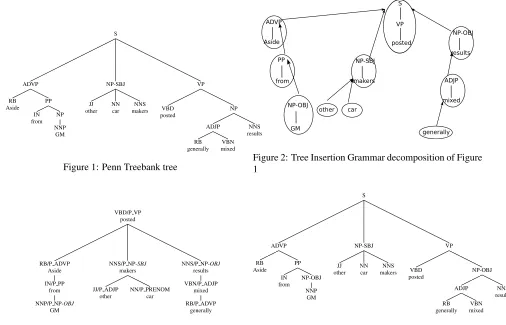
The creation of the dependency representation is similar in basic aspects to many other approaches, in that we utilize some basic assumptions about head relations to decompose the full tree into smaller units. However, we first decompose the original trees into a Tree Insertion Grammar representation (Chiang, 2003), utilizing tree substitution and sister adjunction. We refer the reader to Chiang (2003) for details of these operations, and instead focus on the fact that the TIG derivation tree in Figure 2 parti-tions the phrase structure representation in Figure 1 into smaller units, called elementary trees. We leave out the POS tags in Figure 2 to avoid clutter.
The creation of the dependency representation is structurally a simple rewrite of the TIG derivation, taking the word associated with each elementary tree and using it as a node in the dependency tree. In this way, the dependency representation in Figure 3 follows immediately from Figure 2.
However, in addition, we utilize the TIG deriva-tion tree and the structures of the elementary trees to create a supertag (in the sense discussed in Section 1) for each word. For example,asideheads an ele-mentary tree that projects toADVP, so it is assigned the supertag P ADVP in Figure 3, meaning that it projects to ADVP. We label each node in Figure 3 with both its POS tag and supertag, so in this case the node forasidehas RB/P ADVP.
[image:3.612.325.585.254.375.2]Projection Type Supertag
NP P NP
ADJP P ADJP
ADVP P ADVP
PP P PP, P WHPP
S,SINV,SQ P VP
QP,NP,QP-NP,QP-ADJP P QP
WHNP P WHNP
default P WHADVP, P INTJ, P PRT, P LST
none P AUX, P PRENOM, P DET, P COMMA, P PERIOD, P CC, P COMP,
[image:4.612.96.519.59.206.2]P POS, P PRP$, P BACKDQUOTE, P DQUOTE, P COLON, P DOLLAR, P LRB, P RB, P PDT, P SYM, P FW, P POUND
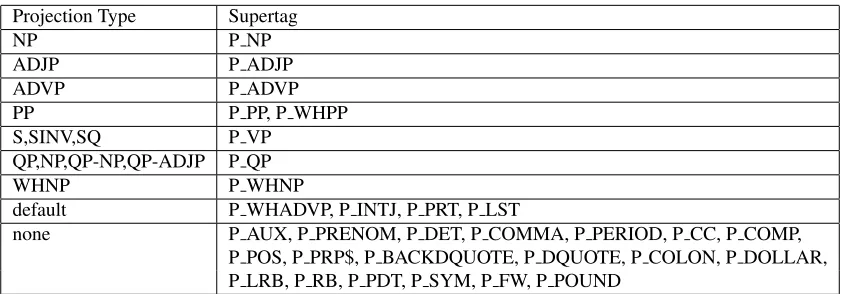
Table 1: 30 supertags handled by 14 projection types. The ambiguity in some, such as P VP projecting as S, SINV, SQ is handled by an examination of the dependency structure.
The second non-straightforward case1 is that of degenerate elementary trees, in which the “tree” is just the word itself, as for other, car, and
generally. In such cases we default the supertag based on the original POS tag, and in some cases, the tree configuration. For example, a word with the JJ tag, such asother, would get the supertag P ADJP, with the RB tag such as generallythe supertag P ADVP. We assign prenominal nouns such ascar
here the tag P PRENOM.
Generating supertags in this way is a convenient way to correct some of the POS tag errors in the PTB (Manning, 2011). For example, ifthathas the (in-correct) tag DT in the complementizer position, it still receives the new POS tagP COMP.
This procedure results in a set of 30 supertags, and Table 1 shows how they are partitioned into 14 pro-jection types. These supertags and propro-jection types are the basis of our DS-to-PS conversion, as dis-cussed further in Section 2.2.
We note here a brief comparison with earlier work on “hybrid” representations, which encode a PS rep-resentation inside a DS one, in order to convert from the latter to the former. (Hall and Nivre, 2008; Jo-han Hall and Nilsson, 2007; JoJo-hansson and Nugues, 2007). Our goal is very different. Instead of
en-1There are other details not discussed here. For example, we
do not automatically assign a P NP supertag to the head child of an NP, since such a head can legitimately be, e.g, a JJ, in which case we make the supertag P ADJP, on the reasoning that it would be encoding “too much” to treat it as P NP. Instead, we rely on the DS and such labels as SBJ or OBJ to determine when to project it as NP in the converted PS.
coding the phrase structure in the dependency tree via complex tags such as SBARQ in Johansson and Nugues (2007), we use a minimal representation and rely on our encoding of the general principles of PTB phrase structure to carry much of the weight. While supertags such as P VP may appear to encode some of the structure, their primary role is as an in-termediate link between the POS tags and the phrase structure conversion. The created supertags are not in fact necessary for this conversion. As we will see in the following sections, we convert from DS to PS using either just the original POS tags, or with our created supertags.
We also include five labels in the dependency rep-resentation: SBJ, OBJ, PRN, COORD CONJ, APP. The example dependency tree in Figure 3 includes instances of the SBJ and OBJ labels, in italics on the node instead of the edges, for convenience. The SBJ label is of course already a function tag in the PTB. We process the PTB when creating the TIG decomposition to add an OBJ tag, as well basing the PRN label on the occurrence of the PRN node. We also use heuristics to identify cases of coordination and apposition, resulting in the COORD CONJ and APP tags. The reasons for including these labels is that they prove useful in the conversion to phrase structure, as illustrated in some of the examples be-low.
in-dicate certain syntactic and semantic information, and of empty categories (and co-indexing) for a more complete and accurate syntactic representa-tion. There is some overlap between the five la-bels we use, as just described, and the PTB func-tion tags, but in general we do not encode the full range of function tags in our representation, saving this for future work. More significantly, we also do not include empty categories and associated co-indexing, which has the consequence that the depen-dency trees are projective.
The reason we have not included these aspects in our representation and conversion yet is that we are focused here first on the evaluation for comparison with previous work, and the basis for this previous work is the usual evalb program (Sekine and Collins, 2008), which ignores function tags and empty cate-gories. We return to this issue in the conclusion.
2.2 From Dependency to Phrase Structure
There are two key aspects to the conversion from de-pendency to phrase structure. (1) We encode general conventions about annotation that are used through-out the annotation guidelines for the PTB. A com-mon example is that of the “single-word” rule, in which a constituent consisting of just a single word is reduced to just that word, without the constituent bracketing, in many cases. (2) We use the set of su-pertags as the basis for defining projection-specific rules for how to attach children on the left or right of the head, in many cases utilizing the supertag names that we include to determine the specific attachment. For example, the leaf GMin Figure 3 has the su-pertag P NP (with the label OBJ), so heading a NP projection, (NP GM). Its parent node, from, has the supertag P PP, indicating that it heads a PP pro-jection, and so attaches the(NP GM)as a sister of
from. It does not reduce it down as a single word, because the encoding of the PP projection specifies that it does not do so for children on its right.
A more substantial case is that of the NPother car makers. Here the head noun, makers, has the supertag P NP, and so projects as an NP. Its first child, other, has the supertag P ADJP, and so projects as an ADJP, resulting in (ADJP other). The second child,car, has the supertag P PRENOM (prenominal), and so does not project at all. When the NP projection formakers is
as-sembled, it applies the “single-word” constraint to children on its left (as encoded in the definition of the NP projection), thus stripping the ADJP off ofother, resulting in the desired flat NPother car makers. Likewise, the ADVP projection for
generallyis stripped off before it is attached as a left sister of the ADJP projection mixed. The encoding of a VP projection specifies that it must project above VP if it is the root of the tree, and so the VP projection forpostedprojects to S (by de-fault).
In this way we can see that encoding some of the general characteristics of the annotation guide-lines allows the particular details of the PTB phrase-structure representation to be created from the less-specific dependency representation.
3 Some Further Examples
3.1 QP Projection or Reduction
As mentioned in Section 2.2, the “single word” con-vention is implemented in the conversion to PS, as was the case withother in the previous section. The projection associated with P QP has a slight twist to this principle, because of the nature of some of the financialspeak in the PTB. In particular, the dollar sign is treated as a displaced word and is therefore not counted, in a QP constituent, as a token for purposes of the “single token” rule.
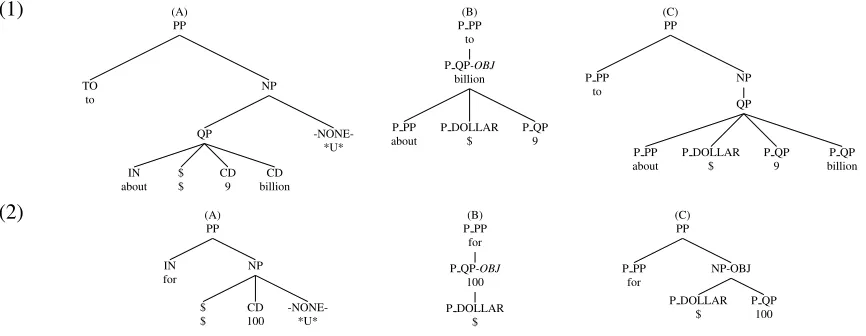
For example, (1abc) in Figure 5 illustrates a case where the QP structure projects to an NP node as well. (1a) is the original PTB PS tree, and (1b) is the DS representation. Note thatbillion heads the about $ 9 billionsubtree, with the su-pertag P QP and the label OBJ.2Because it has more than one child in addition to the $, it is converted to phrase structure as a QP under an NP, implying the empty *U*, although we do not actually put it in.
In contrast, (2abc) is a case in which the QP node is not generated. 100 is the head of the phrase $ 100 *U* in the PTB PS (a), as shown in the dependency structure (b). However, because it only has one child in addition to the $, no additional QP node is cre-ated in the phrase structure representation in (c). We stress that the presence of the QP in (1a) and its
ab-2
(1) (A) PP
TO to
NP
QP
IN about
$ $
CD 9
CD billion
-NONE-*U*
(B) P PP
to
P QP-OBJ billion
P PP about
P DOLLAR $
P QP 9
(C) PP
P PP to
NP
QP
P PP about
P DOLLAR $
P QP 9
P QP billion
(2) (A)
PP
IN for
NP
$ $
CD 100
-NONE-*U*
(B) P PP
for
P QP-OBJ 100
P DOLLAR $
(C) PP
P PP for
NP-OBJ
P DOLLAR $
[image:6.612.88.521.61.229.2]P QP 100
Figure 5: Examples of handling of QP in dependency to phrase-structure conversion.
sence in (2a) is correct annotation, consistent with the annotation guidelines.
3.2 Refinement of VP Projections
As mentioned above, instead of having separate su-pertags for S, SINV, SQ, SBAR, SBARQ, we use only the P VP supertag and let the context determine the specifics of the projection. Sentences (3ab) in Figure 6 illustrate how the SBJ label is used to treat the P VP supertag as indicating projection to SINV (or SQ) instead of S. The determination is based on the children of the P VP node. For example, if there is a child with the P AUX supertag which is before a child with the SBJ label, which in turn is before the P VP node itself, then the latter is treated as project-ing to either SINV or SQ, dependproject-ing on the some additional factors, primarily whether there is a WH word among the children. In this example, there is no WH word, so it becomes a SINV.3We note here that we also include a simple listing of verbs that take complements of certain types - such as verbs of saying, etc., that take SBAR complements, so that a VP will project not just to S, but SBAR, even if the complement is missing.
3.3 Coordination
We represent coordination in the dependency in one of the standard ways, by making the follow-ing conjuncts be children of the head word of
3
This is not a fully precise implementation of the condi-tions distinguishing SQ and SINV projeccondi-tions, in that it does not properly check for whether the clause is a question.
(3) (A) P VP absorbed
P AUX had
P NP-SBJ cost
P DET the
P VP been
(B) SINV
VBD had
NP-SBJ
DT the
NN cost
VP
VBN been
VP
VBN absorbed
Figure 6: (3ab) shows that the local context of the P VP supertag in the dependency tree results in a SINV struc-ture in the converted phrase strucstruc-ture tree (3b).
the first conjunct. For example, a dependency representation of...turn down the volume and close the curtainsis shown in (4a) in Figure 7. The conjunctclose the curtains
is converted as a VP projection projecting to S. How-ever, when the projection forturnis assembled, the code checks if the conjuncts are missing subjects, and if so, reduces the configuration to standard VP coordination, as in (4b). The COORD label is used to identify such structures for examination.
4 Results of Dependency to Phrase Structure Conversion
[image:6.612.319.532.272.353.2](4) (A) P VP
turn
P PRT down
P NP volume
P DET the
P CC and
P VP-COORD close
P NP-OBJ curtains
P DET the
(B) VP
VP
turn PRT
down
NP-OBJ
the volume
and VP
close NP-OBJ
the curtains
Figure 7: (4a) is the dependency representation of a coordination structure, and the resulting phrase structure (4b) shows that the conversion treated it as VP coordination, due to the absence of a subject.
Sec System rec prec f 00 Xia & Palmer ’01 86.2 88.7 87.5
[image:7.612.99.503.62.162.2]Xia et al. ’09 91.8 89.2 90.5 USE-POS-UNLABEL 96.6 97.4 97.0 USE-POS 94.6 95.4 95.0 USE-SUPER 95.9 97.0 96.4 22 Xia et al. ’09 90.7 88.1 89.4 USE-POS 95.0 95.5 95.3 USE-SUPER 96.4 97.1 96.7 23 Wang & Zong ’10 95.9 96.3 96.1 USE-POS 94.8 95.7 95.3 USE-SUPER 96.2 97.3 96.7 24 USE-POS 94.0 94.7 94.4 USE-SUPER 95.9 97.1 96.5
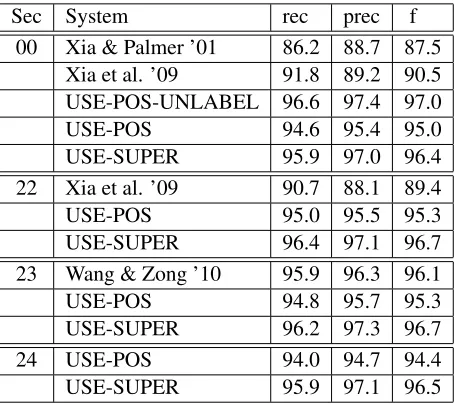
Table 2: Results of dependency to phrase structure con-version. For our system, the results are presented in two ways, using either the gold part-of-speech tags (USE-POS) or our gold supertags (USE-SUPER). For purposes of comparison with Xia and Palmer (2001) and Xia et al. (2009), we also present the results for Section 00 us-ing part-of-speech tags, but with an unlabeled evaluation (USE-POS-UNLABEL).
structure trees, using the standard evalb scoring code (Sekine and Collins, 2008). Xia and Palmer (2001) defined three different algorithms for the conversion, utilizing different heuristics for how to build projec-tion chains, and where to attach dependent subtrees. They reported results for their system for Section 00 of the PTB, and we include in Table 2 only their highest scoring algorithm. The system of Xia et al. (2009) uses conversion rules learned from Section 19, and then tested on Sections 00 and Section 22.
We developed the algorithm using Section 24, and we also report results for Sections 00, 22, and 23, for
comparison with previous work. We ran our system in two ways. In one we use the “gold” supertags that were created as described in Section 2.1 (USE-SUPER), based on the TIG decomposition of the original tree. In the other (USE-POS) we use the gold POS tags, and not the supertags. Because our DS-to-PS algorithm is based on using the supertags to guide the conversion, the USE-POS runs work by using a few straightforward heuristics to guess the correct supertag from the POS tag and the de-pendency structure. For example, if a word x has the POS tag “TO” and the wordy to its immediate right is its parent in the dependency tree andy has one of the verbal POS tags, thenxreceives the su-pertag P AUX, and otherwise P PP. Any word with the POS tag JJ, JJR, or JJS, receives the supertag P ADJP, and so on. The results for Xia and Palmer (2001) and Xia et al. (2009) were reported using an unlabeled version of evalb, so to compare properly we also report our results for Section 00 using an unlabeled evaluation of the run using the POS tags (USE-POS-UNLABEL), while all the other results use a labeled evaluation.
We also compare our system with that of Wang and Zong (2010). Unlike the three other systems (including ours), this was not based on an automatic conversion from a gold dependency tree to phrase structure, but rather used the gold dependency tree as additional input for a phrase structure parser (the Berkeley parser).
4.1 Analysis
[image:7.612.77.304.216.419.2]USE-POS results (95.0, 95.3, 95.3, 94.4). We take this to be an indication of a difference in the sec-tions as to the utility of the POS tags to “bootstrap” the syntactic structure. As just mentioned above, the USE-POS runs work by using heuristics to approxi-mate the gold supertags from the POS tags.
The supertags, because they are partially derived from the phrase structure, can obscure a discon-nect between a POS tag and the syntactic structure it projects. For example, the word according
in the structure (PP (VBG according) (PP (TO to) ...))receives the gold supertag P PP, a more explicit representation of the word’s role in the structure than the ambiguous VBG. This is why the USE-POS score is lower than the USE-SUPER score, since the POS tag and dependency structure do not always, at least with our simple heuristics, lead to the gold supertag. For example, in the USE-POS run, according receives the incorrect su-pertag P VP, leading to an incorrect structure, while in the USE-SUPER run, it is able to use P PP, lead-ing to the correct structure.
However, even with the lower performance of USE-POS, it is well above the results reported in Xia et al. (2009) for Section 22, and even more so with the unlabeled evaluation of Section 00 compared to Xia and Palmer (2001) and Xia et al. (2009). The comparison with Wang and Zong (2010) for Section 23 (they did not report results for any other section) shows something very different, however. Their re-sult, using a gold dependency tree together with the Berkeley parser, is above our USE-POS version and below our USE-SUPER version.
Our interpretation of this is that it provides an indication of what the parser is providing on top of the gold dependency structure, which is roughly the same information that we have encoded in our DS to PS code. However, because the Wang and Zong (2010) system performs better than our USE-POS version, it is likely learning some of the non-straightforward cases of how USE-POS tags can bootstrap the syntactic structure that our USE-POS version is missing. However, any conclusions must be tentative since our dependency structures are not necessarily the same as theirs and so it is not an ex-act comparison.
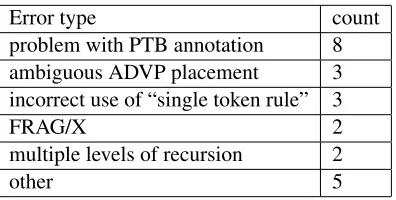
Error type count
problem with PTB annotation 8 ambiguous ADVP placement 3 incorrect use of “single token rule” 3
FRAG/X 2
multiple levels of recursion 2
[image:8.612.327.525.59.159.2]other 5
Table 3: Analysis of errors in first 50 sentences of USE-SUPER run for Section 24
4.2 Errors from Dependency Structure with Supertags to Phrase Structure
We stressed in the introduction that we are interested in understanding better the relationship between the DS and PS representations. Identifying areas where the conversion from DS did not result in a perfect (evalb score) PS is therefore of particular interest.
For this analysis, we used our dev section, 24, with the run USE-SUPER. We use this run because we are interested in cases where, even with the gold supertags, there was still a problem with the conver-sion to the PS. We examined the first 50 sentences in the section, with a total of 23 errors. We recognize that this is a very small sample. An eyeball exam-ination of other sentences does not reveal anything significantly different than what we present here as far as the sorts of errors, although we have only per-formed a rigorous analysis of these 23 errors, which is why we limit our discussion here to these cases.
Table 3 shows a breakdown of these 23 errors. Note that by “error” here we mean a difference be-tween the reconstructed PS structure, and the PTB gold PS structure, causing the score for Section 24, USE-SUPER (last row) in Table 2 to be less than perfect.
re-constructed PS, with an ADVP. There is a mismatch between the POS tag and the node label in the origi-nal tree (5a), and in fact in this case the node label in the PTB tree should have been ADVP-LOC, instead of NP-LOC.
(5) (A) VP
VBD premiered
NP-LOC
RB here
(B) P VP premiered
P ADVP here
(C) VP
VBD premiered
ADVP
RB here
(6) (A) S
NP-SBJ
-NONE-VP
ADVP-MNR
RB frantically
VBG selling
NP
NNS bonds
(B) P VP selling
P ADVP frantically
P NP bonds
(C) S
ADVP
P ADVP frantically
VP
VBG selling
NP
NNS bonds
An example of the “ambiguous ADVP place-ment” error is shown in (6), in which the PTB tree has the adverbfranticallyinside the VP, infor-mation which is not available in the DS (6b). Our conversion code has to choose as to where to put such ADVPs, and it puts them outside the VP, as in (6c), which is sometimes correct, but not in this case.
5 Conclusion and Future Work
In this work we have described an approach to auto-matically converting DS to PS with significantly im-proved accuracy over previous efforts, and compara-ble results to that of using a phrase structure parser guided by the dependency structure.
Following the motivation discussed in Section 1, the next step is straightforward - to adapt the al-gorithm to work on conversion from a dependency representation of the Arabic Treebank to the phrase structure representation necessary for the annotation pipeline. Following this, we will then experiment with parsing the Arabic dependency representation, converting to phrase structure, and evaluating the re-sulting phrase structure representation as usual for parsing evaluation. We will also experiment with dependency parsing for the PTB dependency repre-sentation discussed in this paper. Habash and Roth (2009) discuss an already-existing dependency rep-resentation of parts of the ATB and it will be inter-esting to compare the conversion accuracy using the different dependency representations, although we
expect that there will not be any major differences in the representations.
One other aspect of future work is to implement the algorithm in Wang and Zong (2010), using our own dependency representation, since this would al-low a precise investigation of what the phrase struc-ture parser is contributing as compared to our auto-matic conversion. We note that this work also ex-perimented with dependency parsing, and then auto-matically converting the results to PS, a further basis of comparison.
Finally, we would like to stress that while we have used evalb for scoring the converting PS because it is the standard evaluation for PS work, it is a very insufficient standard for this work. As discussed at the end of Section 2, we have not included all the function tags or empty categories in our representa-tion, a significant omission. We would like to ex-pand our dependency representation to allow all the function tags and empty categories to be included in the converted PS. Our plan is to take our anal-ogy to TAG more seriously (e.g., (Joshi and Ram-bow, 2003)) and use a label akin to adjunction to en-code leftward (non-projective) movement in the tree, also using an appropriate dependency parser as well (Shen and Joshi, 2008).
Acknowledgements
References
Srinivas Bangalore and Aravind K. Joshi, editors. 2010. Supertagging: Using Complex Lexical Descriptions in Natural Language Processing. MIT Press.
Ann Bies, Mark Ferguson, Karen Katz, and Robert Mac-Intyre. 1995. Bracketing guidelines for Treebank II-style Penn Treebank project. Technical Report MS-CIS-95-06, University of Pennsylvania.
David Chiang. 2003. Statistical parsing with an auto-matically extracted Tree Adjoining Grammar. InData Oriented Parsing. CSLI.
Nizar Habash and Ryan Roth. 2009. CATiB: The Columbia Arabic Treebank. In Proceedings of the ACL-IJCNLP 2009 Conference Short Papers, pages 221–224, Suntec, Singapore, August. Association for Computational Linguistics.
Johan Hall and Joakim Nivre. 2008. A dependency-driven parser for German dependency and con-stituency representations. InProceedings of the Work-shop on Parsing German, pages 47–54, Columbus, Ohio, June. Association for Computational Linguis-tics.
Joakim Nivre Johan Hall and Jens Nilsson. 2007. Hy-brid constituency-dependency parser for Swedish. In Proceedings of NODALIDA, Tartu, Estonia.
Richard Johansson and Pierre Nugues. 2007. Extended constituent-to-dependency conversion for english. In Proceedings of NODALIDA, Tartu, Estonia.
Aravind Joshi and Owen Rambow. 2003. A formal-ism for dependency grammar based on Tree Adjoin-ing Grammar. In Proceedings of the Conference on Meaning-Text Theory, Paris, France.
Mohamed Maamouri and Ann Bies. 2004. Developing an arabic treebank: Methods, guidelines, procedures, and tools. In Ali Farghaly and Karine Megerdoomian, editors,COLING 2004 Computational Approaches to Arabic Script-based Languages, pages 2–9, Geneva, Switzerland, August 28th. COLING.
Mohamed Maamouri, Ann Bies, and Seth Kulick. 2011. Upgrading and enhancing the Penn Arabic Treebank. In Joseph Olive, Caitlin Christianson, and John Mc-Cary, editors, Handbook of Natural Language Pro-cessing and Machine Translation: DARPA Global Au-tonomous Language Exploitation. Springer.
Christopher Manning. 2011. Part-of-speech tagging from 97% to 100%: Is it time for some linguistics? In Alexander Gelbukh, editor,Computational Linguis-tics and Intelligent Text Processing, 12th International Conference, CICLing 2011, Proceedings, Part I. Lec-ture Notes in Computer Science 6608.
Mitchell P. Marcus, Beatrice Santorini, and Mary Ann Marcinkiewicz. 1993. Building a large annotated cor-pus of English: The Penn Treebank. Computational linguistics, 19:313–330.
Mitchell Marcus, Grace Kim, Mary Ann Marcinkiewicz, Robert MacIntyre, Ann Bies, Mark Ferguson, Karen Katz, and Britta Schasberger. 1994. The Penn Tree-bank: Annotating predicate argument structure. In Proceedings of HLT.
Satoshi Sekine and Michael Collins. 2008. Evalb. http://nlp.cs.nyu.edu/evalb/.
Libin Shen and Aravind Joshi. 2008. LTAG dependency parsing with bidirectional incremental construction. InProceedings of the 2008 Conference on Empirical Methods in Natural Language Processing, pages 495– 504, Honolulu, Hawaii, October. Association for Com-putational Linguistics.
Zhiguo Wang and Chengqing Zong. 2010. Phrase struc-ture parsing with dependency strucstruc-ture. InCOLING 2010: Posters, pages 1292–1300, Beijing, China, Au-gust.
Fei Xia and Martha Palmer. 2001. Converting depen-dency structures to phrase structures. InHLT-2001. Fei Xia, Owen Rambow, Rajesh Bhatt, Martha Palmer,