Co-Attention Based Neural Network for Source-Dependent Essay Scoring
Haoran Zhang
Department of Computer Science University of Pittsburgh
Pittsburgh, PA 15260 [email protected]
Diane Litman
Department of Computer Science & LRDC University of Pittsburgh
Pittsburgh, PA 15260 [email protected]
Abstract
This paper presents an investigation of us-ing a co-attention based neural network for source-dependent essay scoring. We use a co-attention mechanism to help the model learn the importance of each part of the essay more accurately. Also, this paper shows that the co-attention based neural network model provides reliable score prediction of source-dependent responses. We evaluate our model on two source-dependent response corpora. Results show that our model outperforms the baseline on both corpora. We also show that the atten-tion of the model is similar to the expert opin-ions with examples.
1 Introduction
Manually grading students’ essays is labor inten-sive. Therefore, many automated essay scoring (AES) methods have been developed to support grading essays at scale. However, in different grading tasks, the information required by an AES system is different. For example, if a system needs to assign a holistic score to the essay, the sys-tem needs to take all information into account. In contrast, if a system needs to assign a score for one specific aspect of the essay (e.g. use of evi-dence), the system needs to ignore some informa-tion. Also, if an essay is a source-dependent es-say, the system needs to exploit knowledge of the source article.
This paper focuses on source-dependent essay assessment. In this task, students read a source article before writing the essay, and assessment involves recognizing and analyzing references to the article in the essay. We propose a new type of co-attention based neural network model tai-lored to source-dependent grading, then use two source-dependent essay corpora to evaluate our model. Our first corpus contains the four source-dependent essay sets in the Automated Student
Assessment Prize (ASAP) corpus1. The ASAP grading task is to assign a holistic score to each essay. The second corpus uses the Response to Text Assessment (RTA) (Correnti et al.,2013) to assess students’ analytic writing skills. Instead of evaluating holistic writing skills, the RTA was de-signed to evaluate students’ writing skills along five dimensions: Analysis, Evidence, Organiza-tion, Style, and MUGS (Mechanics, Usage, Gram-mar, and Spelling). Our grading task for this cor-pus is to assign an Evidence score to each essay, by evaluating students’ ability to find and use evi-dence from a source article to support their claims.
The main contributions of this paper are as fol-lows. First, we introduce a co-attention based neu-ral network model that is fully automated and does not need any expert effort to encode knowledge of a source article. Second, our co-attention based neural network model extends prior work by de-signing the model to take a source article into ac-count during grading. Third, we apply our model to the subset of source-dependent responses tasks in the ASAP corpus and show that the model out-performs a previous neural network model devel-oped for the full corpus. Fourth, we show that our model also performs well on the RTA task and again significantly outperforms our baseline neu-ral net model. Last, we use examples to show that our model can assign reasonable attention scores to different sentences in the essay.
In the following sections, we first present re-lated research. Then we describe our tasks by in-troducing the ASAP corpus and the RTA corpus. Next, we explain the structure of our co-attention based neural network model. Finally, we discuss the results of our experiments and future plans.
2 Related Work
Previous research in AES needed feature engineer-ing. In very early work,Page(1968) developed an AES tool named Project Essay Grade (PEG) by only using linguistic surface features. A more re-cent well-known AES system is E-Rater (Burstein et al., 1998), which employs many more natural language processing (NLP) technologies. Later, Attali and Burstein (2004) released E-Rater V2, where they created a new set of features to rep-resent linguistic characteristic related to organiza-tion and development, lexical complexity, prompt-specific vocabulary usage, etc. Similarly toPage (1968), this system used regression equations for assessment of student essays. One limitation of all of the above models is that all need handcrafted features for training the model. In contrast, our model uses a neural network for the AES task and thus does not require feature engineering.
Recently, neural network models have been in-troduced into AES, making the development of handcrafted features unnecessary or at least op-tional. Alikaniotis et al. (2016) and Taghipour and Ng (2016) presented AES models that used Long Short Term Memory (LSTM) networks. Dif-ferently, Dong and Zhang (2016) used a Con-volutional Neural Network (CNN) model for es-say scoring by applying two CNN layers on both the word level and then sentence level. Later, Dong et al. (2017) presented another work that uses attention pooling to replace the mean over time pooling after the convolutional layer in both word level and sentence levels. However, none of these neural network grading models consider the source article if it exists. In this paper, we intro-duce a neural network model that takes the source article into account by using a co-attention mech-anism instead of the self-attention mechmech-anism of prior work.
Our work not only focuses on essay assess-ment using a holistic score, but also evaluates a particular dimension of argument-oriented writing skills, namely use of Evidence.Louis and Higgins (2010) analyze only the content of essays by de-tecting off-topic essays.Ong et al.(2014) used ar-gumentation mining techniques to evaluate if stu-dents use enough evidence to support their posi-tions. However, these two prior studies are not suitable for our task because they did not measure the use of content or evidence from a source ar-ticle. With respect to source-based dimensional
essay analysis,Rahimi et al. (2014,2017) devel-oped a set of rubric-based features that compared a student’s essay and a source article in terms of number of related words or paraphrases. Zhang and Litman(2017) improved their model by intro-ducing word embedding into the feature extraction process to extract relationships previously missed due to lexical errors or use of different vocabulary. However, in both of these studies, human effort was still necessary for pre-processing the source article, for example, by having experts manually create a list of important words and phrases in the article which the system would compare with fea-tures extracted from the student’s essay. In con-trast, our work does not need any human effort to analyze the source article before essay grading. AlthoughRahimi and Litman(2016) investigated extracting example lists by using LDA (Blei et al., 2003) model, the data-driven model missed an ample when there was no essay mentioning the ex-ample. Klebanov et al. (2014) predicted which parts of the source material were important and that students needed to use in their essays. The essay score is required to obtain the content impor-tance for their work, but our work does not need to know the essay score while identifying the content importance.
3 Data
We use two different essay corpora in our exper-iments: source-based essays from the ASAP cor-pus, and source-based RTA essays. While the full ASAP corpus contains essays in response to 8 dif-ferent prompts, we use only essays in response to the 4 source-dependent prompts. The gold stan-dard ASAP assessment is a holistic score. In con-trast, the gold standard assessment in the RTA cor-pus is an Evidence score. In particular, the assess-ment only considers how students use evidence from a source article to support their claims; the assessement thus ignores the lexical and syntactic mistakes made by students and the organization of the essay when assessing the evidence dimension.
3.1 ASAP
Source Excerpt: My mother and fa-ther had come to this country with such courage, without any knowledge of the language or the culture. They came self-lessly, as many immigrants do, to give their children a better life, even though it meant leaving behind their families, friends, and careers in the country they loved.
Essay Prompt: Describe the mood cre-ated by the author in the memoir. Sup-port your answer with relevant and spe-cific information from the memoir.
Figure 1: A source excerpt for ASAP Prompt 5.
the overall quality of the essay, not just a specific dimension. Figure1 contains an excerpt from an ASAP source article and the associated Prompt 5.
Prompt 3 4 5 6
Score 0 39 311 24 44
(2%) (18%) (1%) (3%) Score 1 607 636 302 167
(35%) (36%) (17%) (9%) Score 2 657 570 649 405
(38%) (32%) (36%) (23%) Score 3 423 253 572 817
(25%) (14%) (32%) (45%) Score 4 NA NA 258 367
(14%) (20%) Total 1726 1770 1805 1800
Table 1: The holistic score distribution of ASAP.
In this paper, we only focus on prompts 3, 4, 5, and 6 (denoted byASAP3,ASAP4,ASAP5, and ASAP6 respectively), because they are source-dependent responses. In ASAP, different prompts have different score ranges. The score range of ASAP3 andASAP4 is 0 to 3, while the range of ASAP5 andASAP6is 0 to 4. Figure2shows an excerpt of an essay with score of 4 for ASAP5. The score distribution is shown in Table1.
3.2 RTA
The RTA corpora were collected from upper ele-mentary level students, as described by Correnti et al.(2013). There are two forms of RTA based on different articles that students read before writ-ing essays. The first article is fromTime for Kids
Essay Excerpt:The author of the mem-oir, Narciso Rodriguez creates a caring, happy, and thoughtful mood. By men-tioning the Cuban traditions shared in the neighborhood between close friends, and cooking in the kitchen to share a great meal with one another the mood is happy. When Narciso talks about the great friends he made from different her-itages and knowing the entire commu-nity like family the mood is thoughtful and caring because it shows that the peo-ple really appreciated each other’s com-pany...
Figure 2: Excerpt of an essay with score of 4 for ASAP Prompt 5.
about the Millennium Villages Project, an effort by the United Nations to end poverty in a rural village in Sauri, Kenya; we refer to it asRT AM V P. The
other article talks about the importance of space exploration; we refer to refer it asRT ASpace.
Fig-ure3shows an excerpt from theRT AM V P article
and the associated essay writing prompt. Bolded text spans in the article excerpt are pieces of evi-dence that our experts (School of Education RTA team members) manually labeled as being impor-tant for students to include in their essays.
Source Excerpt: Today, Yala Sub-DistrictHospital has medicine,free of charge, for all of the most common diseases. Water is connected to the hospital, which also has a generator for electricity.Bed nets are usedin ev-ery sleeping site in Sauri...
Essay Prompt: The author provided one specific example of how the quality of life can be improved by the Millen-nium Villages Project in Sauri, Kenya. Based on the article, did the author pro-vide a convincing argument that win-ning the fight against poverty is achiev-able in our lifetime? Explain why or why not with 3-4 examples from the text to support your answer.
Figure 3: A source excerpt for theRT AM V P prompt.
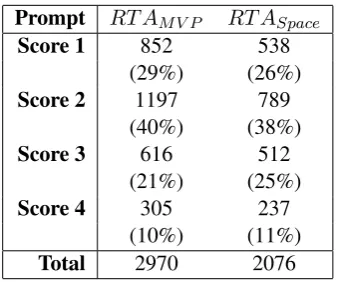
on a scale of 1 to 4 (low to high). The distribution of Evidence scores is shown in Table2. Figure4 shows a student essay with a score of 3. Our ex-perts manually bolded all pieces of evidence found in this essay.
[image:4.595.97.266.451.592.2]Essay: In my opinion I think that they will achieve it in lifetime. During the years threw2004 and 2008 they made progress. People didnt have the money to buy the stuff in 2004. The hospi-tal was packed with patientsand they didnt have alot of treatment in 2004. In 2008 it changed the hospital had medicine, free of charge, and for all the common dieases. Water was con-nected to the hospital and has a gen-erator for electricity. Everybody has net in their site. The hunger crisis has been addressedwithfertilizer and seeds, as well as the tools needed to maintain the food. The school has no feesandthey serve lunch. To me thats sounds like it is going achieve it in the lifetime.
Figure 4: ART AM V P essay with score of 3.
Prompt RT AM V P RT ASpace
Score 1 852 538
(29%) (26%)
Score 2 1197 789
(40%) (38%)
Score 3 616 512
(21%) (25%)
Score 4 305 237
(10%) (11%)
Total 2970 2076
Table 2: The Evidence score distribution of RTA.
4 Model
Our network is inspired by the hierarchical neural network model presented by Dong et al. (2017). In their model, they considered each essay as a sequence of sentences rather than a sequence of words. Their model has three parts. First, they used a convolutional layer and attention pooling layer to get sentence representation. Second, they used an LSTM layer and another attention pooling
layer for document representation. Finally, they used a sigmoid layer for score prediction.
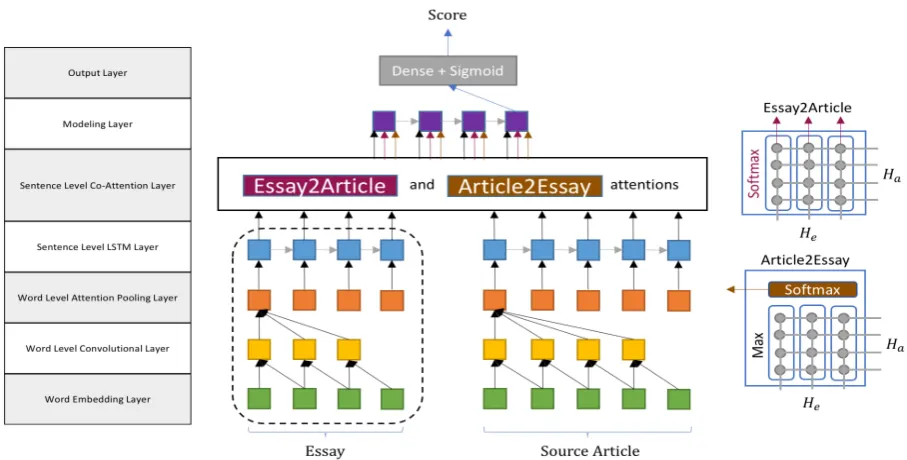
Differently from their model, our model re-places the attention pooling layer for document representation with a bi-directional attention flow layer and an additional modeling layer (Seo et al., 2017). By doing so, our model considers students’ essays associated with a source article and this at-tention mechanism captures the relationship be-tween the essay and the source article. In partic-ular, a higher attention score will be assigned to sentences that are mentioned in the article but less mentioned in other essays. Our model is a hierar-chical neural network and consists of seven layers. Figure5shows the structure of our network. The layers in the dashed box were presented byDong et al.(2017). The sentence level co-attention layer was presented bySeo et al.(2017).
4.1 Word Embedding Layer
This layer maps each word in sentences to a high dimension vector. We use the GloVe pre-trained word embeddings (Pennington et al.,2014) to ob-tain the word embedding vector for each word. It was trained on 6 billion words from Wikipedia 2014 and Gigaword 5. It has 400,000 uncased vo-cabulary items. The dimensionality of GloVe in our model is 50 dimensions. The outputs of this layer are two matrices,LE ∈ RSe×We×dL for the
essay andLA∈RSa×Wa×dLfor the article, where
Se,Sa,We,Wa, anddL are number of sentences
of the essay and the article, length of sentences of the essay and the article, and the embedding size, respectively. Same toDong et al.(2017), a dropout is applied after the word embedding layer.
4.2 Word Level Convolutional Layer
In this layer, we perform 1D convolution over the word representations of bothLE andLA, so that
we can get local representation of each sentence. For each wordwiin each sentence, we perform 1D
convolution:
pi =g([wi:wi+k−1]·Up+bp) (1)
whereg is a nonlinear activation, k is the kernel size, Up is the filter weight matrix, andbp is the
bias vector. The outputs of this layer are Ce ∈
RSe×Pe×dC for the essay and Ca ∈ RSa×Pa×dC
for the article, wherePeandPaare filtered lengths
of sentences of the essay and the article, respec-tively.dCis the number of filters of the 1D
Figure 5: The Co-Attention Based Neural Network Structure.
4.3 Word Level Attention Pooling Layer
After the convolutional layer, a pooling layer is de-manded to obtain the sentence representations. In this layer, we follow the same design presented by Dong et al. (2017). The attention pooling is de-fined as equations below:
mi=tanh(Um·pi+bm) (2)
vi =
euv·mi
P
euv·mj (3)
s=Xvipi (4)
where Um, uv andbm are weight matrix, vector,
and bias vector, respectively. mi andvi are
atten-tion vector and attenatten-tion weight forpi. The
out-puts of this layer areAe ∈ RSe×dC for the essay
andAa∈RSa×dC for the article.
4.4 Sentence Level LSTM Layer
In this layer, we use a Long Short-Term Memory Network (LSTM) (Hochreiter and Schmidhuber, 1997) over the sentence representations of the es-say and the article to capture contextual evidence from previous sentences to refine the sentence rep-resentation.
The LSTM unit is a special kind of RNN unit which has long-term dependency learning abil-ity. LSTMs use three gates to control information flow to avoid the long-term dependency problem by forgetting or remembering information in each LSTM unit. They are an input gate, a forget gate,
and an output gate. The following equations define the LSTM unit:
ft=σ(Wf ·[ht−1, st] +bf) (5)
it=σ(Wi·[ht−1, st] +bi) (6)
˜
ct=tanh(Wc·[ht−1, st] +bc) (7)
ct=ft∗ct−1+it∗c˜t (8)
ot=σ(Wo·[ht−1, st] +bo) (9)
ht=ot∗tanh(ct) (10)
wherestandhtare the input sentence and the
out-put state of time t, respectively. Wf, Wi, Wc,
and Wo are weight matrices. bf, bi, bc, and bo
are bias vectors. σ is the sigmoid function, and
∗ is element-wise multiplication. The output of this layer are He ∈ RSe×dH for the essay and
Ha∈ RSa×dH for the article, wheredH is the
di-mensionality of the output.
4.5 Sentence Level Co-Attention Layer
The concept of this layer is presented bySeo et al. (2017) in the part of attention flow layer. This layer links information fromHeandHa, and
gen-erates a collection of article aware features vec-tor of essay sentences. The attention is computed in two directions, from essay to article, and vice versa. Both attention scores are figured from a similarity matrix by the following equation:
whereWsimis weight matrix,hetandhaj aretth
row vector ofHeandjthrow vector ofHa,bsimis
bias vector. ∗ is element-wise multiplication. [; ] is vector concatenation. After obtaining the simi-larity matrixSim ∈RSe×Sa, we compute the
at-tention in two directions.
Essay to Article Attention measures which sentences in the article are similar to each sentence in students’ essays. The following equations de-fine the essay to article attention:
aea=sof tmax(Sim) (12)
˜
Ha=aeaHa (13)
where aea ∈ RSe×Sa represents the attention
score of each sentence in the article associate with each sentence in the essay,sof tmaxis performed across each row. The output of thisH˜a∈RSe×dH.
Article to Essay Attention measures which sentences in the essay have the closest meaning to one of the sentences in the article. The following equations define the article to essay attention:
aae=sof tmax(maxcol(Sim)) (14)
˜
he=aTaeHe (15)
whereaae∈RSe,maxcolis a maximum function
performed across the column, and˜he ∈RdH.
Be-cause maxcol will find out which sentence in the
article has the closest meaning to each sentence in the essay, so ˜he represents the attention score
of the most important sentence in the essay asso-ciated with the article. After tiling Se times, the
final output of this layer isH˜e∈RSe×dH.
The final outputG is a concatenated matrix of He,H˜e, andH˜adefined by:
G= [He; ˜Ha;He∗H˜a;He∗H˜e] (16)
where∗is element-wise multiplication, and[; ]is concatenation,Heis the original representation of
essay,H˜ais the essay to article attention,He∗H˜a
is the self-aware representation, and He ∗H˜e is
article-aware representation. Therefore, the output of this layer is G ∈ RSe×4dH, the article-aware
representation of each sentence in the essay.
4.6 Modeling Layer
Gis the representation of each sentence, and we need the representation of the essay. Therefore, we introduce another LSTM layer for modeling the essay and only use the output of the final LSTM unit as the output of this layerM ∈ RdM, where
dM is the dimensionality of the output of LSTM
units.
4.7 Output Layer
After obtaining the essay representationM, a lin-ear layer with sigmoid activation will predict the final output. The following equation defines the output layer:
y=sigmoid(WoM +bo) (17)
whereWois weight vector, andbois bias vector.y
is the final predicted score of the essay.
5 Training
Loss. Dong et al. (2017) used mean squared er-ror (MSE) loss, thus we use the same loss func-tion. MSE evaluates the average of squared error between the predicted score and the gold standard. Thus it is widely used in regression tasks. The fol-lowing equation defines MSE:
mse(y, y0) = 1
N
N
X
i=1
(yi−yi0)2 (18)
whereyiis the predicted score,y0iis the gold
stan-dard,N it the total number of samples.
Optimization. The optimizer we use is RMS-prop (Dauphin et al.,2015). The initial learning rate is 0.001, momentum is 0.9, and Dropout rate is 0.5 for preventing overfitting. These setting are the same as used byDong et al.(2017).
6 Experimental Setup
We configure experiments to test three hypotheses:
H1: the model we proposed (denoted by CO-ATTN) will outperform or at least per-form equally well as the baseline (denoted by SELF-ATTN) presented by Dong et al. (2017) on four ASAP essay corpora in the holistic score prediction task.
H2: the model we proposed will outperform or at least perform equally well as the baseline on two RTA corpora in the Evidence score pre-diction task.
H3: the model we proposed will outperform or at least perform equally well as the non-neural network baselines on both corpora.
et al. (2017). In particular, the 4000 most fre-quent words are preserved, with all other words treated as unknowns. The assessment scores will be converted back to their original range during evaluation. We use Quadratic Weighted Kappa (QWK) to evaluate our model. QWK is not only the official criteria of ASAP corpus, but also adopted as evaluation metric inRahimi et al. (2014); Taghipour and Ng (2016); Dong et al. (2017); Rahimi et al. (2017); Zhang and Litman (2017) for both ASAP and RTA corpora.
We use 5-fold cross-validation because both RTA and ASAP corpora have no released labeled test data. We split all corpora into 5 folds. For the ASAP corpus, the partition is the same as the set-ting presented byTaghipour and Ng (2016). For the RTA corpus, since there is no prior work to split the corpus, we separate it into 5 folds ran-domly. In each fold, 60% of the data are used for training, 20% of the data are the development set, and 20% of the data are used for testing.
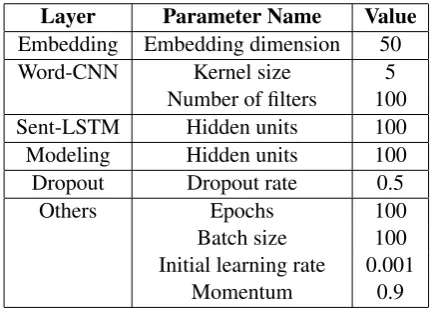
To select the best model, we trained each model on 100 epochs and evaluated on the development set after each epoch. The best model is the model with the best QWK on the development set. This is done five times, once for each partition in the cross-validation. Then the average QWK score from these five evaluations on the test set is re-ported. Paired t-tests are used for significance tests with p < 0.05. Table 3 shows all hyper-parameters for training.
The code of SELF-ATTN are provided byDong et al.(2017), they used Keras (Chollet et al.,2015) 1.1.1 and Theano (Theano Development Team, 2016) 0.8.2 as the backend. Because we are using Keras 2.1.3 and TensorFlow (Abadi et al., 2015) 1.4.0 as the backend, we ran all experiments with our frameworks. Therefore, the numbers of SELF-ATTN have small differences to the numbers re-ported by the baseline model.
For non-neural network baselines, we introduce the SVR and BLRR baselines presented byPhandi et al.(2015) for the ASAP corpus, and SG base-line presented byZhang and Litman(2017) for the RTA corpus.
SVR and BLRR models use Enhanced AI Scor-ing Engine (EASE)2 to extract four types of fea-tures, such as length, part of speech, prompt, and the bag of words. Then they use SVR and BLRR as the classifiers, respectively. We do not perform
2https://github.com/edx/ease
any significance test on both SVR and BLRR be-cause we do not have detailed experiment data. Therefore, we only report the result presented in Phandi et al.(2015).
SG model extracts evidence features based on hand-crafted topic and example lists, and uses ran-dom forest tree as the classifier. We follow the same data partition. However, we only use the training set for training and the testing set for test-ing while ignortest-ing the development set so that we can perform the same paired t-tests in the experi-ments.
Layer Parameter Name Value Embedding Embedding dimension 50
Word-CNN Kernel size 5
Number of filters 100 Sent-LSTM Hidden units 100
Modeling Hidden units 100
Dropout Dropout rate 0.5
Others Epochs 100
Batch size 100 Initial learning rate 0.001
[image:7.595.308.524.232.387.2]Momentum 0.9
Table 3: Hyper-parameters of training.
7 Results
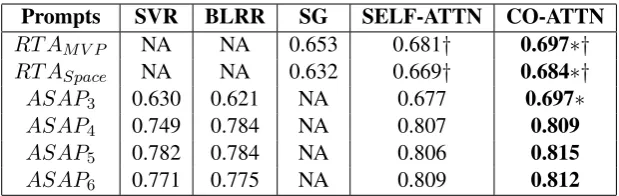
We first examine H1. The results shown in Table4 support this hypothesis. The CO-ATTN model yields higher performance than the SELF-ATTN model on all ASAP prompts. However, the CO-ATTN model only significantly outperforms the SELF-ATTN model on Prompt 3.
Second, we examine H2. Again, the results shown in Table4support this hypothesis. The CO-ATTN model yields higher performance than the SELF-ATTN model, significantly on both of the RTA corpora.
Last, we examine H3. The results shown in Table 4 still support this hypothesis. The CO-ATTN model yields higher performance than all non-neural network baselines.
Prompts SVR BLRR SG SELF-ATTN CO-ATTN RT AM V P NA NA 0.653 0.681† 0.697∗†
RT ASpace NA NA 0.632 0.669† 0.684∗†
ASAP3 0.630 0.621 NA 0.677 0.697∗
ASAP4 0.749 0.784 NA 0.807 0.809
ASAP5 0.782 0.784 NA 0.806 0.815
[image:8.595.144.454.61.159.2]ASAP6 0.771 0.775 NA 0.809 0.812
Table 4: The performance (QWK) of the baselines and our model.∗indicates that the model QWK is significantly better than the SELF-ATTN (p < 0.05). †indicates that the model QWK is significantly better than the SG (p <0.05). The best results in each row are in bold.
model. It treats all evidence equally. However, the neural network models capture this informa-tion automatically.
Apparently, the CO-ATTN model performs bet-ter in the RTA tasks, because it always signifi-cantly outperforms the SELF-ATTN model. One possible reason is that the RTA task only considers the Evidence score. The CO-ATTN model is more suitable for the Evidence score prediction task be-cause it can find pieces of evidence that appear in both students’ essays and the source article better. In contrast, the SELF-ATTN model only consid-ers students’ essays associated with the scores. In this case, if a piece of evidence is not mentioned by students, this data-driven model cannot distin-guish it. Consequently, some important pieces of evidence will be assigned to a lower weight. How-ever, the CO-ATTN model considers not only the students’ essays but also the source article. In other words, if an important piece of evidence is not mentioned by too many students, but it is in the source article, the CO-ATTN model will as-sign this sentence higher attention.
In the ASAP holistic score prediction task, al-though we still see a benefit in using the CO-ATTN model, it is reduced. In this case, the benefit we saw in the Evidence dimension from the CO-ATTN model becomes less significant be-cause the model also needs to consider more as-pects of the essay, such as organization, grammar mistakes, and so on. Our results suggest that the co-attention mechanism of the CO-ATTN model cannot capture these aspects significantly better than the SELF-ATTN model. Therefore, the CO-ATTN model only significantly outperforms the SELF-ATTN model on Prompt 3.
8 Discussion
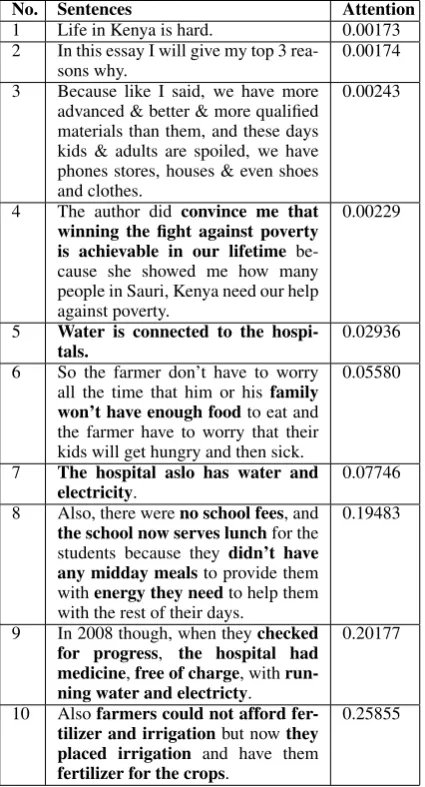
In Table 5, we list 10 sentences from student RT AM V P essays and their associated attention
scores. Because we have a list of examples man-ually extracted by our experts as important evi-dence from the RT AM V P source article,
exam-ining RTA data helps us understand the attention score assigned by our model. Bolded are exam-ples extracted by the expert from the source article that the student includes in the essay. A lower at-tention score means this sentence is less important. Otherwise, the score is high. As we can see, sen-tences 1, 2, 3, and 4 are low attention sensen-tences, sentences 5, 6, and 7 are mid attention sentences, and sentences 8, 9, and 10 are high attention sen-tences. The attention scores reflect the importance of these sentences accurately.
Sentence 1 is a short and general sentence re-lated to the source article, but it has no specific evidence from it. Sentence 2 even has no content related to the source article. Sentence 3 has many details related to the source article. However, it still has no evidence directly from the source ar-ticle. Sentence 4 mentions “The author did con-vince me that winning the fight against poverty is achievable in our lifetime” which comes from both the prompt and the source article, but this state-ment is so general that almost every student men-tions this statement in the essay which makes this statement not distinguishable. For these reasons, these four sentences receive low attention scores.
However, it mentions not only water but also elec-tricity which is more than Sentence 5. For these reasons, these three sentences receive mid atten-tion scores from low to high.
The last three sentences receive high attention scores because they all use more pieces of evi-dence directly from the source article. Sentence 8 talks about the school, and Sentence 9 talks about the hospital. Sentence 10 talks about farming. However, sentence 10 receives the highest atten-tion score, because it menatten-tions evidence from both before and after the MVP project.
No. Sentences Attention 1 Life in Kenya is hard. 0.00173 2 In this essay I will give my top 3
rea-sons why.
0.00174
3 Because like I said, we have more advanced & better & more qualified materials than them, and these days kids & adults are spoiled, we have phones stores, houses & even shoes and clothes.
0.00243
4 The author did convince me that winning the fight against poverty is achievable in our lifetime be-cause she showed me how many people in Sauri, Kenya need our help against poverty.
0.00229
5 Water is connected to the hospi-tals.
0.02936
6 So the farmer don’t have to worry all the time that him or his family won’t have enough foodto eat and the farmer have to worry that their kids will get hungry and then sick.
0.05580
7 The hospital aslo has water and electricity.
0.07746
8 Also, there wereno school fees, and the school now serves lunchfor the students because they didn’t have any midday mealsto provide them withenergy they needto help them with the rest of their days.
0.19483
9 In 2008 though, when theychecked for progress, the hospital had medicine,free of charge, with run-ning water and electricty.
0.20177
10 Alsofarmers could not afford fer-tilizer and irrigationbut nowthey placed irrigation and have them fertilizer for the crops.
[image:9.595.76.289.239.633.2]0.25855
Table 5: Example attention scores of essay sentences.
From these sentences, we can also see that the attention score depends on neither the length of the sentence nor only the specificity of the sen-tence. It instead depends on how many impor-tant pieces of evidence there are in the sentence. For example, Sentence 3 is long and talks about some details of our modern life. Although it also
talks about quality materials or better housing and clothing compared to people living in Kenya, it re-ceives a low attention score because there is no specific evidence directly from the source article. In contrast, Sentence 9 is shorter than Sentence 3. However, it receives a higher attention score be-cause it mentions many pieces of evidence from the source article.
Overall, the CO-ATTN model seems to capture the importance of sentences by assigning reason-able attention scores based on the relevance of the sentence to the source article.
9 Conclusion and Future Work
In this paper, we presented a co-attention based neural network model that outperforms a state of the art attention based neural network model for essay scoring, not only for RTA Evidence assess-ment but also for holistic assessassess-ment of ASAP source-dependent responses. Advantages of our model are that it does not need any expert pre-processing of the source article; the input of this model is only the raw student essay and its source article. Moreover, our model somewhat captures the importance of different pieces of evidence, al-though it is not specifically designed for this pur-pose. However, quantitative experiments that can answer whether the attention scores are correlated to the importance of different pieces of evidence need to be done. Also, this leads to an interesting future investigation, development of a neural net-work approach that both has an acceptable score prediction, and can simultaneously generate evi-dence lists from the source article. Another inter-esting future investigation could be examining the ability of this model to generalize to a new prompt.
Acknowledgments
We would like to show our appreciation to Tazin Afrin and Luca Lugini for their comments on an earlier version of the paper. We are also im-mensely grateful to every member of the RTA group for sharing their pearls of wisdom with us.
References
Mart´ın Abadi, Ashish Agarwal, Paul Barham, Eugene Brevdo, Zhifeng Chen, Craig Citro, Greg S. Cor-rado, Andy Davis, Jeffrey Dean, Matthieu Devin, Sanjay Ghemawat, Ian Goodfellow, Andrew Harp, Geoffrey Irving, Michael Isard, Yangqing Jia, Rafal Jozefowicz, Lukasz Kaiser, Manjunath Kudlur, Josh Levenberg, Dandelion Man´e, Rajat Monga, Sherry Moore, Derek Murray, Chris Olah, Mike Schus-ter, Jonathon Shlens, Benoit Steiner, Ilya Sutskever, Kunal Talwar, Paul Tucker, Vincent Vanhoucke, Vijay Vasudevan, Fernanda Vi´egas, Oriol Vinyals, Pete Warden, Martin Wattenberg, Martin Wicke, Yuan Yu, and Xiaoqiang Zheng. 2015. TensorFlow: Large-scale machine learning on heterogeneous sys-tems. Software available from tensorflow.org.
Dimitrios Alikaniotis, Helen Yannakoudakis, and Marek Rei. 2016. Automatic text scoring using neu-ral networks. In Proceedings of the 54th Annual Meeting of the Association for Computational
Lin-guistics (Volume 1: Long Papers), volume 1, pages
715–725.
Yigal Attali and Jill Burstein. 2004. Automated essay scoring with e-raterR v. 2.0. ETS Research Report
Series, 2004(2).
Steven Bird, Ewan Klein, and Edward Loper. 2009.
Natural language processing with Python: analyz-ing text with the natural language toolkit. ” O’Reilly Media, Inc.”.
David M Blei, Andrew Y Ng, and Michael I Jordan. 2003. Latent dirichlet allocation. Journal of ma-chine Learning research, 3(Jan):993–1022.
Jill Burstein, Karen Kukich, Susanne Wolff, Chi Lu, Martin Chodorow, Lisa Braden-Harder, and Mary Dee Harris. 1998. Automated scoring using a hybrid feature identification technique. In Proceed-ings of the 17th international conference on Compu-tational linguistics-Volume 1, pages 206–210. Asso-ciation for Computational Linguistics.
Franc¸ois Chollet et al. 2015. Keras. https:// keras.io.
Richard Correnti, Lindsay Clare Matsumura, Laura Hamilton, and Elaine Wang. 2013. Assessing stu-dents’ skills at writing analytically in response to texts. The Elementary School Journal, 114(2):142– 177.
Yann Dauphin, Harm de Vries, and Yoshua Bengio. 2015. Equilibrated adaptive learning rates for non-convex optimization. InAdvances in neural
infor-mation processing systems, pages 1504–1512.
Fei Dong and Yue Zhang. 2016. Automatic features for essay scoring–an empirical study. In Proceed-ings of the 2016 Conference on Empirical Methods
in Natural Language Processing, pages 1072–1077.
Fei Dong, Yue Zhang, and Jie Yang. 2017. Attention-based recurrent convolutional neural network for au-tomatic essay scoring. In Proceedings of the 21st Conference on Computational Natural Language
Learning (CoNLL 2017), pages 153–162.
Sepp Hochreiter and J¨urgen Schmidhuber. 1997. Long short-term memory. Neural computation, 9(8):1735–1780.
Beata Beigman Klebanov, Nitin Madnani, Jill Burstein, and Swapna Somasundaran. 2014. Content impor-tance models for scoring writing from sources. In
Proceedings of the 52nd Annual Meeting of the As-sociation for Computational Linguistics (Volume 2: Short Papers), volume 2, pages 247–252.
Annie Louis and Derrick Higgins. 2010. Off-topic es-say detection using short prompt texts. In Proceed-ings of the NAACL HLT 2010 Fifth Workshop on In-novative Use of NLP for Building Educational
Ap-plications, pages 92–95. Association for
Computa-tional Linguistics.
Nathan Ong, Diane Litman, and Alexandra Brusilovsky. 2014. Ontology-based argument mining and automatic essay scoring. In Pro-ceedings of the First Workshop on Argumentation Mining, pages 24–28.
Ellis B Page. 1968. The use of the computer in ana-lyzing student essays. International review of edu-cation, 14(2):210–225.
Jeffrey Pennington, Richard Socher, and Christo-pher D. Manning. 2014. Glove: Global vectors for word representation. InEmpirical Methods in
Nat-ural Language Processing (EMNLP), pages 1532–
1543.
Peter Phandi, Kian Ming A Chai, and Hwee Tou Ng. 2015. Flexible domain adaptation for automated es-say scoring using correlated linear regression. In
Proceedings of the 2015 Conference on Empirical
Methods in Natural Language Processing, pages
431–439.
Zahra Rahimi and Diane Litman. 2016. Automati-cally extracting topical components for a response-to-text writing assessment. In Proceedings of the 11th Workshop on Innovative Use of NLP for Build-ing Educational Applications, pages 277–282. Zahra Rahimi, Diane Litman, Richard Correnti, Elaine
Wang, and Lindsay Clare Matsumura. 2017. As-sessing students use of evidence and organization in response-to-text writing: Using natural language processing for rubric-based automated scoring. In-ternational Journal of Artificial Intelligence in Edu-cation, pages 1–35.
Zahra Rahimi, Diane J Litman, Richard Correnti, Lind-say Clare Matsumura, Elaine Wang, and Zahid Kisa. 2014. Automatic scoring of an analytical response-to-text assessment. In International Conference
on Intelligent Tutoring Systems, pages 601–610.
Minjoon Seo, Aniruddha Kembhavi, Ali Farhadi, and Hannaneh Hajishirzi. 2017. Bidirectional attention flow for machine comprehension. InProceedings of the International Conference on Learning Represen-tations (ICLR).
Kaveh Taghipour and Hwee Tou Ng. 2016. A neural approach to automated essay scoring. In Proceed-ings of the 2016 Conference on Empirical Methods
in Natural Language Processing, pages 1882–1891.
Theano Development Team. 2016. Theano: A Python framework for fast computation of mathematical ex-pressions.arXiv e-prints, abs/1605.02688.
Haoran Zhang and Diane Litman. 2017. Word embed-ding for response-to-text assessment of evidence. In