ECNU: Multi-level Sentiment Analysis on Twitter Using Traditional
Linguistic Features and Word Embedding Features
Zhihua Zhang, Guoshun Wu, Man Lan∗
Shanghai Key Laboratory of Multidimensional Information Processing Department of Computer Science and Technology,
East China Normal University Shanghai 200241, P. R. China
{51131201039, 51141201064}@ecnu.cn, [email protected]∗
Abstract
This paper reports our submission to task 10 (Sentiment Analysis on Tweet, SAT) (Rosen-thal et al., 2015) in SemEval 2015 , which contains five subtasks, i.e., contextual polar-ity disambiguation (subtask A: expression-level), message polarity classification (subtask B: message-level), topic-based message polar-ity classification and detecting trends towards a topic (subtask C and D: topic-level), and de-termining sentiment strength of twitter terms (subtask E: term-level). For the first four sub-tasks, we built supervised models using tradi-tional features and word embedding features to perform sentiment polarity classification. For subtask E, we first expanded the training data with the aid of external sentiment lexi-cons and then built a regression model to esti-mate the sentiment strength. Despite the sim-plicity of features, our systems rank above the average.
1 Introduction
In the past few years, hundreds of millions of peo-ple shared and expressed their opinions through mi-croblogging websites, such as Twitter. The study on this platform is increasingly drawing attention of many researchers and organizations. Given the character limitations on tweets, the sentiment orien-tation classification on tweets is usually analogous to the sentence-level sentiment analysis (Kouloump-is et al., 2011; Kim and Hovy, 2004; Yu and Hatzi-vassiloglou, 2003). However, considering opinions adhering on different topics and expressed by vari-ous expression words in tweets, (Wang et al., 2011;
Jiang et al., 2011; Chen et al., 2012) have inves-tigated various ways to settle these target depen-dent issues. Recently, inspired by (Mikolov et al., 2013a) using neural network to construct distributed word representation (word embedding), several re-searchers employed neural network to perform senti-ment analysis. For example, (Kim, 2014; dos Santos and Gatti, 2014) adopted convolutional neural net-works to learn sentiment-bearing sentence vectors, and (Mikolov et al., 2013b) proposed Paragraph vectorwhich outperformed bag-of-words model for sentiment analysis.
The task of Sentiment Analysis in Twitter (SAT) in SemEval 2015 consists of five subtasks. The first three subtasks focus on determining the polarity of the given tweet, phrase or topic (i.e., subtask A aims at classifying the sentiment of a marked instance in a given message, subtask B is to determine the po-larity of the whole message and subtask C focuses on identifying the sentiment of the message towards the given topic). The fourth subtask D is to detect the sentiment trends of a given set of messages to-wards a topic from the same period of time. The last subtask E is to predict a score between 0 and 1, which is indicative of the strength of association of twitter terms with positive sentiment.
ical features (e.g., the number of URL, emoticon-s, capital wordemoticon-s, elongated wordemoticon-s, hashtagemoticon-s, etc). Besides, inspired by (Kim, 2014; Mikolov et al., 2013b), we also employed novel word embedding features in these tasks.
The remainder of this paper is organized as fol-lows. Section 2 reports our systems including pre-processing, feature engineering, evaluation metrics, etc. The data sets and experiments descriptions are shown in Section 3. Finally, we conclude this paper in Section 4.
2 System Description
For subtask A and B, we compared two classifier-s built on traditional NLP featureclassifier-s (linguiclassifier-stic and Sentiment Lexicon) and word embedding features respectively. We also combined the results of the above two classifiers by summing up the predicted probability score. Due to time limitation, for sub-task C and D, we only used the traditional feature sets to build a classifier. Unlike the above four sub-tasks, for subtask E we built a regression model to calculate a sentimental strength score for each target term with the aid of sentiment lexicon score features and word embedding features.
2.1 Data Preprocessing
Firstly, we collected about 5,000 slangs or abbre-viations from Internet to convert the irregular writ-ing to formal forms. By dowrit-ing this, we also recov-ered the elongated words to its initial forms, e.g.,
”goooooood” to ”good”, ”asap” to ”as soon as possible”,”3q”to”thank you”, etc. Then the pro-cessed data was performed for tokenization, POS tagging and parsing by using CMU Parsing tools
(Owoputi et al., 2013).
2.2 Feature Engineering
Although the first four subtasks all focus on senti-ment polarity classification, they have very different definitions. For example, since subtask B focuses on sentiment classification on whole tweet, we ex-tract features from all words in tweet. However, the other three subtasks, i.e, A, C, and D, perform senti-ment polarity classification only on a certain piece of tweet, i.e., expression words or topic in tweet. Since organizers have provided the annotated target words (for A) and topics (for C and D) for each tweet, we
only chose related words rather than all words in w-hole tweet as pending words for consequential fea-ture extraction. To pick out related words from w-hole tweet, following (Kiritchenko et al., 2014), for each annotated target word we only treated the sur-rounding words from parse tree with distanced≤2
as its relevant words.
In this task, we used four types of features: senti-ment lexicon features (the score calculated from sev-en ssev-entimsev-ent lexicons), linguistic features (n-grams, POS tagger, negations, etc), tweet-specific features (emoticons, all-caps, hashtag, etc) and word embed-ding features.
Sentiment Lexicon Features (SentiLexi):
We employed the following seven sentiment lex-icons to extract sentimental lexicon features: Bing Liu lexicon1,General Inquirer lexicon2,IMDB3,
M-PQA4,SentiWordNet5,NRC Hashtag Sentiment
Lex-icon6, andNRC Sentiment140 Lexicon7. Generally,
we transformed the scores of all words in all sen-timent lexicons to the range of −1 to1, where the minus sign denotes negative sentiment and the posi-tive number indicates posiposi-tive sentiment.
Given extracted pending words, we first convert-ed them to lowercase. Then for each sentiment lexi-con, we calculated the following five sentimental s-cores on the processed pending words: (1) the ra-tio of positive words to pending words, (2) the rara-tio of negative words to pending words, (3) the max-imum sentiment score, (4) the minmax-imum sentiment score, (5) the sum of sentiment scores. If the pend-ing word does not exist in one sentiment lexicon, its corresponding score is set to zero. Specifically, be-fore locating the corresponding term in SentiWord-Netlexicon, we conducted lemmatization for words and selected its first item in searched results accord-ing to its POS tag.
Linguistic Features:
- Word n-grams: We first converted all pending
1
http://www.cs.uic.edu/liub/FBS/sentiment-analysis.html#lexicon
2http://www.wjh.harvard.edu/inquirer/homecat.htm 3http://anthology.aclweb.org//S/S13/S13-2.pdf#page=444 4http://mpqa.cs.pitt.edu/
5http://sentiwordnet.isti.cnr.it/
6
http://www.umiacs.umd.edu/saif/WebDocs/NRC-Hashtag-Sentiment-Lexicon-v0.1.zip
words to lowercase and removed URLs, men-tions, hashtags, and low frequency (threshold value is 10) words. Then we extracted uni-gram andbigramfeatures. Besides, inspired by (Kiritchenko et al., 2014), the words con-nected on parse tree are extracted aspairgram.
- POS Features: We recorded the number of nouns (the corresponding POS tags in CMU parserareN, O,ˆ, S, Z), verbs (i.e.,V, L, M), adjectives (i.e., A), and adverbs (i.e., R) in pending words.
- Negation Features: Usually, the sentiment ori-entation of a message or phrase can be reversed by a modified negation. Thus, we collected29
negations8 from Internet and this binary
fea-ture is set as1 or0 if corresponding negation is present or absent in pending words.
Tweet Specific Features (PAHE):
- Emoticon:We gathered69emoticons from In-ternet and this binary feature records whether the corresponding emoticon is present or ab-sent in pending words.
- Punctuation: The numbers of exclamations (!) and questions (?) are also noted.
- All-caps:It indicates the number of words with uppercase letters.
- Hashtag: It is the number of hashtags in the sentence or phrase.
- Elongated: It represents the number of word-s with one character repeated more than two times, e.g.,“gooooood”.
Word Embedding Features: Word embedding is a continuous-valued representation of the word which usually carries syntactic and semantic infor-mation (Zeng et al., 2014). Since a phrase or sen-tence contains more than one word, usually there are two strategies to convert the words vectors into a sentence vector: (1) summing up all words vec-tors; (2) rolling up the sequential words to obtain a
8The 29 negations and other following manually collected
data are available upon request.
vector that contains context information (i.e., convo-lution neutral network). The convoconvo-lution neural net-work (CNN) is usually employed in image recogni-tion, while many researchers have adopted it in Nat-ural Language Processing (Kim, 2014; dos Santos and Gatti, 2014) and achieved good performance. For subtask A and B, we adopted theCNN toolsin (Kim, 2014) and extracted the penultimate hidden layer content as the sentence word embedding fea-tures to perform classification. For subtask E, we simply adopted the first strategy to sum up the word vectors in the given phrase.
Specifically, in this work we used the publicly availableword2vec vectors to get the word embed-ding with dimensionality of300, which is trained on
100billion words from Google News (Mikolov et al., 2013b). If a word is not in word2vec list, we initialize its vector values to random values.
2.3 Evaluation Metrics
For subtask A, B and C, we used the macro-averaged F score of positive and negative classes (i.e., Fmacro = Fpos+2Fneg) to evaluate the
perfor-mance, which considers a sense of effectiveness on small classes. For subtask D, the averaged absolute difference (i.e., avgAbsDiff = 1
n
∑n
i=1|xi−x¯|)
is employed, which is a common measure of how much a set of observations differ from the aver-age. Since the subtask E aims at predicting the sen-timent score for target term, in order to make the comparison of predicted strength of different terms reasonable, the Kendall rank correlation coefficient (usually measures the association between two mea-sured quantities) and Spearman rank correlation (a nonparametric measure of statistical dependence be-tween two variables) are adopted in this subtask, where the Kendall rank correlation coefficient is the official evaluation criteria.
3 Experiments 3.1 Datasets
data set is made up of the test sets from the same tasks in previous two years. For subtask C and D, this data is divided into many topic sets.
With regard to subtask E, the organizers provided
200terms labeled with a decimal in the range of0to
1. We observed that among these200given terms,
22%are hashtags and15%contain negator. In con-sideration of the lack of training data, we expanded it with1,346terms collected from following sources:
916terms which are present in all above mentioned
7 sentiment lexicons, 230 terms with hashtag and
200terms with negator extracted fromNRC Hash-tag sentiment lexicon randomly. The provided200
terms were used as development data. To predict the strength values of the extended data, we used the M-PQA sentiment lexicon label as reference. There are
6polarity types in MPQA, i.e., strong positive, weak positive, both strong, both weak, weak negative and strong negative. We converted them to numeric s-core as1,0.75,0.5,0.5,0.25,0respectively. By do-ing so, if a target term is present in this expanded lexicon, the output is its corresponding score. Oth-erwise we split the term to several words and calcu-lated their averaged sentiment score as output.
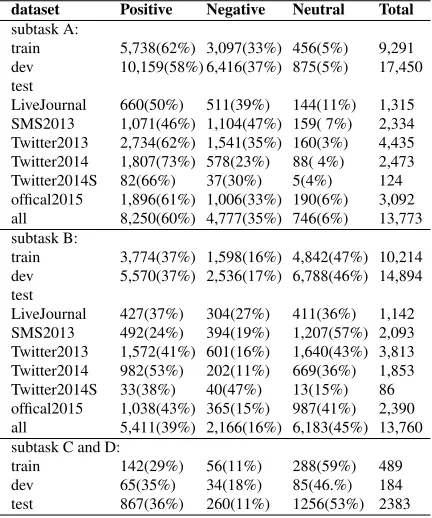
dataset Positive Negative Neutral Total
subtask A:
train 5,738(62%) 3,097(33%) 456(5%) 9,291 dev 10,159(58%) 6,416(37%) 875(5%) 17,450 test
LiveJournal 660(50%) 511(39%) 144(11%) 1,315 SMS2013 1,071(46%) 1,104(47%) 159( 7%) 2,334 Twitter2013 2,734(62%) 1,541(35%) 160(3%) 4,435 Twitter2014 1,807(73%) 578(23%) 88( 4%) 2,473 Twitter2014S 82(66%) 37(30%) 5(4%) 124 offical2015 1,896(61%) 1,006(33%) 190(6%) 3,092 all 8,250(60%) 4,777(35%) 746(6%) 13,773 subtask B:
train 3,774(37%) 1,598(16%) 4,842(47%) 10,214 dev 5,570(37%) 2,536(17%) 6,788(46%) 14,894 test
LiveJournal 427(37%) 304(27%) 411(36%) 1,142 SMS2013 492(24%) 394(19%) 1,207(57%) 2,093 Twitter2013 1,572(41%) 601(16%) 1,640(43%) 3,813 Twitter2014 982(53%) 202(11%) 669(36%) 1,853 Twitter2014S 33(38%) 40(47%) 13(15%) 86 offical2015 1,038(43%) 365(15%) 987(41%) 2,390 all 5,411(39%) 2,166(16%) 6,183(45%) 13,760 subtask C and D:
train 142(29%) 56(11%) 288(59%) 489 dev 65(35%) 34(18%) 85(46.%) 184 test 867(36%) 260(11%) 1256(53%) 2383
Table 1: Statistics of data sets in training (train), devel-opment (dev), test (test) set for subtask A, B, C and D. Twitter2014S stands for Twitter2014Sarcasm.
3.2 Experiments on Training Data 3.2.1 Subtask A and B
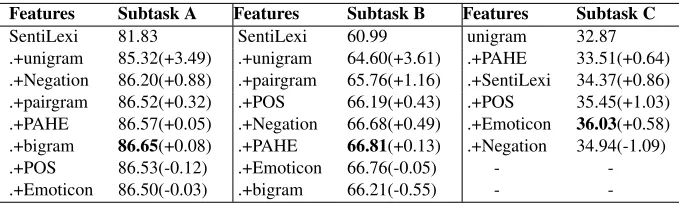
To address subtask A and B, we conducted a se-ries of experiments to examine the effects of differ-ent traditional features. Table 2 describes the exper-iments of various traditional features on subtask A and B. From Table 2, it is interesting to find that: (1) SentiLexi and unigram are the most effective feature types to detect the polarities; (2) POS feature makes contribution to improve the performance for subtask B but no improvement for A. It may be because the neutral instances in subtask B (i.e., 45.58%) are much more than that in subtask A (i.e., 5.01%); (3) The emoticons features are not as effective as ex-pected since most emoticons are already present in unigram.
Besides, following (Kim, 2014) we adopted sen-tence modeling and extracted the penultimate hid-den layer content as novel word embedding feature to build another classifier. Furthermore, we com-bined the intermediate results (i.e., the distances be-tween point to multiple hyperplanes returned from SVM) of two classifiers. The experimental results of using word embedding features in isolation and in combination are shown in Table 3. From Table 3, we find that the word embedding alone performs a bit worse than the traditional features. This may be because the traditional features are dozens of times more than word embedding features and as a result the effectiveness of word embeddings is impaired. However, when we combined the two experimental results, we find that the combination result of two classifiers achieves the best performances in both subtasks. This indicates that although the size of word embeddings is small, it still makes contribu-tion to performance improvement.
Features Subtask A Subtask B
[image:4.612.78.294.407.666.2]Traditional 86.65% 66.81% Word embedding 83.80% 64.85% Combination 87.68% 67.80%
Table 3: Results of subtask A and B using traditional fea-tures, word embedding features and their combination in terms ofFmacroon training data.
imple-Features Subtask A Features Subtask B Features Subtask C
SentiLexi 81.83 SentiLexi 60.99 unigram 32.87
.+unigram 85.32(+3.49) .+unigram 64.60(+3.61) .+PAHE 33.51(+0.64) .+Negation 86.20(+0.88) .+pairgram 65.76(+1.16) .+SentiLexi 34.37(+0.86) .+pairgram 86.52(+0.32) .+POS 66.19(+0.43) .+POS 35.45(+1.03) .+PAHE 86.57(+0.05) .+Negation 66.68(+0.49) .+Emoticon 36.03(+0.58) .+bigram 86.65(+0.08) .+PAHE 66.81(+0.13) .+Negation 34.94(-1.09)
.+POS 86.53(-0.12) .+Emoticon 66.76(-0.05) -
-.+Emoticon 86.50(-0.03) .+bigram 66.21(-0.55) -
-Table 2: Results of feature selection experiments for subtask A, B and C in terms of Fmacro on the training data.
The numbers in the brackets are the performance increments compared with the previous results. PAHEstands for Punctuation&All-caps&Hashtag&Enlongated features. “.+” means to add current feature to the previous feature set.
mented inscikit-learntools (Pedregosa et al., 2011) (e.g., SVM withkernel={linear, rbf}, c=0.1 ,1 ,10, SGD withloss={hinge, log}, RandomForestClassi-fier withn={10, 50, 100}, etc). Table 4 shows the configuration of classifiers with best performance. Thus, in subsequential experiments, we adopted the configurations listed in Table 4.
Task Features Configuration
Subtask A traditionalword embedding SVM, kernel=linear,c=0.1SVM, kernel=rbf,c=0.1
Subtask B traditionalword embedding SVM, kernel=linear,c=0.1SVM, kernel=rbf,c=0.1
Table 4: System configurations for subtask A and B.
3.2.2 Subtask C and D
Table 2 lists the experimental results using several traditional features on subtask C. Since the sentiment trend of given topic in subtask D is calculated from the results of subtask C (i.e., sentiment trend = positive/(positive + negative)), we have not conducted additional ex-periments for subtask D.
Similar with the first two subtasks, we adopted the SVM classification algorithm with kernel=linear, c=0.1as system configurations for follow-up exper-iments.
3.2.3 Subtask E
We transformed the informal terms to their nor-mal forms and used the sentiment lexicons men-tioned in Section 2.2 except MPQA to extract sen-timent lexicon feature. If the target term contained more than one word, we averaged their scores as it-s final it-sentiment lexicon feature. Beit-sideit-s, the word
embedding features were also adopted in this sub-task.
To explore the effectiveness of different feature types, we conducted several feature combination ex-periments shown in Table 5.
Features Kendall Rank Spearman Rank
SentiLexi 48.24% 66.17%
Word embedding 52.97% 70.90%
SentiLexi + Word embedding 56.73% 75.56%
Table 5: Results of feature section experiments for sub-task E on training data.
From Table 5, we find that: (1) The combination of SentiLexi and word embedding is the most effec-tive feature type for sentiment score prediction; (2) The word embedding features achieved better result than SentiLexi features about 4.7% improvement in terms of Kendall measure, which indicates that word embedding feature preserves the sentiment informa-tion and semantic relainforma-tionship between words.
We also performed a series of experiments to op-timize the parameters of SVM classifiers. Similar-ly, we found that SVM classifier withkernel=linear
and c=1 obtained the best performance. Thus, in following experiments on test data, we adopted this configuration with SentiLexi and word embedding features together.
3.3 Results on Test Data
Using the optimum feature set and configurations described in Section 3.2, we trained separate mod-els for each subtasks and evaluated them against the SemEval-2015 Task 10 test set.
[image:5.612.137.477.62.165.2]Subtask Systems LiveJournal SMS2013 Twitter2013 Twitter2014 Twitter2014S Offical2015 Twitter2015
A ECNUunitn 82.49(6)84.46(2) 84.70(4)88.60(2) 85.28(4)90.10(1) 82.09(7)87.12(1) 70.96(7)73.65(3) 84.79(1)81.08(7) - -KLUEless 83.94(4) 88.62(2) 88.56(2) 84.99(3) 75.59(3) 84.51(2)
-B ECNUWebis 71.64(14)74.40(3) 63.92(14)68.49(1) 65.25(22)68.49(10) 66.37(20)70.86(6) 45.87(24)49.33(11) 59.72(19)64.84(1) - -unitn 72.48(12) 68.37(2) 72.79(3) 73.60(2) 55.44(4) 64.59(2)
-C/D TwitterHawkECNU -- -- -- -- -- -- 50.51(1)25.38(5)//0.300(5)0.214(3)
KLUEless - - - 45.48(2)/0.202(1)
Table 6: Performances of our systems and top-ranked systems for subtask A, B, C (Fmacro(%)) and D (avgAbsDiff)
on test data. The numbers in the brackets are the rankings on corresponding data set.
the Table 6, we observe the following findings. Firstly, in accordance with previous work (Rosen-thal et al., 2014), the results of subtask B is much worse than those of subtask A. On one hand, the text in message-level task is long and contains multi-ple/mixed sentiments with different strength and the text in expression-level usually contain a single sen-timent orientation. On the other hand, the polarity distributions of subtask A and B are significantly d-ifferent (i.e., about 6.14%instances in expression-level are neutral while41.30%in message-level).
Secondly, the performances on LiveJournal and SMS are comparable to the results on Twitter2013 and Twitter2014 in both subtasks, which means the Twitter, SMS and LiveJournal have similar charac-teristics and then we may consider to use SMS as training data when the available tweet data is insuf-ficient.
Thirdly, the submissions of subtask C and D only adopted traditional linguistic features rather than the combination of word embeddings, which may result in the poor performance in subtask C and D.
Our systems ranked7thout of11submissions for subtask A,19thout of40submissions for subtask B and performed well on LiveJournal and SMS2013 data sets. For subtask C and D, our systems ranked
5th out of7submissions and5th out of6 submis-sions respectively.
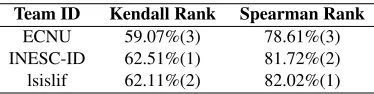
Team ID Kendall Rank Spearman Rank
ECNU 59.07%(3) 78.61%(3)
[image:6.612.92.279.616.663.2]INESC-ID 62.51%(1) 81.72%(2) lsislif 62.11%(2) 82.02%(1)
Table 7: Performances of our systems and the top-ranked systems for subtask E. The numbers in the brackets are the official ranking.
Table 7 shows the results of our system and the top ranked system provided by organizer for subtask E. Our system ranked 3rd out of10submissions. Al-though the word embedding features obtained from large amount of contexts are believed to contain se-mantic information, they contain sentiment informa-tion more or less induced from context. As a conse-quence, with the aid of sentiment lexicon and word embedding, our system is promising.
4 Conclusion
In this paper, we combined the results of two classi-fiers (adopting traditional features and word embed-ding features respectively) to detect the sentiment polarity towards expression-level and message-level (i.e., subtask A, B), adopted several basic feature types to settle topic-level task (i.e., subtask C, D) and built regression model with the aid of senti-ment lexicon features and word embedding features to predict degree of polarity strength on term-level (i.e., subtask E). Using word embedding features alone may not perform good results, but it makes contribution to performance improvement in combi-nation with traditional linguistic features. In future work, we consider to construct the word representa-tions bearing sentiment information to address sen-timent analysis.
5 Acknowledgements
References
Lu Chen, Wenbo Wang, Meenakshi Nagarajan, Shaojun Wang, and Amit P Sheth. 2012. Extracting diverse sentiment expressions with target-dependent polarity from Twitter. InICWSM.
C´ıcero Nogueira dos Santos and Ma´ıra Gatti. 2014. Deep convolutional neural networks for sentiment analysis of short texts. InProceedings of the 25th International Conference on Computational Linguistics (COLING), Dublin, Ireland.
Stefan Evert, Thomas Proisl, Paul Greiner, and Besim K-abashi. 2014. SentiKLUE: Updating a polarity classi-fier in 48 hours.SemEval 2014, page 551.
Long Jiang, Mo Yu, Ming Zhou, Xiaohua Liu, and Tiejun Zhao. 2011. Target-dependent Twitter sentiment clas-sification. In Proceedings of the 49th Annual Meet-ing of the Association for Computational LMeet-inguistics: Human Language Technologies-Volume 1, pages 151– 160.
Soo-Min Kim and Eduard Hovy. 2004. Determining the sentiment of opinions. InProceedings of the 20th in-ternational conference on Computational Linguistics, page 1367.
Yoon Kim. 2014. Convolutional neural networks for sen-tence classification. arXiv preprint arXiv:1408.5882. Svetlana Kiritchenko, Xiaodan Zhu, Colin Cherry, and
Saif Mohammad. 2014. NRC-Canada-2014: Detect-ing aspects and sentiment in customer reviews. pages 437–442, August.
Efthymios Kouloumpis, Theresa Wilson, and Johanna Moore. 2011. Twitter sentiment analysis: The good the bad and the omg! ICWSM, 11:538–541.
Tomas Mikolov, Kai Chen, Greg Corrado, and Jeffrey Dean. 2013a. Efficient estimation of word representa-tions in vector space. arXiv preprint arXiv:1301.3781. Tomas Mikolov, Ilya Sutskever, Kai Chen, Greg S Corra-do, and Jeff Dean. 2013b. Distributed representations of words and phrases and their compositionality. In
Advances in Neural Information Processing Systems, pages 3111–3119.
Saif Mohammad, Svetlana Kiritchenko, and Xiaodan Zhu. 2013. NRC-Canada: Building the state-of-the-art in sentiment analysis of tweets. In Second Joint Conference on Lexical and Computational Semantics (*SEM), Volume 2: Proceedings of the Seventh Inter-national Workshop on Semantic Evaluation (SemEval 2013), pages 321–327, Atlanta, Georgia, USA, June. Preslav Nakov, Sara Rosenthal, Zornitsa Kozareva,
Veselin Stoyanov, Alan Ritter, and Theresa Wilson. 2013. SemEval-2013 Task 2: Sentiment analysis in Twitter. In Second Joint Conference on Lexical and Computational Semantics (*SEM), Volume 2: Pro-ceedings of the Seventh International Workshop on
Se-mantic Evaluation (SemEval 2013), pages 312–320, Atlanta, Georgia, USA, June.
Olutobi Owoputi, Brendan O’Connor, Chris Dyer, Kevin Gimpel, Nathan Schneider, and Noah A Smith. 2013. Improved part-of-speech tagging for online conversa-tional text with word clusters. InHLT-NAACL, pages 380–390.
Fabian Pedregosa, Ga¨el Varoquaux, Alexandre Gram-fort, Vincent Michel, Bertrand Thirion, Olivier Grisel, Mathieu Blondel, Peter Prettenhofer, Ron Weiss, Vin-cent Dubourg, et al. 2011. Scikit-learn: Machine learning in Python. The Journal of Machine Learning Research, 12:2825–2830.
Sara Rosenthal, Preslav Nakov, Alan Ritter, and Veselin Stoyanov. 2014. Semeval-2014 task 9: Sentiment analysis in Twitter. Proc. SemEval, pages 73–80. Sara Rosenthal, Preslav Nakov, Svetlana Kiritchenko,
Saif M Mohammad, Alan Ritter, and Veselin Stoy-anov. 2015. SemEval-2015 Task 10: Sentiment anal-ysis in Twitter. InProceedings of the 9th Internation-al Workshop on Semantic EvInternation-aluation, SemEval ’2015, Denver, Colorado, June.
Xiaolong Wang, Furu Wei, Xiaohua Liu, Ming Zhou, and Ming Zhang. 2011. Topic sentiment analysis in Twit-ter: a graph-based hashtag sentiment classification ap-proach. InProceedings of the 20th ACM internation-al conference on Information and knowledge manage-ment, pages 1031–1040.
Sabih Bin Wasi, Rukhsar Neyaz, Houda Bouamor, and Behrang Mohit. 2014. CMUQ@ Qatar: Using rich lexical features for sentiment analysis on Twitter. Se-mEval 2014, page 186.
Hong Yu and Vasileios Hatzivassiloglou. 2003. Toward-s anToward-swering opinion queToward-stionToward-s: Separating factToward-s from opinions and identifying the polarity of opinion sen-tences. InProceedings of the 2003 conference on Em-pirical methods in natural language processing, pages 129–136.
Daojian Zeng, Kang Liu, Siwei Lai, Guangyou Zhou, and Jun Zhao. 2014. Relation classification via convolu-tional deep neural network. InProceedings of COL-ING, pages 2335–2344.