Proceedings of the 6th Workshop on Balto-Slavic Natural Language Processing, pages 108–118, Valencia, Spain, 4 April 2017. c2017 Association for Computational Linguistics
Toward Never Ending Language Learning for
Morphologically Rich Languages
Kseniya Buraya ITMO University, Russia [email protected]
Lidia Pivovarova University of Helsinki, Finland [email protected]
Sergey Budkov ITMO University, Russia [email protected]
Andrey Filchenkov ITMO University, Russia [email protected]
Abstract
This work deals with ontology learning from unstructured Russian text. We im-plement one of the components of Never Ending Language Learner and introduce the algorithm extensions aimed to gather specificity of morphologically rich free-word-order language. We perform sev-eral experiments comparing different set-tings of the training process. We demon-strate that morphological features signifi-cantly improve the system precision while seed patterns help to improve the cover-age.
1 Introduction
Nowadays a big interest is paid to systems that can extract facts from the Internet (Pasca et al., 2006; Choo et al., 2013; Grozin et al., 2016; Dumais et al., 2016; Samborskii et al., 2016).
The main challenge is to design systems that do not require any human involvement and may ef-ficiently store lots of information limited only by the amount of the knowledge uploaded to the In-ternet. One of the ways of representing informa-tion for such systems isontologies.
According to the famous definition by Gruber (1995), ontology is “an explicit specification of a conceptualization”, i.e. formalization of knowl-edge that underlines language utterance. In the simplest case, ontology is a structure containing conceptsandrelationsamong them. In addition, it may contain a set of axioms that define the rela-tions and constraints on their interpretation (Guar-ino, 1998). One of the advantages of such struc-tures is data formalization that simplifies the au-tomatic processing. Ontologies are widely used in information retrieval, texts analysis and seman-tic applications (Albertsen and Blomqvist, 2007;
Staab and Studer, 2013).
In many practical applications, ontological con-cepts should be associated with lexicon (Hirst, 2009), i.e. with language expressions and struc-tures. Even though ontologies themselves con-tain knowledge about the world, not a language, their primary goal is to ensure semantic interpre-tation of texts. Thus, ontology learningfrom text is an emerging research direction (Maedche, 2012; Staab and Studer, 2013).
One of the approaches that are used to learn facts from unstructured text is called Never End-ing Language LearnEnd-ing (NELL) (Carlson et al., 2010a).1 One of the NELL advantages is its low demand for preprocessed data required for the learning process. Given an initial ontology that contains 10–20 seeds for each category as an in-put, NELL can achieve a high performance level on extracting facts and relations from a large cor-pus (Carlson et al., 2010a).2
The first implementation of NELL (Carlson et al., 2010a) worked with English. An attempt was made to extend the NELL approach for the Por-tuguese language (Duarte and Hruschka, 2014). The main result of these experiments was that ap-plying initial NELL parameters and ontology to non-English web-pages would not show high re-sults; initial configuration did not work well with Portuguese web-pages. The authors made a con-clusion that in order to extend the NELL approach to a new language, it is necessary to prepare a new seed ontology and contextual patterns that depend on the language rules.
In this paper, we introduce a NELL extension 1In this paper, we will use term “NELL” to refer both the
approach and its implementations since it is traditional for the corresponding papers and the project.
2We distinguish two types of concepts:categoriesthat are
top-level concepts in predefined ontology andinstances, that are descendants of top-level concepts; instances, apart from small initial seeds, are learned from text.
to the Russian language. Being a Slavic language, Russian has a rich morphology and free word or-der. Thus, common expressions for semantic re-lations in text have a specific form: the word or-der is less reliable than for Germanic or Romance languages; the morphological properties of words are more crucial. However, many pattern learn-ing techniques are based on word order of pattern components and usually do not include morphol-ogy. Thus, the adaptation of the NELL approach to a Slavic language would require changes in the pattern structure. We introduce an adaptation of NELL to Russian, test it on a small dataset of 2.5 million words for 9 ontology categories and demonstrate that utilizing of morphology is cru-cial for ontology learning for Russian. This is the main contribution of this paper.
The rest of the paper is organized as follows. Section 2 overviews original NELL approach. Our improvements of the algorithm are presented in Section 3. Section 4 describes our data source, its preprocessing, and experiments we run. Results of these experiments are presented and discussed in Section 5. In Section 6, we give a brief overview of the related papers. We summarize the results and outline the future work in Section 7.
2 Never Ending Language Learner
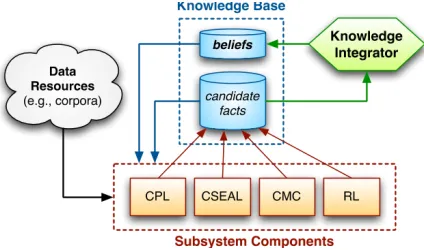
The NELL architecture, which is presented in Fig-ure 1, consists of two major parts: a knowledge base (KB) and a set of iterative learners (shown in the lowest part of the figure). The system works iteratively: first, the learners try to extract as much candidate facts as possible given a current state of the KB; after that, the KB is updated using learn-ers output. This process is running infinitely, with the current state of KB being freely available at the project webpage.3
In this work, we focus on one of the NELL com-ponents, namely Coupled Pattern Learner (CPL). CPL is the free-text extractor that learns contex-tual patterns to extract instances of ontology cat-egories. The key idea of CPL is that simultane-ous (“coupled”) learning of instances and patterns yields a higher performance than learning them in-dependently (Carlson et al., 2010b).
An expression that matches text in CPL con-sists of three parts, wh´ıch must be found within the same sentence:
[image:2.612.323.535.37.162.2]3http://rtw.ml.cmu.edu/rtw/
Figure 1: NELL architecture adapted from (Carl-son et al., 2010a).
1. Category word. The list of category words is fixed and defined in the initial ontology. 2. Instance extracting pattern. A pattern
con-sists of at most three words including punc-tuation like commas or parenthesis, but ex-cluding category and instance words.
3. Instance word. At the beginning 3–5 seed in-stances are defined for each category.
CPL uses two sets: the set of trusted patterns and set oftrusted instances, which are considered to be actual patterns and instances for the cor-responding category. Different implementations may or may not exclude patterns/instances from the corresponding sets during further iterations.
The process starts with a text corpus and a small seed ontology that contains sets of trusted patterns and trusted instances. Then every learning itera-tion consists of the two following steps:
• Instance extraction. To extract new in-stances, the system finds a co-occurrence of the category word with a pattern from the trusted list and then identify the instance word. If both category and instance words satisfy the conditions of the pattern, then the found word is added to the pool of candidate instances for the current iteration. When all sentences are processed, candidate instance evaluation begins after which the most reli-able instances are added to the set of trusted instances;
When all candidate patterns are collected, the most reliable patterns are added to the trusted set.
3 The Proposed Approach
3.1 Adaptation to the Russian Language
Russian patterns should have a specific struc-ture, which should comprise morphological com-ponents. Thus we expand the form of the search expression so that case and number are taken into account for both category and instance words.
Let us consider an example, which illustrates importance of including morphology into pat-terns:
Тренеры знают множество приемов для дрессировки собак, такие как поощрение едой и многие другие.
Coaches know many techniques for trainingdogs, such asstimulationwith food and etc.
This sentence matchessuch aspattern and with-out morphological constraints that may lead to ex-tracting of wrong relations “stimulationis adog”. If the pattern have specified only part-of-speech rules, then our algorithm would produce a lot of errors. Specification of the arguments (nomina-tive in this example) helps to avoid such false pat-tern triggering. Another way to avoid such errors would be a syntax annotation of all data and run-ning CPL on top of this annotation; we leave this approach for further research.4
3.2 Strategies for Expanding the Trusted Sets
To add new patterns and instances to the corre-sponding trusted sets, we useSupport metric. For each category, instances and patterns are ranked separately using the following formulas:
Support(t) c (i) =
P
p∈TruPat(ct−1)Countc(i,p)
Countc(i)
for instances and
Support(t) c (p) =
P
i∈TruInst(ct−1)Countc(i,p)
Countc(p)
4This particular example would probably produce the
same error on the English translation, though we believe that such cases should be more rare. Since English has almost no morphology some other mechanism should be used to restrict over-production of patterns; in particular, distinguishing be-tween verb subject and object is easier for a free-word-order language.
for patterns, where i is an instance word, p is a pattern,Countc(i,p)is the number of cases when
i andcmatch as arguments ofp in the corpus re-lated to categoryc,Countc(x)is the total number of matches of x in the corpus related to category
c,TruInst is a set of trusted instances,TruPat is a set of trusted patterns, and(t)is an iteration.
Instances and patterns with higher support are considred to be trusted. To define trusted patterns and istances, we use FILTERBYTHRESHOLD pro-cedure, which is implemented in two versions us-ing two different strategies.
The first strategy uses a certain threshold on
Support value that is computed after the first iter-ation for patterns and instances separately. On the first iteration, the filter equals to zero, that means we allow pattern and instance extraction without any limitations. Then the threshold is set as a min-imum value of support for all extracted patterns and instances correspondingly. On the next iter-ations, only the instances and patterns that have
Support value greater or equal than these thresh-olds are added to the trusted sets. Note that within this strategy,Supportvalue of any pattern and in-stance does not decrease. We will refer to it as THRESHOLD-SUPPORT. This is the main strategy for CPL-RUS.
THRESHOLD-SUPPORT does not limit trusted elements during algorithm run. It is greedy in sense that it collects all possible instances and pat-terns that are trusted enough and use them to ex-tract new patterns and instances. Thus, final fil-tering should be applied in this case after the al-gorithm stops and the final instances, which has support not less than a certain minimal support, should be selected.
The second strategy uses a threshold on a num-ber of elements of the trusted sets. After extracting new instances and patterns, they are sorted with re-spect to theirSupport, and then 50 most reliable instances and patterns are left in the trusted sets. We assume that this procedure would be able to correct errors made on the earlier iterations, when the algorithm have more evidence. This strategy was used in (Duarte and Hruschka, 2014). We will refer to it as THRESHOLD-50.
3.3 Implementation
Algorithm 1 COUPLED PATTERN LEARNER (CPL-RUS).
Require: set of trusted patternsTruPat(0)c ,set of trusted instancesTruInst(0)c ,text corpusTc
Ensure: Pat(c∞),Inst(c∞)
t←0
repeat
CandInst←EXTRACT(TruPat(ct)) TruInst(ct+1)←TruInst(ct)∪CandInst FILTERBYTHRESHOLD(TruInst(ct+1)) CandPat←EXTRACT(TruInst(ct)) TruPat(ct+1) ←TruPat(ct)∪CandPat FILTERBYTHRESHOLD(TruPat(ct+1))
t←t+ 1
until TruInst(ct+1)\TruInst(ct) ∪ TruPat(ct+1)\TruPat(ct) =∅
trusted patterns, TruPat(0)c , a set of trusted in-stances,TruInst(0)c , and a preprocessed corpus for eachc: we use only sentences that containsc lex-eme(s) to speed up iterations.
Though this algorithm should run infinitely with more and more data (that is how the original NELL process organized), only small corpora are used in our experiments, and the process stops if no more patterns or instances are found during the previous iteration.
4 Experiments
4.1 Data
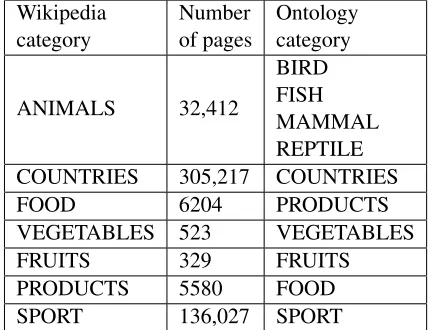
We use Russian Wikipedia as the data source due to the convenience of downloading a relatively small corpus devoted to some particular topic (e.g. animals) using Wikipedia categories.5 However, we do not use a specific Wikipedia structure for anything but corpus collection, thus our method can work with any other source types. Note, that even though the Wikipedia format for articles has its own standards, all of them are written by dif-ferent people with changing of author style across documents. That makes Wikipedia a good re-source to obtain way the data with some varieties in style.
We use Petscan service6to download Wikipedia pages that belong to a certain category. For ini-tial experiments, we collect several corpora try-5Wikipedia categories are different from those in ontology
though they can be easily matched.
6https://petscan.wmflabs.org/
Wikipedia
category Numberof pages Ontologycategory
ANIMALS 32,412
BIRD FISH MAMMAL REPTILE COUNTRIES 305,217 COUNTRIES
FOOD 6204 PRODUCTS
VEGETABLES 523 VEGETABLES
FRUITS 329 FRUITS
PRODUCTS 5580 FOOD
[image:4.612.317.534.38.203.2]SPORT 136,027 SPORT
Table 1: Downloaded Wikipedia pages for CPL input corpus.
ing to select wide but not too general categories. For example, we consideranimalsto be too gen-eral and split it into sevgen-eral subcategories, such as birds, fish, etc. The rational is that too broad cat-egories might be too computationally heavy for initial experiments, while too narrow categories might not contain enough data. In total, we use a corpus of 2.5 million sentences extracted from 7 various categories (see Table 4.1). Then we an-notate text with morphological attributes, such as part-of-speech, case, number, and lexeme, using Pymorphy tool (Korobov, 2015).
The results of the processing are lists of ex-tracted patterns and instances for each category.
4.2 Initial Ontology
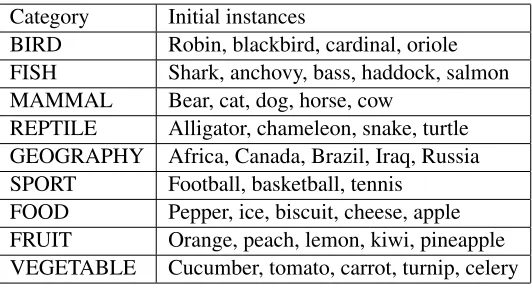
The initial ontology consists of 9 categories and 41 instances; it is presented in Table 4.2.
Note that FRUIT and VEGETABLE are sub-categories for FOOD; we run all three indepen-dently that allow us to compare the algorithm per-formance on more general vs. more narrow cate-gories.
The seed CPL patterns and their morphological constraints are listed in Table 4.2.
4.3 Experiment Design
We run experiments for all categories indepen-dently. Then we collect all extracted instances and manually annotate them as correct or incor-rect. Then for each categoryc,we evaluated pre-cision using the following formula:
Precision(c) = CorrInst(c)
Category Initial instances
BIRD Robin, blackbird, cardinal, oriole FISH Shark, anchovy, bass, haddock, salmon MAMMAL Bear, cat, dog, horse, cow
REPTILE Alligator, chameleon, snake, turtle GEOGRAPHY Africa, Canada, Brazil, Iraq, Russia SPORT Football, basketball, tennis
FOOD Pepper, ice, biscuit, cheese, apple FRUIT Orange, peach, lemon, kiwi, pineapple VEGETABLE Cucumber, tomato, carrot, turnip, celery
Table 2: Seed ontology for Russian CPL (English translation).
Pattern Arg1, Arg2, Arg1, Arg2, Arg1, Arg2, case case num num pos pos arg1,такие как arg2
arg1, such as arg2 nomn nomn plur all noun noun arg2являютсяarg1
arg2 is arg1 ablt nonm all all noun noun arg2относятся кarg1
arg2 refer to arg1 datv nomn all all adjf noun arg2относятся кarg1
[image:5.612.175.441.36.179.2]arg2 refer to arg1 datv nomn all all noun noun
Table 3: Initial trusted patterns for Russian CPL for all categories (English translation).
where CorrInst(c) is the number of correct in-stances extracted for categoryc, andAllInst(c)is the whole number of instances, that were extracted by CPL for categoryc.
When we use the THRESHOLD-SUPPORT strat-egy, we perform a final filtering using different minimal support values. For algorithm compari-son, we use values0.1,0.5 and1.0
The main experiment is devoted to CPL-RUS with THRESHOLD-SUPPORT strategy. The algo-rithm converges after 6–10 iterations depending on category. We run it on all the categories and in-vestigate the dependency of precision on support value used to cut off trusted instances after the al-gorithm converges.
In addition, we perform a set of smaller experi-ments to study CPL properties and impact of dif-ferent parameters. We test: 1) usefulness of mor-phological features; 2) usefulness of pattern seeds; 3) differences between threshold selection strate-gies.
In the first experiment, we compare CPL-RUS and a version of this algorithm which do not use morphology (thus, similar to the English CPL). We will refer to the second one as
CPL-NOMORPH. We run it on three ontology cate-gories: VEGETABLE, FRUIT, and FOOD. The first run uses morphological constraints and the second allows words in all morphological forms.
In the second experiment, we investigate if the usage of seed patterns can improve the quality of the algorithm; the same experiment was conducted by (Duarte and Hruschka, 2014). As can be seen from the description in Section 2, CPL can learn without seed patterns, relying only on the set of initial categories and instances. However, since the initial ontology is small, this might be not the optimal strategy. We will refer to the second algo-rithm as CPL-NOPAT. We run the algorithms on the same three categories: VEGETABLE, FRUIT, and FOOD.
In the third experiment, we compare two
Threshold selection strategies described in Sec-tion 3.3: THRESHOLD-SUPPORT, based on minimal Support after the first iteration and THRESHOLD-50 that keeps the fixed number of patterns and instances and revise the trusted lists after each iteration.
5 Results and Discussion
5.1 On CPL-RUS
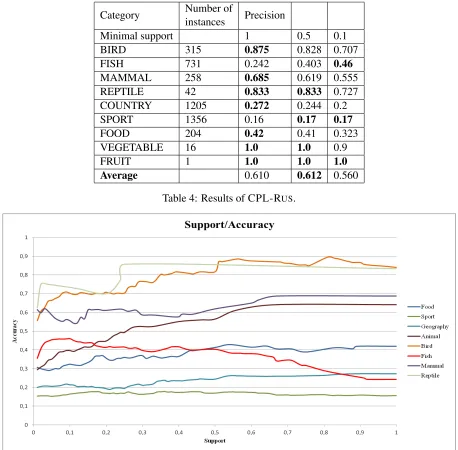
Table 5.1 shows the main results of running CPL-RUSon the whole ontology using seeds.
There is a huge variety in results among cat-egories with COUNTRY and SPORT being the most problematic ones despite the minimum sup-port. FOOD as the more general category performs much worse than more narrow VEG-ETABLE and FRUIT, though for these categories the number of extracted instances is very low (see Table 5.2).
Interestingly, CPL-RUS with minimal support
0.5 shows better results in terms of precision than with minimal support1. It means that some false positives have a very highSupportvalue.
5.2 On Morphological Constraints
The results of evaluating the importance of in-cluding morphological constraints to the Russian CPL are shown in Table 5.2. The precision for all categories, in this case, is much lower, which makes CPL-NOMORPH completely use-less. While CPL-RUScan achieve precision1.0 for VEGETABLE and FRUIT categories, the max-imum result for the same categories in uncon-strained mode is0.43.
Table 5.2 presents results on comparison of the learning progress for the three categories with and without morphological constraints. As can be seen, morphological constraints decrease the num-ber of extracted instances and patterns and slow down the training process.
5.3 On Usage of Seed Patterns
Table 5.3 shows the results for running CPL-NOPAT, which does not use any seed patterns. In comparison with CPL-RUS (Table 5.1), this al-gorithm yields worse precision, especially for the more general FOOD category. Table 5.3 shows the total number of extracted instances in both cases. As can be seen, running algorithm without seed patterns increases its coverage but decreases the resulting precision.
5.4 On Threshold Selection Strategies
Precision for different thresholds of Support in CPL-RUS is shown in Figure 2. The numerical values of precision for three minimal support val-ues are shown in Table 5.1.
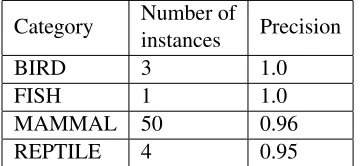
In our final experiment, we test THRESHOLD -50 strategy that re-arrange patterns and instances on every step and allows only 50 of them to be trusted. The results for four ontology categories are shown in Table 5.4. Precision is better for that strategy, but the number of extracted instances is very small. It means that this strategy yields lower Recall (which is hard to evaluate in exact num-bers). This gives us the opportunities for future work to find the way to determine the minimal support value that would satisfy both conditions: the number of extracted instances should not be small, and the precision should be high and does not vary among categories.7
5.5 Comparison with Other Approaches
The results of our experiments can be compared with the two previous work on this approach in English and Portuguese languages. Because in this work we extend the basic CPL algorithm only with morphological features of the Russian language, it makes it easy to compare the accuracy of our CPL realizations. The average accuracy for the English CPL version of the algorithm is reported as 0.78 with the minimum as0.2for the SPORTS EQUIP-MENT category and maximum as1.0for the AC-TOR, CELEBRITY, FURNITURE and SPORTS LEAGUE categories (Carlson et al., 2010a). The maximum average accuracy for the Russian lan-guage is 0.612. As it can be seen, the results for the Russian language also vary between different categories, from 0.16 to 1.0, but the average al-gorithm accuracy is higher for the English lan-guage. The results for the Portuguese version of CPL are presented separately for5,10,15,20 it-erations of the algorithm (Duarte and Hruschka, 2014). Since we did not run more than 10 iter-ations of CPL for each category, the most valu-able result of comparison of two CPL realizations is to choose the accuracy of 10-iterations of the Portuguese CPL. The results of the average accu-racy for the Portuguese CPL is varied from0.04to 0.95(Duarte and Hruschka, 2014).
6 Related Work
In this paper, we focus on coupled pattern and in-stance learning from the text for ontology learn-ing; the papers related to this topic are briefly 7One of the reviewers suggested that it may be also useful
to use a human-in-the-loop procedure, where a threshold is defined manually after a certain number of iterations using procedure similar to what we used for evaluation.
Category Number ofinstances Precision
Minimal support 1 0.5 0.1
BIRD 315 0.875 0.828 0.707
FISH 731 0.242 0.403 0.46
MAMMAL 258 0.685 0.619 0.555
REPTILE 42 0.833 0.833 0.727
COUNTRY 1205 0.272 0.244 0.2
SPORT 1356 0.16 0.17 0.17
FOOD 204 0.42 0.41 0.323
VEGETABLE 16 1.0 1.0 0.9
FRUIT 1 1.0 1.0 1.0
[image:7.612.78.536.36.486.2] [image:7.612.90.288.533.607.2]Average 0.610 0.612 0.560 Table 4: Results of CPL-RUS.
Figure 2: Dependence of CPL-RUSprecision on minimal support value.
Category Number ofinstances Precision Minimal
support 1 0.5 0.1
FOOD 1350 0.14 0.14 0.14
VEGETABLE 335 0.04 0.06 0.06
FRUIT 10 0 0 0.43
Table 5: Results of CPL-NOMORPH.
overviewed in this section. More general introduc-tion to NELL and its predecessors can be found in (Carlson et al., 2010a).
Bootstrapping is well-known as a method for semi-supervised pattern learning. It was initially proposed for Information Extraction, that is for the traditional setting when the event templates are
given beforehand (Riloff et al., 1999; Agichtein and Gravano, 2000; Yangarber, 2003). Bootstrping for ontology learning from text has been ap-plied, for example, by (Liu et al., 2005; Paliouras, 2005; Brewster et al., 2002).
Later the same principle was adapted for Open-Domain Information Extraction, aiming at discov-ering entity relations without any restrictions on their type (Shinyama and Sekine, 2006; Banko et al., 2007; Wang et al., 2011).
Iteration/
Category FRUIT VEGETABLE FOOD
inst pat inst pat inst pat 1 0/2 10/13 0/3 42/139 2/7 37/154 2 1/3 7/10 7/158 50/548 8/416 59/2264 3 0/5 10/10 4/121 42/475 29/696 37/1227
4 0 0 1/43 9/233 39/143 78/0
5 0 0 0/9 0/87 21/63 163/0
6 0 0 0/1 0/14 17/22 213/0
7 0 0 0 0 36/3 131/0
8 0 0 0 0 26/0 72/0
9 0 0 0 0 9/0 101/0
[image:8.612.168.448.37.211.2]10 0 0 0 0 13/0 53/0
Table 6: Number of extracted instances and patterns in case of using/non-using morphological con-straints.
Category Number ofinstances Precision
Minimal support 1 0.5 0.1
FOOD 262 0.07 0.09 0.17
VEGETABLE 12 0.75 0.86 0.73
[image:8.612.336.517.264.347.2]FRUIT 1 1 1 1
Table 7: Results for CPL-NOPAT. Category with seeds without seeds
BIRD 551 652
FISH 731 890
MAMMAL 264 267
REPTILE 45 45
COUNTRY 1204 1276
SPORT 1358 1412
FOOD 204 273
[image:8.612.85.297.266.489.2]VEGETABLE 16 20
Table 8: The number of extracted instances for each category with/without seed patterns.
search field becomes closer to ontology learning and knowledge-base population, though the latter task might be more difficult since it requires cross-document inference (Ji and Grishman, 2011).
The idea of simultaneous (coupled, joint) learn-ing of both instances and relation have been jus-tified. Li and Ji (2014) argued that though these two tasks are traditionally broken down into sepa-rate components, this is a rather artificial division leading to over-simplification and error propaga-tion from the earlier tasks to the later steps.
Using a knowledge base to extract relations has been previously proposed as a distant supervision approach by, among others, (Mintz et al., 2009; Surdeanu et al., 2012; Riedel et al., 2013), though
Category Number ofinstances Precision
BIRD 3 1.0
FISH 1 1.0
MAMMAL 50 0.96
REPTILE 4 0.95
Table 9: Results for running CPL-RUS with THRESHOLD-50.
these works assumed that the KB is rather big (such as Freebase).
As far as we aware, this is the first work on the application of pattern learning techniques for the Russian language, despite general interest in In-formation Extraction (Starostin et al., 2016) and building of linguistic resources (Loukachevitch and Dobrov, 2014; Braslavski et al., 2016). Bocharov et al. (2010) and Sabirova and Lukanin (2014) used rule-based approach to extract taxo-nomic relations from text. Kuznetsov et al. (2016) applied a number of machine learning techniques to automatic relation extraction from the Russian Wikipedia but their method depends on the spe-cific structure of Wikipedia.
7 Conclusion
In this work, we made the first attempt to adapt the NELL approach to the Russian language. We changed CPL component, so it can work with mor-phology. We conducted several experiments with the extended version, CPL-RUSalgorithm on the corpus containing over 2.5 million sentences. Our main findings are the following:
• it is possible to adapt CPL for Russian with relatively little efforts;
• the morphological constraints are crucial for Russian pattern learning;
• a small set of manually compiled seed pat-terns increases CPL accuracy;
• the obtained results vary for different cate-gories; that probably means that the algo-rithm settings should be optimized indepen-dently for each category.
This work leaves a room for further experi-ments. We plan to run CPL on much bigger datasets, including the whole Wikipedia corpus and other web-pages. This would require an ex-pansion of the seed ontology and, probably, a con-struction of seed patterns individually for each cat-egory or a group of categories.
We will also continue working on threshold se-lection strategies. Another line of research is to run CPL on top of syntactic annotation; in prin-ciple, this should increase precision though some amount of errors might be introduced by syntax parser itself.
Acknowledgments
Authors would like to thank Maisa Duarte and Es-tevam Hrushka for assistance during experiments preparation and for giving examples of initial on-tology for CPL algorithm. This research is sup-ported by the Government of Russian Federation, Grant 074-U01.
References
Eugene Agichtein and Luis Gravano. 2000. Snow-ball: Extracting relations from large plain-text col-lections. InProceedings of the fifth ACM conference on Digital libraries, pages 85–94. ACM.
Thomas Albertsen and Eva Blomqvist. 2007. Describ-ing ontology applications. In European Semantic Web Conference, pages 549–563. Springer.
Michele Banko, Michael J. Cafarella, Stephen Soder-land, Matthew Broadhead, and Oren Etzioni. 2007. Open information extraction from the web. In IJ-CAI, volume 7, pages 2670–2676.
Victor Bocharov, Lidia Pivovarova, Valery Rubashkin, and Boris Chuprin. 2010. Ontological parsing of encyclopedia information. InInternational Confer-ence on Intelligent Text Processing and Computa-tional Linguistics, pages 564–579. Springer.
Pavel Braslavski, Dmitry Ustalov, Mikhail Mukhin, and Yuri Kiselev. 2016. Yarn: Spinning-in-progress. InProceedings of the 8th Global WordNet Conference, GWC 2016, pages 58–65.
Christopher Brewster, Fabio Ciravegna, and Yorick Wilks. 2002. User-centred ontology learning for knowledge management. InInternational Confer-ence on Application of Natural Language to Infor-mation Systems, pages 203–207. Springer.
Andrew Carlson, Justin Betteridge, Bryan Kisiel, Burr Settles, Estevam R. Hruschka, and Tom M. Mitchell. 2010a. Toward an architecture for never-ending lan-guage learning. InAAAI, volume 5, page 3.
Andrew Carlson, Justin Betteridge, Richard C. Wang, Estevam R. Hruschka, and Tom M. Mitchell. 2010b. Coupled semi-supervised learning for information extraction. InProceedings of the third ACM inter-national conference on Web search and data mining, pages 101–110. ACM.
Nathanael Chambers and Dan Jurafsky. 2011. Template-based information extraction without the templates. In Proceedings of the 49th Annual Meeting of the Association for Computational Lin-guistics: Human Language Technologies-Volume 1, pages 976–986. Association for Computational Lin-guistics.
Chun Wei Choo, Brian Detlor, and Don Turnbull. 2013. Web work: Information seeking and knowl-edge work on the World Wide Web. Springer Science & Business Media.
Maisa C. Duarte and Estevam R. Hruschka. 2014. How to read the web in Portuguese using the never-ending language learner’s principles. In2014 14th International Conference on Intelligent Systems De-sign and Applications, pages 162–167. IEEE. Susan Dumais, Edward Cutrell, Jonathan J. Cadiz,
Gavin Jancke, Raman Sarin, and Daniel C. Robbins. 2016. Stuff I’ve seen: a system for personal infor-mation retrieval and re-use. InACM SIGIR Forum, volume 49, pages 28–35. ACM.
Anthony Fader, Stephen Soderland, and Oren Etzioni. 2011. Identifying relations for open information ex-traction. InProceedings of the Conference on Em-pirical Methods in Natural Language Processing, pages 1535–1545. Association for Computational Linguistics.
Elena Filatova, Vasileios Hatzivassiloglou, and Kath-leen McKeown. 2006. Automatic creation of domain templates. In Proceedings of the COL-ING/ACL on Main conference poster sessions, pages 207–214. Association for Computational Linguis-tics.
Vladislav Grozin, Kseniya Buraya, and Natalia Gusarova. 2016. Comparison of text forum sum-marization depending on query type for text forums. InAdvances in Machine Learning and Signal Pro-cessing, pages 269–279. Springer.
Thomas R. Gruber. 1995. Toward principles for the design of ontologies used for knowledge sharing? International journal of human-computer studies, 43(5):907–928.
Nicola Guarino. 1998. Formal ontology and informa-tion systems. InProceedings of FOIS, volume 98, pages 81–97.
Graeme Hirst. 2009. Ontology and the lexicon. In Handbook on ontologies, pages 269–292. Springer. Heng Ji and Ralph Grishman. 2011. Knowledge base
population: Successful approaches and challenges. In Proceedings of the 49th Annual Meeting of the Association for Computational Linguistics: Hu-man Language Technologies-Volume 1, pages 1148– 1158. Association for Computational Linguistics. Mikhail Korobov. 2015. Morphological analyzer and
generator for Russian and Ukrainian languages. In International Conference on Analysis of Images, So-cial Networks and Texts, pages 320–332. Springer. Artem Kuznetsov, Pavel Braslavski, and Vladimir
Ivanov. 2016. Family matters: Company relations extraction from wikipedia. InInternational Confer-ence on Knowledge Engineering and the Semantic Web, pages 81–92. Springer.
Qi Li and Heng Ji. 2014. Incremental joint extraction of entity mentions and relations. InACL (1), pages 402–412.
Wei Liu, Albert Weichselbraun, Arno Scharl, and Eliz-abeth Chang. 2005. Semi-automatic ontology ex-tension using spreading activation. Journal of Uni-versal Knowledge Management, 1:50–58.
Natalia Loukachevitch and Boris Dobrov. 2014. Ruthes linguistic ontology vs. Russian wordnets. In Proceedings of Global WordNet Conference GWC-2014, pages 154–162.
Alexander Maedche. 2012. Ontology learning for the semantic web, volume 665. Springer Science & Business Media.
Mike Mintz, Steven Bills, Rion Snow, and Dan Ju-rafsky. 2009. Distant supervision for relation ex-traction without labeled data. InProceedings of the Joint Conference of the 47th Annual Meeting of the ACL and the 4th International Joint Conference on Natural Language Processing of the AFNLP: Vol-ume 2-VolVol-ume 2, pages 1003–1011. Association for Computational Linguistics.
Georgios Paliouras. 2005. On the need to bootstrap ontology learning with extraction grammar learning. In International Conference on Conceptual Struc-tures, pages 119–135. Springer.
Marius Pasca, Dekang Lin, Jeffrey Bigham, Andrei Lifchits, and Alpa Jain. 2006. Organizing and searching the world wide web of facts-step one: the one-million fact extraction challenge. InAAAI, vol-ume 6, pages 1400–1405.
Sebastian Riedel, Limin Yao, Andrew McCallum, and Benjamin M. Marlin. 2013. Relation extraction with matrix factorization and universal schemas. NAACL HLT 2013, pages 74–84.
Ellen Riloff, Rosie Jones, et al. 1999. Learning dic-tionaries for information extraction by multi-level bootstrapping. InAAAI/IAAI, pages 474–479. Kristina Sabirova and Artem Lukanin. 2014.
Auto-matic extraction of hypernyms and hyponyms from Russian texts. InSupplementary Proceedings of the 3rd International Conference on Analysis of Images, Social Networks and Texts (AIST 2014)/Ed. by DI Ignatov, MY Khachay, A. Panchenko, N. Konstanti-nova, R. Yavorsky, D. Ustalov, volume 1197, pages 35–40.
Ivan Samborskii, Andrey Filchenkov, Georgiy Ko-rneev, and Aleksandr Farseev. 2016. Person, orga-nization, or personage: Towards user account type prediction in microblogs. InProceedings of First New Zealand Text Mining Workshop (TMNZ) in con-junction with the 8th Asian Conference on Machine Learning (ACML 2016), pages 1–13.
Yusuke Shinyama and Satoshi Sekine. 2006. Preemp-tive information extraction using unrestricted rela-tion discovery. InProceedings of the main confer-ence on Human Language Technology Conferconfer-ence of the North American Chapter of the Association of Computational Linguistics, pages 304–311. Associ-ation for ComputAssoci-ational Linguistics.
Steffen Staab and Rudi Studer. 2013. Handbook on ontologies. Springer Science & Business Media. Sergey Starostin, Viktor Bocharov, Svetlana Alexeeva,
Anastasiya Bodrova, Alexander Chuchunkov, Irina Efimenko, Dmitriy Granovsky, Vladimir Khoro-shevsky, Irina Krylova, et al. 2016. Factrueval 2016: Evaluation of named entity recognition and fact extraction systems for Russian. In Compu-tational Linguistics and Intellectual Technologies. Proceedings of the Annual International Conference
Dialogue(2016), number 15, pages 702–720.
Mihai Surdeanu, Julie Tibshirani, Ramesh Nallapati, and Christopher D. Manning. 2012. Multi-instance multi-label learning for relation extraction. In Pro-ceedings of the 2012 Joint Conference on Empirical Methods in Natural Language Processing and Com-putational Natural Language Learning, pages 455– 465. Association for Computational Linguistics. Wei Wang, Romaric Besanc¸on, Olivier Ferret, and
Brigitte Grau. 2011. Filtering and clustering re-lations for unsupervised information extraction in open domain. InProceedings of the 20th ACM inter-national conference on Information and knowledge management, pages 1405–1414. ACM.
Roman Yangarber. 2003. Counter-training in discov-ery of semantic patterns. InProceedings of the 41st Annual Meeting on Association for Computational
Linguistics-Volume 1, pages 343–350. Association for Computational Linguistics.