A Neural Architecture for Dialectal Arabic Segmentation
Younes Samih1, Mohammed Attia2, Mohamed Eldesouki3, Hamdy Mubarak3,
Ahmed Abdelali3, Laura Kallmeyer1 and Kareem Darwish3
1Dept. of Computational Linguistics,University of Düsseldorf, Düsseldorf, Germany 2Google Inc., New York City, USA
3Qatar Computing Research Institute, HBKU, Doha, Qatar 1{samih,kallmeyer}@phil.hhu.de
3{mohamohamed,hmubarak,aabdelali,kdarwish}@hbku.edu.qa
Abstract
The automated processing of Arabic dialects is challenging due to the lack of spelling standards and the scarcity of annotated data and resources in general. Segmentation of words into their con-stituent tokens is an important processing step for natural language processing. In this paper, we show how a segmenter can be trained on only 350 annotated tweets using neural networks without any normalization or reliance on lexical features or linguistic resources. We deal with segmenta-tion as a sequence labeling problem at the charac-ter level. We show experimentally that our model can rival state-of-the-art methods that heavily de-pend on additional resources.
1 Introduction
The Arabic language has various dialects and ants that exist in a continuous spectrum. This vari-ation is a result of multiple morpho-syntactic pro-cesses of simplification and mutation, as well as coinage and borrowing of new words in addition to semantic shifts of standard lexical items. Fur-thermore, there was a considerable effect of the interweave between the standard Arabic language that spread throughout the Middle East and North Africa and the indigenous languages in different countries as well as neighboring languages. With the passage of time and the juxtaposition of cul-tures, dialects and variants of Arabic evolved and diverged. Among the varieties of Arabic is so-called Modern Standard Arabic (MSA) which is
the lingua franca of the Arab world, and is typi-cally used in written and formal communications. On the other hand, Arabic dialects, such as Egyp-tian, Moroccan and Levantine, are usually spoken and used in informal communications.
The advent of the social networks and the spread of smart phones, yielded the need for dialect-aware smart systems and motivated the research in Dialectal Arabic such as dialectal Arabic iden-tification for both text (Eldesouki et al., 2016) and speech (Khurana et al., 2016), morphological analysis (Habash et al., 2013) and machine trans-lation (Sennrich et al., 2016; Sajjad et al., 2013).
Due to the rich morphology in Arabic and its dialects,word segmentationis one of the most im-portant processing steps. Word segmentation is considered an integral part for many higher Arabic NLP tasks such as part-of-speech tagging, parsing and machine translation. For example, the Egyp-tian word
AîD.JºÓð
“wmktbhA$” meaning: “and he didn’t write it”) includes four clitics surround-ing the the verb (stem) “ktb”, and is rendered after segmentation as “w+m+ktb+hA+$”. The clitics in this word are the coordinate conjunction “w”, the negation prefix “m”, the object pronoun “hA”, and the post negative suffix “$”.In this paper, we present a dialectal Egyp-tian segmentater that utilizes Bidirectional Long-Short-Term-Memory (BiLSTM) that is trained on limited dialectal data. The approach was moti-vated by the scarcity of dialectal tools and re-sources. The main contribution of this paper is that we build a segmenter of dialectal Egyptian using limited data without the need for specialized
cal resources or deep linguistic knowledge that ri-vals state-of-the-art tools.
Challenges of Dialectal Arabic
Dialectal Arabic (DA) shares many challenges with MSA, as DA inherits the same nature of being a Semitic language with complex templatic deriva-tional morphology. As in MSA, most of the nouns and verbs in Arabic dialects are typically derived from a determined set of roots by applying plates to the roots to generate stems. Such tem-plates may carry information that indicate mor-phological features of words such POS tag, gen-der, and number. Further, stems may accept pre-fixes and/or sufpre-fixes to form words which turn DA into highly inflected language. Prefixes in-clude coordinating conjunctions, determiner, par-ticles, and prepositions, and suffixes include at-tached pronouns and gender and number markers. This results in a large number of words (or surface forms) and in turn a high-level of sparseness and increased number of unseen words during testing. In addition to the shared challenges, DA has its own peculiarities, which can be summarized as follows:
• Lack of standard orthography. Many of the words in DA do not follow a standard ortho-graphic system (Habash et al., 2012).
• Many words do not overlap with MSA as re-sult of language borrowing from other lan-guages (Ibrahim, 2006), such as
éJ ¯A¿
kAfiyh “cafe” andñKAK
tAtuw “tattoo”, or coinage, such as the negative particlesÓ
mi$ “not” andCK.
balA$ “do not”. Code switching is also very common in Arabic dialects (Samih et al., 2016).• Merging multiple words together by concate-nating and dropping letters such as the word
AêÊj.JJ.Ó
mbyjlhA$ (he did not go to her), which is a concatenation of “mA byjy lhA$”. • Some affixes are altered in form from their MSA counterparts, such as the feminine sec-ond person pronoun¼
k→ú»
ky and the sec-ond person plural pronounÕç'
tm→ñK
tw. • Some morphological patterns that do notex-ist in MSA, such as the passive pattern Aito-faEal, such as
QåºK@
Aitokasar “it broke”.• Introduction of new particles, such is the pro-gressive
H.
b meaning ‘is doing’ and the post negative suffix
$, which behaves like the French “ne-pas” negation construct.• Letter substitution and consonant mutation. For example, in dialectal Egyptian, the inter-dental sound of the letter
H
v is often sub-stituted by eitherH
t or
s as inQJ»
kvyr “much”→QJ»
ktyr and the glottal stop is re-duced to a glide, such asQKAg.
jA}iz “possible” →QKAg.
jAyiz. Such features is deeply stud-ied in phonology under lenition, softening of a consonant, or fortition, hardening of a con-sonant.• Vowel elongation, such as
Ég.@P
rAjil “man” fromÉg.P
rajul, and vowel shortening, such asAÖßX
dayomA “always” fromAÖß@X
dAyomA.• The use of masculine plural or singular noun forms instead dual and feminine plural, drop-ping some articles and preposition in some syntactic constructs, and using only one form of noun and verb suffixes such as
áK
yn in-stead ofàð
wn and@ð
wA instead ofàð
wn respectively.• In addition, there are the regular dis-course features in informal texts, such as the use of emoticons and character repe-tition for emphasis, e.g.
úÍððððððñ«X@
AdEwwwwwwwliy “pray for me”.2 Related Work
For segmentation, Yao and Huang (2016) success-fully used a bi-directional LSTM model for seg-menting Chinese text. In this paper, we build on their work and extend it in two ways, namely combining bi-LSTM with CRF and applying on Arabic, which is an alphabetic language. Mo-hamed et al. (2012) built a segmenter based on memory-based learning. The segmenter has been trained on a small corpus of Egyptian Arabic com-prising 320 comments containing 20,022 words fromwww.masrawy.com that were segmented and annotated by two native speakers. They re-ported a 91.90% accuracy on the task of segmen-tation. MADA-ARZ (Habash et al., 2013) is an Egyptian Arabic extension of the Morphological Analysis and Disambiguation of Arabic (MADA). They trained and evaluated their system on both Penn Arabic Treebank (PATB) (parts 1-3) and the Egyptian Arabic Treebank (parts 1-5) (Maamouri et al., 2014) and they reported 97.5% accuracy. MARAMIRA1 (Pasha et al., 2014) is a new ver-sion of MADA and includes as well the function-ality of MADA-ARZ which will be used in this paper for comparison. Monroe et al. (2014) used a single dialect-independent model for segment-ing all Arabic dialects includsegment-ing MSA. They argue that their segmenter is better than other segmenters that use sophisticated linguistic analysis. They evaluated their model on three corpora, namely parts 1-3 of the Penn Arabic Treebank (PATB), Broadcast News Arabic Treebank (BN), and parts 1-8 of the BOLT Phase 1 Egyptian Arabic Tree-bank (ARZ) reporting an F1 score of 95.13%.
3 Arabic Segmentation Model
In this section, we will provide a brief description of LSTM, and introduce the different components of our Arabic segmentation model. For all our work, we used the Keras toolkit (Chollet, 2015). The architecture of our model, shown in Figure 2 is similar to Ma and Hovy (2016), Huang et al. (2015), and Collobert et al. (2011)
3.1 Long Short-term Memory
A recurrent neural network (RNN) belongs to a family of neural networks suited for modeling se-quential data. Given an input sequence x = (x1, ..., xn), an RNN computes the output vector ytof each wordxtby iterating the following
equa-tions fromt= 1ton:
1MADAMIRA release 20160516 2.1
ht=f(Wxhxt+Whhht−1 +bh) yt=Whyht+by
where ht is the hidden states vector, W
de-notes weight matrix, b denotes bias vector and f is the activation function of the hidden layer. Theoretically RNN can learn long distance de-pendencies, still in practice they fail due the van-ishing/exploding gradient (Bengio et al., 1994). To solve this problem, Hochreiter and Schmidhu-ber (1997) introduced the long short-term mem-ory RNN (LSTM). The idea consists in augment-ing the RNN with memory cells to overcome diffi-culties with training and efficiently cope with long distance dependencies. The output of the LSTM hidden layer ht given input xt is computed via
the following intermediate calculations: (Graves, 2013):
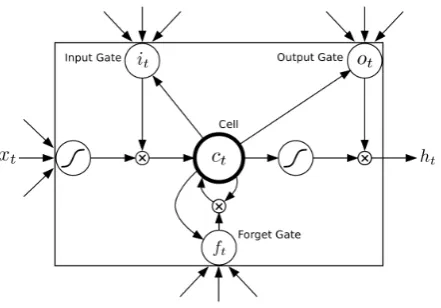
it=σ(Wxixt+Whiht−1+Wcict−1+bi) ft=σ(Wxfxt+Whfht−1+Wcfct−1+bf) ct=ftct−1+ittanh(Wxcxt+Whcht−1+bc) ot=σ(Wxoxt+Whoht−1+Wcoct+bo) ht=ottanh(ct)
[image:3.595.312.533.519.673.2]whereσ is the logistic sigmoid function, andi, f, o andc are respectively the input gate, forget gate, output gate and cell activation vectors. More interpretation about this architecture can be found in (Lipton et al., 2015). Figure 1 illustrates a sin-gle LSTM memory cell (Graves and Schmidhuber, 2005)
Figure 1: A Long Short-Term Memory Cell.
3.2 Bi-directional LSTM
are capable of learning long-term dependencies and maintain contextual features from the past states and future states. As shown in Figure 2, they comprise two separate hidden layers that feed for-wards to the same output layer. A BiLSTM cal-culates the forward hidden sequence−→h, the back-ward hidden sequence←−h and the output sequence yby iterating over the following equations:
− →
ht=σ(Wx−→hxt+W−→h−→h−→ht−1+b−→h) ←−
ht=σ(Wx←−hxt+W←h−←−h←−ht−1+b←−h) yt=W−hy→−→ht+W←hy−←h−t+by
More interpretations about these formulas are found in Graves et al. (2013a).
3.3 Conditional Random Fields (CRF)
Over the last recent years, BiLSTMs have achieved many ground-breaking results in many NLP tasks because of their ability to cope with long distance dependencies and exploit contextual features from the past and future states. Still when they are used for some specific sequence classifi-cation tasks, (such as segmentation and named en-tity detection), where there is a strict dependence between the output labels, they fail to generalize perfectly. During the training phase of the BiL-STM networks, the resulting probability distribu-tion of each time step is independent from each other. To overcome the independence assumptions imposed by the BiLSTM and exploit these kind of labeling constraints in our Arabic segmentation system, we model label sequence logic jointly us-ing Conditional Random Fields (CRF) (Lafferty et al., 2001). CRF, a sequence labeling algorithm, predicts labels for a whole sequence rather than for the parts in isolation as shown in Equation 1. Here,s1tosmrepresent the labels of tokensx1 to xmrespectively, wheremis the number of tokens
in a given sequence. After we have this probabil-ity value for every possible combination of labels, the actual sequence of labels for this set of tokens will be the one with the highest probability.
p(s1...sm|x1...xm) (1)
p(~s|~x;~w) = P exp(~w.~Φ(~x,~s))
~s0Smexp(~w.~Φ(~x,~s0))
(2)
Equation 2 shows the formula for calculating the probability value from Equation 1. Here,S is the
set of labels. In our caseS ={B, M, E, S, WB}, whereBis the beginning of a token,Mis the mid-dle of a token,Eis the end of a token,Sis a single character token, andW Bis the word boundary. ~w is the weight vector for weighting the feature vec-tor~Φ. Training and decoding are performed by the Viterbi algorithm.
Note that replacing the softmax with CRF at the output layer in neural networks has proved to be very fruitful in many sequence labeling tasks (Ma and Hovy, 2016; Huang et al., 2015; Lample et al., 2016; Samih et al., 2016)
3.4 Pre-trained characters embeddings
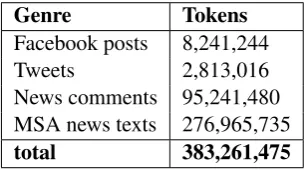
A very important element of the recent success of many NLP applications, is the use of character-level representations in deep neural networks. This has shown to be effective for numerous NLP tasks (Collobert et al., 2011; dos Santos et al., 2015) as it can capture word morphology and re-duce out-of-vocabulary. This approach has also been especially useful for handling languages with rich morphology and large character sets (Kim et al., 2016). We use pre-trained character embed-dings to initialize our look-up table. Characters with no pre-trained embeddings are randomly ini-tialized with uniformly sampled embeddings. To use these embeddings in our model, we simply re-place the one hot encoding character representa-tion with its corresponding 200-dimensional vec-tor. Table 1 shows the statistics of data we used to train our character embeddings.
Genre Tokens
Facebook posts 8,241,244
Tweets 2,813,016
News comments 95,241,480 MSA news texts 276,965,735
[image:4.595.340.494.509.594.2]total 383,261,475
Table 1: character embeddings training data statis-tics
3.5 BiLSTM-CRF for Arabic Segmentation
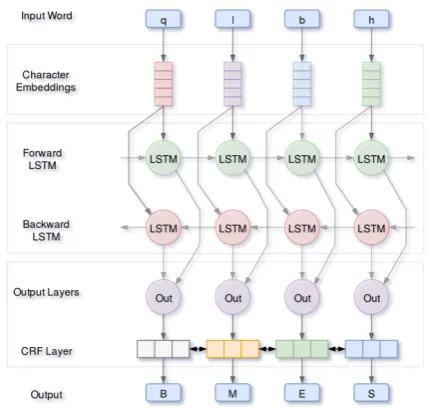
Bound-Figure 2: Architecture of our proposed neural net-work Arabic segmentation model applied to an ex-ample word. Here the model takes the word qlbh, “his heart” as its current input and predicts its cor-rect segmentation. The first layer performs a look up of the characters embedding and stacks them to build a matrix. This latter is then used as the input to the Bi-directional LSTM. On the last layer, an affine transformation function followed by a CRF computes the probability distribution over all la-bels
ary respectively.
The architecture of our segmentation model, shown in Figure 2, is straightforward. It comprises the following three layers:
• Input layer: it contains character embeddings.
• Hidden layer: BiLSTM maps character repre-sentations to hidden sequences.
• Output layer: CRF computes the probability distribution over all labels.
At the input layer a look-up table is initialized by pre-trained embeddings mapping each charac-ter in the input to d-dimensional vector. At the hidden layer, the output from the character embed-dings is used as the input to the BiLSTM layer to obtain fixed-dimensional representations for each character. At the output layer, a CRF is applied over the hidden representation of the BiLSTM to obtain the probability distribution over all the la-bels. Training is performed using stochastic gradi-ent (SGD) descgradi-ent with momgradi-entum0.9and batch
size 50, optimizing the cross entropy objective function.
3.6 Regularization
Dropout Due to the relatively small size the training data set and development data set, over-fitting poses a considerable challenge for our Di-alectal Arabic segmentation system. To make sure that our model learns significant representations, we resort to dropout (Hinton et al., 2012) to miti-gate overfitting. The basic idea of dropout consists in randomly omitting a certain percentage of the neurons in each hidden layer for each presentation of the samples during training. This encourages each neuron to depend less on other neurons to learn the right segmentation decision boundaries. We apply dropout masks to the character embed-ding layer before inputting to the BiLSTM and to its output vector. In our experiments we find that dropout with a rate fixed at0.5decreases overfit-ting and improves the overall performance of our system.
Early Stopping We also employ early stopping (Caruana et al., 2000; Graves et al., 2013b) to mit-igate overfitting by monitoring the model’s perfor-mance on development set.
4 Dataset
We used the dataset described in (Darwish et al., 2014). The data was used in a dialect identifica-tion task to distinguish between dialectal Egyptian and MSA. It contains 350 tweets with more than 8,000 words including 3,000 unique words writ-ten in Egyptian dialect. The tweets have much di-alectal content covering most of didi-alectal Egyptian phonological, morphological, and syntactic phe-nomena. It also includes Twitter-specific aspects of the text, such as #hashtags,@mentions, emoti-cons and URLs.
We manually annotated each word in this corpus to provide: CODA-compliant writing (Habash et al., 2012), segmentation, stem, lemma, and POS, also the corresponding MSA word, MSA segmen-tation, and MSA POS. We make the dataset2 avail-able to researchers to reproduce the results and help in other tasks such as CODA’fication of di-alectal text, didi-alectal POS tagging and dialect to MSA conversion. Table 2 shows an annotation
ex-2Dataset is available at http://alt.qcri.org/
[image:5.595.72.287.63.268.2]ample of the word
½Ëñ®JK.
“byqwlk” (he is saying to you).Field Annotation
Orig. word
½Ëñ®JK.
“byqwlk”CODA
½Ë Èñ®JK.
“byqwl lk”Segmentation
¼
+È Èñ®K
+H.
“b+yqwl l+k”POS PROG_PART+V PREP+PRON
Stem
È Èñ®K
“yqwl l”lemma
È ÈA¯
“qAl l”MSA
½Ë Èñ®K
“yqwl lk” [image:6.595.341.494.61.132.2]MSA Segm.
¼
+È Èñ®K
“yqwl l+k” MSA POS V PREP+PRONTable 2: Annotation Example
For the purpose of this paper, we skip CODA’fication, and conduct segmentation on the original words to increase the robustness of the system. Therefore, the segmentation of the exam-ple in Table 2 is given as
½+Ë+ñ®J+K.
b+yqw+l+k. We need also to note that, by design, the perfective prefixes are not separated from verbs in the current work.5 Experiments and Results
We split the data described in section 4 into 75 sentences for testing, 75 for development and the remaining 200 for training.
The concept We followed in LSTM sequence labeling is that segmentation is one-to-one map-ping at the character level where each character is annotated as either beginning a segment (B), continues a previous segment (M), ends a segment (E), or is a segment by itself (S). After the labeling is complete we merge the characters and labels together, for example
@ñËñ®JK.
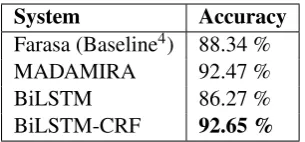
byqwlwA is labeled as “SBMMEBE”, which means that the word is segmented as b+yqwl+wA. We compar results of our two LSTM models (BiLSTM and BiLSTM-CRF) with Farasa (Abdelali et al., 2016), an open source segementer for MSA3, and MADAMIRA for Egyptian dialect. Table 3 shows accuracy for Farasa, MADAMIRA, and both of our models.The results show that for this small test-set BiLSTM-CRF (92.65%) performs better than
3Available for download from:
http://alt.qcri.org/tools/farasa/
System Accuracy
Farasa (Baseline4) 88.34 %
MADAMIRA 92.47 %
BiLSTM 86.27 %
BiLSTM-CRF 92.65 %
Table 3: F1 and accuracy results on the test data. We consider Farasa our baseline. This table compares between Farasa, BiLSTM models with MADAMIRA
MADAMIRA (92.47%) by only 0.18% which is not statistically significant. The advantage of our system is that, unlike MADAMIRA which relies on a hand-crafted lexicon, our system generalizes well on unseen data. To illustrate this point, the test set has 1,449 words, and 586 of them (40%) are not seen in the training set. This shows how well the system is robust with OOV words.
6 Analysis
MADAMIRA error analysis:
When analyzing the errors (109 errors) in MADAMIRA, we found that they are most likely due to lexical coverage or the performance of mor-phological processing and variability.
• OOV words: e.g.
ËQK@ñË@
AlwAyrls “the wireless”,h.AJ AêË@
AlHA$tAj “the hashtag”.• Spelling variation: e.g.
ù¢ ªË@
AlgTY “the cover”,úÎë
B
l>hly “to Ahly”.• Morphological inflection (imperative): e.g.
øY
$dy “pull”,@ñ¯ñ ¯
fwqwA “wake up”. • Segmentation ambiguity: e.g.éJË
lyh meaning“why” or “to him”,
A JËAÓ
mAlnA meaning “our money” or “what we have”.• Combinations not known to MADAMIRA: e.g.
AëñÊ ®®JÓ
mtqflwhA$ “don’t close it”,@ñºÊ ®ð@
>wSflkwA “I describe to you”. [image:6.595.73.294.103.268.2]BiLSTIM Error analysis:
The errors in this system (199 errors) are broadly classified into three categories:
• Confusing prefixes and suffixes with stem’s constituent letters: e.g.
é ®J¢Ë
lTyfh “nice”,ùÖÏA«
EAlmy “international”.• Not identifying segments: e.g.
H.PAK
yArb “O my Lord”,ú×@Y¯
qd Amy “in front of me”.• The majority of errors (108 instances) are bad sequences coming from invalid label com-bination, like having an E or M without a preceding B, or M without a following E. It seems that this label sequence logic is not yet fully absorbed by the system, maybe due to the small amount of training data.
BiLSTIM-CRF Error analysis:
This model successfully avoids the invalid sequence combinations found in BiLSTM. As pointed out by (Lample et al., 2016), BiL-STM makes independent classification decisions which does not work well when there are inter-dependence across labels (e.g., E or M must be preceded by B, and M must be followed by E). Segmentation is one such task, where indepen-dence assumption is wrong, and this is why CRF works better than the softmax in modeling tagging decisions jointly, correctly capturing the sequence logic.
The number of errors in BiLSTIM-CRF is re-duced to 101 and the number of label sequences not found in the gold standard is reduced to just 14, yet with all of them obeying the valid sequence rules. The remaining errors are different from the errors generated by BiLSTM, but they are simi-lar in that the mistokenization happens due to the system’s inability to decide whether a substring (which out of context can be a valid token) is an in-dependent token or part of a word, e.g.
Q m'.
bikhir “is well’,úæ AÓ
mA$iy “OK”.7 Conclusion
Using BiLSTM-CRF, we show that we can build an effective segmenter using limited dialectal Egyptian Arabic labeled data without relying on lexicons, morphological analyzer or linguis-tic knowledge. The CRF optimizer for LSTM successfully captures label sequence logic and
avoids invalid label combinations. The results ob-tained are comparable to a state-of-the-art system, namely MADAMIRA, or even better. Admittedly, the small test set used in this work might not al-low us to generalize the claim, and we plan to run more expansive tests. Nonetheless, given that there are no standard dataset available for this task, objective comparison of different systems remains elusive. A number of improvements can possi-bly enhance the accuracy of our system further, including exploiting large resources available for MSA. Despite the differences dialects and MSA, there is significant lexical overlap between MSA and dialects. This is demonstrated by the accuracy of Farasa which was built to handle MSA exclu-sively, yet achieving 88.34% accuracy on the di-alectal data. Thus, combining MSA and didi-alectal data in training or performing domain adaptation stands to enhance segmentation. Additionally, we plan to carry these achievements further to explore other dialects.
References
Ahmed Abdelali, Kareem Darwish, Nadir Durrani, and Hamdy Mubarak. 2016. Farasa: A fast and furious segmenter for arabic. In Proceedings of the 2016 Conference of the North American Chapter of the Association for Computational Linguistics: Demon-strations, pages 11–16. Association for Computa-tional Linguistics, San Diego, California.
Yoshua Bengio, Patrice Simard, and Paolo Frasconi. 1994. Learning long-term dependencies with gradi-ent descgradi-ent is difficult. IEEE transactions on neural networks, 5(2):157–166.
Fadi Biadsy, Julia Hirschberg, and Nizar Habash. 2009. Spoken arabic dialect identification using phonotactic modeling. InProceedings of the EACL 2009 Workshop on Computational Approaches to Semitic Languages, Semitic ’09, pages 53–61, Stroudsburg, PA, USA. Association for Computa-tional Linguistics.
Houda Bouamor, Nizar Habash, and Kemal Oflazer. 2014. A multidialectal parallel corpus of arabic. In Nicoletta Calzolari (Conference Chair), Khalid Choukri, Thierry Declerck, Hrafn Loftsson, Bente Maegaard, Joseph Mariani, Asuncion Moreno, Jan Odijk, and Stelios Piperidis, editors,Proceedings of the Ninth International Conference on Language Re-sources and Evaluation (LREC’14), Reykjavik, Ice-land, may. European Language Resources Associa-tion (ELRA).
conju-gate gradient, and early stopping. In NIPS, pages 402–408.
François Chollet. 2015. keras. https://github.
com/fchollet/keras.
Ronan Collobert, Jason Weston, Léon Bottou, Michael Karlen, Koray Kavukcuoglu, and Pavel Kuksa. 2011. Natural language processing (almost) from scratch. Journal of Machine Learning Research, 12:2493–2537.
Kareem Darwish, Hassan Sajjad, and Hamdy Mubarak. 2014. Verifiably effective arabic dialect identifica-tion. InEMNLP, pages 1465–1468.
Cıcero dos Santos, Victor Guimaraes, RJ Niterói, and Rio de Janeiro. 2015. Boosting named entity recog-nition with neural character embeddings. In Pro-ceedings of NEWS 2015 The Fifth Named Entities Workshop, page 25.
Mohamed Eldesouki, Fahim Dalvi, Hassan Sajjad, and Kareem Darwish. 2016. Qcri@ dsl 2016: Spoken arabic dialect identification using textual. VarDial 3, page 221.
Alex Graves and Jürgen Schmidhuber. 2005. Frame-wise phoneme classification with bidirectional lstm and other neural network architectures. Neural Net-works, 18(5):602–610.
Alex Graves, Navdeep Jaitly, and Abdel-rahman Mo-hamed. 2013a. Hybrid speech recognition with deep bidirectional lstm. InAutomatic Speech Recognition and Understanding (ASRU), 2013 IEEE Workshop on, pages 273–278. IEEE.
Alex Graves, Abdel-rahman Mohamed, and Geoffrey Hinton. 2013b. Speech recognition with deep re-current neural networks. InAcoustics, speech and signal processing (icassp), 2013 ieee international conference on, pages 6645–6649. IEEE.
Alex Graves. 2013. Generating sequences with recurrent neural networks. arXiv preprint arXiv:1308.0850.
Nizar Habash, Mona T Diab, and Owen Rambow. 2012. Conventional orthography for dialectal ara-bic. InLREC, pages 711–718.
Nizar Habash, Ryan Roth, Owen Rambow, Ramy Es-kander, and Nadi Tomeh. 2013. Morphological analysis and disambiguation for dialectal arabic. In
Hlt-Naacl, pages 426–432.
Geoffrey E Hinton, Nitish Srivastava, Alex Krizhevsky, Ilya Sutskever, and Ruslan R Salakhutdinov. 2012. Improving neural networks by preventing co-adaptation of feature detectors. arXiv preprint arXiv:1207.0580.
Sepp Hochreiter and Jürgen Schmidhuber. 1997. Long short-term memory. Neural computation, 9(8):1735–1780.
Zhiheng Huang, Wei Xu, and Kai Yu. 2015. Bidi-rectional LSTM-CRF models for sequence tagging.
CoRR, abs/1508.01991.
Zeinab Ibrahim. 2006. Borrowing in modern standard arabic. Innovation and Continuity in Language and Communication of Different Language Cultures 9. Edited by Rudolf Muhr, pages 235–260.
Sameer Khurana, Ahmed Ali, and Steve Renals. 2016. Multi-view dimensionality reduction for di-alect identification of arabic broadcast speech. arXiv preprint arXiv:1609.05650.
Yoon Kim, Yacine Jernite, David Sontag, and Alexan-der M Rush. 2016. Character-aware neural lan-guage models. InThirtieth AAAI Conference on Ar-tificial Intelligence.
John D. Lafferty, Andrew McCallum, and Fernando C. N. Pereira. 2001. Conditional random fields: Probabilistic models for segmenting and labeling se-quence data. InProc. ICML.
Guillaume Lample, Miguel Ballesteros, Sandeep Sub-ramanian, Kazuya Kawakami, and Chris Dyer. 2016. Neural architectures for named entity recog-nition. InProceedings of NAACL-HLT, pages 260– 270.
Zachary C Lipton, David C Kale, Charles Elkan, and Randall Wetzell. 2015. A critical review of recur-rent neural networks for sequence learning. CoRR, abs/1506.00019.
Xuezhe Ma and Eduard Hovy. 2016. End-to-end se-quence labeling via bi-directional lstm-cnns-crf. In
Proceedings of the 54th Annual Meeting of the As-sociation for Computational Linguistics (Volume 1: Long Papers), pages 1064–1074, Berlin, Germany, August. Association for Computational Linguistics.
Mohamed Maamouri, Ann Bies, Seth Kulick, Michael Ciul, Nizar Habash, and Ramy Eskander. 2014. De-veloping an egyptian arabic treebank: Impact of di-alectal morphology on annotation and tool develop-ment. InLREC, pages 2348–2354.
Emad Mohamed, Behrang Mohit, and Kemal Oflazer. 2012. Annotating and learning morphological seg-mentation of egyptian colloquial arabic. InLREC, pages 873–877.
Will Monroe, Spence Green, and Christopher D Man-ning. 2014. Word segmentation of informal arabic with domain adaptation. InACL (2), pages 206–211.
Hassan Sajjad, Kareem Darwish, and Yonatan Be-linkov. 2013. Translating dialectal Arabic to En-glish. InProceedings of the 51st Annual Meeting of the Association for Computational Linguistics (Vol-ume 2: Short Papers), ACL ’13, pages 1–6, Sofia, Bulgaria.
Younes Samih, Suraj Maharjan, Mohammed Attia, Laura Kallmeyer, and Thamar Solorio. 2016. Multi-lingual code-switching identification via lstm recur-rent neural networks. InProceedings of the Second Workshop on Computational Approaches to Code Switching,, pages 50–59, Austin, TX.
Mike Schuster and Kuldip K Paliwal. 1997. Bidirec-tional recurrent neural networks. IEEE Transactions on Signal Processing, 45(11):2673–2681.
Rico Sennrich, Barry Haddow, and Alexandra Birch. 2016. Neural machine translation of rare words with subword units. In Proceedings of the 54th Annual Meeting of the Association for Computational Lin-guistics (Volume 1: Long Papers), pages 1715–1725, Berlin, Germany, August. Association for Computa-tional Linguistics.
Yushi Yao and Zheng Huang. 2016. Bi-directional lstm recurrent neural network for chinese word seg-mentation. In International Conference on Neural Information Processing, pages 345–353. Springer. Omar F Zaidan and Chris Callison-Burch. 2014.
Ara-bic dialect identification. Computational Linguis-tics, 40(1):171–202.