Assessing SRL Frameworks with Automatic Training Data Expansion
Silvana Hartmann†‡ ´Eva M´ujdricza-Maydt∗‡ Ilia Kuznetsov† Iryna Gurevych†‡ Anette Frank∗‡
†Ubiquitous Knowledge Processing Lab ∗Department of
Department of Computer Science Computational Linguistics
Technische Universit¨at Darmstadt Heidelberg University
‡Research Training School AIPHES ‡Research Training School AIPHES
{hartmann,kuznetsov,gurevych} {mujdricza,frank}
@ukp.informatik.tu-darmstadt.de @cl.uni-heidelberg.de
Abstract
We present the first experiment-based study that explicitly contrasts the three major se-mantic role labeling frameworks. As a prerequisite, we create a dataset labeled with parallel FrameNet-, PropBank-, and VerbNet-style labels for German. We train a state-of-the-art SRL tool for German for the different annotation styles and provide a comparative analysis across frameworks. We further explore the behavior of the frameworks with automatic training data generation. VerbNet provides larger seman-tic expressivity than PropBank, and we find that its generalization capacity approaches PropBank in SRL training, but it benefits less from training data expansion than the sparse-data affected FrameNet.
1 Introduction
We present the first study that explicitly contrasts the three popular theoretical frameworks for se-mantic role labeling (SRL) – FrameNet, PropBank, and VerbNet1in a comparative experimental setup, i.e., using the same training and test sets annotated with predicate and role labels from the different frameworks and applying the same conditions and criteria for training and testing.
Previous work comparing these frameworks ei-ther provides theoretical investigations, for instance for the pair PropBank–FrameNet (Ellsworth et al., 2004), or presents experimental investigations for the pair PropBank–VerbNet (Zapirain et al., 2008; Merlo and van der Plas, 2009). Theoretical analy-ses contrast the richness of the semantic model of FrameNet with efficient annotation of PropBank la-bels and their suitability for system training.
Verb-1See Fillmore et al. (2003), Palmer et al. (2005) and
Kipper-Schuler (2005), respectively.
Net is considered to range between them on both scales: it fulfills the need for semantically meaning-ful role labels; also, since the role labels are shared across predicate senses, it is expected to generalize better to unseen predicates than FrameNet, which suffers from data sparsity due to a fine-grained sense-specific role inventory. Yet, unlike PropBank and FrameNet, VerbNet has been neglected in re-cent work on SRL, partially due to the lack of train-ing and evaluation data, whereas PropBank and FrameNet were popularized in shared tasks. As a result, the three frameworks have not been com-pared under equal experimental conditions.
This motivates our contrastive analysis of all three frameworksfor German. We harness existing datasets for German (Burchardt et al., 2006; Hajiˇc et al., 2009; M´ujdricza-Maydt et al., 2016) to create
SR3de (Semantic Role Triple Dataset for German), the first benchmark dataset labeled with FrameNet, VerbNet and PropBank roles in parallel.
Our motivation for working on German is that – as for many languages besides English – sufficient amounts of training data are not available. This clearly applies to our German dataset, which con-tains about 3,000 annotated predicates. In such a scenario, methods to extend training data auto-matically or making efficient use of generalization across predicates (i.e., being able to apply role la-bels to unseen predicates) are particularly desirable. We assume that SRL frameworks that generalize better across predicates gain more from automatic training data generation, and lend themselves bet-ter to cross-predicate SRL. System performance also needs to be correlated with the semantic ex-pressiveness of frameworks: with the ever-growing expectations in semantic NLP applications, SRL frameworks also need to be judged with regard to their contribution to advanced applications where expressiveness may play a role, such as question answering or summarization.
Our work explores the generalization properties of three SRL frameworks in a contrastive setup, as-sessing SRL performance when training and evalu-ating on a dataset with parallel annotations for each framework in a uniform SRL system architecture. We also explore to what extent the frameworks ben-efit from training data generation via annotation projection (F¨urstenau and Lapata, 2012).
Since all three frameworks have been applied to several languages,2we expect our findings for German to generalize to other languages as well.
Our contributions are (i) novel resources: par-allel German datasets for the three frameworks, including automatically acquired training data; and (ii) empirical comparison of the labeling perfor-mance and generalization capabilities of the three frameworks, which we discuss in view of their re-spective semantic expressiveness.
2 Related Work
Overview on SRL frameworks FrameNet de-fines frame-specific roles that are shared among predicates evoking the same frame. Thus, general-ization across predicates is possible for predicates that belong to the sameexistingframe, but label-ing predicates for unseen frames is not possible. Given the high number of frames – FrameNet cov-ers about 1,200 frames and 10K role labels – large training datasets are required for system training.
PropBank offers a small role inventory of five core roles (A0 to A4) for obligatory arguments and around 18 roles for optional ones. The core roles closely follow syntactic structures and receive a predicate-specific interpretation, except for the Agent-like A0 and Patient-like A1 that implement Dowty’s proto-roles theory (Dowty, 1991).
VerbNetdefines about 35 semantically defined
thematicroles that are not specific to predicates or predicate senses. Predicates are labeled with Levin-type semantic classes (Levin, 1993). VerbNet is typically assumed to range between FrameNet with respect to its rich semantic representation and Prop-Bank with its small, coarse-grained role inventory. Comparison of SRL frameworks Previous ex-perimental work compares VerbNet and PropBank: Zapirain et al. (2008) find that PropBank SRL is more robust than VerbNet SRL, generalizing bet-ter to unseen or rare predicates, and relying less on predicate sense. Still, they aspire to use more
mean-2Cf. Hajiˇc et al. (2009), Sun et al. (2010), Boas (2009).
ingful VerbNet roles in NLP tasks and thus propose using automatic PropBank SRL for core role iden-tification and then converting the PropBank roles into VerbNet roles heuristically to VerbNet, which appears more robust in cross-domain experiments compared to training on VerbNet data. Merlo and van der Plas (2009) also confirm that PropBank roles are easier to assign than VerbNet roles, while the latter provide better semantic generalization. To our knowledge, there is no experimental work that compares all three major SRL frameworks.
German SRL frameworks and data sets The SALSA project (Burchardt et al., 2006; Rehbein et al., 2012) created a corpus annotated with over 24,200 predicate argument structures, using En-glishFrameNetframes as a basis, but creating new frames for German predicates where required.
About 18,500 of the manual SALSA annota-tions were converted semi-automatically to Prop-Bank-style annotations for the CoNLL 2009 shared task on syntactic and semantic dependency label-ing (Hajiˇc et al., 2009). Thus, the CoNLL dataset shares a subset of the SALSA annotations. To create PropBank-style annotations, the predicate senses were numbered such that different frame annotations for a predicate lemma indicate differ-ent senses. The SALSA role labels were converted to PropBank-style roles using labels A0 and A1 for Agent- and Patient-like roles, and continuing up to A9 for other arguments. Instead of spans, arguments were defined by their dependency heads for CoNLL. The resulting dataset was used as a benchmark dataset in the CoNLL 2009 shared task.
For VerbNet, M´ujdricza-Maydt et al. (2016) re-cently published a small subset of the CoNLL shared task corpus withVerbNet-style roles. It con-tains 3,500 predicate instances for 275 predicate lemma types. Since there is no taxonomy of verb classes for German corresponding to original Verb-Net classes, they used GermaVerb-Net (Hamp and Feld-weg, 1997) to label predicate senses. GermaNet provides a fine-grained sense inventory similar to the English WordNet (Fellbaum, 1998).
Der Umsatz stieg um 14 % auf 1,9 Milliarden . ’Sales rose by 14% to 1.9 billion’
PB A1 steigen.1 A2 A3
VN Patient steigen-3 Extent Goal FN Item Change position
[image:3.595.307.525.62.139.2]on a scale Difference Final value
Figure 1: Parallel annotation example from SR3de for predicatesteigen(’rise, increase’).
Training data generation In this work, we use a corpus-based, monolingual approach to training data expansion. F¨urstenau and Lapata (2012) pro-pose monolingual annotation projection for lower-resourced languages: they create data labeled with FrameNet frames and roles based on a small set of labeled seed sentences in the target language. We apply their approach to the different SRL frame-works, and for the first time to VerbNet-style labels. Other approaches apply cross-lingual projection (Akbik and Li, 2016) or paraphrasing, replacing FrameNet predicates (Pavlick et al., 2015) or Prop-Bank arguments (Woodsend and Lapata, 2014) in labeled texts. We do not employ these approaches, because they assume large role-labeled corpora.
3 Datasets and Data Expansion Method
SR3de: a German parallel SRL dataset The VerbNet-style dataset by M´ujdricza-Maydt et al. (2016) covers a subset of the PropBank-style CoNLL 2009 annotations, which are based on the German FrameNet-style SALSA corpus. This al-lowed us to create SR3de, the first corpus with par-allel sense and role labels from SALSA, PropBank, and GermaNet/VerbNet, which we henceforth ab-breviate as FN, PB, and VN respectively. Figure 1 displays an example with parallel annotations.
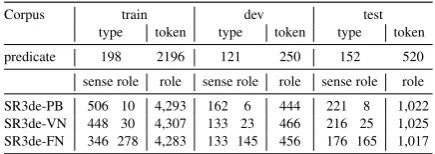
Data statistics in Table 1 shows that with almost 3,000 predicate instances, the corpus is fairly small. The distribution of role types across frameworks highlights their respective role granularity, ranging from 10 for PB to 30 for VN and 278 for FN. The corpus offers 2,196 training predicates and covers the CoNLL 2009 development and test sets; thus it is a suitable base for comparing the three frame-works. We use SR3de for the contrastive analysis of the different SRL frameworks below.
Training data expansion To overcome the data scarcity of our corpus, we usemonolingual anno-tation projection(F¨urstenau and Lapata, 2012) to generate additional training data. Given a set of labeledseed sentencesand a set of unlabeled
ex-Corpus train dev test
type token type token type token predicate 198 2196 121 250 152 520 sense role role sense role role sense role role SR3de-PB 506 10 4,293 162 6 444 221 8 1,022 SR3de-VN 448 30 4,307 133 23 466 216 25 1,025 SR3de-FN 346 278 4,283 133 145 456 176 165 1,017
Table 1: Data statistics for SR3de (PB, VN, FN).
pansion sentences, we select suitable expansions based on the predicate lemma and align dependency graphs of seeds and expansions based on lexical similarity of the graph nodes and syntactic similar-ity of the edges. The alignment is then used to map predicate and role labels from the seed sentences to the expansion sentences. For each seed instance, thekbest-scoring expansions are selected. Given a seed set of size nand the maximal number of expansions per seedk, we get up ton·kadditional training instances. Lexical and syntactic similarity are balanced using the weight parameterα.
Our adjusted re-implementation uses the mate-tools dependency parser (Bohnet, 2010) and word2vec embeddings (Mikolov et al., 2013) trained on deWAC (Baroni et al., 2009) for word similarity calculation. We tune the parameter α
via intrinsic evaluation on the SR3de dev set. We project the seed set train directly to SR3de-dev and compare the labels from thek=1 best seeds for a dev sentence to the gold label, measuring F1 for all projections. Then we use the best-scoring
αvalue for each framework to project annotations from the SR3de training set to deWAC for predicate lemmas occurring at least 10 times. We vary the number of expansionsk, selectingkfrom{1, 3, 5, 10, 20}. Using largerkvalues is justified because a) projecting to a huge corpus is likely to generate many high-quality expansions, and b) we expect a higher variance in the generated data when also selecting lower-scoring expansions.
Intrinsic evaluation on the dev set provides an estimate of the projection quality: we observe F1 score of 0.73 for PB and VN, and of 0.53 for FN. The lower scores for FN are due to data sparsity in the intrinsic setting and are expected to improve when projecting on a large corpus.
4 Experiments
[image:3.595.74.289.64.126.2]perfor-mance of the learned models, and b) explore their behavior in response to expanded training data.
We employ the following settings (cf. Table 2): #BL: Baseline We train on SR3de train, which is
small, but comparable across frameworks. #FB: Full baseline We train on the full
CoNLL-training sections for PropBank and SALSA, to compare to state-of-the-art results and con-trast the low-resource #BL to full resources.3
#EX: Expanded We train on data expanded via
annotation projection.
We train mateplus using the reranker option and the default featureset for German4excluding word embedding features.5 We explore the fol-lowing role labeling tasks: predicate sense predic-tion (pd in mateplus), argument identificapredic-tion (ai) and role labeling (ac) for predicted predicate sense (pd+ai+ac) and oracle predicate sense (ai+ac). We report F1 scores for all three role labeling tasks.
We assure equivalent treatment of all three SRL frameworks in mateplus and train the systems only on the given training data without any framework-specific information. Specifically, we do not ex-ploit constraints on predicate senses for PB in mateplus (i.e., selecting sense.1 as default sense), nor constraints for licensed roles (or role sets) for a given sense (i.e., encoding the FN lexicon). Thus, mateplus learns predicate senses and role sets only from training instances.
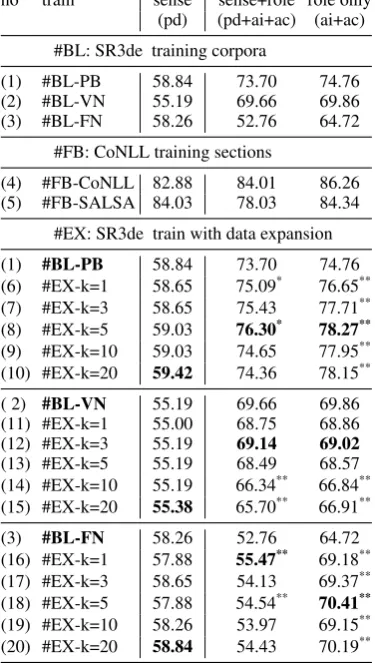
Experiment results for the different SRL frame-works are summarized in Table 2.6 Below, we discuss the results for the different settings. #BL: for role labeling with oracle senses (ai+ac), PB performs best, VN is around 5 percentage points (pp.) lower, and FN again 5 pp. lower. With predicate sense prediction (pd+ai+ac), performance only slightly decreases for VN and PB, while FN suffers strongly: F1 is 17 pp. lower than for VN, despite the fact that its predicate labeling F1 is similar to PB and higher than VN. This indicates that generalization across senses works much bet-ter for VN and PB roles. By contrast, FN, with its sense-dependent role labels, is lacking generaliza-tion capacity, and thus suffers from data sparsity.
3Both #FB training sets contain≈17,000 predicate
in-stances. There is no additional labeled training data for VN.
4https://github.com/microth/mateplus/ tree/master/featuresets/ger
5Given only small differences in mateplus performance
when using word embeddings, we report results without them.
6Significance is computed using approximation
random-ization, i.e., SIGF (Pad´o, 2006) two-tailed, 10k iterations.
no train sense sense+role role only (pd) (pd+ai+ac) (ai+ac) #BL: SR3de training corpora
(1) #BL-PB 58.84 73.70 74.76 (2) #BL-VN 55.19 69.66 69.86 (3) #BL-FN 58.26 52.76 64.72
#FB: CoNLL training sections
(4) #FB-CoNLL 82.88 84.01 86.26 (5) #FB-SALSA 84.03 78.03 84.34
#EX: SR3de train with data expansion (1) #BL-PB 58.84 73.70 74.76 (6) #EX-k=1 58.65 75.09* 76.65**
(7) #EX-k=3 58.65 75.43 77.71**
(8) #EX-k=5 59.03 76.30* 78.27**
(9) #EX-k=10 59.03 74.65 77.95**
(10) #EX-k=20 59.42 74.36 78.15**
( 2) #BL-VN 55.19 69.66 69.86 (11) #EX-k=1 55.00 68.75 68.86 (12) #EX-k=3 55.19 69.14 69.02 (13) #EX-k=5 55.19 68.49 68.57 (14) #EX-k=10 55.19 66.34** 66.84**
(15) #EX-k=20 55.38 65.70** 66.91**
(3) #BL-FN 58.26 52.76 64.72 (16) #EX-k=1 57.88 55.47** 69.18**
(17) #EX-k=3 58.65 54.13 69.37**
(18) #EX-k=5 57.88 54.54** 70.41**
(19) #EX-k=10 58.26 53.97 69.15**
[image:4.595.323.511.71.403.2](20) #EX-k=20 58.84 54.43 70.19**
Table 2: F1 scores for predicate sense and role la-beling on the SR3de test set;pd: predicate sense labeling; pd+ai+ac: sense and role labeling (cf. official CoNLL scores);ai+ac: role labeling with oracle predicate sense. We report statistical signifi-cance of role labeling F1 with expanded data#EX
to the respective#BL(*:p <0.05;**:p <0.01).
#FB: The full baselines #FB show that a larger training data set widely improves SRL performance compared to the small #BL training sets. One reason is the extended sense coverage in the #FB datasets, indicating the need for a larger training set. Still, FN scores are 6 pp. lower than PB (pd+ai+ac). #EX: Automatically expanding the training set for PB leads to performance improvements of around 3 pp. to #BL for k=5 (pd+ai+ac and ai+ac), but the scores do not reach those of #FB. A similar gain is achieved for FN with k=1. Contrary to initial expectations, annotation projection tends to create similar instances to the seen ones, but at the same time, it also introduces noise. Thus, largerk(k>5) results in decreased role labeling performance com-pared to smallerkfor all frameworks.
reach-ing similar role labelreach-ing scores as VN for the oracle sense setting. For predicted senses, performance in-crease is distinctly smaller, highlighting that the sparse data problems for FN senses do not get solved by training data expansion. Performance improvements are significant for FN and PB for both role labeling settings. Against expectation, we do not observe improved role labeling performance for VN. We believe this is due to the more complex label set compared to PB and perform a analyses supporting this hypothesis below.
Analysis: complexity of the frameworks We estimate the role labeling complexity of the frame-works by computingC(d), the average ambiguity of the role instances in the dataset d, d∈ {PB, VN, FN}. C(d)consists of the normalized sumsover the numbernof role candidates licensed for each role instance in d by the predicate sense label; for role instances with unseen senses,nis the number of distinct roles in the framework. The sumsis then divided by all role instances in dataset d.
Results areC(PB)=4.3,C(VN)=9.7,C(FN)=60.
C(d)is inversely correlated to the expected perfor-mance of each framework, and thus predicts the role labeling performance for #BL (pd+ai+ac).
When considering only seen training instances, complexity is 1.67 for both PB and VN, and 1.79 for FN. This indicates a larger difficulty for FN, but does not explain the difference between VN and PB. Yet, next to role ambiguity, the number of instances seen in training for individual role types is a decisive factor for role labeling performance, and thus, the coarser-grained PB inventory has a clear advantage over VN and FN.
The sense labeling performance is lower for VN systems compared to FN and PB. This correlates with the fact that GermaNet senses used with VN are more fine-grained than those in FN, but more abstract than the numbered PB senses. Still, we observe high role labeling performance indepen-dently of the predicate sense label for both VN and PB. This indicates high generalization capabilities of their respective role sets.7
The 5 pp. gap between the VN and PB systems is small, but not negligible. We expect that a suit-able sense inventory for German VN, analogous to VerbNet’s classes, will further enhance VN role
la-7This is confirmed when replacing the predicate sense label
with the lemma for training: the role labeling results are fairly close for PB (74.34%) and VN (68.90%), but much lower for FN (54.26%).
beling performance. Overall, we conclude that the higher complexity of the FrameNet role inventory causes data sparsity, thus FN benefits most from the training data expansion for seen predicates. For the other two frameworks, cross-predicate projection could be a promising way to increase the training data coverage to previously unseen predicates.
5 Discussion and Conclusion
We perform the first experimental comparison of all three major SRL frameworks on a small German dataset with parallel annotations. The experiment settings ensure comparability across frameworks.
Our baseline experiments prove that the gen-eralization capabilities of the frameworks follow the hypothesized order of FrameNet < VerbNet
< PropBank. Comparative analysis shows that PropBank and VerbNet roles generalize well, also beyond predicates. Taking into account the seman-tic expressiveness of VerbNet, these results show-case the potential of VerbNet as an alternative to PropBank. By contrast, FrameNet’s role labeling performance suffers from data sparsity in the small-data setting, given that its role inventory does not easily generalize across predicates.
While VerbNet generalizes better than FrameNet, it does not benefit from our automatic training data generation setup. Currently, annotation projection only applies to lemmas seen in training. Thus, the generalization capacities of VerbNet – and Prop-Bank – are not fully exploited. Relaxing constraints in annotation projection, e.g., projecting across predicates, could benefit both frameworks.
FrameNet suffers most from sparse-data prob-lems and thus benefits most from automatic train-ing data expansion for seen predicates, yet sense labeling persists as its performance bottleneck.
In future work we plan to a) further evalu-ate cross-predicevalu-ate generalization capabilities of VerbNet and PropBank in cross-predicate annota-tion projecannota-tion and role labeling, b) explore semi-supervised methods and constrained learning (Ak-bik and Li, 2016), and c) explore alternative sense inventories for the German VerbNet-style dataset.
We publish our benchmark dataset with strictly parallel annotations for the three frameworks to facilitate further research.8
Acknowledgements The present work was par-tially funded by a German BMBF grant to CLARIN-D and the DFG-funded Research Train-ing School ”Adaptive Preparation of Information from Heterogeneous Sources” (GRK 1994/1). We thank the anonymous reviewers for their valuable comments and suggestions.
References
Alan Akbik and Yunyao Li. 2016. K-SRL: Instance-based Learning for Semantic Role Labeling. In Pro-ceedings of COLING 2016, the 26th International Conference on Computational Linguistics: Techni-cal Papers, pages 599–608, Osaka, Japan, Decem-ber.
Marco Baroni, Silvia Bernardini, Adriano Ferraresi, and Eros Zanchetta. 2009. The WaCky wide web: a collection of very large linguistically processed web-crawled corpora. Language Resources and Evalua-tion, 43(3):209–226.
Anders Bj¨orkelund, Love Hafdell, and Pierre Nugues. 2009. Multilingual semantic role labeling. In Pro-ceedings of the Thirteenth Conference on Computa-tional Natural Language Learning (CoNLL 2009): Shared Task, pages 43–48, Boulder, CO, USA. Hans C. Boas. 2009. Multilingual FrameNets in
com-putational lexicography: methods and applications, volume 200. Walter de Gruyter.
Bernd Bohnet. 2010. Top accuracy and fast depen-dency parsing is not a contradiction. In Chu-Ren Huang and Dan Jurafsky, editors, Proceedings of Coling 2010, pages 89–97.
Aljoscha Burchardt, Kathrin Erk, Anette Frank, An-drea Kowalski, Sebastian Pad´o, and Manfred Pinkal. 2006. The SALSA Corpus: a German Corpus Re-source for Lexical Semantics. In Proceedings of the 5th International Conference on Language Re-sources and Evaluation (LREC 2006), pages 969– 974, Genoa, Italy.
David Dowty. 1991. Thematic Proto-Roles and Argu-ment Selection. Language, 67(3):547–619.
Michael Ellsworth, Katrin Erk, Paul Kingsbury, and Sebastian Pad´o. 2004. PropBank, SALSA, and FrameNet: How design determines product. In
Proceedings of the Workshop on Building Lexical Resources From Semantically Annotated Corpora, LREC-2004, Lisbon, Portugal.
Christiane Fellbaum. 1998. WordNet: an eletronic lexical database. The Mit Press, Cambridge, Mas-sachusetts.
Charles J. Fillmore, Christopher R. Johnson, and Miriam R.L. Petruck. 2003. Background to FrameNet. International Journal of Lexicography, 16(3):235–250.
Hagen F¨urstenau and Mirella Lapata. 2012. Semi-Supervised Semantic Role Labeling via Structural Alignment. Computational Linguistics, 38(1):135– 171.
Jan Hajiˇc, Massimiliano Ciaramita, Richard Johans-son, Daisuke Kawahara, Maria Ant`onia Mart´ı, Llu´ıs M`arquez, Adam Meyers, Nivre Joakim, Sebastian Pad´o, Jan ˇStˇep´anek, Pavel Straˇn´ak, Mihai Surde-nau, Nianwen Xue, and Yi Zhang. 2009. The CoNLL-2009 Shared Task: Syntactic and Semantic Dependencies in Multiple Languages. In Proceed-ings of the Thirteenth Conference on Computational Natural Language Learning (CoNLL): Shared Task, pages 1–18, Boulder, CO, USA.
Birgit Hamp and Helmut Feldweg. 1997. GermaNet -a Lexic-al-Sem-antic Net for Germ-an. InProceedings of the ACL workshop Automatic Information Extrac-tion and Building of Lexical Semantic Resources for NLP Applications, pages 9–15, Madrid, Spain. Karin Kipper-Schuler. 2005. VerbNet: A
broad-coverage, comprehensive verb lexicon. Ph.D. thesis, University of Pennsylvania, Pennsylvania, Philadel-phia, PA.
Beth Levin. 1993. English verb classes and alterna-tions: A preliminary investigation. University of Chicago press.
Paola Merlo and Lonneke van der Plas. 2009. Ab-straction and Generalisation in Semantic Role La-bels: PropBank, VerbNet or both? InProceedings of the 47th Annual Meeting of the ACL and the 4th IJCNLP of the AFNLP, pages 288–296, Suntec, Sin-gapore.
Tomas Mikolov, Ilya Sutskever, Kai Chen, Greg S. Cor-rado, and Jeff Dean. 2013. Distributed representa-tions of words and phrases and their composition-ality. In C. J. C. Burges, L. Bottou, M. Welling, Z. Ghahramani, and K. Q. Weinberger, editors, Ad-vances in Neural Information Processing Systems 26, pages 3111–3119. Curran Associates, Inc. ´Eva M´ujdricza-Maydt, Silvana Hartmann, Iryna
Gurevych, and Anette Frank. 2016. Combining Semantic Annotation of Word Sense & Semantic Roles: A Novel Annotation Scheme for VerbNet Roles on German Language Data. InProceedings of the Tenth International Conference on Language Re-sources and Evaluation (LREC 2016), pages 3031– 3038, Portoro˘z, Slovenia.
Sebastian Pad´o, 2006. User’s guide tosigf: Signifi-cance testing by approximate randomisation. Martha Palmer, Daniel Gildea, and Paul Kingsbury.
2005. The Proposition Bank: An annotated cor-pus of semantic roles. Computational Linguistics, 31(1):71–106.
Van Durme. 2015. FrameNet+: Fast Paraphras-tic Tripling of FrameNet. In Proceedings of the 53rd Annual Meeting of the Association for Compu-tational Linguistics and the 7th International Joint Conference on Natural Language Processing (Vol-ume 2: Short Papers), pages 408–413, Beijing, China.
Ines Rehbein, Joseph Ruppenhofer, Caroline Sporleder, and Manfred Pinkal. 2012. Adding nominal spice to SALSA - Frame-semantic annotation of Ger-man nouns and verbs. In Proceedings of the 11th Conference on Natural Language Processing (KON-VENS’12), pages 89–97, Vienna, Austria.
Michael Roth and Mirella Lapata. 2015. Context-aware frame-semantic role labeling. Transactions of the Association for Computational Linguistics (TACL), 3:449–460.
Michael Roth and Kristian Woodsend. 2014. Composi-tion of word representaComposi-tions improves semantic role labelling. InProceedings of the 2014 Conference on Empirical Methods in Natural Language Processing (EMNLP), pages 407–413, Doha, Qatar.
Lin Sun, Thierry Poibeau, Anna Korhonen, and Cedric Messiant. 2010. Investigating the cross-linguistic potential of VerbNet-style classification. In Proceed-ings of the 23rd International Conference on Com-putational Linguistics (Coling 2010), pages 1056– 1064.
Kristian Woodsend and Mirella Lapata. 2014. Text rewriting improves semantic role labeling. Journal of Artificial Intelligence Research, 51:133–164. Be˜nat Zapirain, Eneko Agirre, and Llu´ıs M`arquez.