Universal Dependencies for Greek
Prokopis Prokopidis
Institute for Language and Speech Processing Athena Research Center
Athens, Greece [email protected]
Haris Papageorgiou
Institute for Language and Speech Processing Athena Research Center
Athens, Greece [email protected]
Abstract
This paper describes work towards the harmonization of the Greek Dependency Treebank with the Universal Dependen-cies v2 standard, and the extension of the treebank with enhanced dependen-cies. Experiments with the latest version of the UD_Greek resource have led to 88.94/87.66 LAS on gold/automatic POS, morphological features and lemmas.
1 Introduction
The Universal Dependencies (Nivre et al., 2016) community effort has led to the development and collection of a large number of treebanks adher-ing to common and extendible annotation guide-lines. These guidelines aim to ease the annotation process and improve the accuracy of parsers and downstream NLP applications in generating use-ful and linguistically sound representations.
Greek is represented in the UD effort with UD_Greek1. In this paper, we provide more de-tails on the annotated resource in section 2 and its conversion to the UD standard. In section 3 we discuss ongoing work for extending GDT with a subset of the enhanced dependencies pro-posed by Schuster and Manning (2016). Sec-tion 4 presents experiments with parsers trained on the different-sized versions of the resource and on manually/automatically annotated morphology and lemmas.
2 The Greek Dependency Treebank and its conversion to UD
UD_Greek is derived from the Greek Dependency Treebank (GDT, Prokopidis et al. (2005)), a re-source developed and maintained by researchers
1https://github.com/UniversalDependencies/
UD_Greek
at the Institute for Language and Speech Process-ing2. Although the conversion and harmonization to UD is work in progress since UD v1.1, the Greek dataset in the v2.0 release was the first one that in-volved extensive manual validation and correction of labeled dependencies generated from the orig-inial annotations.
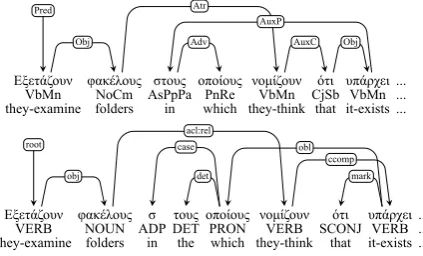
The original annotation scheme used for the an-notation of the resource was based on an adaptation of the guidelines for the Prague Dependency Tree-bank (Böhmová et al., 2003). Trees in the orig-inal data were headed by words bearing, in most cases, the Pred relation. Coordinating conjunc-tions and apposition markers headed participating tokens in relevant constructions. Prepositions and subordinating conjunctions acted as mediators be-tween verbs/nouns and their phrasal and clausal dependents. The tagset used for the morphology layer in the original resource contained 584 combi-nations of basic POS tags and features that capture the rich morphology of the Greek language. As an example, the full tagAjBaMaSgNmfor a word likeταραχώδης/turbulent denotes an adjective of basic degree, masculine gender, singular number and nominative case. The three last features are also used for nouns, articles, pronouns, and passive participles. Verb tags include features for tense and aspect, while articles are distinguished for definite-ness. The top tree in Figure 1 presents an example of a dependency tree with basic POS tags.
Annotated documents in GDT are stored in XML files that integrate annotations for seman-tic roles and events. A procedure based on software described in Zeman et al. (2014) was used for rehanging nodes and changing labels in these files, so that annotations beyond the syn-tactic level were kept intact. The original heads and labels of the original annotation effort were stored as attributes of the XML elements
corre-2http://www.ilsp.gr
Εξετάζουν φακέλους στους οποίους νομίζουν ότι υπάρχει ... VbMn NoCm AsPpPa PnRe VbMn CjSb VbMn ... they-examine folders in which they-think that it-exists ...
Pred Obj
Atr
AuxP
Adv AuxC Obj
Εξετάζουν φακέλους σ τους οποίους νομίζουν ότι υπάρχει ... VERB NOUN ADP DET PRON VERB SCONJ VERB ... they-examine folders in the which they-think that it-exists ...
root obj
acl:rel
obl case
det
[image:2.595.78.290.63.191.2]ccomp mark
Figure 1: Annotation of a sentence fragment with a non-projective arc, according to the the original (top) and the current representation.
sponding to tree nodes. In view of the UD v2.0 release, the results of the automatic conversion were manually examined and corrected, in an ef-fort focusing on errors related to core arguments of content words; heads of the copula; nodes participating in coordinating conjunctions; non-projective dependencies; and multi-word expres-sions acting as clause-introductory markers. An-other difference to previous versions of the re-source concerned preposition-article combinations (e.g. στις/in-the/case/Prep3rdPersFemPlurAcc). These multi-word tokens were split into words that were assigned morphological information and syn-tactic heads. The second tree in Figure 1 is an ex-ample involving several of the conversions men-tioned above. Theacl:relrelation in the exam-ple is a language specific extension used for the annotation of relative clauses. Another extension is obl:arg, which in the current version of the resource is used for prepositional arguments that cliticize and are described by many Greek gram-mars (e.g. Holton et al. (1997)) as indirect objects. GDT is regularly updated with new material from different genres, and its current version comprises 178207/7417 tokens/sentences. The data in UD_Greek have also increased since v1.1 and currently3 consist of 63441/2521 to-kens/sentences. UD_Greek data are derived from annotated texts that are in the public domain, in-cluding Wikinews articles and European Parlia-ment sessions. For the UD v2.* versions sen-tences are not shuffled and documents are not split across train/dev/test partitions. There are
3The dataset is available fromhttps://github.com/
UniversalDependencies/UD_Greek/tree/dev. The
ex-periments described in Section 4 correspond to commit:
https://goo.gl/fhPmbN.
10927/5894/6375 types/lemmas/hapax legomena in the resource, while the average sentence length is 25.17 tokens. Non-projective trees (12.38% of all sentences) allow for the intuitive represen-tations of long-distance dependencies and non-configurational structures common in languages with flexible word order. The relatively free word order of Greek can also be inferred when exam-ining typical head-dependent structures in the re-source. Although determiners and adjectives al-most always precede their nominal heads, the sit-uation is different for arguments of verbs. Of the 2776 explicit subjects in UD_Greek, 32.89% oc-cur to the right of their parent, while the percent-age rises to 46.12% for subjects of verbs heading dependent clauses. The situation is more straight-forward for non-pronominal objects, of which only 2.66% occur to the left of their head. Of those subjects and objects appearing in “non-canonical” positions, 21.58% and 29.63%, respectively, are of neuter gender. This fact can pose problems to parsing, since the case of nominative and ac-cusative neuter homographs is particularly diffi-cult to disambiguate, especially due to the fact that articles and adjectives often preceding them (e.g. το/the κόκκινο/red βιβλίο/book) are also invariant for these two case values.
3 Enhanced dependencies
A recent addition to the resource is semi-automatic annotation for the enhanced dependencies pro-posed by Schuster and Manning (2016). We have initially focused on a subset of these dependencies involving coordination and control structures.
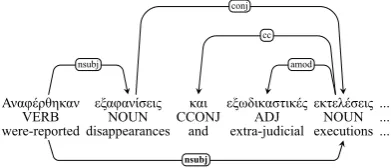
For coordination structures, we have exploited the fact that conjunctions headed these construc-tions in the previous representation and that the ids of the heads of the conjuncts are still available in the current annotation files. We were thus able to convert trees like the one in Figure 2 to the en-hanced dependency graph shown in the same ex-ample.
In the latest GDT version, no ccomp/xcomp
distinction was included for Greek finite clauses that depend on verbs of obligatory subject or ob-ject control. We are currently using Lexis (Anag-nostopoulou et al., 2000), a computational lexicon with syntactic and semantic information for Greek verbs, to annotate instances of these verbs with two extensions of the xcomp relation, xcomp:sc and
gener-Αναφέρθηκαν εξαφανίσεις και εξωδικαστικές εκτελέσεις ... VERB NOUN CCONJ ADJ NOUN ... were-reported disappearances and extra-judicial executions ...
nsubj
conj cc
amod
[image:3.595.341.495.62.139.2]nsubj
Figure 2: Enhanced dependency graph for a coor-dination structure.
Κάλεσε τον βουλευτή να φύγει ... VERB DET NOUN PART VERB.fin ... Asked the MP to leave ...
xcomp:oc obj
det mark
[image:3.595.83.279.63.147.2]nsubj
Figure 3: Enhanced dependency graph for an ob-ject control structure.
ate graphs like the object control one in Figure 3 and also the backward, subject control one in Fig-ure 4.
4 Parsing experiments with the UD representation
In this section, we report on experiments with the current version of UD_Greek and its GDT super-set. In all experiments reported below, we remove the annotations related to the enhanced dependen-cies described in Section 3, since they do not yet cover the whole resource. We examined parsing accuracy in scenarios involving manual and auto-matic annotations for morphology and lemmas. In the latter setting, POS tagging is conducted with a tagger (Papageorgiou et al., 2000) with an ac-curacy of 97.49 when only basic POS is consid-ered. When all features (including, for example, gender and case for nouns, and aspect and tense for verbs) are taken into account, the tagger’s ac-curacy drops to 92.54. As an indication of the rel-atively rich morphology of Greek, the tags/word ratio in the tagger’s lexicon is 1.82. Tags for a word typically differ in only one or two features like case and gender for adjectives. However, dis-tinct basic parts of speech (e.g. Vb/No) is also a possibility. Following POS tagging, a lemmatizer retrieves lemmas from a lexicon of 2M different entries. When a token under examination is asso-ciated in the lexicon with two or more lemmas, the lemmatizer uses information from the POS tags for
Άρχισε να γράφει το παιδί ... VERB PART VERB.fin DET NOUN ... Started to write the child ...
xcomp:sc nsubj
mark det
nsubj
Figure 4: Enhanced dependency graph for a back-ward subject control structure.
disambiguation. For example, the token+POS in-putεξετάσεις/Vbguides the lemmatizer to retrieve the lemma εξετάζω (examine), while the lemma εξέταση (examination)is returned forεξετάσεις/No.
We use the graph-based Mateparser (Bohnet, 2010) and the transition-based version of Bist-parser (Kiperwasser and Goldberg, 2016). For the latter, we projectivise datasets by lifting non-projective arcs (Nivre and Nilsson, 2005), and we use 100-dimensional word-embeddings obtained with the fastText library (Bojanowski et al., 2016) from a 350M token corpus.
Table 1 summarizes the results. Using the whole resource with gold POS, morphological features and lemmas (GDT-MPL), the Mate and Bist LAS are 90.29/89.36, respectively. The difference be-tween the two parsers on input with automatic annotations (GDT-APL) is smaller (88.82/88.36). When comparing the performance of both parsers on the different size datasets, the LAS improve-ment on the bigger dataset is more evident for Bist-parser, with a 1.97% increase from the APL setting with the UD_Greek dataset (UD-APL). For both parsers, best LAS is observed for small sentences of 5-15 tokens long, with the accuracy remaining relatively stable for sentences of 15-25 tokens (cf. Fig. 5).
[image:3.595.100.265.197.279.2]UD-MPL UD-APL GDT-MPL GDT-APL Bist Mate Bist Mate Bist Mate Bist Mate LAS 86.47 88.94 86.39 87.66 89.36 90.29 88.36 88.82
UAS 89.29 90.78 89.49 90.49 91.49 92.01 91.06 91.38
[image:4.595.132.467.61.135.2]LACC 92.73 93.68 92.45 92.22 94.55 94.70 93.56 93.33
Table 1: Results from parsing UD_Greek and GDT with the Bist- and Mate parsers. UD_Greek contains 63K tokens, a subset of GDT’s 178K tokens. (M/A)PL suffixes refer to training and testing on gold and automatic POS, morphological features and lemmas, respectively. All scores are calculated with punctuation excluded, on a test partition containing circa 10% of the tokens of each dataset.
5 15 25 35 45
Sentence length
82 84 86 88 90 92
LAS
bist mate
Figure 5: LAS relative to sentence length in the UD-APL setting.
5 Conclusions
We presented work for the harmonization of the syntactic trees in the Greek Dependency Tree-bank to the UD v.2 standard. We also discussed how we exploited previous annotations and a lex-ical resource to generate enhanced dependencies for the treebank. Finally, we reported a LAS of 88.94 for UD_Greek, by training the Mateparser on gold POS and lemmas. A 90.29 LAS on a larger version of the resource indicates that there is still room for accuracy improvements with ad-ditional data. While training on automatically pre-processed data, we obtain LAS scores (88.82) that are relatively high for morphologically rich lan-guages like Greek. In future work, we plan to im-prove the enhanced dependencies annotation and augment the UD_Greek resource with sentences involving questions and commands.
References
Anagnostopoulou, D., E. Desipri, P. Labropoulou, E. Mantzari, and M. Gavrilidou (2000). Lexis - Lexicographical Infrastructure:
Systematis-ing the Data. In: Computational Lexicography (COMLEX 2000).
Böhmová, A., J. Hajič, E. Hajičová, and B. Hladká (2003). The Prague Dependency Tree-bank: A Three-Level Annotation Scenario. In: Treebanks: Building and Using Parsed Cor-pora. Kluwer.
Bohnet, B. (2010). Very High Accuracy and Fast Dependency Parsing is Not a Contradiction. In: Proceedings of the 23rd International Confer-ence on Computational Linguistics, pp. 89–97. Bojanowski, P., E. Grave, A. Joulin, and T.
Mikolov (2016). Enriching Word Vec-tors with Subword Information. In: CoRR abs/1607.04606.
Holton, D., P. Mackridge, and I. Philippaki-Warburton (1997). Greek: A comprehensive grammar of the modern language. London and New York: Routledge.
Kiperwasser, E. and Y. Goldberg (2016). Simple and Accurate Dependency Parsing Using Bidi-rectional LSTM Feature Representations. In: Transactions of the Association for Computa-tional Linguistics4, pp. 313–327.
Nivre, J., M.-C. de Marneffe, F. Ginter, Y. Gold-berg, J. Hajic, C. D. Manning, R. McDonald, S. Petrov, S. Pyysalo, N. Silveira, R. Tsarfaty, and D. Zeman (2016). Universal Dependencies v1: A Multilingual Treebank Collection. In: Pro-ceedings of the Tenth International Conference on Language Resources and Evaluation (LREC 2016).
Nivre, J. and J. Nilsson (2005). Pseudo-Projective Dependency Parsing. In: Proceedings of the 43rd Annual Meeting of the Association for Computational Linguistics (ACL), pp. 99–106. Papageorgiou, H., P. Prokopidis, V. Giouli, and
[image:4.595.75.276.233.379.2]and Evaluation Conference. European Lan-guage Resources Association, pp. 1455–1462. Prokopidis, P., E. Desypri, M. Koutsombogera, H.
Papageorgiou, and S. Piperidis (2005). Theoret-ical and practTheoret-ical issues in the construction of a Greek Dependency Treebank. In:Proceedings of the Fourth Workshop on Treebanks and Lin-guistic Theories.
Prokopidis, P. and H. Papageorgiou (2014). Ex-periments for Dependency Parsing of Greek. In: Proceedings of the First Joint Workshop on Statistical Parsing of Morphologically Rich Languages and Syntactic Analysis of Non-Canonical Languages, pp. 90–96.
Schuster, S. and C. D. Manning (2016). Enhanced English Universal Dependencies: An Improved Representation for Natural Language Under-standing Tasks. In:Proceedings of the Tenth In-ternational Conference on Language Resources and Evaluation (LREC 2016).
Straka, M., J. Hajic, and J. Straková (2016). UD-Pipe: Trainable Pipeline for Processing CoNLL-U Files Performing Tokenization, Morphologi-cal Analysis, POS Tagging and Parsing. In: Pro-ceedings of the Tenth International Conference on Language Resources and Evaluation (LREC 2016).