Improving Optical Character Recognition of Finnish Historical
Newspapers with a Combination of Fraktur & Antiqua Models and Image
Preprocessing
Mika Koistinen
National Library of Finland The Centre for Preservation
and Digitisation
Kimmo Kettunen
National Library of Finland The Centre for Preservation
and Digitisation
Tuula P¨a¨akk¨onen
National Library of Finland The Centre for Preservation
and Digitisation
tuula.p¨a¨akk¨[email protected]
Abstract
In this paper we describe a method for im-proving the optical character recognition (OCR) toolkit Tesseract for Finnish his-torical documents. First we create a model for Finnish Fraktur fonts. Second we test Tesseract with the created Fraktur model and Antiqua model on single images and combinations of images with different image preprocessing methods. Against commercial ABBYY FineReader toolkit our method achieves 27.48% (FineReader 7 or 8) and 9.16% (FineReader 11) im-provement on word level.
Keywords: Optical Character Recog-nition, OCR Quality, Digital Image Processing, Binarization, Noise Removal, Tesseract, Finnish, Historical Documents
1 Introduction
These days newspapers are published in digital format (born digital). However, historical docu-ments were born before the digital age and need to be scanned first and then extracted as text from the images by using optical character recognition (OCR). Currently the National Library of Fin-land (NLF) has over 10 million scanned histori-cal newspaper and journal pages and there is need to improve the OCR quality, because it affects the usability and information retrieval accuracy for in-dividual users, researchers and companies at the Digi newspaper collection.1
NLF’s current document collection is discussed more in detail in Kettunen et al. (2016). Usually OCR quality of a historical document collection is many times on the level of 70-80% word accuracy. Tanner et al. (2009) estimated that OCR quality of the British 19th century newspaper collection
1digi.kansalliskirjasto.fi
has 78% word accuracy. According to J¨arvelin et al. (2015) improved OCR quality would im-prove the usability and information retrieval re-sults for the Digi collection. Evershed and Fitch (2014) show that over 10% point OCR word ac-curacy improvement could improve the search re-call by over 9% point on OCRed historical English documents. According to Lopresti (2009) better OCR quality would improve the possiblities to uti-lize other text analysis methods for example sen-tence boundary detection, tokenization, and part-of-speech tagging. Also other methods such as named entity recognition, topic modeling and ma-chine translation could benefit from better quality input data.
There are many existing commercial and open source OCR tools available. Open source tools are attractive choices, because they are free and open for improvement. For example Tesseract2 is an open source OCR engine, that is combined with Leptonica image library processing. It has models for over 100 languages. Some of the open source OCR tools e.g. Tesseract, Cuneiform, and OCRo-pus are discussed more in detail in (Smitha et al., 2016; Smith, 2007). From commercial tools AB-BYY FineReader is one of the most known ones.
In our work, we develop a Tesseract Finnish Fraktur model using an existing German Frak-tur model3 as a starting point. We compare the resulting model with the commercial ABBYY FineReader toolkit. Previously, OCR quality of Tesseract and ABBYY FineReader has been com-pared by Heli´nski et al. (2012) on Polish historical documents. In their experiments, Tesseract out-performed FineReader on good quality pages con-taining Fraktur fonts, while FineReader performed better on Antiqua fonts and bad quality pages.
In addition to developing a new Finnish Fraktur model we study the effect of various
preprocess-2https://code.google.com/p/tesseract-ocr/ 3https://github.com/paalberti/tesseract-dan-fraktur
ing methods employed to improve the image qual-ity on final OCR accuracy. Previously these kind of methods have shown to yield improvements in the image and/or OCR quality in several works (Smitha et al., 2016; Ganchimeg, 2015; El Harraj and Raissouni, 2015; Wolf et al., 2002; Sauvola and Pietik¨ainen, 1999).
The rest of the paper is organized as follows. In Section 2, we discuss challenges and methods related to scanned newspaper image quality im-provement and Tesseract model teaching. The de-veloped method and its evaluation are then dis-cussed in Sections 3 and 4, respectively. Finally, we present conclusion on the work in section 5.
2 Challenges
OCRing of Finnish historical documents is diffi-cult mainly because of the varying quality newspa-per images and lack of model for Finnish Fraktur. Also the speed of the OCR algorithm is important, when there is need for OCRing a collection con-taining millions of documents. Scanned histori-cal document images have noise such as scratches, tears, ink spreading, low contrast, low brightness, and skewing etc. Smitha et al. (2016) present that document image quality can be improved by bi-narization, noise removal, deskewing, and fore-ground detection. Image processing methods are briefly explained next as a background for improv-ing the scanned image quality.
2.1 Improving the image quality by image processing methods
Digital images can be processed either by sliding a rectangular window through image to modify it’s pixel values inside the window (local) or the whole image can be processed at once (global).
Binarization is image processing method that turns grayscale image pixels into binary image. The pixels in image are transferred to either black (0) or white (255) by a threshold value. Binarization methods according to Segzin and Sankur (2004) are based on histogram shape-based methods, clustering-shape-based methods such as Otsu (1979), entropy-based, object atribute-based, spatial methods and local methods such as Niblack (1986); Sauvola and Pietik¨ainen (1999). Tesseract toolkit uses Otsu’s algorithm for binarization as a default, which is not always the best method for degraded documents.
Wolf et al. (2002) developed image binarization
algorithm with much better recall and slightly bet-ter precision. The method is based on Niblack and Sauvola algorithms. Niblack’s algorithm is using rectangular window that is slided through the im-age. It’s center pixel threshold (T) is calculated by using the mean (m) and variance (s) of the values inside the window.
T =m+k∗s, (1)
where k is constant set to 0.2. This method unfor-tunately usually creates noise to areas where there is no text. To avoid noise Sauvola’s method in-cluded hypothesis on gray values of text and back-ground pixels, thus modifying the formula into
T =m∗(1−k∗(1− s
R)), (2)
where R is the dynamics of standard deviation that is set to 128. However this hypothesis does not hold in every image documents such as variable contrast degraded documents. Therefore the for-mula was changed to normalize the contrast and mean gray level of the image.
T =m−k∗(1− s
R)∗(m−M)), (3) where R is the maximum standard deviation from all of the windows. M is the minimum graylevel of the image.
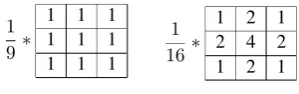
[image:2.595.316.466.553.600.2]Smoothing or blurring is a method to attenu-ate the most frequent image pixels. It is typically used to reduce image noise. Gonzales and Woods (2002) (p. 119-125) presents smoothing windows (Figure 1),
Figure 1: Smoothing windows
histograms, morphology, genetic algorithms, and marginal noise removal. The filtering techniques Gaussian, Sharpen, and Mean are compared, and it is noted that Gaussian blur is best for creat-ing clear and smooth images. Droettboom (2003) mentions problem with broken and touching char-acters in recognizing older documents, and pro-poses broken character connection algorithm us-ing k-nearest neighbours, which is able to find and join 91% of the broken characters. Original, blurred and some binarization methods for four different images can be seen below in Figure 2.
Figure 2: a) Grayscale(left) , b) Gaussian blur c) Niblack, d) Sauvola e) WolfJolion, f) Howe 367.
Image histogram presents image grayscale val-ues(x) between 0-255 and frequencies(y) for all of the image pixels, where value 0 is black and 255 is white. It is a common way to visualize the im-age contents. According to Krutsch and Tenorio (2011) histogram equalization methods are His-togram expansion, Local area hisHis-togram equal-ization, Cumulative Histogram Equalequal-ization, Par Sectioning and Odd Sectioning. These methods try to improve the dynamic range of the image. High dynamic range means same as high contrast. Typically images with low contrast are visually very dull, grayish.
Linear normalization is also called contrast stretching or histogram expansion. Below in Equation 4, a linear transformation function is shown. This function is utilized to map the origi-nal images pixel values for broader range.
y=ymax∗ x−xmin
xmax−xmin (4)
Histogram equalization is another more ad-vanced method for enchancing image contrast. It differs from linear transformation by using sta-tistical probability distributions instead of linear functions. Image pixel probability density func-tion (PDF) and cumulative density funcfunc-tion (CDF)
are utilized to to calculate new image gray levels. However, global methods had problems with vary-ing intensities inside the image. Thus an Adaptive Histogram Equalization (AHE) was developed. It partitions the image usually to 8 x 8 windows. For each of these image windows sub-histogram is used to equalize each window separately, but still AHE created problematic artifacts inside regions that contained noise, but no text.
[image:3.595.73.288.235.351.2]Pizer et al. (1990) developed Contrast Limited Adaptive Histogram Equalization (CLAHE) that was limiting the error in the AHE. CLAHE uses the slope of transform function. It clips the top part of histogram (by predefined clip limit value) before calculating the CDF for each of the images in sliding window (see figure 3). The clipping re-duces the over-amplification AHE had. Result im-age depends from window size and clip limit, and are selected by the user.
Figure 3: CLAHE histogram clipping from Stan-hope (2016)
Below in Figure 4 results of contrast improve-ment methods are shown. CLAHE histogram has clearly equalized more than the linear normalized image.
[image:3.595.310.480.333.399.2] [image:3.595.311.524.536.683.2]Skewing can also be a problem and it can be solved by skew detection and deskewing. Accord-ing to Parashar and Sogi (2012) common meth-ods for skew detection are Hough transform, pro-jection profile and principal component analysis. Skew can be single or multiple. In multiple skew multiple parts of the document are skewed in dif-ferent angle, and in single skew the image has been skewed only to one angle. We are dealing with multiple skew documents. More information about deskewing can be found from (Smith, 1995; Makkar and Singh, 2012). Our method does not use deskewing so far, but it could be included to possibly improve the accuracy.
Multiple other image processing methods ex-ist, too. Image processing methods are widely re-searched for the use of historical document pro-cessing. For example annual International Con-ference on Document Analysis and Recognition DIBCO competition offers new methods for his-torical document image processing (Pratikakis et al., 2013; Ntirogiannis et al., 2014; Howe, 2013).
3 Method
We created a model for Finnish Fraktur charac-ter recognition for Tesseract. Afcharac-ter that we run Tesseract OCR with different image preprocessing methods and chose the best one, by comparing the average confidence measure documents have. We used the hOCR-format8, which is an open standard for presenting OCR results and it has confidence value for each word given by the used OCR tool. The average of Tesseract’s word confidences in a document is used in this method.
Creation of Finnish Fraktur model was started by using German Fraktur model as a baseline. The Fraktur model was iteratively improved. The char-acters that had most errors were improved in train-ing data boxes (letters and two letter combina-tions). Then Tesseract is run 1 to N times with the developed Finnish Fraktur model and already existing Finnish Antiqua model9 in dual model mode, where it selects best choice from Fraktur and Antiqua results.
The images passed into Tesseract OCR on each run are either no processing, or processed by some image processing methods. In case of 1 run that run is selected as a final document, and in case of 2-N runs, the final resulting document is
se-8https://kba.github.io/hocr-spec/1.2/
9https://github.com/tesseract-ocr/langdata/tree/master/fin
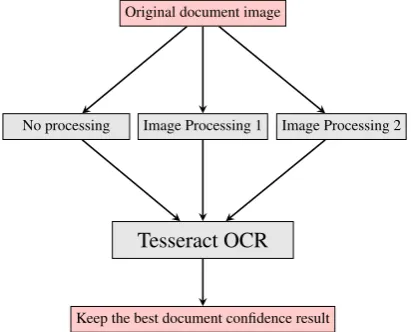
lected by the highest document confidence mea-sure value. Our proposed solution for preprocess-ing and OCRpreprocess-ing uspreprocess-ing the obtained Finnish Frak-tur model can be seen below in Figure 5. Tesseract has build in Otsu’s binarization so actually no pro-cessing means running the Otsu’s algorithm be-fore OCR. Otsu is also run inside Tesseract bebe-fore OCR for all other methods.
Original document image
No processing Image Processing 1 Image Processing 2
Tesseract OCR
[image:4.595.306.512.185.351.2]Keep the best document confidence result
Figure 5: Proposed OCR method
4 Experiments
4.1 Data
For training the Finnish Fraktur model we used 72 images. The images contained 34 newspaper page images from our newspaper collection, and 38 synthetically created images with one column texts with various Finnish Fraktur fonts. The doc-uments were manually boxed by using a box edi-tor10. Training data contained 184,852 characters and two character combinations. Testing data was a proofread set of 462 scanned newspaper pages. It contained 530,579 word tokens, 4,175,710 char-acters. 434 pages were Fraktur, and the rest partly Fraktur and/or Antiqua pages.
4.2 Accuracy measure
As accuracy measures we use word error rate (WER) and character accuracy rate (CER)11. They are defined below in Equations 5 and 6.
CER= i+s+d
n (5)
10https://github.com/zdenop/qt-box-editor
where n is the total number of characters in ref-erence text, i is the minimal number of insertions, s is substitutions and d is deletions on character level to obtain the reference text.
W ER= iw+sw+dw
nw (6)
where nwis the total number of words in reference text, iwis the minimal number of insertions, swis substitutions and dw is deletions on word level to obtain the reference text. Smaller WER and CER means better quality for words and characters. For the WER results Impact centre’s accuracy evalu-tion tool developed by Carrasco (2014) was uti-lized in this research. The Fraktur model CER re-sults were compared by utilizing the Information Science Research Institute’s OCR accuracy tool developed by Rice and Nartker (1996).
4.3 Results
WER results for the different runs of our method can be seen below in Table 1. Result of ABBYY FineReader 11 and 7 or 8 are shown as a base-line, our method with different image processing methods and an Oracle are given as comparison. In our method, Tesseract was run with two mod-els (Fraktur and Antiqua), where Tesseract selects the better one as a result. Oracle is the best result of the combined 2-4 images based on the resulting WER.
Method Result Oracle ABBYY FineReader 11 20.94 N/A ABBYY FineReader 7 or 8 26.23 N/A Tesseract (fi frak mk41+fin)
original (otsu) 23.32 N/A
gaussian blur 24.24 N/A
sauvola 39.49 N/A
wolf 22.67 N/A
clahe 29.19 N/A
l.norm 23.36 N/A
clahe+wolf 32.67 N/A
l.norm+wolf 22.76 N/A
Combined 2
l.norm+wolf,clahe+wolf 20.30 19.42 clahe+wolf,orig 20.40 19.30 clahe+wolf,blur 20.58 19.44 clahe+wolf,wolf 19.98 19.19
Combined 3
clahe+wolf,wolf,blur 19.58 17.53 l.norm+wolf, clahe+wolf,blur 19.68 17.57 l.norm+wolf, clahe,orig 19.69 17.99 l.norm, clahe+wolf,wolf 19.14 17.69 Combined 4
[image:5.595.312.524.61.200.2]l.norm, clahe+wolf,orig,blur 19.11 17.61 l.norm, clahe+wolf,orig,wolf 19.32 16.94 l.norm+wolf, clahe+wolf,orig,blur 19.41 16.94 l.norm+wolf, clahe+wolf,orig,wolf 19.02 17.50
Table 1: WER results, the best of each 1-4 runs on bold (smaller is better)
[image:5.595.310.530.457.527.2]CER results for the Fraktur model for original images can be seen below in Figure 3 and 4. The figures present the most frequent character errors, and their correctness percentage for the Fraktur model, respectively.
[image:5.595.85.277.523.757.2]Figure 6: Most frequent character errors
Figure 7: Correctness percentage
4.4 Execution times
Tesseract was run on IT Centre for Science (CSC)12 machines on 8 core Intel 2.6GHz CPU, 2GB RAM, in Red Hat Enterprise Linux 7 (64-bit) virtual environment, in 8 document batches by GNU parallel, developed by Tange (2011). ABBYY FineReader 11 was run on 1 core Intel 2.6GHz CPU, 4GB RAM, in Windows Server (32-bit) virtual environment. Decoding speeds for the Tesseract and ABBYY FineReader were 722,323 tokens/hour and 30,626 tokens/hour, respectively. Re-OCRing millions of pages is feasible using multiple CSC machines in parallel.
5 Conclusions
We have described a method for improving the Tesseract OCR toolkit for Finnish historical doc-uments. In the tests Tesseract was run in dual model mode using created Finnish Fraktur model and Finnish Antiqua model, and selecting the best document by its confidence value with different 2-4 image combinations. This method has clearly outperformed the ABBYY FineReader results.
The best method was achieved by combining four methods (Linear Normalization + WolfJo-lion, Contrast Limited Adaptive Histogram Equal-ization+WolfJolion, original image and WolfJo-lion), which improves the word level quality of OCR by 1.91 percentage points (which is 9.16%) against the best result on FineReader 11 and by 7.21 percentage points (which is 27.48%) against the FineReader 7 and 8. It is great that FineReader 11 results have clearly improved from an earlier FineReader results. However, our current whole collection have been run only on FineReader 7 and 8, and the FineReader 11 is not feasible to be run for the whole collection due to the current licenc-ing policy. Therefore, our method would correct about 84.6 million words (27.48%) more in the current 1.06 million Finnish newpaper page col-lection (containing Finnish language). However, it can still be improved. The method is 2.08 percent-age points from the optimal Oracle result (16.94). The character accuracy results for Fraktur model show that characters u, m and w have under 80 percent correctness. These letters are overlap-ping with letters such as n and i. It seems, how-ever, that if accuracy for one of them is increased accuracy of others will decrease. Possibly also letter ¨a could be improved, though is has similar overlapping with letters a and ˚a. From 20 most frequent errors only five are under 80% correct. Still, the Fraktur model could be developed more, possibly to recognize also bold letters.
Tesseract’s document confidence value can be used to find the weak quality documents for fur-ther processing. However, it is not a perfect measure when comparing and/or combining other model results together. The confidence measure could possibly be improved by integrating it with a morphological tool, that checks words after OCR, and then weights the confidence measure for each word. The image quality is one of the most impor-tant factors in the recognition accuracy, so further research with image processing algorithms should
continue. In addition to utilizing the confidence measure value, methods to determine noise level in the image could possibly be utilized to choose only bad quality images for further preprocessing.
Acknowledgments
This research was supported by European Re-gional Development Fund (ERDF), University of Helsinki, Mikkeli University Consortium and the City of Mikkeli. (Project Digitalia)
References
R. C. Carrasco. 2014. An open-source OCR evalua-tion tool. InDATeCH ’14 Proceedings of the First International Conference on Digital Access to Tex-tual Cultural Heritage, pages 179–184.
M. Droettboom. 2003. Correcting broken characters in the recognition of historical documents. InJCDL 03 Proceedings of the 3rd ACM/IEEE-CS joint con-ference on Digital libraries, pages 364–366.
A. El Harraj and N. Raissouni. 2015. Ocr accuracy im-provement on document images through a novel pre-processing approach. InSignal & Image Processing : An International Journal (SIPIJ), volume 6, pages 114–133.
J. Evershed and K. Fitch. 2014. Correcting Noisy
OCR: Context beats Confusion (2014). InDATeCH
’14 Proceedings of the First International Confer-ence on Digital Access to Textual Cultural Heritage, pages 45–51.
G. Ganchimeg. 2015. History document image
back-ground noise and removal methods. In
Interna-tional Journal of Knowledge Content Development & Technology, volume 5, pages 11–24.
R. C. Gonzales and R. E. Woods. 2002. Digital Image Processing. Prentice-Hall.
M. Heli´nski, M. Kmieciak, and T. Parkoła. 2012. Re-port on the comparison of Tesseract and ABBYY FineReader OCR engines. Technical report, Pozna´n Supercomputing and networking center, Poland.
N. Howe. 2013. Document Binarization with Auto-matic Parameter Tuning. In Journal International Journal on Document Analysis and Recognition, volume 16, pages 247–258.
K. Kettunen, T. P¨a¨akk¨onen, and M. Koistinen. 2016. Between diachrony and synchrony: evaluation of lexical quality of a digitized historical Finnish news-paper collection with morphological analyzers. In
Baltic HLT 2016, volume 289, pages 122–129.
R. Krutsch and D. Tenorio. 2011. Histogram Equal-ization, Application Note. Technical report.
D. Lopresti. 2009. Optical character recognition er-rors and their effects on natural language processing. InInternational Journal on Document Analysis and Recognition, volume 12, pages 141–151.
N. Makkar and S Singh. 2012. A Brief tour to various Skew Detection and Correction Techniques. In In-ternational Journal for Science and Emerging Tech-nologies with Latest Trend, volume 4, pages 54–58.
W. Niblack. 1986. An Introduction to Image
Pro-cessing, volume SMC-9. Prentice-Hall, Eaglewood Cliffs, NJ.
K. Ntirogiannis, B. Gatos, and I. Pratikakis. 2014. ICFHR2014 Competition on Handwritten
Docu-ment Image Binarization (H-DIBCO 2014). In2014
14th International Conference on Frontiers in Hand-writing Recognition, pages 809–813.
N. Otsu. 1979. A Threshold Selection Method from
Gray-Level Histograms. In IEEE Transactions on
Systems, Man and Cybernetics, volume SMC-9, pages 62–66.
S. Parashar and S. Sogi. 2012. Finding skewness and deskewing scanned document. 3(4):1619–1924.
S. M. Pizer, R. E. Johnston, J. P. Ericksen, B. C. Yankaskas, and K. E. Muller. 1990. Contrast Lim-ited Histogram Equalization Speed and Effective-ness.
I. Pratikakis, B. Gatos, and K. Ntirogiannis. 2013. IC-DAR 2013 Document Image Binarization Contest (DIBCO 2013). In2013 12th International Confer-ence on Document Analysis and Recognition, pages 1471–1476.
S. V. Rice and T. A. Nartker. 1996. The ISRI Analytic Tools for OCR Evaluation Version 5.1. Technical re-port, Information Science Research Institute (ISRI).
J. Sauvola and M. Pietik¨ainen. 1999. Adaptive Docu-ment Image Binarization. InThe Journal of the Pat-tern recognition society, volume 33, pages 225–236.
M. Segzin and B. Sankur. 2004. Survey over im-age thresholding techniques and quantitative perfor-mance evaluation.
R. Smith. 1995. A Simple and Efficient Skew De-tection Algorithm via Text Row Algorithm. In Pro-ceedings 3rd ICDAR’95, IEEE (1995), pages 1145– 1148.
R. Smith. 2007. An Overview of the Tesseract OCR
Engine. In Proc. Ninth Int. Conference on
Doc-ument Analysis and Recognition (ICDAR), IEEE (1995), pages 629–633.
M. L. Smitha, P. J. Antony, and D. N. Sachin. 2016. Document Image Analysis Using Imagemagick and Tesseract-ocr. InInternational Advanced Research Journal in Science, Engineering and Technology (IARJSET), volume 3, pages 108–112.
T. Stanhope. 2016. Applications of Low-Cost Com-puter Vision for Agricultural Implement Feedback and Control.
O. Tange. 2011. GNU Parallel - The Command-Line
Power Tool. InThe USENIX Magazine, pages 42–
47.
S. Tanner, T. Mu˜noz, and P. Hemy Ros. 2009. Measur-ing Mass Text Digitization Quality and Usefulness. Lessons Learned from Assessing the OCR Accuracy of the British Library’s 19th Century Online News-paper Archive. 15(7/8).