22
The Strength of the Weakest Supervision:
Topic Classification Using Class Labels
Jiatong Li1, Kai Zheng2, Hua Xu3, Qiaozhu Mei4, Yue Wang5 1Department of Computer Science, Rutgers University
2Department of Informatics, University of California, Irvine
3School of Biomedical Informatics, The University of Texas Health Science Center at Houston 4School of Information, University of Michigan, Ann Arbor
5School of Information and Library Science, University of North Carolina at Chapel Hill
1[email protected], 2[email protected], 3[email protected],
4[email protected], 5[email protected]
Abstract
When developing topic classifiers for real-world applications, we begin by defining a set of meaningful topic labels. Ideally, an intelli-gent classifier can understand these labels right away and start classifying documents. Indeed, a human can confidently tell if a news article is about science, politics, sports, or none of the above, after knowing just the class labels.
We study the problem of training an initial topic classifier using only class labels. We in-vestigate existing techniques for solving this problem and propose a simple but effective approach. Experiments on a variety of topic classification data sets show that learning from class labels can save significant initial label-ing effort, essentially providlabel-ing a “free” warm start to the topic classifier.
1 Introduction
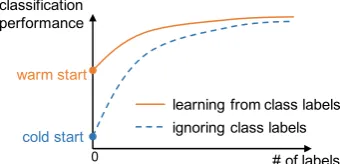
When developing topic classifiers for real-world tasks, such as news categorization, query intent detection, and user-generated content analysis, practitioners often begin by crafting a succinct definition, or a class label, to define each class. Unfortunately, these carefully written class labels are completely ignored by supervised topic clas-sification models. Given a new task, these mod-els typically require a significant amount of la-beled documents to reach even a modest initial performance. In contrast, a human can read-ily understand new topic categories by reading the class definitions and making connections to prior knowledge. Labeling initial examples for ev-ery new task can be time-consuming and labor-intensive, especially in resource-constrained do-mains like medicine and law. Therefore it is de-sirable if a topic classifier can proactively interpret class labels before the training starts, giving itself a “warm start”. An imperfect initial model can al-ways be fine-tuned with more labeled documents.
# of labels classification
performance
learning from class labels ignoring class labels
cold start warm start
[image:1.595.333.506.225.307.2]0
Figure 1: Learning from class labels can give “warm start” to a classifier, accelerating the learning process.
As conceptually shown in Figure1, a warm start can reduce the total number of training labels for a classifier to reach certain performance level.
In this work, we study algorithms that can ini-tialize a topic classifier using class labels only. Since class labels are the starting point of any topic classification task, they can be viewed as the ear-liest hence weakest supervision signal. We pro-pose a simple and effective approach that com-bines word embedding and naive Bayes classifi-cation. On six topic classification data sets, we evaluate a suite of existing approaches and the pro-posed approach. Experimental results show that class labels can train a topic classifier that gener-alizes as well as a classifier trained on hundreds to thousands of labeled documents.
2 Related Work
by self-training: the classifier assigns pseudo la-bels to top-ranked documents as done in pseudo relevance feedback (Rocchio, 1965), and updates itself using those labels.
Semi-supervised learning. Our problem set-ting can be seen as anextreme caseof weak super-vision: we only use class labels as the (noisy) su-pervision signal, and nothing else. If we view class labels as “labeled documents”, one from each class, and to-be-classified documents as unlabeled documents, then we cast the problem as semi-supervised learning (Zhu, 2006). Self-training is one such technique: a generative classifier is trained using only class labels, and then teaches itself using its own predictions on unlabeled data. If we view class labels as “labeled features”, then we expect the classifier to predict a class when a document contains the class label words. For in-stance, Druck et al. (2008) proposed generalized expectation criteria that uses feature words (class labels) to train a discriminative classifier. Jagarla-mudi et al.(2012) andHingmire and Chakraborti (2014) proposed Seeded LDA to incorporate la-beled words/topics into statistical topic modeling. The inferred document-topic mixture probabilities can be used to classify documents.
Zero-shot learningaims to classify visual ob-jects from a new class using only word descrip-tions of that class (Socher et al., 2013). It first learns visual features and their correspondence with word descriptions, and then constructs a new classifier by composing learned features. Most research on zero-shot learning focuses on image classification, but the same principle applies to text classification as well (Pushp and Srivastava, 2017). Our proposed method constructs a new classifier by composing learned word embeddings in a probabilistic manner. Since the new classifier transfers semantic knowledge in word embedding to topic classification tasks, it is broadly related totransfer learning(Pan and Yang, 2010). The main difference is that in transfer learning the in-formation about the new task is in the form of la-beled data, not class definition words.
3 Proposed Method
Let a test document x be a sequence of words
(w1,· · · , wj,· · ·), and a class topic descriptiony be a sequence of wordsdy = (w1,· · ·, wy,· · ·). All words are in vocabularyV. We propose a gen-erative approach, where the predictive
probabil-ityp(y|x) ∝ p(x|y)p(y). Generative approaches tends to perform well when training data is scarce, which is the case in our setting.
We assume there exists weak prior knowledge on which classes are popular and which are rare. We can then construct rough estimatespˆ(y)using simple heuristics as described in (Schapire et al., 2002). It distributes probability mass q evenly among majority classes, and1−q evenly among minority classes. We treat the most frequent class as the majority class, the rest as minority classes, andq= 0.7in our experiments.
By interpreting class topic description as words, we obtainpˆ(x|y) = p(x|dy). We assume that the dy expresses a noisy-OR relation of the words it contains (Oni´sko et al., 2001). Up to first-order approximation:
p(x|dy) = 1− Y
wy∈dy
(1−p(x|wy))
≈ X
wy∈dy
p(x|wy), (1)
where eachwyis a word in the class topic descrip-tion dy. Further, we assume that words in docu-mentxare conditionally independent given a label wordwy (na¨ıve Bayes assumption):
p(x|wy) = Y
wj∈x
p(wj|wy). (2)
Combining (1) and (2), the document likelihood is
ˆ
p(x|y) = X
wy∈dy Y
wj∈x
p(wj|wy). (3)
To this end, we need a word association model p(w1|w2),∀w1, w2 ∈ V. It can be efficiently
learned by word embedding algorithms. The skip-gram algorithm (Mikolov et al.,2013) learns vec-tor representations of words, such that for words w1, w2, their vectors uw1,vw2 approximate the conditional probability1
p(w1|w2) =
exp u>w1vw2
P
w∈V exp (u>wvw2)
. (4)
1
The two sets of word vectors {uw:w∈V} and {vw:w∈V}produced by skip-gram correspond to the
Combining (3) with (4), the document likelihood becomes
ˆ
p(x|y) = X
wy∈dy
exp
X
wj∈x
u>wjvwy−Cwy
,
where Cwy = log P
w∈V exp u>wvwy
is inde-pendent of documentx and only related to label wordwy, therefore can be precomputed and stored to save computation.
Finally, we construct an generative classifier as
ˆ
p(y|x) ∝ pˆ(x|y)ˆp(y). We call this methodword embedding na¨ıve Bayes(WENB).
3.1 Continued Training
The proposed method produces pseudo labels
ˆ
p(y|xj)for unlabeled documents{xj}mj=1. When true labels{(xi, yi)}ni=1are available, we can train
a new discriminative logistic regression classifier pθ(y|x)using both true and pseudo labels (θis the model parameter):
J(θ) =
n X
i=1
X
y∈Y
−1{yi=y}logpθ(y|xi) +λkθk
2
+µ m X
j=1
X
y∈Y
−pˆ(y|xj) logpθ(y|xj). (5)
To find the balance of pseudo vs. true labels in (5), we search the hyperparameter µ on a 5-point grid {10−2,10−1,0.4,0.7,1}. We expect pseudo labels to have comparable importance as true labels when n is small (fine granularity for µ ∈ [10−1,1]), and their importance will dimin-ish asngets large (µ= 10−2).µis automatically selected such that it gives the best 5-fold cross-validation accuracy onntrue labels.
4 Experiments
We compare a variety of methods on six topic clas-sification data sets. The goals are (1) to study the best classification performance achievable using class labels only, and (2) to estimate the equiva-lent amount of true labels needed to achieve the same warm-start performance.
4.1 Compared Methods
Retrieval-based methods. We use language mod-eling retrieval function with Dirichlet smoothing (Zhai and Lafferty,2001) (µ = 2500) to match a document to class labels (IR). The top10 results
are then used as pseudo-labeled documents to re-train three classifiers: IR+Roc: a Rocchio classi-fier (α = 1, β = 0.5, γ = 0); IR+NB: a multi-nomial naive Bayes classifier (Laplace smoothing, α = 0.01);IR+LRa logistic regression classifier (linear kernel,C= 1).
Semi-supervised methods. ST-0: the ini-tial self-training classifier using class labels as “training documents” (multinomial na¨ıve Bayes, Laplace smoothing α = 0.01). ST-1: ST-0 retrained on 10 most confident documents pre-dicted by itself. GE: a logistic regression classi-fier trained using generalized expectation criteria (Druck et al.,2008). Class labels are used as la-beled features. sLDA: a supervised topic model trained using seeded LDA (Jagarlamudi et al., 2012). Besidesk seeded topics (k is the number of classes), we use an extra topic to account for other content in the corpus.
Word embedding-based methods. Cosine: a centroid-based classifier, where class definitions and documents are represented as average of word vectors. WENB: The proposed method (Section 3). WENB+LR: a logistic regression classifier trained only on pseudo labels produced by WENB (Section3.1,n= 0).
For general domain tasks, we take raw text from English Wikipedia, English news crawl (WMT, 2014), and 1 billion word news corpus (Chelba et al., 2013) to train word vectors. For medical domain tasks, we take raw text from MEDLINE abstracts (NLM,2018) to train word vectors. We find 50-dimensional skip-gram word vectors per-form reasonably well in the experiments.
4.2 Data Sets
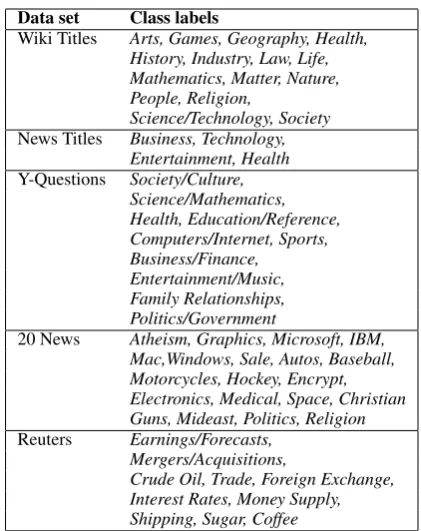
We consider six topic classification data sets with different document lengths and application do-mains. Table1summarizes basic statistics of these data sets. Table4and5in the appendix show ac-tual class labels used in each data set.
Data set Avg word/doc # classes # docs
Wiki Titles 3.1 (1.1) 15 30,000 News Titles 6.7 (9.5) 4 422,937 Y Questions 5.0 (2.6) 10 1,460,000 20 News 101.6 (438.5) 20 18,846 Reuters 76.5 (117.3) 10 8,246 Med WSD 202.8 (46.6) 2/task 190/task
Wiki Titles News Titles Y Questions 20 News Reuters Med WSD
Majority guess .83 13.26 1.82 .48 6.47 34.20 IR 3.14 (.25) 14.20 (.06) 6.15 (.06) 19.57 (.95) 8.37 (.55) 52.99 (.64) IR+Roc 2.93 (.24) 14.20 (.06) 8.35 (1.12) 25.09 (.93) 19.33 (1.87) 59.89 (.54) IR+NB 5.44 (.53) 32.98 (2.13) 14.45 (.45) 30.45 (1.46) 62.59 (2.43) 82.12 (.41)
IR+LR 3.26 (.30) 13.44 (.10) 7.38 (2.08) 34.76 (1.50) 6.48 (.07) 68.35 (.38) ST-0 3.16 (.32) 16.03 (.16) 6.15 (.02) 19.49 (.98) 6.79 (.17) 69.11 (.26) ST-1 5.62 (.29) 24.34 (.36) 10.02 (.49) 22.91 (1.29) 55.77 (1.62) 82.97 (.56)
GE 9.55 (.90) 14.54 (.08) 31.72 (.05) 48.71 (.41) 21.65 (27.36) 62.63 (.37) sLDA 7.07 (0.97) 51.16 (8.10) 40.98 (2.61) 24.80 (4.98) 30.61 (4.80) 69.81 (1.09) Cosine 27.67 (.59) 33.49 (.11) 31.16 (.03) 26.19 (.75) 6.56 (.16) 32.65 (.19)
WENB 26.70 (.48) 63.02 (.10) 44.89 (.06) 32.23 (.48) 34.99 (1.99) 68.27 (.20)
[image:4.595.96.503.62.195.2]WENB+LR 24.88 (.39) 63.76 (.11) 45.69 (.09) 30.57 (.71) 32.04 (1.44) 62.57 (.19)
Table 2:Macro-averagedF1(%) of compared methods on different data sets. The numbers are “mean (standard deviation)” of 5-fold cross validation. Top two numbers in each column are highlighted inboldface.
Data set # of labels
Wiki Titles 1500 News Titles 200 Y Questions 1500-2000 20 News 100-200 Reuters 100-200
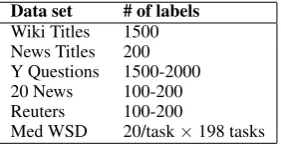
Med WSD 20/task×198 tasks
Table 3: Number of true labels needed for a logistic regression classifier to achieve the same performance as “WENB+LR”.
Three short text data sets are (1) Wiki Titles: Wikipedia article titles sampled from 15 main cat-egories (Wikipedia Main Topic). (2)News Titles: The UCI news title data set (Lichman,2013). (3)
Y Questions: User-posted questions in Yahoo An-swers (Yahoo Language Data,2007).
Three long text data sets are (1)20 News: The well-known 20 newsgroup data set. (2)Reuters. The Reuters-21578 data set (Lewis). We take the articles from the 10 largest topics. (3)Med WSD: The MeSH word sense disambiguation (WSD) data set (Jimeno-Yepes et al.,2011).
Each WSD task aims to tell the sense (mean-ing) of an ambiguous term in a MEDLINE ab-stract. For instance, the term “cold” may refer to
Low Temperature, Common Cold, orChronic Ob-structive Lung Disease, depending on its context. These senses are used as the class labels. We use 198 ambiguous words with at least 100 labeled ab-stracts in the data set, and report the average statis-tics over 198 independent classification tasks.
Although no true labels are used for training, some methods require unlabeled data for retrieval, pseudo-labeling, and re-training. We split unla-beled data into 5 folds, using 4 folds to “train” a classifier and 1 fold for test. We use macro-averaged F1 as the performance metric because
not all data sets have a balanced class distribution.
4.3 Results and Discussion
Label savings. Table 2 shows that overall, class labels can train text classifiers remarkably better than majority guess. This is no small feat consid-ering that the classifier has not seen any labeled documents yet. Such performance gain essentially comes “for free”, as any text classification task has to start by defining classes. In Table3, we report the number of true labels needed for a logistic re-gression model to achieve the same performance as WENB+LR. The most significant savings hap-pen on short documents: class labels are equiv-alent to hundreds to thousands of labeled docu-ments at the beginning of the training process.
Effect of document length. On short docu-ments (Wiki Titles, News Titles, Y Questions), leveraging unlabeled data does not help with most semi-supervised methods due to severe vocabulary mismatch. The proposed methods (WENB and WENB+LR) show robust performance, because pretrained word vectors can capture semantic sim-ilarity even without any word overlap between a class label and a document. This prior knowl-edge is essential when documents are short. On long documents (20 News, Reuters, Med WSD), leveraging unlabeled data helps, since long doc-uments have richer content and are more likely to contain not only label words themselves, but also other topic-specific words. Retrieval-based and semi-supervised methods are able to learn these words by exploiting intra-document word co-occurrences.
[image:4.595.112.253.245.317.2]101 102 103 # true labels 0
[image:5.595.310.526.64.147.2]0.2 0.4 0.6 0.8 1
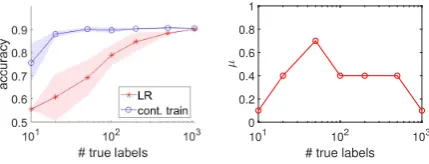
Figure 2: Continued training behavior:Atheismvs.
Autos. Colored band:±1standard deviation.
re-ranking (IR+Roc) is less useful than training classifiers (IR+NB and IR+LR). After initial re-trieval, training a na¨ıve Bayes classifier is almost always better than a logistic regression classifier (IR+NB vs. IR+LR), demonstrating the power of generative models when supervision signal is sparse. Using class labels as labeled features (GE and sLDA) performs well occasionally (GE on 20 News; sLDA on Y Questions), but not consis-tently. The Cosine method performs well only on Wiki Titles, the shortest documents, because without supervision, representing a long document as an average of word vectors causes significant information loss. Finally, it is encouraging to see WENB+LR sometimes outperform WENB, as WENB+LR is much smaller than WENB+LR in terms of model size.
4.4 Continued Training and Error Analysis
Figure2and3compare logistic regression classi-fiers trained with and without pseudo labels gen-erated by WENB. Note that the classifier trained with pseudo labels (cont. train) has a much lower performance variance than the logistic regression classifier trained only on true labels (LR).
The warm-started classifier can serve as a good starting point for further training. Figure2shows a salient warm-start effect on a balanced binary clas-sification task in 20 News. The weightµof pseudo labels increases when true labels are few (initial classifier as an informative prior). As expected,µ decreases when true labels become abundant.
Figure 3 shows another binary classification task in 20 News where the warm-start effect is limited. Correspondingly, µ quickly diminishes as more true labels are available. With 100 or more true labels, pseudo labels have a negligible weight (µ = 10−2). In machine learning terms, these pseudo labels specify an incorrect prior that the model should quickly forget, so that it will not hinder the overall learning process.
101 102 103
# true labels 0
0.2 0.4 0.6 0.8 1
Figure 3: Continued training behavior:Medicalvs.
Mideast. Colored band:±1standard deviation.
A closer investigation reveals that the word vec-tor formideast(the class label of one topic in Fig-ure3) is not well-trained. This is because in gen-eral text corpus, the wordmideast is rather infre-quent compared to commonly used alternatives, such asmiddle east. The word vector ofmideast
is surrounded by other infrequent words or mis-spellings (such ashizballah,jubeir,saudis,isreal) as opposed to more frequent and relevant ones (such asisrael,israeli,saudi,arab). Since WENB uses the semantic knowledge in word vectors to infer pseudo labels, the quality of class label word vectors will affect the pseudo label accuracy.
5 Conclusion and Future Directions
We studied the problem of training topic classi-fiers using only class labels. Experiments on six data sets show that class labels can save a sig-nificant amount of labeled examples in the begin-ning. Retrieval-based and semi-supervised meth-ods tend to perform better on long documents, while the proposed method performs better on short documents.
[image:5.595.75.290.66.148.2]Acknowledgments
We thank the anonymous reviewers for their help-ful comments. This work was in part supported by the National Library of Medicine under grant number 2R01LM010681-05. Qiaozhu Mei’s work was supported in part by the National Science Foundation under grant numbers 1633370 and 1620319. Yue Wang would like to thank the sup-port of the Eleanor M. and Frederick G. Kilgour Research Grant Award by the UNC-CH School of Information and Library Science.
References
2014. WMT 2014 English News Crawl.
http://www.statmt.org/wmt14/ training-monolingual-news-crawl.
Ricardo Baeza-Yates, Berthier de Ara´ujo Neto Ribeiro, et al. 2011. 8.3.2 Naive Text Classification, chap-ter 8. New York: ACM Press; Harlow, England: Addison-Wesley,.
Ciprian Chelba, Tomas Mikolov, Mike Schuster, Qi Ge, Thorsten Brants, Phillipp Koehn, and Tony Robin-son. 2013. One billion word benchmark for measur-ing progress in statistical language modelmeasur-ing. arXiv preprint arXiv:1312.3005.
W Bruce Croft, Donald Metzler, and Trevor Strohman. 2010. Retrieval Models, chapter 7. Addison-Wesley Reading.
Gregory Druck, Gideon Mann, and Andrew McCal-lum. 2008. Learning from labeled features using generalized expectation criteria. In Proceedings of the 31st annual international ACM SIGIR confer-ence on Research and development in information retrieval, pages 595–602. ACM.
Swapnil Hingmire and Sutanu Chakraborti. 2014. Topic labeled text classification: a weakly super-vised approach. In Proceedings of the 37th inter-national ACM SIGIR conference on Research & de-velopment in information retrieval, pages 385–394. ACM.
Jagadeesh Jagarlamudi, Hal Daum´e III, and Raghaven-dra Udupa. 2012. Incorporating lexical priors into topic models. In Proceedings of the 13th Confer-ence of the European Chapter of the Association for Computational Linguistics, pages 204–213. Associ-ation for ComputAssoci-ational Linguistics.
Antonio J Jimeno-Yepes, Bridget T McInnes, and Alan R Aronson. 2011. Exploiting mesh indexing in medline to generate a data set for word sense dis-ambiguation. BMC bioinformatics, 12(1):223.
David D. Lewis. Reuters-21578. http: //www.daviddlewis.com/resources/ testcollections/reuters21578.
M Lichman. 2013. Uci machine learning repository [http://archive. ics. uci. edu/ml]. university of cali-fornia, school of information and computer science.
Irvine, CA.
Tomas Mikolov, Ilya Sutskever, Kai Chen, Greg S Cor-rado, and Jeff Dean. 2013. Distributed representa-tions of words and phrases and their compositional-ity. InAdvances in neural information processing systems, pages 3111–3119.
NLM. 2018. MEDLINE/PubMed Data.
ftp://ftp.ncbi.nlm.nih.gov/pubmed/ baseline.
Agnieszka Oni´sko, Marek J Druzdzel, and Hanna Wa-syluk. 2001. Learning bayesian network parame-ters from small data sets: Application of noisy-or gates. International Journal of Approximate Rea-soning, 27(2):165–182.
Sinno Jialin Pan and Qiang Yang. 2010. A survey on transfer learning. IEEE Transactions on knowledge and data engineering, 22(10):1345–1359.
Pushpankar Kumar Pushp and Muktabh Mayank Sri-vastava. 2017. Train once, test anywhere: Zero-shot learning for text classification. arXiv preprint arXiv:1712.05972.
J. J. Rocchio. 1965. Relevance feedback in information retrieval, report no. ISR-9 to the National Science Foundation, The Computation Laboratory of Har-vard University, to appear August.
Robert E Schapire, Marie Rochery, Mazin Rahim, and Narendra Gupta. 2002. Incorporating prior knowl-edge into boosting. InICML, volume 2, pages 538– 545.
Richard Socher, Milind Ganjoo, Christopher D Man-ning, and Andrew Ng. 2013. Zero-shot learning through cross-modal transfer. In Advances in neu-ral information processing systems, pages 935–943.
Wikipedia Main Topic. Category:Main topic classifications. https://en.wikipedia. org/wiki/Category:Main_topic_
classifications.
Yahoo Language Data. 2007. Yahoo! Answers Comprehensive Questions and Answers version 1.0 (multi part). https://webscope.sandbox. yahoo.com/catalog.php?datatype=l.
Chengxiang Zhai and John Lafferty. 2001. A study of smoothing methods for language models applied to ad hoc information retrieval. InProceedings of 24th International ACM SIGIR Conference on Re-search and Development in Information Retrieval, pages 334–342.
A Class Labels Used in Each Data Set
Data set Class labels
Wiki Titles Arts, Games, Geography, Health, History, Industry, Law, Life, Mathematics, Matter, Nature, People, Religion,
Science/Technology, Society
News Titles Business, Technology, Entertainment, Health
Y-Questions Society/Culture, Science/Mathematics, Health, Education/Reference, Computers/Internet, Sports, Business/Finance,
Entertainment/Music, Family Relationships, Politics/Government
20 News Atheism, Graphics, Microsoft, IBM, Mac,Windows, Sale, Autos, Baseball, Motorcycles, Hockey, Encrypt, Electronics, Medical, Space, Christian Guns, Mideast, Politics, Religion
Reuters Earnings/Forecasts, Mergers/Acquisitions,
[image:7.595.314.518.64.562.2]Crude Oil, Trade, Foreign Exchange, Interest Rates, Money Supply, Shipping, Sugar, Coffee
Table 4: Class labels in 5 topic classification data sets.
Task (ambiguous term)
Class labels (senses)
AA Amino Acids,
Alcoholics Anonymous
ADA Adenosine Deaminase,
American Dental Association
ADH Alcohol dehydrogenase,
Argipressin
ADP Adenosine Diphosphate,
Automatic Data Processing
Adrenal Adrenal Glands, Epinephrine
Ala Alanine,
Alpha-Linolenic Acid, Aminolevulinic Acid
ALS Antilymphocyte Serum,
Amyotrophic Lateral Sclerosis
ANA American Nurses’ Association,
Antibodies, Antinuclear
Arteriovenous Anastomoses
Arteriovenous anastomosis procedure,
Structure of anatomic-arteriovenous anastomosis
Astragalus Talus,
Astragalus Plant
B-Cell Leukemia B-Cell Leukemia,
Chronic Lymphocytic Leukemia
BAT Chiroptera,
Brown Fat
BLM Bloom Syndrome,
Bleomycin
Borrelia Lyme Disease, Borrelia bacteria
BPD Bronchopulmonary Dysplasia,
Borderline Personality-Disorder
BR Brazil,
Bromides
Brucella abortus Brucella abortus infection, Brucella abortus bacterium
BSA Body Surface Area,
Bovine Serum Albumin
BSE Bovine
Spongiform-Encephalopathy, Breast Self-Examination
Ca Hippocampus (Brain),
Calcium, California, Canada
[image:7.595.75.286.89.355.2]