INESC-ID at SemEval-2016 Task 4-A: Reducing the Problem of
Out-of-Embedding Words
Silvio Amir, Ramon F. Astudillo, Wang Ling, M´ario J. Silva, Isabel Trancoso Instituto de Engenharia de Sistemas e Computadores Investigac¸˜ao e Desenvolvimento
Rua Alves Redol 9 Lisbon, Portugal
{samir,ramon.astudillo,wlin,mjs,isabel.trancoso}@inesc-id.pt
Abstract
We present the INESC-ID system for the 2016 edition of SemEval Twitter Sentiment Analy-sis shared task (subtask 4-A). The system was based on the Non-Linear Sub-space Embed-ding (NLSE) model developed for last year’s competition. This model trains a projection of pre-trained embeddings into a small sub-space using the supervised data available. De-spite its simplicity, the system attained perfor-mances comparable to the best systems of last edition with no need for feature engineering. One limitation of this model was the assump-tion that a pre-trained embedding was avail-able for every word. In this paper, we investi-gated different strategies to overcome this lim-itation by exploiting character-level embed-dings and learning representations for out-of-embedding vocabulary words. The resulting approach outperforms our previous model by a relatively small margin, while still attaining strong results and a consistent good perfor-mance across all the evaluation datasets.
1 Introduction
Pre-trained word embeddings provide a simple means to attain semi-supervised learning in Natu-ral Language Processing (NLP) tasks (Collobert et al., 2011). They can be trained with large amounts of unsupervised data and be fine tuned as the initial building block of a semi-supervised system. How-ever, in domains with a significant number of typos, use of slang and abbreviations, such as social me-dia, the high number of singletons leads to a poor fine tuning of the embeddings. In previous work,
we addressed this by learning a projection of the embeddings into a small sub-space (Astudillo et al., 2015b). This allowed us to attain representa-tions also for Out-Of-Vocabulary (OOV) words, pro-vided that embeddings for those words are avail-able. However, even if the embeddings are esti-mated from large amounts of unlabeled text, in noisy domains, such as Twitter, a significant number of words will not be seen and therefore will not have an embedding. We refer to those words as the Out-of-Embedding Vocabulary (OOEV).
In this paper, we focus on the problem of obtain-ing good representations for OOEV words. We ex-perimented with character to word models (C2W) and investigated different strategies for initializing and updating OOEVs from the available training data. The best results were attained by using the la-beled data to perform small updates to these repsentations in the first few epochs of training. The re-sulting system outperforms that of the previous eval-uation, although by a small margin. It ranks fourth in the 2016 evaluation with a consistently high per-formance in all years.
2 NLSE Model Overview
In this section, we briefly review the approach in-troduced in the 2015 evaluation (Astudillo et al., 2015a). For a particular regression or classification task, only a subset of all the latent aspects captured by the word embeddings will be useful. Therefore, instead of updating the embeddings directly with the available labeled data, we estimate a projection of these embeddings into a low dimensional sub-space. This simple method brings two fundamental
tages. Firstly, the lower dimensional embeddings re-quire fewer parameters fitting the complexity of the target task and the available training data. Secondly, the learned projection can be used to adapt the rep-resentations for all words with an embedding, even if they do not occur in the labeled dataset.
Assuming we are given a matrix of pre-trained embeddings, where each column represents a word from a vocabularyV, let such matrix be denoted by E ∈ Re×|V|, where e is the number of latent di-mensions. We define the adapted embedding ma-trix as the factorization S · E, where S ∈ Rs×e,
withs e. The parameters of matrix S are es-timated using the labeled dataset, whileE is kept fixed. In other words, we determine the optimal pro-jection of the embedding matrixEinto a sub-space of dimension s. In what follows, we will refer to this approach as Non-Linear Sub-space Embedding (NLSE) model.
The NLSE can be interpreted as a simple feed-forward neural network model (Rumelhart et al., 1985) with one single hidden layer utilizing the em-bedding sub-space approach. Let
m= [w1· · ·wn] (1)
denote a message of n words. Each column w∈ {0,1}v×1 of m represents a word in one-hot form, that is, a vector of zeros of the size of the vo-cabularyv with a 1 on thei-th entry of the vector. Lety denote a categorical random variable overK classes. The NLSE model, estimates the probabil-ity of each possible categoryy = k ∈ K given a messagemas
p(y=k|m;θ)∝exp (Yk·h·1) (2)
with parametersθ = {S,Y}. Here,h ∈ [0,1]e×n
are the activations of the hidden layer for each word, given by
h=σ(S·E·m) (3)
whereσ()is a sigmoid function acting on each
ele-ment of the matrix. The matrixY∈R3×smaps the
embedding sub-space to the classification space and 1 ∈ 1n×1 is a matrix of ones that sums the scores for all words together, prior to normalization. This is equivalent to a bag-of-words assumption. Finally, the model computes a probability distribution over theKclasses, using thesoftmaxfunction.
3 Out-of-Embedding Vocabulary Words
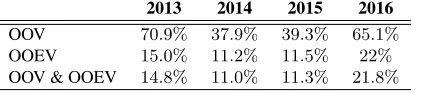
Despite the fact that word embeddings are typi-cally estimated from very large amounts of unla-beled data, it is often the case that a number of words appearing on the training or test sets are not present on the unlabeled corpus. These words will not be represented inE. This problem is even more significant in social media environments like Twit-ter, where there is a significant lexical variation and where novel words, expressions and slang can be in-troduced over time. In Table 1, we show the per-centage of OOV and OOEV words on each Twitter dataset.
The n¨aive way of dealing with this issue, is to sim-ply set the embeddings of unknown words to zero, essentially ignoring them. As will see later, a better approach is to treat these words as model parameters and use the training signal to learn a better represen-tation for them.
3.1 Character-level Embeddings
One natural way of avoiding OOEV in neural net-work models, is to learn character-level embeddings and define a composition function to combine them into word representations, thus obtaining represen-tations for any given word.
We experimented using C2W, a simple compo-sitional model for learning word representations, from character embeddings. Given a word w, the
C2W model generates a set of character n-grams
{c1, . . . , cm}, and projects each n-gram ci into a
vectoreci ∈Rd, wheredis the number of latent di-mensions. The individual character representations are then combined to obtain a fixed-size representa-tion for word w as ew = ec1 ⊕. . .⊕ ecm, where
⊕ denotes pointwise sum. These word representa-tions can be used as the input to a standard neural language model where the parameters are estimated from unlabeled data by learning to predict words within a context.
3.2 MappingC2WtoSSGEmbeddings
2013 2014 2015 2016 OOV 70.9% 37.9% 39.3% 65.1% OOEV 15.0% 11.2% 11.5% 22% OOV & OOEV 14.8% 11.0% 11.3% 21.8% Table 1: Out Of Vocabulary (OOV) and Ouf Of Embedding Vocabulary (OOEV) statistics for the different SemEval Task4-B datasets. Embeddings reported are the Structured Skipgram embeddings used in the experiments.
System 2013 2014 2015
[image:3.612.83.295.65.112.2]2015 hyperparameters 0.618 0.646 0.591 +lower neutral cost 0.706 0.702 0.669 +shuffle per epoch 0.723 0.721 0.649 +update OOEVs 2 iter 0.725 0.729 0.657 Best SemEval 2015 0.722 0.727 0.652
Table 2: Effect of the improvements on the NLSE model.
Structured Skip-Gram embeddings (SSG) (Ling et al., 2015), allowing us compute an approximateSSG
embedding for all the words. To this end, we first obtainedC, the set of words present in the two em-beddings spaces. Then, we learned a linear mapT by solving for the following objective:
T←argmin
T
X
w∈C
||T·cw−sw||2 (4)
where,cwdenotes theC2Wembedding for wordw
andswdenotes theSSGembedding for wordw. This
mapping, was then used to compute aSSG embed-dings for each OOEV assw0 =T·cw0.
3.3 Partial Update of Embeddings during Training
Given the small amount of supervised data, directly updating the embeddings with the SemEval train set leads to very poor results. It is however possible to update only the OOEV words present in the training set simultaneously to the computation of the sub-space (Astudillo et al., 2015a). To obtain positive results with this approach, it was also necessary to reduce the effect of training by lowering the learn-ing rate to0.001and updating the embeddings only
in the first two iterations.
4 Main Improvements over the 2015 NLSE
One complication with Twitter-based evaluations is the need of the participant to retrieve the tweets themselves, since some of the tweets may no longer be available. The INESC-ID system presented in 2015 employed a train set of 8604 tweets, consid-erably smaller than the original dataset (with 11328 tweets). For this edition, it was possible to get ahold of the full dataset, as utilized by Severyn and Mos-chitti (2015). For reproducibility and comparison purposes our systems this year were developed with this dataset.
The system presented in 2015 was very sim-ple both in its structure and the number hyper-parameters. Furthermore, tunning and selection of candidate systems was also performed without au-tomatic grid-search. It was therefore expected that our previous setup would outright produce better re-sults by training on a larger dataset. Disappointingly, this was not the case. In fact, the NLSE optimized for the 2015 competition seemed to be sitting on a local optimum that was difficult to come out from. To overcome this problem, we introduced two mod-ifications in the training procedure1. The NLSE is trained by minimizing the negative log-likelihood. This cost function is sub-optimal taking into account the evaluation metric, as it weights equally positive, negative and neutral predictions. A simple improve-ment over this cost is an asymmetric weighting that penalizes the predictions of neutral tweets. This was incorporated as a multiplicative factor on the log-likelihood of values4/3,4/3 and1/3 for the pos-itive, negative and neutral classes, respectively. To reduce the risk of getting trapped into a local mini-mum, the train data was shuffled before each train-ing epoch. The asymmetric cost and randomization led to a slower, less consistent convergence. For this reason the number of iterations was increased from 8 to 12. The learning rate was changed from0.01to 0.005. Table 2 shows the effect of the improvements
on the submitted system.
After introducing these two improvements, we in-vestigated different methods to address the prob-lem of OOEV as described in the previous
sec-1After paper revision the model inhttps://github.
tion. Namely those exploiting C2W embeddings, mappingC2W embeddings toSSGembeddings and training the embeddings for OOEVs. The results of these strategies are displayed in Table 3.
System 2013 2014 2015 2016 baseline 0.721 0.721 0.649 0.609
C2Wembeddings 0.659 0.689 0.613 0.543
C2W→SSG 0.724 0.715 0.652 0.613 update OOEVs 2 iter 0.723 0.728 0.656 0.610
Table 3: Comparision of strategies to address the problem of OOEV
5 The Submitted System
As mentioned in the previous section, the system submitted is an improvement over our 2015 sys-tem (Astudillo et al., 2015b). It therefore shares the same training characteristics as the previous model. The 52 million tweets used by Owoputi et al. (2013) and the tokenizer described in the same work were used to train the word embeddingsStructured Skip-Gram (SSG). For this submission, the C2W em-beddings were also trained using a publicly avail-able toolkit2. For the annotated SemEval training data, the messages were previously pre-processed as follows: lower-casing, replacing Twitter user men-tions and URLs with special tokens and reducing any character repetition to at most 3 characters. Fol-lowing Astudillo et al. (2015a), we used embeddings with600dimensions and set the sub-space size to10
dimensions.
To train the model, the development set was split into80%for parameter learning and20%for model
evaluation and selection, maintaining the original relative class proportions in each set. The weights were all randomly initialized uniformly with ranges of [−0.001,0.001], [−0.1,0.1] and [−0.7,0.7] for
the OOEVs, subspace and classification layers re-spectively. The training procedure entailed mini-mizing the negative log-likelihood over the train-ing data with respect to the parameters, ustrain-ing stan-dard Stochastic Gradient Descent (Rumelhart et al., 1985) with a fixed learning rate of0.005and
mini-batch of size1, i.e., updating the weights after each
message was processed. We reshuffled the training
2https://github.com/wlin12/wang2vec
System 2013 2014 2015 2016 Avg SwissCheese 0.7005 0.7165 0.6711 0.6331 0.6802
SENSEI-LIF 0.7064 0.7442 0.6622 0.6302 0.6861
unimelb 0.6877 0.7067 0.6514 0.6173 0.6654
INESC-ID 0.7232 0.7273 0.6573 0.6104 0.6793
aueb 0.6668 0.7086 0.6237 0.6055 0.6515
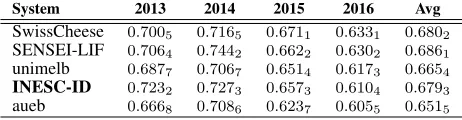
Table 4: Official test-set results for the top five sys-tems in SemEval 2016 Task 4-B. Subscript number indicates position in general ranking.
examples after each training epoch and performed model selection by early stopping after12iterations.
The candidate for submission was manually selected by observing the performance across 2013, 2014 and 2015 datasets. Priority was given to models that presented a consistent high performance in all the datasets. In retrospect, this was most probably a sub-optimal decision judging from the evaluation results. Table 4 displays the performance for the top 5 sys-tems in SemEval 2016 task 4-B (Nakov et al., 2016). The NLSE system (labeled INESC-ID) ranks forth with a stable performance across all years. The re-sults are particularly strong for 2013 with a differ-ence of 0.017points over the next best performing
system on the top five. This is consistent with the divide noticed during system selection between per-formance in 2013 and 2015. High-performing sys-tems in 2014, and particularly in 2013, do not appear to be equally performing in recent years.
6 Conclusions
We presented the INESC-ID system for the SemEval 2016 task 4-A, built on top of the successful Non-Linear Subspace Embedding model. We found that training with a larger dataset required a more careful procedure to avoid overfitting. Reproducing the best results obtained in SemEval 2015 required shuffling the data before each training epoch and adapting the cost function to better reflect the evaluation metric.
[image:4.612.310.541.64.124.2]Acknowledgments
This work was partially supported by Fundac¸˜ao para a Ciˆencia e Tecnologia (FCT), through contracts UID/CEC/50021/2013, EXCL/EEI-ESS/0257/2012 (DataStorm), grant number SFRH/BPD/68428/2010 and Ph.D. scholarship SFRH/BD/89020/2012.
References
Ram´on Astudillo, Silvio Amir, Wang Ling, Mario Silva, and Isabel Trancoso. 2015a. Learning word repre-sentations from scarce and noisy data with embedding subspaces. InProceedings of the 53rd Annual Meet-ing of the Association for Computational LMeet-inguistics and the 7th International Joint Conference on Natu-ral Language Processing (Volume 1: Long Papers), pages 1074–1084, Beijing, China, July. Association for Computational Linguistics.
Ramon F. Astudillo, Silvio Amir, Wang Ling, Bruno Martins, M´ario Silva, and Isabel Trancoso. 2015b. Inesc-id: Sentiment analysis without hand-coded fea-tures or liguistic resources using embedding sub-spaces. InProceedings of the 9th International Work-shop on Semantic Evaluation, SemEval ’2015, Denver, Colorado, June. Association for Computational Lin-guistics.
Ronan Collobert, Jason Weston, L´eon Bottou, Michael Karlen, Koray Kavukcuoglu, and Pavel Kuksa. 2011. Natural language processing (almost) from scratch.
The Journal of Machine Learning Research, 12:2493– 2537.
Wang Ling, Chris Dyer, Alan Black, and Isabel Tran-coso. 2015. Two/too simple adaptations of word2vec for syntax problems. InProceedings of the 2015 Con-ference of the North American Chapter of the Associa-tion for ComputaAssocia-tional Linguistics: Human Language Technologies. Association for Computational Linguis-tics.
Tomas Mikolov, Quoc V Le, and Ilya Sutskever. 2013. Exploiting similarities among languages for machine translation. arXiv preprint arXiv:1309.4168.
Preslav Nakov, Alan Ritter, Sara Rosenthal, Veselin Stoy-anov, and Fabrizio Sebastiani. 2016. SemEval-2016 task 4: Sentiment analysis in Twitter. InProceedings of the 10th International Workshop on Semantic Eval-uation (SemEval 2016).
Olutobi Owoputi, Chris Dyer, Kevin Gimpel, Nathan Schneider, and Noah A. Smith. 2013. Improved part-of-speech tagging for online conversational text with word clusters. InIn Proceedings of NAACL.