A Study of Suggestions in Opinionated Texts and their Automatic
Detection
Sapna Negi1 Kartik Asooja1 Shubham Mehrotra1,2 Paul Buitelaar1 1 Insight Centre for Data Analytics, National University of Ireland, Galway
[email protected] 2Indian Institute of Information Technology Allahabad, India
Abstract
We study the automatic detection of sug-gestion expressing text among the opin-ionated text. The examples of such sug-gestions in online reviews would be, cus-tomer suggestions about improvement in a commercial entity, and advice to the fel-low customers. We present a qualitative and quantitative analysis of suggestions present in the text samples obtained from social media platforms. Suggestion min-ing from social media is an emergmin-ing re-search area, and thus problem definition and datasets are still evolving; this work also contributes towards the same. The problem has been formulated as a sentence classification task, and we compare the re-sults of some popular supervised learning approaches in this direction. We also eval-uate different kinds of features with these classifiers. The experiments indicate that deep learning based approaches tend to be promising for this task.
1 Introduction
Online text is becoming an increasingly popu-lar source for acquiring public opinions towards entities like persons, products, services, brands, events, etc. The area of opinion mining focuses on exploiting this abundance of opinions, by mainly performing sentiment based summarisation of text intopositive, negative, and neutralcategories, us-ing sentiment analysis methods. In addition to the online reviews and blogs, people are increasingly resorting to social networks like Twitter, Facebook etc. to instantly express their sentiments and opin-ions about the products and services they might be experiencing at a given time.
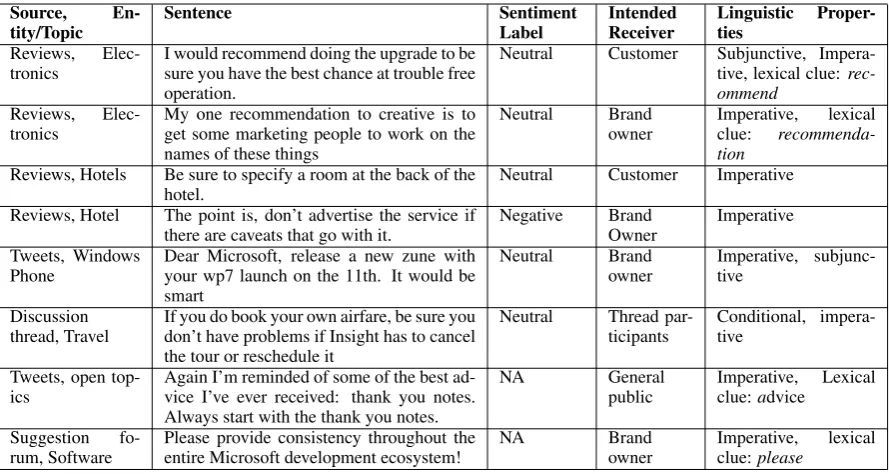
On a closer look, it is noticeable that opinion-ated text also contains information other than sen-timents. This can be validated from the presence of large portions of neutral or objective or non-relevantlabelled text in state of the art sentiment analysis datasets. One such information type is suggestions. Table 1 shows the instances of sug-gestions in sentiment analysis datasets which were built on online reviews. These suggestions may or may not carry positive or negative sentiments to-wards the reviewed entity. In the recent past, sug-gestions have gained the attention of the research community, mainly for industrial research, which led to the studies focussing on suggestion detec-tion in reviews (Ramanand et al., 2010; Brun and Hagege, 2013).
The setting up of dedicated suggestion collec-tion forums by brand owners, shows the impor-tance of suggestions for the stakeholders. There-fore, it would be useful if suggestions can be au-tomatically extracted from the large amount of al-ready available opinions. In the cases of certain entities where suggestion collection platforms 1
are already available and active, suggestion min-ing can be used for summarisation of posts. Often, people tend to provide the context in such posts, which gets repetitive in the case of large number of posts, suggestion mining methods can extract the exact sentence in the post where a suggestion is expressed.
This task has so far been presented as a bi-nary classification of sentences, where the avail-able opinionated text about a certain entity is split into sentences and these sentences are then classi-fied as suggestions or non-suggestions. The pre-vious studies were carried out in a limited scope, mainly for specific domains like reviews, focusing on one use case at a time. The path to the leaf
1
https://feedly.uservoice.com/forums/192636-suggestions/category/64071-mobile
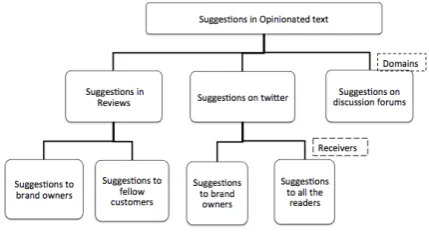
Figure 1: Problem scopes in suggestion detection
nodes in Figure 1 summarises the scope of sug-gestion mining studies so far. These studies de-veloped datasets for individual tasks and domains, and trained and evaluated classifier models on the same datasets.
We analyse manually labelled datasets from dif-ferent domains, including the existing datasets, and the datasets prepared by us. The ratio of sug-gestion and non-sugsug-gestion sentences vary across domains, where the datasets from some domains are too sparse for training statistical classifiers. We also introduce two datasets which are relatively richer in suggestions. In Table 1 we report sim-ilar linguistic nature of suggestions across these datasets, which presses for domain independent approaches. Therefore, as a deviation from previ-ous studies, this work investigates the generalisa-tion of the problem of suggesgeneralisa-tion detecgeneralisa-tion i.e. the detection of all suggestions under the root node in Figure 1.
In this work, we compare different methods of suggestion mining using all available datasets. These include manually crafted rules, Support Vector Machines (SVM) with proposed linguis-tic features, Long Short Term Memory (LSTM) Neural Networks, and Convolutional Neural Net-works (CNN). We also compare the results from these approaches with the previous works whose datasets are available. We also perform cross-domain train test experiments. With most of the datasets, Neural Networks (NNs) outperform SVM with the proposed features. However, the overall results for out of domain training remain low. We also compare two different types of word embeddings to be used with the NNs for this task.
2 Problem Definition and Scope
As stated previously, the task of suggestion de-tection has been framed as binary classification of sentences intosuggestion(positive class) and non-suggestion(negative class).
We previously provided a fine grained problem definition (Negi and Buitelaar, 2015) in order to prepare benchmark datasets and ensure consis-tency in future task definitions. We identified three parameters which define a suggestion in the con-text of opinion mining: receiver of suggestion, tex-tual unit of suggestion, and the type of suggestion in terms of its explicit or implicit nature.
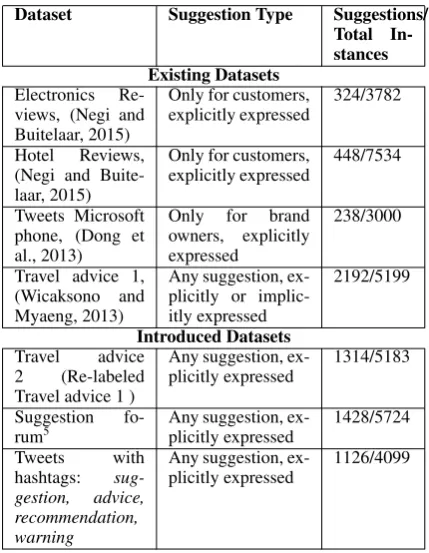
While the unit of suggestion still remains as sentence in this work, and the type as explicit ex-pression, we aim for the evaluation of different classifier models for the detection of any sugges-tion from any opinionated text. The motivasugges-tion lies in our observation that explicitly expressed suggestions appear in similar linguistic forms irre-spective of domain, target entity, and the intended receiver (Table 1). Furthermore, datasets used by the previous studies indicate that aiming the de-tection of specific suggestions restricts the anno-tations to suggestions of a specific type, which in turn aggravates class imbalance problem in the datasets (Table 2). It also renders these datasets unsuitable for a generic suggestion detection task, since the negative instances may also comprise of suggestions, but not of the desired type.
3 Related Work
In the recent years, experiments have been per-formed to automatically detect sentences which contain suggestions. Targeted suggestions were mainly the ones which suggest improvements in a commercial entity. Therefore, online reviews remains the main focus, however, there are a limited number of works focussing on other domains too.
Suggestions for product improvement: Studies
Source,
En-tity/Topic Sentence SentimentLabel IntendedReceiver Linguistic Proper-ties Reviews,
Elec-tronics I would recommend doing the upgrade to besure you have the best chance at trouble free operation.
Neutral Customer Subjunctive, Impera-tive, lexical clue: rec-ommend
Reviews,
Elec-tronics My one recommendation to creative is toget some marketing people to work on the names of these things
Neutral Brand
owner Imperative,clue: recommenda-lexical tion
Reviews, Hotels Be sure to specify a room at the back of the
hotel. Neutral Customer Imperative
Reviews, Hotel The point is, don’t advertise the service if
there are caveats that go with it. Negative BrandOwner Imperative Tweets, Windows
Phone Dear Microsoft, release a new zune withyour wp7 launch on the 11th. It would be smart
Neutral Brand
owner Imperative, subjunc-tive Discussion
thread, Travel If you do book your own airfare, be sure youdon’t have problems if Insight has to cancel the tour or reschedule it
Neutral Thread
par-ticipants Conditional, impera-tive Tweets, open
top-ics Again I’m reminded of some of the best ad-vice I’ve ever received: thank you notes. Always start with the thank you notes.
NA General
public Imperative,clue:advice Lexical Suggestion
[image:3.595.76.521.61.298.2]fo-rum, Software Please provide consistency throughout theentire Microsoft development ecosystem! NA Brandowner Imperative,clue:please lexical
Table 1: Examples of suggestions from different domains, about different entities and topics, and in-tended for different receivers. Sentiment labels are the sentiment towards a reviewed entity, if any.
they used certain hash tags and mined frequently appearing word based patterns from a separate dataset of suggestions about Microsoft phones.
Suggestions for fellow customers: In one of our
previous works(Negi and Buitelaar, 2015), we focussed on the detection of those suggestions in reviews which are meant for the fellow customers. An example of such suggestion in a hotel review is,If you do end up here, be sure to specify a room at the back of the hotel. We used SVM classifier with a set of linguistically motivated features. We also stressed upon the highly subjective nature of suggestion labelling task, and thus performed a study of a formal definition of suggestions in the context of suggestion mining. We also formulated annotation guidelines, and prepared a dataset for the same.
Advice Mining from discussion threads:
Wicak-sono et al. (2013) detected advice containing sentences from travel related discussion threads. They compared sequential classifiers based on Hidden Markov Model (HMM) and Conditional Random Fields (CRF), considering each thread as a sequence of sentences labelled as advice and non-advice. They also some features which were dependent on the position of a sentence in its thread. This approach was therefore specific to the domain of discussion threads. Their annotations seem to consider implicit expressions of advice as
advice.
Text Classification using deep learning:
Re-cently NNs are being effectively used for text classification tasks, like sentiment classification and semantic categorisation. LSTM (Graves, 2012), and CNN (Kim, 2014a) are the two most popular neural network architectures in this regard.
Tweet classification using deep learning:To the
best of our knowledge, deep learning has only been employed for sentiment based classification of tweets. CNN (Severyn and Moschitti, 2015) and LSTM (Wang et al., 2015) have demonstrated good performance in this regard.
4 Datasets
The required datasets for this task are a set of sentences obtained from opinionated texts, which are labelled as suggestion and non-suggestion, where suggestions are explicitly expressed.
Existing Datasets: Datasets from most of
the previous studies on suggestions for product improvement are unavailable due to their indus-trial ownership. The currently available datasets are:
short nature of tweets, suggestion detection is performed on the tweet level, rather than the sen-tence level. The authors indicated that they have labeled the explicit expressions of suggestions in the dataset.
2) Electronics and hotel reviews: A review dataset, where only those sentences which convey suggestions to the fellow customers are consid-ered as suggestions (Negi and Buitelaar, 2015). 3) Travel advice dataset: Obtained from travel re-lated discussion forums. All the advice containing sentences are tagged as advice (Wicaksono and Myaeng, 2013). One problem with this dataset is that the statements of facts (implicit suggestions) are also tagged as advice, for example, The tem-perature may reach upto 40 degrees in summer.
Introduced Datasets: In this work, we identify
additional sources for suggestion datasets, and prepare labelled datasets with larger number of explicitly expressed suggestions.
1) Suggestion forum: Posts from a customer support platform2 which also hosts dedicated
suggestion forums for products. Though most of the forums for commercial products are closed access, we discovered two forums which are openly accessible: Feedly mobile app3, and
Windows app studio4. We collected samples of
posts for these two products. Posts were then split into sentences using the sentence splitter from Stanford CoreNLP toolkit (Manning et al., 2014). Two annotators were asked to label 1000 sentences, on which the inter-annotator agreement (kappa) of 0.81 was obtained. Rest of the dataset was annotated by only one annotator. Due to the annotation costs, we limited the size of data sample, however this dataset is easily extendible due to the availability of much larger number of posts on these forums.
2) We also prepared a tweet dataset where tweets are a mixture of random topics, and not specific to any given entity or topic. These tweets were collected using the hashtags suggestion, advice, recommendation, warning, which increased the chance of appearance of suggestions in this dataset. Due to the noisy nature of tweets, two annotators performed annotation on all the tweets.
2https://www.uservoice.com/
3
https://feedly.uservoice.com/forums/192636-suggestions
4
https://wpdev.uservoice.com/forums/110705-universal-windows-platform
The inter-annotator agreement was calculated as 0.72. Only those tweets were retained for which the annotators agreed on the label.
[image:4.595.306.521.262.539.2]3) We also re-tagged the travel advice dataset from Wicaksono et al. (2013) where only those suggestions which were explicitly expressed were retained as suggestions.
Table 2 details all the available datasets in-cluding the ones we are introducing in this work. The introduced datasets contain higher percentage of suggestions. We therefore train models on the introduced datasets, and evaluate them on the existing datasets.
Dataset Suggestion Type Suggestions/ Total In-stances Existing Datasets
Electronics Re-views, (Negi and Buitelaar, 2015)
Only for customers,
explicitly expressed 324/3782 Hotel Reviews,
(Negi and Buite-laar, 2015)
Only for customers,
explicitly expressed 448/7534 Tweets Microsoft
phone, (Dong et al., 2013)
Only for brand owners, explicitly expressed
238/3000
Travel advice 1, (Wicaksono and Myaeng, 2013)
Any suggestion, ex-plicitly or implic-itly expressed
2192/5199
Introduced Datasets Travel advice
2 (Re-labeled Travel advice 1 )
Any suggestion,
ex-plicitly expressed 1314/5183 Suggestion
fo-rum5 Any suggestion, ex-plicitly expressed 1428/5724
Tweets with hashtags: sug-gestion, advice, recommendation, warning
Any suggestion,
ex-plicitly expressed 1126/4099
Table 2: Available suggestion detection datasets
an advantage over the conventional approaches for this task.
5.1 Rule based classification
This approach uses a set of manually formulated rules aggregated from the previous rule based ex-periments (Ramanand et al., 2010; Goldberg et al., 2009). These rules exclude the rules provided by Brun et al. (2013), because of their dependency on in-house (publicly unavailable) components from Brun et al. (2013). Only those rules have been used which do not depend on any domain specific vocabulary. A given text is labeled as a suggestion, if at least one of the rules is true.
1. Modal verbs (MD) followed by a base form of verb (VB), followed by an adjective. 2. At-least one clause starts with a present tense
of verb (VB, VBZ, VBP). This is a naive method for detecting imperative sentences. Clauses are identified using the parse trees; the sub-trees under S and SBAR are consid-ered as clauses.
3. Presence of any of the suggestion key-words/phrases suggest, recommend, hope-fully, go for, request, it would be nice, adding, should come with, should be able, could come with, i need, we need, needs, would like to, would love to.
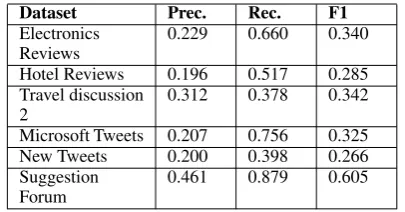
4. Presence of templates for suggestions ex-pressed in the form of wishes [would like *(if), I wish, I hope, I want, hopefully, if only, would be better if, *(should)*, would that, can’t believe .*(didn’t).*, (don’t be-lieve).*(didn’t), (do want), I can has]. The part of speech tagging and parsing is per-formed using Stanford parser (Manning et al., 2014). Table 3 shows the results of rule based classification for the positive class i.e. sugges-tion class. With the available datasets, detecsugges-tion of negative instances is always significantly better than the positive ones, due to class imbalance.
5.2 Statistical classifiers
SVM was used in almost all the related work either as a proposed classifier with some feature en-gineering, or for comparison with other classifiers.
Support Vector Machines: SVM classifiers
are popularly used for text classification in the re-search community. We perform the evaluation of a classifier using SVM with the standard n-gram
Dataset Prec. Rec. F1
Electronics
Reviews 0.229 0.660 0.340
Hotel Reviews 0.196 0.517 0.285 Travel discussion
2 0.312 0.378 0.342
Microsoft Tweets 0.207 0.756 0.325
New Tweets 0.200 0.398 0.266
Suggestion
[image:5.595.314.517.61.167.2]Forum 0.461 0.879 0.605
Table 3: Results of Suggestion Detection using rule based classifier. Reported metrics are only for the suggestion class.
features (uni, bi-grams) and the features proposed in our previous work (Negi and Buitelaar, 2015). These features are sequential POS patterns for im-perative mood, sentence sentiment score obtained using SentiWordNet, and information aboutnsubj
dependency present in the sentence. We use LibSVM6 implementation with the parameters
specified previously in Negi and Buitelaar (2015). No oversampling is used, instead class weighting is applied by using class weight ratio depending upon the class distribution of the negative and positive class respectively in the training dataset.
Deep Learning based classifiers: Recent
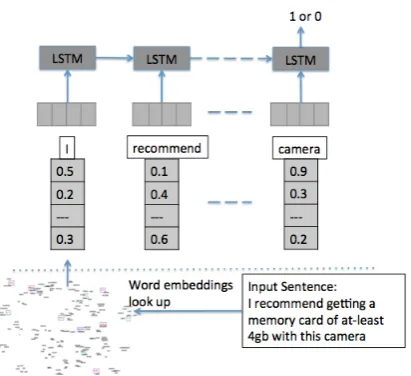
findings about the impressive performance of deep learning based models for some of the natural language processing tasks calls for similar experiments in suggestion mining. We therefore present the first set of deep learning based ex-periments for the same. We experiment with two kinds of neural network architectures: LSTM and CNN. LSTM effectively captures sequential information in text, while retaining the long term dependencies. In a standard LSTM model for text classification, text can be fed to the input layer as a sequence of words, one word at a time. Figure 2 shows the architecture of LSTM neural networks for binary text classification.
On the other hand, CNN is known to effectively capture local co-relations of spatial or temporal structures, therefore a general intuition is that CNN might capture well the good n-gram features at different positions in a sentence.
5.3 Features
Features for SVM: The feature evaluation of
(Negi and Buitelaar, 2015) indicated that POS tags, certain keywords (lexical clues), POS
Figure 2: Architecture for using LSTM as a binary text classifier
patterns for imperative mood, and certain de-pendency information about the subject, can be useful features for the detection of suggestions. In the previous works, the feature types were manually determined. We now aim to eliminate the need of manual determination of feature types. A recently popular approach of doing this is to use neural networks with word embeddings
(Bengio et al., 2003) based feature vectors, in-stead of using classic count-based feature vectors.
Word embeddings for Neural Networks:
In simpler terms, word embeddings are automat-ically learnt vector representations for lexical units. Baroni et al. (2014) compared the word embeddings obtained through different methods, by using them for different semantic tasks. Based on those comparisons, we use a pre-trained COM-POSES7 embeddings, which were developed by
Baroni et al. (2014). These embeddings/word vectors are of size 400. For experiments on twitter datasets, we used Glove (Pennington et al., 2014) based word embeddings learnt on Twitter data8,
which comprises of 200 dimensions.
We additionally experiment with dependency based word embeddings (Deps)9 (Levy and
Goldberg, 2014). These embeddings determine
7Best predict vectors on
http://clic.cimec.unitn.it/composes/semantic-vectors.html
8http://nlp.stanford.edu/projects/glove/
9Dependency-Based on
https://levyomer.wordpress.com/2014/04/25/dependency-based-word-embeddings/
the context of a word on the basis of linguistic dependencies, instead of window based context used by COMPOSES. Therefore, Deps tends to perform better in determining the functional similarity between words, as compared to COM-POSES.
Additional feature for NNs: For neural network based classifiers, we also experimented with POS tags as an additional feature with the pre-trained word embeddings. This tends to decrease the precision and increase the recall, but results in an overall decrease of F-1 score in most of the runs. Therefore, we do not report the results of these experiments.
5.4 Configurations
NN Configuration: Considering the class
imbal-ance in the datasets, we employ oversampling of the minority class (positive) to adjust the class distribution of training data. While performing cross validation, we perform oversampling on training data for each fold separately after cross-validating.
LSTM: For LSTM based classification, we use 2 hidden layers of 100 and 50 neurons respectively, and 1 softmax output layer. We also utilize L2 regularization to counter overfitting. For LSTMs, we use the softsign activation function.
CNN:We used a filter window of 2 with 40 feature maps in CNN, thus giving 40 bigram based filters (Kim, 2014b). A subsampling layer with max pooling is used.
In-Domain and Cross-Domain Evaluation:
Data Precision Recall F1 score
SVM LSTM CNN SVM LSTM CNN SVM LSTM CNN
Hotel 0.580 0.576 0.505 0.512 0.717 0.703 0.543 0.639 0.578
[image:7.595.104.491.61.146.2]Electronics 0.645 0.663 0.561 0.621 0.681 0.671 0.640 0.672 0.612 Travel advice 2 0.458 0.609 0.555 0.732 0.630 0.621 0.566 0.617 0.586 Microsoft Tweets 0.468 0.591 0.309 0.903 0.514 0.766 0.616 0.550 0.441 New tweets 0.693 0.619 0.590 0.580 0.674 0.752 0.632 0.645 0.661 Suggestion forum 0.661 0.738 0.665 0.760 0.716 0.772 0.712 0.727 0.713
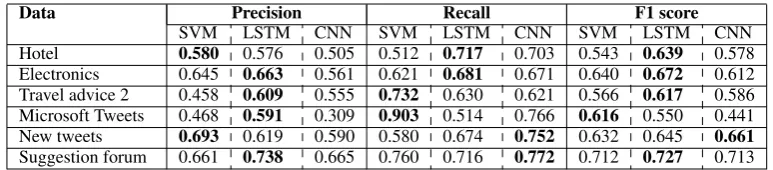
Table 4: In-domain training: Performance of SVM (10 fold), LSTM, and CNN (5 fold) using cross val-idation on the available datasets. The listed results are for the suggestion class only. SVM uses features from Negi and Buitelaar (2015), and neural networks use pre-trained word embeddings (COMPOSES for normal text and Twitter Glove for tweets).
Dataset Related work F1 type F1 (Related
Work) SVM LSTM CNN
Travel Advice 1 (Wicaksono and
Myaeng, 2013) Weightedscore for bothF-1 classes
0.756 0.680 0.762 0.692
Microsoft tweets (Dong et al., 2013) F-1 score for
[image:7.595.74.289.355.420.2]suggestions only 0.694 0.616 0.550 0.441
Table 5: Comparison of the performance of SVM (Negi and Buitelaar, 2015), LSTM and CNN with the best results reported in two of the related works whose datasets are available. 5 fold cross validation was used. The related works used different kinds of F1 scores.
Dataset LSTM CNN
COMP. Deps COMP. Deps
Hotel 0.638 0.607 0.578 0.550
Electronics 0.672 0.608 0.611 0.556 Travel advice 2 0.617 0.625 0.586 0.564 Sugg Forum 0.752 0.732 0.714 0.695 Table 6: F-1 score for the suggestion class, using
COMPOSES and Deps embeddings with LSTM and CNN. 5 fold cross validation.
Pre-processing: We also compared experiments
on tweets with pre-processing, and without pre-processing the tweets. The pre-processing involved removing URLs and hashtags, and normalisation of punctuation repetition. Pre-processing tends to decrease the performance in all the experiments. Therefore, none of the experiments reported by us use pre-processing on tweets.
6 Results and Discussions
Tables 4, 7 show the Precision, Recall and F-1 score for the suggestion class (positive class). In general, rule based classifier shows a higher recall, but very low precision, leading to very low F-1 scores as compared to statistical classifiers, where LSTM emerges as a winner in majority of the runs. Below we summarise different observations from the results.
Embeddings: COMPOSES embeddings prove
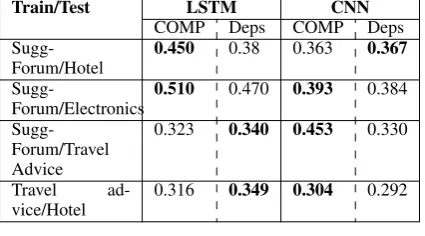
to be a clear winner in our experiments. Deps outperform COMPOSES in only 3 cases out of all the experiments reported in Tables 6, 8. It was observed that using Deps always resulted in higher recall, however F-1 scores dropped due to a simultaneous drop in precision. Also, Deps embeddings tend to perform better with LSTM, as compared to CNN.
Comparison with Related Work: Table 5
Train/Test Precision Recall F-1 score
SVM LSTM CNN SVM LSTM CNN SVM LSTM CNN
[image:8.595.81.513.61.135.2]Sugg-Forum/Hotel 0.327 0.425 0.348 0.156 0.482 0.379 0.211 0.452 0.363 Sugg-Forum/Electronics 0.109 0.500 0.376 0.519 0.532 0.411 0.180 0.516 0.393 Sugg-Forum/Travel advice 0.386 0.52 0.395 0.212 0.235 0.531 0.273 0.323 0.453 Travel advice/Hotel 0.147 0.244 0.206 0.616 0.616 0.582 0.238 0.349 0.304 New Tweets/Microsoft Tweets 0.112 0.189 0.164 0.122 0.351 0.458 0.117 0.246 0.241 Table 7: Cross-domain evaluation: Performance of SVM, LSTM, CNN when trained on new sugges-tion rich datasets and tested on the existing suggessugges-tion datasets. The listed results are for the positive (suggestion) class only.
Train/Test LSTM CNN
COMP Deps COMP Deps
Sugg-Forum/Hotel 0.450 0.38 0.363 0.367
Sugg-Forum/Electronics 0.510 0.470 0.393 0.384
Sugg-Forum/Travel Advice
0.323 0.340 0.453 0.330
Travel
ad-vice/Hotel 0.316 0.349 0.304 0.292 Table 8: Evaluation of COMPOSES and Depen-dencyembeddings with LSTM and CNN in a cross domain train-test setting.
SVM versus NNs: In most cases, the neural
network based classifiers outperformed SVM, see tables 4, 7. Although SVM in combination with feature engineering and parameter tuning, proves to be a competent alternative, specially with the more balanced new datasets. The newly introduced datasets (suggestions about Feedly app and Windows platform) produce better results than the existing sparse datasets for the in-domain evaluation, see table 4. This can be again attributed to the better class representation in this dataset.
Text type: The results of tweet datasets in
general show much lower classification accuracy than the datasets of standard texts for cross domain training, see table 7. In the case of in-domain evaluation for the Microsoft tweet dataset, SVM performs better than neural networks, and vice versa in the case of the new tweet dataset, see table 4.
7 Conclusion and Future Work
In this work, we presented an insight into the problem of suggestion detection, which extracts different kinds of suggestions from opinionated text. We point to new sources of suggestion
rich datasets, and provide two additional datasets which contain larger number of suggestions as compared to the previous datasets. We compare various approaches for suggestion detection, in-cluding the ones used in the previous works, as well as the deep learning approaches for sentence classification which have not yet been applied to this problem.
Since suggestions tend to exhibit similar linguistic nature, irrespective of topics and intended receiver of the suggestions, there is a scope of learning do-main independent models for this task. Therefore, we apply the discussed approaches both in a do-main dependent, and dodo-main independent setting, in order to evaluate the domain independence of the proposed models.
Neural networks in general performed better, in both in-domain and cross-domain evaluation. The initial results for domain independent training are poor. In light of the findings from this work, do-main transfer approaches would be an interesting direction for future works in this problem.
The results also point out the challenges and com-plexity of the task. Preparing datasets where sug-gestions are labeled at a phrase or clause level might reduce the complexities arising due to long sentences.
Acknowledgement
This work has been funded by the European Unions Horizon 2020 programme under grant agreement No 644632 MixedEmotions, and the Science Foundation Ireland under Grant Number SFI/12/RC/2289 (Insight Center).
References
[image:8.595.75.288.204.322.2]for Computational Linguistics (Volume 1: Long Pa-pers), pages 238–247, Baltimore, Maryland, June. Association for Computational Linguistics.
[Bengio et al.2003] Yoshua Bengio, R´ejean Ducharme, Pascal Vincent, and Christian Janvin. 2003. A
neu-ral probabilistic language model. J. Mach. Learn.
Res., 3:1137–1155, March.
[Brun and Hagege2013] C. Brun and C. Hagege. 2013. Suggestion mining: Detecting suggestions for
im-provements in users comments. In Proceedings of
14th International Conference on Intelligent Text Processing and Computational Linguistics.
[Dong et al.2013] Li Dong, Furu Wei, Yajuan Duan, Xi-aohua Liu, Ming Zhou, and Ke Xu. 2013. The au-tomated acquisition of suggestions from tweets. In Marie desJardins and Michael L. Littman, editors,
AAAI. AAAI Press.
[Goldberg et al.2009] Andrew B. Goldberg, Nathanael Fillmore, David Andrzejewski, Zhiting Xu, Bryan Gibson, and Xiaojin Zhu. 2009. May all your wishes come true: A study of wishes and how to
recognize them. In Proceedings of Human
Lan-guage Technologies: The 2009 Annual Conference of the North American Chapter of the Association for Computational Linguistics, NAACL ’09, pages 263–271, Stroudsburg, PA, USA. Association for Computational Linguistics.
[Graves2012] Alex Graves. 2012. Supervised
se-quence labelling. In Supervised Sequence
La-belling with Recurrent Neural Networks, pages 5– 13. Springer Berlin Heidelberg.
[Kim2014a] Yoon Kim. 2014a. Convolutional neural networks for sentence classification. arXiv preprint arXiv:1408.5882.
[Kim2014b] Yoon Kim. 2014b. Convolutional neural
networks for sentence classification. In
Proceed-ings of the 2014 Conference on Empirical Methods in Natural Language Processing (EMNLP), pages 1746–1751, Doha, Qatar, October. Association for Computational Linguistics.
[Levy and Goldberg2014] Omer Levy and Yoav Gold-berg. 2014. Dependency-based word embeddings. InACL.
[Manning et al.2014] Christopher D. Manning, Mihai Surdeanu, John Bauer, Jenny Finkel, Steven J. Bethard, and David McClosky. 2014. The Stan-ford CoreNLP natural language processing toolkit. InAssociation for Computational Linguistics (ACL) System Demonstrations, pages 55–60.
[Negi and Buitelaar2015] Sapna Negi and Paul Buite-laar. 2015. Towards the extraction of
customer-to-customer suggestions from reviews. In
Proceed-ings of the 2015 Conference on Empirical Methods in Natural Language Processing, pages 2159–2167, Lisbon, Portugal, September. Association for Com-putational Linguistics.
[Pennington et al.2014] Jeffrey Pennington, Richard Socher, and Christopher D. Manning. 2014. Glove:
Global vectors for word representation. In
Em-pirical Methods in Natural Language Processing (EMNLP), pages 1532–1543.
[Ramanand et al.2010] J Ramanand, Krishna Bhavsar, and Niranjan Pedanekar. 2010. Wishful thinking -finding suggestions and ’buy’ wishes from product
reviews. In Proceedings of the NAACL HLT 2010
Workshop on Computational Approaches to Analy-sis and Generation of Emotion in Text, pages 54–61, Los Angeles, CA, June. Association for Computa-tional Linguistics.
[Severyn and Moschitti2015] Aliaksei Severyn and Alessandro Moschitti. 2015. Unitn: Training deep convolutional neural network for twitter sentiment
classification. In Proceedings of the 9th
Interna-tional Workshop on Semantic Evaluation (SemEval 2015), pages 464–469, Denver, Colorado, June. Association for Computational Linguistics.
[Wang et al.2015] Xin Wang, Yuanchao Liu, Chengjie SUN, Baoxun Wang, and Xiaolong Wang. 2015. Predicting polarities of tweets by composing word
embeddings with long short-term memory. In
Pro-ceedings of the 53rd Annual Meeting of the Associ-ation for ComputAssoci-ational Linguistics and the 7th In-ternational Joint Conference on Natural Language Processing (Volume 1: Long Papers), pages 1343– 1353, Beijing, China, July. Association for Compu-tational Linguistics.
[Wicaksono and Myaeng2013] Alfan Farizki Wicak-sono and Sung-Hyon Myaeng. 2013. Automatic extraction of advice-revealing sentences foradvice
mining from online forums. In K-CAP, pages 97–