KILLE: a Framework for Situated Agents for Learning
Language Through Interaction
Simon Dobnik
CLASP
University of Gothenburg, Sweden
Erik Wouter de Graaf
University of Gothenburg, Sweden
Abstract
We present KILLE, a framework for situ-ated agents for learning language through interaction with its environment (percep-tion) and with a human tutor (dialogue). We provide proof-of-concept evaluations of the usability of the system in two do-mains: learning of object categories and learning of spatial relations.
1 Introduction
Situated conversational robots have to be capable of both linguistic interaction with humans and in-teraction with their environment through percep-tion and acpercep-tion if we want them a part of our daily lives. Humans interact through language very ef-ficiently and naturally and since most of them are not expert programmers, interaction with a robot in a natural language will be preferred. Secondly, by being part of the human environment contain-ing everyday objects such as tables and chairs, robots too have to have knowledge how humans structure and organise their world which is again reflected in human language.
Connecting language with perception and ac-tion is commonly known as grounding (Harnad, 1990; Roy, 2002). The main challenge in ground-ing is that we are connectground-ing two representa-tion systems, (i) a perceptual which is commonly captured in physical sciences as continuous real-valued features and (ii) a symbolic conceptual sys-tem that makes up human language. There is no one-to-one correspondence between the two: lin-guistic descriptions such as “close to the table” and “red” correspond to some function predict-ing the degree of acceptability over physical or colour space (Logan and Sadler, 1996; Roy, 2002; Roy, 2005; Skoˇcaj et al., 2010; Matuszek et al., 2012; Kennington and Schlangen, 2015; McMa-han and Stone, 2015). The relations between con-cepts are not flat but are made increasingly more
abstract, structures are embedded and recursive (Fellbaum, 1998; Tenenbaum et al., 2011) and or-ganised at several representational layers (Kruijff et al., 2007). It follows that several descriptions may be equally applicable for the same situation: the chair can be “close to the table” or “to the left of the table” which meansvaguenessis preva-lent in grounding. This however, can be resolved through interaction by adopting appropriate inter-action strategies (Kelleher et al., 2005; Skantze et al., 2014; Dobnik et al., 2015).
The meaning of words is not grounded just in perception and action but also grounded in particu-lar linguistic interactions or conversations: partic-ipants continuously adapt and agree on the mean-ing of words as a part of their interaction (Clark, 1996; Fern´andez et al., 2011). This means that having a static model of grounded language which is learned offline from a corpus with a situated robot is not enough but this must be continuously adapted as the interaction unfolds (Skoˇcaj et al., 2011; Matuszek et al., 2012). The idea of dy-namic, continuously updated grounded language models is parallel to dynamic, continuously up-dated maps of the environment that have been commonly used in mobile robotics for a while (Dissanayake et al., 2001). Static models used in early robotics (Winograd, 1976) were just not able to deal with any changes in its environment and the uncertainty that these bring. We want to take the same view for language which is dynamically adjusted through interaction strategies.
In this paper we describe a framework for sit-uated agents that learn grounded language in-crementally and online called KILLE (Kinect Is Learning LanguagE) with the help of a human tu-tor in the fashion previously described. KILLE is a non-mobile table-top robot connecting Kinect sen-sors with image processing and classification and a spoken dialogue system. The system learns to recognise objects presented to it by a human
tor from scratch. It can direct learning by asking for more objects of a particular category if it is not able to classify them with sufficient reliability. If more objects of a particular category are available in the scene and the system is able to recognise them, the system queries the user to describe spa-tial relations between them. Each of these kinds of descriptions focus on different perceptual features and represent two fundamental linguistic semantic categories: entities and entity relations. Overall, KILLE combines both passive and active learning which is incremental at the level of both kinds of linguistic categories.
The contributions of the KILLE framework are two-fold: (i) from the computational perspective it provides a platform for building models of sit-uated language learning and answering questions how to integrate and test existing language tech-nology tools (primarily intended for processing corpora) in an interactive tutoring framework; (ii) it also provides a platform for testing linguistic and psycho-linguistic theories, formalisms and ap-plications on grounding language in interaction (Larsson, 2013; Dobnik et al., 2013) and imple-menting them computationally. This paper fo-cuses on the construction of the Kille framework and its properties while it also provides a proof-of-concept evaluation of such learning of simple object and spatial relations representations. The paper is organised as follows. In Section 2 we describe the main components of the system. In Sections 3 and 4 we describe the perceptual repre-sentations and dialogue strategies that have been implemented so far. Section 5 describes proof-concept learning of objects and Section 5.2 learn-ing of spatial descriptions that demonstrate the us-ability of the framework. We give conclusions and discussion of future work in Section 6.
2 The KILLE system
The system and the architecture that KILLE is us-ing are similar to two existus-ing systems for incre-mental interaction (Schlangen and Skantze, 2011) IrisTK (Skantze and Al Moubayed, 2012) and In-proTK (Kennington et al., 2014). The difference is that instead of starting from the perspective of in-cremental language processing and dialogue man-agement we focus on the mapping between lan-guage and robot’s sensors and actuators and how to learn such mappings through particular dia-logue and interactional strategies. Therefore, we
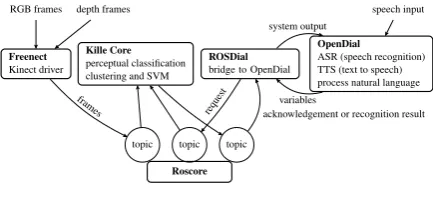
opt for a Robot Operating System (ROS) (Quigley et al., 2009) as our middle-ware which provides a common framework for building modules that communicate with each other (send and receive in-formation) and runs on a variety of popular robotic hardware implementations which makes modules portable between them. We work with a very sim-ple robotic hardware: a Microsoft Kinect sensor supported by thelibfreenect library integrated in ROS.1The Kinect provides us with three sensors:
an RGB camera of resolution 640x480, a depth sensor, which a structured-light 3D scanner that can perceive in a distance between 70 and 300 cm and gives a 3d representation of object, and a multi-array microphone (not used). The Kinect sensor is attached to a laptop computer running ROS and other software and together they repre-sent our interactive robot. This robot does not have actuators which means it is not mobile and so it cannot turn gaze and focus on objects not in its vision field. Objects have to be brought into its at-tention field. We use glass pedestals as object sup-port as to avoid the problem of object segmenta-tion (e.g. object and hand) as glass is not detected by the depth sensor. Although simple, the platform satisfies well our requirements for incremental sit-uated learning of perceptual language through di-alogue. Through ROS the system can be ported to other, more sophisticated robotic platforms with very little modification.
Freenect
Kinect driver
Kille Core
perceptual classification clustering and SVM
Roscore ROSDial
bridge to OpenDial
OpenDial
ASR (speech recognition) TTS (text to speech) process natural language
topic topic topic
speech input RGB frames depth frames
frames
acknowledgement or recognition result request
system output
[image:2.595.307.524.483.585.2]variables
Figure 1: Kille modules
formed over TCP/IP nodes can be distributed over several machines.
For dialogue management we use OpenDial2
(Lison, 2013) which is a domain independent dia-logue manager supporting probabilistic rules. It comes pre-packaged with several other popular NLP tools and interfaces to ASR and TTS sys-tems. User utterances are ran through ASR and POS-tagged with the MaltParser. The output is then processed by a series of dialogue rules which define pre-conditions and post-conditions of their application. Since this is a perceptual dialogue system, dialogue rules involve both linguistic in-formation and inin-formation received from the per-ceptual module of the system (Kille Core), for ex-ample the names of the objects detected and the certainty of detection, the spatial relation between them, etc. The dialogue rules can define further dialogue moves or actions for the perceptual sys-tem to take. In order to use OpenDial in our ROS configuration we had to build a bridge between the two which we call ROSDial. This sets up a ROS node and an instance of OpenDial. As OpenDial, ROSDial is written in Java. ROSDial translates the messages between OpenDial’s information state and a ROS topic. It also ensures that Kille and OpenDial are synchronised. As the interaction is driven by OpenDIAL, sending requests to Kille is straightforward. However, it can also happen that a perceptual event is detected by Kille which the dialogue manager should act upon. ROSDial peri-odically instantiates a dialogue rule to interpret for any new information that has been pushed to its information state from Kille Core. Finally, Kille Core is written in Python and handles all percep-tual representations and learning. The representa-tions of objects and spatial relarepresenta-tions can be saved and reloaded between sessions. Kille Core also sends and receives messages both to and from the Kinect library, e.g. scanned perceptual data, and ROSDial, e.g. linguistic data. Both ROSDial and Kille Core are available on Github.3
3 Perceptual representations
For visual representations we use OpenCV (Open Source Computer Vision)4 which is a popular
library for computer vision including machine learning applications. It is natively written in C
2https://github.com/plison/opendial 3https://github.com/masx/Kille 4http://opencv.org
and C++, but has interfaces for other languages in-cluding Python (Bradski and Kaehler, 2008). It is also optimised for real-time applications. Through ROS we receive real-time frames from Kinect which include both data from the depth sensor and the visual RGB sensor. The frames are converted to the OpenCV format which is compatible with
NumPyarrays and which allows for fast computa-tional manipulation.
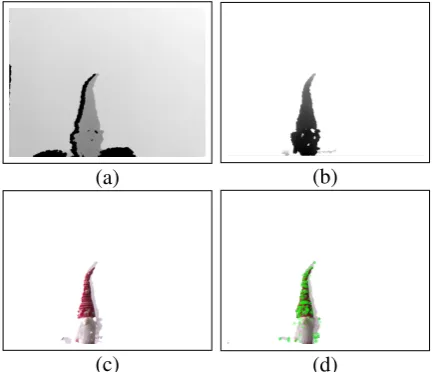
The visual processing is performed in two steps. In the first step the information from the depth sen-sor is used to detect the object in focus and remove irrelevant foreground and background in the RGB image. The depth sensor of Kinect cannot detect objects that are closer to it than 70 cm (Figure 2a). We define background as anything that is further away than 100 cm from the Kinect sensor and re-move it (Figure 2b). This leaves us 30 centime-tre of space that we can present objects in, which turns out to be sufficient and works well for our experiments.
(a) (b)
[image:3.595.308.525.363.549.2](c) (d)
Figure 2: A perception of a plush gnome from the depth sensor (a) including the background, (b) with the background removed, (c) with the RGB image superimposed, and (d) with SIFT features detected in the image. The black border in (a) is a perceptual artefact arising from the interference of sensors.
(Fig-ure 2c). Each point is represented as descriptor, a high dimensional vector which contains informa-tion about the visual properties surrounding each key-point, its orientation and location. SIFT is in-tended to be scale-invariant which means it is ro-bust against changes that are introduced by scal-ing, can handle rotation and small changes in il-lumination. Note that objects (including those that are very similar and belong to the same cate-gory) will have different numbers of SIFT descrip-tors detected depending on their visual properties: some objects have a lot of visual details while oth-ers are smoother. In our interactive scenario this will also be the case each time when the same ob-ject will be re-introduced to the system as the cap-tured frame will be slightly different from the pre-viously captured one because of slight changes in location, lighting and camera noise.
4 Dialogue games
In the dialogue manager we implemented dialogue rules that act upon both linguistic and perceptual knowledge and allow us to have the following conversational games (Kowtko et al., 1992) with users.
1. Direct instruction: objects
User: This is a cup.
System: [Object is focused on and observed.]
S: OK, I learned a cup.
2. Direct instruction: spatial relations
U: The book is to the right of the mug. S: [Objects are focused on and observed.] S: OK. This relation is called “to the right of”. S: [Objects are focused on and observed.] U: Where are the objects?
S: The book is to the right of the mug.
3. Describing objects and relations with (un)certainty
U: What is this?
S: [Object is focused on and observed.]
U: The object is thought to be a book, but it might also be a mug.
4. Reinforcement from feedback
U: What is this?
S: [Object is focused on and observed.] S: This is a cup.
U: That is correct.
S: [Observation is added to the models.]
5. Self initiative: spatial relations
S: [Objects are focused on and observed.]
S: One of the objects is book, the other one is box. Please tell me where things are.
U: The book is to the left of the box. S: OK, this relation is called “to the left of”.
6. Unlearning immediately (e.g. after a mishearing)
U: This is a book.
S: [Object is focused on and observed.] S: OK, this is a box.
U: That is not what I said. S: OK, sorry. I will ignore it.
7. Unlearning later
U: Forget a book. S: OK. I forgot a book.
8. Renaming an object
U: This is a book.
S: [Object is focused on and observed.] S: OK, this is a box.
U: I said a book.
S: OK, sorry. This is a book.
5 Interactive perceptional learning
In the following subsections we present a proof-of concept implementation and evaluation proof-of per-ceptual learning through interaction which demon-strates the usability of the Kille framework.
5.1 Learning to recognise objects
As described in Section 3 every scan, even of the same scene, gives us a different set of SIFT de-scriptors which as data-structures are multidimen-sional vectors. One approach to use SIFT descrip-tors in classification is to pre-cluster them to bags of visual words (BoVW) (see (Bruni et al., 2014) for discussion) and then apply their occurrence counts as features in a classifier such as Linear Support Vector Machine (SVM). However, in the current implementation we chose a simple lazy-learning method based on SIFT clustering as it better fits with the incremental learning scenario. With the SVM method we would have to store and cluster instances and re-train the model on each in-stance update, thus doing far more computational work. Since the domain and the number of exam-ples are small, lazy-learning is justified.
a database instance) and matches each descriptor tokdescriptors in the other list (in our casek=2).
The matched tuples (some of which will have zero or no similarity) have to be filtered. For this the ratio test of (Lowe, 2004) is used which calcu-lates the Euclidean distance between two descrip-tors and those pairs that fall below the empirically defined threshold of 0.75 are discarded. Since different object representations contain a differ-ent number of SIFT features and there is a bias that representations with a small number of fea-tures match representations with a large number of features, we take the harmonic mean of the ratio
#Matched
#Model and the ratio ##PerceivedMatched as the final
match-ing score. In the evaluation 10 consecutive scans are taken and their recognition scores are averaged to a single score. This improves the performance as it makes observations more stable to noise but decreases the processing speed. The name of the item in the database with the closest match is re-turned. If there are several top-ranking candidates of the same category, their category is returned with their mean recognition score.
The location of the recognised object is es-timated by taking the locations of the twenty matched descriptors with the shortest distance.
To evaluate the system’s performance in an in-teractive tutoring scenario we chose typical house-hold objects that could be detected in the per-ception field of the Kinect sensor and which fall into the following 10 categories: apple, banana, teddy bear, book, cap, car, cup, can of paint, shoe and shoe-box. A human tutor successively re-introduces the same 10 objects to the system in a pre-defined order over four rounds trying to keep the presentation identical as much as possible. In each round all objects are first learned and then queried. To avoid ASR errors both in learning and generation text input is used.
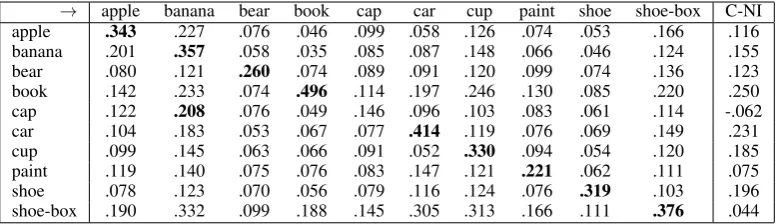
The average recognition scores over four rounds are shown in Table 1. We choose the name of the object with the highest recognition score. The highest values follow all but in one case the diago-nal which means that on overall objects are recog-nised correctly. The only problematic object is the cap which has been consistently confused with a banana. SIFT features do not contain colour in-formation according to which these two categories of objects could be distinguished. There were a few individual confusions which did not affect the overall mean score (not shown in Table 1): the
shoe-box was confused with a car in rounds 1 and 2, and with an apple in round 3. The apple was recognised as a banana in round 2. Otherwise, the system performed extremely accurately. The last column C-NI givesCorrect-NextIncorrectscore (a difference between the matching score of the tar-get object with the object of the correct category and the matching score of the target object with the closest matching object not of the correct cate-gory) which shows on average how visually dis-tinct the object is. The models of most objects preserve significant distinctiveness over presenta-tions and learning across the 4 rounds. If we rank objects by this score, we get the following ranking (from more distinct to least distinct): book>car >shoe>cup>banana>bear>apple >paint >shoe-box>cap.
In the second experiment we evaluated re-recognition of objects at different degrees of rota-tion (45◦, 90◦, 135◦, 180◦, 225◦, 270◦and 315◦in the clockwise direction) using the final model for objects built after the completion of round 4 in the previous experiment. Already at a rotation of 45◦ 6 out of 10 objects are mis-recognised. Objects are affected by rotation in different ways since their sides are visually distinct. For example shoe-box and to a large extent apple are correctly classi-fied at most rotational angles. We observe similar classification scores at those angles at which sym-metric sides of objects are exposed: 45◦:315◦and 90◦:270◦, 135◦:225◦and 0◦:180◦.
In the third experiment we tested the model from the end of the round 4 in the first experiment on 3 new objects of each category. The models for experiment one did not extend well to differ-ent objects for most categories. Only apples (2 out of 3 new objects) and shoe-boxes (all 3 new ob-jects) were recognised correctly. Shoe-box is also the most common mis-classification which means it is similar to other objects.
→ apple banana bear book cap car cup paint shoe shoe-box C-NI apple .343 .227 .076 .046 .099 .058 .126 .074 .053 .166 .116 banana .201 .357 .058 .035 .085 .087 .148 .066 .046 .124 .155 bear .080 .121 .260 .074 .089 .091 .120 .099 .074 .136 .123 book .142 .233 .074 .496 .114 .197 .246 .130 .085 .220 .250 cap .122 .208 .076 .049 .146 .096 .103 .083 .061 .114 -.062 car .104 .183 .053 .067 .077 .414 .119 .076 .069 .149 .231 cup .099 .145 .063 .066 .091 .052 .330 .094 .054 .120 .185 paint .119 .140 .075 .076 .083 .147 .121 .221 .062 .111 .075 shoe .078 .123 .070 .056 .079 .116 .124 .076 .319 .103 .196 shoe-box .190 .332 .099 .188 .145 .305 .313 .166 .111 .376 .044
Table 1: Average recognition scores over four rounds. The object tested are represented in rows. Columns indicate the categories that they were recognised as.
contexts specifically would increase the success of object recognition. Thus, the experiments also point to the complexity of the object recognition. 5.2 Learning to recognise spatial relations Once the system learns to detect several objects in the scene it starts querying the user to describe spatial relations between them. The semantics of spatial relations requires at least three components of meaning: (i) knowledge about the geometri-cal arrangement of objects in the scene; (ii) world knowledge about the objects involved in particu-lar how they interact with each other or what is our take on the scene; (iii) dialogue interaction be-tween conversational partners, for example in co-ordinating and negotiation perspective or the ori-gin of the frame of reference (FoR) used. We hope that Kille will provide us a platform for mod-elling and testing the interaction between all three components, some of which, for example (ii), are learned from a large corpus off-line. Here we mainly focus on interactive learning of the geo-metric component (i).
First, the system must recognise the target and the landmark objects (“the gnome/TARGET is to the left of the book/LANDMARK”) both in the linguistic string and the perceptual scene. Twenty highest ranking SIFT features are taken for each object and theirx(width),y(height) andz(depth) coordinates are averaged, thus giving us the cen-troid of the 20 most salient features of an ob-ject.5 We chose the number 20 based on
prac-tical experience. Higher numbers of features are more demanding for processing in real time. The origin of the coordinate frame for spatial tem-plates must be at the centre of the landmark ob-5This is a simplification as object shape is only partially expressed in theyvariable. This way we distinguish between tall and short objects. Note also that the variablesxandz describe object location whileydescribes object property.
ject which means that the coordinates of the tar-get must be expressed as relative to the landmark’s location. A further transformation of the coordi-nate frame could be made depending on the orien-tation of the viewpoint that sets the perspective. However, in our scenario the geometric coordi-nate frame was always relative to the orientation of Kille. Of course, in conversations with Kille humans could describe locations from a different perspective which means that this can lead (in an absence of a model of FoR assignment) to a more complicated/noisy and ambiguous model of geo-metric spatial template learned. For example the same region could be described as “to the left of” and “to the right of”. The relativised location of the target to the landmark are fed to a Linear Sup-port Vector Classifier (SVC) with descriptions as target classes.
A human tutor taught the system by present-ing it the target object (a book) at 16 different locations in relation to the landmark (the car) as shown in Figure 3. The locations were arranged so that there were 8 locations separated at 45◦ at two different distances around and from the land-mark. These objects were chosen because they have achieved a good recognition accuracy in the previous experiments. The book was shown to the system three times per location in a randomised order which gave us 48 presentations. The target was moved after each presentation. This ensured that there was no semantic influence on descrip-tions between the presentadescrip-tions.6 The spatial
de-scriptions that the human instructor used were to the left of, to the right of, in front of, behind of,
nearandclose to(6). The first 4 descriptions are
projective descriptions and require grounding of FoR, while the last two are topological
tions and do not require grounding of the FoR, only distance. The relativised spatial coordinates implicitly encode both of these features.
1
2 3 4
5
6 7 8 9
10
11
12
13
14 15
16
car →
Kille
↓
Human
[image:7.595.74.287.116.258.2]↑
Figure 3: The locations of the target (“book”), the landmark (“car”) and the conversational partners (Kille and the human). 1 and 9 have been slightly relaxed, as Kille would not be able to detect the car behind the book otherwise.
Note that spatial descriptions are not mutually exclusive: location 4 in Figure 3 could be de-scribed as “near”, “close”, “to the right of” and “in front of” (taking the human FoR) and “near”, “close”, “to the left of” and “behind” (taking Kille’s FoR) which makes learning a difficult task. In the evaluation we are interested if the system would agree strictly with human observers on the most relevant description for that context, if this is not the case, would the system generate an al-ternative acceptable description. The agreement between annotators is highly informative as it tells us about the difficulty of the task.
behind in front of close to near left of right of
100 50 0 50 100 150
centimeter
[image:7.595.78.273.552.696.2]x y z
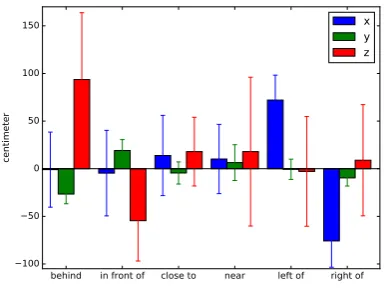
Figure 4: Averagex,yandzvalues for spatial re-lations.
Figure 4 shows the average values of the x
(width),y(height) andz(depth) features with the origin on the landmark object for the instances in our learning dataset. There is quite a clear opposi-tion between “behind” and “in front of” as well as “to the left of” and “to the right of” which means that the instructor was consistent in the usage of the FoR. What is interesting is that different FoR is used for the front-and-back and the lateral dimen-sions. “behind” and “in front of” are grounded in an FoR relative to Kille (away from and to-wards Kille respectively) while “left” and “right” are grounded in an FoR relative to the conversa-tional partner (e.g. “to the left of” corresponds to positivexvalues. Effectively, a split FoR is used. In this scenario, there is no effect of conversational roles on the assignment of FoR (information giver and information receiver) which has been reported by (Schober, 1995). The reason why the target is appears to be lower when it is described to be “be-hind” the landmark is due to the positioning of the sensor higher than the landmark at an angle look-ing down. This means that objects further away appear shorter. Finally both “close” and “near” show short distances from the landmark in each dimension as expected. However, there is, at least in this model, no clear difference between these two descriptions.
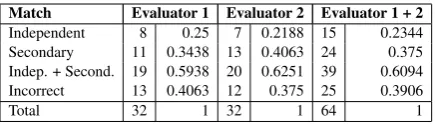
The performance of the system was indepen-dently evaluated by two human conversational partners, one of whom was also the tutor during the learning phase. As during learning, the target object was placed in one of the 16 locations and each location was used twice, which gave each human to evaluate a total of 32 situations which were presented in a random order. After each ob-ject placement, the evaluators first independently wrote down the description they would use to describe the scene. Then the system would be queried to describe the location of the target. The system’s response was recorded and also whether the evaluators agreed with the generated descrip-tion or not.
the evaluators is κ=0.4313. Choosing a spatial description is thus quite a subjective task.
Match Evaluator 1 Evaluator 2 Evaluator 1 + 2
Independent 8 0.25 7 0.2188 15 0.2344 Secondary 11 0.3438 13 0.4063 24 0.375 Indep. + Second. 19 0.5938 20 0.6251 39 0.6094 Incorrect 13 0.4063 12 0.375 25 0.3906
[image:8.595.72.290.101.163.2]Total 32 1 32 1 64 1
Table 2: Observed agreement between the evalua-tors and the system
The observed agreement between the evaluators and the system is shown in Table 2. The evaluators and the system independently chose the same de-scription in 23.44% of cases which is a decrease from 53.13% where only evaluators are compared with each other. However, even if the description was not the one that evaluators chose in this sit-uation, the evaluators thought that the generated description was nonetheless a good description in further 37.5% of situations. Overall, evaluators were satisfied with 60.94% of generations, while 39.06% were considered incorrect. Given the dif-ficulty of the task and that the system on average had a chance to learn each description only from 8 trials (48/6 = 8), thus not observing each descrip-tion at all possible 16 locadescrip-tions, the results are en-couraging and are close to what has been reported for a similar task in the literature (Dobnik, 2009).
behind front left right close near Total
behind 4 2 1 0 0 2 9
front 0 5 3 3 6 0 17
left 0 6 1 0 0 0 7
right 4 1 3 3 0 1 12
close 1 9 1 0 1 2 14
near 1 1 1 0 1 1 5
[image:8.595.71.291.474.561.2]Total 10 24 10 6 8 6 64
Table 3: Agreement between two human evalua-tors (rows) and the system (columns)
Table 3 shows a confusion matrix for all 64 tri-als. The Kappa coefficient, thus the strict observed agreement of 0.2344 (Table 2) discounted by the agreement by chance isκ=0.0537. If we
exam-ine Table 3 we can see, as also shown in Table 2, that non-agreements involve those descriptions that are appropriate alternatives. For example, we expect topological descriptions (e.g. “close”) to partially overlap with projective descriptions (e.g. “front”) or with other projective descriptions (e.g. “left” and “front”). The data also shows
that humans and evaluators have a slightly dif-ferent preference for assigning descriptions. Hu-mans assign descriptions with the following like-lihoods (from the highest to the lowest): “front” (0.2656) > “close” (0.2188) > “right” (0.1875) >“behind” (0.1406)> “left” (0.1094)> “near”
(0.0781) while the system has the following pref-erence “front” (0.375)>“behind”/“left” (0.1563) >“close” (0.125) and>“right”/“near” (0.0938).
The most important differences are thus in the usage of “close”/“right” vs “behind”/“left” and demonstrate the subjective nature of the task and possibly a usage of different FoRs.
6 Conclusion and future work
We presented Kille, a framework for situated agents for learning language through interaction. This is based on a Robotic Operating System (ROS) which simplifies the development of new applications and their communication, as well as allowing the system to be ported to a variety of more sophisticated popular robotic platforms. We focus on the linguistic interactional aspects with a situated agent in the context of learning through instruction and therefore our three main modules are the robotic perceptual system provided by the Kinect sensor, a dialogue system and a module for classification of grounded lexical meanings. We demonstrate and evaluate the usability of the sys-tem on two proof-of-concept applications: learn-ing of object names and learnlearn-ing of spatial rela-tions.
References
Gary Bradski and Adrian Kaehler. 2008. Learning OpenCV: Computer vision with the OpenCV library. ” O’Reilly Media, Inc.”.
Elia Bruni, Nam-Khanh Tran, and Marco Baroni. 2014. Multimodal distributional semantics. Journal of Artificial Intelligence Research (JAIR), 49(1-47).
Herbert H. Clark. 1996. Using language. Cambridge University Press, Cambridge.
M. W. M. G Dissanayake, P. M. Newman, H. F. Durrant-Whyte, S. Clark, and M. Csorba. 2001. A solution to the simultaneous localization and map building (SLAM) problem. IEEE Transactions on Robotic and Automation, 17(3):229–241.
Simon Dobnik, Robin Cooper, and Staffan Larsson. 2013. Modelling language, action, and perception in Type Theory with Records. In Denys Duchier and Yannick Parmentier, editors,Constraint Solving and Language Processing: 7th International Work-shop, CSLP 2012, Orl´eans, France, September 13– 14, 2012, Revised Selected Papers, volume 8114 of Lecture Notes in Computer Science, pages 70–91. Springer Berlin Heidelberg.
Simon Dobnik, Christine Howes, and John D. Kelle-her. 2015. Changing perspective: Local align-ment of reference frames in dialogue. In Christine Howes and Staffan Larsson, editors,Proceedings of goDIAL - Semdial 2015: The 19th Workshop on the Semantics and Pragmatics of Dialogue, pages 24– 32, Gothenburg, Sweden, 24–26th August.
Simon Dobnik. 2009. Teaching mobile robots to use spatial words. Ph.D. thesis, University of Ox-ford: Faculty of Linguistics, Philology and Phonet-ics and The Queen’s College, Oxford, United King-dom, September 4.
Christiane Fellbaum. 1998. WordNet: an electronic lexical database. MIT Press, Cambridge, Mass.
Raquel Fern´andez, Staffan Larsson, Robin Cooper, Jonathan Ginzburg, and David Schlangen. 2011. Reciprocal learning via dialogue interaction: Chal-lenges and prospects. InProceedings of the IJCAI 2011 Workshop on Agents Learning Interactively from Human Teachers (ALIHT), Barcelona, Catalo-nia, Spain.
Stevan Harnad. 1990. The symbol grounding problem. Physica D, 42(1–3):335–346, June.
J.D. Kelleher, F. Costello, and J. van Genabith. 2005. Dynamically structuring updating and interrelating representations of visual and linguistic discourse. Artificial Intelligence, 167:62–102.
Casey Kennington and David Schlangen. 2015. Sim-ple learning and compositional application of per-ceptually grounded word meanings for incremental
reference resolution. InProceedings of the 53rd An-nual Meeting of the Association for Computational Linguistics and the 7th International Joint Confer-ence on Natural Language Processing (Volume 1: Long Papers), pages 292–301, Beijing, China, July. Association for Computational Linguistics.
Casey Kennington, Spyros Kousidis, and David Schlangen. 2014. Inprotks: A toolkit for incre-mental situated processing. Proceedings of SIGdial 2014: Short Papers.
Jacqueline C Kowtko, Stephen D Isard, and Gwyneth M Doherty. 1992. Conversational games within dialogue. HCRC research paper RP-31, University of Edinburgh.
Geert-Jan M. Kruijff, Hendrik Zender, Patric Jensfelt, and Henrik I. Christensen. 2007. Situated dialogue and spatial organization: what, where... and why? International Journal of Advanced Robotic Systems, 4(1):125–138. Special issue on human and robot in-teractive communication.
Staffan Larsson. 2013. Formal semantics for percep-tual classification. Journal of Logic and Computa-tion, online:1–35, December 18.
Pierre Lison. 2013. Structured Probabilistic Mod-elling for Dialogue Management. Ph.D. thesis, De-partment of Informatics, Faculty of Mathematics and Natural Sciences, University of Oslo, 30th Oc-tober.
Gordon D. Logan and Daniel D. Sadler. 1996. A com-putational analysis of the apprehension of spatial re-lations. In Paul Bloom, Mary A. Peterson, Lynn Nadel, and Merrill F. Garrett, editors,Language and Space, pages 493–530. MIT Press, Cambridge, MA.
David G Lowe. 1999. Object recognition from local scale-invariant features. InComputer vision, 1999. The proceedings of the seventh IEEE international conference on, volume 2, pages 1150–1157. IEEE.
David G Lowe. 2004. Distinctive image features from scale-invariant keypoints. International journal of computer vision, 60(2):91–110.
Cynthia Matuszek, Nicholas FitzGerald, Luke Zettle-moyer, Liefeng Bo, and Dieter Fox. 2012. A joint model of language and perception for grounded attribute learning. In John Langford and Joelle Pineau, editors, Proceedings of the 29th Interna-tional Conference on Machine Learning (ICML 2012), Edinburgh, Scotland, June 27th - July 3rd.
Brian McMahan and Matthew Stone. 2015. A bayesian model of grounded color semantics. Trans-actions of the Association for Computational Lin-guistics, 3:103–115.
Morgan Quigley, Ken Conley, Brian Gerkey, Josh Faust, Tully Foote, Jeremy Leibs, Rob Wheeler, and Andrew Y Ng. 2009. ROS: an open-source robot operating system. InICRA workshop on open source software, volume 3, page 5.
Deb K. Roy. 2002. Learning visually-grounded words and syntax for a scene description task. Computer speech and language, 16(3):353–385.
Deb Roy. 2005. Semiotic schemas: a framework for grounding language in action and perception. Artifi-cial Intelligence, 167(1-2):170–205, September.
David Schlangen and Gabriel Skantze. 2011. A gen-eral, abstract model of incremental dialogue pro-cessing.Dialogue and discourse, 2(1):83–111.
Michael F. Schober. 1995. Speakers, addressees, and frames of reference: Whose effort is minimized in conversations about locations? Discourse Pro-cesses, 20(2):219–247.
Gabriel Skantze and Samer Al Moubayed. 2012. IrisTK: a statechart-based toolkit for multi-party face-to-face interaction. InProceedings of the 14th ACM international conference on Multimodal inter-action, pages 69–76. ACM.
Gabriel Skantze, Anna Hjalmarsson, and Catharine Oertel. 2014. Turn-taking, feedback and joint at-tention in situated human-robot interaction. Speech Communication, 65:50–66.
Danijel Skoˇcaj, Miroslav Janiˇcek, Matej Kristan, Geert-Jan M. Kruijff, Aleˇs Leonardis, Pierre Lison, Alen Vreˇcko, and Michael Zillich. 2010. A basic cognitive system for interactive continuous learning of visual concepts. InICRA 2010 workshop ICAIR - Interactive Communication for Autonomous Intel-ligent Robots, pages 30–36, Anchorage, AK, USA.
Danijel Skoˇcaj, Matej Kristan, Alen Vreˇcko, Marko Mahniˇc, Miroslav Jan´ıˇcek, Geert-Jan M. Krui-jff, Marc Hanheide, Nick Hawes, Thomas Keller, Michael Zillich, and Kai Zhou. 2011. A system for interactive learning in dialogue with a tutor. In IEEE/RSJ International Conference on Intelligent Robots and Systems IROS 2011, San Francisco, CA, USA, 25-30 September.
Joshua B. Tenenbaum, Charles Kemp, Thomas L. Grif-fiths, and Noah D. Goodman. 2011. How to grow a mind: Statistics, structure, and abstraction. Science, 331(6022):1279–1285.