Seeking the Ideal Narrative Model for Computer-Generated Narratives
Mariana Chinellato Ferreira Center for Portuguese Literature
Materialities of Literature University of Coimbra, Portugal
Hugo Gonc¸alo Oliveira Center of Informatics & Systems Department of Informatics Engineering
University of Coimbra, Portugal [email protected]
Abstract
The aim of this paper is to discuss and sketch an ideal narrative model based on post-classical narratology approaches, namely Cognitive Narratology to help to improve the interestingness of the output in computer-generated narratives. This model will be further tested in a prototype of a generative system in the Portuguese language that will be based on Brazilian urban novels.
1 Introduction
Generative Literature is not novel in Literary nor Computer Science experiments, but there has been an increase of studies focused on this matter lately, both by artists and scientists. For the last few decades, Literary Studies and Computer Science have been crossing paths, which led to the devel-opment of the Digital Humanities.
Among other applications, Computational Cre-ativity has been focusing on the issues of creativ-ity and the possibilcreativ-ity of programming a computer to produce art or learn how to produce it. In the scope of language, there are various works in col-laboration with Linguistics, Stylistics and Literary Studies, especially when analyzing several textual aspects of large text corpora. More complex ap-proaches are used in CC for the development of automatic text generation systems (Kybartas and Bidarra,2017;Goncalo Oliveira,2017)
This paper is part of a Ph.D. research that aims to foster the crossover between Literary Studies and Computer Science to contribute to the solu-tion of linguistic, literary and aesthetic issues in computer-generated literary artifacts. To this end, it is necessary to find a more general narrative model to be applied in a prototype of a system that generates literary narratives in Portuguese.
Even though the research intends to use
post-classical narratological theories1, it is hard to work
with narratives in Computational Creativity with-out using any formal model of literary narrative. Ergo this paper focuses on understanding how the systems develop and apply the narrative model, most commonly Propp’s Morphology of the Folk-tale (or any other Formalist or Structuralist ap-proach) and propose a new model that will be fur-ther tested on the prototype.
At the current stage of the research, most of the work is still theoretical and must be tested. Never-theless, the aim of this paper is to present a few systems and show how their narrative is devel-oped, dividing them into systems that use Propp’s Morphology as a narrative model and systems that present their own narrative models. The following part of the paper intends to present the proposition of a new narrative model based on Brazilian Ur-ban Novel with the background of the Cognitive Narratology (Herman,2000).
2 Propp’s Morphology of the Russian Folktale
veloping their own theories (Propp,1968). Because Propp’s morphology was the only work in literature to dissect a literary genre into its smallest parts, a great number of projects on nar-rative generation – especially the ones that use story grammars (Lakoff, 1972) as its basis – use Propp’s model in some way. In fact, his work has always been very useful for the development of several systems that generate narratives auto-matically. However, its main criticism is in the fact that Propp has never related his model to the Russian social and cultural context2. Even though
many literary texts and genres seem to be time-less their peculiarities in form and content come mainly from their social and cultural contexts.
Thus, one of the hypotheses this paper takes into consideration is the need to focus on the context of the narrative for the improvement of the narrative model. It does not mean to discard the formal-ist and structuralformal-ist models, but to approach them with the help of post-classical narratological ap-proaches. In this paper, we try to observe the nar-rative model through the lens of the Cognitive Nar-ratology (Herman,2013).
3 Narrative Generators
This part of the papers is dedicated to the presen-tation of different linear narrative generators and their features in terms of literary inspiration. The systems were studied through the written materi-als found (Ph.D. thesis, papers, reports) once most of the systems are not available to the public.
It is interesting to notice that a considerable number of systems even when they do not present a direct link to Propp’s morphology they are some-how related to the fantastic (Todorov,1975) or in the realm of the folktales. This is an interesting fact that raises some questions about the choice of literary genre to be emulated.
The first obvious reason for the fantastic to be an option for the narrative generation is the fact that there are formal models of these narratives. Another possible reason might be that the fantas-tic does not need verisimilitude and strange, cu-rious and atypical things are able to occur in the story. And finally, maybe because the creators of the systems simply liked this literary genre.
Regardless of the reason why the fantastic was
2Different from Propp, L`evi-Strauss (1955) developed a study on the structure of the myth where he took into consid-eration their social and cultural context. (Propp,1968).
chosen, it is the most common choice among the most well-known narrative generators as it will be discussed next.
3.1 Systems based on Propp’s Morphology
As its name suggests, ProtoPropp uses the Mor-phology of Folktales as its narratological back-ground as “it provides a simple (and well-known in the field) formal system, something which is un-usual to find in other post-structuralist or semiotic narrative theories” (Peinado and Gerv´as,2005).
Imababuchi and Ogata (2014) developed a Propp-based story generator that can work inde-pendently, generating stories with the structure of Russian folktales, or work as part of an Integrated Narrative System. They pointed out that most Propp-based systems focus on the function while they intend to include “many productive and the-oretical ideas to contribute to story generation in various sides” (Imabuchi and Ogata,2014).
In the introduction of his Ph.D., Turner (1993) tells the reader that he stumbled upon Propp’s morphology and thought it was fascinating that he could reduce the folktale into grammar. Al-though it was his first inspiration, his final com-puter program barely resembled Propp’s grammar. Minstrel (Turner, 1993) is a case-based problem solver system that generates short stories about King Arthur and the Knights of the Round Table, also in the realm of the fantastic and fairy tales.
Brandon Tearse, Noah Wardrip-Fruin and Michael Mateas (2010) studied Turner’s Minstrel in order to identify the crucial elements of the sys-tem (once it is not available in any format), ex-plore possible new usages of the system, and de-velop and make available a new version of the sys-tem. As there are few theoretical materials about the classical systems as well as few or no access to the systems (or their code) for a deeper analysis, Minstrel Remixed is an important tool for prac-tical analysis of story generation even though it presents a few challenges in terms of usage, es-pecially for those not familiarized with program-ming. As a development of Minstrel, Minstrel Remixed (renamed Skald) (Tearse et al.,2010) has the same theoretical background.
from general descriptions of narrative and simple folktales to generating fully realized narratives” (Kybartas and Bidarra,2017).
3.2 Other narrative models
There are however systems that developed their own narrative model based on different types of literary texts as it follows.
GESTER (Pemberton,1984) is a plot generator whose grammar is based on Old French epic nar-ratives. Even though it is not based on Propp, epic narratives also present fantastic events and might be somehow similar to folktales (once their origin is from oral tradition). Her work is interesting be-cause she states that “[a] full story generating sys-tem would need access to many different kinds of separate but interacting knowledge” (Pemberton,
1989), such as the story structure, the audience, the author, the cultural context and the rules of the sub-genre.
Although MEXICA (P´erez y P´erez,1999) does not use Propp’s morphology or any kind of story grammars, and it tells the story of the Mexicas — old inhabitants of Mexico City. Its output may be classified as fantasy once it presents the love of the princess and the knight, kings and queens, gods and magical ceremonies. Different from other sys-tems, MEXICA worries about characteristics out-side the textual form. Among the postconditions (the effects of the primitive actions) there are the emotional links between characters, their tensions and their positions.
Mark Owen Riedl (2004) developed an archi-tecture for the creation of automatic stories that divides the generation process of a narrative into three layers: (1) fabula generation, (2) discourse generation and (3) media representation. The sto-ries are based in fables and fairy tales, as its name suggests and it is indirectly inspired by Propp’s morphology and directly by Genette’s narrative discourse and Gerald Prince’s (1987) dictionary of narrative. It is interesting to notice that his work starts to merge a more contemporary nar-ratological approach by the use of David Her-man’s and Marie-Laure Ryan’s works (both post-classical theorists) with post-classical narratology.
These are just a few examples out a vast field where it is possible to find many different systems that generate linear or interactive narratives that might use Propp’s morphology or not. The sys-tems presented previously meet the purpose of
il-lustrating that there is the predominance use of the proppian model both in story grammars or literary genre (even though there are other systems that do not use folktales as their main literary genre, such as Brutus, Author, Universe, nn, among others).
4 Ideal Narratological Approach
The presentation of the systems shows us that the formalization of the folktales seems to be the first step in the development of new narrative models to be applied in computer-generated narrative sys-tems. From the literary point of view, there seems not to be any other way for us to analyze a literary text of any kind this thoroughly. But it is known, both in computer science and in literature, that the formalist approach has its weaknesses and the main criticism is the reduction of the importance of the historical, biographical, social and cultural context of the text.
In fact, at first, any kind of pure formalization sounds like the best option in terms of developing narratives using a computer. But the need for more humanistic approaches in order to improve the cre-ativity in artistic artifacts automatically generated is also noticed in the field of Computational Cre-ativity (P´erez y P´erez,2018).
So, this section of the paper intends to present an alternative to the approaches available.
5 Cognitive Narratology
To some degree, formalist and structuralist models were very useful tools in the early stages of Ar-tificial Intelligence and Computational Creativity. As suggested by P´erez y P´erez (2018), the field of Computational Creativity presents a continuum (CC-Continuum) that has two opposite sides: on one side there is the Engineering-Mathematical Approach were scientists work on technical tasks of optimization while on the other side there is the Cognitive-Social Approach where scientist study the human behavior as basis for the development of creative computer artifacts. Their major work is “to find ways of representing in computer terms relevant cognitive, cultural and social behaviours” (P´erez y P´erez,2018).
the characteristics of a text for it to be considered a narrative. It also helps the study of specific story-telling strategies to foster emotional responses of the reader which helps to measure the degree of interestingness of the text.
Herman’s work on the basic elements of narra-tive presents us four main elements divided into: (1) situatednes, (2) event sequencing, (3) world making/ world disruption and (4) what it’s like. What makes his approach to stand out is the focus given on the fourth element: for him, narratives are stories about things that happened to particular people and what it was like for the to experience that. Thus, he uses Monika Fludernik’s concept of experientiality in which narrativity is based on the evocation of a human-like consciousness ( Her-man,2013).
So, the main focus of this approach is to per-ceive the strategies used in narratives to affect the reader somehow, through triggering unconscious feelings. Another aspect of this approach is the ex-ploration of characters and characterization tech-niques, especially the ones that deal with the rela-tionships among the characters.
As the approach does not discard formalization, it helps to understand or even develop a model of narrative worldmaking using: who, what, when, where, how, why (Herman, 2013). It is worth highlighting that all these analyses take into con-sideration all the social and cultural aspects of the texts.
The search for a new approach in Narratology is to propose the experimentation of the language using a more contemporary and natural model of narrative (Fludernik,1996).
6 Literary Corpora
Because most narrative generation systems are in the realm of the fantastic or fairy tales, this work proposes the experimentation with a different kind of narrative text. To try a more natural approach with a more social appeal, the urban novel was the choice for an ontology because they tend to ob-serve people and understand/ describe social rela-tions in the urban environment. This kind of novel has a direct correspondence between text and re-ality. It is realist not because it represents real life, but because of the way reality is represented through a great variety of human experiences.
Although Brazilian Romantic Urban Novel is not such a breakthrough in terms of literary genre,
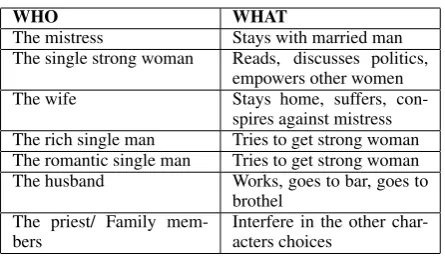
WHO WHAT
The mistress Stays with married man The single strong woman Reads, discusses politics,
empowers other women The wife Stays home, suffers,
con-spires against mistress The rich single man Tries to get strong woman The romantic single man Tries to get strong woman The husband Works, goes to bar, goes to
brothel The priest/ Family
[image:4.595.307.530.59.189.2]mem-bers Interfere in the other char-acters choices
Table 1: Characters (Who) & Action (What)
WHERE WHEN
Street/Bar/Brothel The married man is at the brothel/ street
Street/Caf´e/Home Whenever she is provoked Home/Church Most of the time
Street/ Work/ Bar/ Brothel Whenever he feels like Street/ Home/ Bar/ Caf´e Whenever he meets woman Street/ Home/ work When he needs to feel
pow-erful
Church/ Home Most of the time
Table 2: Place (Where) & Time (When)
it serves our purposes to try to develop a differ-ent narrative model for a prototype of a narrative generator once it presents a fixed structure and a certain number of characters. The plot is also well organized in terms of time and space. There is a large number of texts available in public domain.
Mainly focused on the female audience from the beginning of Brazilian modernization, by the end of the 19th century, these novels presented fixed structures and simple language. Most of the plots were steady – even when they presented different sub-plots that merged. The characters used to de-pict social groups and could be less complex than the characters of the following literary schools. Love is the main motif and it is always related to the social values of the time. They are usually (im-possible) love stories told with some humor in a linear time and space.
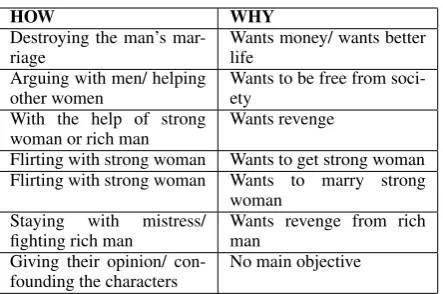
The following tables show a first attempt to obtain a general model of the Brazilian Urban Novel through the personal analysis of the follow-ing books: A Moreninha (Macedo,1844), Senhora (Alencar, 1875), Diva (Alencar, 1864), Luc´ıola (Alencar, 1862). The model was based on Her-man’s Basic Elements of Narative (2009).
7 Final Remarks
HOW WHY Destroying the man’s
mar-riage Wants money/ wants betterlife Arguing with men/ helping
other women Wants to be free from soci-ety With the help of strong
woman or rich man Wants revenge
Flirting with strong woman Wants to get strong woman Flirting with strong woman Wants to marry strong
woman Staying with mistress/
fighting rich man Wants revenge from richman Giving their opinion/
[image:5.595.73.295.59.206.2]con-founding the characters No main objective
Table 3: Plot (How) & Objective (Why)
answered throughout the development of the re-search.
At this point, the study of Cognitive Narratol-ogy applied to the generation of narrative seems to be a good path for the development of systems more cognitive-social oriented. Compared to the previous approaches, it helps us to understand nar-ratives as human experiences and try to replicate it in order to improve the interestingness of the out-put focusing on affecting the reader.
Even if this approach cannot be used to develop a system from scratch, it would be helpful to be applied in existing systems to test its applicability, even though it is still a first draft of the model.
Since urban novels are very distinct from folk-tales it is necessary to observe its own characteris-tics and find the paradigms to formalize this kind of text. At this point, some particularities were al-ready found as showed in the tables.The next step would be the formalization of the narrative genre – work in progress – to be further tested in the pro-totype.
References
Jos´e Alencar. 1862.Luc´ıola. Public Domain.
Jos´e Alencar. 1864.Diva. Public Domain.
Jos´e Alencar. 1875.Senhora. Public Domain.
Selmer Bringsjord and David Ferrucci. 1999.Artificial Intelligence and Literary Creativity: Inside the Mind of BRUTUS, a Storytelling Machine. Lawrence Erl-baum Associates, Hillsdale, NJ.
Monika Fludernik. 1996. Towards a ’natural’ narra-tology, volume 25. Routledge, NY.
Hugo Goncalo Oliveira. 2017. A Survey on Intelli-gent Poetry Generation: Languages, Features, Tech-niques, Reutilisation and Evaluation. Proceedings
of The 10th International Natural Language Gener-ation conference (INLG’17), pages 11–20.
David Herman. 2000. Narratology as a cognitive sci-ence.Image & Narrative, 1(1):1–26.
David Herman. 2009. Basic Elements of Narrative. Blackwell Publishing, Malden, MA.
David Herman. 2013.Cognitive Narratology.
Shohei Imabuchi and Takashi Ogata. 2014. Integrat-ing the Event Generation Mechanism in the Propp-based Story Generation Mechanism into the Inte-grated Narrative Generation System. Journal of Robotics, Networking and Aritficial Life, 1(2):164– 168.
Ben Kybartas and Rafael Bidarra. 2017. A Survey on Story Generation Techniques for Authoring Com-putational Narratives. IEEE Transactions on Com-putational Intelligence and AI in Games, 9(3):239– 253.
George Lakoff. 1972. Structural complexity in fairy tales. The Study of man ; v. 1., 1:. 128–150.
Claude L´evi-Strauss. 1955. The Structural Study fo Myth. The Journal of American Folklore, 68(270):428–444.
Joaquim Manuel de Macedo. 1844. A Moreninha. 91. Public Domain.
Federico Peinado and Pablo Gerv´as. 2005. Creativ-ity issues in plot generation. InWorkshop on Com-putational Creativity, Working Notes. 19th Interna-tional Joint Conference on Artificial Intelligence, International Joint Conference on Artificial Intelli-gence 2005, Edinburgh, Scotland. School of matics, University of Edinburgh, School of Infor-matics, University of Edinburgh.
Lyn Pemberton. 1984. Story Structure: A Narrative Grammar of Nine Chansons de Geste of the Guil-laume d’Orange Cycle. Ph.D. thesis, University of Toronto.
Lyn Pemberton. 1989. A modular approach to story generation.Proceedings of the fourth conference on European{. . .}, pages 217–224.
Rafael P´erez y P´erez. 1999. MEXICA : A Computer Model of Creativity in Writing. Ph.D. thesis, Uni-versity of Sussex.
Rafael P´erez y P´erez. 2018. The Computational Cre-ativity Continuum. InProceedings of the Ninth In-ternational Conference on Computational Creativity ICCC 2018, pages 177–184.
Mark O Riedl. 2004. Narrative Planning: Balancing Plot and Character. Ph.D. thesis, North Carolina University.
Brandon Tearse, Noah Wardrip-fruin, and Michael Mateas. 2010. Minstrel Remixed : Procedurally Generating Stories. Artificial Intelligence, pages 192–197.
Tzvetan Todorov. 1975. The Fantastic: A Structural Approach to a Literary Genre, 1st edition. Cornell University Press.