Detecting anxiety on Reddit
Judy Hanwen Shen University of Toronto
Toronto, Canada
Frank Rudzicz
Toronto Rehabilitation Institute-UHN University of Toronto
Toronto, Canada [email protected]
Abstract
Previous investigations into detecting mental illnesses through social media have predominately focused on detect-ing depression through Twitter corpora (De Choudhury et al.,2013;Resnik et al., 2015;Pedersen, 2015). In this paper, we study anxiety disorders through personal narratives collected through the popular social media website, Reddit. We build a substantial data set of typical and anxiety-related posts, and we apply N-gram lan-guage modeling, vector embeddings, topic analysis, and emotional norms to gener-ate features that accurgener-ately classify posts related to binary levels of anxiety. We achieve an accuracy of 91% with vector-space word embeddings, and an accu-racy of 98% when combined with lexicon-based features.
1 Introduction
Anxiety disorders include a family of conditions characterized by excessive fear, emotional re-sponses to real or perceived threats, and worry in anticipation of future threats. Common forms of anxiety include generalized anxiety, social anxi-ety, health anxianxi-ety, and panic attacks (American Psychiatric Association,2013). The World Health Organization estimates the 12-month prevalence of anxiety disorders to be 26.4% in the United States (Demyttenaere et al.,2004). In adolescents aged 13-18, anxiety disorders are the most com-mon condition with a lifetime prevalence of 31.9% for all anxiety disorders and 8.9% for severe anxi-ety disorders (Merikangas et al.,2010).
Anxiety disorders are primarily diagnosed by physicians or psychologists, but 77% of coun-ties in the United States have a severe shortage
of psychiatrists and non-prescribing mental health providers such as psychiatric nurses, social work-ers, licensed professionals, counselors, and mar-riage and family therapists (Thomas et al.,2009). Given the high prevalence of these disorders, and the shortage of relevant mental health profession-als, there is an urgent need for mental health de-tection tools that are scalable to large populations, and that can be made widely accessible. In par-ticular, the high prevalence of anxiety disorders in adolescents motivates building these screening tools on emerging social media and communica-tion platforms.
2 Background
Social media has become an increasingly popular data source for detecting mental illnesses through text. For example, De Choudhury et al. (2013) built a corpus of more than 2 million Twitter posts, including a ‘depression’ class with tweets from 476 highly active users self-identified as clinically diagnosed with depression. To identify depres-sion, they used feature vectors that included en-gagement with the Twitter platform, the social graph of user Twitter activity, emotional and lin-guistic style using Linlin-guistic Inquiry and Word Count (LIWC) (Pennebaker et al.,2015) and a de-pression lexicon including antidepressant names. De Choudhury et al. (2013) used a mix of text features and metadata features and achieved 70% accuracy in predicting depression in tweets. An-other major data set of tweets labelled for depres-sion was generated byCoppersmith et al. (2015), and contained 3 million tweets from about 2000 Twitter users, including 600 self-identified clini-cally depressed users. From this data set,Nadeem (2016) achieved 86% accuracy with a na¨ıve Bayes unigram classifier. Resnik et al. (2015) used the same data set with latent Dirichlet allocation
(LDA) and supervised LDA techniques to predict the likelihood of target classes based on topics. Their supervised LDA techniques included the as-sociated labels of documents as priors for topic modeling. This approach modified an unsuper-vised learning method and achieved a precision of 0.648 at a recall of 0.5. Preotiuc-Pietro et al. (2015) also participated in the shared task and ap-plied a range methods including: LDA, word vec-tor embeddings, GloVe vecvec-tor embeddings, and unigrams in order to generate word clusters and then feature vectors based on said word clusters. The same data set has also been used to iden-tify patients with post-traumatic stress disorder (PTSD) in social media in the Coppersmith shared task (Coppersmith et al., 2015). Using this data set, Pedersen (2015) used lexical decision lists withN-grams (N between 1 and 6) and achieved a classification accuracy of 74.2% in classifying tweets from people with PTSD.
While Twitter data are available in large vol-umes, tweets are limited in length and can restrict the potential for contextual processing. By con-trast, LiveJournal is a platform for people to dis-cuss common interests, and has also been studied to identify community posts by people with de-pression. Nguyen et al. (2014) found that affec-tive word features from the Affecaffec-tive Norms for English Words (ANEW) and mood tags posted by users gave lower coverage than LIWC features and LDA Topic modeling. Using LIWC and LDA as features for classification, they achieved 93% ac-curacy.
Psychopathology researchers have investigated social anxiety in the context of social media. For example, Fernandez et al. (2012) studied profile information and usage patterns of Facebook users. They concluded that social anxiety was signifi-cantly negatively correlated with the number of Facebook friends and positively correlated with the number of completed sections of a Facebook profile.
Similar to LiveJournal and Facebook, Reddit offers relatively rich bodies of text from users in the context of self-assembled communities. Red-dit is a social website for news aggregation, con-tent rating, and discussion. Reddit allows posts up to 40,000 characters per comment, compared to the 140-character limit of Twitter. Each month, 234 million unique users contribute 75.15 million
posts and 725.85 comments to the site 1. The website contains more than 1 million subpages, called subreddits, each focusing on its own topic, many of which involve sharing personal stories and experiences in order to seek or give advice. The subreddits concerning depression and anxi-ety both involve over 100,000 community mem-bers 2. De Choudhury and De (2014) studied mental health disclosure on Reddit and concluded that users share their experiences and challenges with mental illnesses as well as the impacts of their illnesses on their work, lives, and relation-ships. They also found that users use the plat-form not only for self-expression, but also for seeking diagnosis and treatment information for their conditions. Kumar et al.(2015) studied the r/SuicideWatch community on Reddit after celebrity suicides and found increased posting ac-tivity and increased suicidal ideation in post con-tent, by using linguistic measures,N-gram com-parison, and topic modeling.
Previous success in detecting depression on so-cial media, combined with the previous qualita-tive research in anxiety on social media, suggest that there is potential for detecting anxiety and anxious behavior on social media. In this pa-per, we make the first attempt to detect anxiety-related posts from Reddit using various linguis-tic features. Specifically, we investigate the effec-tiveness of vector-space representations and LDA features, compared to LIWC andN-gram models, in distinguishing anxiety-related texts from more typical texts.
3 Data Collection
The extensive Reddit API allows direct ac-cess to posts by subreddit. For this exper-iment, we collected 22,808 posts on Reddit over 3 months. These posts include 9971 anxiety-related posts (‘Anxiety’) and 12,837 gen-eral posts (‘Control’). The Anxiety posts are predominantly collected from r/anxiety; three other anxiety-related subreddits, including r/panicparty, r/healthanxiety, and r/socialanxiety, are also mined for posts for the Anxiety class. Since the anxiety-related posts are overwhelmingly from a first-person point-of-view, we also collected posts for the Con-trol class from a variety of different subreddits
1about.reddit.com (2017)
anxiety subreddits control subreddits
r/anxiety r/askscience r/relationships r/healthanxiety r/writingprompts r/teaching r/socialanxiety r/writing r/parenting r/panicparty r/atheism r/christianity
r/showerthoughts r/jokes r/lifeprotips r/writing r/personalfinance r/talesfromretail r/theoryofreddit r/talesfromtechsupport r/randomkindness r/talesfromcallcenters r/books r/fitness
r/askdocs r/frugal
[image:3.595.307.525.574.688.2]r/legaladvice r/youshouldknow r/nostupidquestions
Table 1: Subreddits used for data collection.
that involve first-person narratives. Using a di-verse mix of subreddits also minimizes the impact of subject-specific words from any given commu-nity. Table1lists the subreddits included in each category of data. In the Anxiety collection, the av-erage length of posts was 171.83 words (869.14 characters). In the Control posts group, the aver-age length was 164.82 words (846.28 characters). These counts reflect the number of processed to-kens, with URLs, HTML tags and punctuation re-moved. We apply further preprocessing by remov-ing stop words and lemmatizremov-ing word tokens.
4 Feature Generation
4.1 Vector space embeddings: Word2Vec and Doc2Vec
Mikolov et al. (2013) introduced an efficient es-timation of words in vector space for both skip-gram and continuous bag-of-words (CBOW) mod-els. With all training examples, we constructed a CBOW model with a window size of 5 words between current and predicted words in the sen-tence, and use the mean of the context word vec-tors. For training, we make 5 iterations over the corpus and use negative down sampling to draw 5 noise words to speed up training. We empirically select an embedding dimension of 300. With the CBOW model, we constructed feature vectors by taking the mean of all tokens in each training ex-ample. Intuitively, this corresponds to finding the center of the cluster of words in the vector space belonging to the target label category.
Predictive models can be further strengthened by incorporating paragraph context. Le and Mikolov (2014) introduced a distributed mem-ory model with paragraph vectors (PV-DM). Each paragraph vector was mapped to a unique vec-tor in addition to each word being mapped to a
unique vector. In the present work, during train-ing of the feature-generation model, in addition to word vector updates, paragraph vectors are in-ferred with each new training example using gra-dient descent. The paragraph vectors are used in addition to the word vectors to build the post’s fea-ture vector. Fixed length contexts are computed using a sliding window over the paragraph. The contexts produce paragraph information which act as a memory component to provide history when predicting the next word. We construct a PV-DM model with a window size of 10 and again empir-ically select an embedding dimension of 300 for all training example, and use negative down sam-pling to draw 5 noise words. To increase model representation capacity, we iterate over the corpus 10 times. We use the average of the paragraph and word vectors for classification. After generat-ing the PV-DM model, we infer the feature vector using the model by averaging the paragraph vec-tor with the vecvec-tor representations with the other words in the sentence for each training example.
4.2 LDA topic modeling
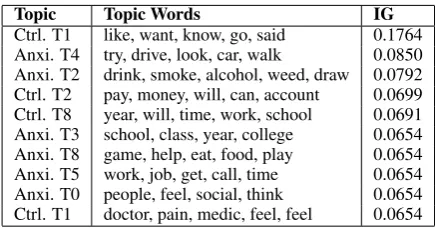
Topic Topic Words IG
Ctrl. T1 like, want, know, go, said 0.1764 Anxi. T4 try, drive, look, car, walk 0.0850 Anxi. T2 drink, smoke, alcohol, weed, draw 0.0792 Ctrl. T2 pay, money, will, can, account 0.0699 Ctrl. T8 year, will, time, work, school 0.0691 Anxi. T3 school, class, year, college 0.0654 Anxi. T8 game, help, eat, food, play 0.0654 Anxi. T5 work, job, get, call, time 0.0654 Anxi. T0 people, feel, social, think 0.0654 Ctrl. T1 doctor, pain, medic, feel, feel 0.0654
Table 2: Topics from the LDA model with the highest information gain (IG) in bits.
a mixture of underlying latent topics where each topic is characterized by a distribution over indi-vidual words (Blei et al.,2003). First, we use the training set to generate two LDA models for the Control and Anxiety classes, respectively. After training the LDA model, we generate the latent unlabelled topics for each class. Table 2 shows the 10 topics, across both groups, with the highest information gain.
Here, each training example is represented by a 20-dimensional array of likelihoods generated by the top 10 topics for each of the Anxiety and Con-trol LDA models.
4.3 LIWC features
Attributes IG
Anxiety 0.3939
Negative 0.2260 Dictionary words 0.1815
Affect 0.1396
First person sing 0.1373 Emotional tone 0.1158 Authentic 0.1112
Clout 0.0988
Analytic 0.0783
[image:4.595.127.238.281.395.2]Feel 0.0766
Table 3: Features from LIWC 2015 with highest information gain (IG) in bits.
We use LIWC 2015 (Pennebaker et al.,2015) to extract lexico-syntactic features as a baseline mea-sure, and the default LIWC dictionary with 95 cat-egories to generate the feature vectors. Table 3 shows the top 10 features from the 94 features of LIWC 2015 with the highest information gain in our data.
4.4 N-gram language models
Another standard method used to extract features from text is to calculate the probability of a doc-ument within a language model. In our experi-ments, we use four different corpora to calculate probabilities of unigrams and bigrams. We build the first two models using the Anxiety and Control training examples, respectively. We build the third model using 100,000 unlabelled tweets from the Sentiment140 dataset (Go et al.,2009) and use the NLTK Brown corpus (Bird, 2006) for the fourth model. To generate feature vectors, we calculate the log-probability of each input sentence as uni-grams and as biuni-grams. For each Reddit post, the associated feature subvector contains a unigram
and bigram probability, with Laplace smoothing for each model, i.e., 8 dimensions in total.
4.5 Learning embeddings and topics
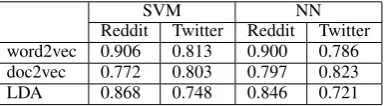
The type of model from which we extract features can be built using any corpus. Here, we compare using in-domain training examples with using an-other corpus for building the word vector (with word2vec), document vector (with doc2vec), and topic (LDA) models. Here, we choose Twitter as a suitable candidate, since it constitutes a similar so-cial media platform, and since previous literature used Twitter data. To compare, 100,000 tweets from Sentiment140 (Go et al.,2009) were used to build word2vec, doc2vec and LDA topic models. These models were further used to generate train-ing and test feature vectors. Table 4summarizes the different accuracies of using our Reddit train-ing set compared to ustrain-ing Twitter data to build the feature generation models. Higher accura-cies were achieved when the models were trained with Reddit examples rather than with the 100,000 tweets for word2vec and LDA features. However, the Twitter-trained document vector model gener-ated more effective feature vectors than the equiv-alent model from Reddit data. This result is likely due to the larger number of training examples used to build the Twitter doc2vec model. While word vectors are shared between documents, document vectors are always unique in each new document (Le and Mikolov,2014). Compared to our Red-dit corpus, this Twitter corpus includes a higher number of training documents but each document is shorter in length. Thus using the Twitter cor-pus in training vector representations may increase the complexity of the doc2vec model more than the word2vec model. To achieve higher accuracy while maintaining consistency, we hereafter use training examples to build models for feature vec-tor generation.
SVM NN
Reddit Twitter Reddit Twitter word2vec 0.906 0.813 0.900 0.786 doc2vec 0.772 0.803 0.797 0.823 LDA 0.868 0.748 0.846 0.721
[image:4.595.322.515.644.697.2]5 Results
Several quantitative results are discussed, below.
5.1 Frequency
To compare differences in lexicon, we use the en-tire labelled data set of 22,808 Reddit posts. We compute the frequencies of all unigrams over both the Anxiety and Control sets. The top 200 uni-grams for each category are sorted, and the un-igrams which appear in both lists are removed, in order to find differentiating subsets. We use the same process for finding the most frequent bi-grams. Table 5 summarizes the top 15 most fre-quent unigrams and top 10 most frefre-quent bigrams, for each group.
Category most frequent n-grams
Anxiety unigrams anxiety, myself, anyone, social, panic, friends, feeling, hav-ing, anxious, else, talk, bad, thought, better, felt
Control unigrams our, call, us, edit, old, tell, phone, use, give, same, cus-tomer, post, money, let, reddit Anxiety bigrams (my anxiety), (social anxiety),
(my life), (anxiety and), (anxi-ety i), (anyone else), (talk to), (panic attacks), (panic attack), (where i)
[image:5.595.75.285.285.458.2]Control bigrams (we are), (from the), (we have), (she was), (he was), (thank you), (that the), (and he), (and she), (what is)
Table 5: Frequent N-grams (N=1, 2) in each class.
The Anxiety unigrams and bigrams explicitly mention anxiety and anxiety-related conditions such as social anxiety and panic attacks. Among the most frequent Anxiety unigrams are words related to feelings (e.g., feeling, thought, felt, bad). In contrast, unigrams and bigrams in Control data contain vocabulary general to Reddit (e.g., edit, post, Reddit). Control group data from r/talesfromcallcenters,
r/talesfromtechsupport and
r/talesfromretail contain unique customer- and phone-related words (e.g., call, phone, customer) that are not frequently present in the Anxiety group data. The Control set also frequently contains more third-person and first-person plural pronouns compared than the Anxiety set. The most frequent unigrams and bi-grams of the Anxiety set include more first-person singular pronouns, however.
5.2 Collocations
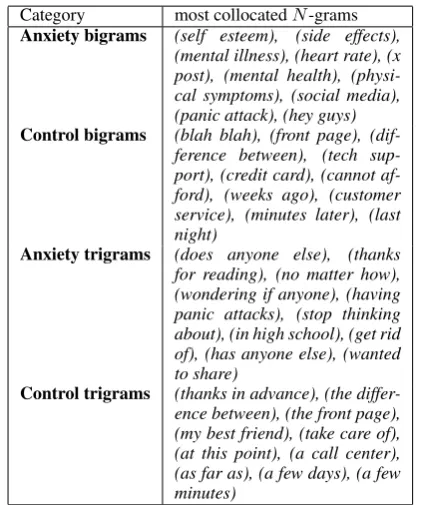
Studying collocations captures how groups of words are combined to produce meaning beyond the sum of individual component words. While N-gram frequencies in the previous section reveal how often words appear, identifying collocations can reveal important topics mentioned within a corpus. To find the collocations in both the Con-trol and Anxiety posts, we again analyze the entire data set. Using the NLTK collocation library, we filter collocations by empirically selecting a min-imum frequency of 100 for bigrams and 75 for trigrams. We then extract the 30 most collocated N-grams ranked by pointwise mutual information (Manning et al., 1999) from each of the Anxiety and Control sets. We also remove collocations that appear in both the Anxiety and Control collocation lists. Table6 summarizes the top 10 most collo-cated bigrams and trigrams for both groups.
Category most collocatedN-grams
Anxiety bigrams (self esteem), (side effects), (mental illness), (heart rate), (x post), (mental health), (physi-cal symptoms), (social media), (panic attack), (hey guys) Control bigrams (blah blah), (front page),
(dif-ference between), (tech sup-port), (credit card), (cannot af-ford), (weeks ago), (customer service), (minutes later), (last night)
Anxiety trigrams (does anyone else), (thanks for reading), (no matter how), (wondering if anyone), (having panic attacks), (stop thinking about), (in high school), (get rid of), (has anyone else), (wanted to share)
[image:5.595.311.522.337.590.2]Control trigrams (thanks in advance), (the differ-ence between), (the front page), (my best friend), (take care of), (at this point), (a call center), (as far as), (a few days), (a few minutes)
Table 6: Highly collocatedN-grams (N=2, 3).
wonder-ing if anyone, has anyone else, wanted to share). There are also collocations that indicate age infor-mation (e.g.,in high school), and users’ struggles with anxiety disorders (e.g., no matter how, stop thinking about, get rid of).
5.3 Classification
Table 7 summarizes the 10-fold cross-validated accuracy and precision rates of using various types of feature, across logistic regression (LR), a linear kernel support vector machine (SVM), and a neu-ral network (NN) for binary classification. The LR and SVM classifiers were implemented with SciKit-Learn (Pedregosa et al., 2011). We built a custom 2-layer neural network with 256 hidden units per layer and sigmoid activations. During optimization, we empirically used a batch size of 500 and a learning rate of 0.01 for 200 iterations.
Overall, all features are useful in classify-ing anxiety-related posts on Reddit. For sclassify-ingle- single-source features, we achieve the best results, of 91% accuracy, through word-vector embeddings (word2vec), and through N-gram probabilities. The performance of word2vec is slightly better than the word-vector techniques used by Preotiuc-Pietro et al. (2015) on the Coppersmith Twit-ter corpus (Coppersmith et al., 2015). By con-trast, usingN-gram probabilities achieve an over-all slightly better precision (92% with NN) than word2vec (91% with SVM). The LDA topic fea-tures also perform better than previous results us-ing LDA to detect depression on Twitter (Resnik et al.,2015). Whether topic modelling is more ap-propriate for long-form posts, as in our data, is the subject of future work.
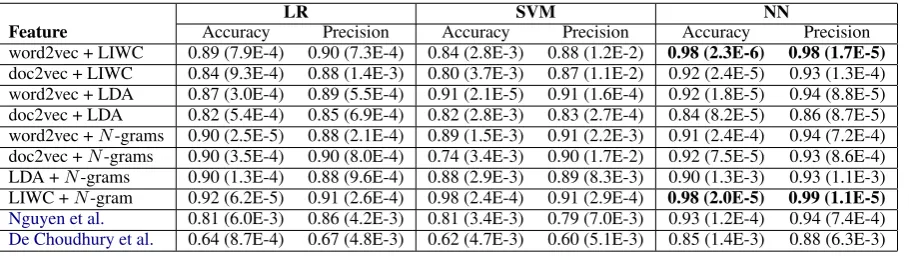
Since our data did not include meta-data, we im-plemented content-based features fromDe Choud-hury et al. (2013) including emotion, linguistic style (from LIWC 2007), and an anxiety lexicon. In addition, we combined LIWC and LDA fea-tures from Nguyen et al.(2014). The accuracies and precisions of these implementations, as well as the aggregate features, are summarized in Table 8.
For combined methods, our neural network classifier consistently produces the best results. We achieve the highest of accuracy of 98% by combining LIWC with N-gram probabili-ties and by combining word-vector embeddings (word2vec) with LIWC using this classifier. We improve classification accuracy by 7% over only
using word2vec and by 13% over the LIWC-only baseline. Also, N-grams+LIWC (99%) achieves slightly higher precision than word2vec+LIWC (98%), which is consistent with the difference in N-grams-only word2vec-only results. Combined models, specifically word2vec+N-gram probabil-ities, word2vec+LDA, and LIWC+ LDA (Nguyen et al., 2014), achieve comparable results with 95%, 94%, and 95% precision, respectively.
For all accuracy and precision values in Ta-ble7and Table8, the associated recall was high; between 79% and 99% depending on the classi-fier. The neural network classifier consistently produced recall values above 90% with variances in the order of10−4. The SVM classifier produced
the lowest recall (79%-90%) with larger variances in the order of10−2. This fluctuation may be due
to using a linear kernel which has a lower repre-sentational power than a non-linear kernel
6 Discussion
The LIWC 2015 dictionary provides sufficient coverage of anxiety-related word usage to success-fully classify Anxiety and Control Reddit posts. However, by combining LIWC features with N-gram probabilities or unsupervised feature-generation techniques (i.e., vector space embed-dings and LDA Topic modeling), we can elevate the classification accuracy to 98%. Moreover, we find correlations between anxiety and specific LDA topics such as school and alcohol (and drug) consumption (see Table2). This could be an ef-fective method of identifying topics that people with anxiety or other mental illnesses discuss on-line. By counting unigram and bigram frequency, we also find lexicons relating to feelings and first-person, singular pronouns predominantly repre-sented in the Anxiety group. Furthermore, study-ing frequent collocations suggests that authors of anxiety-related posts are looking to find other peo-ple sharing similar experiences with anxiety.
Due to the relatively recent popularity in the platform, little work has involved the linguistic as-pects of Reddit, compared to Twitter. The lengths of posts and community organization of the web-site suggests considerable potential for sophisti-cated methods of feature extraction as well as qualitative analysis.
LR SVM NN
[image:7.595.92.506.61.134.2]Feature Accuracy Precision Accuracy Precision Accuracy Precision word2vec 0.87 (9.3E-5) 0.89 (3.4E-4) 0.91 (1.0E-5) 0.91 (7.8E-5) 0.90 (9.1E-5) 0.91 (2.2E-3) doc2vec 0.78 (9.4E-5) 0.75 (3.7E-4) 0.77 (8.0E-6) 0.76 (3.0E-5) 0.80 (9.5E-5) 0.78 (2.3E-4) LDA 0.80 (9.8E-5) 0.80 (1.6E-3) 0.87 (1.4E-4) 0.87 (2.8E-4) 0.85 (1.6E-4) 0.85 (7.5E-4) LIWC 0.85 (4.2E-4) 0.85 (2.1E-3) 0.71 (1.1E-2) 0.81 (1.5E-2) 0.82 (1.0E-2) 0.85 (4.9E-3) N-grams 0.90 (8.8E-5) 0.89 (4.1E-4) 0.85 (6.9E-3) 0.86 (9.4E-3) 0.91 (2.2E-4) 0.92 (1.4E-3)
Table 7: Accuracies, precisions (and variances) for single-source features.
LR SVM NN
Feature Accuracy Precision Accuracy Precision Accuracy Precision word2vec + LIWC 0.89 (7.9E-4) 0.90 (7.3E-4) 0.84 (2.8E-3) 0.88 (1.2E-2) 0.98 (2.3E-6) 0.98 (1.7E-5)
doc2vec + LIWC 0.84 (9.3E-4) 0.88 (1.4E-3) 0.80 (3.7E-3) 0.87 (1.1E-2) 0.92 (2.4E-5) 0.93 (1.3E-4) word2vec + LDA 0.87 (3.0E-4) 0.89 (5.5E-4) 0.91 (2.1E-5) 0.91 (1.6E-4) 0.92 (1.8E-5) 0.94 (8.8E-5) doc2vec + LDA 0.82 (5.4E-4) 0.85 (6.9E-4) 0.82 (2.8E-3) 0.83 (2.7E-4) 0.84 (8.2E-5) 0.86 (8.7E-5) word2vec +N-grams 0.90 (2.5E-5) 0.88 (2.1E-4) 0.89 (1.5E-3) 0.91 (2.2E-3) 0.91 (2.4E-4) 0.94 (7.2E-4) doc2vec +N-grams 0.90 (3.5E-4) 0.90 (8.0E-4) 0.74 (3.4E-3) 0.90 (1.7E-2) 0.92 (7.5E-5) 0.93 (8.6E-4) LDA +N-grams 0.90 (1.3E-4) 0.88 (9.6E-4) 0.88 (2.9E-3) 0.89 (8.3E-3) 0.90 (1.3E-3) 0.93 (1.1E-3) LIWC +N-gram 0.92 (6.2E-5) 0.91 (2.6E-4) 0.98 (2.4E-4) 0.91 (2.9E-4) 0.98 (2.0E-5) 0.99 (1.1E-5)
Nguyen et al. 0.81 (6.0E-3) 0.86 (4.2E-3) 0.81 (3.4E-3) 0.79 (7.0E-3) 0.93 (1.2E-4) 0.94 (7.4E-4)
De Choudhury et al. 0.64 (8.7E-4) 0.67 (4.8E-3) 0.62 (4.7E-3) 0.60 (5.1E-3) 0.85 (1.4E-3) 0.88 (6.3E-3)
Table 8: Accuracies, precisions (and variances) for aggregate features.
Further work should also include larger data sets in combination with explicitly associated diagnostic criteria, assessments, or health records, to empha-size validity.
References
American Psychiatric Association. 2013. Diagnostic and Statistical Manual of Mental Disorders, Fifth Edition: DSM-5R. American Psychiatric Associ-ation.
Steven Bird. 2006. Nltk: the natural language toolkit. In Proceedings of the COLING/ACL on Interac-tive presentation sessions. Association for Compu-tational Linguistics, pages 69–72.
David M Blei, Andrew Y Ng, and Michael I Jordan. 2003. Latent Dirichlet allocation. Journal of Ma-chine Learning Research3(Jan):993–1022.
Glen Coppersmith, Mark Dredze, Craig Harman, Kristy Hollingshead, and Margaret Mitchell. 2015. CLPsych 2015 shared task: Depression and PTSD on Twitter. InProceedings of ACL. pages 31–39. Munmun De Choudhury and Sushovan De. 2014.
Mental health discourse on Reddit: Self-disclosure, social support, and anonymity. In Proceedings of ICWSM. pages 71–80.
Munmun De Choudhury, Michael Gamon, Scott Counts, and Eric Horvitz. 2013. Predicting depres-sion via social media. InProceedings of ICWSM. page 2.
Koen Demyttenaere, Ronny Bruffaerts, Jose Posada-Villa, Isabelle Gasquet, Viviane Kovess, Jean Pierre
Lepine, et al. 2004. Prevalence, severity, and unmet need for treatment of mental disorders in the World Health Organization World Mental Health surveys. Jama291(21):2581–2590.
Katya C Fernandez, Cheri A Levinson, and Thomas L Rodebaugh. 2012. Profiling: Predicting social anx-iety from Facebook profiles. Social Psychological and Personality Science3(6):706–713.
Alec Go, Richa Bhayani, and Lei Huang. 2009. Twit-ter sentiment classification using distant supervision. CS224N Project Report, Stanford1(12).
Mrinal Kumar, Mark Dredze, Glen Coppersmith, and Munmun De Choudhury. 2015. Detecting changes in suicide content manifested in social media fol-lowing celebrity suicides. InProceedings of ACM. ACM, pages 85–94.
Quoc V Le and Tomas Mikolov. 2014. Distributed rep-resentations of sentences and documents. In Pro-ceedings of ICML. volume 14, pages 1188–1196.
Christopher D Manning, Hinrich Sch¨utze, et al. 1999. Foundations of statistical natural language process-ing, volume 999. MIT Press.
Kathleen Ries Merikangas, Jian-ping He, Marcy Burstein, Sonja A Swanson, Shelli Avenevoli, Li-hong Cui, et al. 2010. Lifetime prevalence of men-tal disorders in us adolescents: results from the Na-tional Comorbidity Survey Replication–Adolescent Supplement (NCS-A). Journal of the Ameri-can Academy of Child & Adolescent Psychiatry 49(10):980–989.
[image:7.595.75.530.170.298.2]representations in vector space. arXiv preprint arXiv:1301.3781.
Moin Nadeem. 2016. Identifying
depres-sion on Twitter. CoRR abs/1607.07384.
http://arxiv.org/abs/1607.07384.
Thin Nguyen, Dinh Phung, Bo Dao, Svetha Venkatesh, and Michael Berk. 2014. Affective and content anal-ysis of online depression communities. IEEE Trans-actions on Affective Computing5(3):217–226. Ted Pedersen. 2015. Screening Twitter users for
de-pression and PTSD with lexical decision lists. In Proceedings of ACL. pages 46–53.
Fabian Pedregosa, Gael Varoquaux, Alexander Gram-fort, Vincent Michel, Bertrand Thirion, Olivier Grisel, et al. 2011. Scikit-learn: Machine learning in Python. Journal of Machine Learning Research 12:2825–2830.
James W Pennebaker, Ryan L Boyd, Kayla Jordan, and Kate Blackburn. 2015. The development and psy-chometric properties of LIWC2015. Technical re-port, University of Texas at Austin, Austin, Texas. Daniel Preotiuc-Pietro, Maarten Sap, H Andrew
Schwartz, and LH Ungar. 2015. Mental illness detection at the world well-being project for the clpsych 2015 shared task. Proceedings of NAACL HLT 2015page 40.
Philip Resnik, William Armstrong, Leonardo Claudino, Thang Nguyen, Viet-An Nguyen, and Jordan Boyd-Graber. 2015. Beyond LDA: exploring supervised topic modeling for depression-related language in Twitter. InProceedings of ACL. pages 99–107.