Surface Statistics of an Unknown Language Indicate How to Parse It
Dingquan Wang and Jason Eisner
Department of Computer Science, Johns Hopkins University {wdd,jason}@cs.jhu.edu
Abstract
We introduce a novel framework for delex-icalized dependency parsing in a new lan-guage. We show that useful features of the target language can be extracted automati-cally from an unparsed corpus, which con-sists only of gold part-of-speech (POS) se-quences. Providing these features to our neural parser enables it to parse sequences like those in the corpus. Strikingly, our sys-tem has no supervision in the target lan-guage. Rather, it is a multilingual sys-tem that is trained end-to-end on a vari-ety of otherlanguages, so it learns a fea-ture extractor that works well. We show experimentally across multiple languages: (1) Features computed from the unparsed corpus improve parsing accuracy. (2) In-cluding thousands of synthetic languages in the training yields further improvement. (3) Despite being computed fromunparsed
corpora, our learned task-specific features beat previous work’s interpretable typolog-ical features that requireparsedcorpora or expert categorization of the language. Our best method improved attachment scores on held-out test languages by an average of 5.6 percentage points over past work that does not inspect the unparsed data (McDonald et al.,2011), and by 20.7 points over past “grammar induction” work that does not use training languages (Naseem et al.,2010).
1 Introduction
Dependency parsing is one of the core natural language processing tasks. It aims to parse a given sentence into its dependency tree: a directed graph of labeled syntactic relations between words. Supervised dependency parsers—which are trained using a “treebank” of known parses in the target language—have been very successful (McDonald, 2006; Nivre, 2008; Kiperwasser and Goldberg, 2016). By contrast, the progress
of unsupervised dependency parsers has been slow, and they have apparently not been used in any downstream NLP systems (Mareˇcek, 2016). An unsupervised parser does not have access to a treebank, but only to a corpus of unparsed sentences in the target language.
Unsupervised parsing has been studied for decades. The most common approach is gram-mar induction (Lari and Young, 1990; Carroll and Charniak, 1992;Klein and Manning, 2004). Grammar induction induces an explicit grammar from the unparsed corpus, such as a probabilis-tic context-free grammar (PCFG), and uses that to parse sentences of the language. This approach has encountered two major difficulties:
• Search error: Most formulations of gram-mar induction involve optimizing a highly non-convex objective function such as likeli-hood. The optimization is typically NP-hard (Cohen and Smith, 2012), and approximate local search methods tend to get stuck in lo-cal optima.
• Model error: Likelihood does not correlate well with parsing accuracy anyway (Smith, 2006, Figure 3.2). Likelihood optimization seeks latent trees that help to predict the observed sentences, but these unsupervised trees may use a non-standard syntactic anal-ysis or even be optimized to predict non-syntactic properties such as topic. We seek a standard syntactic analysis—what Smith (2006) calls the MATCHLINGUISTtask.
We address both difficulties by using a super-vised learning framework—one whose objective function is easier to optimize and explicitly tries to match linguists’ standard syntactic analyses.
Our approach is inspired by Wang and Eisner (2017), who use an unparsed but tagged corpus to predict the fine-grained syntactic typology of
667
a language. For example, they may predict that about 70% of the direct objects fall to the right of the verb. Their system is trained on a large num-ber of (unparsed corpus, true typology) pairs, each representing a different language. With this train-ing, it can generalize to predict typology from the unparsed corpus of a new language. Our approach is similar except that we predict parses rather than just a typology. In both cases, the system is trained to optimize a task-specific quality measure. The system’s parameterization can be chosen to sim-plify optimization (strikingly, the training objec-tive could even be madeconvexby using a condi-tional random field architecture) and/or to incor-porate linguistically motivated features.
The positive results ofWang and Eisner(2017) demonstrate that there are indeed surface clues to syntactic structure in the input corpus, at least if it is POS-tagged (as in their work and ours). How-ever, their method only found global typological information: it did not establishwhich70% of the direct objects fell to the right of their verbs, let alone identify which nouns were in fact direct ob-jects of which verbs. That requires a token-level analysis of each sentence, which we undertake in this paper. Again, the basic idea is that instead of predicting interpretable typological properties of a language asWang and Eisner(2017) did, we will predict a language-specific version of the scoring function that a parser uses to choose among vari-ous actions or substructures.
2 Unsupervised Parsing with Supervised Tuning
Our fundamental question is whether gold part-of-speech (POS) sequences carry useful information about the syntax of a language.1As we will show, the answer is yes, and the information can be ex-tracted and used to obtain actual parses.
This is the same question that has been implic-itly asked by previous papers in the unsupervised parsing tradition (see §5). Unsupervised pars-ing of gold POS sequences is an artificial task, to be sure.2 Nonetheless, it is a starting point
1
We also include an experiment on noisy POS sequences. 2
It is clearly not the task setting faced by human language learners. Nor is it a plausible engineering setting: a language with gold POS sequences often also has at least a small tree-bank of gold parses, or at least parallel text in a language from which noisy parses can be noisily projected (Agi´c et al., 2016). There is also no practical reason to consider POS tags without their attached words.
for more ambitious settings that would learn from words and real-world grounding (with or without the POS tags). Even this starting point has proved surprisingly difficult over decades of research, so it has not been clear whether the POS sequences even contain the necessary information.
Yet this task—like others that engineers, lin-guists, or human learners might face—might be solvable with general knowledge about the distri-bution of human languages. An experienced lin-guist can sometimes puzzle out the structure of a new language. The reader may be willing to guess a parse for the gold POS sequence VERB DET NOUN ADJ DET NOUN. After all, adjectives usually attach to nouns (Naseem et al.,2010), and the adjective in this example seems to attach to the first noun—not to the second, since determiners usually fall at the edge of a noun phrase. Mean-while, the sequence’s sole verb is apparently fol-lowed by two noun phrases, which suggests ei-ther VSO (verb-subject-object) or VOS order— and VSO is a good guess as it is more common (Dryer and Haspelmath,2013). Observing a cor-pus of additional POS sequences might help re-solve the question of whether this language is pri-marily VSO or VOS, for example, by guessing that short noun phrases in the corpus (for example, un-modified pronouns) are more often subjects.
Thus, we propose to solve the task by training a kind of “artificial linguist” that can do such analy-sis on corpora of new languages.
unsupervised learners includes strapping (Eisner and Karakos,2005;Karakos et al., 2007), which tunes with the help of both real and synthetic datasets, just as we will (§3).
Are such systems really “unsupervised”? Yes, in the sense that they are able to discover desirable structure in anewdataset. Unsupervised learners are normally crafted using assumptions about the data domain. Their structure and hyperparameters may have been manually tuned to produce pleas-ing results for typical datasets in that domain. In the domain of POS corpora, we simply scale up this practice toautomaticallytune a large set of pa-rameters, which later guide our system’s search for linguist-approved structure on each new human-language dataset. Our system should be regarded as “supervised” if the examples are taken to be en-tire languages: after all, we train it to map un-labeled corpora to usefully un-labeled corpora. But once trained, it is “unsupervised” if the examples are taken to be the sentences within a given corpus: by analyzing the corpus, our system figures out how to map sentences ofthat language to parses, without any labeled examples in that language.
3 Data
We use two datasets in our experiment:
UD: Universal Dependencies version 1.2 (Nivre et al.,2015) A collection of 37 dependency tree-banks of 33 languages, tokenized and annotated with a common set of POS tags and dependency relations.3 In principle, our trained system could be applied to predict UD-style dependency re-lations in any tokenized natural-language corpus with UD-style POS tags.
GD: Galactic Dependencies version 1.0 (Wang and Eisner, 2016) A collection of dependency treebanks for 53,428 synthetic languages (of which we will use a subset). A GD treebank is generated by starting with some UD treebank and stochastically permuting the child subtrees of nouns and/or verbs to match their orders in other UD treebanks. For example, one of the GD treebanks reflects what the English UD tree-bank might have looked like if English had been both VSO (like Irish) and postpositional (like Japanese). This typologically diverse collection
3While it might have been preferable to use the expanded
and revised UD version 2.0, we wished to compare fairly with GD 1.0, which is based on UD 1.2.
of resource-rich synthetic languages aims to pro-pel the development of NLP systems that can han-dle diverse natural languages, such as multilingual parsers and taggers.
3.1 Why Synthetic Training Languages?
We hope for our system to do well, on average, at matching real linguist-parsed corpora of real hu-man languages. We therefore tune its parameters
Θon such treebanks. UD provides training exam-plesactuallydrawn from that distributionDover treebanks—but alas, rather few. Thus to better es-timate the expected performance of Θ under D, we follow Wang and Eisner (2017) and augment our training data with GD’ssynthetictreebanks.
Ideally we would have sampled these synthetic treebanks from a careful estimateDˆ ofD: for ex-ample, the mean of a Bayesian posterior for D, derived from prior assumptions and UD evidence. However, such adventurous “extrapolation” of un-seen languages would have required actually con-structing such an estimateDˆ—which would em-body a distribution over semantic content and a full theory of universal grammar! The GD tree-banks were derived more simply and more con-servatively by “interpolation” among the actual UD corpora. They combine observed parse trees (which provide attested semantic content) with stochastic word order models trained on observed languages (which attempt to mimic attested pat-terns for presenting that content). GD’s sampling distribution Dˆ still offers moderately varied syn-thetic datasets, which remain moderately realistic, as they are limited to phenomena observed in UD. As Wang and Eisner(2016) pointed out, syn-thetic examples have been used in many other su-pervised machine learning settings. A common technique is to exploit invariance: if real image
z should be classified as a cat, then so should a rotatedversion of image z. Our technique is the same! We assume that if real corpusushould be parsed as having certain dependencies among the word tokens, then so should a version of corpus
uin which those tokens have beensystematically permutedin alinguistically plausibleway.4 This is analogous to how rotation sytematically trans-forms the image (rotating all pixels through the sameangle) in a physically plausible way (as real objects do rotate relative to the camera). The sys-tematicity is needed to ensure that the task on
thetic data is feasible. In our case, the synthetic corpus then provides many sentences that have been similarly permuted, which may jointly pro-vide enough clues to guess the word order of this synthetic language (for example, VSO vs. VOS in §2) and thus recover the dependencies. SeeWang and Eisner(2018, §2) for related discussion.
With enough good synthetic languages to use for training, even nearest-neighbor could be an effective method. That is, one could obtain the parser for a test corpus simply by copying the trained parser for the most similar training cor-pus (under some metric).Wang and Eisner(2016) explored this approach of “single-source transfer” from synthetic languages. Yet with only thousands of synthetic languages, perhaps nosingletraining corpus is sufficiently similar.5 To draw on pat-terns inmanytraining corpora to figure out how to parse the test corpus, we will train a single parser that can handle all of the training corpora (Ammar et al., 2016), much as we trained our typological classifier in earlier work (Wang and Eisner,2017).
4 Task Formulation
An unsupervised parser for language ` is built without any gold parse trees for `. However, we assume a corpus u of unparsed but POS-tagged sentences of`is available. Fromu, we will extract statisticsT(u)that are informative about the syn-tactic structure of `, to guide us in parsing POS-tagged sentences of`.
Overall, our approach is to train a “language-agnostic” parser—one that does not know what language`it is parsing in. It produces a parse tree
ˆ
y = ParseΘ(x;u)from a sentence x,
construct-ingT(u) as an intermediate quantity that carries (for example) typological information about `. The parameters Θ are shared by all languages, and determine how to construct and use T. To learn them, we will allow`to range over training languages, and then test our ability to parse when `ranges over novel test languages.
OurParseΘ(x;u)system has two stages. First
it uses a neural network to computeT(u)∈Rm, a vector that represents the typological properties of `and resembles thelanguage embedding of Am-mar et al.(2016). Then it parses sentencexwhile takingT(u)as an additional input. We will give
5Wang and Eisner(2018) do investigate synthesis “on
de-mand” of a permuted training corpus that is as similar as pos-sible to the test corpus.
details of these two components in §6and §7. We assume in this paper that the input sentence xis given as a POS sequence: that is, our parser is delexicalized. This spares us from also need-ing language-specific lexical parameters associ-ated with the specific vocabulary of each language, a problem that we leave to future work.
We will choose our universal parameter values by minimizing an estimate of their expected loss,
ˆ
Θ= argmin
Θ
mean
`∈Ltrain
Loss(Θ;x(`),y(`),u(`))
(1)
whereLtrainis a collection of training languages (ideally drawn IID from the distributionDof pos-sible human languages) for which some syntac-tic information is available. Specifically, each training language ` has a treebank (x(`),y(`)), wherex(`)is a collection of POS-tagged sentences whose correct dependency trees are given byy(`). Each`also has an unparsed corpusu(`)(possibly equal tox(`)or containingx(`)). We can therefore define the parser’s loss on training language`as
Loss(Θ;x(`),y(`),u(`)) (2)
= mean
(x,y)∈(x(`),y(`))loss(ParseΘ(x;u (`))
| {z }
ˆ y
, y)
whereloss(. . .)is a task-specific per-sentence loss (defined in §8.1) that evaluates the parser’s output
ˆ
yon sentencexagainstx’s correct treey.
5 Related Work
5.1 Per-Language Learning
Many papers rely on someuniversal learning pro-cedureto determineT(u)(see §4) for a target lan-guage. For example,T(·)may be the Expectation-Maximization (EM) algorithm, yielding a PCFG
T(u)that fully determines a CKY parser (Carroll and Charniak, 1992;Klein and Manning, 2004). Since EM and CKY are fixed algorithms, this ap-proach has no trainable parameters.
method to beat a simple right-branching heuris-tic. Headden III et al. (2009) and Spitkovsky et al. (2012) made the DMV more expressive by considering higher-order valency or punctuation. To reduce search error, strategies for eliminating or escaping local optima have included convex-ified objectives (Wang et al., 2008; Gimpel and Smith,2012), smart initialization (Klein and Man-ning, 2004; Mareˇcek and Straka, 2013), search bias (Smith and Eisner,2005,2006;Naseem et al., 2010;Gillenwater et al.,2010), branch-and-bound search (Gormley and Eisner,2013), and switching objectives (Spitkovsky et al.,2013).
Unsupervised parsing(which is also our task) tries to turn the same corpus directly into a tree-bank, without necessarily finding a grammar. We discuss some recent milestones here. Grave and Elhadad (2015) propose a transductive learning objective for unsupervised parsing, and a convex relaxation of it. (Jiang et al.(2017) combined that work with grammar induction.) Martínez Alonso et al. (2017) create an unsupervised dependency parser that is formally similar to ours in that it uses cross-linguistic knowledge as well as statis-tics computed from a corpus of POS sequences in the target language. However, its cross-linguistic knowledge is hand-coded: namely, the set of POS-to-POS dependencies that are allowed by the UD annotation scheme, and the typical directions for some of these dependencies. The only cor-pus statistic extracted from u is whether ADP
-NOMINAL or NOMINAL-ADP bigrams are more
frequent,6which distinguishes prepositional from postpositional languages. The actual parser starts by identifying the head word as the most “central” word according to a PageRank (Page et al.,1999) analysis of the graph of candidate edges, and pro-ceeds by greedily attaching words of decreasing PageRank at lower depths in the tree.
5.2 Multi-Language Learning
This approach parses a “target” language using the treebanks of other resource-rich languages as “source” languages. There are two main variants.
Memory-based. This method trains a super-vised parsing model on each source treebank. It uses these (delexicalized) source-language models to help parse the target sentence, favoring sources that are similar to the target language. A common
6
In our notation of §6.1, below, this asks whether
P
t∈{NOUN,PRON,PROPN}π
w
t|ADPis greater forw= 1orw=−1.
similarity measure (Rosa and Žabokrtský,2015a) considers the probability of the target language’s POS-corpusuunder a trigram language model of source-language POS sequences.
Single-source transfer (SST) (Rosa and Žabokrtský, 2015a; Wang and Eisner, 2016) simply uses the parser for themost similarsource treebank. Multi-source transfer (MST) (Rosa and Žabokrtský, 2015a) parses the target POS sequence with each of the source parsers, and then combines these parses into a consensus tree using the Chu-Liu-Edmonds algorithm (Chu, 1965;Edmonds,1967). As a faster variant, model interpolation (Rosa and Žabokrtský,2015b) builds a consensus model for the target language (via a weighted average of source models’ parameters), rather than a consensus parse for each target sentence separately.
Memory-based methods require storing models for all source treebanks, which is expensive when we include thousands of GD treebanks (§3).
Model-based. This method trains a single language-agnostic model.McDonald et al.(2011) train a delexicalized parser on the concatenation of all source treebanks, achieving a large gain over grammar induction. This parser can learn univer-sals such as the preference for determiners to at-tach to nouns (which was hard-coded byNaseem et al.(2010)). However, it is expected to parse a sentence x without being told the language ` or even a corpusu, possibly by guessing properties of the language from the configurations it encoun-ters in the single sentencexalone.
Further gains were achieved (Naseem et al., 2012;Täckström et al.,2013b;Zhang and Barzi-lay, 2015;Ammar et al., 2016) by providingthe parser with about 10 typological properties of x’s language—for example, whether direct objects generally fall to the right of the verb—as listed in the World Atlas of Linguistic Structures (Dryer and Haspelmath,2013).
However, relying on WALS raises some is-sues. (1) The unknown language might not be in WALS.7(2) Some typological features are missing for some languages. (3) All the WALS features are categorical values, which loses useful infor-mation about tendencies (for example, how often the canonical word order is violated). (4) Not all WALS features are useful—only 56 of them per-tain to word order, and only 8 of those have been
used in past work. (5) With a richer parser (a stack LSTM dependency parser), WALS features do not appear to help at all on unknown languages ( Am-mar et al.,2016, footnote 30).
5.3 Exploiting Parallel Data
Some other work on generalizing from source to target languages assumes the availability of source-target parallel data, or bitext. Two uses:
Induction of multilingual word embeddings.
Similar to universal POS tags, multilingual word embeddings serve as a universal representation that bridges the lexical differences among lan-guages. Guo et al. (2016) proposed two ap-proaches: (1) Training a variant of the skip-gram model (Mikolov et al., 2013) by using bilingual sets of context words. (2) Generating the ding of each target word by averaging the embed-dings of the source words to which it is aligned.
Annotation projection. Given aligned bitext, one can generate an approximate parse for a tar-get sentence by “projecting” the parse tree of the corresponding source sentence. A target-language parser can then be trained from these approxi-mate parses. The idea was originally proposed by Yarowsky et al. (2001), and then applied to dependency parsing on low-resource languages (Hwa et al., 2005; Ganchev et al., 2009; Smith and Eisner, 2009; Tiedemann, 2014, inter alia). McDonald et al. (2011) extend this approach to multiple source languages by projected transfer. Later work in this vein mainly tries to improve the approximate parses, including translating the source treebanks into the target language with an off-the-shelf machine translation system ( Tiede-mann et al., 2014), augmenting the trees with weights (Agi´c et al.,2016), and using only partial trees with high-confidence alignments (Rasooli and Collins,2015,2017;Lacroix et al.,2016).
5.4 Situating Our Work
Our own approach can be categorized as model-based multi-language learning with no parallel text or target-side supervision. However, we also analyze an unparsed corpus u of the target lan-guage, as the per-language systems of §5.1 do. Our analysis ofu does not produce a specialized target grammar or parser, but only extracts a tar-get vectorT(u)to be fed to the language-agnostic parser. The analyzer is trained jointly with the parser, over many languages.
T(
u
)
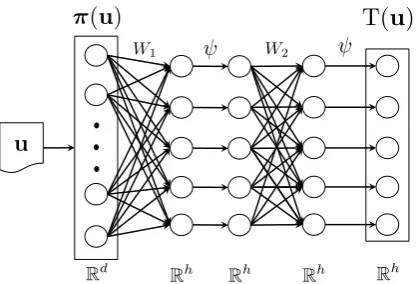
[image:6.595.312.521.60.202.2]W1 W2
Figure 1: A 2-layer typology component. The bias vectors (bW) are suppressed for readability.
6 The Typology Component
Wang and Eisner(2017) extract typological prop-erties of a language from its POS-tagged corpusu, in effect predicting syntactic structure from super-ficial features. Like them, we compute a hidden layerT(u)using a standard multilayer perceptron architecture, for example,
T(u) =ψ(Wπ(u) +bW)∈Rh (3)
where π(u) ∈ Rd is the surface features of u,
W ∈ Rh×d maps π(u) into a h-dimensional space, bW ∈ Rh is a bias vector, and ψ is an
element-wise activation function. While equa-tion (3) has only 1 layer, we explore versions with from 0 to 3 layers (where T(u) = π(u) in the 0-layer case). A 2-layer version is shown in Fig-ure1. The number of layers is chosen by cross-validation, as arehand theψfunction.
6.1 Design of the Surface Featuresπ(u)
To defineπ(u), we used development data to se-lect the following fast but effective subset of the features proposed byWang and Eisner(2017).
Hand-engineered features. Given a tokenjin a sentence, let itsright windowRj be the sequence of POS tagspj+1, . . . , pj+w(padding the sentence as needed with#symbols).wis thewindow size. Define gw(t | j) ∈ [0,1] to be the fraction of words inRj tagged witht. Now, given a corpus
u, define
πwt = mean
j g
w(t|j), πw
t|s= meanj:T
j=s
gw(t|j)
where j ranges over tokens of u. The unigram prevalenceπw
of an averagestag (in a window of sizew). For each of these quantities, we have a corresponding mirror-image quantity (denoted by negatingw) by computing it on a reversed version of the corpus.
The final hand-engineeredπ(u)includes:
• πtw, for each tag type t and each w ∈ {1,3,8,100}. This quantity measures how frequentlytappears inu.
• πtw|s//πtw andπt−|sw//πt−w, for each tag type pairs, tand eachw∈ {1,3,8,100}. We
de-finex//y = min(x/y,1)to bound the
fea-ture values for better generalization. Notice that ifw= 1, the log ofπtw|s/πwt is the bigram pointwise mutual information. Each matched pair of these quantities is intuitively related to the word order typology—for example, if ADPs are more likely to have closely following than closely preceding NOUNs (πwNOUN|ADP//πwNOUN > π
−w
NOUN|ADP//π
−w
NOUN),
the language is more likely to be preposi-tional than postposipreposi-tional.
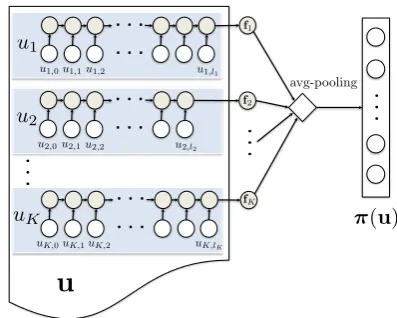
Neural features. In contrast, our neural features automatically learn to extract arbitrary predictive configurations. As Figure 2 shows, we encode each POS-tagged sentenceui ∈ uusing a recur-rent neural network, which reads one-hot POS em-beddings from left to right, then outputs its final hidden state vector fi as the encoding. The final neural π(u) is the average encoding of all sen-tences (average-pooling): that is, the average of all sentence-level configurations. We specifically use a gated recurrent unit (GRU) network (Cho et al., 2014). The GRU is jointly trained with all other parameters in the system so that it focuses on de-tecting word-order properties ofu that are useful for parsing.
7 The Parsing Architecture
To constructParse(x;u), we can extend any sta-tistical parsing architecture Parse(x) to be sen-sitive to T(u). For our experiments, we ex-tend the delexicalized graph-based implementa-tion of the BIST parser (Kiperwasser and Gold-berg, 2016)—an arc-factored dependency model with neural context features extracted by a bidi-rectional LSTM. This recent parser was the state of the art when it was published.
Given a POS-sentence x and a corpus u, our
. . .
. . . f1
. . . . . .
. .
.
. . .
. . . f2. . . . .
.
avg-pooling
[image:7.595.314.513.61.220.2]⇡(u)
Figure 2: Computing the neural feature vectorπ(u).
parser first computes an unlabeled projective tree
argmax
y∈Y(x)
score(x, y;u) (4)
where, lettingarange over the arcs in treey,
score(x, y;u) =X
a∈y
s(φ(a;x,u)) (5)
With this definition, the argmax in (4) is com-puted efficiently by the algorithm ofEisner(1996).
s(·)is a neural scoring function on vectors,
s(φ(· · ·)) =vtanh(V φ(· · ·) +bV) (6)
whereV is a matrix,bV is a bias vector, andvis a vector, all being parameters inΘ.
The functionφ(a;x,u)extracts the feature vec-tor of arcagivenxandu. BIST scores unlabeled arcs, soadenotes a pair(i, j)—the indices of the parent and child, respectively. We define
φ(a;x,u) = [B(x, i; T(u));B(x, j; T(u))] (7)
which concatenates contextual representations of tokens i andj. B(x, i) is itself a concatenation of the hidden states of a left-to-right LSTM and a right-to-left LSTM (Graves,2012) when each has read sentencexup through wordi(really POS tag i). These LSTM parameters are included inΘ.
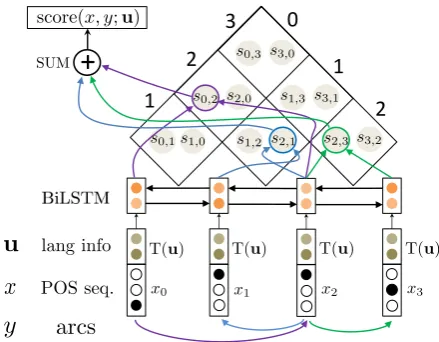
The POS tags inxare provided to the LSTMs as one-hot vectors. Crucially,T(u)is also provided to the LSTM at each step, as shown in Figure3.
After selecting the best tree via equation (4), we use each arc’sφvector again to predict its label. This yields the labeled treeyˆ= ParseΘ(x;u).
T(u) T(u) T(u) T(u)
1 2
3 0
1 2 s0,1s1,0 s1,2 s2,1 s2,3 s3,2
s3,1
s1,3 s0,2 s2,0
s0,3 s3,0
y
x
+
SUM
x0 x1 x2 x3
u
score(x, y;u)
lang info
arcs
[image:8.595.70.290.60.231.2]POS seq.
Figure 3: The architecture of the delexicalized graph-based BIST parser with the introduction of T(u), wheresi,jin each cell is the arc scores(φ(a;x,T(u))
from equation (6). The root of the tree is always posi-tion 0, wherex0 is a distinguished “root” symbol that
is prepended to the input sentence.
to supply T(u) to the BiLSTM.8 This extension is not a significant slowdown at test time, since
T(u)only needs to be computed once per test lan-guage, not once per test sentence. SinceT(u)can be computed for any novel language at test time, this differs from the “many languages, one parser” architecture (Ammar et al.,2016), in which a test-time language must have been seen at training test-time or at least must have known WALS features.
Product of experts. We also consider a variant of the function (6) for scoring arca, namely
λsH(a) + (1−λ)sN(a) (8)
wheresH(a)andsN(a)are the scores produced by separately trained systems using, respectively, the hand-engineered and neural features from §6.1. Hyperparameterλ∈[0,1]is tuned on dev data.
8 Training the System
8.1 Training Objective
We exactly follow the training method of Kiper-wasser and Goldberg (2016), who minimize a structured max-margin hinge loss (Taskar et al., 2004;McDonald et al.,2005;LeCun et al.,2007).
8
An alternative would be to concatenateT(u)with the representation computed by the BiLSTM. This gets empiri-cally worse results, probably because the BiLSTM does not have advance knowledge of language-specific word order as it reads the sentence. We also tried an architecture that does both, with no notable improvement.
We want the correct treeyto beat each treey0 by a margin equal to the number of errors in y0 (we count spurious edges). Formally, loss(x, y;u) is given by
max(0,−score(x, y;u)+
max
y0
score(x, y0;u)
| {z }
model score
+ X
a∈y0
1a /∈y
| {z }
precision error
) (9)
wherearanges over the arcs of a treey, and1a /∈y is an indicator that is 1if a /∈ y. Thus, this loss function is high if there exists a treey0 that has a high score relative toyyet low precision.9
The training algorithm makes use of loss-augmented inference (Taskar et al.,2005), a vari-ant on the ordinary inference of (4). The most vi-olating treey0 (in themaxy0 above) is computed
again by an arc-factored dependency algorithm (Eisner, 1996), where the score of any candidate arcaiss(φ(a;x,u)) +1a /∈y.
Actually, the above method would only train the
scorefunction to predict the correctunlabeledtree
as above (sincearanges over unlabeled arcs as be-fore). In practice, we also jointly train the labeler to predict the correct labels on the gold arcs, using a separate hinge-loss objective. Because these two components share parameters through φ(a;x,u), this is a multi-task learning problem.
8.2 Training Algorithm
Augment training data. Unlike ordinary NLP problems whose training examples are sentences, each training example in equation (1) is an entire language. Unfortunately, UD (§3) only provides a few dozen languages—presumably not enough to generalize well to novel languages. We therefore augment our training dataset Ltrain with thou-sands of synthetic languages from the GD dataset (§3), as already discussed in §3.1.
Stochastic gradient descent (SGD).10 Treating each language as a single large example during training would lead to slow SGD steps. Instead, we take our SGD examples to be individual sen-tences, by regarding equations (1)–(2) together as
9
Formally, for this loss function to be used in equation (2), we must interpretParseΘin that equation as returning a
for-est of scored parses, not just a single parse.
10More precisely, we use Adam (Kingma and Ba,2015), a
an objective averaged over sentences. Each ex-ample(x, y,u)is sampled hierarchically, by first drawing a language`fromLtrainand settingu=
u(`), then drawing the sentence (x, y) uniformly from(x(`),y(`)). We train using mini-batches of 100 sentences; each mini-batch can mix many lan-guages.
Encourage real languages. To sample ` from
Ltrain, we first flip a coin with weightβ∈[0,1]to choose “real” vs. “synthetic,” and then sample uni-formly within that set. Why? The test sentences will come from real languages, so the synthetic languages are out-of-domain. Including them re-duces variance but increases bias. We raise β to keep them from overwhelming the real languages.
Sample efficiently. The sentences (x, y) are stored in different files by language. To reduce disk accesses, we do not visit a file on each sample. Rather, for each language`, we maintain in memory a subset of (x(`),y(`)), obtained by reservoir sampling. Samples from (x(`),y(`))
are drawn sequentially from this “chunk,” and when it is used up we fetch a new chunk. We also maintain u(`) and the hand-engineered features fromπ(u(`))in memory.
9 Experiments
9.1 Basic Setup
Our data split follows that of Wang and Eisner (2017), as shown in Table 2,11 which has 18 training languages (20 treebanks) and 17 test lan-guages. All hyperparameters are tuned via 5-fold cross-validation on the 20 training treebanks—that is, we evaluate each fold (4 treebanks) using the model trained on the remaining folds (16 tree-banks). However, a model trained on a treebank of language`is never evaluated on another treebank of language `. We selected the hyperparameters that maximized the average unlabeled attachment score (UAS) (Kübler et al., 2009), which is the evaluation metric that is reported by most
previ-11However, as we are interested in transfer to
unseen lan-guages, our Table2follows the principle ofEisner and Wang (n.d.) and does not test on the Finnishftbor Latin treebanks because other treebanks of those languages appeared in train-ing data. Specifically, Latinitt and Latinproielfall in the same training folds as French and Italian, respectively. For the same reason, Table2does not show cross-validation devel-opment results on these Latin treebanks—nor on the Ancient Greekgrc and Ancient Greekgrc_proiel treebanks, which fall in the same training folds as Czech and Danish, respectively.
ous work on unsupervised parsing. We also report labeled attachment score (LAS).12
When augmenting the data, the 16 training banks are “mixed and matched” to get GD tree-banks for16×17×17 = 4624additional synthetic training languages (Wang and Eisner,2016, §5).
The next sections analyze these cross-validation results. Finally, §9.8 will evaluate on 15 pre-viously unseen languages (excluding Latin and Finnishftb) with our model trained on all 18 train-ing languages (20 treebanks for UD, plus20×21×
21 = 8840 when adding GD) with the
hyperpa-rameters that achieved the best average unlabeled attachment score during cross-validation.
The UD and GD corpora provide a train/dev/test split of each treebank, denoted as(xtrain,ytrain),
(xdev,ydev) and (xtest,ytest). Throughout this paper, for both training and testing languages, we
take(x(`),y(`)) = (xtrain,ytrain). We takeu(`)
to consist of allxtrainsentences with≤40tokens.
9.2 Comparison Among Architectures
Table1shows the cross-validation parsing results over different systems discussed so far. For each architecture, we show the best average unlabeled attachment score (the UAS column) chosen by cross-validation, and the corresponding labeled at-tachment score (the LAS column). In brief, the main sources of improvement are twofold:
Synthetic languages. We observe that +GD consistently outperforms UD across all architec-tures. It even helps with the baseline system that we tried, which simply ignores the target cor-pus u(`). In that system (similar to McDonald et al. (2011)), the BiLSTM may still manage to extract`-specific information from the single sen-tencex ∈ x(`)that it is parsing.13 The additional GD training languages apparently help it learn to do so in a way that generalizes to new languages.
12
When reporting LAS and when studying the labeling er-rors in §9.7, we would ideally have first re-tuned our sys-tem to optimize LAS via cross-validation. Unfortunately, these potentially improved LAS results would have required months of additional computation. The optimal hyperparam-eters may not be very different, however, since UAS and LAS rose and fell together when we varied other training condi-tions in Figures4–6.
13
oracle features
z
}|
{
UAS LAS
System UD +GD UD +GD
SST 66.22* 65.70 50.40 50.54
Baseline 63.95 67.97 48.46 52.78
H 64.83 69.41 49.41 53.63
N 65.30 70.06 49.43 54.19
H;N 65.26 69.62 49.67 53.68
H+N 67.34* 70.65* 52.02* 55.18*
TD 65.94 70.01* 49.77 53.43
[image:10.595.323.507.59.195.2]TW 64.84 69.75 49.30 53.79
Table 1: Average parsing results over 16 languages, computed by 5-fold cross-validation. We compare training on real languages only (the UD column) ver-sus augmenting with synthetic languages atβ = 0.2 (the +GD column). Baseline is the ablated system that omits T(u)(§9.2). SST is the single-source transfer approach (§5.2). H and N use only hand-engineered features or neural features, while H;N defines π(u) to concatenate both (§6.1) and H+N is the product-of-experts model (§7).TDandTWthat incorporate oracle
knowledge of the target-language syntax (§9.4). For each comparison between UD and +GD, we boldface the better (higher) result, or both if they are not signifi-cantly different (paired permutation test over languages
withp <0.05). In each column, we star the best result
as well as all results that are not significantly worse.
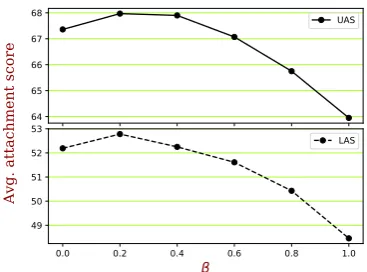
To better understand the trend, we study how the performance varies when more synthetic lan-guages are used. As shown in Figure4, whenβ = 1, all the training languages are sampled from real languages. By gradually increasing the propor-tion of GD languages (reducingβfrom §8.2), the baseline UAS increases dramatically from 63.95
to67.97. However, if all languages are uniformly sampled (β = 4624+1616 ≈0.003) or only synthetic languages are used (β = 0), the UAS falls back slightly to67.42or67.36. The bestβvalue is0.2, which treats each real language as 0.8/46240.2/16 ≈ 72
times more helpful than each synthetic language, yet80%of the training data is contributed by syn-thetic languages.β= 0.2was also optimal for the non-baseline systems in Table1.
Unparsed corpora. The systems that exploit unparsed corpora consistently outperform the baseline system in both the UD and +GD condi-tions. To investigate, we examine the impact of reducingu(`)when parsing a held-out language`. We used the system in row N and column +GD of Table1, which was trained on full-sizedu cor-pora. When testing on a held-out language`, we computeT(u(`))using only a random size-t sub-set ofu(`). As shown in Figure5, the system does
64 65 66 67 68
Avg. attachment score
UAS
0.0 0.2 0.4 0.6 0.8 1.0
49 50 51 52 53
LAS
Figure 4: Effect ofβ. The UAS and LAS (y-axis) of the baseline system as a function ofβ(x-axis).
61 62 63 64
Avg. attachment score
UAS
16 32 64 128 256 512 1024
Size of unparsed corpus
45 46 47 48 49
[image:10.595.81.285.61.186.2]LAS
Figure 5: Effect of the size|u(`)|of the unparsed
cor-pus. The y-axis represents the cross-validation UAS and LAS scores, averaged over the 7 languages that have|u(`)| ≥9000sentences, when using only a
sub-set of the sentences fromu(`). Using all ofu(`)would
achieve64.61UAS and49.04LAS. The plot shows the average over10runs with different random subsets; the error bars indicate the 10th to the 90th percentile of those runs. The 7 languages are Finnish (Finnic), Nor-wegian (Germanic), Dutch (Germanic), Czech (Slavic), German (Germanic), Hindi (Indic), and English (Ger-manic).
not need a very large unparsed corpus—most of the benefit is obtained byt = 256. Nonetheless, a larger corpus always achieves a better and more stable performance.
9.3 Comparison to SST
[image:10.595.308.525.242.405.2]more UD languages get involved.14 For H+N, however, the extra GD languages do help to iden-tify the truly useful surface patterns inu.
We also considered trying model interpolation (Rosa and Žabokrtský,2015b). Unfortunately, as mentioned in §5.2, this method is impractical with GD languages, because it requires storing 4624
(§9.1) additional local models. Nonetheless, we can estimate an “upper bound” on how well the interpolation might do. Our upper bound is SST where an oracle is used to choose the source lan-guage;Rosa and Žabokrtský(2015b) found that in practice, this does better than interpolation. This approximate upper bound is 68.03 of UAS and 52.10 of LAS, neither of which is significantly bet-ter than H+N on UD, but both of which are signif-icantly outperformed by H+N on +GD.
9.4 Oracle Typology vs. Our LearnedT(u)
The results in Table1demonstrate that we learned to extract features T(u), from the unparsed tar-get corpusu, that improve the baseline parser. We consider replacingT(u) by an oracle that has ac-cess to the true syntax of the target language. We consider two different oracles,TDandTW.
TD is the directionalities typology that was studied by Liu(2010) and used as a training tar-get by Wang and Eisner (2017). Specifically,
TD ∈ [0,1]57 is a vector of the directionalities of each type of dependency relation; it specifies what fraction of direct objects fall to the right of the verb, and so on.15 In principle, this should be very helpful for parsing, but it must be extracted from a treebank, which is presumably unavailable for unknown languages.
We also consider TW—the WALS features— as the typological classification given by linguists. This resembles the previous multi-language learn-ing approaches (Naseem et al., 2012;Täckström et al., 2013b; Zhang and Barzilay, 2015; Am-mar et al., 2016) that exploited the WALS fea-tures. In particular, we use 81A, 82A, 83A, 85A, 86A, 87A, 88A and 89A—a union of WALS fea-tures used by those works. In order to derive the WALS features for a synthetic GD language, we first copy the features from its substrate language
14
The number of real treebanks in our cross-validation set-ting is 16, greater than the 10 inWang and Eisner(2016).
15
The directionality of a relationain language`is given
bycount`(→a)
count`(a), where count`(
a
→)is the count ofa-relations that point from left to right, and count`(a)is the count of alla
-relations.
(Wang and Eisner, 2016). We then replace the 81A, 82A, 83A features—which concern the order between verbs and their dependents—by those of its V-superstrate language16 (if any). We replace 85A, 86A, 87A, 88A and 89A—which concern the order between nouns and their dependents— by those of itsN-superstrate language (if any).
As a pleasant surprise, we find that our best sys-tem (H+N) is competitive with both oracle meth-ods. It outperforms both of them on both UAS and LAS, and the improvements are significant and substantial in 3 of these 4 cases. Our parser has learned to extract informationT(u)that is not only cheap (no treebank needed), but also at least as useful as “gold” typology for parsing.
9.5 Selected Hyperparameter Settings
For the rest of the experiments, we use the H+N system, as it wins under cross-validation on both UD and +GD (Table1). This is a combination via (8) of the best H system and the best N system under cross-validation, with the mixture hyperpa-rameterλalso chosen by cross-validation.
For both UD and +GD, cross-validation se-lected125as the sizes of the LSTM hidden states and100as the sizes of the hidden layers for scor-ing arcs (the length ofvin equation (6)).
Hyperparameters for UD. The H system com-putes T(u) with a 1-layer network (as in equa-tion (3)), with hidden sizeh= 128andψ= tanh
as the activation function. For the N system,T(u)
is a 1-layer network with hidden sizeh = 64and
ψ = sigmoidas the activation function. The size
of the hidden state of GRU as shown in Figure2is
128. The mixture weight for the final H+N system isλ= 0.5.
Hyperparameters for +GD. The H system computesT(u)with a 2-layer network (as shown in Figure1), withh = 128andψ = sigmoidfor both hidden layers. For N,T(u) is a 1-layer net-work with hidden sizeh = 64andψ= sigmoid. The size of the hidden state of GRU is256. Both H and N setβ = 0.2(see §8.2). The mixture weight for the final H+N system isλ= 0.4.
9.6 Performance on Noisy Tag Sequences
We test our trained system in a more realistic sce-nario where bothu andx for held-out languages
16The language whose word order model is used to
55 60 65 70
Avg. attachment score
0.1K 0.2K
0.4K 0.8K
1.6K 3.2K 6.4K
12.8K UAS
80 85 90 95 100
Avg. tagging accuracy
35 40 45 50
55 LAS
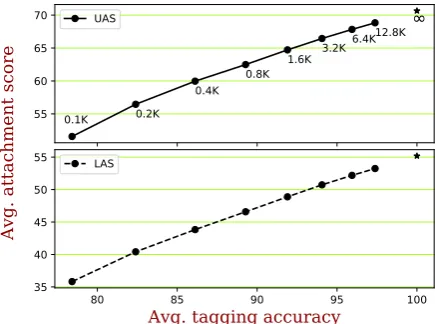
Figure 6: Performance on noisy input over 16 train-ing languages. Each dot is an experiment annotated by the number of sentences used to train the tagger. (The rightmost “∞” point uses gold tags instead of a tagger, which is the result from Table1.) Thex-axis gives the average accuracy of the trained RDRPOSTagger. The
y-axis gives the average parsing performance.
consist of noisy POS tags rather than gold POS tags. Following Wang and Eisner (2016, Ap-pendix B), at test time, the gold POS tags in a cor-pus are replaced by a noisy version produced by the RDRPOSTagger (Nguyen et al.,2014) trained on a subset of the original gold-tagged corpus.17 Figure6 shows a linear relationship between the performance of our best model (H+N with +GD) and the noisiness of the POS tags, which is con-trolled by altering the amount of training data. With only 100 training sentences, the performance suffers greatly—the UAS drops from 70.65 to
51.57. Nonetheless, even this is comparable to Naseem et al. (2010) on gold POS tags, which yields a UAS of50.00. That system was the first grammar induction approach to exploit knowledge of the distribution of natural languages, and re-mained state-of-the-art (Noji et al., 2016) until the work ofMareˇcek(2016) andMartínez Alonso et al.(2017).
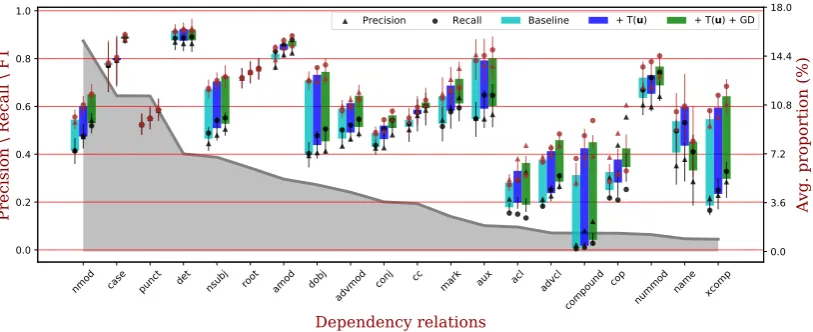
9.7 Analysis by Dependency Relation Type
Figure 7 breaks down the results by dependency relation type—showing that usinguand synthetic data improves resultsalmost across the board.
We also notice large differences between la-beled and unlala-beled F1 scores for some relations, especially rarer ones. In other words, the sys-tem mislabels the arcs that it correctly
recov-17Another way to get noisy tags, as a reviewer notes, would
have been to use a cross-lingual POS tagger designed for low-resource settings (Täckström et al.,2013a;Kim et al.,2017).
ers. (Remember from §9.2 that the hyperparam-eters were selected to maximize unlabeled scores (UAS) rather than labeled (LAS).)
Figure 8 gives the label confusion matrix. While the dark NONE column shows that arcs of each type are often missed altogether (recall er-rors), the dark diagonal shows that they are usually labeled correctly if found. That said, it is relatively common to confuse the different labels for nom-inal dependents of verbs (nsubj,dobj, nmod). We suspect that lexical information could help sort out these roles via distributional semantics. Some other mistakes arise from discrepancies in the an-notation scheme. For example,negcan be easily confused with advmod, as some languages (for example, Spanish) use ADV instead of PART for negations.
9.8 Final Evaluation on Test Data
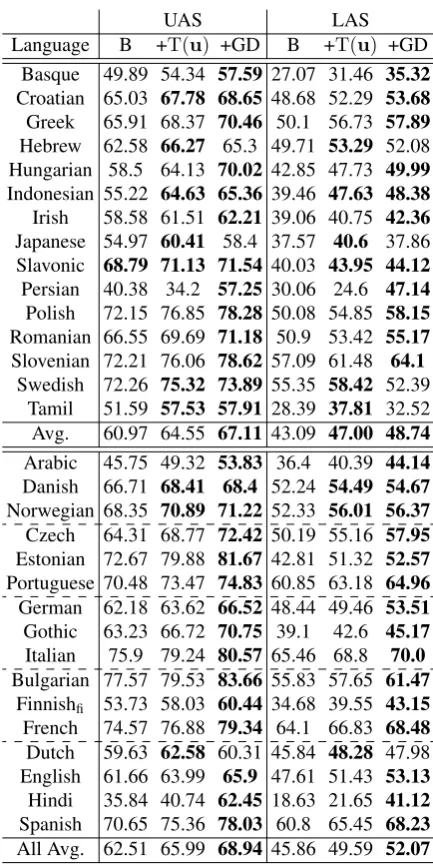
In all previous sections, we evaluated on the 16 languages in the training set by cross-validation. For the final test, we combine all the 20 tree-banks and train the system with the hyperparam-eters given in §9.5, then test on the 15 unseen test languages. Table 2 displays results on these 15 test languages (top) as well as the cross-validation results on the 16 languages (bottom).
We see that we improve significantly over base-line on almost every language. Indeed, on the test languages, +T(u) improves both UAS and LAS by > 3.5percentage points on average. The im-provement grows to>5.6if we augment the train-ing data as well (+GD, meantrain-ing +T(u)+GD).
One disappointment concerns theaddedbenefit on theLAS of +GD over just +T(u): while this data augmentation helped significantly on nearly every one of the 16 development languages, it produced less consistent improvements on the test languages and hurt some of them. We suspect that this is because we tuned the hyperparameters to maximize UAS, not LAS (§9.2). As a result, while the average benefit across our 15 test languages was fairly large, this sample was not large enough to establish that it was significantly greater from 0, that is, that future test languages would also see an improvement from data augmentation.
[image:12.595.72.290.61.223.2]0.0 3.6 7.2 10.8 14.4 18.0
Avg. proportion (%)
nmod case punct det nsubj root amod dobj advmod conj cc mark aux acl advcl
compound cop
nummod name xcomp
Dependency relations
0.0 0.2 0.4 0.6 0.8 1.0
Precision \ Recall \ F1
[image:13.595.95.502.61.227.2]Precision Recall Baseline + T(u) + T(u) + GD
Figure 7: Evaluation by dependency relation type, showing an equal-weighted average of the 16 development languages. Each vertical bar spans the range from labeled F1 (bottom) to unlabeled F1 (top), with error bars given by bootstrap resampling over the 16 languages. Precision and recall are also indicated. The pattern is that F1, precision, and recall—both labeled and unlabeled—are improved over baseline when we exploit unlabeled corpora (+T(u)), and improved again when we augment training data (+T(u)+GD). The relations are sorted by their average gold proportion in the 16 languages, shown by the gray area and right vertical axis. For example,
nmodis the most common relation, accounting for 15.5% of all arcs. Altogether, the 20 most frequent relations (shown here) account for 94% of the arcs.
Wang and Eisner(2016)) tended to have consider-ably smaller unparsed corporau, so there may be a domain mismatch problem. To ameliorate this problem, one could include training examples with versions ofuthat are truncated to lengths seen in test data (cf. Figure5). One could also include the size|u|explicitly inT(u).
10 Conclusion and Future Work
We showed how to build a “language-agnostic” delexicalized dependency parser that can better parse sentences of an unknown language by ex-ploiting an unparsed (but POS-tagged) corpus of that language. Unlike grammar induction, which estimates a PCFG from the unparsed corpus, we train a neural network to extract a feature vec-tor from the unparsed corpus that helps a subse-quent neural parser. By end-to-end training on the treebanks of many languages (optionally includ-ing synthetic languages), our neural network can extract linguistic information that helps neural de-pendency parsing.
Variants of our architecture are possible. In fu-ture work, the neural parser could useattentionto look at individual relevant sentences ofu, which are posited to betriggersin some theories of child grammar acquisition (Gibson and Wexler, 1994; Frank and Kapur, 1996). We could also try in-jectingT(u)into the neural parser by means other than concatenating it with the input POS embed-dings. We might also consider parsing
architec-tures other than BIST, such as the LSTM-Minus architecture for scoring spans (Cross and Huang, 2016), or the recent attention-based arc-factored model (Dozat and Manning, 2017). Finally, our approach is applicable to tasks other than depen-dency parsing, such as constituent parsing or se-mantic parsing—if suitable treebanks are available for many training languages.
For applied uses, it would be interesting to combine the unsupervised techniques of this pa-per withlow-resourcetechniques that make use of some annotated or parallel data in the target lan-guage. It would also be interesting to include fur-ther synthetic languages that have been modified to better resemble the actual target languages, us-ing the method of (Wang and Eisner,2018).
nmod punct case det nsubj root amod dobj advmod conj cc mark aux acl advcl compound cop nummod name xcomp OTHERS NONE
Predicted relations
OTHERSxcomp name nummodcop compoundadvcl acl aux markcc conj advmoddobj amodroot nsubjdet case punct nmod
Gold relations
[image:14.595.307.524.58.491.2]0.0 0.5
Figure 8: The confusion matrix of our parser, as an equal-weight average over 16 development languages. Each row is normalized to sum to 1 and represents a frequent gold relation. For example, the nsubj
row shows how well we recovered the gold nsubj
arcs; the (nsubj,dobj) entry showsp(predicted =
dobj|gold=nsubj), which measures the fraction
of nsubjrelations that are recovered but mislabeled
asdobj. The diagonal represents correct arcs: where dark, it indicates high labeled recall for that relation. The final column represents gold arcs that were not re-covered with any label: where dark, it indicates low unlabeled recall for that relation. We show the top 20 relations sorted by gold frequency.
One takeaway message from this work is contained in our title. Surface statistics of a language—mined from the surface part-of-speech order—provide clues about how to find the un-derlying syntactic dependencies.Chomsky(1965) imagined that such clues might be exploited by a Language Acquisition Device, so it is interesting to know that they do exist.
Another takeaway message is that synthetic training languages are useful for NLP. Using syn-thetic examples in training is a way to encourage a system to be invariant to superficial variation. We created synthetic languages by varying the surface structure in a way that “should” preserve the deep structure. This allows our trained system to be in-variant to variation in surface structure, just as ob-ject recognition wants to be invariant to an image’s angle or lighting conditions (§3.1).
Our final takeaway goes beyond language: one can treat unsupervised structure discovery as a su-pervised learning problem. As §§1–2 discussed, this approach inherits the advantages of supervised learning. Training may face an easier optimization landscape, and we can train the system to find the
UAS LAS
Language B +T(u) +GD B +T(u) +GD
Basque 49.89 54.34 57.59 27.07 31.46 35.32
Croatian 65.03 67.78 68.65 48.68 52.29 53.68
Greek 65.91 68.37 70.46 50.1 56.73 57.89
Hebrew 62.58 66.27 65.3 49.71 53.29 52.08 Hungarian 58.5 64.13 70.02 42.85 47.73 49.99
Indonesian 55.22 64.63 65.36 39.46 47.63 48.38
Irish 58.58 61.51 62.21 39.06 40.75 42.36
Japanese 54.97 60.41 58.4 37.57 40.6 37.86 Slavonic 68.79 71.13 71.54 40.03 43.95 44.12
Persian 40.38 34.2 57.25 30.06 24.6 47.14
Polish 72.15 76.85 78.28 50.08 54.85 58.15
Romanian 66.55 69.69 71.18 50.9 53.42 55.17
Slovenian 72.21 76.06 78.62 57.09 61.48 64.1
Swedish 72.26 75.32 73.89 55.35 58.42 52.39 Tamil 51.59 57.53 57.91 28.39 37.81 32.52 Avg. 60.97 64.55 67.11 43.09 47.00 48.74
Arabic 45.75 49.32 53.83 36.4 40.39 44.14
Danish 66.71 68.41 68.4 52.24 54.49 54.67
Norwegian 68.35 70.89 71.22 52.33 56.01 56.37
Czech 64.31 68.77 72.42 50.19 55.16 57.95
Estonian 72.67 79.88 81.67 42.81 51.32 52.57
Portuguese 70.48 73.47 74.83 60.85 63.18 64.96
German 62.18 63.62 66.52 48.44 49.46 53.51
Gothic 63.23 66.72 70.75 39.1 42.6 45.17
Italian 75.9 79.24 80.57 65.46 68.8 70.0
Bulgarian 77.57 79.53 83.66 55.83 57.65 61.47
Finnishfi 53.73 58.03 60.44 34.68 39.55 43.15
French 74.57 76.88 79.34 64.1 66.83 68.48
Dutch 59.63 62.58 60.31 45.84 48.28 47.98 English 61.66 63.99 65.9 47.61 51.43 53.13
Hindi 35.84 40.74 62.45 18.63 21.65 41.12
Spanish 70.65 75.36 78.03 60.8 65.45 68.23
All Avg. 62.51 65.99 68.94 45.86 49.59 52.07
Table 2: Data splits and final evaluation on the 15 test languages (top), along with cross-validation results on the 16 development languages (bottom) grouped by 5 folds (separated by dashed lines). For languages with multiple treebanks, we identify them by subscripts. We use “Slavonic” for Old Church Slavonic. Column B is the baseline that doesn’t use T(u) (McDonald et al., 2011). +T(u) is our H+N system, and +GD is that system when the training data is augmented with synthetic languages. In comparing among these three systems, we boldface the highest score as well as all scores that are not significantly worse (paired permutation test,p <0.05). If a row is an average over many sentences of a single language, then each paired datapoint is asentence, so a significant improvement should generalize to new sentences. But if a row is an average, then each paired datapoint is a language
(as in Table 1), so a significant improvement should generalize to new languages.
[image:14.595.73.288.58.242.2]Acknowledgements This material is based upon work supported by the U.S. National Science Foundation under Grants No. 1423276 and 1718846. We are grateful to the state of Maryland for providing indispensable computing resources via the Maryland Advanced Research Computing Center (MARCC). Thanks to Kiper-wasser and Goldberg (2016) for releasing their Dynet parsing code, which was the basis for our reimplementation in PyTorch. We thank the Argo lab members for useful discussions. Finally, we thank TACL action editor Marco Kuhlmann and the anonymous reviewers for high-quality suggestions.
References
Željko Agi´c, Anders Johannsen, Barbara Plank, Héctor Martínez Alonso, Natalie Schluter, and Anders Søgaard. 2016. Multilingual projec-tion for parsing truly low-resource languages. Transactions of the Association for Computa-tional Linguistics, 4:301–312.
Waleed Ammar, George Mulcaire, Miguel Balles-teros, Chris Dyer, and Noah Smith. 2016. Many languages, one parser. Transactions of the As-sociation of Computational Linguistics, 4:431– 444.
Sumit Basu, Chuck Jacobs, and Lucy Vander-wende. 2013. Powergrading: A clustering ap-proach to amplify human effort for short an-swer grading. Transactions of the Association for Computational Linguistics, 1:391–402.
Glenn Carroll and Eugene Charniak. 1992. Two experiments on learning probabilistic depen-dency grammars from corpora. In Working Notes of the Workshop on Statistically-Based NLP Techniques, pages 1–13.
Kyunghyun Cho, Bart van Merrienboer, Dzmitry Bahdanau, and Yoshua Bengio. 2014. On the properties of neural machine translation: Encoder-decoder approaches. In Proceedings of Eighth Workshop on Syntax, Semantics and Structure in Statistical Translation, pages 103– 111.
Noam Chomsky. 1965. Aspects of the Theory of Syntax. MIT Press, Cambridge, MA.
Yoeng-Jin Chu. 1965. On the shortest arbores-cence of a directed graph. Science Sinica, 14:1396–1400.
Shay B. Cohen and Noah A. Smith. 2012. Empirical risk minimization for probabilis-tic grammars: Sample complexity and hard-ness of learning. Computational Linguistics, 38(3):479–526.
James Cross and Liang Huang. 2016. Incre-mental parsing with minimal features using bi-directional LSTM. InProceedings of the 54th Annual Meeting of the Association for Compu-tational Linguistics (Volume 2: Short Papers), pages 32–37, Berlin.
Timothy Dozat and Christopher D. Manning. 2017. Deep biaffine attention for neural depen-dency parsing. InProceedings of the Interna-tional Conference on Learning Representations.
Matthew S. Dryer and Martin Haspelmath, editors. 2013. The World Atlas of Language Structures
Online. Max Planck Institute for Evolutionary
Anthropology. http://wals.info/.
Jack Edmonds. 1967. Optimum branchings. Jour-nal of Research of the NatioJour-nal Bureau of Stan-dards B, 71(4):233–240.
Jason Eisner. 1996. Three new probabilistic mod-els for dependency parsing: An exploration. In Proceedings of the 16th International Confer-ence on Computational Linguistics, pages 340– 345.
Jason Eisner and Damianos Karakos. 2005. Boot-strapping without the boot. In Proceedings of Human Language Technology Conference and Conference on Empirical Methods in Natural Language Processing, pages 395–402.
Jason Eisner and Dingquan Wang. No date. On evaluating cross-lingual generalization. To be posted on arXiv.
Robert Frank and Shyam Kapur. 1996. On the use of triggers in parameter setting. Linguistic In-quiry, 27:623–660.
via bitext projection constraints. In Proceed-ings of the Joint Conference of the 47th An-nual Meeting of the ACL and the 4th Interna-tional Joint Conference on Natural Language Processing of the AFNLP, pages 369–377.
Edward Gibson and Kenneth Wexler. 1994. Trig-gers. Linguistic Inquiry, 25(3):407–454.
Jennifer Gillenwater, Kuzman Ganchev, João Gra ca, Fernando Pereira, and Ben Taskar. 2010. Sparsity in dependency grammar induction. In Proceedings of the ACL 2010 Conference Short Papers, pages 194–199.
Kevin Gimpel and Noah A. Smith. 2012. Concav-ity and initialization for unsupervised depen-dency parsing. InProceedings of the 2012 Con-ference of the North American Chapter of the Association for Computational Linguistics: Hu-man Language Technologies, pages 577–581.
Xavier Glorot and Yoshua Bengio. 2010. Under-standing the difficulty of training deep feedfor-ward neural networks. In Proceedings of the International Conference on Artificial Intelli-gence and Statistics, volume 9, pages 249–256.
Matthew Gormley and Jason Eisner. 2013. Non-convex global optimization for latent-variable models. In Proceedings of the 51st Annual Meeting of the Association for Computational Linguistics, pages 444–454.
Edouard Grave and Noémie Elhadad. 2015. A convex and feature-rich discriminative ap-proach to dependency grammar induction. In Proceedings of the 53rd Annual Meeting of the Association for Computational Linguistics and the 7th International Joint Conference on Natu-ral Language Processing, pages 1375–1384.
Alex Graves. 2012. Supervised Sequence
Labelling with Recurrent Neural Networks.
Springer.
Jiang Guo, Wanxiang Che, David Yarowsky, Haifeng Wang, and Ting Liu. 2016. A repre-sentation learning framework for multi-source transfer parsing. In Proceedings of the Thirti-eth AAAI Conference on Artificial Intelligence, pages 2734–2740.
William P. Headden III, Mark Johnson, and David McClosky. 2009. Improving unsupervised
dependency parsing with richer contexts and smoothing. In Proceedings of Human Lan-guage Technologies: The 2009 Annual Confer-ence of the North American Chapter of the As-sociation for Computational Linguistics, pages 101–109.
Rebecca Hwa, Philip Resnik, Amy Weinberg, Clara Cabezas, and Okan Kolak. 2005. Boot-strapping parsers via syntactic projection across parallel texts. Natural Language Engineering, 11(3):311–325.
Yong Jiang, Wenjuan Han, and Kewei Tu. 2017. Combining generative and discriminative ap-proaches to unsupervised dependency parsing via dual decomposition. InProceedings of the 2017 Conference on Empirical Methods in Nat-ural Language Processing, pages 1689–1694.
Damianos Karakos, Jason Eisner, Sanjeev Khu-danpur, and Carey E. Priebe. 2007. Cross-instance tuning of unsupervised document clus-tering algorithms. In Human Language Tech-nologies: Proceedings of the Annual Confer-ence of the North American Chapter of the As-sociation for Computational Linguistics, pages 252–259.
Joo-Kyung Kim, Young-Bum Kim, Ruhi Sarikaya, and Eric Fosler-Lussier. 2017. Cross-lingual transfer learning for POS tagging without cross-lingual resources. In Proceed-ings of the 2017 Conference on Empirical Methods in Natural Language Processing, pages 2832–2838.
Diederik Kingma and Jimmy Ba. 2015. Adam: A method for stochastic optimization. In Proceed-ings of the International Conference on Learn-ing Representations.
Eliyahu Kiperwasser and Yoav Goldberg. 2016. Simple and accurate dependency parsing us-ing bidirectional LSTM feature representations. Transactions of the Association of Computa-tional Linguistics, 4:313–327.
Sandra Kübler, Ryan McDonald, and Joakim Nivre. 2009. Dependency Parsing. Morgan and Claypool.
Ophélie Lacroix, Lauriane Aufrant, Guillaume Wisniewski, and François Yvon. 2016. Frustratingly easy cross-lingual transfer for transition-based dependency parsing. In Proceedings of the 2016 Conference of the North American Chapter of the Association for Computational Linguistics: Human Language Technologies, pages 1058–1063.
Karim Lari and Steve J. Young. 1990. The estima-tion of stochastic context-free grammars using the Inside-Outside algorithm. Computer Speech and Language, 4(1):35–56.
Yann LeCun, Sumit Chopra, Raia Hadsell, and Fu Jie Huang. 2007. A tutorial on energy-based learning. In Gökhan Bakır, Thomas Hofmann, Bernhard Schölkopf, Alexander J. Smola, Ben Taskar, and S. V. N. Vishwanathan, editors, Pre-dicting Structured Data. MIT Press.
Haitao Liu. 2010. Dependency direction as a means of word-order typology: A method based on dependency treebanks. Lingua, 120(6):1567–1578.
David Mareˇcek. 2016. Delexicalized and min-imally supervised parsing on universal de-pendencies. In Statistical Language and Speech Processing: 4th International Confer-ence, SLSP 2016, Pilsen, Czech Republic, Oc-tober 11-12, 2016, Proceedings, pages 30–42, Cham.
David Mareˇcek and Milan Straka. 2013. Stop-probability estimates computed on a large cor-pus improve unsupervised dependency parsing. In Proceedings of the 51st Annual Meeting of the Association for Computational Linguistics, pages 281–290.
David Mareˇcek. 2016. Twelve years of un-supervised dependency parsing. In Proceed-ings of the 16th ITAT Conference Information Technologies—Applications and Theory, pages 56–62.
Héctor Martínez Alonso, Željko Agi´c, Barbara Plank, and Anders Søgaard. 2017. Parsing uni-versal dependencies without training. In
Pro-ceedings of the 15th Conference of the Euro-pean Chapter of the Association for Compu-tational Linguistics: Volume 1, Long Papers, pages 230–240.
Ryan McDonald. 2006. Discriminative Learning and Spanning Tree Algorithms for Dependency
Parsing. Ph.D. thesis, University of
Pennsylva-nia.
Ryan McDonald, Koby Crammer, and Fernando Pereira. 2005. Online large-margin training of dependency parsers. InProceedings of the 43rd Annual Meeting of the Association for Compu-tational Linguistics (ACL’05), pages 91–98.
Ryan McDonald, Slav Petrov, and Keith Hall. 2011. Multi-source transfer of delexicalized de-pendency parsers. InProceedings of the 2011 Conference on Empirical Methods in Natural Language Processing, pages 62–72.
Tomas Mikolov, Ilya Sutskever, Kai Chen, Greg S. Corrado, and Jeff Dean. 2013. Distributed representations of words and phrases and their compositionality. InAdvances in Neural Infor-mation Processing Systems, pages 3111–3119.
Tahira Naseem, Regina Barzilay, and Amir Globerson. 2012. Selective sharing for multi-lingual dependency parsing. InProceedings of the 50th Annual Meeting of the Association for Computational Linguistics, pages 629–637.
Tahira Naseem, Harr Chen, Regina Barzilay, and Mark Johnson. 2010. Using universal linguis-tic knowledge to guide grammar induction. In Proceedings of the 2010 Conference on Empir-ical Methods in Natural Language Processing, pages 1234–1244.
Dat Quoc Nguyen, Dai Quoc Nguyen, Dang Duc Pham, and Son Bao Pham. 2014. RDRPOSTag-ger: A ripple down rules-based part-of-speech tagger. InProceedings of the Demonstrations at the 14th Conference of the European Chapter of the Association for Computational Linguistics, pages 17–20.
Joakim Nivre. 2008. Algorithms for determinis-tic incremental dependency parsing. Computa-tional Linguistics, 34(4):513–553.
Ballesteros, John Bauer, Kepa Bengoetxea, Riyaz Ahmad Bhat, Cristina Bosco, Sam Bow-man, Giuseppe G. A. Celano, Miriam Connor, Marie-Catherine de Marneffe, Arantza Diaz de Ilarraza, Kaja Dobrovoljc, Timothy Dozat, Tomaž Erjavec, Richárd Farkas, Jennifer Foster, Daniel Galbraith, Filip Ginter, Iakes Goenaga, Koldo Gojenola, Yoav Goldberg, Berta Gon-zales, Bruno Guillaume, Jan Hajiˇc, Dag Haug, Radu Ion, Elena Irimia, Anders Johannsen, Hi-roshi Kanayama, Jenna Kanerva, Simon Krek, Veronika Laippala, Alessandro Lenci, Nikola Ljubeši´c, Teresa Lynn, Christopher Manning, Cˇatˇalina Mˇarˇanduc, David Mareˇcek, Héctor Martínez Alonso, Jan Mašek, Yuji Matsumoto, Ryan McDonald, Anna Missilä, Verginica Mi-titelu, Yusuke Miyao, Simonetta Montemagni, Shunsuke Mori, Hanna Nurmi, Petya Osenova, Lilja Øvrelid, Elena Pascual, Marco Passarotti, Cenel-Augusto Perez, Slav Petrov, Jussi Piitu-lainen, Barbara Plank, Martin Popel, Prokopis Prokopidis, Sampo Pyysalo, Loganathan Ra-masamy, Rudolf Rosa, Shadi Saleh, Sebastian Schuster, Wolfgang Seeker, Mojgan Seraji, Na-talia Silveira, Maria Simi, Radu Simionescu, Katalin Simkó, Kiril Simov, Aaron Smith, Jan Štˇepánek, Alane Suhr, Zsolt Szántó, Takaaki Tanaka, Reut Tsarfaty, Sumire Uematsu, Lar-raitz Uria, Viktor Varga, Veronika Vincze, Zdenˇek Žabokrtský, Daniel Zeman, and Hanzhi Zhu. 2015. Universal dependencies 1.2. LIN-DAT/CLARIN digital library at the Institute of Formal and Applied Linguistics, Charles Uni-versity in Prague.
Hiroshi Noji, Yusuke Miyao, and Mark Johnson. 2016. Using left-corner parsing to encode uni-versal structural constraints in grammar induc-tion. InProceedings of the 2016 Conference on Empirical Methods in Natural Language Pro-cessing, pages 33–43.
Lawrence Page, Sergey Brin, Rajeev Motwani, and Terry Winograd. 1999. The PageRank cita-tion ranking: Bringing order to the Web. Tech-nical Report 1999-66, Stanford InfoLab.
Mark A. Paskin. 2001. Cubic-time parsing and learning algorithms for grammatical bigram.
Mark A. Paskin. 2002. Grammatical bigrams. InAdvances in Neural Information Processing Systems, pages 91–97.
Mohammad Sadegh Rasooli and Michael Collins. 2015. Density-driven cross-lingual transfer of dependency parsers. InProceedings of the 2015 Conference on Empirical Methods in Natural Language Processing, pages 328–338.
Mohammad Sadegh Rasooli and Michael Collins. 2017. Cross-lingual syntactic transfer with lim-ited resources. Transactions of the Association for Computational Linguistics, 5:279–293.
Rudolf Rosa and Zdenˇek Žabokrtský. 2015a.
KLcpos3 – a language similarity measure for
delexicalized parser transfer. InProceedings of the 53rd Annual Meeting of the Association for Computational Linguistics and the 7th Interna-tional Joint Conference on Natural Language Processing, pages 243–249.
Rudolf Rosa and Zdenˇek Žabokrtský. 2015b. Mstparser model interpolation for multi-source delexicalized transfer. In Proceedings of the 14th International Conference on Parsing Tech-nologies, pages 71–75.
Sebastian Ruder, Ivan Vuli´c, and Anders Søgaard. 2017. A survey of cross-lingual word embed-ding models. Computing Research Repository, arXiv:1706.04902.
David A. Smith and Jason Eisner. 2009. Parser adaptation and projection with quasi-synchronous grammar features. InProceedings of the Conference on Empirical Methods in Natural Language Processing, pages 822–831.
Noah A. Smith. 2006. Novel Estimation Methods for Unsupervised Discovery of Latent Structure
in Natural Language Text. Ph.D. thesis, Johns
Hopkins University.
Noah A. Smith and Jason Eisner. 2005. Guid-ing unsupervised grammar induction usGuid-ing con-trastive estimation. InInternational Joint Con-ference on Artificial Intelligence (IJCAI) Work-shop on Grammatical Inference Applications, pages 73–82.