The SIGMORPHON 2016 Shared Task—Morphological Reinflection
Ryan Cotterell
Dept. of Computer Science Johns Hopkins University [email protected]
Christo Kirov
Dept. of Computer Science Johns Hopkins University
John Sylak-Glassman
Dept. of Computer Science Johns Hopkins University
David Yarowsky
Dept. of Computer Science Johns Hopkins University
Jason Eisner
Dept. of Computer Science Johns Hopkins University
Mans Hulden
Dept. of Linguistics University of Colorado [email protected]
Abstract
The 2016 SIGMORPHON Shared Task was devoted to the problem of morphological reinflection. It introduced morphological datasets for 10 languages with diverse ty-pological characteristics. The shared task drew submissions from 9 teams represent-ing 11 institutions reflectrepresent-ing a variety of ap-proaches to addressing supervised learning of reinflection. For the simplest task, in-flection generation from lemmas, the best system averaged 95.56% exact-match ac-curacy across all languages, ranging from Maltese (88.99%) to Hungarian (99.30%). With the relatively large training datasets provided, recurrent neural network architec-tures consistently performed best—in fact, there was a significant margin between neu-ral and non-neuneu-ral approaches. The best neural approach, averaged over all tasks and languages, outperformed the best non-neural one by 13.76% absolute; on individ-ual tasks and languages the gap in accu-racy sometimes exceeded 60%. Overall, the results show a strong state of the art, and serve as encouragement for future shared tasks that explore morphological analysis and generation with varying degrees of su-pervision.
1 Introduction
Many languages use systems of rich overt morpho-logical marking in the form of affixes (i.e. suffixes, prefixes, and infixes) to convey syntactic and se-mantic distinctions. For example, each English count noun has both singular and plural forms (e.g. robot/robots, process/processes), and these are known as the inflected forms of the noun. While English has relatively little inflectional mor-phology, Russian nouns, for example, can have a total of 10 distinct word forms for any given
hablar
hablo
hablas habla hablamos
habláis hablan
caminar
camino caminas
camina caminamos camináis caminan
-o
-as -a -amos -áis
[image:1.595.344.494.265.459.2]-an
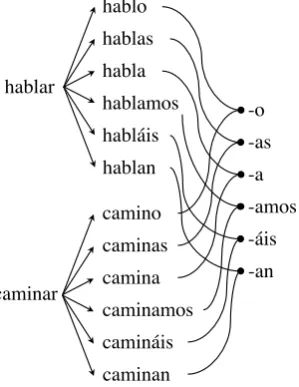
Figure 1: The relatedness of inflected forms, such as the present indicative paradigm of the Spanish verbs hablar ‘speak’ andcaminar‘walk,’ allows generalizations about the shape and affixal content of the paradigm to be extracted.
lemma and 30 for an imperfective verb.1 In the extreme,Kibrik (1998)demonstrates that even by a conservative count, a verb conjugation in Archi (Nakh-Daghestanian) consists of 1,725 forms, and if all sources of complexity are considered, a sin-gle verb lemma may give rise to up to 1,502,839 distinct forms. The fact that inflected forms are systematically related to each other, as shown in Figure1, is what allows humans to generate and analyze words despite this level of morphological complexity.
A core problem that arises in languages with rich morphology is data sparsity. When a single lexical item can appear in many different word
1This latter figure rises to 52 if the entire imperfective-perfective pair (e.g.govorit’/skazat’‘speak, tell’) is consid-ered to be a single lemma.
forms, the probability of encountering any sin-gle word form decreases, reducing the effective-ness of frequency-based techniques in performing tasks like word alignment and language modeling (Koehn, 2010; Duh and Kirchhoff, 2004). Tech-niques like lemmatization and stemming can ame-liorate data sparsity (Goldwater and McClosky, 2005), but these rely on morphological knowl-edge, particularly the mapping from inflected forms to lemmas and the list of morphs together with their ordering. Developing systems that can accurately learn and capture these mappings, overt affixes, and the principles that govern how those affixes combine is crucial to maximizing the cross-linguistic capabilities of most human language technology.
The goal of the 2016 SIGMORPHON Shared Task2 was to spur the development of systems that could accurately generate morphologically in-flected words for a set of 10 languages based on a range of training parameters. These 10 languages included low resource languages with diverse mor-phological characteristics, and the training param-eters reflected a significant expansion upon the tra-ditional task of predicting a full paradigm from a lemma. Of the systems submitted, the neu-ral network-based systems performed best, clearly demonstrating the effectiveness of recurrent neu-ral networks (RNNs) for morphological genera-tion and analysis.
We are releasing the shared task data and evalu-ation scripts for use in future research.
2 Tasks, Tracks, and Evaluation
Up to the present, the task of morphological in-flection has been narrowly defined as the gener-ation of a complete inflectional paradigm from a lemma, based on training from a corpus of com-plete paradigms.3This task implicitly assumes the availability of a traditional dictionary or gazetteer, does not require explicit morphological analysis, and, though it mimics a common task in second language (L2) pedagogy, it is not a realistic learn-ing settlearn-ing for first language (L1) acquisition.
Systems developed for the 2016 Shared Task had to carry outreinflectionof an already inflected form. This involved analysis of an already
in-2Official website: http://ryancotterell. github.io/sigmorphon2016/
3A paradigm is defined here as the set of inflected word forms associated with a single lemma (or lexeme), for exam-ple, a noun declension or verb conjugation.
Task 1 Task 2 Task 3
Lemma run — —
Source tag — PAST —
Source form — ran ran
Target tag PRESPART PRESPART PRESPART
Target form running running running
Lemma decir — —
Source tag — PRESENT1S —
Source form — digo digo
Target tag FUTURE2S FUTURE2S FUTURE2S
[image:2.595.309.532.62.180.2]Target form dir´as dir´as dir´as Table 1: Systems were required to generate the target form, given the information above the line. Two examples are shown for each task—one in English and one in Spanish. Task 1 is inflection; tasks 2–3 are reinflection.
Restricted Standard Bonus
Task 1 1 1 1, M
Task 2 2 1, 2 1, 2, M
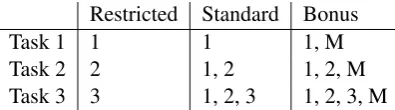
Task 3 3 1, 2, 3 1, 2, 3, M Table 2: Datasets that were permitted for each task under each condition. Numbers indicate a dataset from that respec-tive task, e.g. ‘1’ is the dataset from Task 1, and ‘M’ indicates bonus monolingual text from Wikipedia dumps.
flected word form, together withsynthesisof a dif-ferent inflection of that form. The systems had to learn from limited data: they were not given complete paradigms to train on, nor a dictionary of lemmas.
Specifically, systems competed on the three tasks illustrated in Table1, of increasing difficulty. Notice that each task can be regarded as mapping a source string to a target string, with other input ar-guments (such as the target tag) that specify which version of the mapping is desired.
For each language and each task, participants were provided with supervised training data: a collection of input tuples, each paired with the cor-rect output string (target form).
Each system could compete on a task under any of three tracks (Table 2). Under the restricted track, only data for that task could be used, while for the standard track, data from that task and any from a lower task could be used. The bonus track was the same as the standard track, but allowed the use of monolingual data in the form of Wikipedia dumps from 2 November 2015.4
Each system was required to produce, for ev-ery input given at test time, either a single string or a ranked list of up to 20 predicted strings for each task. Systems were compared on the
[image:2.595.317.515.241.296.2]ing metrics, averaged over all inputs:
• Accuracy: 1 if the top predicted string was correct, else 0
• Levenshtein distance: Unweighted edit dis-tance between the top predicted string and the correct form
• Reciprocal rank: 1/(1 +ranki), where ranki
is the rank of the correct string, or 0 if the correct string is not on the list
The third metric allows a system to get partial credit for including a correct answer on its list, preferably at or near the top.
3 Data
3.1 Languages and Typological Characteristics
Datasets from 10 languages were used. Of these, 2 were held as surprise languages whose identity and data were only released at evaluation time.
• Standard Release: Arabic, Finnish, Geor-gian, German, Navajo, Russian, Spanish, and Turkish
• Surprise: Hungarian and Maltese
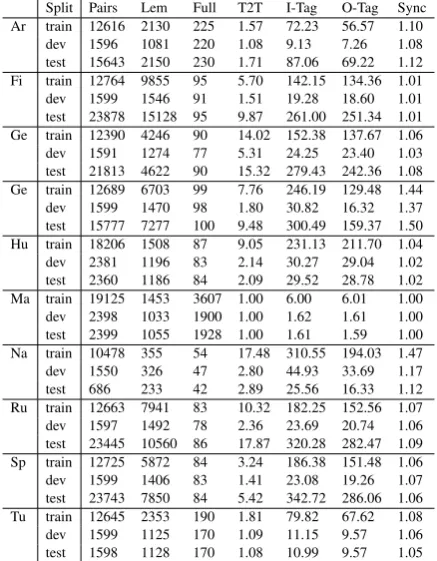
Finnish, German, and Spanish have been the sub-ject of much recent work, due to data made avail-able by Durrett and DeNero (2013), while the other datasets used in the shared task are released here for the first time. For all languages, the word forms in the data are orthographic (not phonolog-ical) strings in the native script, except in the case of Arabic, where we used the romanized forms available from Wiktionary. An accented letter is treated as a single character. Descriptive statistics of the data are provided in Table3.
The typological character of these languages varies widely. German and Spanish inflection generation has been studied extensively, and the morphological character of the languages is simi-lar: Both are suffixing and involve internal stem changes (e.g., a 7→ ¨a, e 7→ ie, respectively). Russian can be added to this group, but with consonantal rather than vocalic stem alternations. Finnish, Hungarian, and Turkish are all agglu-tinating, almost exclusively suffixing, and have vowel harmony systems. Georgian exhibits com-plex patterns of verbal agreement for which it utilizes circumfixal morphology, i.e. simultane-ous prefixation and suffixation (Aronson, 1990).
Split Pairs Lem Full T2T I-Tag O-Tag Sync Ar train 12616 2130 225 1.57 72.23 56.57 1.10
[image:3.595.306.525.63.344.2]dev 1596 1081 220 1.08 9.13 7.26 1.08 test 15643 2150 230 1.71 87.06 69.22 1.12 Fi train 12764 9855 95 5.70 142.15 134.36 1.01 dev 1599 1546 91 1.51 19.28 18.60 1.01 test 23878 15128 95 9.87 261.00 251.34 1.01 Ge train 12390 4246 90 14.02 152.38 137.67 1.06 dev 1591 1274 77 5.31 24.25 23.40 1.03 test 21813 4622 90 15.32 279.43 242.36 1.08 Ge train 12689 6703 99 7.76 246.19 129.48 1.44 dev 1599 1470 98 1.80 30.82 16.32 1.37 test 15777 7277 100 9.48 300.49 159.37 1.50 Hu train 18206 1508 87 9.05 231.13 211.70 1.04 dev 2381 1196 83 2.14 30.27 29.04 1.02 test 2360 1186 84 2.09 29.52 28.78 1.02 Ma train 19125 1453 3607 1.00 6.00 6.01 1.00 dev 2398 1033 1900 1.00 1.62 1.61 1.00 test 2399 1055 1928 1.00 1.61 1.59 1.00 Na train 10478 355 54 17.48 310.55 194.03 1.47 dev 1550 326 47 2.80 44.93 33.69 1.17 test 686 233 42 2.89 25.56 16.33 1.12 Ru train 12663 7941 83 10.32 182.25 152.56 1.07 dev 1597 1492 78 2.36 23.69 20.74 1.06 test 23445 10560 86 17.87 320.28 282.47 1.09 Sp train 12725 5872 84 3.24 186.38 151.48 1.06 dev 1599 1406 83 1.41 23.08 19.26 1.07 test 23743 7850 84 5.42 342.72 286.06 1.06 Tu train 12645 2353 190 1.81 79.82 67.62 1.08 dev 1599 1125 170 1.09 11.15 9.57 1.06 test 1598 1128 170 1.08 10.99 9.57 1.05
Table 3: Descriptive statistics on data released to shared task participants. Figures represent averages across tasks. Abbre-viations in the headers: ‘Lem’ = lemmas, ‘Full’ = number of full tags, T2T = average occurrences of tag-to-tag pairs, I-Tag & O-Tag = average occurrences of each input or output tag, resp., and ‘Sync’ = average forms per tag (syncretism).
Navajo, like other Athabaskan languages, has pri-marily prefixing verbal morphology with conso-nant harmony among its sibilants (Rice, 2000; Hansson, 2010). Arabic and Maltese, both Semitic languages, utilize templatic, non-concatenative morphology. Maltese, due partly to its contact with Italian, also uses concatenative morphology (Camilleri, 2013).
3.2 Quantifying Morphological Processes
It is helpful to understand how often each lan-guage makes use of different morphological pro-cesses and where they apply. In lieu of a more careful analysis, here we use a simple heuris-tic to estimate how often inflection involves pre-fix changes, stem-internal changes (apophony), or suffix changes (Table 4). We assume that each word form in the training data can be divided into three parts—prefix, stem and suffix—with the pre-fix and sufpre-fix possibly being empty.
Language Prefix Stem Suffix
[image:4.595.94.269.64.225.2]Arabic 68.52 37.04 88.24 Finnish 0.02 12.33 96.16 Georgian 4.46 0.41 92.47 German 0.84 3.32 89.19 Hungarian 0.00 0.08 99.79 Maltese 48.81 11.05 98.74 Navajo 77.64 18.38 26.40 Russian 0.66 7.70 85.00 Spanish 0.09 3.25 90.74 Turkish 0.21 1.12 98.74
Table 4: Percentage of inflected word forms that have modi-fied each part of the lemma, as estimated from the “lemma7→ inflected” pairs in task 1 training data. A sum<100%for a language implies that sometimes source and target forms are identical; a sum> 100%implies that sometimes multiple parts are modified.
to pad, we choose the alignment that results in minimum Hamming distance between these equal-length padded strings, i.e., characters at corre-sponding positions should disagree as rarely as possible. For example, we align the German verb formsbrennen‘burn’ andgebrannt‘burnt’ as follows:
--brennen
gebrannt-From this aligned string pair, we heuristically split off a prefix pair before the first matching char-acter (∅ 7→ ge), and a suffix pair after the last matching character (en7→t). What is left is pre-sumed to be the stem pair (brenn7→brann):
Pref. Stem Suff.
brenn en
ge brann t
We conclude that when correctly mapping this source form to this target form, the prefix, stem, and suffix parts all change. In what fraction of training examples does each change, according to this heuristic? Statistics for each language (based on task 1) are shown in Table4.
The figures roughly coincide with our expec-tations. Finnish, Hungarian, Russian, Spanish, and Turkish are largely or exclusively suffixing. The tiny positive number for Finnish prefixation is due to a single erroneous pair in the dataset. The large rate of stem-changing in Finnish is due to the phenomenon of consonant gradation, where stems undergo specific consonant changes in
cer-tain inflected forms. Navajo is primarily prefix-ing,5and Arabic exhibits a large number of “stem-internal” changes due to its templatic morphology. Maltese, while also templatic, shows fewer stem-changing operations than Arabic overall, likely a result of influence from non-Semitic languages. Georgian circumfixal processes are reflected in an above-average number of prefixes. German has some prefixing, where essentially the only forma-tion that counts as such is the circumfixge t for forming the past participle.
3.3 Data Sources and Annotation Scheme
Most data used in the shared task came from the English edition of Wiktionary.6 Wiktionary is a crowdsourced, broadly multilingual dictionary with content from many languages (e.g. Spanish, Navajo, Georgian) presented within editions tai-lored to different reader populations (e.g. English-speaking, Spanish-speaking). Kirov et al. (2016) describe the process of extracting lemmas and in-flected wordforms from Wiktionary, associating them with morphological labels from Wiktionary, and mapping those labels to a universalized anno-tation scheme for inflectional morphology called the UniMorph Schema (Sylak-Glassman et al., 2015b).
The goal of the UniMorph Schema is to en-code the meaning captured by inflectional mor-phology across the world’s languages, both high-and low-resource. The schema decomposes the morphological labels into universal attribute-value pairs. As an example, consider again Table1. The FUT2S label for a Spanish future tense second-person singular verb form, such asdir´as, is de-composed intoPOS=VERB, mood=INDICATIVE, tense=FUTURE, person=2, number=SINGULAR.
The accuracy of data extraction and label asso-ciation for data from Wiktionary was verified ac-cording to the process described in Kirov et al. (2016). However, verifying the full linguistic ac-curacy of the data was beyond the scope of prepa-ration for the task, and errors that resulted from the original input of data by crowdsourced authors re-mained in some cases. These are noted in several of the system description papers. The full dataset from the English edition of Wiktionary, which
in-5The Navajo verb stem is always a single syllable ap-pearing in final position, causing our heuristic to misclassify many stem changes as suffixal. In reality, verb suffixes are very rare in Navajo (Young and Morgan, 1987).
cludes data from 350 languages, ≈977,000 lem-mas, and ≈14.7 million inflected word forms, is available at unimorph.org, along with de-tailed documentation on the UniMorph Schema and links to the references cited above.
The Maltese data came from the ˙Gabra open lexicon7 (Camilleri, 2013), and the descriptive features for inflected word forms were mapped to features in the UniMorph Schema similarly to data from Wiktionary. This data did not go through the verification process noted for the Wiktionary data. Descriptive statistics for the data released to shared task participants are given in Table3.
4 Previous Work
Much previous work on computational approaches to inflectional morphology has focused on a spe-cial case of reinflection, where the input form is always the lemma (i.e. the citation form). Thus, the task is to generate all inflections in a paradigm from the lemma and often goes by the name of paradigm completion in the literature. There has been a flurry of recent work in this vein: Durrett and DeNero (2013) heuristically extracted trans-formational rules and learned a statistical model to apply the rules,Nicolai et al. (2015)tackled the problem using standard tools from discriminative string transduction, Ahlberg et al. (2015) used a finite-state construction to extract complete candi-date inflections at the paradigm level and then train a classifier, Faruqui et al. (2016) applied a neu-ral sequence-to-sequence architecture (Sutskever et al., 2014) to the problem.
In contrast to paradigm completion, the task of reinflection is harder as it may require both mor-phologically analyzing the source form and trans-ducing it to the target form. In addition, the train-ing set may include only partial paradigms. How-ever, many of the approaches taken by the shared task participants drew inspiration from work on paradigm completion.
Some work, however, has considered full rein-flection. For example, Dreyer and Eisner (2009) and Cotterell et al. (2015) apply graphical mod-els with string-valued variables to model the paradigm jointly. In such models it is possible to predict values for cells in the paradigm condi-tioned on sets of other cells, which are not required to include the lemma.
7http://mlrs.research.um.edu.mt/ resources/gabra/
5 Baseline System
To support participants in the shared task, we pro-vided a baseline system that solves all tasks in the standard track (see Tables1–2).
Given the input string (source form), the system predicts a left-to-right sequence of edits that con-vert it to an output string—hopefully the correct target form. For example, one sequence of edits that could be legally applied to the Finnish input katossa is copy, copy, copy, insert(t), copy, delete(3). This results in the output katto, via the following alignment:
1 2 3 4 5 6
k a t - o ssa
k a t t o
-In general, each edit has the form copy, insert(string), delete(number), or subst(string), wheresubst(w) has the same effect asdelete(|w|) followed byinsert(w).
The system treats edit sequence prediction as a sequential decision-making problem, greedily choosing each edit action given the previously chosen actions. This choice is made by a deter-ministic classifier that is trained to choose the cor-rect edit on the assumption that that all previous edits on this input string were correctly chosen.
To prepare training data for the classifier, each supervised word pair in training data was aligned to produce a desired sequence of edits, such as the 6-edit sequence above, which corresponds to 6 su-pervised training examples. This was done by first producing a character-to-character alignment of the source and target forms (katossa,katto), using an iterative Markov Chain Monte Carlo method,and then combining consecutive deletions, insertions, or substitutions into a single compound edit. For example, delete(3) above was obtained by combining the consecutive deletions of s, s, anda.
The system uses a linear multi-class classi-fier that is trained using the averaged perceptron method (Freund and Schapire, 1999). The classi-fier considers the following binary features at each position:
• The previous 1, 2, and 3 input characters, e.g.t,at,katfor the 4th edit in the exam-ple.
• The following 1, 2, and 3 input characters, e.g.o,os,ossfor the 3rd edit.
• The previous edit. (The possible forms were given above.)
• The UniMorph morphosyntactic features of the source tagSor the target tagT(according to what type of mapping we are building— see below). For example, when lemmatiz-ing katossa into katto as in the exam-ple above,S = POS=NOUN, case=IN+ESS, number=SINGULAR, yielding 3 morphosyn-tactic features.
• Each conjunction of two features from the above list where the first feature in the com-bination is a morphosyntactic feature and the second is not.
For task 1, we must edit from LEMMA → T. We train a separate edit classifier for each part-of-speech, including the morphosyntactic description ofT as features of the classifier. For task 2, we must map fromS → T. We do so by lemmatiz-ingS → LEMMA(lemmatization) and then rein-flecting LEMMA→ T via the task 1 system.8 For the lemmatization step, we again train a separate edit classifier for each part-of-speech, which now draws on source tag S features. For task 3, we build an additional classifier to analyze the source form to its morphosyntactic description S (using training data from all tasks, as allowed in the stan-dard track). This classifier uses substrings of the word form as its features, and is also implemented by an averaged perceptron. The classifier treats each unique sequence of feature-value pairs as a separate class. Task 3 is then solved by first recov-ering the source tag and then applying the task 2 system.
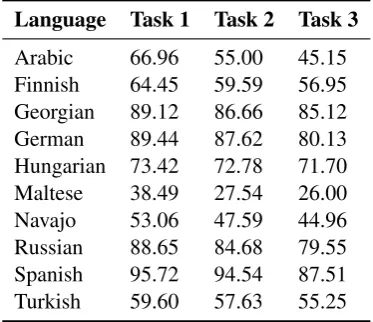
The baseline system performs no tuning of pa-rameters or feature selection. The averaged per-ceptron is not trained with early stopping or other regularization and simply runs for 10 iterations or until the data are separated. The results of the baseline system are given in Table5. Most partic-ipants in the shared task were able to outperform the baseline, often by a significant margin.
8Note that at training time, we know the correct lemma for
Sthanks to the task 1 data, which is permitted for use by task 2 in the standard track. This is also why task 2 is permitted to use the trained task 1 system.
Language Task 1 Task 2 Task 3
[image:6.595.323.510.63.224.2]Arabic 66.96 55.00 45.15 Finnish 64.45 59.59 56.95 Georgian 89.12 86.66 85.12 German 89.44 87.62 80.13 Hungarian 73.42 72.78 71.70 Maltese 38.49 27.54 26.00 Navajo 53.06 47.59 44.96 Russian 88.65 84.68 79.55 Spanish 95.72 94.54 87.51 Turkish 59.60 57.63 55.25
Table 5: Accuracy results for the baseline system on the stan-dard track test set.
6 System Descriptions
The shared task received a diverse set of submis-sions with a total of 11 systems from 9 teams rep-resenting 11 different institutions. For the sake of clarity, we have grouped the submissions into three camps.
The first camp adopted a pipelined approach similar to that of the baseline system provided. They first employed an unsupervised alignment algorithm on the source-target pairs in the train-ing data to extract a set of edit operations. Af-ter extraction, they applied a discriminative model to apply the changes. The transduction models limited themselves to monotonic transduction and, thus, could be encoded through weighted finite-state machine (Mohri et al., 2002).
The second camp focused on neural approaches, building on the recent success of neural sequence-to-sequence models (Sutskever et al., 2014; Bah-danau et al., 2014). Recently,Faruqui et al. (2016) found moderate success applying such networks to the inflection task (our task 1). The neural systems were the top performers.
Finally, the third camp relied on linguistically-inspired heuristic means to reduce the structured task of reinflection to a more reasonable multi-way classification task that could be handled with stan-dard machine learning tools.
6.1 Camp 1: Align and Transduce
CRF (Sarawagi and Cohen, 2004).
EHU EHU (Alegria and Etxeberria, 2016) took an approach based on standard grapheme-to-phoneme machinery. They extend the Phoneti-saurus (Novak et al., 2012) toolkit, based on the OpenFST WFST library (Allauzen et al., 2007), to the task of morphological reinflection. Their system is organized as a pipeline. Given pairs of input and output strings, the first step involves an unsupervised algorithm to extract an alignment (many-to-one or one-to-many). Then, they train the weights of the WFSTs using the imputed align-ments, introducing morphological tags as symbols on the input side of the transduction.
Alberta The Alberta system (Nicolai et al.,
2016) is derived from the earlier work byNicolai et al. (2015) and is methodologically quite sim-ilar to that of EHU—an unsupervised alignment model is first applied to the training pairs to im-pute an alignment. In this case, they employ the M2M-aligner (Jiampojamarn et al., 2007). In contrast to EHU, Nicolai et al. (2016) do allow many-to-many alignments. After computing the alignments, they discriminatively learn a string-to-string mapping using the DirectTL+ model (Ji-ampojamarn et al., 2008). This model is state-of-the-art for the grapheme-to-phoneme task and is very similar to the EHU system in that it as-sumes a monotonic alignment and could therefore be encoded as a WFST. Despite the similarity to the EHU system, the model performs much better overall. This increase in performance may be at-tributable to the extensive use of language-specific heuristics, detailed in the paper, or the application of a discriminative reranker.
Colorado The Colorado system (Liu and Mao,
2016) took the same general tack as the previous two systems—they used a pipelined approach that first discovered an alignment between the string pairs and then discriminatively trained a transduc-tion. The alignment algorithm employed is the same as that of the baseline system, which relies on a rich-get-richer scheme based on the Chinese restaurant process (Sudoh et al., 2013), as dis-cussed in§5. After obtaining the alignments, they extracted edit operations based on the alignments and used a semi-Markov CRF to apply the edits in a manner very similar to the work ofDurrett and DeNero (2013).
OSU The OSU system (King, 2016) also used a pipelined approach. They first extracted se-quences of edit operations using Hirschberg’s al-gorithm (Hirschberg, 1975). This reduces the string-to-string mapping problem to a sequence tagging problem. Like the Colorado system, they followed Durrett and DeNero (2013) and used a semi-Markov CRF to apply the edit operations. In contrast toDurrett and DeNero (2013), who em-ployed a 0th-order model, the OSU system used a 1st-order model. A major drawback of the sys-tem was the cost of inference. The unpruned set of edit operations had over 500 elements. As the cost of inference in the model is quadratic in the size of the state space (the number of edit operations), this created a significant slowdown with over 15 days required to train in some cases.
6.2 Camp 2: Revenge of the RNN
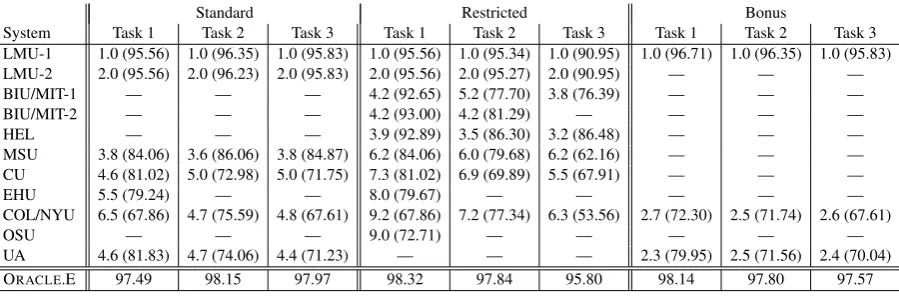
A surprising result of the shared task is the large performance gap between the top performing neu-ral models and the rest of the pack. Indeed, the results ofFaruqui et al. (2016)on the task of mor-phological inflection only yielded modest gains in some languages. However, the best neural ap-proach outperformed the best non-neural apap-proach by an average (over languages) of 13.76% abso-lute accuracy, and at most by 60.04%!
LMU The LMU system (Kann and Sch¨utze, 2016) was the all-around best performing sys-tem in the shared task. The syssys-tem builds off of the encoder-decoder model for machine transla-tion (Sutskever et al., 2014) with a soft attentransla-tion mechanism (Bahdanau et al., 2014). The archi-tecture is identical to the RNN encoder-decoder architecture ofBahdanau et al. (2014)—a stacked GRU (Cho et al., 2014). The key innovation is in the formatting of the data. The input word along with both the source and target tags were fed into the network as asingle stringand trained to predict the target string. In effect, this means that if there aren elements in the paradigm, there is a single model for alln2 possible reinflectional mappings.
Thus, the architecture shares parameters among all reinflections, using a single encoder and a single decoder.
BIU-MIT The BIU-MIT (Aharoni et al., 2016)
im-Standard Restricted Bonus
System Task 1 Task 2 Task 3 Task 1 Task 2 Task 3 Task 1 Task 2 Task 3
LMU-1 1.0 (95.56) 1.0 (96.35) 1.0 (95.83) 1.0 (95.56) 1.0 (95.34) 1.0 (90.95) 1.0 (96.71) 1.0 (96.35) 1.0 (95.83)
LMU-2 2.0 (95.56) 2.0 (96.23) 2.0 (95.83) 2.0 (95.56) 2.0 (95.27) 2.0 (90.95) — — —
BIU/MIT-1 — — — 4.2 (92.65) 5.2 (77.70) 3.8 (76.39) — — —
BIU/MIT-2 — — — 4.2 (93.00) 4.2 (81.29) — — — —
HEL — — — 3.9 (92.89) 3.5 (86.30) 3.2 (86.48) — — —
MSU 3.8 (84.06) 3.6 (86.06) 3.8 (84.87) 6.2 (84.06) 6.0 (79.68) 6.2 (62.16) — — —
CU 4.6 (81.02) 5.0 (72.98) 5.0 (71.75) 7.3 (81.02) 6.9 (69.89) 5.5 (67.91) — — —
EHU 5.5 (79.24) — — 8.0 (79.67) — — — — —
COL/NYU 6.5 (67.86) 4.7 (75.59) 4.8 (67.61) 9.2 (67.86) 7.2 (77.34) 6.3 (53.56) 2.7 (72.30) 2.5 (71.74) 2.6 (67.61)
OSU — — — 9.0 (72.71) — — — — —
UA 4.6 (81.83) 4.7 (74.06) 4.4 (71.23) — — — 2.3 (79.95) 2.5 (71.56) 2.4 (70.04)
[image:8.595.75.525.61.209.2]ORACLE.E 97.49 98.15 97.97 98.32 97.84 95.80 98.14 97.80 97.57
Table 6: Summary of results, showing average rank (with respect to other competitors) and average accuracy (equally weighted average over the 10 languages and marked in parentheses) by system. Oracle ensemble (ORACLE.E) accuracy represents the
probability that at least one of the submitted systems predicted the correct form.
provements. Most importantly, they augment the encoder with a bidirectional LSTM to get a more informative representation of the context and they represent individual morphosyntactic attributes as well. In addition, they include template-inspired components to better cope with the templatic mor-phology of Arabic and Maltese. The second archi-tecture, while also neural, more radically departs from previously proposed sequence-to-sequence models. The aligner from the baseline system is used to create a series of edit actions, similar to the systems in Camp 1. Rather than use a CRF, the BIU-MIT team predicted the sequence of edit ac-tions using a neural model, much in the same way as a transition-based LSTM parser does (Dyer et al., 2015;Kiperwasser and Goldberg, 2016). The architectural consequence of this is that it replaces the soft alignment mechanism of (Bahdanau et al., 2014) with a hard attention mechanism, similar to Rastogi et al. (2016).
Helsinki The Helsinki system (¨Ostling, 2016),
like LMU and BIU-MIT, built off of the sequence-to-sequence architecture, augmenting the system with several innovations. First, a single decoder was used, rather than a unique one for all pos-sible morphological tags, which allows for addi-tional parameter sharing, similar to LMU. More LSTM layers were also added to the decoder, cre-ating a deeper network. Finally, a convolutional layer over the character inputs was used, which was found to significantly increase performance over models without the convolutional layers.
6.3 Camp 3: Time for Some Linguistics
The third camp relied on linguistics-inspired heuristics to reduce the problem to multi-way clas-sification. This camp is less unified than the other two, as both teams used very different heuristics.
Columbia – New York University Abu Dhabi
The system developed jointly by Columbia and NYUAD (Taji et al., 2016) is based on the work of Eskander et al. (2013). It is unique among the submitted systems in that the first step in the pipeline is segmentation of the input words into prefixes, stems, and suffixes. Prefixes and suf-fixes are directly associated with morphological features. Stems within paradigms are further pro-cessed, using either linguistic intuitions or an em-pirical approach based on string alignments, to ex-tract the stem letters that undergo changes across inflections. The extracted patterns are intended to capture stem-internal changes, such as vowel changes in Arabic. Reinflection is performed by selecting a set of changes to apply to a stem, and attaching appropriate affixes to the result.
Moscow State The Moscow State system
M¨uller et al., 2015). Once a complete set of ab-stract paradigms has been extracted from the data, the problem is reduced to multi-way classifica-tion, where the goal is to select which abstract paradigm should be applied to perform reinflec-tion. The Moscow State system employs a multi-class SVM (Bishop, 2006) to solve the selection problem. Overall, this was the best-performing non-neural system. The reason for this may be that the abstract paradigm approach enforces hard constraints between reinflected forms in a way that many of the other non-neural systems do not.
6.4 Performance of Submitted Systems
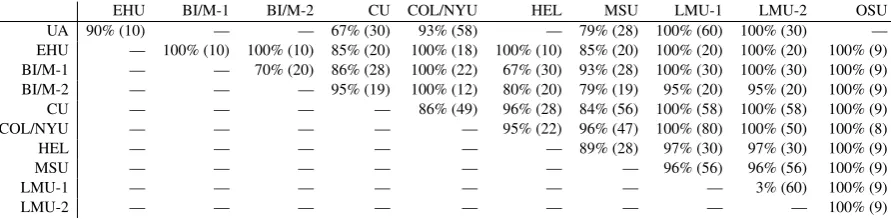
Relative system performance is described in Ta-ble 6, which shows the average rank and per-language accuracy of each system by track and task. The table reflects the fact that some teams submitted more than one system (e.g. LMU-1 & LMU-2 in the table). Full results can be found in the appendix. Table 7 shows that in most cases, competing systems were significantly dif-ferent (average p < 0.05 across 6 unpaired per-mutation tests for each pair with 5000 permuta-tions per test). The only case in which this did not hold true was in comparing the systems submitted by LMU to one another.
Three teams exploited the bonus re-sources in some form: LMU, Alberta and Columbia/NYUAD. In general, gains from the bonus resources were modest. Even in Arabic, where the largest benefits were observed, going from track 2 to track 3 on task 1 resulted in an absolute increase in accuracy of only ≈ 3% for LMU’s best system.
The neural systems were the clear winner in the shared task. In fact, the gains over classical systems were quite outstanding. The neural sys-tems had two advantages over the competing ap-proaches. First, all these models learned to align and transduce jointly. This idea, however, is not intrinsic to neural architectures; it is possible—in fact common—to train finite-state transducers that sum over all possible alignments between the in-put and outin-put strings (Dreyer et al., 2008; Cot-terell et al., 2014).
Second, they all involved massive parameter sharing between the different reinflections. Since the reinflection task entails generalizing from only a few data pairs, this is likely to be a boon. In-terestingly, the second BIU-MIT system, which
trained a neural model to predict edit operations, consistently ranked behind their first system. This indicates that pre-extracting edit operations, as all systems in the first camp did, is not likely to achieve top-level performance.
Even though the top-ranked neural systems do very well on their own, the other submitted sys-tems may still contain a small amount of comple-mentary information, so that an ensemble over the different approaches has a chance to improve ac-curacy. We present an upper bound on the possible accuracy of such an ensemble. Table 6 also in-cludes an ‘Oracle’ that gives the correct answer if anyof the submitted systems is correct. The aver-age potential ensemble accuracy gain across tasks over the top-ranked system alone is 2.3%. This is the proportion of examples that the top system got wrong, but which some other system got right.
7 Future Directions
Given the success of the submitted reinflection systems in the face of limited data from typolog-ically diverse languages, the future of morpho-logical reinflection must extend in new directions. Further pursuing the line that led us to pose task 3, the problem of morphological reinflection could be expanded by requiring systems to learn with less supervision. Supervised datasets could be smaller or more weakly supervised, forcing sys-tems to rely more on inductive bias or unlabeled data.
One innovation along these lines could be to provide multiple unlabeled source forms and ask for the rest of the paradigm to be produced. In another task, instead of using source and target morphological tags, systems could be asked to in-duce these from context. Such an extension would necessitate interaction with parsers, and would more closely integrate syntactic and morphologi-cal analysis.
Reflecting the traditional linguistic approaches to morphology, another task could allow the use of phonological forms in addition to orthographic forms. While this would necessitate learning a grapheme-to-phoneme mapping, it has the poten-tial to actually simplify the learning task by re-moving orthographic idiosyncrasies (such as the Spanish ‘c/qu’ alternation, which is dependent on the backness of the following vowel, but preserves the phoneme /k/).
EHU BI/M-1 BI/M-2 CU COL/NYU HEL MSU LMU-1 LMU-2 OSU
UA 90% (10) — — 67% (30) 93% (58) — 79% (28) 100% (60) 100% (30) —
EHU — 100% (10) 100% (10) 85% (20) 100% (18) 100% (10) 85% (20) 100% (20) 100% (20) 100% (9) BI/M-1 — — 70% (20) 86% (28) 100% (22) 67% (30) 93% (28) 100% (30) 100% (30) 100% (9) BI/M-2 — — — 95% (19) 100% (12) 80% (20) 79% (19) 95% (20) 95% (20) 100% (9)
CU — — — — 86% (49) 96% (28) 84% (56) 100% (58) 100% (58) 100% (9)
COL/NYU — — — — — 95% (22) 96% (47) 100% (80) 100% (50) 100% (8)
HEL — — — — — — 89% (28) 97% (30) 97% (30) 100% (9)
MSU — — — — — — — 96% (56) 96% (56) 100% (9)
LMU-1 — — — — — — — — 3% (60) 100% (9)
[image:10.595.77.523.62.173.2]LMU-2 — — — — — — — — — 100% (9)
Table 7: How often each pair of systems had significantly different accuracy under a paired permutation test (p <0.05), as a fraction of the number of times that they competed (on the same language, track and task). The number of such competitions is in parentheses.
implemented as finite state transducers (Beesley and Karttunen, 2003), often return all morpho-logically plausible analyses if there is ambiguity. Learning to mimic the behavior of a hand-written analyzer in this respect could offer a more chal-lenging task, and one that is useful within un-supervised learning (Dreyer and Eisner, 2011) as well as parsing. Existing wide-coverage morpho-logical analyzers could be leveraged in the design of a more interactive shared task, where hand-coded models or approximate surface rules could serve as informants for grammatical inference al-gorithms.
The current task design did not explore all po-tential inflectional complexities in the languages included. For example, cliticization processes were generally not present in the language data. Adding such inflectional elements to the task can potentially make it more realistic in terms of real-world data sparsity in L1 learning scenarios. For example, Finnish noun and adjective inflec-tion is generally modeled as a paradigm of 15 cases in singular and plural, i.e. with 30 slots in total—the shared task data included precisely such paradigms. However, adding all combinations of clitics raises the number of entries in an inflection table to 2,253 (Karlsson, 2008).
Although the languages introduced in this year’s shared task were typologically diverse with a range of morphological types (agglutinative, fu-sional; prefixing, infixing, suffixing, or a mix), we did not cover reduplicative morphology, which is common in Austronesian languages (and else-where) but is avoided by traditional computational morphology since it cannot be represented using finite-state transduction. Furthermore, the focus was solely on inflectional data. Another version of the task could call for learning derivational
mor-phology and predicting which derivational forms led to grammatical output (i.e. existing words or neologisms that are not subject to morphological blocking; Poser (1992)). This could be extended to learning the morphology of polysynthetic lan-guages. These languages productively use not only inflection and derivation, which call for the addition of bound morphemes, but also incorpo-ration, which involves combining lexical stems that are often used to form independent words (Mithun, 1984). Such languages combine the need to decompound, generate derivational alternatives, and accurately inflect any resulting words.
8 Conclusion
References
Roee Aharoni, Yoav Goldberg, and Yonatan Belinkov. 2016. Improving sequence to sequence learning for morphological inflection generation: The BIU-MIT systems for the SIGMORPHON 2016 shared task for morphological reinflection. In Proceedings of the 2016 Meeting of SIGMORPHON, Berlin, Ger-many. Association for Computational Linguistics. Malin Ahlberg, Markus Forsberg, and Mans Hulden.
2014. Semi-supervised learning of morphological paradigms and lexicons. InProceedings of the 14th EACL, pages 569–578, Gothenburg, Sweden. Asso-ciation for Computational Linguistics.
Malin Ahlberg, Markus Forsberg, and Mans Hulden. 2015. Paradigm classification in supervised learning of morphology. InHuman Language Technologies: The 2015 Annual Conference of the North American Chapter of the ACL, pages 1024–1029, Denver, CO. Association for Computational Linguistics.
I˜naki Alegria and Izaskun Etxeberria. 2016. EHU at the SIGMORPHON 2016 shared task. A simple pro-posal: Grapheme-to-phoneme for inflection. In Pro-ceedings of the 2016 Meeting of SIGMORPHON, Berlin, Germany, August. Association for Compu-tational Linguistics.
Cyril Allauzen, Michael Riley, Johan Schalkwyk, Woj-ciech Skut, and Mehryar Mohri. 2007. OpenFST: A general and efficient weighted finite-state transducer library. InImplementation and Application of Au-tomata, 12th International Conference, CIAA 2007, Prague, Czech Republic, July 16-18, 2007, Revised Selected Papers, pages 11–23.
Howard I. Aronson. 1990. Georgian: A Reading Grammar. Slavica, Columbus, OH.
Dzmitry Bahdanau, Kyunghyun Cho, and Yoshua Ben-gio. 2014. Neural machine translation by jointly learning to align and translate. arXiv preprint arXiv:1409.0473.
Kenneth R. Beesley and Lauri Karttunen. 2003. Fi-nite State Morphology. CSLI Publications, Stan-ford, CA.
Christopher M. Bishop. 2006. Pattern Recognition and Machine Learning. Springer.
John J. Camilleri. 2013. A computational grammar and lexicon for Maltese. Master’s thesis, Chalmers University of Technology. Gothenburg, Sweden. Kyunghyun Cho, Bart Van Merri¨enboer, Dzmitry
Bah-danau, and Yoshua Bengio. 2014. On the properties of neural machine translation: Encoder-decoder ap-proaches. arXiv preprint arXiv:1409.1259.
Grzegorz Chrupała, Georgiana Dinu, and Josef van Genabith. 2008. Learning morphology with Mor-fette. InLREC.
Ryan Cotterell, Nanyun Peng, and Jason Eisner. 2014. Stochastic contextual edit distance and probabilistic fsts. InProceedings of the 52nd Annual Meeting of the Association for Computational Linguistics (Vol-ume 2: Short Papers), pages 625–630, Baltimore, Maryland. Association for Computational Linguis-tics.
Ryan Cotterell, Nanyun Peng, and Jason Eisner. 2015. Modeling word forms using latent underlying morphs and phonology. Transactions of the Associ-ation for ComputAssoci-ational Linguistics, 3:433–447. Markus Dreyer and Jason Eisner. 2009. Graphical
models over multiple strings. InProceedings of the 2009 Conference on Empirical Methods in Natural Language Processing: Volume 1, pages 101–110. Association for Computational Linguistics.
Markus Dreyer and Jason Eisner. 2011. Discover-ing morphological paradigms from plain text usDiscover-ing a Dirichlet process mixture model. InProceedings of EMNLP 2011, pages 616–627, Edinburgh. Asso-ciation for Computational Linguistics.
Markus Dreyer, Jason R. Smith, and Jason Eisner. 2008. Latent-variable modeling of string transduc-tions with finite-state methods. In EMNLP, pages 1080–1089.
Kevin Duh and Katrin Kirchhoff. 2004. Automatic learning of language model structure. In Pro-ceedings of the 20th International Conference on Computational Linguistics (COLING), pages 148– 154, Stroudsburg, PA. Association for Computa-tional Linguistics.
Greg Durrett and John DeNero. 2013. Supervised learning of complete morphological paradigms. In
Proceedings of the 2013 Conference of the North American Chapter of the Association for Computa-tional Linguistics: Human Language Technologies, pages 1185–1195, Atlanta. Association for Compu-tational Linguistics.
Chris Dyer, Miguel Ballesteros, Wang Ling, Austin Matthews, and Noah A. Smith. 2015. Transition-based dependency parsing with stack long short-term memory. InACL.
Ramy Eskander, Nizar Habash, and Owen Rambow. 2013. Automatic extraction of morphological lex-icons from morphologically annotated corpora. In
Proceedings of the 2013 Conference on Empirical Methods in Natural Language Processing, EMNLP 2013, pages 1032–1043.
Yoav Freund and Robert E. Schapire. 1999. Large margin classification using the perceptron algorithm.
Machine Learning, 37(3):277–296.
Sharon Goldwater and David McClosky. 2005. Im-proving statistical MT through morphological anal-ysis. In Proceedings of the Conference on Human Language Technology and Empirical Methods in Natural Language Processing (HLT-EMNLP), pages 676–683, Stroudsburg, PA. Association for Compu-tational Linguistics.
Dan Gusfield. 1997. Algorithms on strings, trees and sequences: Computer science and computational bi-ology. Cambridge University Press.
Gunnar ´Olafur Hansson. 2010. Consonant Harmony: Long-Distance Interaction in Phonology. Univer-sity of California Publications in Linguistics. Uni-versity of California Press, Berkeley, CA.
Daniel S. Hirschberg. 1975. A linear space al-gorithm for computing maximal common subse-quences. Communications of the ACM, 18(6):341– 343.
Sittichai Jiampojamarn, Grzegorz Kondrak, and Tarek Sherif. 2007. Applying many-to-many alignments and hidden Markov models to letter-to-phoneme conversion. In Proceedings of the Human Lan-guage Technology Conference of the North Amer-ican Chapter of the Association of Computational Linguistics, pages 372–379.
Sittichai Jiampojamarn, Colin Cherry, and Grzegorz Kondrak. 2008. Joint processing and discrimina-tive training for letter-to-phoneme conversion. In
ACL 2008, Proceedings of the 46th Annual Meet-ing of the Association for Computational LMeet-inguis- Linguis-tics, pages 905–913.
Katharina Kann and Hinrich Sch¨utze. 2016. MED: The LMU system for the SIGMORPHON 2016 shared task on morphological reinflection. In Pro-ceedings of the 2016 Meeting of SIGMORPHON, Berlin, Germany. Association for Computational Linguistics.
Fred Karlsson. 2008. Finnish: An essential grammar. Routledge.
Aleksandr E. Kibrik. 1998. Archi. In Andrew Spencer and Arnold M. Zwicky, editors, The Handbook of Morphology, pages 455–476. Blackwell, Oxford. David King. 2016. Evaluating sequence alignment for
learning inflectional morphology. InProceedings of the 2016 Meeting of SIGMORPHON, Berlin, Ger-many, August. Association for Computational Lin-guistics.
Eliyahu Kiperwasser and Yoav Goldberg. 2016. Sim-ple and accurate dependency parsing using bidirec-tional LSTM feature representations. arXiv preprint arXiv:1603.04351.
Christo Kirov, John Sylak-Glassman, Roger Que, and David Yarowsky. 2016. Very-large scale pars-ing and normalization of Wiktionary morphologi-cal paradigms. In Proceedings of the Tenth Inter-national Conference on Language Resources and Evaluation (LREC 2016), pages 3121–3126, Paris, France. European Language Resources Association (ELRA).
Philipp Koehn. 2010.Statistical Machine Translation. Cambridge University Press, Cambridge.
Ling Liu and Lingshuang Jack Mao. 2016. Morpho-logical reinflection with conditional random fields and unsupervised features. In Proceedings of the 2016 Meeting of SIGMORPHON, Berlin, Germany. Association for Computational Linguistics.
Marianne Mithun. 1984. The evolution of noun incor-poration.Language, 60(4):847–894, December. Mehryar Mohri, Fernando Pereira, and Michael
Ri-ley. 2002. Weighted finite-state transducers in speech recognition. Computer Speech & Language, 16(1):69–88.
Thomas M¨uller, Ryan Cotterell, Alexander Fraser, and Hinrich Sch¨utze. 2015. Joint lemmatization and morphological tagging with LEMMING. In Empir-ical Methods in Natural Language Processing. Garrett Nicolai, Colin Cherry, and Grzegorz Kondrak.
2015. Inflection generation as discriminative string transduction. InNAACL HLT 2015, The 2015 Con-ference of the North American Chapter of the Asso-ciation for Computational Linguistics: Human Lan-guage Technologies, pages 922–931.
Garrett Nicolai, Bradley Hauer, Adam St. Arnaud, and Grzegorz Kondrak. 2016. Morphological reinflec-tion via discriminative string transducreinflec-tion. In Pro-ceedings of the 2016 Meeting of SIGMORPHON, Berlin, Germany. Association for Computational Linguistics.
Josef R. Novak, Nobuaki Minematsu, and Keikichi Hi-rose. 2012. WFST-based grapheme-to-phoneme conversion: Open source tools for alignment, model-building and decoding. In10th International Workshop on Finite State Methods and Natural Lan-guage Processing (FSMNLP), pages 45–49. Robert ¨Ostling. 2016. Morphological reinflection with
convolutional neural networks. In Proceedings of the 2016 Meeting of SIGMORPHON, Berlin, Ger-many. Association for Computational Linguistics. William J. Poser. 1992. Blocking of phrasal
con-structions by lexical items. In Ivan Sag and Anna Szabolcsi, editors,Lexical Matters, pages 111–130, Palo Alto, CA. CSLI.
Keren Rice. 2000. Morpheme Order and Semantic Scope: Word Formation in the Athapaskan Verb. Cambridge University Press, Cambridge, UK. Sunita Sarawagi and William W. Cohen. 2004.
Semi-Markov conditional random fields for information extraction. InAdvances in Neural Information Pro-cessing Systems 17 [Neural Information ProPro-cessing Systems, NIPS 2004], pages 1185–1192.
Alexey Sorokin. 2016. Using longest common subse-quence and character models to predict word forms. In Proceedings of the 2016 Meeting of SIGMOR-PHON, Berlin, Germany. Association for Computa-tional Linguistics.
Katsuhito Sudoh, Shinsuke Mori, and Masaaki Na-gata. 2013. Noise-aware character alignment for bootstrapping statistical machine transliteration from bilingual corpora. InProceedings of the 2013 Conference on Empirical Methods in Natural Lan-guage Processing, EMNLP 2013, pages 204–209. Ilya Sutskever, Oriol Vinyals, and Quoc V. Le. 2014.
Sequence to sequence learning with neural net-works. InAdvances in Neural Information Process-ing Systems, pages 3104–3112.
John Sylak-Glassman, Christo Kirov, Matt Post, Roger Que, and David Yarowsky. 2015a. A universal feature schema for rich morphological annotation and fine-grained cross-lingual part-of-speech tag-ging. In Cerstin Mahlow and Michael Piotrowski, editors, Proceedings of the 4th Workshop on Sys-tems and Frameworks for Computational Morphol-ogy (SFCM), pages 72–93. Springer, Berlin. John Sylak-Glassman, Christo Kirov, David Yarowsky,
and Roger Que. 2015b. A language-independent feature schema for inflectional morphology. In Pro-ceedings of the 53rd Annual Meeting of the Associ-ation for ComputAssoci-ational Linguistics and the 7th In-ternational Joint Conference on Natural Language Processing (ACL-IJCNLP), pages 674–680, Beijing. Association for Computational Linguistics.
Dima Taji, Ramy Eskander, Nizar Habash, and Owen Rambow. 2016. The Columbia University - New York University Abu Dhabi SIGMORPHON 2016 morphological reinflection shared task submission. In Proceedings of the 2016 Meeting of SIGMOR-PHON, Berlin, Germany. Association for Computa-tional Linguistics.