Evaluating Word Embeddings Using a Representative Suite of Practical
Tasks
Neha Nayak
Stanford University Stanford, CA 94305
Gabor Angeli
Stanford University Stanford, CA 94305
Christopher D. Manning
Stanford University Stanford, CA 94305
{nayakne, angeli, manning}@cs.stanford.edu
Abstract
Word embeddings are increasingly used in natural language understanding tasks requiring sophisticated semantic informa-tion. However, the quality of new embed-ding methods is usually evaluated based on simple word similarity benchmarks. We propose evaluating word embeddings
in vivo by evaluating them on a suite of popular downstream tasks. To ensure the ease of use of the evaluation, we take care to find a good point in the tradeoff space between (1) creating a thorough evalua-tion – i.e., we evaluate on a diverse set of tasks; and (2) ensuring an easy and fast evaluation – by using simple models with few tuned hyperparameters. This allows us to release this evaluation as a standard-ized script and online evaluation, available athttp://veceval.com/.
1 Introduction
Many modern NLP systems, especially those employing deep learning techniques, benefit from word representations in the form of low-dimensional word embeddings. This has led to a burgeoning body of work focusing on improving these representations. These word representations are used either as features for a conventional statis-tical classifier, or in a deep learning setup, where they are tuned to a particular task through back-propagation.
However, the quality of these unsupervised em-beddings is often asserted on the basis of restricted lexical semantics tasks, such as scoring word sim-ilarity or linear relationships for analogies. These intrinsic evaluations are carried out with little at-tention paid to how performance correlates with downstream tasks. We propose instead
evaluat-ing word embeddevaluat-ings usevaluat-ing a standardized suite of characteristic downstream tasks.
This has two advantages, which constitute the main contributions of the paper. First, an improve-ment in performance on these representative tasks is more likely to generalize to real-world applica-tions of the embedding, as compared to improve-ments in performance on current word similarity benchmarks. Therefore, this evaluation offers a better metric to hill-climb on than current lexical semantics tasks.
Second, this evaluation allows for higher fi-delity qualitative assessment on the strengths and weaknesses of an embedding method. For in-stance, certain embeddings may excel at syntac-tic tasks, or on sequence modeling tasks, whereas others may capture the semantics of a word better, or work better for classification tasks. We believe this evaluation can facilitate consolidating and for-malizing such insights, currently latent in the col-lective consciousness of the NLP community.
2 Related work
Existing work on creating evaluations for word embeddings has focused on lexical semantics tasks. An example of such tasks is WordSim-353 (Finkelstein et al., 2001), in which a series of word pairs are assigned similarity judgments by human annotators, and these are compared to the similar-ity scores obtained from word embeddings.
A thorough such lexical semantics evaluation was created by Faruqui and Dyer (2014)1. This
website allows a user to upload a set of embed-dings, and evaluates these embeddings on a se-ries of word similarity benchmarks. We follow the model presented in Faruqui and Dyer (2014), but extend to a series of more realistic downstream tasks.
1http://www.wordvectors.org
Schnabel et al. (2015) carried out both a thor-ough intrinsic evaluation of word vectors, and a limited extrinsic evaluation showing that an em-bedding’s intrinsic performance did not necessar-ily correlate with its real-world performance. This finding is a key motivation for this work – we aim to create a metric which does correlate with down-stream performance.
3 Motivation
While extensive research has gone into the devel-opment of meaningful intrinsic evaluation meth-ods, extrinsic evaluation remains the de-facto proving ground for novel word embedding meth-ods (Pennington et al., 2014; Dhillon et al., 2012). We aim to create an evaluation methodol-ogy which is representative of real-world perfor-mance, but nonetheless fast and easy to evaluate against. These two criteria are somewhat at odds with each other, which necessitates finding a good point in a number of key tradeoffs:
Choice of Tasks Optimally, new embeddings would be evaluated on as large a number of tasks as possible. However, such an evaluation would become prohibitively slow and impracti-cal. Therefore, we limit our evaluation to 6 tasks of moderate size, allowing models to be trained and evaluated quickly while nonetheless covering a range of NLP phenomena.
Choice of Models Optimally, new embeddings would be evaluated as components of a range of different models. However, the addition of more models – and in particular more sophisticated models – slows down the evaluation. Therefore, we opt to use uncontroversial off-the-shelf neural models for each task. Although none of the mod-els achieve state-of-the-art results, we only care about relative scores between embeddings. Sim-ple models are equally, if not more suitable for this criterion.
Choice of hyperparameters The performance of neural models often vary greatly depending on the choice of hyperparameters. To be fair to ev-eryone, we must either cross-validate for each em-bedding, or aggressively minimize the number of hyperparameters. For the sake of efficiency, we opt for the latter.
Reproducibility To ensure reproducibility, we release our evaluation script, and host a public
website where users can upload their embeddings to be evaluated.
4 Tasks
The following are a selection of tasks to be in-cluded in the benchmark suite. These were chosen to be a representative – though certainly not ex-haustive – sampling of relevant downstream tasks. Two tasks are included to test syntactic proper-ties of the word embeddings – part-of-speech tag-ging and chunking. Part-of-speech tagtag-ging is car-ried out on the WSJ dataset described in Toutanova et al. (2003). In order to simplify the task and avoid hand-coded features, we evaluate against the universal part-of-speech tags proposed in Petrov et al. (2012). For chunking, we use the dataset from the CoNLL 2000 shared task (Tjong Kim Sang and Buchholz, 2000), derived from the Wall Street Journal.
Four tasks test the semantic properties of the word embeddings. At the word level, we include named entity recognition. We evaluate on a 4-class Named Entity Recognition task: PERSON, LOCATION, ORGANIZATION, and MISC, us-ing the CoNLL 2003 dataset (Tjong Kim Sang and De Meulder, 2003), and an IOB tagging scheme. At the sentence level, we include two tasks – sen-timent classification and question classification. We implement binary sentiment classification us-ing the Stanford Sentiment Treebank dataset, and the coarse-grained question classification task de-scribed in Li and Roth (2006).
Finally, above the word level, we test the abil-ity of word embeddings to propagate the lexical relation information they contain into representa-tions of larger units of text. This involves the task of phrase-level natural language inference, derived from a dataset presented in Ganitkevitch et al. (2013).
These tasks were selected so as to cover both syntactic and semantic capabilities, but also as they are fast to train, fulfilling another of the char-acteristics put forward in Section 3.
5 Models
Our goal is to select the simplest possible mod-els for each task, while maintaining respectable performance. We therefore train straightforward models using standard neural net layers.
al. (2011). Features for each token in a sequence are constructed by concatenating the word embed-dings of a window of words centered on the token. This is passed through a two-layer neural network, followed by a softmax classifier.
For tasks with sentence-level labeling, sen-tence representations are constructed using a basic LSTM. Classification is then carried out by pass-ing through a one-layer neural network, followed by a softmax classifier.
Finally, the NLI task requires representations for both the premise and hypothesis sequences. Embeddings for each sequence are constructed as described in the sentence embedding tasks, us-ing two separate LSTMs. These embeddus-ings are concatenated, and similarly passed through a one-layer neural network and softmax classifier. Our implementations of these simple models are able to train with a new set of embeddings and evaluate the resulting model in a few hours.
Although these simplistic models do not achieve state-of-the-art performance on any of the tasks, they are faster and in many ways more ro-bust to variations in training methodology than more sophisticated models, maintaining a reduced hyperparameter set. Furthermore, a valid compar-ison between word vectors requires only that the model isfairto each representation, not necessar-ily that the models achieve state-of-the-art perfor-mance, fulfilling our requirements from Section 3. This evaluation aims solely to test the properties of word embeddings, and not phrase or sentence embeddings. For the tasks that demand phrase and sentence representations, we elect to construct these from the word embeddings using an LSTM, rather than to extend the evaluation to other types of embeddings.
6 Evaluation metrics
Our goal is to distill performance on extrinsic tasks into a short but comprehensive “report” that indi-cates the strengths and weaknesses of a particu-lar set of embeddings on a variety of downstream tasks. For each set of embeddings tested, we re-port results based on the metric most appropriate for the task –F1 score for NER, and accuracy for
the rest of the tasks.
We use SVD as a baseline embedding method. Using the hyperwords software of Levy et al. (2015), we apply SVD to a PMI-transformed co-occurrence matrix derived from the same
pre-Raw results on downstream tasks
POS
(Acc.) Chunk(Acc.) NER(F1) Sentiment(Acc.) Questions(Acc.) NLI(Acc.)
Fixed 93.30 91.20 96.30 87.40 82.10 48.40 (Baseline) 82.80 77.60 94.20 69.20 84.00 46.40
Fine-tuned 97.10 93.30 95.80 78.70 88.80 45.60 (Baseline) 96.90 92.80 96.10 76.70 84.40 43.90
Raw results on word similarity tasks
WordSim Analogy(Sem.) Analogy(Syn.)
[image:3.595.305.512.73.527.2]Anonymous vectors 0.640 52.0 63.0 Baseline 0.560 38.0 48.0
scribed corpus, resulting in a set of SVD vectors. We present a baseline for each task, which is the
F1score or accuracy attained by the SVD vectors.
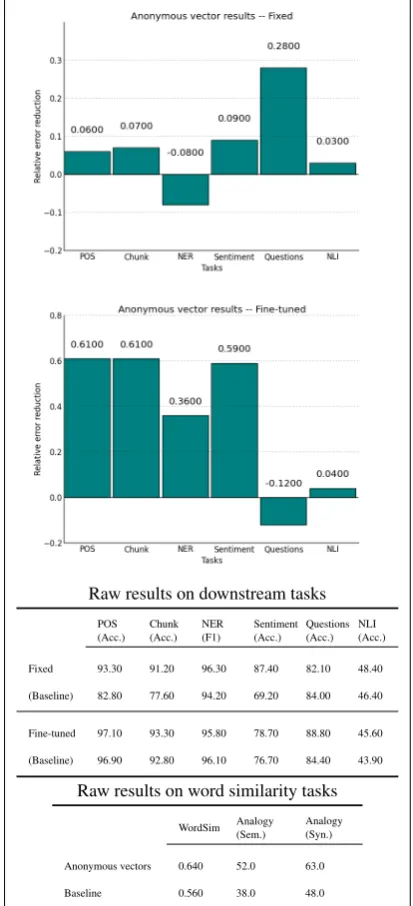
Due to the diversity of the tasks, it is difficult to compare the raw values or differences over the baseline. These measures, especially when ag-gregated, tend to implicitly reward large improve-ments over low-baseline tasks more than small improvements over high-baseline tasks. To illus-trate, whereas a 1% improvement on POS tagging should be considered significant, the same 1% im-provement on a task with a 80% baseline is less impressive. As such, the primary metric we report is not accuracy or F1, but rather the relative
er-ror reduction as compared to the SVD baseline. This allows us to calculate a meaningful aggre-gate, averaging relative error reduction over tasks. For backwards compatibility with prior work, we also report correlations on WordSim-353, as well as precision at 1 for the analogy task presented in Mikolov et al. (2013).
The figure shows an example report generated by our evaluation, using arbitrary but realistic val-ues. It can be seen that the relative error reduction depicted in the charts enables a clearer representa-tion of the relative performance on different tasks, as compared to the raw values provided in the ta-ble.
7 Experimental methodology
7.1 Training hyperparameters
Following Schnabel et al. (2015), we prescribe the use of a fixed snapshot of Wikipedia (dated 2008-03-01) for training the embeddings to be evalu-ated. This corpus was selected to be as close in time as possible to the corpus Collobert et al. (2011)’s embeddings were trained on. It was preprocessed by applying the Stanford tokenizer (Manning et al., 2014), and replacing all digits with zeros.
7.2 Avoiding bias
Since this method of evaluation involves training a number of neural network models, there is a sig-nificant danger of overfitting to the embeddings used to find the hyperparameters. We attempt to mitigate this in two ways.
First, we use simple models with standard neu-ral net layers to limit the number of hyperparam-eters tuned. We tune only the optimizer type, the l2 coefficient for regularization, and the learning
rate. We set any additional hyperparameters to fast yet reasonable defaults, which also facilitate short training times. For example, in an LSTM layer, we use a hidden layer size equal to the input vec-tor size. Second, rather than optimizing for each individual task, we select only two hyperparame-ter settings – one for the sequence labelling tasks (POS tagging, chunking and NER), and a separate setting for the other tasks. This is necessitated by the difference in model structure.
7.3 Fine-tuning
Most deep learning-based models backpropagate into the word embeddings used so as to fine tune them to the task at hand. This is a realistic setting in which to examine the performance of word em-beddings, in their capacity as an initialization for the various tasks. In contrast, disallowing back-propagation into the embeddings allows us to de-termine the amount of syntactic or semantic infor-mation inherently present in the embeddings. As such, we propose reporting accuracies attained in both these settings.
8 Practical details
Evaluation takes place on the web site http: //www.veceval.com. It is assumed that the user will train word embeddings to be evaluated, using the corpus provided on the website. The sen-tence and phrase embeddings used in the evalua-tion are produced by composing these given word embeddings. The user is required to prepare a gzipped text file, containing the word embeddings to be evaluated, in a simple format specified on the website. When the file is uploaded to the website, evaluation will begin. Once the evaluation is com-plete, a link to a report of the embeddings’ perfor-mance appears on the homepage.
It is expected that the evaluation will take a few hours. For example, the best performing hyper-parameters on the baseline embeddings result in a running time of 4 hours and 24 minutes.
9 Conclusion
References
Ronan Collobert, Jason Weston, L´eon Bottou, Michael Karlen, Koray Kavukcuoglu, and Pavel Kuksa. 2011. Natural language processing (almost) from scratch. The Journal of Machine Learning Re-search, 12:2493–2537.
Paramveer Dhillon, Jordan Rodu, Dean Foster, and Lyle Ungar. 2012. Two step cca: A new spec-tral method for estimating vector models of words. arXiv preprint arXiv:1206.6403.
Manaal Faruqui and Chris Dyer. 2014. Community evaluation and exchange of word vectors at word-vectors. org. In Proceedings of the 52nd Annual Meeting of the Association for Computational Lin-guistics: System Demonstrations. Association for Computational Linguistics.
Lev Finkelstein, Evgeniy Gabrilovich, Yossi Matias, Ehud Rivlin, Zach Solan, Gadi Wolfman, and Ey-tan Ruppin. 2001. Placing search in context: The concept revisited. InProceedings of the 10th inter-national conference on World Wide Web, pages 406– 414. ACM.
Juri Ganitkevitch, Benjamin Van Durme, and Chris Callison-Burch. 2013. PPDB: The paraphrase database. InHLT-NAACL.
Omer Levy, Yoav Goldberg, and Ido Dagan. 2015. Im-proving distributional similarity with lessons learned from word embeddings. Transactions of the Associ-ation for ComputAssoci-ational Linguistics, 3:211–225. Xin Li and Dan Roth. 2006. Learning question
clas-sifiers: the role of semantic information. Natural Language Engineering, 12(03):229–249.
Christopher D Manning, Mihai Surdeanu, John Bauer, Jenny Finkel, Steven J Bethard, and David Mc-Closky. 2014. The stanford corenlp natural lan-guage processing toolkit. In Proceedings of 52nd Annual Meeting of the Association for Computa-tional Linguistics: System Demonstrations, pages 55–60.
Tomas Mikolov, Kai Chen, Greg Corrado, and Jef-frey Dean. 2013. Efficient estimation of word representations in vector space. arXiv preprint arXiv:1301.3781.
Jeffrey Pennington, Richard Socher, and Christopher D Manning. 2014. Glove: Global vectors for word representation. Proceedings of the Empiricial Methods in Natural Language Processing (EMNLP 2014), 12:1532–1543.
Slav Petrov, Dipanjan Das, and Ryan McDonald. 2012. A universal part-of-speech tagset. InProceedings of LREC, May.
Tobias Schnabel, Igor Labutov, David Mimno, and Thorsten Joachims. 2015. Evaluation methods for unsupervised word embeddings. InProceedings of
the Conference on Empirical Methods in Natural Language Processing (EMNLP).
Erik F Tjong Kim Sang and Sabine Buchholz. 2000. Introduction to the CoNLL-2000 shared task: Chunking. InCoNLL.
Erik F Tjong Kim Sang and Fien De Meulder. 2003. Introduction to the CoNLL-2003 shared task: Language-independent named entity recognition. In HLT-NAACL.