On the Compositionality and Semantic Interpretation of
English Noun Compounds
Corina Dima
Collaborative Research Center 833 University of T¨ubingen, Germany
Abstract
In this paper we present a study cover-ing the creation of compositional distri-butional representationsfor English noun compounds (e.g. computer science) using two compositional models proposed in the literature. The compositional representa-tions are first evaluated based on their sim-ilarity to the corresponding corpus-learned representations and then on the task of au-tomatic classification of semantic relations for English noun compounds. Our experi-ments show that compositional models are able to build meaningful representations for more than half of the test set pounds. However, using pre-trained com-positional models does not lead to the ex-pected performance gains for the semantic relation classification task. Models using compositional representations have a sim-ilar performance as a basic classification model, despite the advantage of being pre-trained on a large set of compounds.
1 Introduction
Creating word representations for multiword ex-pressions is a challenging NLP task. The chal-lenge comes from the fact that these constructions have “idiosyncratic interpretations that cross word boundaries (or spaces)” (Sag et al., 2002). A good example of such challenging multiword expres-sions are noun compounds (e.g.finger nail,health care), where the meaning of a compound often in-volves combining some aspect or aspects of the meanings of its constituents.
Over the last few years distributed word repre-sentations (Collobert et al., 2011b; Mikolov et al., 2013; Pennington et al., 2014) have proven very successful at representing single-token words, and there have been several attempts at creating com-positional distributional models of meaning for
multi-token expressions, in particular adjective-word phrases (Baroni and Zamparelli, 2010), de-terminer phrases (Dinu et al., 2013b) or verb phrases (Yin and Sch¨utze, 2014).
Studying the semantics of multiword units, and in particular the semantic interpretation of noun compounds has been an active area of research in both theoretical and computational linguistics. Here, one train of research has focused on under-standing the mechanism of compounding by pro-viding a label for the relation between the con-stituents (e.g. infinger nail, thenailisPART OFthe finger) as in ( ´O S´eaghdha, 2008; Tratz and Hovy, 2010) or by identifying the preposition in the pre-ferred paraphrase of the compound (e.g. nail of
the finger) as in (Lauer, 1995).
In this paper, we explore compositional distri-butional models for English noun compounds, and analyze the impact of such models on the task of predicting the compound-internal semantic rela-tion given a labeled dataset of compounds. At the same time, we analyze the results of the compo-sitional process through the lens of the semantic relation annotation, in an attempt to uncover com-pounding patterns that are particularly challenging for the compositional distributional models.
2 Context and Compound Interpretation
There are two possible settings for compound interpretation: out-of-context interpretation and context-dependent interpretation.
Bauer (1983, pp. 45) describes a continuum of types of complex words, arranged with respect to their formation status and to how dependent their interpretation is on the context: (i)“nonce for-mations, coined by a speaker/writer on the spur of the moment to cover some immediate need”, where there is a large ambiguity with respect to the meaning of the compound which cannot be resolved without the immediate context (e.g. Nakov’s (2013) example compoundplate length,
for which a possible interpretation in a given con-text could be what your hair is when it drags in your food); (ii) institutionalized lexemes, whose potential ambiguity is canceled by the frequency of use and familiarity with the term, and whose more established meaning could be inferred based on the meanings of the constituents and prior world experience, without the need for an imme-diate context (e.g. orange juice); (iii) lexicalized lexemes, where the meaning has become a vention which cannot be inferred from the con-stituents alone and can only be successfully inter-preted if the term is familiar or if the context pro-vides enough clues (e.g.couch potato1).
The available datasets we use (described in Sec-tion 3) are very likely to contain some very low frequency items of type (i), whose actual inter-pretation would necessitate taking the immediate context into account, as well some highly lexical-ized compounds of type (iii), where the meaning can only be deduced from context. Nevertheless, because of a lack of annotated resources that pro-vide the semantic interpretation of a compound to-gether with its context, we will focus on the out-of-context interpretation of compounds.
3 Datasets
3.1 English Compound Dataset for Compositionality
The English compound dataset used for the com-position tests was constructed from two existing compound datasets and a selection of the nom-inal compounds in the WordNet database. The first existing compound dataset was described in (Tratz, 2011) and contains 19158 compounds2.
The second existing compound dataset was pro-posed in ( ´O S´eaghdha, 2008) and contains 1443 compounds3.
Additional compounds were collected from the WordNet 3.1 database files 4, more specifically
from the noun database file data.noun. The WordNet compound collection process involved 3 steps: (i) collecting all candidate compounds,
1acouch potatois not a potato, but a person who exercises
little and spends most of the time in front of a TV.
2The dataset is part of the semantically-enriched
parser described in (Tratz, 2011) which can be obtained fromhttp://www.isi.edu/publications/licensed-sw/ fanseparser/
3Available at http://www.cl.cam.ac.uk/˜do242/
Resources/1443_Compounds.tar.gz
4Available at http://wordnetcode.princeton.edu/
wn3.1.dict.tar.gz
i.e. words that contained an underscore or a dash (e.g.abstract entity,self-service); (ii) filtering out candidates that included numbers or dots, or had more than 2 constituents; (iii) filtering out candi-dates where either one of the constituents had a part-of-speech tag that was different from noun
orverb. The part-of-speech tagging of the can-didate compounds was performed using thespaCy Python library for advanced natural language pro-cessing5. The reason for allowing both noun
and verb as accepted part-of-speech tags was that given the extremely limited context available when PoS-tagging a compound the tagger would frequently label asverb multi-sense words that were actually nouns in the given context (e.g. eye drop, wheredropwas tagged as a verb). The final compound list extracted from WordNet 3.1 con-tained 18775 compounds.
The compounds collected from all three re-sources were combined into one list. The list was deduplicated and filtered for capitalized com-pounds (the Tratz (2011) dataset contained a small amount of person names and titles). A final fil-tering step removed all the compounds where ei-ther of the two constituents or the compound itself did not have a minimum frequency of 100 in the support corpus (presented later, in Section 4.1). The frequency filtering step was motivated by the assumption that the compositional process can be better modeled using “well-learned” word vectors that are based on a minimum number of contexts.
The final dataset contains 27220 compounds, formed through the combination of 5335 modifiers and 4761 heads. The set of unique modifiers and heads contains 7646 words, with 2450 words ap-pearing both as modifiers and as heads. The dictio-nary for the final dataset contains therefore 34866 unique words. The dataset was partitioned into
train, test anddev splits containing 19054, 5444 and 2722 compounds respectively.
3.2 English Compound Datasets for Semantic Interpretation
The Tratz (2011) dataset and the ´O S´eaghdha (2008) dataset are both annotated with seman-tic relations between the compound constituents. The Tratz (2011) dataset has 37 semantic relations and 19158 compounds. The ´O S´eaghdha (2008) dataset has 1443 compounds annotated with 6 coarse relation labels (ABOUT,ACTOR,BE,HAVE,
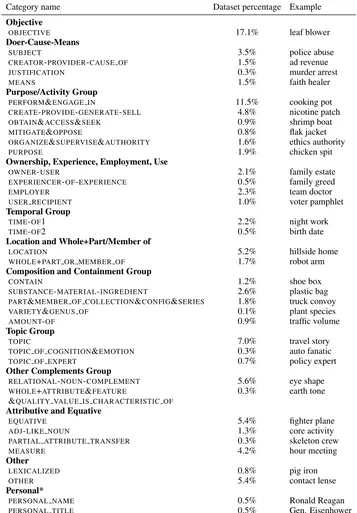
IN, INST). Appendix A lists the relations in the
two datasets together with some example anno-tated compounds.
For both datasets a small fraction of the constituents had to be recoded to the artificial underscore-based form described in Section 4.1, in order to maximize the coverage of the word repre-sentations for the constituents (e.g. databasewas recoded todata base).
4 Composition Models for English Nominal Compounds
A common view of natural language regards it as being inherently compositional. Words are com-bined to obtain phrases, which in turn combine to create sentences. The composition continues to the paragraph, section and document levels. It is this defining trait of human language, its compo-sitionality, that allows us to produce and to under-stand the potentially infinite number of utterances in a human language.
Gottlob Frege (1848-1925) is credited with phrasing this intuition into the form of a principle, known as the Principle of Compositionality: “The meaning of the whole is a function of the mean-ing of the parts and their mode of combination” (Dowty et al., 1981, p.8).
The adoption of distributional vectors as a proxy for the meaning of individual words (in other words, having a “meaning of the parts”) en-couraged researchers to focus their attention on findingcomposition modelswhich could act as the “mode of combination”.
When applied to vector space models of lan-guage, the idea of looking for a “mode of combination” translates to finding a composi-tion funccomposi-tion f which takes as input some n -dimensional distributional representations for the two constituents constructed using a support cor-pus, ucorpus, vcorpus ∈ Rn and outputs another
n-dimensional representation for the compound
pcomposed∈Rn,
pcomposed=f(ucorpus, vcorpus)
Additionally, we consider pcorpus ∈ Rn, the
learned representation for the compound, to be the “gold standard” for the composed representation of the compound pcomposed. Therefore the
com-position function f should minimize JMSE, the
mean squared error between the composed and the
corpus-induced representations:
JMSE = nc
X
i=1
1
n
n
X
j=1
(pcomposedij −pcorpusij )2
where nc is the number of compounds in our dataset.
Previous studies like (Guevara, 2010; Baroni and Zamparelli, 2010) evaluate their proposed composition functions on training data created us-ing the followus-ing procedure: first, they gather a set of word pairs to model. Then, a large corpus is used to construct distributional representations both for the word pairs as well as for the individ-ual words in each pair. In order to derive word pair representations the corpus is first pre-processed such that all the occurrences of the word pairs of interest are linked with the underscore character ‘ ’. This tricks the tokenizer into considering each pair a singe-unit word, thus making it possible to record its co-occurrence statistics using the same distributional methods one would use for a gen-uine single-unit word.
The same methodology is applied here for creat-ing a traincreat-ing dataset for compositional models us-ing the list of compounds described in Section 3.1. The process is detailed in Section 4.1.
Next, we selected two composition functions (we also refer to them as composition models) from the ones presented in the literature:
• the full additive model, introduced in Zan-zotto et al. (2010) (in their work this model is called the estimated additive model) and popularized as part of the DISSECT toolkit
(Dinu et al., 2013a; Dinu et al., 2013b). In this model the two constituent vectorsu and
v ∈ Rn are composed by multiplying them
via two square matrices A,B ∈ Rn×n. A
andBare the same for everyuandv, so dur-ing traindur-ing we only have to estimate the pa-rameters in twon×nmatrices, making the model constant in the number of parameters. The mathematical formulation of the full ad-ditive model is presented in Eq. 1.
p=Au+Bv (1)
• thematrixmodel, introduced in Socher et al. (2011). It is a non-linear composition model where the constituent vectors u, v ∈ Rn
[u;v] ∈ R2n and then multiplied with a
ma-trix W ∈ R2n×n. The result of the
mul-tiplication is ann-dimensional vector which is passed as a final step through a non-linear functiong(in this case the element-wise hy-perbolic tangenttanh). The parameter ma-trixWwhich has to be estimated during the training process is the same for all the pos-sible input vectorsuandv. Since this com-position function is implemented via a neural network, a bias termb∈Rnis added after the
multiplication of the matrixWwith the con-catenated vector[u;v]. The complete form of this composition function is given in Eq. 2.
p=g(W[u;v] +b) (2) The preference for these particular composition models is justified by their constant number of pa-rameters with respect to the vocabulary size. This allows us to use this composition model for a sig-nificantly larger number of constituents than the one in the list of compounds it was trained on. In particular, this allows us to predict a composition vector even for the compounds that were not at-tested in the corpus, if their constituents are fre-quent enough to be part of our full vocabulary.
Both models were reimplemented using the Torch7 library (Collobert et al., 2011a), whose nn-graphmodule allows for an easy creation of archi-tectures with multiple inputs and outputs. Reim-plementing the composition models is also justi-fied by the use of trained composition models as a form ofpre-trainingfor the semantic interpreta-tion models described in Secinterpreta-tion 5.
4.1 Compound-aware Word Representations
Thesupport corpusfor creating English word rep-resentations for compositionality experiments (re-ferred to in Section 3.1) was obtained by concate-nating the raw text from theENCOW14AXcorpus
(Sch¨afer, 2015) and the pre-processed 2014 En-glish Wikipedia dump described and made avail-able in M¨uller and Sch¨utze (2015). A preprocess-ing step similar to the one described in M¨uller and Sch¨utze (2015) was applied to the concate-nated corpus: the text was lowercased and the dig-its were replaced with 0s. An additional prepro-cessing step was necessary for creating compound representations. A list of compounds (described in Section 3.1) was used to recode the initial cor-pus such that the two-part compounds in the list
would be considered a single token. The recod-ing process involved replacrecod-ing different spellrecod-ing variants of a compound - written as two sepa-rate words, contiguously or with a dash (as in dress code, dresscode or dress-code), as well as their respective plural forms (dress codes, dress-codes, dress-codes) with an artificial underscore-based form (e.g. dress code). We did not, how-ever, modify the plural first constituents (i.e. sav-ings account), nor did we normalize the spelling variation which is the result of different spelling standards as incolor scheme(American English) and colour scheme (British English). The result was a 9 billion words raw-text corpus with a cor-responding vocabulary containing 424,014 words (both simplex words and compounds) with mini-mum frequency 100 (the full vocabulary had 16M words).
The raw-text corpus was the basis for training 300 dimensional word representations using the GloVe package (Pennington et al., 2014). The GloVe model was trained for 15 iterations using a 10-word symmetric context (20 words in total) for constructing the co-occurence matrix. The vector spaces were normalized to the L2-norm, first across features and then across samples using scikit-learn(Pedregosa et al., 2011).
4.2 Evaluation and Results
The parameters of the two composition models described in Section 4 were estimated with the help of the list of compounds in the train set described in Section 3.1 and the word represen-tations presented in Section 4.1. We evaluated the performance of the composition models on the
test split of the dataset, using the rank evalu-ation proposed by Baroni and Zamparelli (2010). Using a trained model, we generatecomposed rep-resentations for all the compounds in the test
VARIETY&GENUS_OF
TOPIC_OF_COGNITION&EMOTION JUSTIFICATION
PARTIAL_ATTRIBUTE_TRANSFER
WHOLE+ATTRIBUTE&FEATURE&QUALITY_VALUE_IS_CHARACTERISTIC_OF EXPERIENCER-OF-EXPERIENCE
TIME-OF2 TOPIC_OF_EXPERTMITIGATE&OPPOSEADJ-LIKE_NOUN
OBTAIN&ACCESS&SEEK LEXICALIZEDAMOUNT-OF
USER_RECIPIENT CONTAIN
CREATOR-PROVIDER-CAUSE_OF MEANS
ORGANIZE&SUPERVISE&AUTHORITYWHOLE+PART_OR_MEMBER_OF
PART&MEMBER_OF_COLLECTION&CONFIG&SERIES PURPOSETIME-OF1
OWNER-USER
SUBSTANCE-MATERIAL-INGREDIENT EMPLOYER SUBJECTMEASURE
CREATE-PROVIDE-GENERATE-SELL LOCATIONOTHER
RELATIONAL-NOUN-COMPLEMENT EQUATIVE TOPIC
PERFORM&ENGAGE_IN OBJECTIVE
0 5 10 15 20 25
median ranks
0 500 1000 1500 2000 2500 3000
compound count
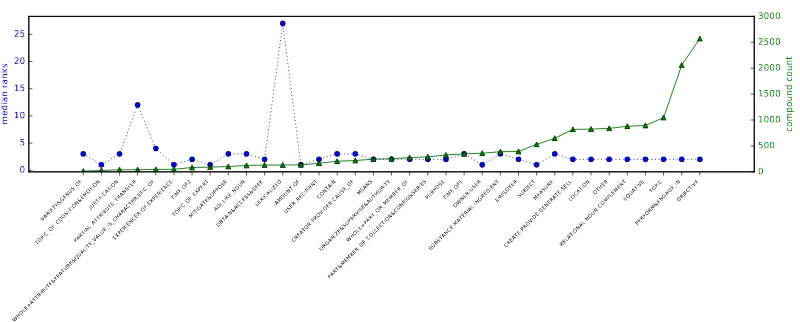
Figure 1: Semantic relations in the Tratz (2011) dataset: number of compounds labeled with a relation (green triangle) vs. the median rank assigned to their composed representations by thefull additivemodel (blue circle).
≥1000. The first, second and third quartiles (Q1, Q2/median, Q3) are then computed for the sorted list of ranks of the composed representations of the test set compounds. The result of our evaluation are displayed in Table 1.
Model Ranksdev Rankstest
Q1 Q2 Q3 Max Q1 Q2 Q3 Max matrix 2 5 28 1K 1 5 25 1K
[image:5.595.100.500.60.221.2]full additive 1 5 28 1K 1 5 25 1K
Table 1: Composition models results: quartiles for the ranks assigned to thedevandtest com-posed representations (lower is better).
Both composition models obtain good results on thetest dataset with respect to the Q1, Q2, Q3 quartiles. Ranks in the 1-5 range, which were assigned to half of thetest set compounds cor-respond to a well-built compound representation which resides in the expected vectorial neighbor-hood. For the next quarter of the data, the rank in the 6-25 range points to a representation that might still be considered reasonable depending on the application. For the last segment of ranked com-pounds the constructed representations are most likely incorrect. As detailed in the next paragraph, such high ranks usually suggest a difficulty in cre-ating a compound representation based on the con-stituent representations and indicate that the com-pound belongs to a special class (e.g. lexicalized, multi-sense etc). For both models the maximum assigned rank is the cut-off rank 1000.
To put these results into perspective, the results
of compositional models were interpreted through the lens of annotated semantic relations in publicly available datasets. Figure 1 plots the median rank assigned to the compounds with a particular se-mantic relation against the number of compounds labeled with that semantic relation in the subset of the Tratz (2011) dataset included in the compo-sitionality dataset described in Section 3.1. The figure confirms the intuition that recovering the meaning of lexicalized compounds likeeye candy and basket case is very difficult given only the constituents: the LEXICALIZED relation, which
labels 131 compounds, has the median rank 27. Another difficult semantic relation for the compo-sition model isPARTIAL ATTRIBUTE TRANSFER,
which labels compounds such as hairline crack and bullet train, which has a median rank of 12 for its 41 compounds. The high median rank sug-gests that this type of attributive relation is difficult to model using distributional representations of the individual constituents, as it is based on a common attribute which is not present in the surface form of the compound (the width for the hairline and thecrack; thespeedfor thebulletand thetrain).
5 Automatic Semantic Relation Classification for English Nominal Compounds
com-pound, given a fixed set of possible labels (e.g. the label of the relation linking ironto fencein iron fenceis MATERIAL). The two datasets described
in Section 3.2 are used as a testbed for the com-parison of the composition models described in Section 4. The state of the art results for these datasets are 65.4% 5-fold cross-validation (CV) accuracy for the ´O S´eaghdha dataset, obtained in ´O S´eaghdha and Copestake (2013), 79.3% 10-fold CV accuracy for an unpublished version of the Tratz dataset, with 17509 noun pairs annotated with 43 semantic relations (Tratz and Hovy, 2010) and 77.70% 10-fold CV accuracy on a subset of the Tratz (2011) dataset obtained in (Dima and Hinrichs, 2015).
Our MLP architecture for semantic classifica-tion consists of two modules: the composition modulewhich constructs the compound represen-tation from the represenrepresen-tations of its constituents and the classification module which takes as in-put the constructed compound representation and uses it as a basis for classifying the compound with respect to the semantic relations defined by each dataset.6
In the experiments described next the architec-ture of the composition module varies according to the method used for creating compound rep-resentations, while the classification module al-ways follows the same architecture: a linear layer
Wrel ∈ Rnc×k wherencis the dimensionality of
the compound representation andkis the number of semantic relations in the dataset, the nonlin-earity tanh and a softmax layer that selects the “winning” semantic relation from the k possible relations. Another constant addition to the full ar-chitecture is a 0.1 dropout layer for regularization and areLUnonlinearity between the composition and the classification modules.
All the described models are trained using a negative log-likelihood criterion, optimized with mini-batch Adagrad (Duchi et al., 2011) with a fixed initial learning rate (0.1, Tratz dataset;5e−2, ´O S´eaghdha dataset), learning rate decay 1e−5, weight decay1e−5and a batch size of 100 as hy-perparameters for the optimization process. The models are trained using early stopping with a pa-tience of 100 epochs.
Our working hypothesis is that learning first how to compose, and then doing the semantic
re-6The code for composing representations and for doing
automatic classification of semantic relations is available at https://github.com/corinadima/gWordcomp
lation classification task should yield better results than when the composition is learned based only on the signal provided by the classification task. We expect that pre-training the composition mod-ule would make the semantic relation classifica-tion task easier and that having a good compound representation would aid its semantic interpreta-tion.
We define as a basic composition module a simple architecture that takes as input u and v, the twon-dimensional constituent representations, concatenates them, and multiplies the concate-nated 2n-dimensional vector with a matrix W. Depending on the output dimensions of the model we want to compare it to, the dimensions of W
will range from∈R2n×nto∈R2n×4n.
Table 2 presents the results of the classification models, grouped according to the number of pa-rameters in the composition module. We used the matrixandfull additivecomposition models eval-uated in Section 4.2 as pre-trained composition modules.
The first two rows in Table 2 present the results of doing semantic relation classification using the composed compound representations as the only input to the classifier. In these settings, which are labeledcompoM300×600andcompoFA300×600, the
input is the composed representation as computed by the pretrainedmatrixandfull additive compo-sition models. The composed representations are kept fixed during the classification process. This configuration obtained the weakest results from all the tested configurations. An explanation for this result might be that the composition models per-form well for only half of our test compounds, meaning that a good portion of the compounds have a potentially suboptimal representation.
In the next two rows the pre-trained composition models are fine-tuned for the semantic classification task (models labeled pretrain matrix600×300 and
pre-train fullAdditive600×300). The input in this
case are the initial corpus-based vectors of the two constituents.
Contrary to our hypothesis, the classification re-sults of thebasic600×300 model (the last model in
the first subsection) are on par or slightly better than the previous results, where the classification used the direct or fine-tuned output of a pre-trained composition module.
Composition module Pre-trained? Fine-tuned? Tratz CV ´O S´eaghdha CV
compoM300×600 yes no 74.22% 57.52%
compoFA300×600 yes no 73.70% 56.62%
pretrain matrix600×300 yes yes 78.05% 59.18%
pretrain fullAdditive600×300 yes yes 77.89% 59.18%
basic600×300 no no 78.57% 59.25%
pretrain matrix fullAdd600×600 yes yes 78.92% 59.39%
basic600×600 no no 78.88% 59.60%
c1c2 compoM900×900 yes no 79.06% 61.12%
c1c2 compoFA900×900 yes no 79.07% 59.60%
basic600×1200 no no 79.03% 59.60%
c1c2 compoMcompoFA1200×1200 yes no 79.16% 59.18%
basic600×2400 no no 79.36% 58.49%
Table 2: Semantic relation classification results on the Tratz and ´O S´eaghdha datasets using accuracy as a classification measure. Results obtained through 10-fold cross-validation on the Tratz dataset and 5-fold CV on the ´O S´eaghdha dataset (with the original folds).
were investigated, where:
• both pre-trained composition models are used for the composition module; the com-pound representation is the concatenation of the two composed representations ( pre-train matrix fullAdd600×600); even if the
combined classifier outperforms each of the classifiers based on only one composition model, its results are still on par with the ones of the basic classifier with a similar num-ber of parameters (basic600×600, see results
in Table 2, subsection 2).
• the initial vector representations of the constituents as well as their composed representation are used as an input (c1c2 compoM900×900,
c1c2 compoFA900×900); the composition
is in this case not fine-tuned; the results on the Tratz (2011) dataset are again similar to the comparable basic model (basic600×1200). The c1c2 compoM900×900
obtains the best overall result, 61.12%, on the ´O S´eaghdha (2008) dataset.
• the input consists of the initial vector rep-resentations and both composed representa-tions (c1c2 compoMcompoFA1200×1200); the
composed vectors are fixed; the results are compared to thebasic600×2400model (again,
with a similar number of parameters). This last section contains the best overall result for
the Tratz (2011) dataset,79.36%, obtained by thebasic600×2400model.
To understand this unexpected result we analyzed the predictions made by the best performing classification models, basic600×2400
and c1c2 compoMcompoFA1200×1200, on the
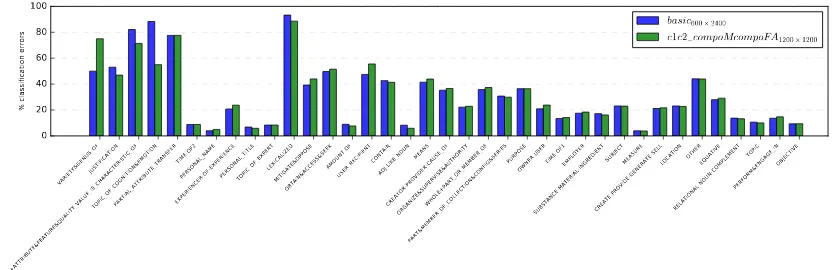
Tratz (2011) dataset. The analysis targeted the dis-tribution of errors per semantic relation for each of the two classifiers. As the distribution of com-pounds labeled with a particular semantic relation is rather skewed, we found it more informative to look at the percentage of errors for each class (shown in Figure 2) rather than at the absolute er-ror values.
A first conclusion that can be drawn from this figure is that the two models have roughly the same distribution of errors: both struggle the most with the semantic relations with a low com-pound count (left side of the figure) and with the class of lexicalized compounds. In addition, even some of the relations with more than 500 labeled examples (starting fromSUBSTANCE-MATERIAL -INGREDIENT) remain difficult to identify (in
par-ticular the heterogeneous OTHER relation, which
labels compounds whose relation is not covered by the rest of the inventory, and theEQUATIVE
re-lation, which labels compounds based on subtype or logical-and relations, i.e.mozzarella cheese, fe-male owner).
VARIETY&GENUS_OF JUSTIFICATION
WHOLE+ATTRIBUTE&FEATURE&QUALITY_VALUE_IS_CHARACTERISTIC_OF TOPIC_OF_COGNITION&EMOTIONPARTIAL_ATTRIBUTE_TRANSFER
TIME-OF2 PERSONAL_NAME
EXPERIENCER-OF-EXPERIENCE
PERSONAL_TITLETOPIC_OF_EXPERTLEXICALIZEDMITIGATE&OPPOSE OBTAIN&ACCESS&SEEK
AMOUNT-OF USER_RECIPIENT
CONTAIN ADJ-LIKE_NOUN
MEANS
CREATOR-PROVIDER-CAUSE_OF ORGANIZE&SUPERVISE&AUTHORITYWHOLE+PART_OR_MEMBER_OF
PART&MEMBER_OF_COLLECTION&CONFIG&SERIES PURPOSE
OWNER-USERTIME-OF1EMPLOYER
SUBSTANCE-MATERIAL-INGREDIENT SUBJECTMEASURE
CREATE-PROVIDE-GENERATE-SELL LOCATIONOTHEREQUATIVE
RELATIONAL-NOUN-COMPLEMENT TOPIC
PERFORM&ENGAGE_IN OBJECTIVE 0
20 40 60 80 100
% classification errors
basic600×2400
[image:8.595.93.509.65.200.2]c1c2_compoMcompoFA1200×1200
Figure 2: Error analysis for semantic relation classification on the Tratz (2011) dataset: the percentage of errors for each semantic class for thebasic600×2400(blue, left) and thec1c2 compoMcompoFA1200×1200
(green, right) models. The semantic relations are sorted by compound count (low count to the left, high count to the right).
of compounds labeled with a relation (e.g. TOPIC
for compounds with guide: travel guide, fishing guide), other compounds with the headguidewill be assigned the same relation (e.g. user guide is labeled TOPIC although the correct relation is USER RECIPIENT). This phenomenon where the
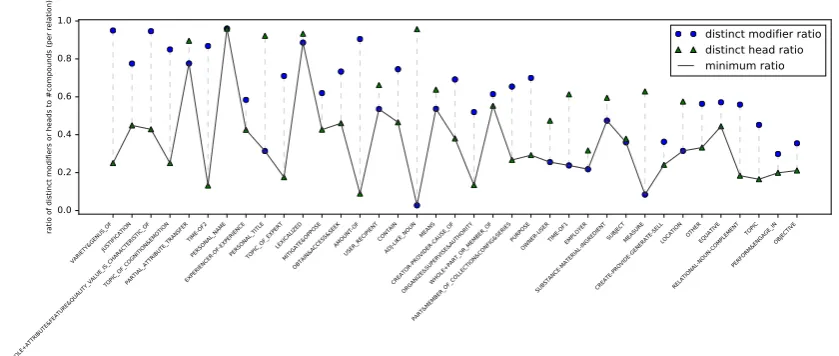
classifier memorizes lexical associations between words in particular slots and classification labels as opposed to learning relations between the words in the two slots is referred to in Levy et al. (2015) aslexical memorization. To get a sense of how this phenomenon affects our classification task we plot in Figure 3 two ratios for every semantic relation in the Tratz (2011) dataset: the number ofdistinct modifiersover the total number of compounds and the number ofdistinct headsover the total number of compounds. A small ratio indicates that a large subset of the compounds labeled with a particular semantic relation share a common constituent: for example, the ADJ-LIKE NOUN subclass has only
7 distinct modifiers for 254 compounds, resulting in a very low modifier ratio (0.03). Similarly the
AMOUNT OFsubclass has 168 compounds with 15
heads (head ratio:0.09).
Comparing Figure 3 to Figure 2, one can ob-serve that the majority of the classes with ei-ther a low head ratio or a low modifier ra-tio also have the lowest percentage of er-rors per class. This is the case for relations likeTIME OF2,TOPIC OF EXPERT,AMOUNT-OF, ADJ-LIKE NOUN and MEASURE, all of which
have under 10% error rate. A notable excep-tion is thePERSONAL NAMEsemantic relation for
which the classifiers manage to have a small error
rate even with very diverse modifiers and heads (both modifier and head ratio is 0.96). A more re-alistic estimate of the actual performance of the classifiers are the semantic relations which have both a larger number of compounds and a more diverse set of constituents, like in the case of
USER RECIPIENT, CREATOR PROVIDER CAUSE -OF,WHOLE+PART OR MEMBER OForPURPOSE,
which have a 40-60% error rate.
cap-VARIETY&GENUS_OF JUSTIFICATION
WHOLE+ATTRIBUTE&FEATURE&QUALITY_VALUE_IS_CHARACTERISTIC_OF TOPIC_OF_COGNITION&EMOTIONPARTIAL_ATTRIBUTE_TRANSFER
TIME-OF2 PERSONAL_NAME
EXPERIENCER-OF-EXPERIENCE
PERSONAL_TITLETOPIC_OF_EXPERTLEXICALIZEDMITIGATE&OPPOSE OBTAIN&ACCESS&SEEK
AMOUNT-OF USER_RECIPIENT
CONTAIN ADJ-LIKE_NOUN
MEANS
CREATOR-PROVIDER-CAUSE_OF ORGANIZE&SUPERVISE&AUTHORITYWHOLE+PART_OR_MEMBER_OF
PART&MEMBER_OF_COLLECTION&CONFIG&SERIES PURPOSE
OWNER-USERTIME-OF1EMPLOYER
SUBSTANCE-MATERIAL-INGREDIENT SUBJECTMEASURE
CREATE-PROVIDE-GENERATE-SELL LOCATIONOTHEREQUATIVE
RELATIONAL-NOUN-COMPLEMENT TOPIC
PERFORM&ENGAGE_IN OBJECTIVE 0.0
0.2 0.4 0.6 0.8 1.0
ratio of distinct modifiers or heads to #compounds (per relation)
[image:9.595.89.509.66.244.2]distinct modifier ratio distinct head ratio minimum ratio
Figure 3: Diversity of modifiers and heads per relation: a low ratio for either the modifier (blue circle) or the head (green triangle) correlates with a small error rate for the classification task.
ture both lexical and relational aspects, but do not explicitly model pairwise constituent interactions.
6 Conclusions
In this paper we have presented a study covering the creation of compositional distributional rep-resentations for English noun compounds. The representations created by the compositional mod-els were further evaluated on the task of auto-matic semantic relation classification for English noun compounds, using two preexisting annotated datasets. The experiments are, to the best of our knowledge, the first compositional investiga-tions focusing on English noun compounds. The composition models have a good performance and manage to build meaningful composed vectors for half of the test set compounds.
The investigation of semantically annotated compound datasets revealed that composition models cannot represent compounds with lexical-ized meaning. This suggests that the represen-tations of compounds where the meaning of the whole is substantially different from the one of the parts should be learned directly from corpus co-occurence data. Another vocabulary-related observation concerns the extensive pre-processing necessary to create distributional representations for compounds. Spelling variation (e.g. health care, health-care, healthcare) artificially creates separate forms with the same meaning. Such forms should be identified and collapsed back to a single meaning representation when creating vec-tor space models of language.
The semantic relation classification experi-ments showed that state-of-the-art composition models must be further refined before they can be of use for downstream semantic tasks. In our experiments compositional models were unable to improve upon a basic model for semantic relation identification, despite being pretrained on a large set of compounds. Their mediocre performance on the semantic relation classification task is likely caused by the use of individual word representa-tions as the exclusive source of input, combined with the expectation that mathematical composi-tion funccomposi-tions can directly extract and model pat-terns of interaction between pairs of words. We hypothesize that composition models can be im-proved by first modeling the semantic relations be-tween words and then using the semantic relation representations together with the word representa-tions as inputs to the composition process.
Acknowledgments
References
Marco Baroni and Roberto Zamparelli. 2010. Nouns are vectors, adjectives are matrices: Represent-ing adjective-noun constructions in semantic space. In Proceedings of the Conference on Empirical Methods in Natural Language Processing (EMNLP 2010), pages 1183–1193, Massachussetts, USA.
Laurie Bauer. 1983. English word-formation. Cam-bridge University Press.
Ronan Collobert, Koray Kavukcuoglu, and Cl´ement Farabet. 2011a. Torch7: A Matlab-like environment for machine learning. InBigLearn, NIPS Workshop.
Ronan Collobert, Jason Weston, L´eon Bottou, Michael Karlen, Koray Kavukcuoglu, and Pavel Kuksa. 2011b. Natural language processing (almost) from scratch. The Journal of Machine Learning Re-search, 12:2493–2537.
Corina Dima and Erhard Hinrichs. 2015. Auto-matic noun compound interpretation using deep neu-ral networks and word embeddings. InProceedings of the 11th International Conference on Computa-tional Semantics (IWCS 2015), pages 173–183, Lon-don, UK.
Georgiana Dinu, The Pham Nghia, and Marco Baroni. 2013a. DISSECT - DIStributional SEmantics Com-position Toolkit. InProceedings of the 51st Annual Meeting of the Association for Computational Lin-guistics (ACL 2013), pages 31–36, Sofia, Bulgaria.
Georgiana Dinu, The Pham Nghia, and Marco Baroni. 2013b. General estimation and evaluation of com-positional distributional semantic models. InACL Workshop on Continuous Vector Space Models and their Compositionality, Sofia, Bulgaria.
David R. Dowty, Robert Wall, and Stanley Peters. 1981. Introduction to Montague semantics, vol-ume 11 of Synthese Language Library. Springer Science & Business Media.
John Duchi, Elad Hazan, and Yoram Singer. 2011. Adaptive subgradient methods for online learning and stochastic optimization. The Journal of Ma-chine Learning Research, 12:2121–2159.
Emiliano Guevara. 2010. A regression model of adjective-noun compositionality in distributional se-mantics. In Proceedings of the 2010 Workshop on GEometrical Models of Natural Language Seman-tics, pages 33–37. Association for Computational Linguistics.
Mark Lauer. 1995. Designing statistical language learners: Experiments on compound nouns. Ph.D. thesis, Macquarie University.
Omer Levy, Steffen Remus, Chris Biemann, Ido Da-gan, and Israel Ramat-Gan. 2015. Do Supervised
Distributional Methods Really Learn Lexical Infer-ence Relations? InProceedings of the 2015 Confer-ence of the North American Chapter of the Associ-ation for ComputAssoci-ational Linguistics - Human Lan-guage Technologies (NAACL HLT 2015), Denver, CO, USA.
Tomas Mikolov, Kai Chen, Greg Corrado, and Jef-frey Dean. 2013. Efficient estimation of word representations in vector space. arXiv preprint arXiv:1301.3781.
Thomas M¨uller and Hinrich Sch¨utze. 2015. Robust morphological tagging with word representations. InProceedings of the 2015 Conference of the North American Chapter of the Association for Computa-tional Linguistics - Human Language Technologies (NAACL HLT 2015), Denver, CO, USA.
Preslav Nakov. 2013. On the interpretation of noun compounds: Syntax, semantics, and entailment.
Natural Language Engineering, 19(03):291–330.
Diarmuid ´O S´eaghdha and Ann Copestake. 2013. In-terpreting compound nouns with kernel methods.
Natural Language Engineering, 19(03):331–356.
Diarmuid ´O S´eaghdha. 2008. Learning compound noun semantics. Ph.D. thesis, Computer Laboratory, University of Cambridge. Published as University of Cambridge Computer Laboratory Technical Re-port 735.
F. Pedregosa, G. Varoquaux, A. Gramfort, V. Michel, B. Thirion, O. Grisel, M. Blondel, P. Pretten-hofer, R. Weiss, V. Dubourg, J. Vanderplas, A. Pas-sos, D. Cournapeau, M. Brucher, M. Perrot, and E. Duchesnay. 2011. Scikit-learn: Machine learn-ing in Python. Journal of Machine Learning Re-search, 12:2825–2830.
Jeffrey Pennington, Richard Socher, and Christo-pher D. Manning. 2014. GloVe: Global vectors for word representation. InProceedings of the Em-piricial Methods in Natural Language Processing (EMNLP 2014), volume 12.
Ivan A. Sag, Timothy Baldwin, Francis Bond, Ann Copestake, and Dan Flickinger. 2002. Multiword expressions: A pain in the neck for NLP. In Compu-tational Linguistics and Intelligent Text Processing, pages 1–15. Springer.
Roland Sch¨afer. 2015. Processing and querying large web corpora with the COW14 architecture. In
Challenges in the Management of Large Corpora (CMLC-3).
Stephen Tratz and Eduard Hovy. 2010. A taxonomy, dataset, and classifier for automatic noun compound interpretation. In Proceedings of the 48th Annual Meeting of the Association for Computational Lin-guistics (ACL-10), Uppsala, Sweden.
Stephen Tratz. 2011. Semantically-enriched parsing for natural language understanding. Ph.D. thesis, University of Southern California.
Wenpeng Yin and Hinrich Sch¨utze. 2014. An explo-ration of embeddings for generalized phrases. In
ACL 2014 Student Research Workshop, pages 41– 47, Baltimore, USA.
A Overview of the Semantic Relations in the Tratz (2011) and ´O S´eaghdha (2008) Datasets
Category name Dataset percentage Example
Objective
OBJECTIVE 17.1% leaf blower
Doer-Cause-Means
SUBJECT 3.5% police abuse
CREATOR-PROVIDER-CAUSE OF 1.5% ad revenue
JUSTIFICATION 0.3% murder arrest
MEANS 1.5% faith healer
Purpose/Activity Group
PERFORM&ENGAGE IN 11.5% cooking pot
CREATE-PROVIDE-GENERATE-SELL 4.8% nicotine patch
OBTAIN&ACCESS&SEEK 0.9% shrimp boat
MITIGATE&OPPOSE 0.8% flak jacket
ORGANIZE&SUPERVISE&AUTHORITY 1.6% ethics authority
PURPOSE 1.9% chicken spit
Ownership, Experience, Employment, Use
OWNER-USER 2.1% family estate
EXPERIENCER-OF-EXPERIENCE 0.5% family greed
EMPLOYER 2.3% team doctor
USER RECIPIENT 1.0% voter pamphlet
Temporal Group
TIME-OF1 2.2% night work
TIME-OF2 0.5% birth date
Location and Whole+Part/Member of
LOCATION 5.2% hillside home
WHOLE+PART OR MEMBER OF 1.7% robot arm
Composition and Containment Group
CONTAIN 1.2% shoe box
SUBSTANCE-MATERIAL-INGREDIENT 2.6% plastic bag
PART&MEMBER OF COLLECTION&CONFIG&SERIES 1.8% truck convoy
VARIETY&GENUS OF 0.1% plant species
AMOUNT-OF 0.9% traffic volume
Topic Group
TOPIC 7.0% travel story
TOPIC OF COGNITION&EMOTION 0.3% auto fanatic
TOPIC OF EXPERT 0.7% policy expert
Other Complements Group
RELATIONAL-NOUN-COMPLEMENT 5.6% eye shape
WHOLE+ATTRIBUTE&FEATURE 0.3% earth tone
&QUALITY VALUE IS CHARACTERISTIC OF
Attributive and Equative
EQUATIVE 5.4% fighter plane
ADJ-LIKE NOUN 1.3% core activity
PARTIAL ATTRIBUTE TRANSFER 0.3% skeleton crew
MEASURE 4.2% hour meeting
Other
LEXICALIZED 0.8% pig iron
OTHER 5.4% contact lense
Personal*
PERSONAL NAME 0.5% Ronald Reagan
[image:12.595.120.477.109.622.2]PERSONAL TITLE 0.5% Gen. Eisenhower
Relation Frequency Proportion Examples
BE 191 13.2% guide dog, rubber wheel, cat burglar
HAVE 199 13.8% family firm, coma victim, sentence structure, computer clock, star cluster IN 308 21.3% pig pen, air disaster, evening edition, dawn attack
ACTOR 266 18.4% army coup, project organiser
INST 236 16.4% cereal cultivation, foot imprint
[image:13.595.97.502.66.143.2]ABOUT 243 16.8% history book, waterways museum, embryo research, house price