DOCAL - Vicomtech’s Participation in the WMT16 Shared Task on
Bilingual Document Alignment
Andoni Azpeitia and Thierry Etchegoyhen
Vicomtech-IK4 Mikeletegi Pasalekua, 57
Donostia / San Sebastian, Gipuzkoa, Spain
{aazpeitia, tetchegoyhen}@vicomtech.org
Abstract
This article presents the DOCAL system
for document alignment, which took part in the WMT 2016 shared task on bilin-gual document alignment. The system is meant to offer a portable solution for var-ied document alignment scenarios, from parallel to comparable corpora, with mini-mal deployment effort. Its main goal is to provide an optimal balance between align-ment precision and recall using minimal resources and adaptation across alignment scenarios. We describe and discuss the performance of the system in the recall-oriented shared task.
1 Introduction
Parallel corpora are essential to the develop-ment of data-driven approaches to translation such as statistical machine translation (Brown et al., 1990). As it feeds further processes in the creation of bitexts, multilingual document alignment plays an important role in building accurate resources.
This article presents theDOCALsystem for
doc-ument alignment, which took part in the WMT 2016 shared task on bilingual document align-ment. The system is meant to offer a portable solution for varied document alignment scenarios, from parallel to comparable corpora.
The alignment of multilingual documents has been performed with a variety of techniques over the years, with alternatives targeting various sce-narios, from parallel to weakly comparable cor-pora.
Simple approaches based on file name match-ing can provide fast document pairmatch-ing, as they do not rely on any analysis of the content of docu-ments. Unfortunately, these approaches rely on
consistent file naming conventions, an assump-tion which is often defeated in practice (Tiede-mann, 2011). This approach is thus often com-plemented with content-based alignment methods, as in (Chen et al., 2004), whose system includes a filename-based module and a semantic similar-ity component based on a vector space model with frequency-weighted term vectors.
The usefulness of document metadata for doc-ument alignment has been explored in depth by (Resnik and Smith, 2003), who exploit URL prop-erties and structural tags to gather bilingual cor-pora from HTML pages on the Web. (Chen and Nie, 2000) is another example of an approach that exploits URL properties, along with docu-ment size and language identifiers. (Munteanu and Marcu, 2005) use date-aligned documents as input for their binary classification approach to compa-rable sentence alignment.
To address comparable corpora specifically, dif-ferent types of content-based approaches have been proposed. (Fung and Cheung, 2004), for in-stance, present the first exploration of very non-parallel corpora using a document similarity mea-sure based on bilingual lexical matching defined over mutual information scores on word pairs. (Patry and Langlais, 2005) present a feature-based method based on an Ada-Boost classifier that in-cludes features such as length, entities, and punc-tuation, along with a filtering component to re-move alignment duplicates. The BITS system is
another alternative proposed by (Ma and Liber-man, 1999) for bilingual text mining on the Web, measuring content similarity by counting the ratio of token translation pairs over the total number of tokens in the source document, where translation pairs are determined within fixed windows of text. Other general methods include (Ion et al., 2011), who propose an approach based on expectation-maximization using bilingual
cons, and (Li and Gaussier, 2013), whose com-parability metric measures the overall proportion of words for which a translation can be found in a comparable corpus using bilingual dictionaries.
The Jaccard coefficient (Jaccard, 1901), which is a core component ofDOCAL, has been used for
instance by (Paramita et al., 2013) whose com-parable document similarity measure is partially based on this metric computed over a subset of sentence pairs in the documents.
DOCAL (Etchegoyhen and Azpeitia, 2016) is
a simple method to measure multilingual docu-ment similarity, whose main goal is to provide an optimal balance between alignment precision and recall with minimal resources and adaptation across alignment scenarios. The next sections de-scribe the system and its performance in the recall-oriented shared task.
2 DOCAL
The core of the DOCAL approach relies on
ex-panded lexical translation sets, defined at the doc-ument level, and the Jaccard coefficient com-puted on those sets. Two token sets are thus ex-tracted from each pair of documents, along with two corresponding sets containing lexical transla-tions of the tokens. The translation sets are then augmented through set expansion operations, de-scribed below, and similarity is computed as the ratio of intersection over union on the original to-ken sets and their corresponding translation sets.
Formally, the following components are gener-ated for each document pair:
• di anddj: tokenised documents in languages
l1andl2, respectively.
• Si: set of tokens indi.
• Sj: set of tokens indj.
• Tij: set of expanded lexical translations into
l2for all tokens inSi.
• Tji: set of expanded lexical translations into l1for all tokens inSj.
From these elements, the similarity score is computed as in Equation 1:
simdocal=
|Tij∩Sj| |Tij∪Sj|+ |
Tji∩Si| |Tji∪Si|
2 (1)
In other words, the score is defined as the aver-age of the document-level Jaccard similarity coef-ficients computed in both translation directions.
Lexical translations are extracted from seed par-allel corpora, with translation probabilities com-puted according to IBM models (Brown et al.,
1993).1 For each token, thek-best translation op-tions are selected among the alternatives ranked according to their lexical translation probability. The actual probability values are not used beyond the ranking they enable, i.e. all selected transla-tions are equally considered in the computation of similarity. This is meant to abstract away from dif-ferences in lexical distributions between the seed corpora used to create translation tables and the data in the domain at hand, which is often of a dif-ferent nature.
No filtering is performed on the token sets, leav-ing punctuation marks alongside functional and content words, and the text is preserved with its original capitalisation. Pprocessing is thus re-duced to the minimal operation of tokenisation.
We now describe in turn the aforementioned set expansion operations, the retrieval of alignment candidates, and the available optimisations of the core method.
2.1 Set Expansion
Since lexical translation tables cannot be expected to cover a given domain satisfactorily, the transla-tion sets are expanded with tokens that may be in-dicators of similarity, although absent from trans-lation tables. First, all capitalised tokens are added to the sets if they are not found in the translation tables.2 This simple operation, which we perform at set creation time, provides coverage for named entities, which can be viewed as important indica-tors of content similarity given their low relative frequency. The same process applies to numbers as well, which can also be strong indicators of sim-ilarity, in particular when they denote dates.
DOCALincludes an additional set expansion
op-eration based on longest common prefixes (LCP),
which are computed over the minimal sets of ele-ments that may have a common stem, defined to be the following two set differences: Tij0 =Tij −Sj
1We useGIZA++ (Och and Ney, 2003) to extract lexical translation tables.
andTji0 = Tji−Si. For each element inTij0 (re-spectively Tji0 ) and each element in Sj (respec-tively Si), if a common prefix is found with an
empirically set minimal length ofncharacters, the prefix is added to both sets. This specific expan-sion operation is not included by default in the ac-tual usage of the system, as it increases the over-all computational cost and its benefits are largely dependent on the specifics of the corpora and lan-guage pairs at hand.
2.2 Alignment Candidates
Alignments are computed from source to target documents, with the additional filtering described in Section 2.3.
In some document alignment scenarios, an alignment process based on the Cartesian prod-uct of the document sets might be the optimal ap-proach, as the alignment space is guaranteed to be searched exhaustively. Since this approach has quadratic complexity, it is however computation-ally prohibitive if the volumes of documents reach a certain amount.
For scenarios where the volume of documents renders an exhaustive comparison unsustainable, a standard cross-linguistic information retrieval (CLIR) approach is provided. Target documents
are first indexed using the Lucene search engine3 and retrieved by building a query over the ex-panded translation sets created from each source document. This strategy drastically reduces the overall processing time and resource consump-tion, at the cost of missing some correct alignment pairs.4
2.3 Alignment Filtering
As the alignment process is executed from source to target documents, a given target document can be selected as the best alignment for more than one source document. This results in hidden correct alignments, often with scores that are marginally lower than the top alignment scores assigned by the similarity metric.
A simple solution to this issue consists in re-moving all alignments between a source docu-ment and a target if the latter is aligned to a different source document with a better similar-ity score. That is, we remove alignment tuples
(di, dj, simij)between any two documentsdiand
3https://lucene.apache.org.
4In experiments on different datasets, the loss of correct alignment pairs was minimal, at around 1% per test set.
dj if there exists a different tuple (dk, dj, simkj) such thatsimkj > simij.
This process often produces large improve-ments, as it allows previously hidden correct align-ments to surface, and is included by default inDO -CAL.
3 WMT 2016 Bilingual Document Alignment Task
The WMT 2016 shared task on multilingual doc-ument alignment5 consists in identifying pairs of English and French documents from a given col-lection of documents such that one document is the translation of the other. Candidate pairs were defined as all pairs of documents from the same web domain for which the source side has been identified as mostly English and the target side as mostly French.
Participants were to submit a list of possible pairings, with each source URL matched with at most one target URL and vice-versa. The evalu-ation metric was selected to be recall on the test set, i.e. the percentage of the test-set pairs that a participating system could find after enforcing the 1-1 alignment rule.
Our participation in the shared task was meant to check the effectiveness of DOCAL in a new
large-scale document alignment task with no task-specific adaptation, in accordance with our stated aim at portability and ease of deployment across document alignment scenarios. Thus, the system was applied in its default configuration and the provided training datasets were not used beyond testing the processing tools provided for the task. Document metadata or URL properties were not exploited either, to strictly measure our content-based approach to document alignment.
In the next section, we describe the setup for our system, with results presented in Section 3.2. 3.1 System Setup
As mentioned above,DOCALwas applied in its
de-fault configuration. Lexical translation tables were created withGIZA++ on the JRC-Acquis
Commu-nautaire corpus.6 For the English-French pair, the training corpus consisted in 708.896 aligned sen-tences. No experiments were made with different translation tables, larger or more varied, although
we view this research path as worth exploring in future work.
We setk= 5 to define the range ofk-best
lex-ical translations, as a compromise between larger sets with less reliable translation candidates and smaller sets which may miss translation alterna-tives. Note that this value could have been tuned on the provided training data, thus optimising the setting to this specific task. However, as previ-ously mentioned, our goal was to evaluate the ap-proach with portability in mind, where no particu-lar adaptation is performed; we therefore used this default value for thekparameter.
Document content was tokenised using the scripts provided in the Moses toolkit (Koehn et al., 2007). For all but four web domains in the test set, the set of possible alignment pairs was computed using the Cartesian product of source-target documents, as this guaranteed an exhaustive search in the alignment space and the computation was deemed practical for up to 260 million pos-sible pairings.7 The remaining four domains fea-tured potential pairs above the 300 million mark and theCLIRapproach using Lucene was used in
those cases.8
Finally, DOCALwas used with alignment
filter-ing, as described in Section 2.3, and without the set expansion operation based on longest common prefixes described in Section 2.1.
3.2 Results and Discussion
Overall,DOCALranked in 5th place on the official
test set, with 2128 pairs retrieved out of 2402 for a recall score of 88.59%. It is interesting to note that several systems, and in particular all four systems with better scores, have submitted a significantly larger number of pairs than DOCAL, which is
in-dicative of underlying differences in terms of pre-cision and f-measure. However, without knowing the correctness of the alignments outside the test set pairs, it is obviously not possible to determine whether these differences show better precision on the part ofDOCALor not.
While performing an error analysis of the cases where our system had retrieved the incorrect pair according to the test set, we found 100 cases where the test set contained what we consider to be
incor-7The documents were processed on a single server with 64G of RAM and 16 cores.
8The domains were: www.domainepechlaurier.com; www.desmarais-robitaille.com; italiasullarete.it; and: egode-sign.ca.
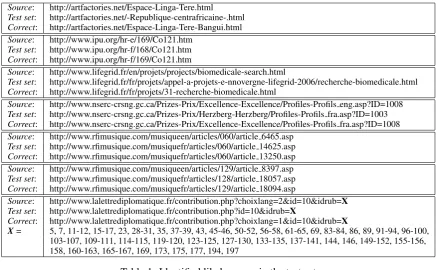
rect alignments. That is, in all 100 cases, shown in Table 1,9 the target pair found by DOCAL seems to us to be the correct one. In most of these cases, the French documents in the test set and the one re-trieved byDOCALwere nearly identical, with only
minor differences where the test set document was missing a small portion of information from the source document.10
These cases account for 4.16% of the test, and impact the final results, as shown in Table 2.11On the corrected test set, DOCAL reaches a score of
92.76%, significantly better than its result on the original test set.
It is of course entirely possible that other partic-ipating systems had actually retrieved the correct target documents as well in those cases, and that the final ranking of systems would thus be unaf-fected. Whether this is actually the case or not is unknown to us at the time of this writing.
4 Conclusion
Overall, we found the results obtained byDOCAL
on the shared task to be satisfactory, in particu-lar as a test case for the portability of the default method in a new large-scale alignment scenario.
The system was developed to seek an opti-mal balance between precision and recall, and has shown promising results along these lines in different scenarios involving both parallel and comparable corpora (Etchegoyhen and Azpeitia, 2016). In future tasks, it would be interesting to compare our approach to alternatives in terms of f-measure as well, to fully assess the usefulness of available methods for multilingual document alignment.
Acknowledgments
This work was partially funded by the Spanish Ministry of Economy and Competitiveness and the
9As many of the erroneous cases came from a single do-main, namely www.lalettrediplomatique.fr, we indicate the URL structure once where replacing the place-holder X with one of the values in the last line forms the actual URL. Note also that we indicate ranges with a dash, e.g., X = 15-17 in-dicates that all values from 15 to 17 (included) lead to a URL that is in the set of identified errors.
10For instance, 94 of the cases came from the domain www.lalettrediplomatique.fr, where the English source doc-ument content contains a date which is accurately translated in the document retrieved byDOCAL, and incorrect in the tar-get document in the test set.
Source: http://artfactories.net/Espace-Linga-Tere.html
Test set: http://artfactories.net/-Republique-centrafricaine-.html
Correct: http://artfactories.net/Espace-Linga-Tere-Bangui.html
Source: http://www.ipu.org/hr-e/169/Co121.htm
Test set: http://www.ipu.org/hr-f/168/Co121.htm
Correct: http://www.ipu.org/hr-f/169/Co121.htm
Source: http://www.lifegrid.fr/en/projets/projects/biomedicale-search.html
Test set: http://www.lifegrid.fr/fr/projets/appel-a-projets-e-nnovergne-lifegrid-2006/recherche-biomedicale.html
Correct: http://www.lifegrid.fr/fr/projets/31-recherche-biomedicale.html
Source: http://www.nserc-crsng.gc.ca/Prizes-Prix/Excellence-Excellence/Profiles-Profils eng.asp?ID=1008
Test set: http://www.nserc-crsng.gc.ca/Prizes-Prix/Herzberg-Herzberg/Profiles-Profils fra.asp?ID=1003
Correct: http://www.nserc-crsng.gc.ca/Prizes-Prix/Excellence-Excellence/Profiles-Profils fra.asp?ID=1008
Source: http://www.rfimusique.com/musiqueen/articles/060/article 6465.asp
Test set: http://www.rfimusique.com/musiquefr/articles/060/article 14625.asp
Correct: http://www.rfimusique.com/musiquefr/articles/060/article 13250.asp
Source: http://www.rfimusique.com/musiqueen/articles/129/article 8397.asp
Test set: http://www.rfimusique.com/musiquefr/articles/128/article 18057.asp
Correct: http://www.rfimusique.com/musiquefr/articles/129/article 18094.asp
Source: http://www.lalettrediplomatique.fr/contribution.php?choixlang=2&id=10&idrub=X
Test set: http://www.lalettrediplomatique.fr/contribution.php?id=10&idrub=X
Correct: http://www.lalettrediplomatique.fr/contribution.php?choixlang=1&id=10&idrub=X
[image:5.595.80.517.60.330.2]X= 5, 7, 11-12, 15-17, 23, 28-31, 35, 37-39, 43, 45-46, 50-52, 56-58, 61-65, 69, 83-84, 86, 89, 91-94, 96-100, 103-107, 109-111, 114-115, 119-120, 123-125, 127-130, 133-135, 137-141, 144, 146, 149-152, 155-156, 158, 160-163, 165-167, 169, 173, 175, 177, 194, 197
Table 1: Identified likely errors in the test set
TEST SETS FOUND PAIRS SUBMITTED PAIRS PAIRS AFTER1-1RULE RECALL
wmt2016 2.128 191.993 191.993 88.592839
wmt2016 corr 2.228 191.993 191.993 92.756037
Table 2: DOCALresults
Department of Economic Development and Com-petitiveness of the Basque Government through the AdapTA (RTC-2015-3627-7) and TRADIN (IG-2015/0000347) projects. We would like to thank MondragonLingua Translation & Commu-nication for their support as coordinator of these projects, and the organisers of the shared task for their work and support.
References
Peter F Brown, John Cocke, Stephen A Della Pietra, Vincent J Della Pietra, Fredrick Jelinek, John D Laf-ferty, Robert L Mercer, and Paul S Roossin. 1990. A statistical approach to machine translation. Com-putational linguistics, 16(2):79–85.
Peter F Brown, Vincent J Della Pietra, Stephen A Della Pietra, and Robert L Mercer. 1993. The mathemat-ics of statistical machine translation: Parameter esti-mation. Computational linguistics, 19(2):263–311.
Jiang Chen and Jian-Yun Nie. 2000. Parallel Web Text Mining for Cross-language IR. In Content-Based Multimedia Information Access - Volume 1, RIAO ’00, pages 62–77, Paris, France, France. Cen-tre des hautes tudes internationales d’informatique documentaire.
Jisong Chen, Rowena Chau, and Chung-Hsing Yeh. 2004. Discovering parallel text from the world wide web. In Proceedings of the second workshop on Australasian information security, Data Mining and Web Intelligence, and Software Internationalisation-Volume 32, pages 157–161. Australian Computer Society, Inc.
Thierry Etchegoyhen and Andoni Azpeitia. 2016. A Portable Method for Parallel and Comparable Doc-ument Alignment. Baltic Journal of Modern Com-puting, 4(2):243–255. Special Issue: Proceedings of EAMT 2016.
Pascale Fung and Percy Cheung. 2004. Mining Very Non-Parallel Corpora: Parallel Sentence and Lexi-con Extraction via Bootstrapping and E.M. In Pro-ceedings of Empirical Methods in Natural Language Processing, pages 57–63.
Radu Ion, Alexandru Ceaus¸u, and Elena Irimia. 2011. An expectation maximization algorithm for textual unit alignment. InProceedings of the 4th Workshop on Building and Using Comparable Corpora: Com-parable Corpora and the Web, pages 128–135. As-sociation for Computational Linguistics.
Philipp Koehn, Hieu Hoang, Alexandra Birch, Chris Callison-Burch, Marcello Federico, Nicola Bertoldi, Brooke Cowan, Wade Shen, Christine Moran, Richard Zens, et al. 2007. Moses: Open source toolkit for statistical machine translation. In Pro-ceedings of the 45th Annual Meeting of the ACL, pages 177–180. Association for Computational Lin-guistics.
Bo Li and Eric Gaussier. 2013. Exploiting comparable corpora for lexicon extraction: Measuring and im-proving corpus quality. InBuilding and Using Com-parable Corpora, pages 131–149. Springer.
Xiaoyi Ma and Mark Liberman. 1999. Bits: A method for bilingual text search over the web. InMachine Translation Summit VII, pages 538–542.
Dragos Stefan Munteanu and Daniel Marcu. 2005. Im-proving machine translation performance by exploit-ing non-parallel corpora. Computational Linguis-tics, 31(4):477–504.
Franz Josef Och and Hermann Ney. 2003. A sys-tematic comparison of various statistical alignment models. Computational linguistics, 29(1):19–51.
Monica Lestari Paramita, David Guthrie, Evangelos Kanoulas, Rob Gaizauskas, Paul Clough, and Mark Sanderson. 2013. Methods for collection and evalu-ation of comparable documents. InBuilding and Us-ing Comparable Corpora, pages 93–112. SprUs-inger.
Alexandre Patry and Philippe Langlais. 2005. Au-tomatic identification of parallel documents with light or without linguistic resources. InProceedings of the 18th Canadian Society Conference on Ad-vances in Artificial Intelligence, AI’05, pages 354– 365, Berlin, Heidelberg. Springer-Verlag.
Philip Resnik and Noah A Smith. 2003. The web as a parallel corpus. Computational Linguistics, 29(3):349–380.