317
Toward Zero-shot Entity Recognition
in Task-oriented Conversational Agents
Marco Guerini1, Simone Magnolini1,2, Vevake Balaraman1, Bernardo Magnini1 1Fondazione Bruno Kessler, Via Sommarive 18, Povo, Trento — Italy
2AdeptMind Scholar
{guerini,magnolini,balaraman,magnini}@fbk.eu
Abstract
We present a domain portable zero-shot learning approach for entity recognition in task-oriented conversational agents, which does not assume any annotated sentences at training time. Rather, we derive a neu-ral model of the entity names based only on available gazetteers, and then apply the model to recognize new entities in the con-text of user utterances. In order to eval-uate our working hypothesis we focus on nominal entities that are largely used in e-commerce to name products. Through a set of experiments in two languages (En-glish and Italian) and three different do-mains (furniture, food, clothing), we show that the neural gazetteer-based approach outperforms several competitive baselines, with minimal requirements of linguistic features.
1 Introduction
In this paper we focus on user utterance under-standing, where a conversational system has to in-terpret the content of a user dialogue turn. At this step, most of conversational systems try to cap-ture both the intent of the utterance and the rele-vant entities and relations that are mentioned. As an example, given a user query like: Can I find a Canada Goose parka blue for -30?, an online shop assistant should be able to recognize that the intent of the utterance is ‘Search’ and that the fol-lowing entities are mentioned: Product Category = parka; Brand = Canada Goose; Color = blue; Min temperature = -30. We are particularly in-terested in application domains, like e-commerce, which show specific characteristics: large variety of entity names for the same category (e.g.a black and white t-shirt,black pants,white vintage shoes
are all names of clothes); compositionality of en-tity names (e.g. black pants, black short pants); utterances with multiple occurrences of the same entity category (e.g. “I would like to order asalami pizzaand twomozzarella cheese sandwiches” con-tains two occurrences of food); strong require-ments of multilinguality (e.g.scarpe bianche vin-tageandwhite vintage shoes). Finally, we are in-terested in domains where available repositories can only cover a portion of the possible entity names that a user can express in an interaction.
Our working hypothesis is that, in such scenar-ios, current entity recognition approaches based on supervision (i.e. we call them pattern-based
as they need utterances annotated with entities in the context they occur), need a huge amount of su-pervision to manage the variety of entity names, which would make those approaches ineffective in most practical situations. Thus, we propose an entity recognition method, we call it gazetteer-based, which takes advantage of available entity names for a certain category to train a neural model that is then applied to label new unseen entities in a user utterance. This method shares several features with recent proposals in zero-shot learning (Xie et al., 2016), as we do not assume any annotated utterances at training time, and we make use of entity names as “side information”.
We run several experiments on three e-commerce domains (furniture, food, clothing) and two languages (English and Italian), with differ-ent characteristics in terms of differ-entity names, and show that: (i) the gazetteer-based approach signif-icantly outperforms the pattern-based approach in our domains and languages; (ii) the method cap-tures linguistic properties of the entity names re-lated to their compositionality, which are reliable indicators of the complexity of the task.
addressing. Section 3 provides background and relevant related work. Section 4 describes the gazetteer-based methodology that we adopt for en-tity recognition in user utterances. Finally, section 5 and 6 describe, respectively, the experimental setting and the obtained results.
2 Entity Recognition for E-commerce
Common conversational systems adopt a slot fill-ing approach as semantic representation of the terance content. Usually, it is assumed that the ut-terance contains just one entity for each slot. In addition, typical entities corresponds to named en-tities (e.g. locations) or to almost closed classes (e.g. time, dates, quantities, currencies). Although this is substantially true for several popular task oriented scenarios, like flight booking (a well known dataset is ATIS – Air Travel Information Services), point of interest navigation, and calen-dar scheduling (for instance the dataset used in (Eric and Manning, 2017)), other conversational scenarios show different characteristics. In this section we focus on conversational agents for the e-commerce scenario, and highlight the charac-teristics which we believe are relevant for entity recognition.
Task-oriented dialogue. E-commerce chat-bots are supposed to carry on a task-oriented dialogue whose goal is helping the user to select products presented in an online shop, and, ultimately, buy them. For the purposes of this paper we restrict our attention to written chat-style dialogues (i.e. voice is not considered).
Entity names. The main focus of the interac-tion is on products (i.e. users search, compare, assess information on products they are interested in). Products can be referred to in several ways, in-cluding their descriptions (e.g.a round table with a marble top), proper names (e.g.Adidas Gazelle), or with a mix of them (e.g. a white Billy shelf). Depending on the complexity of the domain, a sin-gle online shop may manage from thousands to several hundreds of thousand of different products, with hundreds of variants (e.g. size and colour for clothes). Throughout this paper, we refer to such product descriptions asentity names. As we will see, there is a high variance in the way online ven-dors assign and manage such names. For the pur-poses of this paper, it is relevant to notice that tak-ing advantage of e-commerce website catalogs, it
is relatively easy to download repositories of en-tity names for a large variety of products, and for several languages. On the other hand, a structured description of such entities - in term of slot-value pairs - is often missing. We call these repositories of entity namesgazetteers.
Conversational patterns. Conversational pat-terns in e-commerce dialogues are relatively sim-ple. High level user intents vary from searching for one or more products, asking to compare char-acteristics of products, and finalizing the purchase. Although there are just a few datasets available to support our intuition (e.g. the Frames dataset pre-sented in (El Asri et al.,2017)), we may assume that the context in which product names appear is quite limited. Compared to other scenarios (e.g. booking hotels and flights), it is quite frequent that user mention more than one product in the same utterance (e.g. ”Please deliver at home a salami pizza, apepperoni pizza with onionsand two moz-zarella cheese sandwiches”).
Multilinguality. E-commerce is becoming more and more multilingual. The market is world-wide and vendors offer navigation in several lan-guages. For our purposes a strong requirement is that approaches for entity recognition must be eas-ily portable through languages.
3 Background and Related Work
In this section we report useful context for the
gazetteer basedapproach that will be described in Section 4. We focus on entity recognition, zero-shot learning and generation of synthetic data.
3.1 Entity Recognition
Entity recognition has been largely approached as a sequence labeling task (see, for instance, the Conll shared tasks on named entities recognition (Tjong Kim Sang and De Meulder,2003)). Given an utteranceU = {t1, t2, ..., tn} and a set of en-tity categoriesC = {c1, c2, ..., cm}, the task is to label the tokens inU that refer to entities belong-ing to the categories in C. As an example, us-ing the IOB format (Inside, Outside, Beginnus-ing) (Ramshaw and Marcus, 1995), the utterance ”I would like to order a salami pizza and two moz-zarella cheese sandwiches”, would be labeled as shown in Table1.
I would like to order a salami pizza and two mozzarella cheese sandwiches
O O O O O O B-FOOD I-FOOD O O B-FOOD I-FOOD I-FOOD
Table 1: IOB annotation of food entities inside user request.
two main entity classes are distinguished: named entities and nominal entities. We focus on the lat-ter, as this is more relevant for utterance under-standing in the e-commerce scenario. Nominal entities are noun phrase expressions describing an entity. They can be composed by a single name (e.g.pasta,carpet,parka) or by more than one to-ken (e.g.capri sofa bed beige,red jeans skinny fit,
lightweigh full frame camera, grilled pork belly tacos). Nominal entities are typically composi-tional, as they do allow morphological and syntac-tic variations (e.g. for food names,spanish baked salmon, roasted salmonandhot smoked salmon), which makes it possible to combine tokens of one entity name with tokens of another entity name to generate new names (e.g. for food names,salmon tacosis a potential food name given the existence of salmon and tacos). In addition to adjectival and prepositional modifiers, conjunctions are also very frequent (e.g.beef and bean burritos, black and white t-shirt). Compositionality is crucial in our approach, as we take advantage of it to syn-tethically generate negative training examples for a certain entity category, as detailed in Section 4.1.
3.2 Zero-shot Learning
In conversational agents there is a general lack of data, both annotated and unannotated, as real con-versations are still not widely available for dif-ferent domains and languages. To overcome this limit, in our gazetteer-based approach we take ad-vantage of the fact that it is relatively easy to ob-tain repositories of entity names for several cat-egories (e.g. food names, locations, movie titles, names of products, etc.). We use such reposito-ries as “side information” in zero-shot learning to recognize entity names for a certain class, even if no annotated utterances are available for that class. While similar approaches have been already pro-posed to improve portability across domains (e.g. (Bapna et al., 2017) uses slot names as side in-formation), in this paper we take advantage of the zero-shot approach focusing on large repositories of compositional entity names.
Several approaches have been proposed to im-plement zero-shot learning, including those that use multiple embeddings (Norouzi et al., 2013),
those that extract features that generalize through different domains (Socher et al.,2013), and those that recast zero-shot learning as a domain adapta-tion problem (Elhoseiny et al.,2013).
3.3 Synthetic Data Generation
Partly due to the need of large amounts of train-ing data to feed neural networks, recently there has been a diffused interest on methods for auto-matically generate synthetic data (see (Jaderberg et al.,2014)). The effectiveness of synthetic data generation has been shown in several domains, in-cluding the generation of textual descriptions of visual scenes (Hoag,2008), and of parallel corpora for Machine Translation (Abdul-Rauf et al.,2016). Alternative approaches to data generation for con-versational agents are based on simulated conver-sations (Shah et al.,2018). As for the e-commerce domain, because of the dramatic scarcity of avail-able datasets, we were forced to use synthetic gen-eration in two cases: negative training examples for entity names, used to train our gazetteer-based approach, and lexicalization of utterances, used for testing the performance of our approach.
4 NNgEntity Recognition
In our zero-shot learning assumption we propose a neural gazetteer-based approach, which includes two main components: a neural classifier (NNg) trained solely on the entity names in a gazetteer, described in Section 4.1, and the entity tagger that applies the neural classifier to a user utterance, de-scribed in Section 4.2.
4.1 NNg Classifier
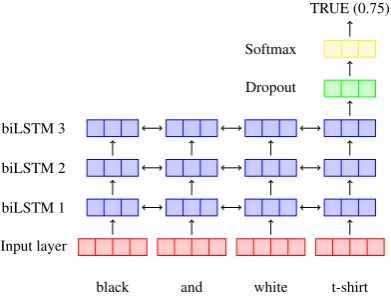
The NNg classifier is the core of the gazetteer-based approach. It is implemented using a mul-tilayer bidirectional LSTM (Schuster and Paliwal,
black and white t-shirt TRUE (0.75)
Input layer biLSTM 1 biLSTM 2 biLSTM 3
[image:4.595.82.278.64.212.2]Dropout Softmax
Figure 1: Structure of the Neural Gazetteer (NNg) entity classifier. The input layer concatenates the features in a single vector.
(dropout probability of 0.5) between the third biL-STM and the output layer. This topology (see Fig-ure1) has been empirically defined using the train and dev portions of the synthetic gazetteers de-scribed in section 5.2. (ii) The output layer is a softmax layer – instead of a CRF layer – because the goal of NNg is to classify the whole sequence and not to tag each single token using the IOB for-mat. The softmax layer provides the probability of a sequence being positive or negative for a cer-tain category, based on the output from the previ-ous layers. We use this probability as aconfidence scorefor a sequence being positive or negative.
This multilayer biLSTM is meant to build an internal representation of the core compositional structure of the entity names that are listed in the gazetteer, and to generalize such structure to rec-ognize new entity names of the same category.
Synthetic Training Data. In order to train the NNg classifier, we need not only positive exam-ples (i.e. entity name), but also negative ones, i.e. sub-sequences of an utterance where no en-tities are present or where only parts of the entity name are present. To obtain such negative exam-ples we used the following methodology based on synthetic generation. For each entity name i in a gazetteer G, negative counterparts can be ob-tained either using a sub-sequence of i (making sure it is not present in the gazetteer), or by tak-ing i and adding tokens at the beginning or end of it (or both), following the pattern t1 + i + t2, where t1 is the ending token of a random entity inGandt2 is the starting token of a random en-tity inG. Between these tokens andithere can be
separators, as a white space, a comma or theand
conjunction, so to mimic how multiple entities are usually expressed in sentences. Alternatively, t1 and t2 can be tokens randomly extracted from a generic corpus, so as to mimic cases when the en-tity is expressed in isolation. For example, if the initial positive example isblack and white t-shirt, the possible negative sub-sequences that are gen-erate are: |black |white |black and |and white |black and white|. The sub-sequences|white t-shirt|t-shirt|are not considered because they are already included in the gazetteer as positive ex-amples. Adding tokens, using the pattern t1 + i
+ t2, we obtain other potential negative examples:
|buy black and white t-shirt |black and white t-shirt and sweater|buy black and white t-shirt and sweater|, and so on. According to this procedure, we generate more negative examples than positive. In order to avoid an unbalanced dataset, we ran-domly select two negative examples per positive one: a sub-sequence and an example surrounded by other words, resulting in a 1:2 proportion.
Classifier Features. The NNg classifier com-bines several features: two different word em-beddings (i.e. generic and specific), a char-based embedding, and seven handcrafted features. The generic word embedding is employed to capture generic language use, and it is similar to the one used in (Lample et al., 2016). For English it was trained using the English Gigaword version 5, while for Italian it was trained using a dump of the Italian Wikipedia. We use an embedding dimension of 64 for both English and Italian, a minimum word frequency cutoff of 4, and a win-dow size of 8. The second word embedding is em-ployed to capture language use that is specific for each domain, and it is extracted using the training gazetteer as corpus, with a dimension of 30, a min-imum word frequency cutoff of 1, and a window size of 2. Finally, the char-based embedding with a dimension of 50 is still based on (Lample et al.,
2016) and it is trained on the domain gazetteers. Its function is to deal with out of vocabulary terms and possible misspellings.
name containing a certain token; (v) the average position of the token in the entity name it appears in; (vi) the bigram probability with reference to the previous token in the entity name; (vii) the list of all the possible PoS associated to the token.
4.2 NNg Tagger
The neural classifier described in the previous sec-tion is applied to all the sub-sequences of a certain utterance (see algorithm1), in order to select can-didates entity names for a certain category. After classification the algorithm takes a further step to select the actual entities, by ranking the candidates according to the confidence score provided by the classifier, and by selecting the top not overlapping candidates. As an example, the utterance “I’m looking for golden yellow shorts and dark blue shirt” contains six sub-sequences that are classi-fied as positive by the NNg classifier (lines [1-5]):
| shorts | yellow shorts | golden yellow shorts | shirt|blue shirt|dark blue shirt|, while all other sub-sequences, such as: | I’m looking | looking for a golden| shorts and dark | dark blue|, are classified as negative. Then, positive examples are ranked according to their confidence score (lines [6]): |golden yellow shorts|yellow shorts|dark blue shirt|etc. Finally,golden yellow shortsis se-lected whileyellow shortsis discarded because the latter overlaps with the former. Likewisedark blue shirt is selected since it is not overlapping with other already selected sub-sequences while all re-maining ones are discarded (lines [7-11]).
Algorithm 1NNgTagger
1: forsub-sequenceinutterancedo
2: ifsub-sequenceis an entitythen
3: addsub-sequencetoentity-list
4: else
5: discardsub-sequence
6: orderentity-listby confidence-score 7: forelementinentity-listdo
8: if element not overlap previous elements
then
9: tagelementas entity
10: else
11: discardelement
5 Experimental Setting
In this section we first introduce two alternative approaches for entity recognition that we used as
Algorithm 2Rule-based entity recognition 1: G: tokens in Gazetteer - excluding stopwords. 2: morpho: morphological variations of token. 3: P OS: possible PoS tags for the token. 4: bigram: All bi-grams in Gazetteer. 5:
6: fortokeninutterancedo
7: iftokenis in an NP chunkthen
8: ifIN GAZETTEER(token)then
9: tagtokenas entity
10: else
11: ifany(morpho[word]inG)then
12: ifany(P oS[word]isnoun)then
13: tagtokenas entity
14: fortokeniinutterancedo
15: ifbigram(tokeni, tokeni+1)exitsthen 16: tagtokeniandtokeni+1as entity
17: Formattags to IOB notation
comparison with NNg, and then the datasets that are used for our experiments.
5.1 Entity Recognition Algorithms
We have compared the NNg approach described in Section 4 with two alternative entity recogni-tion approaches: an unsupervised rule-based al-gorithm, which takes advantage of both the en-tity gazetteer and of linguistic information about chunking, and a supervised algorithm that needs annotated sentences as training.
Rule-based entity recognition. This approach is based on (Eftimov et al., 2017), a system that uses a terminological-driven and rule-based named entity recognizer, taking advantage of both entity dictionaries and rules based on chunks. The core strategy is that a chunk in a text is recognized as belonging to a categoryC if any of its tokens are present in the gazetteer for category C. The approach in (Eftimov et al.,2017) is tailored to a single domain/language and involves merging suc-cessive chunks into a single one based on the rules imposed by the algorithm. We extended the ap-proach by adding morphological features and the possible PoS of a word, for which we used TextPro (Pianta et al.,2008), (see Algorithm2).
tar-get entity white t-shirt with long sleeves can be correctly identified as long as there are entities in the gazetteer that contain the tokens of in-terest, such as black and white t-shirt and red t-shirt with long sleeves.
Neural pattern-based entity recognition (NNp). We used the bidirectional LSTM architecture in-troduced by (Lample et al.,2016) for named entity recognition. Given an input embedding for a to-ken in the utterance, the outputs from the forward and backward LSTM are concatenated to yield the context vector for the token, which is then used by a CRF layer to classify it to the output type (O, I-, B-). There are 100 LSTM units and a dropout of 0.5 is applied to the BiLSTM layer. To train the NNp model, we used pre-trained embeddings on Wikipedia corpora. This helps the model to adapt itself to unseen words in the test data, provided they have an embedding.
As expected, the proposed NNpmodel is highly efficient to identify the context in which an entity occurs in the utterance. However, it is also prone to make errors in the sequence of the tags (i.e. tag-ging a token to be I- without a preceding B- tag). This is because, when trained with limited data, the entities in the training data do not cover all possible tags for a token, and also not all the possi-ble entities (Lample’s model was trained on more than ten thousand sentences per language, but in our scenario the training data is limited to few hun-dred sentences). For this reason, and to highlight the model’s capability to identify the context of an entity, at test time the outputs of the model are post-processed to comply with the IOB notation; e.g. tag sequences such as O, I-, B-, I- are modi-fied to O, B-, I-, I-.
5.2 Datasets
We experimented entity recognition in three e-commerce domains and two languages for a to-tal of six configurations. The three domains are respectively: food, clothing and furniture. Lan-guages are Italian and English. In order to run our experiments the following datasets were used.
Entity gazetteers (positive examples for NNg). We collected a gazetteer of nominal entities for each domain-language pair. To allow for con-sistent comparisons across languages and domains we scraped just one website per domain and ex-tracted the English/Italian gazetteers versions. In Table 2 we describe each gazetteer, reporting its
size in terms of number of entity names, the av-erage length of the names (in number of tokens), plus the length variability of such names (standard deviation, SD). We also report additional metrics that try to grasp the complexity of entity name in the gazetteer: (i) the normalized type-token ra-tio (TTR), as a rough measure of how much lex-ical diversity there is for the nominal entities in a gazetteer, see (Richards,1987); (ii) the ratio of type1tokens, i.e. tokens that can appear in the first position of an entity name but also in other po-sitions, and type2 tokens, i.e. tokens appearing at the end and elsewhere; (iii) the ratio of enti-ties that contain another entity as sub-part of their name. With these measures we are able to par-tially quantify how difficult it is to recognize the length of an entity, how difficult is to individu-ate the boundaries of an entity (ratio of type1 and type2tokens), how much compositionality there is starting from basic entities (i.e. how many new entities can be potentially constructed by adding new tokens). Note that type1 and type2 ratios can cover cases in common with sub-entity ratio, but they model different phenomena: given white t-shirt, the entity nameblack and white skirt repre-sents a case of type1 token forwhite but without sub-entity matching, whilewhite t-shirt with long sleeves represents a sub-entity matching without makingwhitea type1token.
Synthetic Gazetteers (positive + negative ex-amples for NNg) (SG). To train NNg, we apply the methodology described in Section4.1 to ob-tain synthetic negative data. After splitting each gazetteer using a 64:16:20 ratio (train:dev:test), we created the aforementioned data sets, where – for each entity i (positive example) present in the train-dev splits – we added two negative ex-amples obtained by randomly selecting one of the methodologies described in Section4.1. The op-timal number of negative examples was obtained during the training phase by varying their ratio.
Synthetic Utterances (training for NNp, test
de-Gazetteer #entities #tokens length±SD TTR type1(%) type2(%) sub-entity(%) food EN 58539 265726 4.54±2.53 0.76 21.37 14.61 10.70 food IT 29340 101860 3.47±1.80 0.69 16.90 22.44 13.31 furniture EN 3595 13601 3.78±1.48 0.62 3.24 7.10 2.75 furniture IT 2624 10045 3.83±1.56 0.63 2.32 7.61 3.43 clothing EN 36290 127944 3.53±1.05 0.63 13.12 0.30 12.60 clothing IT 34698 130106 3.75±1.24 0.64 0.29 14.71 13.50
Table 2: Gazetteers used in the experiments. Description in terms of number of entity names, total number of tokens, average length and standard deviation (SD) of entities, type-token ratio (TTR, norm obtained by repeated sampling of 200 tokens), type1and type2 unique tokens ratio and sub-entity ratio.
Intent Template
Select I’m fine with<entity>
Description Could you explain to me what
<entity>is
AddToList I want to put both<entity>and
<entity>on my list
RateItem I want to give<entity>two stars
Table 3: Examples of intents and corresponding templates used to generate test utterances.
velop learning algorithms for text understanding and reasoning - were all constructed in a synthetic way (Weston et al.,2015).
We created 237 templates for English and the same amount for Italian. These templates were manually designed in order to be domain indepen-dent (e.g. using terminology that can be applied to any domain), and correspond to typical intents that can be found in the e-commerce scenario (e.g. buy, add to list, rate item, etc.) and were evenly distributed in order to contain 1 to 3 entity names. A few examples are given in Table3.
We split the templates in a 64:16:20 ratio (train:dev:test) before lexicalization: to lexicalize SUtrain we randomly choose entities that were in the train split of the gazetteers, while for SUtestwe randomly choose entities than were in the test split of the gazetteers. It should be noted that we used this procedure to better isolate the effect of entity name and their compositional nature over learning approaches, in fact: (i) we controlled for the im-pact of patterns on learning by using the same pat-terns across data sets train and test splits. (ii) we made the task more challenging than in standard situations, since no entity present in the training can be present in the test sets as well. In this way we can assess the ability of the approaches to learn the structure of entity names and generalize it to
NNgfeatures config. F1 SDV Gazetteer-info 88.08 4.94 Handcrafted 86.39 5.90 Embeddings 87.66 4.10
All 89.95 4.05
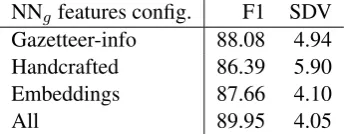
Table 4: Average F1 and standard deviation for various features configurations of NNgover the six SG data sets (three domains and two languages).
new examples. So, for example, a simple baseline that uses exact match over the train gazetteers to identify entities in the test sentences would report a F1 of 0.
Finally, according to our zero-shot assumption, the NNg is trained using solely SG, while its per-formances are computed using SUtest.
6 Experiments and Results
We run two different sets of experiments to ex-plore the impact of compositionality on the task of entity recognition. The first set was meant to find the optimal feature configuration for NNg, and the second one was the comparison of the three main approaches over the six SU datasets.
1. Experiments with NNg on SG. We run a set of experiments to assess the best feature configu-ration for the gazetteer-based approach. In Table4
English Italian
[image:8.595.103.495.61.132.2]Food Furniture Clothing Food Furniture Clothing Baseline 1: Rule-based 5.74 33.61 34.75 21.26 25.13 44.78 Baseline 2: NNp 25.53 43.67 61.76 14.79 25.33 22.88 NNg approach 32.43 63.28 76.92 37.17 40.41 62.64
Table 5: Experimental results (F1) over the six domain-language data sets.
is the second best, indicating that even in the worst case, in which no linguistic resource is available, we can still expect to obtain competitive results.
2. Experiments and Comparison on SU. Ta-ble5reports the comparison among the rule-based baseline, the NNpbaseline, and the NNgapproach. NNg is the best approach on all domains and lan-guages. This confirms our initial hypothesis that the structure of entity names induced by gazetteers is fundamental when having little knowledge of the context in which entities occur within utter-ances (i.e. having few training examples).
It should be noted that the effect of entity name complexity (reported in Table2) emerges clearly from the experiments: all the approaches tend to be affected by it. In both languages we have the following order in term of performances food < furniture < clothing. While for food results are evident (the highest length-SD, TTR, type1 and type2 token ratios and high sub-entity ratio affect the performances even if the gazetteers are big) for
furniture and clothing we need to look closer at the metrics in Table2. Neglecting the possible ef-fects of gazetteer size, we see thatclothingtends to have higher ratio of type1 or type2tokens: this is due to the large use of modifiers, such as colour, typical of the domain (depending on language the modifier is attached before or after the headwhite t-shirtvsmaglietta bianca). Still, being the other token type almost 0, either the beginning or the end of an entity name is unambiguous, and in case of adjacent entities in a sentence this is enough to recognize the boundaries between the two.
The NNg version that uses only gazetteer fea-tures (i.e. no linguistic knowledge is assumed), even if not reported in Table5, showed to perform more poorly than the version using all features. Still, it is competitive against NNp, outperform-ing it in five SU data sets out of six, and providoutperform-ing an average F1 improvement of 10 points.
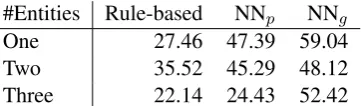
Finally, in Table 6 we report the results of an additional analysis, where we computed the F1 scores according to the number of entities present
in the test sentences (all domain and languages). As can be seen, NNg is the least sensitive to the number of entities present in the test sentences (i.e. NNgis the most consistent in term of performance under all circumstances). This can be explained by the fact that NNg, being focused on recogniz-ing entities rather than patterns, is less sensitive to cases of contiguous occurrences of entities that can be wrongly segmented by other approaches.
#Entities Rule-based NNp NNg
One 27.46 47.39 59.04
Two 35.52 45.29 48.12
Three 22.14 24.43 52.42
Table 6: Results (F1) of the three approaches according to the number of entities in the SU datasets.
7 Conclusions and Future Work
We have provided experimental evidence that zero-shot entity recognition based on gazetteers is highly performing. To our knowledge, this is the first time that a neural model has been applied to capture compositionality of entity names. Due to the scarcity of annotated utterances, the pro-posed approach is particularly recommendable for its portability through different domains and lan-guages. Our experiments have been tested on syn-thetic data (i.e. utterances semi-automatically gen-erated starting from a set of conversational pat-terns) in the context of e-commerce chat-bots, tak-ing advantage of some of the characteristics of the scenario. As for the future, we intend to test the approach on natural utterances (i.e. not syntheti-cally generated).
Acknowledgements
[image:8.595.327.508.304.357.2]References
Sadaf Abdul-Rauf, Holger Schwenk, Patrik Lambert, and Mohammad Nawaz. 2016. Empirical use of information retrieval to build synthetic data for SMT domain adaptation. IEEE/ACM Trans. Audio, Speech & Language Processing24(4):745–754.
Ankur Bapna, Gokhan Tur, Dilek Hakkani-Tur, and Larry Heck. 2017. Towards zero shot frame seman-tic parsing for domain scaling. InInterspeech 2017.
Joe Cheri and Pushpak Bhattacharyya. 2017. Towards harnessing memory networks for coreference reso-lution. InProceedings of the 2nd Workshop on Rep-resentation Learning for NLP. pages 37–42.
George Doddington, Alexis Mitchell, Mark Przybocki, Lance Ramshaw, Stephanie Strassel, and Ralph Weischedel. 2004. The automatic content extrac-tion (ace) program - tasks, data, and evaluaextrac-tion. In Proceedings of the Fourth International Con-ference on Language Resources and Evaluation (LREC-2004). European Language Resources As-sociation (ELRA), Lisbon, Portugal. ACL An-thology Identifier: L04-1011. http://www.lrec-conf.org/proceedings/lrec2004/pdf/5.pdf.
Tome Eftimov, Barbara Korouˇsi´c Seljak, and Pe-ter Koroˇsec. 2017. A rule-based named-entity recognition method for knowledge extraction of evidence-based dietary recommendations. PLoS ONE12(6):e0179488.
Layla El Asri, Hannes Schulz, Shikhar Sharma, Jeremie Zumer, Justin Harris, Emery Fine, Rahul Mehrotra, and Kaheer Suleman. 2017. Frames: a corpus for adding memory to goal-oriented dialogue systems. InProceedings of the 18th Annual SIG-dial Meeting on Discourse and Dialogue. Associa-tion for ComputaAssocia-tional Linguistics, pages 207–219.
http://aclweb.org/anthology/W17-5526.
Mohamed Elhoseiny, Babak Saleh, and Ahmed Elgam-mal. 2013. Write a classifier: Zero-shot learning using purely textual descriptions. InComputer Vi-sion (ICCV), 2013 IEEE International Conference on. IEEE, pages 2584–2591.
Mihail Eric and Christopher D. Manning. 2017. Key-value retrieval networks for
task-oriented dialogue. CoRR abs/1705.05414.
http://arxiv.org/abs/1705.05414.
Shizhu He, Cao Liu, Kang Liu, and Jun Zhao. 2017. Generating natural answers by incorporating copying and retrieving mechanisms in sequence-to-sequence learning. InProceedings of the 55th An-nual Meeting of the Association for Computational Linguistics (Volume 1: Long Papers). volume 1, pages 199–208.
Joseph E. Hoag. 2008. Synthetic Data Generation: Theory, Techniques and Applications. Ph.D. thesis, Fayetteville, AR, USA. AAI3317844.
Max Jaderberg, Karen Simonyan, Andrea Vedaldi, and Andrew Zisserman. 2014. Synthetic data and artificial neural networks for natural scene text recognition. CoRR abs/1406.2227.
http://arxiv.org/abs/1406.2227.
Guillaume Lample, Miguel Ballesteros, Sandeep Subramanian, Kazuya Kawakami, and Chris Dyer. 2016. Neural architectures for named entity recognition. CoRR abs/1603.01360.
http://arxiv.org/abs/1603.01360.
Mohammad Norouzi, Tomas Mikolov, Samy Ben-gio, Yoram Singer, Jonathon Shlens, Andrea Frome, Greg Corrado, and Jeffrey Dean. 2013.
Zero-shot learning by convex combination of semantic embeddings. CoRR abs/1312.5650.
http://arxiv.org/abs/1312.5650.
Emanuele Pianta, Christian Girardi, and Roberto Zanoli. 2008. The textpro tool suite. In Proceedings of the Sixth International Confer-ence on Language Resources and Evaluation (LREC’08). Marrakech, Morocco. Http://www.lrec-conf.org/proceedings/lrec2008/.
Lance A. Ramshaw and Mitchell P. Marcus. 1995.
Text chunking using transformation-based learning. CoRR cmp-lg/9505040. http://arxiv.org/abs/cmp-lg/9505040.
Brian Richards. 1987. Type/token ratios: What do they really tell us? Journal of child language14(2):201– 209.
M. Schuster and K.K. Paliwal. 1997.
Bidi-rectional recurrent neural networks.
Trans. Sig. Proc. 45(11):2673–2681.
https://doi.org/10.1109/78.650093.
Pararth Shah, Dilek Hakkani-T¨ur, G¨okhan T¨ur, Ab-hinav Rastogi, Ankur Bapna, Neha Nayak, and Larry P. Heck. 2018. Building a conversational agent overnight with dialogue self-play. CoRR abs/1801.04871.
Richard Socher, Milind Ganjoo, Christopher D Manning, and Andrew Ng. 2013. Zero-shot learning through cross-modal transfer. In Ad-vances in Neural Information Processing Sys-tems 26, Curran Associates, Inc., pages 935– 943. http://papers.nips.cc/paper/5027-zero-shot-learning-through-cross-modal-transfer.pdf.
Erik F Tjong Kim Sang and Fien De Meulder. 2003. Introduction to the conll-2003 shared task: Language-independent named entity recognition. In Proceedings of the seventh conference on Natural language learning at HLT-NAACL 2003-Volume 4. Association for Computational Linguistics, pages 142–147.
Sihong Xie, Shaoxiong Wang, and Philip S. Yu. 2016.
Active zero-shot learning. In Proceedings of the 25th ACM International on Conference on Infor-mation and Knowledge Management. ACM, New York, NY, USA, CIKM ’16, pages 1889–1892.
https://doi.org/10.1145/2983323.2983866.
Appendix
In this section we provide some examples where NNg is able to handle cases of entity names that other approaches are not able to. These cases are mainly due to token type (type1 and type2) and consecutive entities in a sentence – see table7.
NNg NNp Rule-based Type1token error
roasted B- B- B-asparagus I- I-
I-with I- O
I-orange I- B-
I-glaze I- I-
I-ann B- O
B-chair I- B-
I-mustard I- I- I-Type2token error
dolly B- B-
B-cushion I- I-
I-cover I- O
I-beige I- B-
I-Consecutive entities error
layene B- B-
B-armchair I- I-
I-bed I- I-
I-brown I- I-
I-trap B- I-
I-chair I- I-
I-dark I- I-
I-brown I- I-
I-ralf B- I-
I-chair I- I-
I-and O O
I-malira B- B-
B-table I- I-