376
Multi-task learning for Joint Language Understanding and Dialogue State
Tracking
Abhinav Rastogi Google AI Mountain View
Raghav Gupta Google AI Mountain View
Dilek Hakkani-Tur Google AI Mountain View
Abstract
This paper presents a novel approach for multi-task learning of language under-standing (LU) and dialogue state tracking (DST) in task-oriented dialogue systems. Multi-task training enables the sharing of the neural network layers responsible for encoding the user utterance for both LU and DST and improves performance while reducing the number of network parame-ters. In our proposed framework, DST op-erates on a set of candidate values for each slot that has been mentioned so far. These candidate sets are generated using LU slot annotations for the current user utterance, dialogue acts corresponding to the preced-ing system utterance and the dialogue state estimated for the previous turn, enabling DST to handle slots with a large or un-bounded set of possible values and deal with slot values not seen during training. Furthermore, to bridge the gap between training and inference, we investigate the use of scheduled sampling on LU output for the current user utterance as well as the DST output for the preceding turn.
1 Introduction
Task-oriented dialogue systems interact with users in natural language to accomplish tasks they have in mind, by providing a natural language interface to a backend (API, database or service). State of the art approaches to task-oriented dialogue sys-tems typically consist of a language understand-ing (LU) component, which estimates the seman-tic parse of each user utterance and a dialogue state tracking (DST) or belief tracking component, which keeps track of the conversation context and the dialogue state (DS). Typically, DST uses the
System: Hello! How can I help? Acts: greeting
User: Hello, book me a table for two at Cascal. Intent: RESERVE RESTAURANT
Acts: greeting,inform(#people),inform(restaurant) State: restaurant=Cascal,#people=two
System: I found a table for two at Cascal at 6 pm. Does that work?
Acts: offer(time=6 pm)
User: 6 pm isn’t good for us. How about 7 pm? Acts: negate(time),inform(time)
State: restaurant=Cascal,#people=two, time=7 pm
Figure 1: A dialogue with user intent, user and system dialogue acts, and dialogue state.
semantic parse generated by LU to update the DS at every dialogue turn. The DS accumulates the preferences specified by the user over the dialogue and is used to make requests to a backend. The re-sults from the backend and the dialogue state are then used by a dialogue policy module to generate the next system response.
Pipelining dialogue system components often leads to error propagation, hence joint modeling of these components has recently gained popular-ity (Henderson et al., 2014;Mrkˇsi´c et al., 2017;
Liu and Lane, 2017), owing to computational ef-ficiency as well as the potential ability to recover from errors introduced by LU. However, combin-ing joint modelcombin-ing with the ability to scale to mul-tiple domains and handle slots with a large set of possible values, potentially containing entities not seen during training, are active areas of research.
Utterance: Table for two at Olive Garden
↓ ↓ ↓ ↓ ↓ ↓
Slot Tags: O O B-# O B-rest I-rest
Figure 2: IOB slot tags for a user utterance. Slot values # = two and rest = Olive Garden are ob-tained from corresponding B and I tags.
in the user utterance. Slot values obtained using these slot tags (as shown in Figure2) are then used to update the set of candidate values for each slot. Similar to Rastogi et al. 2017, these candidate val-ues are then scored by a recurrent scoring network which is shared across all slots, thus giving an ef-ficient model for DST which can handle new en-tities that are not present in the training set - i.e., out-of-vocabulary (OOV) slot values.
During inference, the model uses its own pre-dicted slot tags and previous turn dialogue state. However, ground truth slot tags and dialogue state are used for training to ensure stability. Aiming to bridge this gap between training and inference, we also propose a novel scheduled sampling ( Ben-gio et al.,2015) approach to joint language under-standing and dialogue state tracking.
The paper is organized as follows: Section 2
presents related work, followed by Section 3 de-scribing the architecture of the dialogue encoder, which encodes the dialogue turns to be used as fea-tures by different tasks in our framework. The sec-tion also defines and outlines the implementasec-tion of the LU and DST tasks. Section4describes our setup for scheduled sampling. We then conclude with experiments and discussion of results.
2 Related Work
The initial motivation for dialogue state tracking came from the uncertainty in speech recognition and other sources (Williams and Young, 2007), as well as to provide a comprehensive input to a downstream dialogue policy component decid-ing the next system action. Proposed belief track-ing models have ranged from rule-based (Wang and Lemon, 2013), to generative (Thomson and Young, 2010), discriminative (Henderson et al.,
2014), other maximum entropy models (Williams,
2013) and web-style ranking (Williams,2014). Language understanding has commonly been modeled as a combination of intent and dia-logue act classification and slot tagging (Tur and De Mori, 2011). Recently, recurrent neural net-work (RNN) based approaches have shown good
results for LU. Hakkani-T¨ur et al. 2016 used a joint RNN for intents, acts and slots to achieve better overall frame accuracy. In addition, mod-els such as Chen et al. 2016, Bapna et al. 2017
andSu et al. 2018further improve LU results by incorporating context from dialogue history.
Henderson et al. 2014 proposed a single joint model for single-turn LU and multi-turn DST to improve belief tracking performance. However, it relied on manually constructed semantic dictio-naries to identify alternative mentions of ontology items that vary lexically or morphologically. Such an approach is not scalable to more complex do-mains (Mrkˇsi´c et al.,2017) as it is challenging to construct semantic dictionaries that can cover all possible entity mentions that occur naturally in a variety of forms in natural language. Mrkˇsi´c et al. 2017proposed the NBT model which eliminates the LU step by directly operating on the user ut-terance. However, their approach requires iterat-ing through the set of all possible values for a slot, which could be large or potentially unbounded (e.g. date, time, usernames). Perez and Liu 2017
incorporated end-to-end memory networks, as in-troduced inSukhbaatar et al. 2015, into state track-ing and Liu and Lane 2017 proposed an end-to-end model for belief tracking. However, these two approaches cannot accommodate OOV slot values as they represent DS as a distribution over all pos-sible slot values seen in the training set.
To handle large value sets and OOV slot values,
Rastogi et al. 2017proposed an approach, where a set of value candidates is formed at each turn using dialogue context. The DST then operates on this set of candidates. In this work, we adopt a similar approach, but our focus is on joint modeling of LU and DST, and sampling methods for training them jointly.
3 Model Architecture
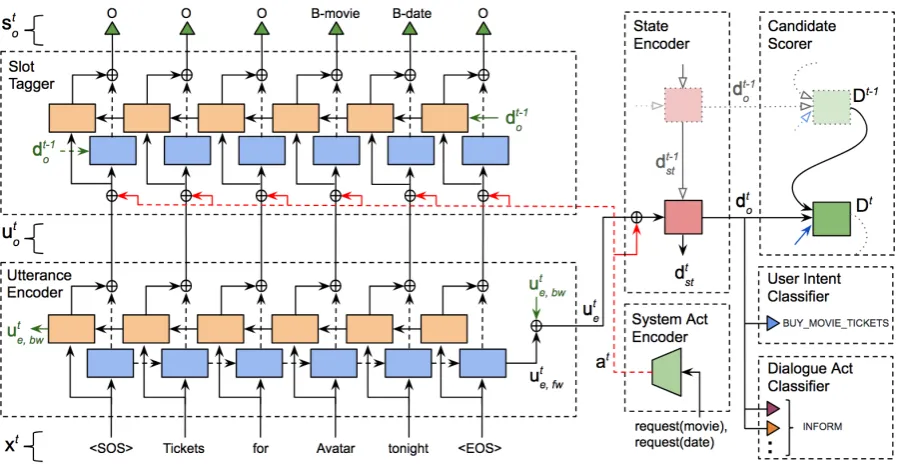
Let a dialogue be a sequence of T turns, each turn containing a user utterance and the preced-ing system dialogue acts output by the dialogue manager. Figure3gives an overview of our model architecture, which includes a user utterance en-coder, a system act enen-coder, a state enen-coder, a slot tagger and a candidate scorer. At each turn
t∈ {1, ..., T}, the model takes a dialogue turn and the previous dialogue stateDt−1as input and
Figure 3: Architecture of our joint LU and DST model as described in Section 3. xt is the sequence of user utterance token embeddings,atis the system act encoding and blue arrows indicate additional features used by DST as detailed in Section3.8.
dialogue stateDt.
As a new turn arrives, the system act encoder (Section3.1) encodes all system dialogue acts in the turn to generate the system dialogue act vector
at. Similarly, the utterance encoder (Section3.2) encodes the user utterance into a vector ut
e, and
also generates contextual token embeddingsutofor each utterance token. The state encoder (Section
3.3) then usesat, ut
e and its previous turn hidden
state, dtst−1, to generate the dialogue context vec-tordto, which summarizes the entire observed dia-logue, and its updated hidden statedt
st.
The dialogue context vector dto is then used by the user intent classifier (Section3.4) and user di-alogue act classifier (Section3.5). The slot tagger (section3.6) uses the dialogue context from previ-ous turndto−1, the system act vectoratand contex-tual token embeddingsutoto generate refined con-textual token embeddingssto. These refined token embeddings are then used to predict the slot tag for each token in the user utterance.
The system dialogue acts and predicted slot tags are then used to update the set of candidate values for each slot (Section3.7). The candidate scorer (Section3.8) then uses the previous dialogue state
Dt−1, the dialogue context vector dto and other features extracted from the current turn (indicated by blue arrows in Figure3) to update the scores for all candidates in the candidate set and outputs the
updated dialogue stateDt. The following sections describe these components in detail.
3.1 System Act Encoder
Previous turn system dialogue acts play an impor-tant role in accurate semantic parsing of a user ut-terance. Each system dialogue act contains an act type and optional slot and value parameters. The dialogue acts are first encoded into binary vectors denoting the presence of an act type. All dialogue acts which don’t have any associated parameters (e.g.greetingandnegate) are encoded as a binary indicator vectoratutt. Dialogue acts with just a slot
sas parameter (e.g.request(date)) are encoded as
atslot(s), whereas acts having a candidate valuec
for a slotsas parameter (e.g.offer(time=7pm)) are encoded asat
cand(s, c). These binary vectors are
then combined using equations 1-4 to obtain the combined system act representation at, which is used by other units of dialogue encoder (as shown in Figure3). In these equations, esis a trainable slot embedding defined for each slots.
atsc(s) =atslot(s)⊕es⊕Σcatcand(s, c) (1)
a0tsc(s) =ReLU(Wsca ·atsc(s) +basc) (2)
atusc= 1
|St| X
s∈St
a0tsc(s)⊕atutt (3)
3.2 Utterance Encoder
The user utterance takes the tokens corresponding to the user utterance as input. Special tokensSOS and EOS are added at the beginning and end of the token list. Letxt = {xtm ∈ Rud,∀0 ≤m <
Mt}denote the embedded representations of these tokens, where Mt is the number of tokens in the user utterance for turnt(includingSOSandEOS). We use a single layer bi-directional GRU recur-rent neural network (Cho et al., 2014) with state sizeduand initial state set to 0, to encode the user utterance. The first output of the user utterance en-coder isute∈ R2du, which is a compact
represen-tation of the entire user utterance, defined as the concatenation of the final states of the two RNNs. The second output is uto = {uto,m ∈ R2du,0 ≤
m < Mt, which is the embedded representation of each token conditioned on the entire utterance, de-fined as the concatenation of outputs at each step of the forward and backward RNNs.
3.3 State Encoder
The state encoder completes our hierarchical dia-logue encoder. At turn t, the state encoder gen-eratesdto, which is an embedded representation of the dialogue context until and including turnt. We implement the state encoder using a unidirectional GRU RNN with each timestep corresponding to a dialogue turn. As shown in Figure3, the dialogue encoder takesat⊕uteand its previous hidden state
dtst−1as input and outputs the updated hidden state
dtstand the encoded representation of the dialogue contextdto(which are the same in case of GRU).
3.4 User Intent Classification
The user intent is used to identify the backend with which the dialogue system should interact. We predict the intents at each turn to allow user to switch intents during the dialogue. However, we assume that a given user utterance can contain at-most one intent and model intent prediction as a multi-class classification problem. At each turn, the distribution over all intents is calculated as
pti =sof tmax(Wi·dto+bi) (5)
where dim(pti) = |I|, Wi ∈ Rd×|I| and bi ∈
R|I|, I denoting the user intent vocabulary and
d = dim(dto). During inference, we predict
argmax(pti)as the intent label for the utterance.
3.5 User Dialogue Act Classification
Dialogue acts are structured semantic representa-tions of user utterances. User dialogue acts are
used by the dialogue manager in deciding the next system action. We model user dialogue act clas-sification as a multilabel clasclas-sification problem, to allow for the presence of more than one dialogue act in a turn (Tur and De Mori, 2011). At each turn, the probability for actais predicted as
pta=sigmoid(Wa·dto+ba) (6)
where dim(pta) = |Au|, Wa ∈ Rd×|Au|, ba ∈
R|Au|,Auis the user dialogue act vocabulary and d= dim(dto). For each actα,pta(α)is interpreted as the probability of presence ofαin turnt. Dur-ing inference, all dialogue acts with a probability greater thantu are predicted, where0< tu <1.0
is a hyperparameter tuned using the dev set.
3.6 Slot Tagging
Slot tagging is the task of identifying the presence of values of different slots in the user utterance. We use the IOB tagging scheme (Tjong Kim Sang and Buchholz 2000, see Figure2) to assign a label to each token. These labels are then used to extract the values for different slots from the utterance.
The slot tagging network consists of a single-layer bidirectional LSTM RNN (Hochreiter and Schmidhuber, 1997), which takes the contextual token embeddings uto generated by the utterance encoder as input. It outputs refined token embed-dings sto = {so,mt ,∀0 ≤ m < Mt} for each to-ken,Mtbeing the number of tokens in user utter-ance at turnt.
Models making use of dialogue context for LU have been shown to achieve superior performance (Chen et al.,2016). In our setup, the dialogue con-text vector dto−1 encodes all the preceding turns and the system act vector at encodes the system dialogue acts preceding the user utterance. As shown in Figure3,dto−1 is used to initialize1the hidden state (cell states are initialized to zero) for the forward and backward LSTM recurrent units in the slot tagger, while at is fed as input to the tagger by concatenating with each element ofuto
as shown below. We use an LSTM instead of a GRU for this layer since that resulted in better per-formance on the validation set.
stin ={uto,m⊕at,∀0≤m < Mt} (7)
ste,bw, sto,bw=LST Mbw(stin) (8)
ste,f w, sto,f w=LST Mf w(stin) (9)
sto =sto,bw⊕sto,f w (10)
LetS be the set of all slots in the dataset. We define a set of2|S|+ 1labels (one B- and I- label for each slot and a single O label) for IOB tagging. The refined token embeddingsto,mis used to pre-dict the distribution across all IOB labels for token at indexmas
pts,m=sof tmax(Ws·sto,m+bs) (11)
wheredim(pts,m) = 2|S|+ 1,Ws ∈ Rds×2|S|+1
andbs ∈ R2|S|+1, ds = dim(sto,m) is the output
size of slot tagger LSTM. During inference, we predictargmax(pts,m)as the slot label for themth
token in the user utterance in turnt.
3.7 Updating Candidate Set
A candidate setCstis defined as a set of values of a slotswhich have been mentioned by either the user or the system till turn t. Rastogi et al. 2017
proposed the use of candidate sets in DST for ef-ficiently handling slots with a large set of values. In their setup, the candidate set is updated at ev-ery turn to include new values and discard old val-ues when it reaches its maximum capacity. The dialogue state is represented as a set of distribu-tions over value set Vst = Cst ∪ {δ, φ} for each slot s ∈ St, where δ and φ are special values dontcare(user is ok with any value for the slot) andnull(slot not specified yet) respectively, and
Stis the set of all slots that have been mentioned either by the user or the system till turnt.
Our model uses the same definition and update rules for candidate sets. At each turn we use the predictions of the slot tagger (Section3.6) and sys-tem acts which having slot and value parameters to update the corresponding candidate sets. All candidate sets are padded with dummy values for batching computations for all slots together. We keep track of valid candidates by defining indi-cator featuresmtv(s, c)for each candidate, which take the value1.0if candidate is valid or0.0if not.
3.8 Candidate Scorer
The candidate scorer predicts the dialogue state by updating the distribution over the value setVstfor each slot s ∈ St. For this, we define three in-termediate features rtutt, rslott (s) and rcandt (s, c).
rt
utt is shared across all value sets and is defined
by equation 12. rslott (s) is used to update scores for Vst and is defined by equation 13. Further-more, rt
cand(s, c) is defined for each candidate c ∈ Cst ⊂ Vst using equation14 and contains all features that are associated to candidatecof slots.
ruttt =dto⊕atutt (12)
rslott (s) =atslot(s)⊕[pδt−1(s), ptφ−1(s)] (13)
rcandt (s, c) =atcand(s, c) ⊕ [ptc−1(s)]⊕
[mtv(s, c), mtu(c)] (14)
In the above equations, dt
o is the dialogue
con-text at turntoutput by the state encoder (Section
3.3), atutt,atslot(s) andatcand(s, c) are system act encodings generated by the system act encoder (Section3.1), ptδ−1(s) andptφ−1(s) are the scores associated withdontcareandnullvalues for slotsrespectively. ptc−1(s)is the score associated with candidatecof slotsin the previous turn and is taken to be0ifc 6∈ Cst. mtv(s, c) are variables indicating whether a candidate is valid or padded (Section3.8). We define another indicator feature
mtu(c) which takes the value1.0 if the candidate is a substring of the user utterance in turn t or
0.0otherwise. This informs the candidate scorer which candidates have been mentioned most re-cently by the user.
r0tslot(s) =rtutt⊕rtslot(s) (15)
lst(δ) =F F1cs(r0tslot(s)) (16)
lts(c) =F F2cs(r0tslot(s)⊕rtcand(s, c)) (17)
pts=sof tmax(lts) (18)
Features used in Equations12-14are then used to obtain the distribution overVt
s using Equations 15-17. In the above equations, lts(δ) denotes the logit fordontcarevalue for slots,lst(c)denotes the logit for a candidate c ∈ Ct
s and lts(φ) is a
trainable parameter. These logits are obtained by processing the corresponding features using feed-forward neural networks F Fcs1 and F Fcs2, each having one hidden layer. The output dimension of these networks is 1 and the dimension of the hidden layer is taken to be half of the input dimen-sion. The logits are then normalized using softmax to get the distributionptsoverVst.
4 Scheduled Sampling
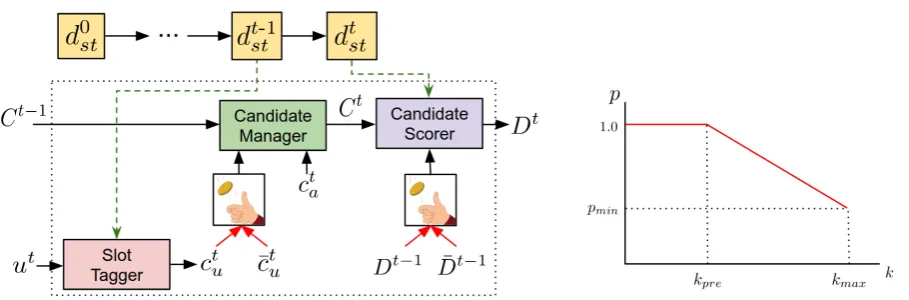
Figure 4: Illustration of scheduled sampling for training the candidate scorer. The left figure shows the two locations in our setup where we can perform scheduled sampling, while the plot on the right shows the variation of sampling probabilitiespcandpD with training step. See Section4for details.
mismatch. Scheduled sampling has been shown to achieve improved slot tagging performance on sin-gle turn datasets (Liu and Lane, 2016). Figure4
shows our setup for scheduled sampling for DST, which is carried out at two different locations - slot tags and dialogue state.
The performance of slot tagger is critical to DST because any slot value missed by the slot tag-ger will not be added to the candidate set (unless it is tagged in another utterance or present in any system act). To account for this, during training, we sample between the ground truth slot tags (¯ctu) and the predicted slot tags (ctu), training initially with c¯tu (i.e. with keep probabilitypc = 1) but
gradually reducing pc i.e. increasingly replacing
¯
ctuwithctu. Using predicted slot tags during train-ing allows DST to train in presence of noisy can-didate sets.
During inference, the candidate scorer only has access to its own predicted scores in the previous turn (Equations 13and14). To better mimic this setup during training, we start with using ground truth previous scores taken fromD¯t−1 (i.e. with
keep probabilitypD = 1) and gradually switch to
Dt−1, the predicted previous scores, reducingpD.
BothpcandpDvary as a function of the training stepk, as shown in the right part of Figure4; only ground truth slot tags and dialogue state are used for training i.e. pc andpD stay at 1.0 for the first
kpre training steps, and then decrease linearly as the ground truth slot tags and state are increasingly replaced by model predictions during training.
5 Experiments
The major contributions of our work are two-fold. First, we hypothesize that joint modeling of LU and DST results in a computationally efficient model with fewer parameters without compromis-ing performance. Second, we propose the use of scheduled sampling to improve the robustness of DST during inference. To this end, we conduct experiments across the following two setups.
Separate vs Joint LU-DST- Figure3shows the joint LU-DST setup where parameters in the utter-ance encoder and state encoder are shared across LU tasks (intent classification, dialogue act clas-sification and slot tagging) and DST (candidate scoring). As baselines, we also conduct experi-ments where LU and DST tasks use separate pa-rameters for utterance and state encoders.
Scheduled Sampling - We conduct scheduled sampling (as described in Section4) experiments in four different setups.
1. None- Ground truth slot tags (¯ct
u) and previous
dialogue state (D¯t−1) are used for training. 2. Tags - Model samples between ground truth
(c¯t
u) and predicted (ctu) slot tags, sticking to
ground truth previous state.
3. State - Model samples between ground truth (D¯t−1) and predicted (Dt−1) previous state, sticking to ground truth slot tags.
4. Both- Model samples betweenD¯t−1andDt−1
as well as betweenc¯tuandctu.
In the last three setups, we start sampling from predictions only after kpre = 0.3kmax training
5.1 Evaluation Metrics
We report user intent classification accuracy, F1 score for user dialogue act classification, frame ac-curacy for slot tagging and joint goal acac-curacy and slot F1 score for DST. During DST evaluation, we always use the predicted slot values and the dia-logue state in the previous turn. Slot frame accu-racy is defined as the fraction of turns for which all slot labels are predicted correctly. Similarly, joint goal accuracy is the fraction of turns for which the predicted and ground truth dialogue state match for all slots. Since it is a stricter metric than DST slot F1, we use it as the primary metric to identify the best set of parameters on the validation set.
5.2 Datasets
We evaluate our approaches on two datasets: • Simulated Dialogues2- The dataset, described
in Shah et al. 2017, contains dialogues from restaurant (Sim-R) and movie (Sim-M) do-mains across three intents. A challenging as-pect of this dataset is the prevalence of OOV entities e.g. only 13% of the movie names in the dev/test sets also occur in the training data. • DSTC2- We use the top ASR hypothesis and
system dialogue acts as inputs. Dialogue act labels are obtained from top SLU hypothesis and state labels for requestable slots. DS labels are obtained from state labels for informable slots. We use a semantic dictionary ( Hender-son et al.,2014) to obtain ground truth slot tags. We also use the semantic dictionary to canoni-calize the candidate values since the slot val-ues in the dialogue state come from a fixed set in the DSTC2 dialogues and may be different from those present in the user utterance.
5.3 Training
We use sigmoid cross entropy loss for dialogue act classification and softmax cross entropy loss for all other tasks. During training, we minimize the sum of all task losses using ADAM optimizer (Kingma and Ba, 2014), for 100k training steps with batches of 10 dialogues each. We used grid-search to identify the best hyperparameter values (sampled within specified range) for learning rate (0.0001 - 0.005) and token embedding dimension (50 - 200). For scheduled sampling experiments, the minimum keep rate i.e.pminis varied between
2Dataset available at
http://github.com/google-research-datasets/simulated-dialogue/
0.1 - 0.9 with linear decay. The layer sizes for the utterance encoder and slot tagger are set equal to the token embedding dimension, and that of the state encoder to half this dimension.
Slot Value dropout - To make the model ro-bust to OOV tokens arising from new entities not present in the training set, we randomly replace slot value tokens in the user utterance with a spe-cial OOV token with a probability that linearly in-creases from 0.0 to 0.4 during training.
6 Results and Discussion
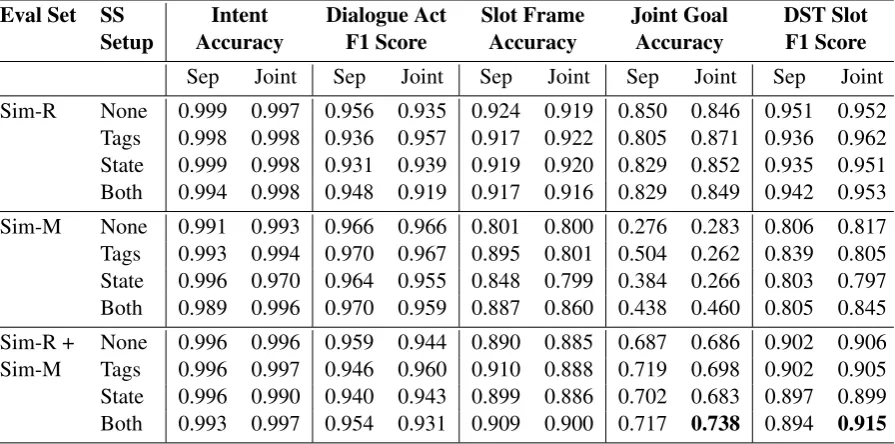
Table 1 shows our results across the two setups described in Section 5, for the Simulated Dia-logues datasets. For Sim-R + Sim-M, we ob-serve that the joint LU-DST model with sched-uled sampling (SS) on both slot tags and dialogue state performs the best, with a joint goal accuracy of 73.8% overall, while the best separate model gets a joint goal accuracy of 71.9%, using SS only for slot tags. Even for the no-SS baselines, the joint model performs comparably to the separate model (joint goal accuracies of 68.6% and 68.7% respectively), indicating that sharing results in a more efficient model with fewer parameters, with-out compromising overall performance. For each SS configuration, our results comparing separate and joint modeling are statistically significant, as determined by the McNemar’s test withp <0.05. On the Sim-R dataset, the best joint model ob-tains a joint goal accuracy of 87.1%, while the best separate model obtains 85.0%. However, we ob-serve a significant drop in joint goal accuracy for the Sim-M dataset for both the joint model and the separate model as compared to Sim-R. This can partly be attributed to the Sim-M dataset being much smaller than Sim-R (384 training dialogues as opposed to 1116) and that the high OOV rate of the movieslot in Sim-M makes slot tagging per-formance more crucial for Sim-M. While SS does gently bridge the gap between training and testing conditions, its gains are obscured in this scenario possibly since it is very hard for DST to recover from a slot value being completely missed by LU, even when aided by SS.
drasti-Table 1: Experiments and results on test set with variants of scheduled sampling on separate and joint LU-DST models, when trained on Sim-M + Sim-R.
Eval Set SS Intent Dialogue Act Slot Frame Joint Goal DST Slot
Setup Accuracy F1 Score Accuracy Accuracy F1 Score
Sep Joint Sep Joint Sep Joint Sep Joint Sep Joint
Sim-R None 0.999 0.997 0.956 0.935 0.924 0.919 0.850 0.846 0.951 0.952 Tags 0.998 0.998 0.936 0.957 0.917 0.922 0.805 0.871 0.936 0.962 State 0.999 0.998 0.931 0.939 0.919 0.920 0.829 0.852 0.935 0.951 Both 0.994 0.998 0.948 0.919 0.917 0.916 0.829 0.849 0.942 0.953
Sim-M None 0.991 0.993 0.966 0.966 0.801 0.800 0.276 0.283 0.806 0.817 Tags 0.993 0.994 0.970 0.967 0.895 0.801 0.504 0.262 0.839 0.805 State 0.996 0.970 0.964 0.955 0.848 0.799 0.384 0.266 0.803 0.797 Both 0.989 0.996 0.970 0.959 0.887 0.860 0.438 0.460 0.805 0.845
Sim-R + None 0.996 0.996 0.959 0.944 0.890 0.885 0.687 0.686 0.902 0.906 Sim-M Tags 0.996 0.997 0.946 0.960 0.910 0.888 0.719 0.698 0.902 0.905 State 0.996 0.990 0.940 0.943 0.899 0.886 0.702 0.683 0.897 0.899 Both 0.993 0.997 0.954 0.931 0.909 0.900 0.717 0.738 0.894 0.915
[image:8.595.70.518.112.334.2]cally reducing the joint goal accuracy. This gap is even more pronounced for Sim-M because of the poor performace of slot tagger on movieslot, which is often mentioned by the user in the begin-ning of the dialogue. The relatively high values of overall DST slot F1 for Sim-M for all experiments also corroborates this observation.
Table 2: Reported joint goal accuracy of model variants on the DSTC2 test set.
Model Separate Joint
No SS 0.661 0.650
Tags only SS 0.655 0.670
State only SS 0.661 0.660 Tags + State SS 0.656 0.658
Liu and Lane 2017 - 0.73
Mrkˇsi´c et al. 2017 - 0.734
Table2shows our results on the DSTC2 dataset, which contains dialogues in the restaurant domain. The joint model gets a joint goal accuracy of 65.0% on the test set, which goes up to 67.0% with SS on slot tags. Approaches like NBT (Mrkˇsi´c et al.,2017) or Hierarchical RNN (Liu and Lane,
2017) are better suited for such datasets, where the set of all slot values is already known, thus elimi-nating the need for slot tagging. On the other hand, our setup uses slot tagging for candidate genera-tion, which allows it to scale to OOV entities and scalably handle slots with a large or unbounded set
of possible values, at the cost of performance. Analyzing results for scheduled sampling, we observe that for almost all combinations of met-rics, datasets and joint/separate model configura-tions, the best result is obtained using a model trained with some SS variant. For instance, for Sim-M, SS over slot tags and state increases joint goal accuracy significantly from 28.3% to 46.0% for joint model. SS on slot tags helps the most with Sim-R and DSTC2: our two datasets with the most data, and low OOV rates, while SS on both slot tags and dialogue state helps more on the smaller Sim-M. In addition, we also found that slot value dropout (Section5.3), improves LU as well as DST results consistently. We omit the results without this technique for brevity.
7 Conclusions
[image:8.595.85.278.488.590.2]References
Ankur Bapna, Gokhan Tur, Dilek Hakkani-Tur, and Larry Heck. 2017. Sequential dialogue context modeling for spoken language understanding. In
Proceedings of the 18th Annual SIGdial Meeting on Discourse and Dialogue, pages 103–114.
Samy Bengio, Oriol Vinyals, Navdeep Jaitly, and Noam Shazeer. 2015. Scheduled sampling for se-quence prediction with recurrent neural networks. InAdvances in Neural Information Processing Sys-tems, pages 1171–1179.
Yun-Nung Chen, Dilek Hakkani-T¨ur, Jianfeng Gao, and Li Deng. 2016. End-to-end memory networks with knowledge carryover for multi-turn spoken lan-guage understanding.
Kyunghyun Cho, Bart Van Merri¨enboer, Caglar Gul-cehre, Dzmitry Bahdanau, Fethi Bougares, Holger Schwenk, and Yoshua Bengio. 2014. Learning phrase representations using rnn encoder-decoder for statistical machine translation. arXiv preprint arXiv:1406.1078.
Dilek Hakkani-T¨ur, Asli Celikyilmaz, Yun-Nung Chen, Jianfeng Gao, Li Deng, and Ye-Yi Wang. 2016. Multi-domain joint semantic frame parsing using bi-directional rnn-lstm.
M. Henderson, B. Thomson, and S. Young. 2014. Word-based dialog state tracking with recurrent neu-ral networks. In Proceedings of the 15th Annual Meeting of the Special Interest Group on Discourse and Dialogue (SIGDIAL), pages 292–299.
Sepp Hochreiter and J¨urgen Schmidhuber. 1997. Long short-term memory. Neural computation, 9(8):1735–1780.
Diederik P Kingma and Jimmy Ba. 2014. Adam: A method for stochastic optimization. arXiv preprint arXiv:1412.6980.
Bing Liu and Ian Lane. 2016. Joint online spoken lan-guage understanding and lanlan-guage modeling with recurrent neural networks. In17th Annual Meeting of the Special Interest Group on Discourse and Dia-logue, page 22.
Bing Liu and Ian Lane. 2017. An end-to-end trainable neural network model with belief tracking for task-oriented dialog. InProceedings of Interspeech.
Nikola Mrkˇsi´c, Diarmuid ´O S´eaghdha, Tsung-Hsien Wen, Blaise Thomson, and Steve Young. 2017. Neural belief tracker: Data-driven dialogue state tracking. InProceedings of the 55th Annual Meet-ing of the Association for Computational LMeet-inguistics (Volume 1: Long Papers), volume 1, pages 1777– 1788.
Julien Perez and Fei Liu. 2017. Dialog state track-ing, a machine reading approach using memory net-work. InProceedings of the 15th Conference of the
European Chapter of the Association for Compu-tational Linguistics: Volume 1, Long Papers, vol-ume 1, pages 305–314.
A. Rastogi, D. Hakkani-T¨ur, and L. Heck. 2017. Scal-able multi-domain dialogue state tracking. InIEEE Workshop on Automatic Speech Recognition and Understanding (ASRU).
P. Shah, D. Hakkani-T¨ur, G. Tur, A. Rastogi, A. Bapna, N. Nayak, and L. Heck. 2017. Building a conversa-tional agent overnight with dialogue self-play. arXiv preprint arXiv:1801.04871.
Shang-Yu Su, Pei-Chieh Yuan, and Yun-Nung Chen. 2018. How time matters: Learning time-decay at-tention for contextual spoken language understand-ing in dialogues. InProceedings of the 2018 Con-ference of the North American Chapter of the Asso-ciation for Computational Linguistics: Human Lan-guage Technologies.
Sainbayar Sukhbaatar, Jason Weston, Rob Fergus, et al. 2015. End-to-end memory networks. InAdvances in neural information processing systems, pages 2440–2448.
Blaise Thomson and Steve Young. 2010. Bayesian update of dialogue state: A pomdp framework for spoken dialogue systems. Computer Speech & Lan-guage, 24(4):562–588.
Erik F Tjong Kim Sang and Sabine Buchholz. 2000. Introduction to the conll-2000 shared task: Chunk-ing. InProceedings of the 2nd workshop on Learn-ing language in logic and the 4th conference on Computational natural language learning-Volume 7, pages 127–132. Association for Computational Lin-guistics.
Gokhan Tur and Renato De Mori. 2011. Spoken lan-guage understanding: Systems for extracting seman-tic information from speech. John Wiley & Sons.
Zhuoran Wang and Oliver Lemon. 2013. A simple and generic belief tracking mechanism for the dia-log state tracking challenge: On the believability of observed information. In Proceedings of the SIG-DIAL 2013 Conference, pages 423–432.
Jason Williams. 2013. Multi-domain learning and gen-eralization in dialog state tracking. InProceedings of the SIGDIAL 2013 Conference, pages 433–441.
Jason D Williams. 2014. Web-style ranking and slu combination for dialog state tracking. In Proceed-ings of the 15th Annual Meeting of the Special Inter-est Group on Discourse and Dialogue (SIGDIAL), pages 282–291.