Evaluating Semantic Parsing against a Simple Web-based Question
Answering Model
Alon Talmor
Tel-Aviv University [email protected]
Mor Geva
Tel-Aviv University [email protected]
Jonathan Berant
Tel-Aviv University [email protected]
Abstract
Semantic parsing shines at analyzing plex natural language that involves com-position and computation over multiple pieces of evidence. However, datasets for semantic parsing contain many factoid questions that can be answered from a sin-gle web document. In this paper, we pro-pose to evaluate semantic parsing-based question answering models by comparing them to a question answering baseline that queries the web and extracts the answer only from web snippets, without access to the target knowledge-base. We investigate
this approach on COMPLEXQUESTIONS,
a dataset designed to focus on composi-tional language, and find that our model obtains reasonable performance (∼35 F1
compared to 41 F1of state-of-the-art). We
find in our analysis that our model per-forms well on complex questions involv-ing conjunctions, but struggles on ques-tions that involve relation composition and superlatives.
1 Introduction
Question answering (QA) has witnessed a surge of interest in recent years (Hill et al.,2015;Yang et al.,2015;Pasupat and Liang,2015;Chen et al.,
2016;Joshi et al.,2017), as it is one of the promi-nent tests for natural language understanding. QA can be coarsely divided into semantic parsing-based QA, where a question is translated into a logical form that is executed against a
knowledge-base (Zelle and Mooney, 1996; Zettlemoyer and
Collins, 2005; Liang et al., 2011; Kwiatkowski et al., 2013; Reddy et al., 2014; Berant and Liang,2015), and unstructured QA, where a ques-tion is answered directly from some relevant text
(Voorhees and Tice,2000;Hermann et al.,2015;
Hewlett et al.,2016;Kadlec et al.,2016;Seo et al.,
2016).
In semantic parsing, background knowledge has already been compiled into a knowledge-base (KB), and thus the challenge is in interpreting the question, which may contain compositional con-structions (“What is the second-highest mountain
in Europe?”) or computations (“What is the
dif-ference in population between France and
Ger-many?”). In unstructured QA, the model needs
to also interpret the language of a document, and thus most datasets focus on matching the question against the document and extracting the answer from some local context, such as a sentence or a paragraph (Onishi et al., 2016; Rajpurkar et al.,
2016;Yang et al.,2015).
Since semantic parsing models excel at han-dling complex linguistic constructions and reason-ing over multiple facts, a natural way to exam-ine whether a benchmark indeed requires model-ing these properties, is to train an unstructured QA model, and check if it under-performs compared to semantic parsing models. If questions can be answered by examining local contexts only, then the use of a knowledge-base is perhaps unneces-sary. However, to the best of our knowledge, only models that utilize the KB have been evaluated on common semantic parsing benchmarks.
The goal of this paper is to bridge this evalua-tion gap. We develop a simple log-linear model, in the spirit of traditional web-based QA systems (Kwok et al.,2001;Brill et al.,2002), that answers questions by querying the web and extracting the answer from returned web snippets. Thus, our evaluation scheme is suitable for semantic pars-ing benchmarks in which the knowledge required for answering questions is covered by the web (in contrast with virtual assitants for which the knowl-edge is specific to an application).
We test this model on COMPLEXQUESTIONS
(Bao et al., 2016), a dataset designed to re-quire more compositionality compared to earlier datasets, such as WEBQUESTIONS (Berant et al.,
2013) and SIMPLEQUESTIONS (Bordes et al.,
2015). We find that a simple QA model, despite
having no access to the target KB, performs rea-sonably well on this dataset (∼35 F1 compared to
the state-of-the-art of 41 F1). Moreover, for the
subset of questions for which the right answer can be found in one of the web snippets, we outper-form the semantic parser (51.9 F1vs. 48.5 F1). We
analyze results for different types of composition-ality and find that superlatives and relation com-position constructions are challenging for a web-based QA system, while conjunctions and events with multiple arguments are easier.
An important insight is that semantic parsers must overcome the mismatch between natural guage and formal language. Consequently, lan-guage that can be easily matched against the web may become challenging to express in logical
form. For example, the word“wife”is an atomic
binary relation in natural language, but expressed
with a complex binary λx.λy.Spouse(x, y) ∧
Gender(x,Female) in knowledge-bases. Thus,
some of the complexity of understanding natural language is removed when working with a natural language representation.
To conclude, we propose to evaluate the extent to which semantic parsing-based QA benchmarks require compositionality by comparing semantic parsing models to a baseline that extracts the an-swer from short web snippets. We obtain
rea-sonable performance on COMPLEXQUESTIONS,
and analyze the types of compositionality that are challenging for a web-based QA model. To en-sure reproducibility, we release our dataset, which
attaches to each example from COMPLEXQUES
-TIONSthe top-100 retrieved web snippets.1
2 Problem Setting and Dataset
Given a training set of triples{q(i), R(i), a(i)}N i=1,
whereq(i) is a question,R(i) is a web result set,
anda(i)is the answer, our goal is to learn a model
that produces an answer a for a new
question-result set pair(q, R). A web result setR consists ofK(= 100)web snippets, where each snippetsi
1Data can be downloaded from https:
//worksheets.codalab.org/worksheets/ 0x91d77db37e0a4bbbaeb37b8972f4784f/
R:
s1: Billy Batts (Character) - Biography - IMDb Billy Batts (Character) on IMDb: Movies, TV, Celebs, and more... ... Devino is portrayed by Frank Vincent in the film Goodfellas. Page last up-dated by !!!de leted!!!
s2: Frank Vincent - Wikipedia He appeared in Scorsese’s 1990 film Goodfellas, where he played Billy Batts, a made man in the Gambino crime fam-ily. He also played a role in Scorsese’s...
.. .
s100:Voice-over in GoodfellasIn the summer when they played cards all night, nobody ever called the cops. .... But we had a problem with Billy Batts. This was a touchy thing. Tommy had killed a made man. Billy was a part of the Bambino crew and un-touchable. Before you...
q:“who played the part of billy batts in goodfellas?”
a:“Frank Vincent”
Figure 1: A training example containing a result set R, a questionqand an answera. The result setRcontains 100 web snippetssi, each including a title (boldface) and text. The answer is underlined.
has a title and a text fragment. An example for a training example is provided in Figure1.
Semantic parsing-based QA datasets contain question-answer pairs alongside a background KB. To convert such datasets to our setup, we run the questionqagainst Google’s search engine and
scrape the top-K web snippets. We use only the
web snippets and ignore any boxes or other infor-mation returned (see Figure1and the full dataset in the supplementary material).
Compositionality We argue that if a dataset truly requires a compositional model, then it should be difficult to tackle with methods that only match the question against short web snip-pets. This is since it is unlikely to integrate all necessary pieces of evidence from the snippets.
We convert COMPLEXQUESTIONS into the
aforementioned format, and manually analyze the types of compositionality that occur on 100
ran-dom training examples. Table1 provides an
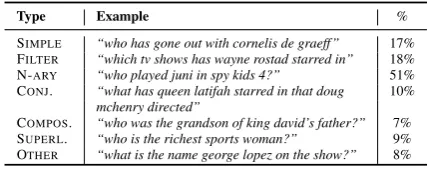
ex-ample for each of the question types we found: SIMPLE: an application of a single binary
re-lation on a single entity.
FILTER: a question where the semantic type
of the answer is mentioned (“tv shows”in Ta-ble1).
N-ARY: A question about a single event that
involves more than one entity (“juni” and
“spy kids 4”in Table1).
CONJUNCTION: A question whose answer is
Type Example % SIMPLE “who has gone out with cornelis de graeff” 17% FILTER “which tv shows has wayne rostad starred in” 18% N-ARY “who played juni in spy kids 4?” 51% CONJ. “what has queen latifah starred in that doug 10%
mchenry directed”
[image:3.595.73.288.62.147.2]COMPOS. “who was the grandson of king david’s father?” 7% SUPERL. “who is the richest sports woman?” 9% OTHER “what is the name george lopez on the show?” 8%
Table 1: An example for each compositionality type and the proportion of examples in 100 random examples. A question can fall into multiple types, and thus the sum exceeds 100%.
COMPOSITION A question that involves
composing more than one binary relation
over an entity (“grandson”and “father” in
Table1).
SUPERLATIVEA question that requires
sort-ing or comparsort-ing entities based on a numeric property.
OTHERAny other question.
Table 1 illustrates that COMPLEXQUESTIONS
is dominated byN-ARYquestions that involve an
event with multiple entities. In Section4we eval-uate the performance of a simple QA model for
each compositionality type, and find that N-ARY
questions are handled well by our web-based QA system.
3 Model
Our model comprises two parts. First, we extract a set of answer candidates,A, from the web result set. Then, we train a log-linear model that outputs a distribution over the candidates inA, and is used at test time to find the most probable answers. Candidate Extraction We extract all 1-grams, 2-grams, 3-grams and 4-grams (lowercased) that appear inR, yielding roughly 5,000 candidates per question. We then discard any candidate that fully appears in the question itself, and define Ato be the top-K candidates based on their tf-idf score, where term frequency is computed on all the snip-pets inR, and inverse document frequency is com-puted on a large external corpus.
Candidate Ranking We define a log-linear model over the candidates inA:
pθ(a|q, R) = exp(φ(q, R, a)
>θ) P
a0∈Aexp(φ(q, R, a0)>θ),
where θ ∈ Rd are learned parameters, and
φ(·) ∈ Rd is a feature function. We train
our model by maximizing the regularized condi-tional log-likelihood objectivePNi=1logpθ(a(i) |
q(i), R(i)) +λ· ||θ||2
2. At test time, we return the
most probable answers based onpθ(a|q, R)
(de-tails in Section4). While semantic parsers
gener-ally return a set, in COMPLEXQUESTIONS87% of
the answers are a singleton set.
Features A candidate spanaoften has multiple mentions in the result setR. Therefore, our feature functionφ(·)computes the average of the features extracted from each mention. The main informa-tion sources used are the match between the candi-date answer itself and the question (top of Table2) and the match between the context of a candidate answer in a specific mention and the question
(bot-tom of Table 2), as well as the Google rank in
which the mention appeared.
Lexicalized features are useful for our task, but the number of training examples is too small to train a fully lexicalized model. Therefore, we de-fine lexicalized features over the 50 most common
non-stop words in COMPLEXQUESTIONS. Last,
our context features are defined in a 6-word win-dow around the candidate answer mention, where the feature value decays exponentially as the dis-tance from the candidate answer mention grows. Overall, we compute a total of 892 features over the dataset.
4 Experiments
COMPLEXQUESTIONS contains 1,300 training
examples and 800 test examples. We performed 5 random 70/30 splits of the training set for de-velopment. We computed POS tags and named entities with Stanford CoreNLP (Manning et al.,
2014). We did not employ any co-reference
reso-lution tool in this work. If after candidate extrac-tion, we do not find the gold answer in the
top-K(=140) candidates, we discard the example,
re-sulting in a training set of 856 examples.
We compare our model, WEBQA, to STAGG
(Yih et al., 2015) and COMPQ (Bao et al.,
2016), which are to the best of our knowledge
the highest performing semantic parsing models
on both COMPLEXQUESTIONS and WEBQUES
-TIONS. For these systems, we only report test F1
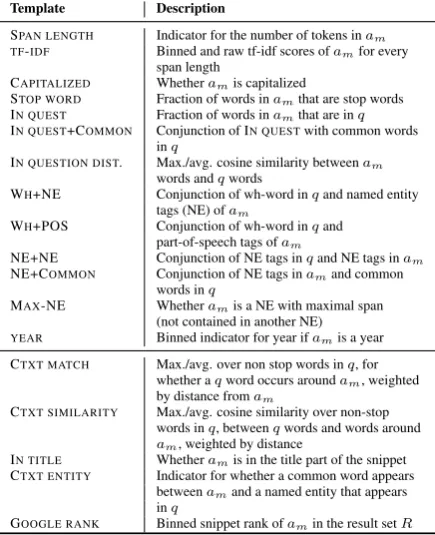
Template Description
SPAN LENGTH Indicator for the number of tokens inam
TF-IDF Binned and raw tf-idf scores ofamfor every span length
CAPITALIZED Whetheramis capitalized
STOP WORD Fraction of words inamthat are stop words IN QUEST Fraction of words inamthat are inq
IN QUEST+COMMON Conjunction of IN QUESTwith common words inq
IN QUESTION DIST. Max./avg. cosine similarity betweenam
words andqwords
WH+NE Conjunction of wh-word inqand named entity tags (NE) ofam
WH+POS Conjunction of wh-word inqand part-of-speech tags ofam
NE+NE Conjunction of NE tags inqand NE tags inam
NE+COMMON Conjunction of NE tags inamand common words inq
MAX-NE Whetheramis a NE with maximal span (not contained in another NE) YEAR Binned indicator for year ifamis a year CTXT MATCH Max./avg. over non stop words inq, for
whether aqword occurs aroundam, weighted by distance fromam
CTXT SIMILARITY Max./avg. cosine similarity over non-stop words inq, betweenqwords and words around
am, weighted by distance
IN TITLE Whetheramis in the title part of the snippet CTXT ENTITY Indicator for whether a common word appears
betweenamand a named entity that appears inq
[image:4.595.71.292.63.336.2]GOOGLE RANK Binned snippet rank ofamin the result setR
Table 2: Features templates used to extract features from each answer candidate mentionam. Cosine similarity is computed with pre-trained GloVe embeddings (Pennington et al.,2014). The definition ofcommon wordsandweighting by distanceis in the body of the paper.
between the set of answers returned by the system and the set of gold answers, and averages across questions. To allow WEBQA to return a set rather
than a single answer, we return the most
proba-ble answer a∗ as well as any answer asuch that
(φ(q, R, a∗)>θ−φ(q, R, a)>θ) < 0.5. We also
compute precision@1 and Mean Reciprocal Rank
(MRR) for WEBQA, since we have a ranking over
answers. To compute metrics we lowercase the gold and predicted spans and perform exact string match.
Table 3 presents the results of our evaluation.
WEBQA obtained 32.6 F1(33.5 p@1, 42.4 MRR)
compared to 40.9 F1 of COMPQ. Our candidate
extraction step finds the correct answer in the
top-K candidates in 65.9% of development examples
and 62.7% of test examples. Thus, our test F1
on examples for which candidate extraction
suc-ceeded (WEBQA-SUBSET) is 51.9 (53.4 p@1,
67.5 MRR).
We were able to indirectly compare WEB
QA-SUBSETto COMPQ:Bao et al.(2016) graciously
provided us with the predictions of COMPQ when
it was trained on COMPLEXQUESTIONS, WE
-BQUESTIONS, and SIMPLEQUESTIONS. In this
Dev Test
System F1 p@1 F1 p@1 MRR
STAGG - - 37.7 -
-COMPQ - - 40.9 -
[image:4.595.312.520.63.147.2]-WEBQA 35.3 36.4 32.6 33.5 42.4 WEBQA-EXTRAPOL - - 34.4 - -COMPQ-SUBSET - - 48.5 - -WEBQA-SUBSET 53.6 55.1 51.9 53.4 67.5
Table 3: Results on development (average over random splits) and test set. Middle: results on all examples. Bottom: results on the subset where candidate extraction succeeded.
setup, COMPQ obtained 42.2 F1 on the test set
(compared to 40.9 F1, when training on COM
-PLEXQUESTIONSonly, as we do). Restricting the
predictions to the subset for which candidate ex-traction succeeded, the F1of COMPQ-SUBSETis
48.5, which is 3.4 F1 points lower than WEB
QA-SUBSET, which was trained on less data.
Not using a KB, results in a considerable
disad-vantage for WEBQA. KB entities have normalized
descriptions, and the answers have been annotated according to those descriptions. We, conversely, find answers on the web and often predict a cor-rect answer, but get penalized due to small string differences. E.g., for“what is the longest river in
China?” we answer “yangtze river”, while the
gold answer is“yangtze”. To quantify this effect we manually annotated all 258 examples in the first random development set split, and determined whether string matching failed, and we actually returned the gold answer.2 This improved
perfor-mance from 53.6 F1 to 56.6 F1 (on examples that
passed candidate extraction). Further normaliz-ing gold and predicted entities, such that“Hillary
Clinton”and“Hillary Rodham Clinton”are
uni-fied, improved F1to 57.3 F1. Extrapolating this to
the test set would result in an F1of 34.4 (WEB QA-EXTRAPOLin Table3) and 34.9, respectively.
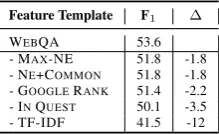
Last, to determine the contribution of each fea-ture template, we performed ablation tests and we present the five feature templates that resulted in the largest drop to performance on the develop-ment set in Table4. Note that TF-IDF is by far the most impactful feature, leading to a large drop of 12 points in performance. This shows the impor-tance of using the redundancy of the web for our QA system.
Analysis To understand the success of WEBQA
on different compositionality types, we
[image:4.595.73.291.67.335.2]Simple Filter N-ary Conj. Compos. Superl. Other 0%
10% 20% 30% 40% 50%
60% % Passed cand. extraction % Failed cand. extraction
0 10 20 30 40 50 60 70
F1 Value
[image:5.595.80.281.66.165.2]Average dev F1
Figure 2: Proportion of examples that passed or failed can-didate extraction for each compositionality type, as well as average F1 for each compositionality type. COMPOSITION and SUPERLATIVEquestions are difficult for WEBQA.
Feature Template F1 ∆ WEBQA 53.6 - MAX-NE 51.8 -1.8 - NE+COMMON 51.8 -1.8 - GOOGLERANK 51.4 -2.2 - INQUEST 50.1 -3.5 - TF-IDF 41.5 -12
Table 4: Feature ablation results. The five features that lead to largest drop in performance are displayed.
ally annotated the compositionality type of 100 random examples that passed candidate extrac-tion and 50 random examples that failed candi-date extraction. Figure 2 presents the results of this analysis, as well as the average F1 obtained
for each compositionality type on the 100 exam-ples that passed candidate extraction (note that a question can belong to multilpe
compositional-ity types). We observe that COMPOSITION and
SUPERLATIVEquestions are challenging for WE -BQA, while SIMPLE, FILTER, and N-ARY
quesi-tons are easier (recall that a large fraction of the
questions in COMPLEXQUESTIONS are N-ARY).
Interestingly, WEBQA performs well on CON
-JUNCTION questions (“what film victor garber
starred in that rob marshall directed”), possibly
because the correct answer can obtain signal from multiple snippets.
An advantage of finding answers to ques-tions from web documents compared to seman-tic parsing, is that we do not need to learn the “language of the KB”. For example, the
ques-tion “who is the governor of California 2010”
can be matched directly to web snippets, while
in Freebase (Bollacker et al., 2008) the word
“governor” is expressed by a complex predicate
λx.∃z.GoverPos(x, z) ∧ PosTitle(z,Governor). This could provide a partial explanation for the
reasonable performance of WEBQA.
5 Related Work
Our model WEBQA performs QA using web
snip-pets, similar to traditional QA systems like MUL -DER(Kwok et al.,2001) and AskMSR (Brill et al.,
2002). However, it it enjoys the advances in com-merical search engines of the last decade, and uses a simple log-linear model, which has become stan-dard in Natural Language Processing.
Similar to this work, Yao et al. (2014)
ana-lyzed a semantic parsing benchmark with a simple QA system. However, they employed a semantic parser that is limited to applying a single binary relation on a single entity, while we develop a QA system that does not use the target KB at all.
Last, in parallel to this workChen et al.(2017) evaluated an unstructured QA system against se-mantic parsing benchmarks. However, their fo-cus was on examining the contributions of multi-task learning and distant supervision to training rather than to compare to state-of-the-art seman-tic parsers.
6 Conclusion
We propose in this paper to evaluate semantic parsing-based QA systems by comparing them to a web-based QA baseline. We evaluate such a QA
system on COMPLEXQUESTIONSand find that it
obtains reasonable performance. We analyze
per-formance and find that COMPOSITION and SU
-PERLATIVE questions are challenging for a
web-based QA system, while CONJUNCTION and
N-ARY questions can often be handled by our QA
model.
Reproducibility Code, data, annotations, and experiments for this paper are available on the
CodaLab platform athttps://worksheets.
codalab.org/worksheets/
0x91d77db37e0a4bbbaeb37b8972f4784f/.
Acknowledgments
We thank Junwei Bao for providing us with the test predictions of his system. We thank the anony-mous reviewers for their constructive feedback. This work was partially supported by the Israel Science Foundation, grant 942/16.
References
[image:5.595.127.237.236.303.2]knowl-edge graph. In International Conference on Com-putational Linguistics (COLING).
J. Berant, A. Chou, R. Frostig, and P. Liang. 2013. Se-mantic parsing on Freebase from question-answer
pairs. InEmpirical Methods in Natural Language
Processing (EMNLP).
J. Berant and P. Liang. 2015. Imitation learning of
agenda-based semantic parsers. Transactions of the
Association for Computational Linguistics (TACL)
3:545–558.
K. Bollacker, C. Evans, P. Paritosh, T. Sturge, and J. Taylor. 2008. Freebase: a collaboratively created graph database for structuring human knowledge. In
International Conference on Management of Data (SIGMOD). pages 1247–1250.
A. Bordes, N. Usunier, S. Chopra, and J. Weston. 2015. Large-scale simple question answering with
mem-ory networks. arXiv preprint arXiv:1506.02075.
E. Brill, S. Dumais, and M. Banko. 2002. An analy-sis of the AskMSR question-answering system. In
Association for Computational Linguistics (ACL). pages 257–264.
D. Chen, J. Bolton, and C. D. Manning. 2016. A thor-ough examination of the CNN / Daily Mail reading
comprehension task. In Association for
Computa-tional Linguistics (ACL).
Danqi Chen, Adam Fisch, Jason Weston, and Antoine Bordes. 2017. Reading Wikipedia to answer
open-domain questions. In Association for
Computa-tional Linguistics (ACL).
K. M. Hermann, T. Koisk, E. Grefenstette, L. Espe-holt, W. Kay, M. Suleyman, and P. Blunsom. 2015.
Teaching machines to read and comprehend. In
Ad-vances in Neural Information Processing Systems (NIPS).
D. Hewlett, A. Lacoste, L. Jones, I. Polosukhin, A. Fandrianto, J. Han, M. Kelcey, and D. Berthelot. 2016. Wikireading: A novel large-scale language
understanding task over Wikipedia. In Association
for Computational Linguistics (ACL).
F. Hill, A. Bordes, S. Chopra, and J. Weston. 2015. The goldilocks principle: Reading children’s books with
explicit memory representations. In International
Conference on Learning Representations (ICLR).
Mandar Joshi, Eunsol Choi, Daniel S Weld, and Luke Zettlemoyer. 2017. Triviaqa: A large scale distantly supervised challenge dataset for reading
comprehen-sion.arXiv preprint arXiv:1705.03551.
R. Kadlec, M. Schmid, O. Bajgar, and J. Kleindienst. 2016. Text understanding with the attention sum
reader network. In Association for Computational
Linguistics (ACL).
T. Kwiatkowski, E. Choi, Y. Artzi, and L. Zettlemoyer. 2013. Scaling semantic parsers with the-fly
on-tology matching. InEmpirical Methods in Natural
Language Processing (EMNLP).
C. Kwok, O. Etzioni, and D. S. Weld. 2001. Scaling
question answering to the web. ACM Transactions
on Information Systems (TOIS)19:242–262.
P. Liang, M. I. Jordan, and D. Klein. 2011. Learn-ing dependency-based compositional semantics. In
Association for Computational Linguistics (ACL). pages 590–599.
C. D. Manning, M. Surdeanu, J. Bauer, J. Finkel, S. J. Bethard, and D. McClosky. 2014. The stanford coreNLP natural language processing toolkit. In
ACL system demonstrations.
T. Onishi, H. Wang, M. Bansal, K. Gimpel, and D. McAllester. 2016. Whodid what: A large-scale
person-centered cloze dataset. In Empirical
Meth-ods in Natural Language Processing (EMNLP).
P. Pasupat and P. Liang. 2015. Compositional semantic
parsing on semi-structured tables. InAssociation for
Computational Linguistics (ACL).
J. Pennington, R. Socher, and C. D. Manning. 2014. Glove: Global vectors for word representation. In
Empirical Methods in Natural Language Processing (EMNLP).
P. Rajpurkar, J. Zhang, K. Lopyrev, and P. Liang. 2016. Squad: 100,000+ questions for machine
comprehen-sion of text. InEmpirical Methods in Natural
Lan-guage Processing (EMNLP).
S. Reddy, M. Lapata, and M. Steedman. 2014. Large-scale semantic parsing without question-answer
pairs. Transactions of the Association for
Compu-tational Linguistics (TACL)2(10):377–392.
M. Seo, A. Kembhavi, A. Farhadi, and H. Hajishirzi. 2016. Bidirectional attention flow for machine
com-prehension. arXiv.
E. M. Voorhees and D. M. Tice. 2000. Building a
question answering test collection. In ACM
Spe-cial Interest Group on Information Retreival
(SI-GIR). pages 200–207.
Y. Yang, W. Yih, and C. Meek. 2015. WikiQA: A chal-lenge dataset for open-domain question answering. InEmpirical Methods in Natural Language Process-ing (EMNLP). pages 2013–2018.
X. Yao, J. Berant, and B. Van-Durme. 2014. Freebase QA: Information extraction or semantic parsing. In
Workshop on Semantic parsing.
W. Yih, M. Chang, X. He, and J. Gao. 2015. Semantic parsing via staged query graph generation: Question
answering with knowledge base. InAssociation for
M. Zelle and R. J. Mooney. 1996. Learning to parse database queries using inductive logic
program-ming. InAssociation for the Advancement of
Arti-ficial Intelligence (AAAI). pages 1050–1055. L. S. Zettlemoyer and M. Collins. 2005. Learning to
map sentences to logical form: Structured
classifica-tion with probabilistic categorial grammars. In