Semantic Frame Labeling with Target-based Neural Model
Yukun Feng1, Dong Yu1∗, Jian Xu2, ChunHua Liu1
1Beijing Language and Culture University, 2 University of Science and Technology of China [email protected],[email protected],
[email protected],[email protected]
Abstract
This paper explores the automatic learning of distributed representations of the tar-get’s context for semantic frame labeling with target-based neural model. We con-strain the whole sentence as the model’s input without feature extraction from the sentence. This is different from many pre-vious works in which local feature extrac-tion of the targets is widely used. This constraint makes the task harder, especial-ly with long sentences, but also makes our model easily applicable to a range of re-sources and other similar tasks. We evalu-ate our model on several resources and get the state-of-the-art result on subtask 2 of SemEval 2015 task 15. Finally, we extend the task to word-sense disambiguation task and we also achieve a strong result in com-parison to state-of-the-art work.
1 Introduction and Related Work
Semantic frame labeling is the task of selecting the correct frame for a given target based on it-s it-semantic it-scene. A target iit-s often called lexi-cal unit which evokes the corresponding seman-tic frame. The lexical unit can be a verb, ad-jective or noun. Generally, a semantic frame de-scribes how the lexical unit is used and specifies its characteristic interactions. There are many se-mantic frame resources, such as FrameNet ( Bak-er et al., 1998), VerbNet (Schuler, 2006), Prop-Bank (Palmer et al., 2005) and Corpus Pattern Analysis (CPA) frames (Hanks,2012). However, most existing frame resources are manually creat-ed, which is time-consuming and expensive. Au-tomatic semantic frame labeling can lead to the de-velopment of a broader range of resources.
∗The corresponding author
Early works for semantic frame labeling main-ly focus on FrameNet, PropBank and VerbNet sources. But most of them focus only one re-source and rely heavily on feature engineering (e.g., Honnibal and Hawker 2005; Abend et al. 2008). Recently, there are some works on learn-ing CPA frames based on a new semantic frame resource, the Pattern Dictionary of English Verbs (PDEV) (El Maarouf and Baisa,2013;El Maarouf et al., 2014). The above two works also rely on features and both are only tested on 25 verbs. Most works aim at constructing the context represen-tations of the target with explicit rules based on some basic features, e.g., Parts Of Speech (POS), Named Entities (NE) and dependency relations re-lated to the target. Currently, some deep learning models have been applied with dependency fea-tures. Hermann et al. (2014) used the direct de-pendents and dependency path to extract the con-text representation based on distributed word em-beddings on English FrameNet. Inspired by the work, Zhao et al.(2016) used a deep feed forward neural network on Chinese FrameNet with similar features. This is different from our goal where we want to explore an appropriate deep learning ar-chitecture without complex rules to construct the context representations. Feng et al. (2016) used a multilayer perceptrons (MLP) model on CPA frames without extra feature extraction, but the model is quite simple and has an input window which is not convenient.
In this paper, we present a target-based neural model which takes the whole target-specific sen-tence as input and gives the semantic frame label as output. Our goal is to make the model light without explicit rules to construct context repre-sentations and applicable to a range of resources. To cope with variable-length sentences under our constraint, a simple idea is to use recurrent neu-ral networks (RNN) to process the sentences. But
noise caused by irrelevant words in long sentences may hinder learning. In fact, the arguments re-lated to the target are usually distributed near the target because when we write or speak, we will focus mainly on arguments that are in the imme-diate context of a core word. We use two RNNs each of which processes one part of the sentence split by the target. The model takes the target as the center and we call it the target-based recurren-t nerecurren-tworks (TRNN). In facrecurren-t, TRNN irecurren-tself is norecurren-t novel enough, but according to our knowledge, no related research has focused on this topic. We will show that TRNN is quite suitable for learning the context of the target.
2 Model Description
1
w w w ... wT
...
... ...
LSTM LSTM LSTM ... LSTM
...
Embedding Layer
1
x xT
Context representations
xtarget xtarget
target target
This procedure can force a minister to answer for what his department intends to do
Correct CPA frame for current input:
[Phrasal verb. Human answers for Eventuality]
[image:2.595.76.293.289.456.2]Output Layer frame1 frame2 ... frameN
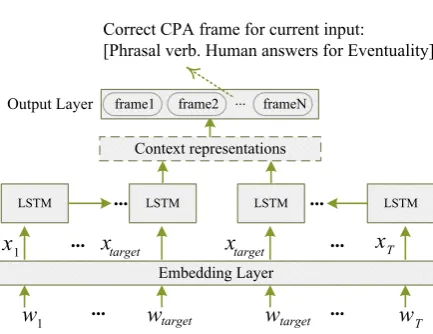
Figure 1: Architecture of TRNN with an example sentence whose target word is in bold.
In our model we select long short-term memo-ry (LSTM) networks, a type of RNN designed to avoid the vanishing and exploding gradients. The overall structure is illustrated Figure 1. wtis the
t-th word in the sentence the length of which is
T andtargetis the index of the target. xt is
ob-tained by mappingwt into a fixed vector through
well pre-trained word vectors. The model has t-wo LSTMs each of which processes one part of the sentence split by the target. The model can au-tomatically learn the distributed representation of target’s context fromwwith few manual design.
2.1 Context Representations
An introduction about LSTM can be found in the work of Hochreiter and Schmidhuber(1997). The parameters of LSTM areWx∗,Wh∗andb∗where
∗stands for one of several internal gates. Wx∗ is
the matrix between the input vectorxtand gates,
Wh∗is the matrix between the outputhtof LSTM
and gates andb∗ is the bias vector on gates. The
formulas of LSTM are:
it=σ(Wxixt+Whiht−1+bi)
ft=σ(Wxfxt+Whfht−1+bf)
ct=ftct−1+ittanh(Wxcxt+Whcht−1+bc)
ot=σ(Wxoxt+Whoht−1+bo)
ht=ottanh(ct)
whereσ is the sigmoid function andrepresents the element-wise multiplication. it, ft ct andot
are the output of input gates, forget gates, cell s-tates and output gates, respectively. In our model, two LSTMs share the same parameters. At last, the target’s context representations cr are added by the outputs of two LSTMs:
cr=htarget−1+htarget
The dimension ofcris decided by the number of hidden units in LSTM, which is a hyper parameter in our model, and is usually much lower than that of one word vector. Here we make some intuition-s behind the above formulaintuition-s. The gradientintuition-s from last layer flow equally on the (target−1)-th LST-M box and thetarget-th LSTM box and then the two flows go to both ends. As it is quite common in deep learning models, the gradients usually be-come ineffective as the depth of the flow increas-es increas-especially when the sentence is very long. The gradients on words far from the target get less im-pact than those near the target. As a whole, more data are usually required to learn the arguments far from the target than those near the target. If the real arguments are distributed near the target, this model will be suitable as its architecture is de-signed to take care of the local context of the tar-get.
2.2 Output Layer
We use Softmax layer as the output layer on the context representations. The output layer com-putes a probability distribution over the semantic frame labels. During the training, the cost we min-imize is the negative log likelihood of the model:
L=−XM
m=1
logptm
HereM is number of the training sentences,tmis
3 Experiments 3.1 Datasets
We simply divide all the datasets in two types:
per-targetandnon per-target. Per-target seman-tic frame resources define a different set of frame labels for each target and we train one model for each target; different targets may share some se-mantic frame labels in non per-target resources and we train a single model for such resources. We use the Semlink project (Loper et al.,2007) to cre-ate our datasets 1. Semlink aims to link together
different lexical resources via a set of mappings. We use its corpus which annotates FrameNet and Propbank frames for the WSJ section of the Pen-n TreebaPen-nk. APen-nother resource we use is PDEV2
which is quite new and has CPA frame annotat-ed examples on British National Corpus. All the original instances are sentence-tokenized and the punctuation was removed. The details of creating the datasets are as follows:
• FrameNet: Non per-target type. We get FrameNet annotated instances through Sem-link. If one FrameNet frame label contains more than 300 instances, we divide it propor-tionately: 70%, 20% and 10%. Then we re-spectively accumulate the three parts by each frame label to create the training, test and val-idation set.
• PropBank: Per-target type. The creation pro-cess is same as FrameNet except that we fi-nally get training, test and validation set for each target and the cutoff is set to 70 instead of 300.
• PDEV: Same as PropBank but with the cutoff set to 100 instead of 70.
Since the performance of our model is almost decided by the training data we empirically choose the cutoff above to keep the instances of each label enough. Summary statistics of the above datasets are in Table2.
3.2 Models and Training
We compare our model with the following base-lines.:
1 The current version of the Semlink project has some
problems to get the right position of targets in WSJ section of Penn Treebank. Instead, we use annotations of PropBank corpus, also annotated in WSJ section of Penn Treebank, to index targets.
2http://pdev.org.uk/
Sentences Frame Names
In Moscow theykeptasking us things like why do you make
15 different corkscrews Activityongoing It said it has taken measures to
continueshipments during
the work stoppage. Activityongoing But the Army Corps of Engineers
expects the river level to
continuefalling this month. Processcontinue The oil industry’s middling profits
couldpersistthrough the rest
of the year. Processcontinue
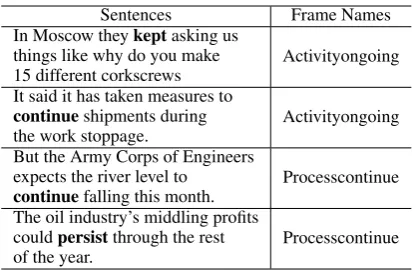
Table 1: Non per-target examples. Frames are from FrameNet and the target words are in bold.
FrameNet PropBank PDEV Per-target No 153 targets 407 targets Train 41206 31212 (204) 152218 (374) Test 11762 8568 (56) 42328 (104) Valid. 5871 4131 (27) 20350 (50) Frame 33 443 (2.89) 2197 (5.39)
[image:3.595.313.522.60.195.2]Words/sent. 23 23 12
Table 2: Summary statistics for the datasets. The average numbers per target are shown in the paren-theses for per-target resources.
• MF: The most frequent (MF) method selects the most frequent semantic frame label seen in training instances for each instance in the test dataset. MF is actually a strong baseline for per-target dataset because we observed that most targets have one main frame label.
• Target-Only: For FrameNet dataset, we use Target-Only method: if the target in the test instance has a unique frame label in the train-ing data we give this frame label to current test instance; if the target has multiple frame labels in the training data we select the most frequent one in these labels; if the target is not seen in the training data, we select the most frequent label from the whole training data. This baseline is especially for FrameNet be-cause we observed that each frame label has a set of targets but only a few targets have mul-tiple frame labels. It may be easy to predict the frame label for test instances only accord-ing to the target.
• LSTM: The standard LSTM model.
• MaxEnt: The Maximum Entropy model. We use the Stanford CoreNLP module 3 to
tract features for MaxEnt toolkit 4. All
de-pendents related to the target, their POS tags, dependency relations, lemmas, NE tags and the target itself will be extracted as features.
The number of the iterations for MaxEnt is decid-ed by the validation set. For simplicity, we set the learning rate to 1.0 for TRNN and LSTM. The number of hidden units is tested on validation da-ta with the values {35, 45, 55} for per-target re-source and {80, 100, 120} for non per-target re-source. We use the publicly available word2vec vectors, a dimensionality of 300, that were trained through the GloVe model (Pennington et al.,2014) on Wikipedia and Gigaword. For words not ap-peared in the vector model, their word vectors are all set to zero vectors. We train these models by stochastic gradient descent with minibatches. The minibatch is set to 10 for per-target resource and 50 for non per-target resource. We keep the word vectors static since no obvious improvement has been observed. Training will stop when the zero-one loss is zero over training data.
3.3 Results
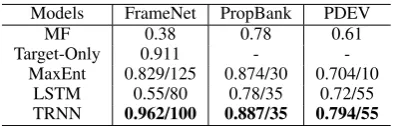
The results of the above datasets are in Table 3. Target-Only gets very high scores on FrameNet dataset. FrameNet dataset has 55 targets which has multiple frame labels in the training data and these targets have 1981 instances in the test da-ta. We get 0.769 F-score on these instances and 0.393 F-score on 64 unseen targets with 77 test instances. This can be the extreme case that the main feature for the correct frame is the target it-self. Despite this simple fact, standard LSTM per-forms very badly on FrameNet. The main reason is that sentences in FrameNet dataset are too long and standard LSTM can not learn well due to the large number of irrelevant words that appear in long sentences. To show this, we select the size of truncation window for original FrameNet sen-tences and we get the best size of 5 on validation data with each 2 words surrounding the target. Fi-nally, we get 0.958 F-score on FrameNet test data which is still lower than TRNN on full sentences. As for PropBank and PDEV dataset, we train one model for each target so the final F-score is the av-erage of all targets. However, the number of train-ing instances per target is limited. TRNN will usu-ally not perform well when it tries to learn some
4https://github.com/lzhang10/maxent
frames which consist of many different concept-s and econcept-specially when the frame haconcept-s a few train-ing instances. Considertrain-ing the sentence 4 of Table
4 as an example, it is difficult to TRNN to learn what is ’Activity’ in the correct frame because this concept is huge. TRNN may need lots of data to learn something related to this concept. Howev-er, this correct frame only has 6 instances in our training data. The second reason of TRNN’s fail-ure is lack of knowledge due to unseen words in test data. The sentence 1 of Table 4shows TRNN will make the right decision since we observe that it has seen the word ’cow’ in the training data and knows this word belongs to the concept ’Animate or Plant’ in the correct frame. But TRNN does not know the word ’Elegans’ in sentence 3 so it usually selects the most frequent frame seen in the training data. However, in many cases, the unseen words can be captured by well trained word em-beddings as the sentence 2 shows where ’ducks’, ’chickens’ and ’geese’ are all unseen words.
Models FrameNet PropBank PDEV
MF 0.38 0.78 0.61
Target-Only 0.911 -
-MaxEnt 0.829/125 0.874/30 0.704/10 LSTM 0.55/80 0.78/35 0.72/55
TRNN 0.962/100 0.887/35 0.794/55
Table 3: Results on several semantic frame resources. The format of cell value is score/hidden unit” for TRNN and LSTM and ”F-score/iteration” for MaxEnt toolkit.
3.4 CPA Experiment
[image:4.595.318.515.358.421.2]ID Sentences Frame Prediction True Frame 1 One of the farmer’s cows hadraising fears of cross-infection...diedof BSE Same with true frame Animate or Plant dies
2 One of the farmer’s duckshaddiedof BSE raising fears of cross-infection...|chickens|geese Same with true frame Animate or Plant dies
3 Elegans also in central Americadieof damping off as a function of distance Human dies ((Time Point)(Location)(Causation)(at Number or at the age of or at birth or earlage)) Animate or Plant dies
[image:5.595.79.518.61.137.2]4 Indeed, the MEC does notthe use of any insecticidal shampoo for...advise Human 1 or Institution 1 advises Human 2or Institution 2 to-infinitive Human or Institution advises Activity
Table 4: Case study for CPA frames. The target words are in bold.
our model on CPA clustering. Unfortunately, the datasets provided by CPA clustering is a per-target resource for our model and the targets in train-ing and test set are not the same. Since this task is not limited to use extra resources, we use the training set of FrameNet, a type of non per-target, mentioned in section 3.1 to solve this problem. The hyper parameters are the same as before. C-PA clustering is evaluated by B-cubed F-score, a metric for clustering problem, so we do not need to convert the FrameNet frame label to CPA frame label. The result is in Table 5. All the models are supervised except for baseline and DULUTH.
Feng et al.(2016) used the MLP to classify fixed-length local text of the target based on distribut-ed word embdistribut-eddings. But the representation of the target’s context is simply constructed with con-catenated word embeddings and the length of local context has to be chosen manually. Besides, MLP may fail to train or predict well when some key words are out of its input window.
System B-cubed F-score
BOB90(Best in SemEval 2015) 0.741 SemEval 2015 baseline 0.588
DULUTH 0.525
Feng et al.(2016) 0.70
This paper 0.763
Table 5: Results on Microcheck dataset of CPA clustering.
3.5 Word Sense Disambiguation Experiment
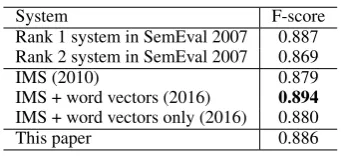
Finally, we choose Word Sense Disambiguation (WSD) task to extend our experiment. As our benchmark for WSD task, we choose English Lex-ical Sample WSD tasks of SemEval-2007 task 17 (Pradhan et al.,2007). We use cross-validation on the training set and we observe the model per-forms better when we update the word vectors which is different from the preceding experimen-tal setup. The number of hidden units is set to 55. The result is in Table 6. The rows from 4 to 6 come from Iacobacci et al. (2016). They
inte-grate word embeddings into IMS (It Makes Sense) system (Zhong and Ng,2010) which uses support vector machine as its classifier based on some s-tandard WSD features and they get the best result; they use an exponential decay function, also de-signed to give more importance to close context, to compute the word representation, but their method need manually choose the window size of the tar-get word and one parameter of their exponential decay function. Both with word vectors only, our model is comparable with the sixth row.
System F-score
Rank 1 system in SemEval 2007 0.887 Rank 2 system in SemEval 2007 0.869
IMS (2010) 0.879
IMS + word vectors (2016) 0.894
IMS + word vectors only (2016) 0.880
This paper 0.886
Table 6: Result on Lexical Sample task of SemEval-2007 task 17
4 Conclusion
In this paper, we describe an end-to-end neural model to target-specific semantic frame labeling. Without explicit rule construction to fit for some specific resources, our model can be easily applied to a range of semantic frame resources and similar tasks. In the future, non-English semantic frame resources can be considered to extend the coverage of our model and our model can integrate the best features explored in the state-of-the-art work to see how many improvements our model can make.
Acknowledgments
[image:5.595.331.502.339.417.2] [image:5.595.79.281.473.539.2]References
Omri Abend, Roi Reichart, and Ari Rappoport. 2008. A supervised algorithm for verb disambiguation into verbnet classes. InProceedings of the 22nd Inter-national Conference on Computational Linguistics-Volume 1. Association for Computational Linguis-tics, pages 9–16.
V´ıt Baisa, Jane Bradbury, Silvie Cinkova, Ismail El Maarouf, Adam Kilgarriff, and Octavian Popes-cu. 2015. Semeval-2015 task 15: A cpa dictionary-entry-building task. In Proceedings of the 9th International Workshop on Semantic Evaluation (SemEval 2015). Association for Computational Linguistics, Denver, Colorado, pages 315–324.
http://www.aclweb.org/anthology/S15-2053. Collin F Baker, Charles J Fillmore, and John B Lowe.
1998. The berkeley framenet project. In Proceed-ings of the 17th international conference on Compu-tational linguistics-Volume 1. Association for Com-putational Linguistics, pages 86–90.
Ismaıl El Maarouf and Vıt Baisa. 2013. Automatic classification of patterns from the pattern dictionary of english verbs. InJoint Symposium on Semantic Processing..
Ismail El Maarouf, Jane Bradbury, V´ıt Baisa, and Patrick Hanks. 2014. Disambiguating verbs by col-location: Corpus lexicography meets natural lan-guage processing. InLREC. pages 1001–1006.
Francesco Elia. 2016. Syntactic and semantic classi-fication of verb arguments using dependency-based and rich semantic features. arXiv preprint arX-iv:1604.05747.
Yukun Feng, Qiao Deng, and Dong Yu. 2015. Bl-cunlp: Corpus pattern analysis for verbs based on dependency chain. In Proceedings of the 9th International Workshop on Semantic Evalua-tion (SemEval 2015). Association for Computation-al Linguistics, Denver, Colorado, pages 325–328.
http://www.aclweb.org/anthology/S15-2054.
Yukun Feng, Yipei Xu, and Dong Yu. 2016. An end-to-end approach to learning semantic frames with feedforward neural network. InProceedings of the NAACL Student Research Workshop. Association for Computational Linguistics, San Diego, California, pages 1–7. http://www.aclweb.org/anthology/N16-2001.
Patrick Hanks. 2012. How people use words to make meanings: Semantic types meet valencies. Input, Process and Product: Developments in Teaching and Language Corporapages 54–69.
Karl Moritz Hermann, Dipanjan Das, Jason Weston, and Kuzman Ganchev. 2014. Semantic frame iden-tification with distributed word representations. In
Proceedings of the 52nd Annual Meeting of the As-sociation for Computational Linguistics (Volume 1:
Long Papers). Association for Computational Lin-guistics, Baltimore, Maryland, pages 1448–1458.
http://www.aclweb.org/anthology/P/P14/P14-1136. Sepp Hochreiter and J¨urgen Schmidhuber. 1997.
Long short-term memory. Neural computation
9(8):1735–1780.
Matthew Honnibal and Tobias Hawker. 2005. Identi-fying framenet frames for verbs from a real-text cor-pus. InProceedings of Australasian Language Tech-nology Workshop.
Ignacio Iacobacci, Mohammad Taher Pilehvar, and Roberto Navigli. 2016. Embeddings for word sense disambiguation: An evaluation study. In Proceed-ings of the 54th Annual Meeting of the Association for Computational Linguistics. pages 897–907. Edward Loper, Szu-Ting Yi, and Martha Palmer. 2007.
Combining lexical resources: mapping between propbank and verbnet. InProceedings of the 7th In-ternational Workshop on Computational Linguistics, Tilburg, the Netherlands.
Chad Mills and Gina-Anne Levow. 2015. Cmill-s: Adapting semantic role labeling features to dependency parsing. In Proceedings of the 9th International Workshop on Semantic Evaluation (SemEval 2015). Association for Computational Linguistics, Denver, Colorado, pages 433–437.
http://www.aclweb.org/anthology/S15-2075. Martha Palmer, Daniel Gildea, and Paul Kingsbury.
2005. The proposition bank: An annotated corpus of semantic roles. Computational linguistics31(1):71– 106.
Jeffrey Pennington, Richard Socher, and Christopher D Manning. 2014. Glove: Global vectors for word representation. InEMNLP. volume 14, pages 1532– 1543.
Sameer S Pradhan, Edward Loper, Dmitriy Dligach, and Martha Palmer. 2007. Semeval-2007 task 17: English lexical sample, srl and all words. In Pro-ceedings of the 4th International Workshop on Se-mantic Evaluations. Association for Computational Linguistics, pages 87–92.
Karin Kipper Schuler. 2006. VerbNet: A Broad-Coverage, Comprehensive Verb Lex-icon. Ph.D. thesis, University of Penn-sylvania. http://verbs.colorado.edu/ kip-per/Papers/dissertation.pdf.
Hongyan Zhao, Ru Li, Sheng Zhang, and Liwen Zhang. 2016. Chinese frame identification with deep neural network 30(6):75.