Candidate re-ranking for SMT-based grammatical error correction
Zheng Yuan, Ted Briscoe and Mariano Felice The ALTA Institute
Computer Laboratory University of Cambridge
{zy249,ejb,mf501}@cam.ac.uk
Abstract
We develop a supervised ranking model to re-rank candidates generated from an SMT-based grammatical error correction (GEC) system. A range of novel features with respect to GEC are investigated and implemented in our re-ranker. We train a rank preference SVM model and demonstrate that this outperforms both Minimum Bayes-Risk and Multi-Engine Machine Translation based re-ranking for the GEC task. Our best system yields a significant improvement in I-measure when testing on the publicly available FCE test set (from 2.87% to 9.78%). It also achieves an F0.5 score of
38.08% on the CoNLL-2014 shared task test set, which is higher than the best original re-sult. The oracle score (upper bound) for the re-ranker achieves over 40% I-measure perfor-mance, demonstrating that there is consider-able room for improvement in the re-ranking component developed here, such as incorpo-rating features able to capture long-distance dependencies.
1 Introduction
Grammatical error correction (GEC) has attracted considerable interest in recent years. Unlike clas-sifiers built for specific error types (e.g. determiner or preposition errors), statistical machine transla-tion (SMT) systems are trained to deal with all error types simultaneously. An SMT system thus learns to translate incorrect English into correct English using a parallel corpus of corrected sentences. The SMT framework has been successfully used for GEC, as demonstrated by the top-performing systems in the CoNLL-2014 shared task (Ng et al., 2014).
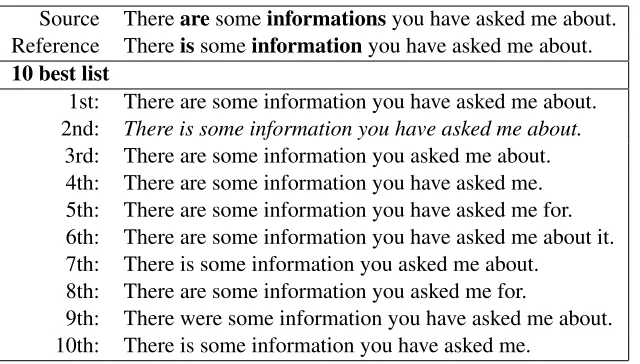
However, the best candidate produced by an SMT system is not always the best correction. An exam-ple is given in Table 1.
Since SMT was not originally designed for GEC, many standard features do not perform well on this task. It is necessary to add new local and global fea-tures to help the decoder distinguish good from bad corrections. Felice et al. (2014) used Levenshtein distance to limit the changes made by their SMT sys-tem, given that most words translate into themselves and errors are often similar to their correct forms. Junczys-Dowmunt and Grundkiewicz (2014) also augmented their SMT system with Levenshtein dis-tance and other sparse features that were extracted from edit operations.
However, the integration of additional mod-els/features into the decoding process may affect the dynamic programming algorithm used in SMT, be-cause it does not support some complex features, such as those computed from an n-best list. An al-ternative to performing integrated decoding is to use additional information to re-rank an SMT decoder’s output. The aim of n-best list re-ranking is to re-rank the translation candidates produced by the SMT sys-tem using a rich set of features that are not used by the SMT decoder, so that better candidates can be selected as ‘optimal’ translations. This has several advantages: 1) it allows the introduction of new fea-tures that are tailored for GEC; 2) unlike in SMT, we can use various types of features without wor-rying about fine-grained smoothing issues and it is easier to use global features; 3) re-ranking is easy to implement, and the existing decoder does not need to be modified; and 4) the decoding process in SMT
Source Therearesomeinformationsyou have asked me about. Reference Thereissomeinformationyou have asked me about. 10 best list
1st: There are some information you have asked me about. 2nd: There is some information you have asked me about.
3rd: There are some information you asked me about. 4th: There are some information you have asked me. 5th: There are some information you have asked me for. 6th: There are some information you have asked me about it. 7th: There is some information you asked me about.
8th: There are some information you asked me for.
[image:2.612.149.469.55.237.2]9th: There were some information you have asked me about. 10th: There is some information you have asked me.
Table 1:In this example, there are two errors in the sentence (marked inbold): an agreement error (are→is) and a mass noun error (informations→information). The best output is the one with highest probability, which only corrects the mass noun error, but misses the agreement error. However, the2nd-ranked candidate corrects both errors and matches the reference (marked initalics). The source sentence and error annotation are taken from the FCE dataset (Yannakoudakis et al., 2011), and the 10-best list is from an SMT system trained on the whole CLC (Nicholls, 2003). More details about the datasets and system are presented in Section 3.
only needs to be performed once, which allows for fast experimentation.
Most previous work on GEC has used evaluation methods based on precision (P), recall (R), and F-score (e.g. the CoNLL 2013 and 2014 shared tasks). However, they do not provide an indicator of im-provement on the original text so there is no way to compare GEC systems with a ‘do-nothing’ baseline. Since the aim of GEC is to improve text quality, we use the Improvement (I) score calculated by the I-measure (Felice and Briscoe, 2015), which tells us whether a system improves the input.
The main contributions of our work are as fol-lows. First, to the best of our knowledge, we are the first to use a supervised discriminative re-ranking model in SMT for GEC, showing that n-best list re-ranking can be used to improve sentence quality. Second, we propose and investigate a range of easily computed features for GEC re-ranking. Finally, we report results on two well-known publicly available test sets that can be used for cross-system compar-isons.
2 Approach
Our re-ranking approach is defined as follows:
1. an SMT system is first used to generate an n-best list of candidates for each input sentence;
2. features that are potentially useful to discrimi-nate between good and bad corrections are ex-tracted from the n-best list;
3. these features are then used to determine a new ranking for the n-best list;
4. the new highest-ranked candidate is finally out-put.
2.1 SMT for grammatical error correction Following previous work (e.g. Brockett et al. (2006), Yuan and Felice (2013), Junczys-Dowmunt and Grundkiewicz (2014)), we approach GEC as a trans-lation problem from incorrect into correct English.
to each mapping in the phrase table as proposed by Felice et al. (2014).
Decoding is performed using Moses (Koehn et al., 2007). The language models used during de-coding are built from the corrected sentences in the learner corpus, to make sure that the final sys-tem outputs fluent English sentences. The IRSTLM Toolkit (Federico et al., 2008) is used to build n-gram language models (up to 5-n-grams) with modi-fied Kneser-Ney smoothing (Kneser and Ney, 1995). Previous work has shown that adding bigger lan-guage models based on larger corpora improves performance (Yuan and Felice, 2013; Junczys-Dowmunt and Grundkiewicz, 2014). The use of big-ger language models will be investigated at the re-ranking stage, as it allows us to compute a richer set of features that would otherwise be hard to integrate into the decoding stage.
2.2 Ranking SVM
The SMT system is not perfect, and candidates with the highest probability from the SMT system do not always constitute the best correction. An n-best list re-ranker is trained to re-rank these candidates in or-der to find better corrections. We treat n-best list re-ranking as a discriminative ranking problem. Un-like standard SMT, the source input sentence is also added to the candidate pool if it is not in the n-best list, since in many cases the source sentence has no error and should be translated as itself.
We use rank preference SVMs (Joachims, 2002) in the SVMrank package (Joachims, 2006). This
model learns a ranking function from preference training examples and then assigns a score to each test example, from which a global ordering is de-rived. The default linear kernel is used due to train-ing and test time costs.
Rank preference SVMs work as follows. Suppose that we are given a set of ranked instances R con-taining training samplesxi and their target rankings
ri:
R={(x1, r1),(x2, r2), ...,(xl, rl)} (1) such thatxixjwhenri < rj, wheredenotes a preference relationship. A set of ranking functions
f ∈Fis defined, where eachf determines the pref-erence relations between instances:
xixj ⇔f(xi)> f(xj) (2) The aim is to find the best function f that min-imises a given loss function ξ with respect to the given ranked instances. Instead of using the R set directly, a set of pair-wise difference vectors is cre-ated and used to train a model. For linear ranking models, this is equivalent to finding the weight vec-torwthat maximises the number of correctly ranked pairs:
∀(xi xj) :w(xi−xj)>0 (3) which is, in turn, equivalent to solving the follow-ing optimisation problem:
min
w
1
2wTw+C
X
ξij (4)
subject to
∀(xi xj) :w(xi−xj)≥1−ξij (5) where ξij ≥ 0 are non-negative slack variables that measure the extent of misclassification.
2.3 Feature space
New features are introduced to identify better cor-rections in the n-best produced by the SMT decoder. We use general features that work for all types of errors, leaving L2-specific features for future work. These are described briefly below.
A) SMT feature set: Reuses information ex-tracted from the SMT system. As the SMT frame-work has been shown to produce good results for GEC, we reuse these pre-defined SMT features. This feature set includes:
Decoder’s scores: Includes unweighted trans-lation model scores, reordering model scores, lan-guage model scores and word penalty scores. We use unweighted scores, as the weights for each score will be reassigned during training.
N-best list ranking information: Encodes the original ranking information provided by the SMT decoder. Bothlinearandnon-lineartransformations are used.
system output. If the source sentence is not in the n-best list, it will not have these two kinds of features and zeros will be used.
B) Language model feature set: Raw candidates from an SMT system can include many malformed sentences so we introduce language model (LM) features and adaptive language model (ALM) fea-tures in an attempt to identify and discard them.
LM: Language models are widely used in GEC, especially to rank correction suggestions proposed by other models. Ideally, correct word sequences will get high probabilities, while incorrect or un-seen ones will get low probabilities. We use Mi-crosoft’s Web N-gram Services, which provide ac-cess to large smoothed n-gram LMs built from web documents (Gao et al., 2010). All our experiments are based on the 5-gram ‘bing-body:apr10’ model. We also build several n-gram LMs from native and learner corpora, including the CLC, the British Na-tional Corpus (BNC) and ukWaC (Ferraresi et al., 2008). The LM feature set contains unnormalised sentence scores, normalised scores usingarithmetic mean and geometric mean, and the minimum and maximum n-gram probability scores.
ALM: Adaptive LM scores are calculated from the n-best list’s n-gram probabilities. N-gram counts are collected using the entries in the n-best list for each source sentence. N-grams repeated more of-ten than others in the n-best list get higher scores, thus ameliorating incorrect lexical choices and word order. The n-gram probability for a target word ei given its historyeii−−1n+1 is defined as:
pn−best(ei|eii−−1n+1) = countn−best(ei, e i−1 i−n+1)
countn−best(eii−−1n+1) (6) The sentence score for thesth candidateHsis cal-culated as:
score(Hs) = log( Y
pn−best(ei|eii−−1n+1)) (7)
The sentence score is then normalised by sentence length to get an average word log probability, mak-ing it comparable for candidates of different lengths. In our re-ranking system, different values of nare
used, from 2 to 6. This feature is taken from Hilde-brand and Vogel (2008).
C) Statistical word lexicon feature set: We use the word lexicon learnt by the IBM Model 4, which contains translation probabilities for word-to-word mappings. The statistical word translation lexicon is used to calculate the translation probabilityPlex(e) for each word e in the target sentence. Plex(e) is the sum of all translation probabilities ofefor each wordfj in the source sentencef1J. Specifically, this can be defined as:
Plex(e|f1J) = J+ 11 J X
j=0
p(e|fj) (8)
where fJ
1 is the source sentence and J is the source sentence length.p(e|fj)is the word-to-word translation probability of the target wordefrom one source wordfj.
As noted by Ueffing and Ney (2007), the sum in Equation (8) is dominated by the maximum lexicon probability, which we also use as an additional fea-ture:
Plex−max(e|f1J) = maxj=0,...,Jp(e|fj) (9)
For both lexicon scores, we sum over all words
ei in the target sentence and normalise by sentence length to get sentence translation scores. Lexicon scores are calculated in both directions. This feature is also taken from Hildebrand and Vogel (2008). D) Length feature set: These features are used to make sure that the final system does not make un-necessary deletions or insertions. This set contains four length ratios:
score(Hs, E) = NN((HEs)) (10)
score(Hs, H1) = NN((HHs)
1) (11)
score(Hs, Hmax) = NN(H(Hs)
max) (12)
score(Hs, Hmin) = NN(H(Hs)
whereHsis thesth candidate,Eis the source (er-roneous) sentence, H1 is the 1-best candidate (the candidate ranked 1stby the SMT system), N(·)is the sentence’s length, N(Hmax) is the maximum candidate length in the n-best list for that source sentence and N(Hmin) is the minimum candidate length.
3 Experiments
3.1 Dataset
We use the publicly available FCE dataset (Yan-nakoudakis et al., 2011), which is a part of the CLC. The FCE dataset is a set of 1,244 scripts written by learners of English taking the First Certificate in English (FCE) examination around the world be-tween 2000 and 2001. The texts have been man-ually error-annotated with a taxonomy of approxi-mately 80 error types (Nicholls, 2003). The FCE dataset covers a wide variety of L1s and was used in the HOO-2012 error correction shared task (Dale et al., 2012). Compared to the National Univer-sity of Singapore Corpus of Learner English (NU-CLE) (Dahlmeier et al., 2013) used in the CoNLL 2013 and 2014 shared tasks, which contains essays written by students at the National University of Sin-gapore, the FCE dataset is a more representative test set of learner writing, which is why we use it for our experiments. The performance of our model on the CoNLL-2014 shared task test data is also presented in Section 3.7.
Following Yannakoudakis et al. (2011), we split the publicly available FCE dataset into training and test sets: we use the 1,141 scripts from the year 2000 and the 6 validation scripts for training, and the 97 scripts from the year 2001 for testing. The FCE training set contains about 30,995 pairs of par-allel sentences (approx. 496,567 tokens on the tar-get side), and the test set contains about 2,691 pairs of parallel sentences (approx. 41,986 tokens on the target side). Both FCE and NUCLE are too small to build good SMT systems, considering that previ-ous work has shown that training on small datasets does not work well for SMT-based GEC (Yuan and Felice, 2013; Junczys-Dowmunt and Grund-kiewicz, 2014). To overcome this problem, Junczys-Dowmunt and Grundkiewicz (2014) introduced ex-amples collected from the language exchange social
networking website Lang-8, and were able to im-prove system performance by 6 F-score points. As noticed by them, Lang-8 data may be too noisy and error-prone, so we decided to add examples from the fully annotated learner corpus CLC to our train-ing set (approx. 1,965,727 pairs of parallel sentences and 29,219,128 tokens on the target side).
Segmentation and tokenisation are performed us-ing RASP (Briscoe et al., 2006), which is expected to perform better on learner data than a system de-veloped exclusively from high quality copy-edited text such as the Wall Street Journal.
3.2 Evaluation
System performance is evaluated using the I-measure proposed by Felice and Briscoe (2015), which is designed to address problems with previous evaluation methods and reflect any improvement on the original sentence after applying a system’s cor-rections. AnIscore is computed by comparing sys-tem performance (WAccsys) with that of a baseline
that leaves the original text uncorrected (WAccbase):
I =
bWAccsysc ifWAccsys =WAccbase
WAccsys−WAccbase
1−WAccbase ifWAccsys >WAccbase WAccsys
WAccbase −1 otherwise
(14) Values ofIlie in the[−1,1]interval. Positive val-ues indicate improvement, while negative valval-ues in-dicate degradation. A score of 0 inin-dicates no im-provement (i.e. baseline performance), 1 indicates 100% correct text and -1 indicates 100% incorrect text.
In order to compute the I score, system perfor-mance is first evaluated in terms of weighted accu-racy (WAcc), based on a token-level alignment be-tween a source sentence, a system’s candidate, and a gold-standard reference:1
1TP: true positives, TN: true negatives, FP: false positives,
WAcc= w·TP+TN
w·(TP+FP) +TN+FN−(w+ 1)·FPN2
(15) In Section 3.3 and 3.7, we also report results us-ing another two evaluation metrics for comparison: F0.5 from M2 Scorer (Dahlmeier and Ng, 2012b) and GLEU (Napoles et al., 2015). The M2 Scorer was the official scorer in the CoNLL 2013 and 2014 shared tasks, with the latter using F0.5 as the sys-tem ranking metric. GLEU is a simple variant of BLEU (Papineni et al., 2002), which shows better correlation with human judgments on the CoNLL-2014 shared task test set.
3.3 SMT system
We train several SMT systems and select the best one for our re-ranking experiments. These systems use different configurations, defined as follows:
• GIZA++: uses GIZA++ for word alignment;
• Pialign: uses Pialign to learn a phrase table;
• FCE: uses the publicly available FCE as train-ing data;
• + LD: limits edit distance by adding the character-level Levenshtein distance as a new feature;
• + CLC: incorporates additional training exam-ples extracted from the CLC.
Evaluation results using the aforementioned met-rics are presented in Table 2. As we mentioned ear-lier, a baseline system which makes no corrections gets zero F score. We can see that not all the systems make the source text better. Pialign outperforms GIZA++. Adding more learner examples improves system performance. The Levenshtein distance fea-ture further improves performance. The best system in terms of the I-measure is the one that has been trained on the whole CLC, aligned with Pialign, and includes edit distance as an additional feature ( Pi-align + FCE + CLC + LD). The positive I score of 2.87 shows a real improvement in sentence qual-ity. This system is also the best system in terms of GLEU and F0.5 so we use the n-best list from this system to perform re-ranking.
3.4 SVM re-ranker
The input to the re-ranking model is the n-best list output from an SMT system. The original source sentence is used to collect a 10-best list of candidates generated by the SMT decoder, which is then used to build a supervised re-ranking model. For training, we use per-sentence I-measure values as gold labels. The effectiveness of our re-ranker is proved by the results: performing a 10-best list re-ranking yields a statistically significant improvement in performance over the top-ranked output from the best existing SMT system.2 The best re-ranking model is built using all features, achievingI = 9.78(Table 3 #1). In order to measure the contribution of each feature set to the overall improvement in sentence quality, a number of ablation tests are performed, where new models are built by removing one feature type at a time. In Table 3, SMT best is the best SMT sys-tem output without re-ranking. FullFeat combines all feature types described in Section 2.3. The rest areFullFeatminus the indicated feature type.
The ablation tests tell us that all the features in theFullFeatset have positive effects on overall per-formance. Among them, the SMT decoder’s scores are the most effective, as their absence is responsible for a 6.58 decrease in I-measure (Table 3 #2). The removal of the word lexicon features also acounts for a 2.13 decrease (#6), followed by SMT n-best list ranking information (1.46 #3), ALM (1.43 #5), length features (0.75 #7) and the LM features (0.22 #4). In order to test the performance of the SMT decoder’s scores on their own, we built a new re-ranking model using only these features, which we report in Table 3 #8. We can see that using only the SMT decoder’s scores yields worse performance than no re-ranking, suggesting that the existing fea-tures used by the SMT decoder are not optimal when used outside the SMT ecosystem. We hypothesise that this might be caused by the lack of scores for the source sentences that are not included in the n-best list of the original SMT system.
Looking at the re-ranker’s output reveals that there are some L2 learners errors which are missed by the SMT system but are captured by the re-ranker - see Table 4.
Align Setting GLEU P MR2 F I-measure
0.5 WAcc I
Baseline 60.39 100 0 0 86.83 0
GIZA++ FCE 61.42 36.66 16.97 29.76 83.24 -4.14
+ LD 61.64 37.70 16.40 29.92 83.64 -3.68
+ CLC 67.70 48.67 37.64 45.97 83.94 -3.33
+ CLC + LD 67.98 49.87 37.16 46.67 84.42 -2.78
Pialign FCE 62.22 43.13 11.34 27.64 84.94 -2.17
+ LD 62.19 43.07 11.17 27.41 85.00 -2.11
+ CLC 70.07 62.37 32.19 52.52 87.01 1.38
[image:7.612.132.479.56.209.2]+ CLC + LD 70.15 63.27 31.95 52.90 87.21 2.87
Table 2:SMT system performance on the FCE test set (in percentages). The best results are marked inbold.
# Feature WAcc I
0 SMT best 87.21 2.87
1 FullFeat 88.12 9.78
2 - SMT (decoder) 87.25 3.20
3 - SMT (rank) 87.93 8.32
4 - LM 88.09 9.56
5 - ALM 87.93 8.35
6 - word lexicon 87.84 7.65
7 - length 88.02 9.03
[image:7.612.98.275.245.387.2]8 SMT (decoder) 87.15 2.40
Table 3: Results of 10-best list re-ranking on the FCE test set (in percentages). The best results are marked inbold.
3.5 Oracle score
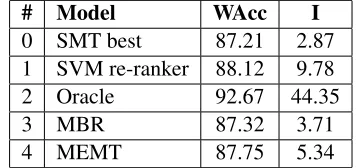
In order to estimate a realistic upper bound on the task, we calculate an oracle score from the same 10-best list generated by our 10-best SMT model. The ora-cle set is created by selecting the candidate which has the highest sentence-level weighted accuracy (WAcc) score for each source sentence in the test set. Table 5 #0-2 compares the results of standard SMT (i.e. the best candidate according to the SMT model), the SVM re-ranker (the best re-ranking model from Section 3.4) and the approximated or-acle. The oracle score is about 41 points higher than the standard SMT score in terms of I, and about 5 points higher in terms ofWAcc, suggesting that there are alternative candidates in the 10-best list that are not chosen by the SMT model. Our re-ranker im-proves theI score from2.87to9.78, and theWAcc score from 87.21 to 88.12, a significant improve-ment over the standard SMT model. However, there
is still much room for improvement.
The oracle score tells us that, under the most favourable conditions, our models could only im-prove the original text by 44.35% at most. This also reveals that in many cases, the correct translation is not in the 10-best list. Therefore, it would be im-possible to retrieve the correct translation even if the re-ranking model was perfect.
3.6 Benchmark results
We also compare our ranking model with two other methods: Minimum Bayes-Risk (MBR) re-ranking and Multi-Engine Machine Translation (MEMT) candidate combination.
MBR was first proposed by Kumar and Byrne (2004) to minimise the expected loss of translation errors under loss functions that measure translation performance. Instead of using the model’s best output, the one that is most similar to the most likely translations is selected. We use the same n-best list as the candidate set and the likely translation set. MBR re-ranking can then be considered as selecting aconsensus candidate: the least ‘risky’ candidate which is closest on average to all the likely candidates.
The MEMT system combination technique was first proposed by Heafield and Lavie (2010) and was successfully applied to GEC by Susanto et al. (2014). Aconfusion networkis created by align-ing the candidates, on which a beam search is later performed to find the best candidate.
System Example sentences
Source I meet a lot of people oninternetand it reallyinterestme. Reference I meet a lot of people onthe Internetand it reallyinterestsme. SMT best I meet a lot of people onthe internetand it reallyinterestme. SVM re-ranker I meet a lot of people onthe Internetand it reallyinterestsme. Source And theyeffecteveryone’s life directly or indirectly.
Reference And theyaffecteveryone’s life directly or indirectly. SMT best And theyeffecteveryone’s life directly or indirectly. SVM re-ranker And theyaffecteveryone’s life directly or indirectly.
[image:8.612.100.515.53.243.2]Source Of course I will give you some moredetailabout the student conference. Reference Of course I will give you some moredetailsabout the student conference. SMT best Of course I will give you some moredetailabout the student conference. SVM re-ranker Of course I will give you some moredetailsabout the student conference.
Table 4:Example output from SMT best and SVM re-ranker.
# Model WAcc I
0 SMT best 87.21 2.87
1 SVM re-ranker 88.12 9.78
2 Oracle 92.67 44.35
3 MBR 87.32 3.71
4 MEMT 87.75 5.34
Table 5: Performance of SMT best, SVM re-ranker, oracle best, MBR re-ranking and MEMT candidate combination (in percentages).
presented in Table 5 #3-4.SVM re-rankeris our best ranking model (#1), MBR is the MBR re-ranking (#3) and MEMT is the MEMT candidate combina-tion (#4). We can see that our supervised ranking model achieves the bestIscore, followed by MEMT candidate combination and MBR re-ranking. Our model clearly outperforms the other two methods, showing its effectiveness in re-ranking candidates for GEC.
3.7 CoNLL-2014 shared task
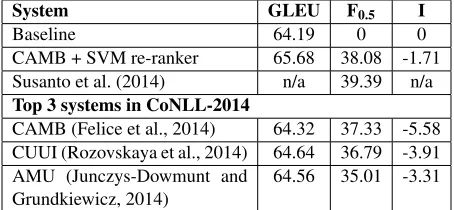
The CoNLL-2014 shared task on grammatical error correction required participating systems to correct all errors present in learner English text. The official training and test data comes from the NUCLE. F0.5 was adopted as the evaluation metric, as reported by the M2 Scorer. In order to test how well our re-ranking model generalises, we apply our best model trained on the CLC to the CoNLL-2014 shared task test data. We re-rank the 10-best correction can-didates from the winning team in the shared task
(CAMB, Felice et al. (2014)), which were kindly provided to us for these experiments. After the shared task, there has been an on-going discussion about how to best evaluate GEC systems, and dif-ferent metrics have been proposed (Dahlmeier and Ng, 2012b; Felice and Briscoe, 2015; Bryant and Ng, 2015; Napoles et al., 2015; Grundkiewicz et al., 2015). We evaluated our re-ranker using GLEU, the M2Scorer and the I-measure. Our proposed re-ranking model (SVM re-ranker) is compared with five other systems: the baseline, the top three sys-tems in the shared task and a GEC system by Su-santo et al. (2014), which combined the output of two classification-based systems and two SMT-based systems, and achieved a state-of-the-art F0.5 score of 39.39% - see Table 6. We can see that our re-ranker outperforms the top three systems on all evaluation metrics. It also achieves a comparable F0.5score to the system of Susanto et al. (2014) even though our re-ranker is not trained on the NUCLE data or optimised for F0.5. This result shows that our model generalises well to other datasets. We expect these results might be further improved by retokenis-ing the test data to be consistent with the tokenisa-tion of the CLC.3
4 Related work
The aim of GEC for language learners is to correct errors in non-native text. Brockett et al. (2006) first
3The NUCLE data was preprocessed using the NLTK
[image:8.612.95.273.273.357.2]System GLEU F0.5 I
Baseline 64.19 0 0
CAMB + SVM re-ranker 65.68 38.08 -1.71 Susanto et al. (2014) n/a 39.39 n/a
Top 3 systems in CoNLL-2014
CAMB (Felice et al., 2014) 64.32 37.33 -5.58 CUUI (Rozovskaya et al., 2014) 64.64 36.79 -3.91 AMU (Junczys-Dowmunt and
[image:9.612.71.298.59.164.2]Grundkiewicz, 2014) 64.56 35.01 -3.31
Table 6:System performance on the CoNLL-2014 test set with-out alternative answers (in percentages).
proposed the use of a noisy channel SMT model for correcting a set of 14 countable/uncountable nouns which are often confusing for learners. Dahlmeier and Ng (2012a) developed a beam-search decoder to iteratively generate candidates and score them us-ing individual classifiers and a general LM. Their decoder focused on five types of errors: spelling, ar-ticles, prepositions, punctuation insertion, and noun number. Three classifiers were used to capture three of the common error types: article, prepo-sition and noun number. Yuan and Felice (2013) trained phrase-based and POS-factored SMT sys-tems to correct 5 error types using learner and ar-tificial data. Later, researchers realised the need for new features in SMT for GEC. Felice et al. (2014) and Junczys-Dowmunt and Grundkiewicz (2014) in-troduced Levenshtein distance and sparse features to their SMT systems, and reported better perfor-mance. In addition, Felice et al. (2014) used a LM to re-rank the 10-best candidates after they noticed that better corrections were in the n-best list. Simi-larly, for Chinese GEC, Zhao et al. (2015) confirmed that their system included correct predictions in its 10-best list not selected during decoding, so a re-ranking of the n-best list was clearly needed.
Re-ranking has been widely used in many natural language processing tasks such as parsing, tagging and sentence boundary detection (Collins and Duffy, 2002; Collins and Koo, 2005; Roark et al., 2006; Huang et al., 2007). Various machine learning algo-rithms have been adapted to these re-ranking tasks, including boosting, perceptrons and SVMs.
In machine translation, generative models have been widely used. Over the last decade, re-ranking techniques have shown significant improvement. Discriminative re-ranking (Shen et al., 2004), one of
the best-performing strategies, used two perceptron-like re-ranking algorithms that improved translation quality over a baseline system when evaluating with BLEU. Goh et al. (2010) employed an online train-ing algorithm for SVM-based structured prediction. Various global features were investigated for SMT re-ranking, such as the decoder’s scores, source and target sentences, alignments and POS tags, sen-tence type probabilities, posterior probabilities and back translation features. More recently, Farzi and Faili (2015) proposed a re-ranking system based on swarm algorithms.
5 Conclusions and future work
We have investigated n-best list re-ranking for SMT-based GEC. We have shown that n-best list re-ranking can be performed to improve correction quality. A supervised machine learning model has proved to be effective and to generalise well. Our best re-ranking model achieves anI score of 9.78% on the publicly available FCE test set, compared to a 2.87% score for our best SMT system without re-ranking. When testing on the official CoNLL-2014 test set without alternative answers, our model achieves an F0.5 score of 38.08%, an I score of -1.71%, and a GLEU score of 65.68%, outperform-ing the top three teams on all metrics.
Acknowledgements
We would like to thank Christopher Bryant for his valuable comments, Cambridge English Language Assessment and Cambridge University Press for granting us access to the CLC for research purposes, as well as the anonymous reviewers for their feed-back.
References
Ted Briscoe, John Carroll, and Rebecca Watson. 2006. The second release of the RASP system. In Proceed-ings of the COLING/ACL 2006 Interactive Presenta-tion Sessions, pages 77–80.
Chris Brockett, William B. Dolan, and Michael Gamon. 2006. Correcting ESL errors using phrasal SMT tech-niques. In Proceedings of the COLING/ACL 2006, pages 249–256.
Peter F. Brown, Vincent J. Della Pietra, Stephen A. Della Pietra, and Robert L. Mercer. 1993. The mathemat-ics of statistical machine translation: parameter esti-mation. Computational Linguistics, 19(2):263–311. Christopher Bryant and Hwee Tou Ng. 2015. How far
are we from fully automatic high quality grammatical error correction? InProceedings of the ACL/IJCNLP 2015, pages 697–707.
Michael Collins and Nigel Duffy. 2002. New ranking al-gorithms for parsing and tagging: kernels over discrete structures, and the voted perceptron. InProceedings of the ACL 2002, pages 263–270.
Michael Collins and Terry Koo. 2005. Discrimina-tive reranking for natural language parsing. Compu-tational Linguistics, 31(1).
Daniel Dahlmeier and Hwee Tou Ng. 2012a. A beam-search decoder for grammatical error correction. In Proceedings of the EMNLP/CoNLL 2012, pages 568– 578.
Daniel Dahlmeier and Hwee Tou Ng. 2012b. Better eval-uation for grammatical error correction. In Proceed-ings of the NAACL 2012, pages 568–572.
Daniel Dahlmeier, Hwee Tou Ng, and Siew Mei Wu. 2013. Building a large annotated corpus of learner en-glish: the NUS Corpus of Learner English. In Pro-ceedings of the 8th Workshop on Innovative Use of NLP for Building Educational Applications, pages 22– 31.
Robert Dale, Ilya Anisimoff, and George Narroway. 2012. HOO 2012: a report on the preposition and de-terminer error correction shared task. InProceedings of the 7th Workshop on the Innovative Use of NLP for Building Educational Applications, pages 54–62.
Saeed Farzi and Heshaam Faili. 2015. A swarm-inspired re-ranker system for statistical machine translation. Computer Speech & Language, 29:45–62.
Marcello Federico, Nicola Bertoldi, and Mauro Cettolo. 2008. IRSTLM: an open source toolkit for handling large scale language models. InProceedings of the 9th Annual Conference of the International Speech Com-munication Association, pages 1618–1621.
Mariano Felice and Ted Briscoe. 2015. Towards a stan-dard evaluation method for grammatical error detec-tion and correcdetec-tion. In Proceedings of the NAACL 2015, pages 578–587.
Mariano Felice, Zheng Yuan, Øistein E. Andersen, He-len Yannakoudakis, and Ekaterina Kochmar. 2014. Grammatical error correction using hybrid systems and type filtering. InProceedings of the 18th Confer-ence on Computational Natural Language Learning: Shared Task, pages 15–24.
Adriano Ferraresi, Eros Zanchetta, Marco Baroni, and Silvia Bernardini. 2008. Introducing and evaluating ukWaC, a very large web-derived corpus of English. In Proceedings of the 4th Web as Corpus Workshop (WAC-4).
Jianfeng Gao, Patrick Nguyen, Xiaolong Li, Chris Thrasher, Mu Li, and Kuansan Wang. 2010. A com-parative study of Bing Web N-gram language models for Web search and natural language processing. In Proceeding of the 33rd Annual ACM SIGIR Confer-ence, pages 16–21.
Chooi-Ling Goh, Taro Watanabe, Andrew Finch, and Ei-ichiro Sumita. 2010. Discriminative reranking for SMT using various global features. InProceedings of the 4th International Universal Communication Sym-posium, pages 8–14.
Roman Grundkiewicz, Marcin Junczys-Dowmunt, and Edward Gillian. 2015. Human evaluation of gram-matical error correction systems. In Proceedings of the EMNLP 2015, pages 461–470.
Kenneth Heafield and Alon Lavie. 2010. CMU multi-engine machine translation for WMT 2010. In Pro-ceedings of the Joint 5th Workshop on Statistical Ma-chine Translation and MetricsMATR, pages 301–306. Almut Silja Hildebrand and Stephan Vogel. 2008.
Com-bination of machine translation systems via hypothesis selection from combined n-best lists. InProceedings of the 8th Conference of the Association for Machine Translation in the Americas.
Zhongqiang Huang, Mary P. Harper, and Wen Wang. 2007. Mandarin part-of-speech tagging and dis-criminative reranking. In Proceedings of the EMNLP/CoNLL 2007, pages 1093 – 1102.
Conference on Knowledge Discovery and Data Mining (KDD), pages 133–142.
Thorsten Joachims. 2006. Training linear SVMs in linear time. InProceedings of the 12th ACM Conference on Knowledge Discovery and Data Mining (KDD). Marcin Junczys-Dowmunt and Roman Grundkiewicz.
2014. The AMU system in the CoNLL-2014 shared task: grammatical error correction by data-intensive and feature-rich statistical machine translation. In Proceedings of the 18th Conference on Computational Natural Language Learning: Shared Task, pages 25– 33.
Reinhard Kneser and Hermann Ney. 1995. Improved backing-off for M-gram language modeling. In Pro-ceedings of the IEEE International Conference on Acoustics, Speech, and Signal Processing, pages 181– 184.
Philipp Koehn, Hieu Hoang, Alexandra Birch, Chris Callison-Burch, Marcello Federico, Nicola Bertoldi, Brooke Cowan, Wade Shen, Christine Moran, Richard Zens, Chris Dyer, Ondˇrej Bojar, Alexandra Con-stantin, and Evan Herbst. 2007. Moses: open source toolkit for statistical machine translation. In Proceed-ings of the ACL 2007 Interactive Poster and Demon-stration Sessions, pages 177–180.
Shankar Kumar and William Byrne. 2004. Minimum Bayes-Risk decoding for statistical machine transla-tion. InProceedings of the NAACL 2004.
Courtney Napoles, Keisuke Sakaguchi, Matt Post, and Joel Tetreault. 2015. Ground truth for grammati-cal error correction metrics. In Proceedings of the ACL/IJCNLP 2015, pages 588–593.
Graham Neubig, Taro Watanabe, Eiichiro Sumita, Shin-suke Mori, and Tatsuya Kawahara. 2011. An unsuper-vised model for joint phrase alignment and extraction. InProceedings of the ACL 2011, pages 632–641. Hwee Tou Ng, Siew Mei Wu, Ted Briscoe, Christian
Hadiwinoto, Raymond Hendy Susanto, and Christo-pher Bryant. 2014. The CoNLL-2014 shared task on grammatical error correction. In Proceedings of the 18th Conference on Computational Natural Language Learning: Shared Task, pages 1–14.
Diane Nicholls. 2003. The Cambridge Learner Corpus - error coding and analysis for lexicography and ELT. InProceedings of the Corpus Linguistics 2003 Confer-ence, pages 572–581.
Franz Josef Och and Hermann Ney. 2003. A system-atic comparison of various statistical alignment mod-els. Computational Linguistics, 29(1):19–51.
Kishore Papineni, Salim Roukos, Todd Ward, and Wei-Jing Zhu. 2002. BLEU: a method for automatic eval-uation of machine translation. InProceedings of the ACL 2002, pages 311–318.
Brian Roark, Yang Liu, Mary Harper, Robin Stewart, Matthew Lease, Matthew Snover, Izhak Shafran, Bon-nie Dorr, John Hale, Anna Krasnyanskaya, and Lisa Yung. 2006. Reranking for sentence boundary de-tection in conversational speech. In Proceedings of the 2006 IEEE International Conference on Acoustics, Speech and Signal Processing.
Alla Rozovskaya, Kai-Wei Chang, Mark Sammons, Dan Roth, and Nizar Habash. 2014. The Illinois-Columbia System in the CoNLL-2014 Shared Task. In Proceed-ings of the 18th Conference on Computational Natural Language Learning: Shared Task, pages 34–42. Libin Shen, Anoop Sarkar, and Franz Josef Och. 2004.
Discriminative reranking for machine translation. In Proceedings of the NAACL 2004.
Hendy Raymond Susanto, Peter Phandi, and Tou Hwee Ng. 2014. System combination for grammatical error correction. InProceedings of the EMNLP 2014, pages 951–962.
Nicola Ueffing and Hermann Ney. 2007. Word-level confidence estimation for machine translation. Com-putational Linguistics, 33(1):9–40.
Stephan Vogel, Hermann Ney, and Christoph Tillmann. 1996. HMM-based word alignment in statistical translation. InProceedings of the 16th International Conference on Computational Linguistics, volume 2, pages 836–841.
Helen Yannakoudakis, Ted Briscoe, and Ben Medlock. 2011. A new dataset and method for automatically grading ESOL texts. InProceedings of the ACL 2011, pages 180–189.
Zheng Yuan and Mariano Felice. 2013. Constrained grammatical error correction using statistical machine translation. InProceedings of the 17th Conference on Computational Natural Language Learning: Shared Task, pages 52–61.