Proceedings of NAACL-HLT 2016, pages 161–169,
Fracking Sarcasm using Neural Network
Aniruddha Ghosh
University College Dublin
Tony Veale
University College Dublin [email protected]
Abstract
Precise semantic representation of a sentence and definitive information extraction are key steps in the accurate processing of sentence meaning, especially for figurative phenom-ena such as sarcasm, Irony, and metaphor cause literal meanings to be discounted and secondary or extended meanings to be inten-tionally profiled. Semantic modelling faces a new challenge in social media, because grammatical inaccuracy is commonplace yet many previous state-of-the-art methods ex-ploit grammatical structure. For sarcasm de-tection over social media content, researchers so far have counted on Bag-of-Words(BOW), N-grams etc. In this paper, we propose a neural network semantic model for the task of sarcasm detection. We also review se-mantic modelling using Support Vector Ma-chine (SVM) that employs constituency partrees fed and labeled with syntactic and se-mantic information. The proposed neural net-work model composed of Convolution Neu-ral Network(CNN) and followed by a Long short term memory (LSTM) network and fi-nally a Deep neural network(DNN). The pro-posed model outperforms state-of-the-art text-based methods for sarcasm detection, yielding an F-score of .92.
1 Introduction
Figurative language, such as metaphor, irony and sarcasm, is a ubiquitous aspect of human communi-cation from ancient religious texts to modern micro-texts. Sarcasm detection, despite being a well-studied phenomenon in cognitive science and lin-guistics (Gibbs and Clark, 1992; gib, 2007; Kreuz
and Glucksberg, 1989; Utsumi, 2000), is still at its infancy as a computational task. Detection is diffi-cult because literal meaning is discounted and sec-ondary or extended meanings are instead intention-ally profiled. In social contexts, one’s ability to detect sarcasm relies heavily on social cues such as sentiment, belief, and speaker’s intention. Sar-casm is mocking and often involves harsh delivery to achieve savage putdowns, even though it can be also crafted more gently as the accretion of polite-ness and the abatement of hostility around a criti-cism (Brown and Levinson, 1978; Dews and Win-ner, 1995). Moreover, sarcasm often couches crit-icism within a humorous atmosphere (Dews and Winner, 1999). (Riloff et al., 2013) addressed one common form of sarcasm as the juxtaposition of a positive sentiment attached to a negative situation, or vice versa. (Tsur et al., 2010) modeled sarcasm via a composition of linguistic elements, such as specific surface features about a product, frequent words, and punctuation marks. (Gonz´alez-Ib´anez et al., 2011) views sarcasm as a conformation of lex-ical and pragmatic factors such as emoticons and profile references in social media. Most research ap-proaches toward the automatic detection of sarcasm are text-based and consider sarcasm to be as a func-tion of contrasting condifunc-tions or lexical clues. Such approaches extract definitive lexical cues as features, where the linguistic scale of features is stretched from words to phrases to provide richer contexts for analysis. Lexical feature cues may yield good re-sults, yet without a precise semantic representation of a sentence, which is key for determining the in-tended gist of a sentence, robust automatic sarcasm
detection will remain a difficult challenge to real-ize. Accurate semantic modelling of context be-comes obligatory for automatic sarcasm detection if social cues and extended meaning are to be grasped. Encouraging an immediate and very social use of language, social media platforms such as Twitter1
are rich sources of texts for Natural Language Pro-cessing (NLP). Social micro-texts are dense in fig-urative language, and are useful for figfig-urative anal-ysis because of their topicality, ease of access, and the use of self-annotation via hashtag. In Twitter, language is distorted, often plumbing the depths of bad language (Eisenstein, 2013). Yet due to the pres-ence of grammatical errors liberally mixed with so-cial media markers (hashtags, emoticons, profiles), abbreviations, and code switching, these micro-texts are harder to parse, and parsing is the most com-monly used method to obtain a semantic represen-tation of a sentence. The accuracy of state-of-the-art constituency parsers over tweets can be signif-icantly lower than that for normal texts, so social media researchers still largely rely on surface level features. With the recent move to artificial neural networks in NLP, ANNs provide an alternative basis for semantic modelling. In this paper, we perform semantic modelling of sentences using neural net-works for the task of sarcasm detection. The paper is organized as follows. Section 2 surveys related works, section 3 outlines methods of data collection and data processing, section 4 describes the recur-sive SVM model, section 5 describes the neural net-work model, section 6 & 7 outline our experimental setup and experimental analysis respectively, while section 8 presents a simple sarcastic Twitter bot. Fi-nally, section 9 concludes with a short discussion of future work.
2 Related work
Semantic modelling of sentence meaning is a well-researched topic in NLP. Due to ’bad language’ in Twitter and a noticeable drop of accuracy for start-of-the-art constituency parsers on tweets, the se-mantic modelling of tweets has captured the atten-tion of researchers. To build a semantic represen-tation of a sentence in various NLP tasks such as sentiment analysis, researchers have used
syntac-1https://twitter.com
tic structure to compose a total representation as a function of the word-vector representation of a sen-tence’s parts. (Nakagawa et al., 2010) describes a Tree-CRF classifier which uses a data-driven depen-dency parser, maltparser2, to obtain a parse tree for a
sentence, and whose composition function uses the head-modifier relations of the parse tree. (Mitchell and Lapata, 2010) and (Mitchell and Lapata, 2008) defined the composition function of a sentence by algebraic operations over word meaning vectors to obtain sentence meaning vectors. (Guevara, 2010) and (Malakasiotis, 2011) formulated their composi-tion funccomposi-tion using a set of specific syntactic rela-tions or specific word categories (Baroni and Zam-parelli, 2010). (Socher et al., 2011) proposed a struc-tured recursive neural network based on the convo-lutional operation, while (Kalchbrenner et al., 2014) proposed a convolution neural network (CNN) with dynamic k-max pooling, considering max pooling as function of input length. For sarcasm detection, due to the complexity of the task and the some-what poorer accuracy of start-of-the-art constituency parsers on tweets, researchers have considered sur-face level lexical and syntactic cues as legitimate features. Kreuz and Caucci (Kreuz and Caucci, 2007) explored the role of lexical indicators, such as interjections (e.g., “gee” or “gosh”), punctuation symbols (e.g., ‘?’), intensifiers, and other linguistic markers for e.g. non-veridicality and hyperbole, in recognizing sarcasm in narratives. Tsur (Tsur et al., 2010) noted the occurrence of “yay!” or “great!” as a recurring aspect of sarcastic patterns in Amazon product reviews. Davidov (Davidov et al., 2010) ex-amined the effectiveness of social media indicators such as hashtags to identify sarcasm. Lukin (Lukin and Walker, 2013) proposed a potential bootstrap-ping method for sarcasm classification in social dia-logue to expand lexical N-gram cues related to sar-casm (e.g. “oh really”, “no way”, etc.) as well as lexico-syntactic patterns. Riloff (Riloff et al., 2013) and Liebrecht (Liebrecht et al., 2013) ap-plied N-grams features to a classifier for English and Dutch tweets and observed that some topics recur frequently in sarcastic tweets, such as schools, den-tists, church life, public transport, the weather and so on.
In this paper, we investigate the usefulness of neural-network-based semantic modelling for sarcasm detection. We propose a neural net-work model for semantic modelling in tweets that combines Deep Neural Networks (DNNs) with time-convolution and Long Short-Term Memory (LSTM). The proposed model is compared to a recursive Support Vector Machine (SVM) model based on constituency parse trees.
3 Dataset
Twitter provides functionality to users to summa-rize their intention via hashtags. Using a user’s self-declaration of sarcasm as a retrieval cue, #sar-casm, we have crawled the Twittersphere. Since this simple heuristic misses those uses of sarcasm that lack an explicit mention of #sarcasm, we used LSA-based approach to extend the list of indicative hashtags (e.g.to include #sarcastic, #yeahright etc.). We also harvested tweets from user profiles with a strong bias toward sincerity or (for professional wits) sarcasm. To build our sarcastic data set we aggregated all tweets containing one or more posi-tive markers of sarcasm, but removed such markers from the tweets, while tweets which did not contain any positive markers of sarcasm were considered non-sarcastic. The training dataset of 39K tweets is evenly balanced containing 18k sarcastic data and 21K non-sarcastic data. As a test set, we have cre-ated a dataset of 2000 tweets annotcre-ated by an inter-nal team of researchers. For purposes of compar-ison, we also used two different publicly available sarcasm datasets.
Social media contains many interesting elements such as hashtags, profile references and emoticons. Due to the size limitation of tweets, users exploit these elements to provide contextual information. To tightly focus our research question, we did not in-clude sarcasm from the larger conversational context and thus dropped all profile information from the in-put text. As users often use multi-worded hashtags to add an additional sarcastic dimension to a tweet. we used a hashtag splitter to split these phrasal tags and appended their words to the text.
For the recursive-SVM, we used the Stanford con-stituency parser3for parsing tweets. In order to
ex-3http://nlp.stanford.edu/software/lex-parser.shtml
tract maximum information from the parse tree, we used both a pre-processing and a post-processing method which are described below.
3.1 Recursive-SVM Data Processing
Constituency parse trees offer a syntactic model of a sentence which can form a strong basis for seman-tic modelling. In order to use Stanford constituency parser here, the tweets were first pre-processed by removing social media markers such as profile ref-erences, retweets and hashtags. As a tweet may con-tain multiple sentences, each is split into sentences using the Standford sentence splitter, parsed sepa-rately and then stitched back together with a sen-tence tag (S). Hashtags are dense annotations offered by users of their own texts, and their scope gener-ally applies to the entire content of a tweet. Thus we restored back Hashtags into parse tree by attaching them to the root node of the parse tree of the tweet with a tag (HT). Let’s consider the following tweet as example,
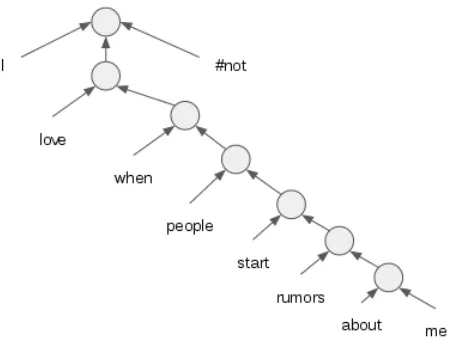
I love when people start rumors about me. #not
[image:3.612.315.540.439.612.2]Hashtag #not is attached to root of parse tree using Part-of-speech tag (HT) (Figure 1).
Figure 1:parse tree with Hashtag
4 Recursive SVM
Feature Type Feature
Node wi
Node wiposi
Node wiposibi
Node+Edge wi..wjposi..posjbi..posj
Node+Edge wi..wjposi..posjbi..posjci+1..cj
Node+Edge wi..wjposi..posjbi..posjci +
[image:4.612.73.302.70.173.2]1..cjoi+ 1..oj
Table 1:recursive SVM features
form, root form and part-of-speech respectively of lthword of S, while ni denotes the ith node and pi,
hi, and oi denote phrase, head node and offensive
word-marker of the ith node respectively. The 0th
node is the root node, while si and sai denote the
predicted values of sentiment polarity and sarcastic polarity of the constituency subtrees whose root is the ithnode, (si∈+1, 0, sai∈+1, 0). Table 1 shows
training vectors (xi ∈ <n, i = 0, .. , n) where yi =
1, 0 is the label for the ith node. As the number of
parameters is larger than the number of instances, dual-based solvers offer the best fit for this problem. Through grid-search, the optimum penalty value (C) is determined and set to 1000 and 2000 for senti-ment and sarcasm detection respectively. The stop-ping tolerance value was set to -0.0001. Among the variation of different loss functions, L2-regularized L1-loss and L2-loss function yielded the best results.
5 Neural network
Semantic modelling of sentence meaning using neu-ral networks has been a target of attention in the social media community. Neural network archi-tectures, such as CNN, DNN, RNN, and Recur-sive Neural Networks (RecNN) have shown excel-lent capabilities for modelling complex word com-position in a sentence. A sarcastic text can be con-sidered elementally as a sequence of text signals or word combinations. RNN is a perfect fit for mod-elling temporal text signals as it includes a tempo-ral memory component, which allows the model to store the temporal contextual information directly in the model. It can aggregate the entire sequence into a temporal context that is free of explicit size constraints. Among the many implementations of RNNs, LSTMs are easy to train and do not suffer from vanishing or exploding gradients while
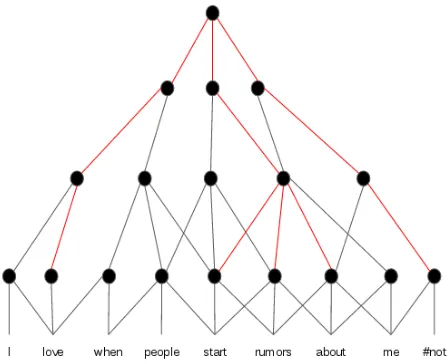
per-Figure 2:Sentence modelling with CNN
forming back propagation through time. LSTM has the capability to remember long distance tem-poral dependencies. Moreover, as they performs temporal text modelling over input features, higher level modelling can distinguish factors of linguis-tic variation within the input. CNNs can also cap-ture temporal text sequence through convolutional filters. CNNs reduce frequency variation and convo-lutional filters connect a subset of the feature space that is shared across the entire input (Chan and Lane, 2015). (Dos Santos et al., 2015) have shown that CNNs can directly capture temporal text patterns for shorter texts, yet in longer texts, where temporal text patterns may span across 15 to 20 words, CNNs must rely on higher-level fully connected layers to model long distance dependencies as the maximum convolutional filter width for a text is 5 (Figure 2).
[image:4.612.315.539.73.255.2]DNN, added on top of an LSTM network, can pro-vide better classification by mapping between output and hidden variables by transforming features into an output space. In the following section we define our proposed network in detail.
5.1 Input layer
Consider a tweet as input containing n words. The tweet is converted into a vector by replacing each word with its dictionary indexs∈ <1×n. To resolve
different lengths of input, the tweet vector is padded and the tweet is converted into matrix s ∈ <1×l,
wherelis the maximum length of tweets in the in-put corpus. The inin-put vector is fed to the embedding layer which converts each word into a distributional vector of dimension D. Thus the input tweet matrix is converted tos∈ <l×D.
5.2 Convolutional network
The aim of a convolution network is to reduce fre-quency variation through convolutional filters and extracting discriminating word sequences as a com-posite feature map for the LSTM layer. The con-volution operation maps the input matrixs ∈ <l×D
into c ∈ <|s|+m−1 using a convolutional filterk ∈ <D×m. Each component is computed as follows:
ci = (s∗k)i =X k,j
(S:,i−m+1:i⊗F)kj (1)
Convolution filter, which has the same dimension D of the input matrix, which slides along the column dimension of the input matrix, performing an ele-ment wise product between a column slice s and a filter matrixkproducing a vector componentci and
summed to create a feature mapc ∈ R1(|s|m+1). f filters create a feature map C ∈ Rf(|s|m+1). We choseSigmoidfor non-linearity. Initially we passed the output of the convolutional network through a
pooling layer and max-pooling is used with size 2
and 3. Later, we discarded the max-poolinglayer and fed the LSTM network with all of the compos-ite features to judge sarcasm, which improved the performance of the model.
5.3 LSTM
RNN has demonstrated the power of semantic mod-elling quite efficiently by incorporating feedback cy-cles in the network architecture. RNN networks
in-clude a temporal memory component, which allows the model to store the temporal contextual informa-tion directly in the model. At each time step, it con-siders the current input xt and hidden state ht−1. Thus the RNN is unable to plot long term depen-dencies if the gap between two time steps becomes too large. (Hochreiter and Schmidhuber, 1997) in-troduced LSTM, which is able to plot long term dependencies by defining each memory cell with a set of gates <d, where d is the memory
dimen-sion of hidden state of LSTM, and it does not suf-fer from vanishing or exploding gradient while per-forming back propagation through time. LSTM con-tains three gates, which are functions ofxtandht−1: input gateit, forget gateft, and output gateot. The
gates jointly decide on the memory update mecha-nism. Equation (3) and (2) denote the amount of information to be discarded or to be stored from and to store in memory. Equation (5) denotes the output of the cellct.
it=σ(Wi[ht−1, xt] +bi) (2)
ft=σ(Wf[ht−1, xt] +bf) (3)
qt=tanh(Wq[ht−1, xt] +bq) (4)
ot=σ(Wo[ht−1, xt] +bo) (5)
ct=ftct−1+itqt (6)
ht=ottanh(ct) (7)
5.4 Deep Neural Network Layer
The output of LSTM layer is passed to a fully con-nected DNN layer, which produces a higher order feature set based on the LSTM output, which is eas-ily separable for the desired number of classes. Fi-nally a softmax layer is added on top of the DNN layer. Training of network is performed by mini-mizing the binary cross-entropy error. For parame-ter optimization, we have used ADAM (Kingma and Ba, 2014) with the learning rate set to 0.001.
6 Experiment
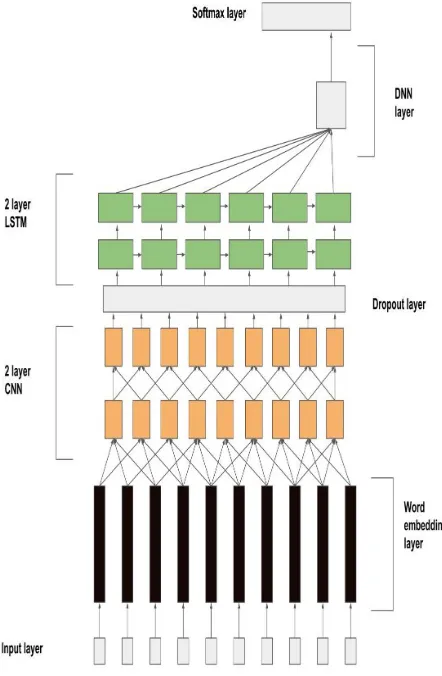
Figure 3:Neural network
set to 256. We tested our model with different set-tings of the hyperparameters for CNN (number of filter, filter size), LSTM (hidden memory dimension, dropout ratio), and DNN (number of hidden mem-ory units (HMU)). Initially we passed the output of CNN via amaxdropout layer, withmaxpoolingsize 2 and 3, to the LSTM, but later we dropped the max-pooling layer, which improved the performance by 2%.
In our experiment, apart from the combination of CNN, LSTM, and DNN, we observed the per-formance for each of the neural networks individ-ually. The CNN network is investigated by varying the number of filters and the filter widths, set to 64, 128, 256 and 2, 3 respectively. For the LSTM net-work, the number of memory units is varied from 64 to 256. Sigmoidis chosen as activation function for both networks. We used Gaussian initialization scaled by the fan-in and the fan-out for the
embed-ding layer and Gaussian initialization scaled by the fan-in for the CNN, the LSTM, and the DNN layer as initial probability distribution. The code was im-plemented usingkeras4library.
7 Experimental Analysis
In the neural network, success depends on the apt input and the selection of hyperparameters. As we observed that the inclusion of hashtag information in the recursive-SVM method gained a better F-score, we pertained the same input structure for the neural network. Apart from difficulties in training a neu-ral network, enormous training time is another pas-sive obstacle. We observed that compared to stacked LSTM network, the CNN-LSTM network converges faster as CNN reduces frequency variation and pro-duces better composite representation of the input to the LSTM network. Sarcasm detection is consid-ered a complex task, as very subtle contextual infor-mation often triggers the sarcastic notion. Thus we noticed that the inclusion of a dropout layer on top of the CNN layer, our model suffered a decrease in performance. In the testing dataset, we observed an interesting example.
I don’t know about you man but I love the history homework.
With the dropout layer, model identified above mentioned example as non-sarcastic, yet without the dropout layer, our model labeled it as sarcastic. This indicates that the word ”man”, which functions as an intensifier of sarcasm in this context, was dropped out from the output of the CNN layer. Also we observed that incrementing the filter width of the CNN layer boosted the performance of our model by a small margin. To obtain the apt network size, we have also trained with bigger network sizes and larger filter widths, but no improvement has been observed. Table 2 contains the experimental results over our dataset.
Sarcasm is a very subjective phenomenon. Even for the human annotators, it was quite hard to decide if the speaker was sarcastic or not. It was interest-ing to observe the performance of our model when human annotators interpreted differently. Since our
Model Feature/Hyper parameter Precision Recall F-score
recursive SVM BOW + POS .719 .613 .663
recursive SVM BOW + POS + Sentiment .722 .661 .691
recursive SVM BOW + POS + Sentiment + HT-splitter .743 .721 .732
CNN + CNN
filter size = 64 + filter width = 2 .838 .857 .847 filter size = 128 + filter width = 2 .842 .86 .854 filter size = 256 + filter width = 2 .855 .879 .868 filter size = 64 + filter width = 3 .839 .854 .847 filter size = 128 + filter width = 3 .856 .879 .868 filter size = 256 + filter width = 3 .861 .882 .872
LSTM + LSTM
hidden memory unit = 64 .849 .816 .832 hidden memory unit = 128 .854 .871 .862 hidden memory unit = 256 .868 .89 .879 CNN + LSTM + DNN (with
dropout) filter size = 256 + filter width = 2 + HMU= 256 .899 .91 .904 CNN + LSTM + DNN (without
dropout) filter size = 256 + filter width = 2 + HMU= 256 .912 .911 .912 CNN + LSTM + DNN (without
[image:7.612.74.541.71.351.2] [image:7.612.92.280.386.536.2]dropout) filter size = 256 + filter width = 3 + HMU= 256 .919 .923 .921 Table 2:Experimental Results
Figure 4:Performance evaluation of model
dataset contains 3 annotations per tweet, we ob-tained 4 different values for an average sarcasm score from the annotations. We divided the dataset based on the average sarcasm score and observed the performance of the model in each section. From fig-ure 4, we observed that our model performed better for distinct sarcastic data than distinct non-sarcastic data. For dicey examples of sarcasm, where the av-erage sarcasm score is between .7 and .3, our model performed better with non-sarcastic data than
sar-castic data.
dataset Model P R F1
riloff
riloff method .44 .62 .51
CNN + LSTM + DNN + filter size = 256 + filter width = 2
.882 .861 .872
CNN + LSTM + DNN + filter size = 256 + filter width = 3
.883 .879 .881
tsur
SASI .912 .756 .827
CNN + LSTM + DNN + filter size = 256 + filter width = 2
.878 .901 .889
CNN + LSTM + DNN + filter size = 256 + filter width = 3
[image:7.612.312.543.394.661.2].894 .912 .901
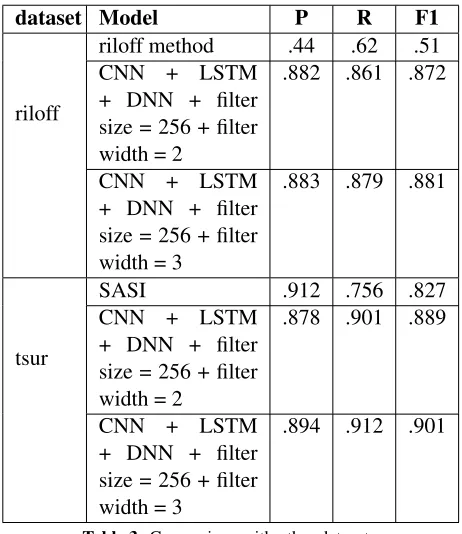
Table 3:Comparison with other datasets
that our model has performed with a better f-score than both of the systems, but it has a lower precision value than SASI (Davidov et al., 2010).
8 Twitter Bot
In NLP research, building a carefully crafted corpus has always played a crucial role. In recent research, Twitter has been used as an excellent source for var-ious NLP tasks due to its topicality and availability. While sharing previous datasets, due to copyright and privacy concerns, researchers are forced to share only tweet identifiers along with annotations instead of the actual text of each tweet. As a tweet is a per-ishable commodity and may be deleted, archived or otherwise made inaccessible over time by their orig-inal creators, resources are lost in the course of time. Following our idea of retweeting via a dedicated account (@onlinesarcasm) to refrain tweets from perishing without copyright infringement, we have retweeted only detected sarcastic tweets. Regard-ing the quality assurance of the automated retweets, we observed that a conflict between human anno-tation and the output of the model is negligible for those tweets predicted with a softmax class proba-bility higher than 0.75.
9 Conclusion & Future work
Sarcasm is a complex phenomenon and it is linguis-tically and semanlinguis-tically rich. By exploiting the se-mantic modelling power of the neural network, our model has outperformed existing sarcasm detection systems with a f-score of .92. Even though our model performs very well in sarcasm detection, it still lacks an ability to differentiate sarcasm with similar concepts. As an example, our model clas-sified “I Just Love Mondays!”correctly as sarcasm, but it failed to classify “Thank God It’s Monday!”
as sarcasm, even though both are similar at the con-ceptual level. Feeding the model with word2vec5to
find similar concepts may not be beneficial, as not every similar concept employs sarcasm. For
exam-ple, “Thank God It’s Friday!”is non-sarcastic in
nature. For future works, selective use of word2vec can be exploited to improve the model. Also per-forming a trend analysis from the our twitter bot
5https://code.google.com/archive/p/word2vec/
can also benefit the system to separate the semantic space of sarcasm and non-sarcasm more efficiently.
Acknowledgments
This research is supported by Science Founda-tion Ireland (SFI) as a part of the CNGL Centre for Global Intelligent Content at UCD (Grant No: CNGLII, R13645).
References
Marco Baroni and Roberto Zamparelli. 2010. Nouns are vectors, adjectives are matrices: Representing adjective-noun constructions in semantic space. In
Proceedings of the 2010 Conference on Empiri-cal Methods in Natural Language Processing, pages 1183–1193. Association for Computational Linguis-tics.
Penelope Brown and Stephen C Levinson. 1978. Uni-versals in language usage: Politeness phenomena. In
Questions and politeness: Strategies in social interac-tion.
William Chan and Ian Lane. 2015. Deep convolu-tional neural networks for acoustic modeling in low resource languages. InIEEE International Conference on Acoustics, Speech and Signal Processing.
Dmitry Davidov, Oren Tsur, and Ari Rappoport. 2010. Semi-supervised recognition of sarcastic sentences in twitter and amazon. In Proceedings of the Four-teenth Conference on Computational Natural Lan-guage Learning, pages 107–116. Association for Computational Linguistics.
Shelly Dews and Ellen Winner. 1995. Muting the mean-ing a social function of irony. Metaphor and Symbol, 10(1):3–19.
Shelly Dews and Ellen Winner. 1999. Obligatory pro-cessing of literal and nonliteral meanings in verbal irony. Journal of pragmatics, 31(12):1579–1599. Cıcero Nogueira Dos Santos, Bing Xiang, and Bowen
Zhou. 2015. Classifying relations by ranking with convolutional neural networks. InProceedings of the 53rd Annual Meeting of the Association for Computa-tional Linguistics and the 7th InternaComputa-tional Joint Con-ference on Natural Language Processing, volume 1, pages 626–634.
Jacob Eisenstein. 2013. What to do about bad language on the internet. InHLT-NAACL, pages 359–369. 2007.Irony in language and thought: A cognitive science
reader. Psychology Press.
Roberto Gonz´alez-Ib´anez, Smaranda Muresan, and Nina Wacholder. 2011. Identifying sarcasm in twitter: a closer look. InProceedings of the 49th Annual Meet-ing of the Association for Computational LMeet-inguistics: Human Language Technologies: short papers-Volume 2, pages 581–586. Association for Computational Lin-guistics.
Emiliano Guevara. 2010. A regression model of adjective-noun compositionality in distributional se-mantics. In Proceedings of the 2010 Workshop on GEometrical Models of Natural Language Semantics, pages 33–37. Association for Computational Linguis-tics.
Sepp Hochreiter and J¨urgen Schmidhuber. 1997. Long short-term memory. Neural computation, 9(8):1735– 1780.
Nal Kalchbrenner, Edward Grefenstette, and Phil Blun-som. 2014. A convolutional neural network for mod-elling sentences. arXiv preprint arXiv:1404.2188. Diederik Kingma and Jimmy Ba. 2014. Adam: A
method for stochastic optimization. arXiv preprint arXiv:1412.6980.
Roger J. Kreuz and Gina M. Caucci. 2007. Lexical influ-ences on the perception of sarcasm. InProceedings of the Workshop on Computational Approaches to Figu-rative Language.
Roger J Kreuz and Sam Glucksberg. 1989. How to be sarcastic: The echoic reminder theory of verbal irony.
Journal of Experimental Psychology: General. CC Liebrecht, FA Kunneman, and APJ van den Bosch.
2013. The perfect solution for detecting sarcasm in tweets #not.
Stephanie Lukin and Marilyn Walker. 2013. Really? well. apparently bootstrapping improves the perfor-mance of sarcasm and nastiness classifiers for online dialogue. In Proceedings of the Workshop on Lan-guage Analysis in Social Media, pages 30–40. Prodromos Malakasiotis. 2011. Paraphrase and Textual
Entailment Recognition and Generation. Ph.D. thesis, Ph. D. thesis, Department of Informatics, Athens Uni-versity of Economics and Business, Greece.
Jeff Mitchell and Mirella Lapata. 2008. Vector-based models of semantic composition. InACL, pages 236– 244.
Jeff Mitchell and Mirella Lapata. 2010. Composition in distributional models of semantics. Cognitive science, 34(8):1388–1429.
Tetsuji Nakagawa, Kentaro Inui, and Sadao Kurohashi. 2010. Dependency tree-based sentiment classification using crfs with hidden variables. InHuman Language Technologies: The 2010 Annual Conference of the North American Chapter of the Association for Com-putational Linguistics, pages 786–794. Association for Computational Linguistics.
Ellen Riloff, Ashequl Qadir, Prafulla Surve, Lalindra De Silva, Nathan Gilbert, and Ruihong Huang. 2013. Sarcasm as contrast between a positive sentiment and negative situation. InEMNLP, pages 704–714. Richard Socher, Jeffrey Pennington, Eric H Huang,
An-drew Y Ng, and Christopher D Manning. 2011. Semi-supervised recursive autoencoders for predicting sen-timent distributions. InProceedings of the Conference on Empirical Methods in Natural Language Process-ing, pages 151–161. Association for Computational Linguistics.
Oren Tsur, Dmitry Davidov, and Ari Rappoport. 2010. Icwsm-a great catchy name: Semi-supervised recogni-tion of sarcastic sentences in online product reviews. InICWSM.
A. Utsumi. 2000. Verbal irony as implicit display of ironic environment: Distinguishing ironic utterances from nonirony. Journal of Pragmatics.
Pascal Vincent, Hugo Larochelle, Yoshua Bengio, and Pierre-Antoine Manzagol. 2008. Extracting and com-posing robust features with denoising autoencoders. In