Embedding a Semantic Network in a Word Space
Richard Johansson and Luis Nieto Pi˜na
Spr˚akbanken, Department of Swedish, University of Gothenburg Box 200, SE-40530 Gothenburg, Sweden
{richard.johansson, luis.nieto.pina}@svenska.gu.se
Abstract
We present a framework for using continuous-space vector representations of word meaning to derive new vectors representing the mean-ing ofsenseslisted in a semantic network. It is a post-processing approach that can be ap-plied to several types of word vector represen-tations. It uses two ideas: first, that vectors for polysemous words can be decomposed into a convex combination of sense vectors; sec-ondly, that the vector for a sense is kept sim-ilar to those of its neighbors in the network. This leads to a constrained optimization prob-lem, and we present an approximation for the case when the distance function is the squared Euclidean.
We applied this algorithm on a Swedish se-mantic network, and we evaluate the quality of the resulting sense representations extrinsi-cally by showing that they give large improve-ments when used in a classifier that creates lexical units for FrameNet frames.
1 Introduction
Representing word meaning computationally is cen-tral in natural language processing. Manual, knowledge-based approaches to meaning represen-tation maps word strings to symbolic concepts, which can be described using any knowledge rep-resentation framework; using the relations between concepts defined in the knowledge base, we can in-fer implicit facts from the information stated in a text: amouseis arodent, so it has prominentteeth.
Conversely, data-driven meaning representation approaches rely on cooccurrence patterns to derive a vector representation (Turney and Pantel, 2010). There are two classes of methods that compute word vectors: context-counting and context-predicting;
while the latter has seen much interest lately, their respective strengths and weaknesses are still being debated (Baroni et al., 2014; Levy and Goldberg, 2014). The most important relation defined in a vec-tor space between the meaning of two words is sim-ilarity: amouseis something quite similar to arat. Similarity of meaning is operationalized in terms of geometry, by defining a distance metric.
Symbolic representations seem to have an advan-tage in describing word sense ambiguity: when a surface form corresponds to more than one concept. For instance, the wordmouse can refer to arodent
or anelectronic device. Vector-space representations typically represent surface forms only, which makes it hard to search e.g. for a group of words similar to the rodent sense of mouseor to reliably use the vectors in classifiers that rely on the semantics of the word. There have been several attempts to create vectors representing senses, most of them based on some variant of the idea first proposed by Sch¨utze (1998): that senses can be seen as clusters of similar contexts. Recent examples in this tradition include the work by Huang et al. (2012) and Neelakantan et al. (2014). However, because sense distributions are often highly imbalanced, it is not clear that context clusters can be reliably created for senses that occur rarely. These approaches also lack interpretability: if we are interested in the rodent sense of mouse, which of the vectors should we use?
In this work, we instead derive sense vectors by embedding the graph structure of a semantic net-work in the word space. By combining two com-plementary sources of information – corpus statis-tics and network structure – we derive useful vec-tors also for concepts that occur rarely. The method, which can be applied to context-counting as well as context-predicting spaces, works by
ing word vectors as linear combinations of sense vectors, and by pushing the sense vectors towards their neighbors in the semantic network. This in-tuition leads to a constrained optimization problem, for which we present an approximate algorithm.
We applied the algorithm to derive vectors for the senses in a Swedish semantic network, and we evaluated their quality extrinsically by using them as features in a semantic classification task – map-ping senses to their corresponding FrameNet frames. When using the sense vectors in this task, we saw a large improvement over using word vectors.
2 Embedding a Semantic Network
The goal of the algorithm is to embed the seman-tic network in a geometric space: that is, to asso-ciate each sensesij with asense embedding, a
vec-torE(sij)of real numbers, in a way that reflects the
topology of the semantic network but also that the vectors representing the lemmas are related to those corresponding to the senses. We now formalize this intuition, and we start by introducing some notation. For each lemmali, there is a set of possible senses
si1, . . . , simi for which li is a surface realization.
Furthermore, for each sensesij, there is a neighbor-hoodconsisting of senses semantically related tosij.
Each neighbornijkofsij is associated with a weight
wijkrepresenting the degree of semantic relatedness
betweensij andnijk. How we define the
neighbor-hood, i.e. our notion of semantical relatedness, will obviously have an impact on the result. In this work, we simply assume that it can be computed from the network, e.g. by picking a number of hypernyms and hyponyms in a lexicon such as WordNet. We then assume that for each lemma li, we have aD
-dimensional vector F(li)of real numbers; this can
be computed using any method described in Section 1. Finally, we assume a distance function ∆(x, y) that returns a non-negative real number for each pair of vectors inRD.
The algorithm maps each sensesij to a sense
em-bedding, a real-valued vector E(sij) in the same
vector space as the lemma embeddings. The lemma and sense embeddings are related through amix con-straint: F(li) is decomposed as a convex
combi-nation PjpijE(sij), where the {pij} are picked
from the probability simplex. Intuitively, the mix
variables correspond to the occurrence probabilities of the senses, but strictly speaking this is only the case when the vectors are built using simple context counting. Since the mix gives an estimate of which sense is the most frequent in the corpus, we get a strong baseline for word sense disambiguation (Mc-Carthy et al., 2007) as a bonus; see our followup paper (Johansson and Nieto Pi˜na, 2015) for a dis-cussion of this.
We can now formalize the intuition above: the weighted sum of distances between each sense and its neighbors is minimized, while satisfying the mix constraint for each lemma. We get the following constrained optimization program:
minimize
E,p
X
i,j,k
wijk∆(E(sij), E(nijk))
subject to X
j
pijE(sij) =F(li) ∀i
X
j
pij = 1 ∀i
pij ≥0 ∀i, j
(1)
The mix constraints make sure that the solution is nontrivial. In particular, a very large number of words are monosemous, and the procedure will leave the embeddings of these words unchanged. 2.1 An Approximate Algorithm
The difficulty of solving the problem stated in Equa-tion (1) obviously depends on the distance funcEqua-tion ∆. Henceforth, we focus on the case where ∆ is the squared Euclidean distance. This is an impor-tant special case that is related to a number of other distances or similarities, e.g. cosine similarity and Hellinger distance. In this case, (1) is a quadratically constrained quadratic problem, which is NP-hard in general and difficult to handle with off-the-shelf op-timization tools. We therefore resort to an approx-imation; we show empirically in Sections 3 and 4 that it works well in practice.
The approximate algorithm works in an online fashion by considering one lemma at a time. It ad-justs the embeddings of the senses as well as their mix in order to minimize the loss function
Li =
X
jk
The embeddings of the neighborsnijk of the sense
are kept fixed at each such step. We iterate through the whole set of lemmas for a fixed number of epochs or until the objective is unchanged.
Furthermore, instead of directly optimizing with respect to the sense embeddings (which involves mi ·D scalars), the sense embeddings (and
there-fore also the lossLi) can be computed analytically if
the mix variablespi1, . . . , pimiare given, so we have
reduced the optimization problem to one involving mi−1scalars, i.e. it is univariate in most cases.
Given a sense sij of a lemma li, we define the weighted centroidof the set of neighbors ofsij as
cij =
P
kPwijkE(nijk)
kwijk . (3)
If the mix constraints were removed, cij would be
the solution to the optimization problem: they min-imize the weighted sum of squared Euclidean dis-tances to the neighbors. Then, given the mix, the
residualis defined
ri= X 1
j
p2
ij
P
kwijk
X
j
pijcij−F(li)
. (4)
The vectorri represents the difference between the
linear combination of the weighted centroids and the lemma embedding. Finally, we the sense embed-dings for the lemmalibecome
E(sij) =cij −Ppij
kwijkri. (5)
Equations (4) and (5) show the role of the mix vari-ables: ifpij = 0, then the sense embeddingE(sij)is
completely determined by the neighbors of the sense (that is, it is equal to the weighted centroid). On the other hand, ifpij = 1, then the sense embedding
be-comes equal to the embedding of the lemma,F(li).
To optimize the mix variablespi1, . . . , pimi with
re-spect to the lossLi, basically any search procedure
could be used; we found it easiest to use a variant of a simple randomized gradient-free search method (Matyas, 1965).
3 Application to Swedish Data
The algorithm described in Section 2 was applied to Swedish data: we started with lemma embeddings computed from a corpus, and then created sense em-beddings by using the SALDO semantic network (Borin et al., 2013). The algorithm was run for a few epochs, which seemed to be enough for reach-ing a plateau in performance; the total runtime of the algorithm was a few minutes.
3.1 Creating Lemma Embeddings
We created a corpus of 1 billion words downloaded from Spr˚akbanken, the Swedish language bank.1
The corpora are distributed in a format where the text has been tokenized, part-of-speech-tagged and lemmatized. Compounds have been segmented au-tomatically and when a lemma was not listed in SALDO, we used the parts of the compounds in-stead. The input to the software computing the lemma embedding consisted of lemma forms with concatenated part-of-speech tags, e.g. dricka..vb
for the verb ‘to drink’ and dricka..nnfor the noun ‘drink’. We used theword2vectool2 to build the
lemma embeddings. All the default settings were used, except the vector space dimensionality which was set to 512.
3.2 SALDO, a Swedish Semantic Network SALDO (Borin et al., 2013) is the largest freely available lexical resource for Swedish. We used a version from May 2014, which contains 125,781 entries organized into a single semantic network. Compared to WordNet (Fellbaum, 1998), there are similarities but also significant differences. Most significantly, SALDO is organized according to the lexical-semantic relation ofassociation, notis-aas in WordNet. In SALDO, when we go up in the hierarchy we move from specialized vocabulary to the most central vocabulary of the language (e.g. ‘move’, ‘want’, ‘who’); in WordNet we move from specific to abstract (e.g. ‘entity’). Another differ-ence is that sense distinctions in SALDO tend to be more coarse-grained than in WordNet.
Each entry except a special root is connected to other entries, its semantic descriptors. One of the
1http://spraakbanken.gu.se
semantic descriptors is called the primary descrip-tor: this is the semantic neighbor that is conceptu-ally most central. Primary descriptors are most of-ten hypernyms or synonyms, but they can also be e.g. antonyms or meronyms, or be in an argument– predicate relationship with the entry. To exemplify, we consider the word rock, which has two senses: a long coat and rock music, respectively. Its first sense has the primary descriptorkappa‘coat’, while for the second sense it ismusik‘music’.
When embedding the SALDO network using the algorithm in Section 2, the neighbors nijk of a
SALDO sense sij are its primary descriptor and
inverse primaries (the senses for which sij is the
primary descriptor). We did not use any descrip-tors beside the primary. The neighborhood weights were set so that the primary descriptor and the set of inverse primaries were balanced, and so that all weights sum to 1. If there were N inverse pri-maries, we set the weight of the primary descriptor to 12 and of each inverse primary to 21N. We did not see any measurable effect of using a larger set of neighbors (e.g. adding connections to second-order neighbors).
3.3 Inspection of Sense Embeddings
Table 1 shows a list of the nearest neighbors of the two senses ofrock; as we can see, both lists make sense semantically. (A similar query among the lemma embeddings returns a list almost identical to that of the second sense.)
rock-1 ‘coat’ rock-2 ‘rock music’
syrtut-1 ‘overcoat’ punk-1 ‘punk music’
k˚apa-2 ‘cloak’ pop-1 ‘pop music’
kappa-1 ‘coat’ soul-1 ‘soul music’
kavaj-1 ‘blazer’ h˚ardrock-1 ‘hard rock’
jacka-1 ‘jacket’ hot-2 ‘hot jazz’
Table 1: The senses closest to the two senses ofrock.
A more difficult and interesting use case, where corpus-based methods clearly have an advantage over knowledge-based methods, is to search among the lemmas that have occurred in the corpus but which are not listed in SALDO. Table 2 shows the result of this search, and again the result is very use-ful. We stress that the list for the first sense would
have been hard to derive in a standard word vector space, due to the dominance of the music sense.
rock-1 ‘coat’ rock-2 ‘rock music’
midjekort‘doublet’ indie‘indie’
trekvarts¨arm‘3/4 sleeve’ indierock‘indie rock’
spetsbh‘lace bra’ doo-wop‘doo-wop’
bl˚ajeans‘blue jeans’ psykedelia‘psychedelia’
treggings‘treggings’ R&B‘R&B’
Table 2: The unlisted lemmas closest to the two senses ofrock.
4 Evaluation
Evaluating intrinsically using e.g. a correlation be-tween a graph-based similarity measure and geo-metric similarity would be problematic, since this is in some sense what our algorithm optimizes. We therefore evaluate extrinsically, by using the sense vectors in a classifier that maps senses to semantic classes defined by FrameNet (Fillmore and Baker, 2009). FrameNet is a semantic database consisting of two parts: first, an ontology ofsemantic frames– the classes – and secondly a lexicon that maps word senses to frames. In standard FrameNet terminol-ogy, the senses assigned to a frame are called its
lexical units(LUs). Coverage is often a problem in frame-semantic lexicons, and this has a negative im-pact on the quality of NLP systems using FrameNet (Palmer and Sporleder, 2010). The task of finding LUs for frames is thus a useful testbed for evaluat-ing lemma and sense vectors.
To evaluate, we used 567 frames from the Swedish FrameNet (Friberg Heppin and Toporowska Gronostaj, 2012); in total we had 28,842 verb, noun, adjective, and adverb LUs, which we split into training (67%) and test sets (33%). For each frame, we trained a SVM with LIBLINEAR(Fan et al., 2008), using the LUs in that
frame as positive training instances, and all other LUs as negative instances. Each LU was repre-sented as a vector: its lemma or sense embedding normalized to unit length.
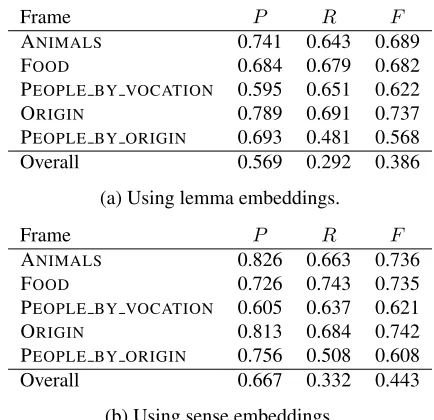
out of the five largest frames, the classifiers using sense vectors clearly outperform those using lemma vectors. The frame where we do not see any im-provement by introducing sense distinctions, PEO -PLE BY VOCATION, contains terms for professions
such aspainter andbuilder; since SALDO derives such terms from their corresponding verbs rather than from a common hypernym (e.g. worker), they do not form a coherent subnetwork in SALDO or subregion in the embedding space.
Frame P R F
ANIMALS 0.741 0.643 0.689
FOOD 0.684 0.679 0.682
PEOPLE BY VOCATION 0.595 0.651 0.622 ORIGIN 0.789 0.691 0.737 PEOPLE BY ORIGIN 0.693 0.481 0.568 Overall 0.569 0.292 0.386
(a) Using lemma embeddings.
Frame P R F
ANIMALS 0.826 0.663 0.736
FOOD 0.726 0.743 0.735
PEOPLE BY VOCATION 0.605 0.637 0.621 ORIGIN 0.813 0.684 0.742 PEOPLE BY ORIGIN 0.756 0.508 0.608 Overall 0.667 0.332 0.443
[image:5.612.79.296.199.409.2](b) Using sense embeddings.
Table 3: FrameNet lexical unit classification.
5 Conclusion
We have presented a new method to embed a se-mantic network consisting of linked word senses into a continuous-vector word space; the method is agnostic about whether the original word space was produced using a counting or context-predicting method. Unlike previous approaches for creating sense vectors, since we rely on the network structure, we can create representations for senses that occur rarely in corpora. While the experiments described in this paper have been carried out using a Swedish corpus and semantic network, the algo-rithm we have described is generally applicable and the software3can be applied to other languages and
semantic networks.
3http://demo.spraakdata.gu.se/richard/scouse
The algorithm takes word vectors and uses them and the network structure to induce the sense vec-tors. It is based on two separate ideas: first, sense embeddings should preserve the structure of the se-mantic network as much as possible, so two senses should be close if they are neighbors in the graph; secondly, the word vectors are a probablistic mix of sense vectors. These two ideas are stated as an opti-mization problem where the first becomes the objec-tive and the second a constraint. While this is hard to solve in the general case, we presented an approx-imation that can be applied when using the squared Euclidean distance.
We implemented the algorithm and used it to em-bed the senses of a Swedish semantic network into a word space produced using the skip-gram model. While a qualitative inspection of nearest-neighbor lists of a few senses gives very appealing results, our main evaluation was extrinsic: a FrameNet lexical unit classifier saw a large performance boost when using sense vectors instead of word vectors.
In a followup paper (Johansson and Nieto Pi˜na, 2015), we have shown that sense embeddings can be used to build an efficient word sense disambiguation system that is much faster than graph-based systems with a similar accuracy, and that the mix variables can be used to predict the predominant sense of a word. In future work, we plan to investigate whether the sense vectors are useful for retrieving rarely oc-curring senses in corpora. Furthermore, since we now evaluated extrinsically, it would be useful to de-vise intrinsic sense-based evaluation schemes, e.g. a sense analogy task similar to the word analogy task used by Mikolov et al. (2013).
Acknowledgments
This research was funded by the Swedish Re-search Council under grant 2013–4944, Distribu-tional methods to represent the meaning of frames and constructions, and grant 2012–5738,Towards a knowledge-based culturomics. The evaluation mate-rial used in this work was developed in the project
References
Marco Baroni, Georgiana Dinu, and Germ´an Kruszewski. 2014. Don’t count, predict! a systematic compari-son of context-counting vs. context-predicting seman-tic vectors. InProceedings of the 52nd Annual Meet-ing of the Association for Computational LMeet-inguistics (Volume 1: Long Papers), pages 238–247, Baltimore, United States.
Lars Borin, Markus Forsberg, and Lennart L¨onngren. 2013. SALDO: a touch of yin to WordNet’s yang.
Language Resources and Evaluation, 47(4):1191– 1211.
Rong-En Fan, Kai-Wei Chang, Cho-Jui Hsieh, Xiang-Rui Wang, and Chih-Jen Lin. 2008. LIBLINEAR: A li-brary for large linear classification. Journal of Ma-chine Learning Research, 9:1871–1874.
Christiane Fellbaum, editor. 1998. WordNet: An elec-tronic lexical database. MIT Press.
Charles J. Fillmore and Collin Baker. 2009. A frames ap-proach to semantic analysis. In B. Heine and H. Nar-rog, editors,The Oxford Handbook of Linguistic Anal-ysis, pages 313–340. Oxford: OUP.
Karin Friberg Heppin and Maria Toporowska Gronostaj. 2012. The rocky road towards a Swedish FrameNet – creating SweFN. InProceedings of the Eighth confer-ence on International Language Resources and Evalu-ation (LREC-2012), pages 256–261, Istanbul, Turkey. Eric H. Huang, Richard Socher, Christopher D. Manning,
and Andrew Y. Ng. 2012. Improving word repre-sentations via global context and multiple word pro-totypes. InAssociation for Computational Linguistics 2012 Conference (ACL 2012), pages 41–48, Boston, United States.
Richard Johansson and Luis Nieto Pi˜na. 2015. Combin-ing relational and distributional knowledge for word sense disambiguation. In Proceedings of the 20th Nordic Conference of Computational Linguistics, Vil-nius, Lithuania.
Omer Levy and Yoav Goldberg. 2014. Linguistic regu-larities in sparse and explicit word representations. In
Proceedings of the Eighteenth Conference on Compu-tational Natural Language Learning, pages 171–180, Ann Arbor, United States.
J. Matyas. 1965. Random optimization. Automation and Remote Control, 26(2):246–253.
Diana McCarthy, Rob Koeling, Julie Weeds, and John Carroll. 2007. Unsupervised acquisition of pre-dominant word senses. Computational Linguistics, 33(4):553–590.
Tom´aˇs Mikolov, Wen-tau Yih, and Geoffrey Zweig. 2013. Linguistic regularities in continuous space word representations. In Proceedings of the 2013 Confer-ence of the North American Chapter of the
Associa-tion for ComputaAssocia-tional Linguistics: Human Language Technologies, pages 746–751, Atlanta, USA.
Arvind Neelakantan, Jeevan Shankar, Alexandre Pas-sos, and Andrew McCallum. 2014. Efficient non-parametric estimation of multiple embeddings per word in vector space. InProceedings of the 2014 Con-ference on Empirical Methods in Natural Language Processing (EMNLP), pages 1059–1069, Doha, Qatar, October.
Alexis Palmer and Caroline Sporleder. 2010. Evaluating FrameNet-style semantic parsing: the role of coverage gaps in FrameNet. In Coling 2010: Posters, pages 928–936, Beijing, China.
Hinrich Sch¨utze. 1998. Automatic word sense discrimi-nation. Computational Linguistics, 24(1):97–123. Peter D. Turney and Patrick Pantel. 2010. From
fre-quency to meaning: Vector space models of semantics.