Cache-Augmented Latent Topic Language Models for Speech Retrieval
Jonathan Wintrode
Center for Language and Speech Processing Johns Hopkins University
Baltimore, MD
Abstract
We aim to improve speech retrieval perfor-mance by augmenting traditional N-gram lan-guage models with different types of topic context. We present a latent topic model framework that treats documents as arising from an underlying topic sequence combined with a cache-based repetition model. We ana-lyze our proposed modelbothfor its ability to capture word repetition via the cache and for its suitability as a language model for speech recognition and retrieval. We show this model, augmented with the cache, captures intuitive repetition behavior across languages and ex-hibits lower perplexity than regular LDA on held out data in multiple languages. Lastly, we show that our joint model improves speech re-trieval performance beyond N-grams or latent topics alone, when applied to a term detection task in all languages considered.
1 Introduction
The availability of spoken digital media continues to expand at an astounding pace. According to YouTube’s publicly released statistics, between Au-gust 2013 and February 2015 content upload rates have tripled from 100 to 300 hours of video per minute (YouTube, 2015). Yet the information con-tent therein, while accessible via links, tags, or other user-supplied metadata, is largely inaccessible via content search within the speech.
Speech retrieval systems typically rely on Large Vocabulary Continuous Speech Recognition (LVSCR) to generate a lattice of word hypotheses for each document, indexed for fast search (Miller
and others, 2007). However, for sites like YouTube, localized in over 60 languages (YouTube, 2015), the likelihood of high accuracy speech recognition in most languages is quite low.
Our proposed solution is to focus ontopic infor-mation in spoken language as a means of dealing with errorful speech recognition output in many lan-guages. It has been repeatedly shown that a task like topic classification is robust to high (40-60%) word error rate systems (Peskin, 1996; Wintrode, 2014b). We would leverage the topic signal’s strength for re-trieval in a high volume, multilingual digital media processing environment.
The English word topic, defined as a particu-lar ’subject of discourse’ (Houghton-Mifflin, 1997), arises from the Greek root,τoπoς, meaning a physi-cal ’place’ or ’location’. However, the semantic con-cepts of a particular subject are not disjoint from the physical location of the words themselves.
The goal of this particular work is to jointly model two aspects of topic information,local context (rep-etition) and broad context (subject matter), which we previously treated in an ad hoc manner (Win-trode and Sanjeev, 2014) in a latent topic frame-work. We show that in doing so we can achieve bet-ter word retrieval performance than language mod-els with only N-gram context on a diverse set of spo-ken languages.
2 Related Work
The use of both repetition and broad topic con-text have been exploited in a variety of ways by the speech recognition and retrieval communities. Cache-based or adaptive language models were
some of the first approaches to incorporate informa-tion beyond a short N-gram history (where N is typ-ically 3-4 words).
Cache-based models assume the probability of a word in a document d is influenced both by the global frequency of that word and N-gram context as well as by the N-gram frequencies ofd(or preceding cacheofKwords). Although most words are rare at the corpus level, when they do occur, they occur in bursts. Thus a local estimate, from the cache, may be more reliable than the global estimate. Jelinek (1991) and Kuhn (1990) both successfully applied these types of models for speech recognition, and Rosenfeld (1994), using what he referred to as ’trig-ger pairs’, also realized significant gains in WER. More recently, recurrent neural network language models (RNNLMs) have been introduced to capture more of these ”long-term dependencies” (Mikolov et al., 2010). In terms of speech retrieval, recent ef-forts have looked at exploiting repeated keywords at search time, without directly modifying the recog-nizer (Chiu and Rudnicky, 2013; Wintrode, 2014a).
Work within the information retrieval (IR) com-munity connects topicality with retrieval. Hearst and Plaunt (1993) reported that the ”subtopic structur-ing” of documents can improve full-document re-trieval. Topic models such as Latent Dirichlet Al-location (LDA) (Blei et al., 2003) or Probabilistic Latent Semantic Analysis (PLSA) (Hofmann, 2001) are used to the augment the document-specific lan-guage model in probabilistic, lanlan-guage-model based IR (Wei and Croft, 2006; Chen, 2009; Liu and Croft, 2004; Chemudugunta et al., 2007). In all these cases, topic information was helpful in boosting re-trieval performance above baseline vector space or N-gram models.
Our proposed model closely resembles that from Chemudugunta et al. (2007), with our notions of broad and local context corresponding to their ”gen-eral and specific” aspects. The unigram cache case of our model should correspond to their ”special words” model, however we do not constrain our cache component to only unigrams.
With respect to speech recognition, Florian and Yarowsky (Florian and Yarowsky, 1999) and Khu-danpur and Wu (KhuKhu-danpur and Wu, 1999) use vector-space clustering techniques to approximate the topic content of documents and augment a
Algorithm 1Cache-augmented generative process for allt∈ T do
draw φ(t)∼Dirichlet(β)
for alld∈ Ddo
draw θ(d)∼Dirichlet(α)
draw κ(d) ∼Beta(ν 0, ν1)
for wd,i,1≤i≤ |d|do
draw kd,i ∼Bernoulli(κ(d))
ifkd,i = 0then
draw zd,i ∼θ(d)
draw wd,i ∼φ(t=zd,i)
else
draw wd,i ∼Cache(d, W−i)
end if
baseline N-gram model with topic-specific N-gram counts. Clarkson and Robinson (1997) proposed a similar application of cache and mixture mod-els, but only demonstrate small perplexity improve-ments. Similar approaches use latent topic models to infer a topic mixture of the test document (soft clus-tering) with significant recognition error reductions (Heidel et al., 2007; Hsu and Glass, 2006; Liu and Liu, 2008; Huang and Renals, 2008). Instead of in-terpolating with a traditional backoff model, Chien and Chueh (2011) use topic models with and with-out a dynamic cache to good effect as a class-based language model.
We build on the cluster-oriented results, particu-larly Khudanpur and Wu (1997) and Wintrode and Khudanpur (2014), but within an explicit frame-work, jointly capturing both types of topic informa-tion that many have leveraged individually.
3 Cache-augmented Topic Model
We propose a straightforward extension of the LDA topic model (Blei et al., 2003; Steyvers and Griffiths, 2007), allowing words to be generatedeitherfrom a latent topic or from a document-level cache. At each word position we flip a biased coin. Based on the outcome we either generate a latent topic and then the observed word, or we pick a new word directly from the cache of already observed words. Thus we would jointly learn the underlying topics and the ten-dency towards repetition.
multinomial random variable in the size of the vo-cabulary whereφ(vt)is the probabilityP(wv|t). For
each document we drawθ(d), whereθ(d)
t is the
prob-abilityP(t|d).
We introduce two additional sets of variables,κ(d)
andkd,i. The statekd,i is a Bernoulli variable
indi-cating whether a wordwd,iis drawn from the cache
or from the latent topic state. κ(d)is the document
specific prior on the cache statekd,i.
Algorithm 1 gives the generative process explic-itly. We choose a Beta prior κ(d) for the Bernoulli
variableskd,i. As with the Dirichlet priors, this
al-lows for a straightforward formulation of the joint probabilityP(W, Z, K,Φ,Θ, κ), from which we de-rive densities for Gibbs sampling. A plate diagram is provided in Figure 1, illustrating the dependence both on latent variables and the cache of previous observations.
We implement our model as a collapsed Gibbs sampler extending Java classes from the Mallet topic modeling toolkit (McCallum, 2002). We use the Gibbs sampler for parameter estimation (training data) and inference (held-out data). We also lever-age Mallet’s hyperparameter re-estimation (Wallach et al., 2009), which we apply toα,β, andν.
4 Language Modeling
Our primary goal in constructing this model is to apply it to language models for speech recognition and retrieval. Given an LVCSR system with a stan-dard N-gram language model (LM), we now de-scribe how we incorporate the inferred topic and cache model parameters of a new document into the base LM for subsequent recognition tasks on that specific document.
We begin by estimating model parameters on a training corpus: topicsφ(t), cache proportionsκ(d),
and hyperparameters,α, β, andν(the Beta hyperpa-rameter). In our experiments we restrict the training set to the LVCSR acoustic and language model train-ing. This restriction is required by the Babel task, not the model. Using other corpora or text resources certainly should be considered for other tasks.
To apply the model during KWS, we first decode a new audio documentdwith the base LM,PLand
extract the most likely observed word sequenceW
for inference. The inference process gives us the
es-w z
k θ(d)
α
κ ν
φ(z)
β
W−i |d|
[image:3.612.326.540.477.604.2]D T
Figure 1: Cache-augmented model plate diagram.
timates forθ(d)andκ(d), which we then use to
com-pute document-specific and cache-augmented lan-guage models.
From a language modeling perspective we treat the multinomialsφ(t) as unigram LM’s and use the
inferred topic proportions θ(d) as a set of mixture
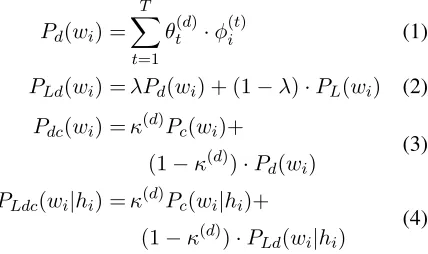
weights. From these we compute the document-specific unigram model ford(Eqn. 1). This serves to capture what we have referred to as thebroadtopic context.
We incorporate both Pd as well as the cachePc
(local context) into the base modelPLusing linear
interpolation of probabilities. Word histories are de-noted hi for brevity. For our experiments we first
combine Pd with the N-gram model (Eqn. 2). We
then interpolate with the cache model to get a joint topic and cache language model (Eqn. 4).
Pd(wi) = T
X
t=1
θt(d)·φ(it) (1)
PLd(wi) =λPd(wi) + (1−λ)·PL(wi) (2) Pdc(wi) =κ(d)Pc(wi)+
(1−κ(d))·Pd(wi) (3) PLdc(wi|hi) =κ(d)Pc(wi|hi)+
(1−κ(d))·P
Ld(wi|hi) (4)
We expect the inferred document cache probabil-ity κ(d) to serve as a natural interpolation weight
when combining document-specific unigram model
Pdc and cache. We consider alternatives to
per-documentκ(d) as part of the speech retrieval
Language 50t 100t 150t 200t
[image:4.612.93.275.53.122.2]Tagalog 0.41 0.29 0.22 0.16 Vietnamese 0.51 0.39 0.29 0.22 Zulu 0.33 0.26 0.21 0.16 Tamil 0.36 027 0.18 0.14
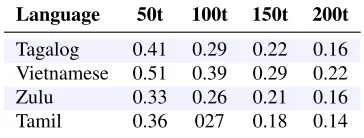
Table 1: Meanκ(d)inferred from 10 hour development
data, by number of latent topics
5 Model Analysis
Before looking at the model in terms of retrieval per-formance (Section 6), here we aim to examine how our model captures the repetition of each corpus and how well it functions as a language model (cf. Equa-tion 3) in terms of perplexity.
To focus on language models for speech retrieval in the limited resource setting, we build and evalu-ate our model under the IARPA Babel Limited Lan-guage Pack (LP), No Target Audio Reuse (NTAR) condition (Harper, 2011). We selected the Tagalog, Vietnamese, Zulu, and Tamil corpora1to expose our
model to as diverse a set of languages as possible (in terms of morphology, phonology, language family, etc., in line with the Babel program goals).
The Limited LP includes a 10 hour training set (audio and transcripts) which we use for building acoustic and language models. We also estimate the parameters for our topic model from the same training data. The Babel corpora contain sponta-neous conversational telephone speech, but without the constrained topic prompts of LDC’s Fisher col-lections we would expect a sparse collection of top-ics. Yet for retrieval we are nonetheless able to lever-age the information.
We estimate parameters φ(t), κ(d), α, β, and ν
on the training transcripts in each language, then use these parameters to inferθ(d)(topic proportions) and
κ(d) (cache usage) for each document in the
held-out set. We use the inferredκ(d)andθ(d)to perform
the language model interpolation (Eqns. 3, 4). But also, the mean of the inferredκ(d) values for a
cor-pus ought to provide a snapshot of the amount of repetition within.
Two trends emerge when we examine the mean overκ(d) by language. First, as shown in Table 1,
1Releases babel106b-v0.2g, babel107b-v0.7,
babel206b-v0.1e, and babel204b-v1.1b, respectively
Figure 2: Cache and corpus frequencies for each word type in Vietnamese and Zulu training corpora.
the more latent topics are used, the lower the in-ferredκvalues. Regardless of the absolute value, we see thatκfor Vietnamese is consistently higher than the other languages. This fits our intuition about the languages given that the Vietnamese transcripts had syllable-level word units and we would expect to see more repetition.
Secondly we consider which words are drawn from the cache versus the topics during the infer-ence process. Examining the final sampling state, we count how often each word in the vocabulary is drawn from the cache (where kd,i = 1).
Intu-itively, this count is highly correlated (ρ > 0.95) with the corpus frequency of each word (cf. Fig-ure 2). That is, cache states are assigned to word types most likely to repeat.
5.1 Perplexity
While our measurements of cache usage corre-sponds to intuition, our primary goal is to con-struct useful language models. After estimating parameters on the training corpora, we infer κ(d)
and θ(d) then measure perplexity using
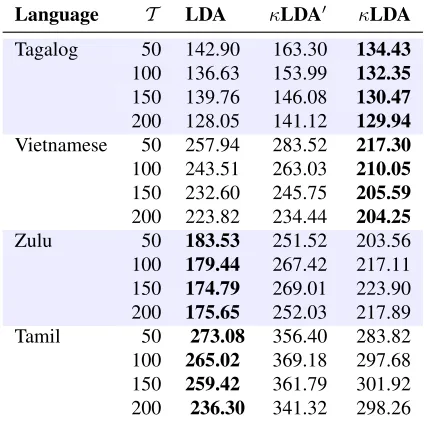
document-specific language models on the development set. We compute perplexity on the topic unigram mix-tures according toPd andPdc (Eqns.1 & 3). Here
we do not interpolate with the base N-gram LM, so as to compare only unigram mixtures. Table 2 gives the perplexity for standard LDA (Pd only) and for
our model with and without the cache added (κLDA0
andκLDA respectively).
[image:4.612.320.532.56.185.2]Language T LDA κLDA0 κLDA Tagalog 50 142.90 163.30 134.43
100 136.63 153.99 132.35
150 139.76 146.08 130.47
200 128.05 141.12 129.94
Vietnamese 50 257.94 283.52 217.30
100 243.51 263.03 210.05
150 232.60 245.75 205.59
200 223.82 234.44 204.25
Zulu 50 183.53 251.52 203.56
100 179.44 267.42 217.11
150 174.79 269.01 223.90
200 175.65 252.03 217.89
Tamil 50 273.08 356.40 283.82
100 265.02 369.18 297.68
150 259.42 361.79 301.92
[image:5.612.79.291.53.265.2]200 236.30 341.32 298.26
Table 2: Perplexities of topic unigram mixtures on held-out data, with and withheld-out cache.
perplexity decreases as the number of latent topics increases, excepting certain Zulu and Tamil models. For Tagalog and Vietnamese our cache-augmented model outperforms standard LDA model in terms of perplexity. However, as we will see in the next sec-tion, the lowest perplexity models are not necessar-ily the best in terms of retrieval performance. 6 Speech Retrieval
We evaluate the utility of our topic language model for speech retrieval via the term detection, or key-word search (KWS) task. Term detection accuracy is the primary evaluation metric for the Babel pro-gram. We use the topic and cache-augmented lan-guage models (Eqn. 4) to improve the speech recog-nition stage of the term detection pipeline, increas-ing overall search accuracy by 0.5 to 1.7% absolute over a typical N-gram language model.
The term detection task is this: given a corpus of audio documents and a list of terms (words or phrases), locate all occurrences of the key terms in the audio. The resulting list of detections is scored using Term Weighted Value (TWV) metric. TWV is a cost-value trade-off between the miss probabil-ity, P(miss), and false alarm probability, P(F A), averaged over all keywords (NIST, 2006). For com-parison with previously published results, we score against the IARPA-supplied evaluation keywords.
We train acoustic and language models (LMs) on the 10 hour training set using the Kaldi toolkit (Povey and others, 2011), according to the training recipe described in detail by Trmal et al. (2014). While Kaldi produces different flavors of acoustic models, we report results using the hybrid HMM-DNN (deep neural net) acoustic models, trained with a minimum phone error (MPE) criterion, and based on PLP (perceptual linear prediction) features aug-mented with pitch. All results use 3-gram LMs with Good-Turing (Tagalog, Zulu, Tamil) or Modified Kneser-Ney (Vietnamese) smoothing. This AM/LM combination (our baseline) has consistently demon-strated state-of-the art performance for a single sys-tem on the Babel task.
As described, we estimate our model parameters
φ(t),κ(d),α,β, andν from the training transcripts.
We decode the development corpus with the base-line models, then inferθ(d) and κ(d) from the first
pass output. In principle we simply computePLdc
for each document and re-score the first pass output, then search for keywords.
Practical considerations for cache language mod-els are, for example, just how big should the cache be, or should it decay, where words further away from the current word are discounted proportionally. In the Kaldi framework, speech is processed in seg-ments (i.e. conversation turns). Current tools do not allow one to vary the language model within a par-ticular segment (dynamically). With that in mind, our KWS experiments construct a different language model (PLdc) for each segment, where Pc is
com-puted from all other segments in the current docu-ment except that being processed.
6.1 Results
We can show, by re-scoring LCVSR output with a cache-augmented topic LM, that both the document-specific topic (Pd) and cache (Pc) information
to-gether improve our overall KWS performance in each language, up to 1.7% absolute.
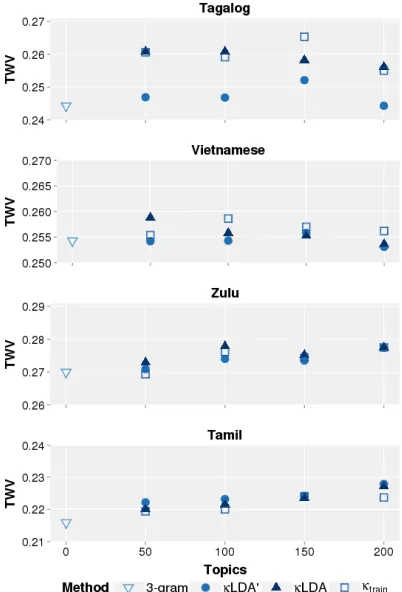
Figure 3 illustrates search accuracy (TWV) for each language under various settings forT. It also captures alternatives to usingκ(d)as an interpolation
weight for the cached unigrams. To illustrate this contrast we substituted the training meanκtrain
in-stead ofκ(d)as the interpolation weight when
Figure 3: KWS accuracy for different choices ofT
κ(d)were more effective, but not hugely so.
The effect of latent topics T on search accuracy also varies depending on language, as does the over-all effect of incorporating the cache in addition to latent topics (κLDA0 vs. κLDA). For example, in
Tagalog, we observe most of the improvement over N-grams from the cache information, whereas in Tamil, the cache provided no additional information over latent topics.
The search accuracy for the best systems from Figure 3 are shown in Table 3 with corresponding choice ofT. Effects on WER was mixed under the cache model, improving Zulu from 67.8 to 67.6% and degrading Tagalog from 60.8 to 61.1%, with Vietnamese and Tamil unchanged.
7 Conclusions and Future Work
With our initial effort in formulating model combin-ing latent topics with a cache-based language model, we believe we have presented a model that esti-mates both informative and useful parameters from
Language T 3-gram κLDA0 κLDA Tagalog 50 0.244 0.247 0.261
Vietnamese 50 0.254 0.254 0.259
Zulu 100 0.270 0.274 0.278
Tamil 200 0.216 0.228 0.227
Table 3: Best KWS accuracy (TWV) is each language.
the data and supports improved speech retrieval per-formance. The results presented here reinforce the conclusion that topics and repetition,broadand lo-calcontext, are complementary sources of informa-tion for speech language modeling tasks.
We hope to address two particular limitations of our model in the near future. First, all of our im-provements are obtained adding unigram probabili-ties to a 3-gram language model. We would natu-rally want to extend our model to explicitly capture the cache and topic behavior of N-grams.
Secondly, our models are restricted by the first pass output of the LVCSR system. Keywords not present in the first pass cannot be recalled by a re-scoring only approach. An alternative would be to use our model to re-decode the audio and realize subsequently larger gains. Given that our re-scoring model worked sufficiently well across four funda-mentally different languages, we are optimistic this would be the case.
Acknowledgements
This work was partially supported by the In-telligence Advanced Research Projects Activity (IARPA) via Department of Defense U.S. Army Research Laboratory (DoD / ARL) contract num-ber W911NF-12-C-0015. The U.S. Government is authorized to reproduce and distribute reprints for Governmental purposes notwithstanding any copy-right annotation thereon. Disclaimer: The views and conclusions contained herein are those of the authors and should not be interpreted as necessarily repre-senting the official policies or endorsements, either expressed or implied, of IARPA, DoD/ARL, or the U.S. Government.
[image:6.612.83.284.55.351.2]References
David M Blei, Andrew Y Ng, and Michael I Jordan. 2003. Latent Dirichlet Allocation. In JMLR, vol-ume 3, pages 993–1022. JMLR.org.
Chaitanya Chemudugunta, Padhraic Smyth, and Steyvers Mark. 2007. Modeling General and Specific Aspects of Documents with a Probabilistic Topic Model. In
Advances in Neural Information Processing Systems 19: Proceedings of the 2006 Conference, volume 19, page 241. Mit Press.
Berlin Chen. 2009. Latent Topic Modelling of Word Co-occurence Information for Spoken Document Re-trieval. InProc. of ICASSP, pages 3961–3964. IEEE. Jen-Tzung Chien and Chuang-Hua Chueh. 2011.
Dirich-let Class Language Models for Speech Recogni-tion. Audio, Speech, and Language Processing, IEEE Transactions on, 19(3):482–495.
Justin Chiu and Alexander Rudnicky. 2013. Using con-versational word bursts in spoken term detection. In
Proc. of Interspeech, pages 2247–2251. ISCA. Kenneth Ward Church and William A Gale. 1995.
Poisson Mixtures. Natural Language Engineering, 1(2):163–190.
Philip R Clarkson and Anthony J Robinson. 1997. Lan-guage Model Adaptation Using Mixtures and an Ex-ponentially Decaying Cache. InProc. of ICASSP, vol-ume 2, pages 799–802. IEEE.
Radu Florian and David Yarowsky. 1999. Dynamic Nonlocal Language Modeling via Hierarchical Topic-based Adaptation. InProc. of ACL, pages 167–174. ACL.
Mary Harper. 2011. Babel BAA. http: //www.iarpa.gov/index.php/
research-programs/babel/baa.
Marti A Hearst and Christian Plaunt. 1993. Subtopic Structuring for Full-length Document Access. InProc. of SIGIR, pages 59–68. ACM.
Aaron Heidel, Hung-an Chang, and Lin-shan Lee. 2007. Language Model Adaptation Using Latent Dirichlet Allocation and an Efficient Topic Inference Algorithm. InProc. of Interspeech. ICSA.
Thomas Hofmann. 2001. Unsupervised Learning by Probabilistic Latent Semantic Analysis. Machine Learning, 42(1):177–196.
Houghton-Mifflin. 1997. The American Heritage Col-lege Dictionary. Houghton Mifflin.
Bo-June Paul Hsu and James Glass. 2006. Style & Topic Language Model Adaptation Using HMM-LDA. In
Proc. of EMNLP, pages 373–381. ACL.
Songfang Huang and Steve Renals. 2008. Unsupervised Language Model Adaptation Based on Topic and Role Information in Multiparty Meetings. InProc. of Inter-speech. ICSA.
Frederick Jelinek, Bernard Merialdo, Salim Roukos, and Martin Strauss. 1991. A Dynamic Language Model for Speech Recognition.HLT, 91:293–295.
Sanjeev Khudanpur and Jun Wu. 1999. A Maximum En-tropy Language Model Integrating N-grams and Topic Dependencies for Conversational Speech Recognition. InProc. of ICASSP, volume 1, pages 553–556. IEEE. Roland Kuhn and Renato De Mori. 1990. A
Cache-based Natural Language Model for Speech Recogni-tion. Transactions on Pattern Analysis and Machine Intelligence, 12(6):570–583.
Xiaoyong Liu and W Bruce Croft. 2004. Cluster-based Retrieval Using Language Models. InProc. of SIGIR, pages 186–193. ACM.
Yang Liu and Feifan Liu. 2008. Unsupervised Lan-guage Model Adaptation via Topic Modeling Based on Named Entity Hypotheses. InProc. of ICASSP, pages 4921–4924. IEEE.
Andrew Kachites McCallum. 2002. MALLET: A Ma-chine Learning for Language Toolkit. http://
mallet.cs.umass.edu.
Tomas Mikolov, Martin Karafi´at, Lukas Burget, Jan Cer-nock`y, and Sanjeev Khudanpur. 2010. Recurrent Neural Network Based Language Model. InProc. of Interspeech. ICSA.
David Miller et al. 2007. Rapid and Accurate Spoken Term Detection. InProc. of Interspeech. ICSA. NIST. 2006. The Spoken Term Detection (STD)
2006 Evaluation Plan. http://www.itl.nist. gov/iad/mig/tests/std/2006/docs/ std06-evalplan-v10.pdf. [Online; accessed 28-Feb-2013].
Barbara et al. Peskin. 1996. Improvements in Switch-board Recognition and Topic Identification. InProc. of ICASSP, volume 1, pages 303–306. IEEE.
Daniel Povey et al. 2011. The Kaldi Speech Recognition Toolkit. InProc. of ASRU Workshop. IEEE.
Ronald Rosenfeld. 1994. Adaptive Statistical Language Modeling: a Maximum Entropy Approach. Ph.D. the-sis, CMU.
Mark Steyvers and Tom Griffiths. 2007. Probabilistic Topic Models. Handbook of Latent Semantic Analysis, 427(7):424–440.
Jan et al. Trmal. 2014. A Keyword Search System Using Open Source Software. InProc. of Spoken Language Technoloty Workshop. IEEE.
Jonathan Wintrode and Khudanpur Sanjeev. 2014. Com-bining Local and Broad Topic Context to Improve Term Detection. InProc. of Spoken Language Tech-noloty Workshop. IEEE.
Jonathan Wintrode. 2014a. Can you Repeat that? Using Word Repetition to Improve Spoken Term Detection. InProc. of ACL. ACL.
Jonathan Wintrode. 2014b. Limited Resource Term De-tection For Effective Topic Identification of Speech. In
Proc. of ICASSP. IEEE.