Combining the output of two coreference resolution systems for two
source languages to improve annotation projection
Yulia Grishina
Applied Computational Linguistics FSP Cognitive Science
University of Potsdam
Abstract
Although parallel coreference corpora can to a high degree support the development of SMT systems, there are no large-scale parallel datasets available due to the com-plexity of the annotation task and the vari-ability in annotation schemes. In this study, we exploit an annotation projec-tion method to combine the output of two coreference resolution systems for two different source languages (English, Ger-man) in order to create an annotated cor-pus for a third language (Russian). We show that our technique is superior to pro-jecting annotations from a single source language, and we provide an in-depth analysis of the projected annotations in or-der to assess the perspectives of our ap-proach.
1 Introduction
Most of the recent work on exploiting corefer-ence relations in Machine Translation focused on improving the translation of anaphoric pronouns (Le Nagard and Koehn,2010;Hardmeier and Fed-erico, 2010; Guillou, 2012; Nov´ak et al., 2015;
Guillou and Webber, 2015), disregarding other types of coreference relations, one of the reasons being the lack of annotated parallel corpora as well as the variability in the annotated data. How-ever, this could be alleviated by exploiting anno-tation projection across parallel corpora to create more linguistically annotated resources for new languages. More importantly, applying annotation projection using several source languages would support the creation of corpora less biased to-wards the peculiarities of a single source annota-tion scheme.
In our study, we aim at exploring the usability
of annotation projection for the transfer of auto-matically produced coreference chains. In partic-ular, our idea is that using several source annota-tions produced by different systems could improve the performance of the projection method. Our approach to the annotation projection builds upon the approach recently introduced by (Grishina and Stede, 2017), who experimented with projecting manually annotated coreference chains from two source languages to the target language. However, our goal is slightly different: We are interested in developing a fully automatic pipeline, which would support the automatic creation of paral-lel annotated corpora in new languages. There-fore, in contrast to (Grishina and Stede,2017), we use automatic source annotations produced by two state-of-the-art coreference systems, and we com-bine the output of our projection method for two source languages (English and German) to obtain target annotations for a third language (Russian). Through performing the error analysis of the pro-jected annotations, we investigate the most com-mon projection errors and assess the benefits and drawbacks of our method.
The paper is organized as follows: Section 2 presents an overview of the related work and Sec-tion 3 describes the experimental setup. In SecSec-tion 4, we give a detailed error analysis and discuss the results of our experiment. The conclusions and the avenues for future research are presented in Sec-tion 5.
2 Related work
Annotation projection is a method that allows for automatically transferring annotations from a well-studied (source) language to a low-resource (target) language in a parallel corpus in order to automatically obtain annotated data. It was first introduced in the work of (Yarowsky et al.,2001)
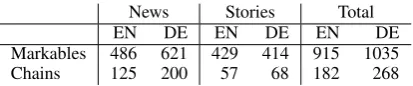
News Stories Total
EN DE EN DE EN DE
Markables 486 621 429 414 915 1035
Chains 125 200 57 68 182 268
Table 1: Number of markables and coreference chains in the automatic annotations
MUC B3 CEAF
m Avg.
P R F1 P R F1 P R F1 P R F1
[image:2.595.196.403.61.104.2]berkeley (EN) 49.5 41.4 45.0 38.9 27.8 32.1 45.9 40.4 42.9 44.7 36.5 40.0 CorZu (DE) 66.9 59.2 62.5 59.2 41.3 46.6 52.4 52.8 52.3 59.5 51.1 53.8
Table 2: Evaluation of the automatic source annotations
and then extensively exploited for different kinds of linguistic tasks, including coreference resolu-tion. Specifically, several studies used annotation projection to acquire annotated data, such as ( Pos-tolache et al.,2006;Rahman and Ng,2012; Mar-tins,2015;Grishina and Stede,2015).
Thereafter, (Grishina and Stede, 2017) posed a multi-source method for annotation pro-jection: They used a manually annotated trilin-gual coreference corpus and two source languages (English-German, English-Russian) to transfer an-notations to the target language (Russian and German, respectively). Although their approach showed promising results, it was based on trans-ferring manually produced annotations, which are typically not available for other languages and, more importantly, can not be acquired large-scale due to the complexity of the annotation task.
3 Annotation projection experiment
In our experiment, we propose a fully automatic projection setup: First, we perform coreference resolution on the source language data and then we implement the single- and multi-source ap-proaches to transfer the automatically produced annotations. We use the English-German-Russian unannotated corpus of (Grishina and Stede,2017) as the basis for our experiment, which contains texts in two genres – newswire texts (229 tences per language) and short stories (184 sen-tences per language). Furthermore, we use manual annotations present in the corpus as the gold stan-dard for our evaluation. It should be noted that the manual annotations were performed accord-ing to the parallel coreference annotation guide-lines of (Grishina and Stede, 2016) that are in general compatible with the annotation of the the OntoNotes corpus (Hovy et al., 2006) and are therefore suitable for our evaluation.
3.1 Coreference resolution on the source language data
Since the main goal of this experiment is to as-sess the quality of the projection of automatic an-notations, first we need to automatically label the source language data. For the English side of the corpus, we chose the Berkeley Entity Reso-lution system (Durrett and Klein, 2014), which was trained on the English part of the OntoNotes corpus (Hovy et al.,2006) and achieves the aver-age F1 of 61.71 on the OntoNotes dataset ( Dur-rett and Klein,2014). For the German side of the corpus, we use the state-of-the-art CorZu system (Tuggener,2016) to obtain the source annotations, which achieves the average of 66.9 F1 on the Ger-man part of the SemEval 2010 dataset (Klenner and Tuggener,2011).
Corpus statistics for the English and German datasets are presented in Table 1. Interestingly, CorZu was able to resolve slightly more mark-ables and coreference chains in total than Berke-ley (1035 vs. 915, 268 vs. 182 respectively). In particular, the numbers of found markables and chains in English and German diverge for the newswire texts, which further supports the claim that this part of the corpus contains more complex coreference relations than the short stories1.
To estimate the quality of the automatically produced annotations, we evaluate the resulting dataset against the manually annotated English and German parts of the corpus (Table2). As one can see from this table, CorZu and Berkeley do not perform equally good on our dataset: the average F1 of 53.8 for German as compared to the average F1 of 40.0 for English.
1As already stated in (Grishina and Stede, 2017), the
MUC B3 CEAF
m Avg.
P R F1 P R F1 P R F1 P R F1
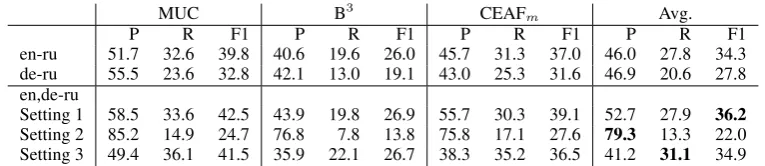
en-ru 51.7 32.6 39.8 40.6 19.6 26.0 45.7 31.3 37.0 46.0 27.8 34.3 de-ru 55.5 23.6 32.8 42.1 13.0 19.1 43.0 25.3 31.6 46.9 20.6 27.8 en,de-ru
Setting 1 58.5 33.6 42.5 43.9 19.8 26.9 55.7 30.3 39.1 52.7 27.9 36.2
[image:3.595.107.490.61.144.2]Setting 2 85.2 14.9 24.7 76.8 7.8 13.8 75.8 17.1 27.6 79.3 13.3 22.0 Setting 3 49.4 36.1 41.5 35.9 22.1 26.7 38.3 35.2 36.5 41.2 31.1 34.9
Table 3: Projection results from English and German into Russian
3.2 Annotation projection strategies
For our experiment, we implement a direct projec-tion method for coreference as described in ( Gr-ishina and Stede,2015). Our method works as fol-lows: For each markable on the source side, we automatically select all the corresponding tokens on the target side aligned to it, and we then take the span between the first and the last word as the new target markable, which has the same corefer-ence chain number as the source one. Since the corpus was already sentence- and word-aligned2,
we use the available alignments to transfer the an-notations.
Thereafter, we re-implement the multi-source approach as described in (Grishina and Stede,
2017). In particular, they (a) looked at disjoint chains coming from different sources and (b) used the notion of chain overlap to measure the simi-larity between two coreference chains that contain some identical mentions3. In our experiment, we
apply the following strategies from (Grishina and Stede,2017):
1. Setting 1 (‘add’): disjoint chains from one source language are added to all the chains projected from the other source language; 2. Setting 2 (‘unify-intersect’): the intersection
of mentions for overlapping chains is se-lected.
3. Setting 3 (‘unify-concatenate’): chains that overlap are treated as one chain starting from a certain percentage of overlap.
For both single- and multi-source approaches, we deliberately rely solely on word alignment in-formation to project the annotations, in order to keep our approach easily transferable to other lan-guages.
2Sentence alignment was performed using HunAlign
(Varga et al., 2007); word alignments were computed with GIZA++ (Och and Ney,2003) on a parallel newswire corpus (Grishina and Stede,2015).
3Computed as Dice coefficient.
3.3 Results
To evaluate the projection results, we computed the standard coreference metrics – MUC (Vilain et al.,1995), B-cubed (Bagga and Baldwin,1998) and CEAF (Luo, 2005) – and their average for each of the approaches (Table3). As one can see from the table, the quality of projections from En-glish to Russian outperforms the quality of projec-tions from German to Russian by 6.5 points F1. Moreover, while Precision number are quite simi-lar, projections from English exhibit higher Recall numbers.
As for the multi-source settings, we were able to achieve the highest F1 of 36.2 by combining dis-joint chains (Setting 1), which is 1.9 point higher than the best single-source projection scores and constitutes almost 62% of the quality of the pro-jection of gold standard annotations reported in (Grishina and Stede, 2017). We were able to achieve the highest Precision scores by intersect-ing the overlappintersect-ing chains (Settintersect-ing 2) and the highest Recall by concatenating them (Setting 3).
Finally, we evaluate the annotations coming from English and German against each other, in order to estimate their comparability and the per-centage of overlap. Interestingly, we achieve 52.0 F1, with Precision being slightly higher than Re-call (53.9 vs. 50.2), which shows the dissimilarity between the two projections.
4 Error analysis and discussion
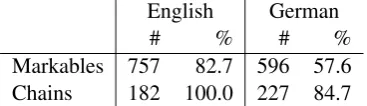
are the opposite: Annotation projection from En-glish to Russian performs better than from German to Russian. Our hypothesis is that the reason for the lower percentage of transferred annotations is the lower quality of word alignments for German-Russian as compared to English-German-Russian. Further-more, since the original language of the texts was English, we presume that the German and Russian translations are closer to English and less similar to each other.
English German
# % # %
[image:4.595.369.463.98.170.2]Markables 757 82.7 596 57.6 Chains 182 100.0 227 84.7 Table 4: Transferred chains and markables
Since we do not have access to any gold align-ment data, we estimate the quality of the word alignments by computing the number of unaligned tokens. Not surprisingly, we see a higher percent-age of unaligned words for German-Russian than for English-Russian: 17.03% vs. 14.96% respec-tively, which supports our hypothesis regarding the difference in the alignment quality for the two pairs. Furthermore, we computed the distribution of unaligned words: The highest percentage of unaligned tokens disregarding punctuation marks are prepositions; pronouns constitute only 3% and 5% of all unaligned words for the alignments be-tween English-Russian and German-Russian re-spectively. However, these numbers do not con-stitute more than 5% of the overall number of pro-nouns in the corpus.
Following the work of (Grishina and Stede,
2017), we analyse the projection accuracy for common nouns (‘Nc’), named entities (‘Np’) and pronouns (‘P’) separately4: Table5shows the
per-centage of correctly projected markables of each type out of all the projected markables of this type. Our results conform to the results of (Grishina and Stede, 2017): For both languages, pronouns ex-hibit the highest projection quality, while common and proper nouns are projected slightly less ac-curately, which is probably due to the fact that pronouns typically consist of single tokens and are better aligned than multi-token common and proper names. Overall, for all the markables, the projection accuracy for English-Russian is around
4Using the automatic POS annotations already present in
the corpus and provided by TreeTagger (Schmid,2013).
10% better than projection accuracy for German-Russian.
en-ru de-ru Nc 64.5 60.7 Np 70.5 66.6
P 83.6 76.5
[image:4.595.90.274.210.263.2]All 65.1 55.6
Table 5: Projection accuracy for common nouns, proper nouns and pronouns (%)
Moreover, we compare the projected annota-tions across the two genres. Interestingly, the re-sults for the two languages vary: While the av-erage coreference scores for English-Russian are quite comparable (news: 34.2 F1, stories: 33.3 F1), the scores for German-Russian differ consid-erably (news: 30.8 F1, stories: 20.8 F1). We at-tribute this difference to the quality of the source annotations and the performance of the source coreference resolvers on different genres of texts.
5 Summary and outlook
In this study, we assessed the applicability of an-notation projection in a scenario where we have access to two coreference resolvers in two source languages, the output of which is projected to a third language in a low-resource setting. Our re-sults have shown that projection from two source languages is able to reach 62% of the quality of the projection of manual annotations and improves the projection scores by 1.9 F1. Moreover, using the output of two completely different coreference resolution systems, we observed the similar ten-dencies as while projecting gold standard annota-tions: Projection from English to Russian achieves higher scores than projection from German to Rus-sian, and pronouns have the highest projection ac-curacy.
Overall, we envision our future work in exploit-ing more than two source annotations as well as multiple coreference resolution systems for a sin-gle source language to improve the source coref-erence annotations. Specifically, we plan on ap-plying our method on other language pairs and datasets, in order to explore its generalizabililty for a wider range of languages. Furthermore, we are interested in exploiting our approach as a first step to create coreference annotated corpora in new languages by providing automatically pro-jected target coreference chains to human annota-tors for a subsequent validation.
References
Amit Bagga and Breck Baldwin. 1998. Entity-based cross-document coreferencing using the vec-tor space model. InProceedings of the 17th inter-national conference on Computational linguistics-Volume 1. Association for Computational Linguis-tics, pages 79–85.
Greg Durrett and Dan Klein. 2014. A joint model for entity analysis: Coreference, typing, and linking. In
Transactions of the Association for Computational Linguistics.
Yulia Grishina and Manfred Stede. 2015. Knowledge-lean projection of coreference chains across lan-guages. In Proceedings of the 8th Workshop on Building and Using Comparable Corpora, Beijing, China. Association for Computational Linguistics, page 14.
Yulia Grishina and Manfred Stede. 2016. Parallel coreference annotation guidelines. University of Potsdam.
Yulia Grishina and Manfred Stede. 2017. Multi-source annotation projection of coreference chains: Assess-ing strategies and testAssess-ing opportunities. In Sec-ond Workshop on Coreference Resolution BeySec-ond OntoNotes. Association for Computational Linguis-tics, page 41.
Liane Guillou. 2012. Improving pronoun translation for statistical machine translation. InProceedings of the Student Research Workshop at the 13th Confer-ence of the European Chapter of the Association for Computational Linguistics. Association for Compu-tational Linguistics, pages 1–10.
Liane Guillou and Bonnie Webber. 2015. Analysing ParCor and its translations by state-of-the-art SMT systems. InProceedings of the Second Workshop on Discourse in Machine Translation. Association for Computational Linguistics, page 24.
Christian Hardmeier and Marcello Federico. 2010. Modelling pronominal anaphora in statistical
ma-chine translation. In IWSLT (International Work-shop on Spoken Language Translation); Paris, France; December 2nd and 3rd, 2010.. pages 283– 289.
Eduard Hovy, Mitchell Marcus, Martha Palmer, Lance Ramshaw, and Ralph Weischedel. 2006. OntoNotes: the 90% solution. InProceedings of the Human lan-guage technology conference of the NAACL, Com-panion Volume: Short Papers. Association for Com-putational Linguistics, pages 57–60.
Manfred Klenner and Don Tuggener. 2011. An incre-mental entity-mention model for coreference resolu-tion with restrictive antecedent accessibility. In Pro-ceedings of the international conference on Recent Advances in Natural Language Processing. pages 178–185.
Ronan Le Nagard and Philipp Koehn. 2010. Aiding pronoun translation with co-reference resolution. In
Proceedings of the Joint Fifth Workshop on Statisti-cal Machine Translation and Metrics (MATR). As-sociation for Computational Linguistics, pages 252– 261.
Xiaoqiang Luo. 2005. On coreference resolution per-formance metrics. In Proceedings of the confer-ence on Human Language Technology and Empiri-cal Methods in Natural Language Processing. Asso-ciation for Computational Linguistics, pages 25–32. Andr´e Martins. 2015. Transferring coreference re-solvers with posterior regularization. In Proceed-ings of the 53rd Annual Meeting of the Associa-tion for ComputaAssocia-tional Linguistics. volume 1, pages 1427–1437.
Michal Nov´ak, Dieke Oele, and Gertjan van Noord. 2015. Comparison of coreference resolvers for deep syntax translation. In Proceedings of the Second Workshop on Discourse in Machine Translation. As-sociation for Computational Linguistics, page 17. Franz Josef Och and Hermann Ney. 2003. A systematic
comparison of various statistical alignment models.
Computational Linguistics29(1):19–51.
Oana Postolache, Dan Cristea, and Constantin Orasan. 2006. Transferring coreference chains through word alignment. In Proceedings of 5th international conference on Language Resources and Evaluation (LREC).
Altaf Rahman and Vincent Ng. 2012. Translation-based projection for multilingual coreference reso-lution. In Proceedings of the 2012 Conference of the North American Chapter of the Association for Computational Linguistics: Human Language Tech-nologies. Association for Computational Linguis-tics, pages 720–730.
Don Tuggener. 2016. Incremental Coreference Resolu-tion for German. Ph.D. thesis, University of Zurich. D´aniel Varga, P´eter Hal´acsy, Andr´as Kornai, Viktor Nagy, L´aszl´o N´emeth, and Viktor Tr´on. 2007. Paral-lel corpora for medium density languages. Amster-dam Studies in the Theory and History of Linguistic Science Series 4292:247.
Marc Vilain, John Burger, John Aberdeen, Dennis Con-nolly, and Lynette Hirschman. 1995. A model-theoretic coreference scoring scheme. In Pro-ceedings of the 6th conference on Message under-standing. Association for Computational Linguis-tics, pages 45–52.