Proceedings of NAACL-HLT 2018, pages 2070–2080
LSDSCC: A Large Scale Domain-Specific Conversational Corpus
for Response Generation with Diversity Oriented Evaluation Metrics
Zhen Xu1, Nan Jiang2, Bingquan Liu1, Wenge Rong2,
Bowen Wu3, Baoxun Wang3, Zhuoran Wang3, and Xiaolong Wang1
1School of Computer Science and Technology, Harbin Institute of Technology, Harbin, China 2School of Computer Science and Engineering, Beihang University, Beijing, China
3Tricorn (Beijing) Technology Co., Ltd, Beijing, China
{zxu,liubq,wangxl}@insun.hit.edu.cn {nanjiang, w.rong}@buaa.edu.cn
{wubowen, wangbaoxun, wangzhuoran}@trio.ai
Abstract
It has been proven that automatic conversa-tional agents can be built up using the End-to-End Neural Response Generation (NRG) framework, and such a data-driven methodol-ogy requires a large number of dialog pairs for model training and reasonable evaluation met-rics for testing. This paper proposes a Large Scale Domain-Specific Conversational Corpus (LSDSCC) composed of high-quality query-response pairs extracted from the domain-specific online forum, with thorough pre-processing and cleansing procedures. Also, a testing set, including multiple diverse re-sponses annotated for each query, is con-structed, and on this basis, the metrics for measuring the diversity of generated results are further presented. We evaluate the per-formances of neural dialog models with the widely applied diversity boosting strategies on the proposed dataset. The experimental results have shown that our proposed corpus can be taken as a new benchmark dataset for the NRG task, and the presented metrics are promising to guide the optimization of NRG models by quantifying the diversity of the generated re-sponses reasonably.
1 Introduction
Conversational agents (a.k.a. Chat-bots) are ef-fective media to establish communications with human beings and have received much attention from academic and industrial experts in recent years (Serban et al.,2017). One essential fact pro-moting the research work on conversational agents is the explosive growth of human interaction data accumulated in the social network services, such as Twitter1and Reddit2. So, it is possible to build
Chat-bots based on data-driven approaches ( Ser-ban and Pineau,2015).
1https://twitter.com/ 2https://www.reddit.com/
Nevertheless, there still remains a great chal-lenge for building such conversational agents: at present, the automatic evaluation metrics of NRG models can hardly afford to measure the seman-tic relevance and diversity of generated results reasonably, and even the latter evaluation aspect has been paid little attention. The widely ac-cepted evaluating methods employed by the exist-ing NRG models can be categorized as: a) metrics inherited from Machine Translation, e.g., BLEU, Perplexity, etc. (Yao et al., 2015; Lowe et al.,
2017; Wu et al., 2018); b) discrete scores mea-suring the quality of generated results by human labeling (Shang et al., 2015;Serban et al., 2016;
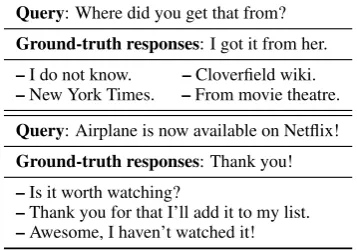
Xu et al.,2017); and c) case study comparing the generated results of different NRG models (Shang et al.,2015;Wang et al.,2017). The disappointing situation is that these evaluating methods have not revealed tangible difference among NRG models, the reasons for which can be reflected by the ex-ample given in Table1.
Query: Where did you get that from? Ground-truth responses: I got it from her. –I do not know. –Cloverfield wiki. –New York Times. –From movie theatre. Query: Airplane is now available on Netflix! Ground-truth responses: Thank you! –Is it worth watching?
[image:1.595.326.505.524.649.2]–Thank you for that I’ll add it to my list. –Awesome, I haven’t watched it!
Table 1: Cases of queries with diverse responses.
For each query in Table 1, one response from the testing set is taken as the ground truth, together with responses with more morphological and se-mantic variations, marked with the symbol “–”. These samples indicate that the numerical met-rics inherited from NMT which discard the
sity among responses, cannot reflect marginal dif-ferences among generative models, which is sup-ported by the research work of Liu et al. (2016). Thus, an NRG model with good capability to pro-duce diverse and meaningful responses is possible to be judged as a poor one by the BLEU/Perplexity based evaluations. Meanwhile, the metrics based on human labeling are still promising, yet the expensive cost and inconsistency among labelers limit the scale of human-annotation. Therefore, it becomes a necessity to develop reasonable auto-matic evaluation metrics, that can be taken to mea-sure both candidate response’s diversity and its relevance to the given query, to effectively guide the training of NRG models towards the state of promoting meaningful and diverse responses (Li et al., 2016a;Shao et al., 2017; Freitag and Al-Onaizan,2017).
In order to evaluate the performance of NRG models automatically and reasonably, a well-annotated testing set should be built first. But then, building such a high-quality testing set is a non-trivial task indeed. On one hand, most exist-ing source datasets cover various domains, mak-ing it difficult to evaluate the generated results in case that the domain of the generated response is different from that of the reference. On the other hand, a large number of noises, typos, and slangs distribute in existing large-scale datasets, such as Twitter corpus (Ritter et al., 2011) and Ubuntu dialog corpus (Kadlec et al., 2015). For instance, there are many file directories with com-puter names in Ubuntu dialog corpus. Therefore, qualified domain-specific datasets are desperately required to evaluate NRG models with different ar-chitectures reasonably.
To address the above issues, we build a high-quality and domain-specific dialog corpus com-posed of a carefully prepared training set, and meanwhile, a testing set is constructed by collect-ing multiple reference responses for each query and conducting group-aware human annotation on collected responses. On this basis, we proposed three discriminative metrics: MaxBLEU, Mean
Di-versity Score (MDS), and Probabilistic Diversity
Score (PDS), to primarily evaluate the diversity
of generated responses with relevance also con-sidered. To further assess the performance and effectiveness of the test set cooperating with the proposed metrics, the widely applied Sequence-to-Sequence (Seq2Seq) (Bahdanau et al., 2014;
Sutskever et al., 2014) based models with the available diversity promotion methods are imple-mented, and experiments are conducted on the proposed Large Scale Domain-Specific Conversa-tional Corpus (LSDSCC) dataset. The experimen-tal results stay consistent with the previous ex-perience acquired from human-labeled sets, and the performance of these models suggests that the LSDSCC corpus and discriminative metrics will provide insights for future research in the field of NRG.
2 Related Work
Seq2Seq based conversation modeling approaches have been proven to be able to generate response directly (Vinyals and Le,2015;Shang et al.,2015). However, these models tend to produce generic responses to any given queries, namely the defi-cient diversity problem(Shao et al.,2017). Recent studies attempt to constrain these universal replies and promote more diverse responses with various strategies during the procedure of training or in-ference (Li et al.,2016a,b;Mou et al.,2016;Xing et al.,2017;Shao et al.,2017). Besides, there still exits another meaningful option, that is, to employ reasonable diversity oriented evaluation metrics to guide the optimization of models.
The quality of testing sets is a primary fac-tor for such evaluation of NRG models. Existing large-scale corpora contain the Movie Dialogue, Ubuntu, Twitter, and Reddit corpus (Banchs,
2012; Uthus and Aha, 2013; Ritter et al., 2010;
Besides the testing set, evaluation metrics are also important for the performance measurement of NRG models. Most frequently applied evalu-ation metrics for NRG models are inherited from NMT to measure the fluency and relevance of gen-erated responses, such as Perplexity, BLEU ( Pap-ineni et al., 2002) and deltaBLEU (Galley et al.,
2015). Although these metrics demonstrate the relevance between the given query and the gen-erated responses, they overlook the reply’s diver-sity that is of great importance in conversation set-ting. Thus, efforts are devoted to simulate the hu-man subjective judgment, which is similar with the response ranking task in retrieval-based chat agents (Lowe et al.,2017;Tao et al.,2018), but un-avoidable uncertainty and errors are brought into the systems (Hu et al., 2014). In addition, auto-matic evaluation metrics (e.g. BLEU, deltaBLEU, etc.) are limited by the fact that each query only has references with the exact same meaning and many overlapped phrases, which is unreasonable in the conversational scenario.
3 Data Processing and Analysis
Previous studies indicate that more focused topics and less diverged domain is helpful to guide NRG models away from the state of producing univer-sal responses (Mou et al.,2016;Xing et al.,2017), so we compose a domain-specific corpora by con-straining the domain of crawled dialogues from Reddit to its movie discussion board3. The quality
of the data in Reddit movie category has been dis-cussed by Stoddard(2015) and Jamnik and Lane
(2017), who point out that the popularity is a good indication of relative quality and the movie cate-gory is one of the most popular boards in Reddit. Thus, the data in Reddit movie category is orig-inally high-quality. In this section, the pipeline for building the LSDSCC dataset will be discussed in detail, and necessary statistical indicators are collected to demonstrate its distribution. More-over, human evaluation is conducted to measure the quality of the obtained training set.
3.1 Data Processing
Data Cleansing.We crawl threads from the movie discussion board of Reddit that includes human-to-human conversations as the raw dataset, and conduct the following cleansing operations:
3https://www.reddit.com/r/movies/, selected from https://www.reddit.com/r/datasets
a) For each thread, we strip away the mark-downandhtmlsyntax tokens, e.g., “[word](url)” is transformed to “word”, “>” is reformed to “>”,
etc. Meanwhile, all forms of urls, emails and dig-its withing the paragraphs are normalized as “url”, “email” and “digits” tokens respectively;
b) As emoticons in the data originated from so-cial media services always provide essential emo-tional information of users, we propose to convert the same groups of emoticons into corresponding words (e.g., “:-)” will be reverted to “happy”) to preserve such emotion knowledge;
c) Finally, replicated words or characters (e.g., “cooool” and “ahahaha”, etc.) are substituted with its normal form using regular expressions.
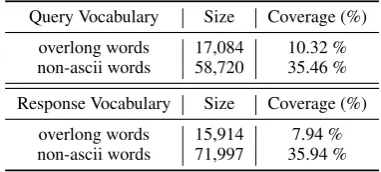
Query Vocabulary Size Coverage (%) overlong words 17,084 10.32 % non-ascii words 58,720 35.46 % Response Vocabulary Size Coverage (%)
[image:3.595.319.510.281.367.2]overlong words 15,914 7.94 % non-ascii words 71,997 35.94 % Table 2: Composition of noise words in the query and response vocabulary of the raw data.
Vocabulary Truncation. After the above pre-processing operations, there still exist redun-dant unformatted slang and noisy strings (e.g., “Iloveyou”), which have low-frequency in the crawled raw data. Consequently, the vocabulary size of the dataset is exceeding 160K as shown in Table 2. Keeping a such large vocabulary for Seq2Seq based models will consume exces-sive memory and make those models difficult to converge, while pruning low-frequency unformat-ted slang and noisy strings into “UNK” symbols would directly harm the performance of the model since excessive knowledge hidden in these strings are ignored in the training process. To address this issue, we break these slangs and noises into sev-eral frequent words in our corpus and eliminate non-ASCII tokens. In this way, sufficient informa-tion of the dataset is maintained for model train-ing. Finally, the vocabulary sizes of the dataset are reduced to around50K.
re-100
90
80
70
60
50 Query Length
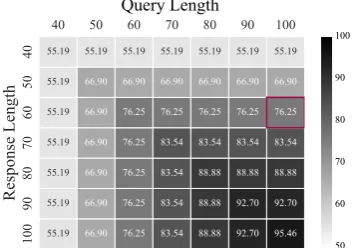
Figure 1: Sentence length coverage of queries and re-sponses within the dataset.
sponses would make the decoder hard to con-verge (Greff et al.,2017), it is necessary to prune the pairs containing very long sentences. After the sentences are tokenized using theNLTK toolk-its4, the cases with queries longer than 100 or
re-sponses exceeding 60 words are pruned directly, and 76.25% of the dataset are finally reserved.
After pruning the corpus, there remain 738,095 single-turn and 346,543 multi-turn conversations. Since this paper focuses on the single-turn dialogs, the evaluative testing set and detailed experiments in the following sections are designed for single-turn corpus. As the testing set will select pairs from the preprocessed data, the corresponding tu-ples will be deleted to avoid coverage.
3.2 Query-Response Relevance of the Dataset
As one of the most important qualities of the con-versational corpus, the query-response relevance demonstrates the overall quality of the dataset. Human evaluations of the query-response rele-vance are conducted to validate the quality of the dataset used in this paper. Nine experienced an-notators are invited to evaluate the query-response relevance of 500 single-turn dialogs uniformly sampled from the whole dataset obtained in Sub-section 3.1. In the evaluation, we ask each an-notator to label whether the response is appropri-ate to the corresponding query in the given query-response pair. A pair is tagged as “Unsure” if the annotator could not confirm the degrees of relevance without related context and background movie knowledge. The labeled result is shown in Table 3. It is observed that 85% samples in the query-response relevance task are confirmed to keep high relevance between the query and the corresponding responses. Moreover, there exist
4http://www.nltk.org/
only about 6.6% irrelevant noises. So, the resource can be considered as a high-quality one and can be used in the practical task.
Category Relevant Unsure Irrelevant
Numbers 427 40 33
[image:4.595.91.271.64.188.2]Percentage 85.4% 8% 6.6%
Table 3: Query-Response Relevance on the single-turn training set.
4 Testing Set and Evaluation Metrics
Existing evaluation metrics of dialog agents mea-sure the quality of the generated sentences only by referring to the existing responses, which obeys the same principle with NMT models’ metrics. However, one essential difference between NRG and NMT lies in the fact that, a large group of re-sponses can be considered as relevant to a given query in conversations, while the number of ref-erences to a translation result is quite limited for NMT models. So the diversity degree of candi-dates which have not covered by NMT oriented evaluation metrics, is supposed to be quantified and measured in NRG models.
Currently, few studies focus on the evalua-tion based on the group of references, which is more meaningful and reasonable for NRG models. Therefore, we proposed three metrics: MaxBLEU,
Mean Diversity Score, and Probabilistic Diversity Score, to quantify both the relevance and diver-sity of the generated responses. Since these met-rics are based on the multi-reference, we first de-scribe the procedure of building testing set, with multi-references for each query. Then, the metrics for NRG models are detailed based on the multi-reference testing set.
4.1 Multi-Reference Testing Set Construction
[image:4.595.327.504.117.162.2]them is also time-consuming and expensive. Nev-ertheless, there exist large amounts of queries that are highly semantically similar or correlated with each other. This indicates that the multiple refer-ences can be obtained by selecting responses of queries that are semantically identical to the orig-inal query. What’s more, the human-annotation is involved to proofread the filtered pairs’ quality and complete the final labeling.
5eply Aggregation
3HUFHQWDJH
[image:5.595.305.525.63.161.2]
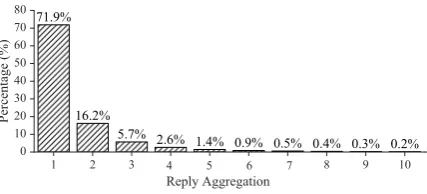
Figure 2: Distribution of reply quantities in training set.
When constructing the testing set, the very first step is getting semantically similar (or even identical) queries with the given ones. For this purpose, this paper adopts the TF-IDF similarity and semantic embedding based distance to mea-sure the similarity between queries. The pro-cedure of gaining similar queries is divided into two stage: In the first stage, we employ Apache Lucene5to exploit the word-level TF-IDF patterns
within queries, and then extract the top 100 sim-ilar queries with highest scores given by Lucene for each query. Yet, these candidates only capture n-gram level similarity with the probably diverged semantics. Thus, in the second stage, we utilize paragraph vector algorithm (a.k.a Doc2vec6) (Le and Mikolov, 2014) to resort the selected simi-lar queries in the semantic space and only queries of similarity score higher than a certain threshold (i.e., 0.9) are reserved. Table4lists several identi-cal queries filtered by Lucene and Doc2vec meth-ods with the given query. It should be noted that the Lucene index and Doc2vec need to be initial-ized by feeding all the sentences in the dialogue corpus.
To reserve as much information as possible and balance the distribution of the composed testing set, we divide the dataset into several subsets based on the response number of queries, and then sample testing data from each subset uniformly. Concretely, according to the response number,
5https://lucene.apache.org/
6https://radimrehurek.com/gensim/models/doc2vec.html
Similar Queries Similarity
If you haven’t already, watch the animatrix. 0.97 Do not watch the animatrix,
you may leave you house. 0.95
I don’t have much to ad except,
[image:5.595.74.288.194.291.2]that people really should watch animatrix. 0.94 I recommend you watch the matrix. 0.91 Table 4: Filtered queries identical to the original query: “You should watch the animatrix.”
queries of the dataset are divided into three sub-sets: a) queries with less than 3 responses, b) queries with 3 to 5 responses, and c) queries with more than 5 responses. We randomly sample 100 queries from each subset, and thus 300 queries are obtained as the testing set. Aiming at building a multiple references testing set, each query in the testing set is assigned with 15 responses, includ-ing the original responses and the ones of the most similar queries obtained by the procedure of last paragraph.
Afterwards, three skilled and experienced label-ers familiar with movies are employed and care-fully trained to crosswise annotate the filtered test-ing set. In addition, labelers can also obtain some background of the corresponding query since there are additional details for most queries in Reddit. In this case, the quality of selected samples can be guaranteed. Besides, the annotators are asked not only to label the relevance of query and ref-erence responses, but also reorganize the indepen-dent references into groups by the semantic simi-larity subjectively. The grouping strategy is intro-duced for the purpose of evaluating the diversity of responses generated by different models.
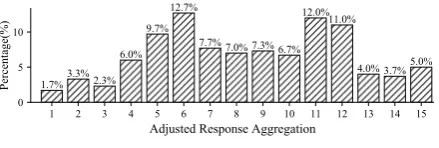
At last, we obtain a high-quality testing set, in which each query is assigned with different num-bers of reference responses. Fig.3shows the dis-tribution of the response numbers in the testing set. Comparing to the original response number distri-bution in Fig.2, the replies distribution of the test-ing set is much more appropriate for the conver-sational scenario. Furthermore, responses to the corresponding query are categorized into several groups. In this case, NRG models can be evaluated reasonably using such a testing set. One sampled case in the testing set is shown in the left phase of Fig.4, and there are eight responses in the la-beled data divided into four groups. The different metrics in this figure will be introduced in the fol-lowing sections. It should be noted that both the single-turn dialogs and the annotated testing set are released7.
$GMXVWHG5HVSRQVH$JJUHJDWLRQ
3HUFHQWDJH
[image:6.595.73.293.316.390.2]
Figure 3: Aggregated responses per query in testing set.
4.2 The Metric on Response Relevance
Since the NRG architecture is analogous to the NMT models, introducing the BLEU scores to evaluate the semantic relevance of the generated results is acceptable. However, it is not reason-able to average the BLEU scores of the generated response to each reference, because the seman-tic of each reference varies significantly. Aiming at revealing the variation and diversity among re-sponses, which have not yet covered at the NMT models, we propose aMaxBLEUmetric customized
for response generation based on the Multi-BLEU metric (Madnani et al., 2008). Noticing that the metrics inherited from SMT, like BLEU, is not able to evaluate the diversity of responses, we pro-pose the specified metrics for diversity evaluation, which will be described in the next subsection.
Given an input query, the NRG model is able to generate a set of hypothesis {hi}8. Meanwhile,
7 https://drive.google.com/file/d/1nbpbnhwNP14xAc4SAc1-NN5lvEr01dQb/view?usp=sharing
8Following the terms in machine translation, this part takes “hypothesis” to represent “response”.
according to the human-annotation strategy de-scribed in Subsection4.1, the set of references can be reorganized, based on their semantic similarity, into the groups with the format of{rij}, whererij
denotes the j-th reference in the i-th group. On
this basis, theMaxBLEUmetric is defined as:
MaxBLEU(hi) = arg max
k Multi-BLEU(hi, rk·) (1)
where rk· denotes all the references in the k
-th group. That is, we begin by calculating all the multi-BLEU scores between each hypothesis and grouped references, and pick the score for the sentence with the highest BLEU as the score for this set of hypothesis, so that we make an alignment between generated hypothesis hto the
group-aware referencesr. For simplicity, one
re-sponse can only be aligned to one group reference, and multi-group references are not considered in this work.
4.3 Metrics on Response Diversity
Given a query, the diversity degree of candidate responses is an essential criterion for evaluating the performances of NRG models. Currently, most studies tend to demonstrate the diversities of dif-ferent models by sampling and comparing the erated results, or labeling the diversity of the gen-erated samples, which makes it difficult to bench-mark and automatically evaluate different models. AlthoughLi et al.(2017a) propose to calculate the number of distinct unigrams and bigrams of gener-ated responses, such scores do not align well with human inspection (Serban et al.,2017).
Algorithm 1Two Response Diversity Metrics.
Input:
hypothesis setHand reference setR; Output:
Mean Diversity Score (MDS); Probabilistic Diversity Score (PDS);
1: for allri·∈Rdo .Initialize
2: pi= 1/|R|, 3: p0i=|ri·|/Pj|rj·|. 4: end for
5: for allhi∈Hdo .Compute alignment 6: k= arg maxjMulti-BLEU(hi, rj·).
7: MDS(k) =pk, 8: PDS(k) =p0k. 9: end for
10: returnPkMDS(k),PkPDS(k)
Therefore, we propose two evaluative metrics based on the MaxBLEU metric for diversity
mea-surement: a) Mean Diversity Score (MDS) and b)
1.1 Rogen and Goldberg are producing a movie being acted by the Workaholics guys.
1.2 I think Rogen is producing a movie from Workaholics guys, should be fun!
2.1 He's also in top five by Chris Rock.
2.2 He has an important role in the top five and it's hilarious. 2.3 He was quite in in top five, another comedy that came out recently. 2.4 Looks he have pretty big role in top five, the new Chris Rock movie. 3.1 When I saw Anders, I thought he was going to be a CIA analyst, especially when Rogen asked him if he was still Associate Producer. 4.1 Anders is my favorite too Blake annoys me sometimes but the show wouldn't be the same without him.
Query: Anders from Workaholics being in there was more unexpected for me, I hope he gets bigger roles in major comedies he's definitely my favorite.
Grouped Reference Responses
1 The Workaholics should be fun. 2 The Workaholics guys are fun.
3 He's also in top five by Chris Rock. 4 He has an important role. 5 I saw Anders, and he is good.
6 I thought he was good. 7 He is my favorite. 8 Anders annoys me.
Hypothesis MaxBLEU 0.02 1.00 0.007
0.62 0.10 0.09 0.14 0.13
2 2 2
K 4 4 4 1 1
MDS 3/4
PDS 7/8
Figure 4: A sampled testing case including a given query, the grouped reference responses and the generated ones (hypothesis) with the proposed metrics, among which “K” is obtained by performingarg max uponMaxBLEU scores. TheMDSmetric is calculated with the partitioned groups andPDSmetric is calculated with the weight of each group in the overall the candidate set.
two metrics aim at measuring the overall diversity of the whole set of generation results (hypothe-sis) by taking them as an entirety, and the detailed calculation steps of the proposed metrics are illus-trated in Algorithm1. According to the algorithm, thePDSmetric assumes that the weight of each
ref-erence group is distributed uniformly, regardless of the reference number in each group. Similarly, the MDS metric takes the count of the members
in each group as the weight of the corresponding group, and actually compute the weighted cover-age upon the reference group.
5 Experiments and Analysis
In this section, we present the detailed experi-ments on the single-turn dialog dataset and analy-sis on generated results, in accordance to the pro-posed metrics.
5.1 Baselines and Experimental Setups
Experiments are conducted using the popular Seq2Seq based models with the currently available diversity prompting strategies as follows:
1)Basic Seq2Seq. We employ the basic Seq2Seq to build the encoder-decoder architecture running on the proposed dataset, by taking the bidirec-tional LSTM cell as the encoder to address the in-put sentences ordering problem and classic LSTM cell as the decoder (Vinyals and Le,2015). 2)Attention-Seq2Seq. As proposed by Vinyals and Le(2015);Luong et al.(2015), a concatenated version of attention mechanism is applied upon the basic Seq2Seq model.
3)Greedy-Seq2Seq. Based on the basis Seq2Seq model, the diversity promotion strategy proposed
by Li et al.(2016b) is applied in the generating procedure, and the training procedure stays the same. Hyper parameterγ, a.k.a.diversity rate, are
set with empirical experiments (i.e.,γ = 0.1,0.8) to reveal the efforts.
4) Greedy-Attn-Seq2Seq. Following the work ofLi et al. (2016b), the greedy diversity promo-tion strategy is applied on the Seq2Seq model with attention mechanism similar with model 2, and we set hyper parameterγ = 0.1,0.8.
5) MMI-Seq2Seq. In the generation procedure, Maximum Mutual Information (MMI) model is applied in the decoder to prune generic answers on the basic Seq2Seq model (Li et al.,2016a).
In our research, we implement these models on the TensorFlow platform9, and Adam
opti-mizer (Kingma and Ba,2015) is employed for gra-dient optimization during training. Besides, we choose to prune the words whose frequencies are below 2, so the source and target vocabulary are set to42,257and46,865respectively.
In addition, we set the batch size to 50, hidden size of encoder to 256, hidden size of decoder to 512 and learning rate to 2e−4. The gradients are clipped within[−3.0,3.0]to avoid the gradient
explosion problem. Every model runs on a single GPU separately for at least one week before con-vergence. Afterwards, for all these methods, we generate a set of hypothesis sentences with beam size set tok = 50, and the evaluation scores are obtained using the proposed metrics.
After running through 25 epochs on the dataset, the training log-loss of the basic Seq2Seq
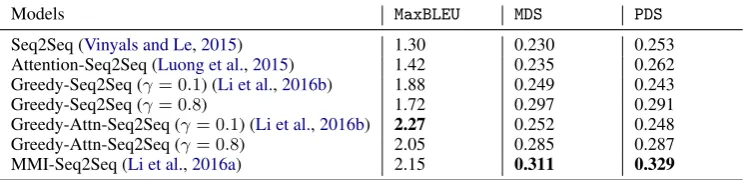
Models MaxBLEU MDS PDS
Seq2Seq (Vinyals and Le,2015) 1.30 0.230 0.253
Attention-Seq2Seq (Luong et al.,2015) 1.42 0.235 0.262 Greedy-Seq2Seq (γ= 0.1) (Li et al.,2016b) 1.88 0.249 0.243
Greedy-Seq2Seq (γ= 0.8) 1.72 0.297 0.291
Greedy-Attn-Seq2Seq (γ= 0.1) (Li et al.,2016b) 2.27 0.252 0.248
Greedy-Attn-Seq2Seq (γ= 0.8) 2.05 0.285 0.287
[image:8.595.112.484.64.154.2]MMI-Seq2Seq (Li et al.,2016a) 2.15 0.311 0.329
Table 5: Performances of different models trained on the LSDSCC dataset with three metrics:MaxBLEU,MDS,PDS.
els converge to about 4.2 and the Seq2Seq models augmented with attention converge to 3.1. Also, we set the dropout rate to 0.5, which enables us
to tune the models though much more epochs and avoid the over-fitting problems.
5.2 Relevance Analysis
The semantic relevance of the generated responses is represented by theMaxBLEU scores, which are
listed in the corresponding column of Table 5. From this benchmarking table, it can be observed that the attention mechanism is helpful for de-coders to improve the relevance of the generated responses, since the Attention-Seq2Seq performs better than the basic Seq2Seq on the dataset, in terms of all the three metrics. However, the rela-tive gain of the attention layer is limited, indicat-ing that modelindicat-ing relation of query and response by attention module is not able to directly solve the learning paradigm of conversations.
In accordance to the results of Greedy-Seq2Seq (γ = 0.1) and Greedy-Seq2Seq (γ = 0.8), the
hyper-parameterγactually plays an important role
in the generation steps of the decoder. Since γ
is introduced to constrain the selection probabil-ity of the next-step word by performing the re-ranking process, and the larger value of this pa-rameter will lead to the greater impact upon gen-erating steps and produce more diverse sentences, we evaluate this greedy strategy with γ set with
two empirical value. It can be seen that the model with the smaller γ performs better than the one
with the larger parameter, which can be attributed to the fact that responses with more diversity are less similar to references. Similar observation can be get from the results of models Greedy-Attn-Seq2Seq (γ = 0.1) and Greedy-Attn-Seq2Seq
(γ = 0.8). Besides, the reason for setting γ = 0.1,0.8in this part is that they are well represented
for the poor diversity and good diversity, which the exact score ofγ will vary under different
configu-rations and structures of model.
In addition, the MMI model is proved to be promising to enhance the generation models, by improving both the relevant and diversity of gen-erated responses. Even though theMMI-Seq2Seq
model has not got the highestMaxBLEU, it
outper-forms the other ones on diversity, which will be discussed in the following subsection.
5.3 Diversity Analysis
Table5 also illustrates the MDSandPDS score of
each benchmark. It is observed that the greedy strategies in the generating procedure with the greater parameterγcan boost the diversity of
gen-erated responses obviously. This phenomenon is attributed to the inter-sibling ranking policy in the decoding procedure, which tends to choose hy-potheses from diverse parents. In addition, the MMI strategy gets the highest MDS andPDS,
be-cause the MMI criterion relieves the constraint of the language model, under which general re-sponses always get a higher generative probability. Meanwhile, the PDS metric aligns well with
the basic MDS, but the relative gap becomes
larger within the Greedy-Seq2Seq (γ = 0.1) and
Greedy-Seq2Seq (γ = 0.8) models. The
rea-son for enlarging relative gap between different models, is to distinguish the performance of sim-ilar models and evaluate the performance of spe-cific module inside the models. When comparing Seq2Seq and Attention-Seq2Seq, relative gain of applied attention module to the overall model in terms ofMDSwas2.1%, while it became3.6%
con-sidering thePDSmetric.
Practically, it is reasonable to make a trade-off between the relevance and diversity. The PDSis
more suitable for choosing the systems with strin-gent diversity requirement, and theMDSis a softer
metric, which should be taken into consideration when measuring the diversity improvements by in-tegrating some new modules into NRG models.
with the increasing of the diversity oriented PDS
andMDS. This phenomenon indicates a
relation-ship between relevance and diversity against that in some of text generation tasks (e.g., image cap-tion (Yao et al.,2017)). Since there are generally many references for a given query, the relevance and diversity are possible to be improved simulta-neously for the response generation task (Li et al.,
2016a). And thus, the topic changing on the gen-erated results is tolerable.
5.4 Human Correlation Analysis
To validate the correlations between human rat-ings and the proposed metrics, we further invite 9 annotators with rich movie knowledge to judge the relevance and diversity of the generated responses from benchmark methods. Each baseline model generate 10 responses for each query in the test dataset. The annotators are first asked to judge whether a generated response is relevant to the query (labeled with 1) or not (labeled with 0). Af-ter that, the annotators estimate the diversity of relevant responses of each query with a scale of 1 to 3. The final Fleiss Kappa (Fleiss,1971) score is 0.46, which denotes moderate agreement of the annotators.
Model Spearman p-value Pearson p-value
MaxBLEU 0.31 0.022 0.29 0.036
MDS 0.36 0.041 0.33 0.028
PDS 0.39 0.038 0.35 0.040
Table 6: Correlation between the proposed metrics and human judgments for the Reddit dataset.
The Pearson and Spearman correlation between the human evaluations and each metric are given in Table6. It can be observed that the proposed met-rics correlate with human judgments moderately with p−value < 0.05, which is quite different
from the correlation test inLiu et al.(2016). This can be attributed to the fact that there are multi-ple references for each query in our test dataset. Although the proposed metrics are derived from the word-overlap based BLEU scores, expanding references of each query makes such scores much more reasonable for evaluating the relevance and diversity of generated responses.
6 Conclusion and Future Work
In this paper, we have proposed the Large Scale Domain-Specific Conversational Corpus
(LSD-SCC), collected from the movie discuss threads in the Reddit community, for training and testing the Neural Response Generation (NRG) models. In addition, necessary data cleansing and prun-ing works are done to remove noises in the ut-terances. Moreover, we employ volunteers to an-notate a diverse query-responses testing set, with reference groups taken into consideration for ob-jectively quantifying the diversity of generated re-sults. On the basis of the testing set, we propose two evaluative diversity metrics (mean diversity score and probabilistic diversity score) calculated according to the standardMaxBLEUscore.
Furthermore, we investigate the performance of popular Seq2Seq based models with various diver-sity promotion strategies, and the score of them are collected to validate the effectiveness of the pro-posed metrics. The propro-posed dataset and evalua-tion metrics are expected to be used for the effec-tive training and reasonable testing of NRG mod-els.
In the future studies, we would explore the pos-sibility of promoting diversity on the learning pro-cedure, by directly optimizing diversity loss in the cost function. Besides, injecting external infor-mation during response’s generation would be an-other challenging work.
Acknowledgments
We thank the anonymous reviewers for their in-sightful comments. This research is partially supported by National Natural Science Foun-dation of China (No.61572151, No.61602131, No.61672192) and the National High Technology Research and Development Program (“863” Pro-gram) of China (No.2015AA015405).
References
Dzmitry Bahdanau, Kyunghyun Cho, and Yoshua Ben-gio. 2014. Neural machine translation by jointly learning to align and translate. InProc. of ICLR.
Rafael E. Banchs. 2012. Movie-dic: a movie dialogue corpus for research and development. In Proc. of ACL, pages 203–207.
J. L. Fleiss. 1971. Measuring nominal scale agree-ment among many raters. Psychological Bulletin, 76(5):378–382.
Markus Freitag and Yaser Al-Onaizan. 2017. Beam search strategies for neural machine translation. In Proceedings of the First Workshop on Neural Ma-chine Translation, pages 56–60.
Michel Galley, Chris Brockett, Alessandro Sordoni, Yangfeng Ji, Michael Auli, Chris Quirk, Mar-garet Mitchell, Jianfeng Gao, and Bill Dolan. 2015. deltableu: A discriminative metric for generation tasks with intrinsically diverse targets. InProc. of ACL, pages 445–450.
K. Greff, R. K. Srivastava, J. Koutnk, B. R. Steune-brink, and J. Schmidhuber. 2017. Lstm: A search space odyssey. IEEE Trans. Neural Netw. Learn. Syst., 28(10):2222–2232.
Baotian Hu, Zhengdong Lu, Hang Li, and Qingcai Chen. 2014. Convolutional neural network architec-tures for matching natural language sentences. In Proc. of NIPS, pages 2042–2050.
Matthew R. Jamnik and David J. Lane. 2017. The use of reddit as an inexpensive source for high-quality data. Practical Assessment Research & Evaluation, 22(5).
Rudolf Kadlec, Martin Schmid, and Jan Kleindienst. 2015. Improved deep learning baselines for ubuntu corpus dialogs. InMachine Learning for SLU Inter-action Workshop, NIPS.
Diederik P Kingma and Jimmy Ba. 2015. Adam: A method for stochastic optimization. In Proc. of ICLR.
Quoc V. Le and Tomas Mikolov. 2014. Distributed rep-resentations of sentences and documents. InProc. of ICML, pages 1188–1196.
Jiwei Li, Michel Galley, Chris Brockett, Jianfeng Gao, and Bill Dolan. 2016a. A diversity-promoting ob-jective function for neural conversation models. In Proc. of NAACL-HLT, pages 110–119.
Jiwei Li, Will Monroe, and Dan Jurafsky. 2016b. A simple, fast diverse decoding algorithm for neural generation. CoRR, abs/1611.08562.
Jiwei Li, Will Monroe, and Dan Jurafsky. 2017a. Learning to decode for future success. CoRR, abs/1701.06549.
Yanran Li, Hui Su, Xiaoyu Shen, Wenjie Li, Ziqiang Cao, and Shuzi Niu. 2017b. Dailydialog: A manu-ally labelled multi-turn dialogue dataset. InProc. of IJCNLP, pages 986–995.
Chia-Wei Liu, Ryan Lowe, Iulian Serban, Mike Nose-worthy, Laurent Charlin, and Joelle Pineau. 2016. How not to evaluate your dialogue system: An em-pirical study of unsupervised evaluation metrics for dialogue response generation. InProc. of EMNLP, pages 2122–2132.
Ryan Lowe, Michael Noseworthy, Iulian Vlad Ser-ban, Nicolas Angelard-Gontier, Yoshua Bengio, and Joelle Pineau. 2017. Towards an automatic turing test: Learning to evaluate dialogue responses. In Proc. of ACL, pages 1116–1126.
Thang Luong, Hieu Pham, and Christopher D. Man-ning. 2015. Effective approaches to attention-based neural machine translation. In Proc. of EMNLP, pages 1412–1421.
Nitin Madnani, Philip Resnik, Bonnie J Dorr, and Richard Schwartz. 2008. Are multiple reference translations necessary? investigating the value of paraphrased reference translations in parameter op-timization. InProc. of AMTA, pages 143–152.
Lili Mou, Yiping Song, Rui Yan, Ge Li, Lu Zhang, and Zhi Jin. 2016. Sequence to backward and forward sequences: A content-introducing approach to gen-erative short-text conversation. InProc. of COLING, pages 3349–3358.
Kishore Papineni, Salim Roukos, Todd Ward, and Wei-Jing Zhu. 2002. Bleu: a method for automatic eval-uation of machine translation. In Proc. of ACL, pages 311–318. Association for Computational Lin-guistics.
Alan Ritter, Colin Cherry, and Bill Dolan. 2010. Unsu-pervised modeling of twitter conversations. InProc. of NAACL-HLT, pages 172–180.
Alan Ritter, Colin Cherry, and William B. Dolan. 2011. Data-driven response generation in social media. In Proc. of EMNLP, pages 583–593.
Nicolas Schrading, Cecilia Ovesdotter Alm, Ray Ptucha, and Christopher Homan. 2015. An analy-sis of domestic abuse discourse on reddit. InProc. of EMNLP, pages 2577–2583.
Iulian V. Serban and Joelle Pineau. 2015. Text-based speaker identification for multi-participant open-domain dialogue systems. InMachine Learning for Spoken Language Understanding and Interaction, NIPS 2015 Workshop.
Iulian Vlad Serban, Ryan Lowe, Laurent Charlin, and Joelle Pineau. 2017. A survey of available corpora for building data-driven dialogue systems. CoRR, abs/1703.05742.
Iulian Vlad Serban, Alessandro Sordoni, Yoshua Ben-gio, Aaron C. Courville, and Joelle Pineau. 2016. Building end-to-end dialogue systems using genera-tive hierarchical neural network models. InProc. of AAAI, pages 3776–3784.
Lifeng Shang, Zhengdong Lu, and Hang Li. 2015. Neural responding machine for short-text conversa-tion. InProc. of ACL, pages 1577–1586.
Generating high-quality and informative conversa-tion responses with sequence-to-sequence models. InProc. of EMNLP, pages 2210–2219.
Alessandro Sordoni, Michel Galley, Michael Auli, Chris Brockett, Yangfeng Ji, Margaret Mitchell, Jian-Yun Nie, Jianfeng Gao, and Bill Dolan. 2015. A neural network approach to context-sensitive gen-eration of conversational responses. In Proc. of HLT-NAACL, pages 196–205.
Greg Stoddard. 2015. Popularity dynamics and intrin-sic quality in reddit and hacker news. InICWSM, pages 416–425.
Ilya Sutskever, Oriol Vinyals, and Quoc V Le. 2014. Sequence to sequence learning with neural net-works. InProc. of NIPS, pages 3104–3112.
Chongyang Tao, Lili Mou, Dongyan Zhao, and Rui Yan. 2018. Ruber: An unsupervised method for au-tomatic evaluation of open-domain dialog systems. InProc. of AAAI, pages 1–8.
David C. Uthus and David W. Aha. 2013. The ubuntu chat corpus for multiparticipant chat analysis. In AAAI Spring Symposium: Analyzing Microtext.
Oriol Vinyals and Quoc V. Le. 2015. A neural conver-sational model. InProc. of ICLR.
Jianan Wang, Xin Wang, Fang Li, Zhen Xu, Zhuoran Wang, and Baoxun Wang. 2017. Group linguistic bias aware neural response generation. In Proceed-ings of the 9th SIGHAN Workshop on Chinese Lan-guage Processing, pages 1–10.
Yu Wu, Wei Wu, Dejian Yang, Can Xu, Zhoujun Li, and Ming Zhou. 2018. Neural response generation with dynamic vocabularies. InProc. of AAAI.
Chen Xing, Wei Wu, Yu Wu, Jie Liu, Yalou Huang, Ming Zhou, and Wei-Ying Ma. 2017. Topic aware neural response generation. InProc. of AAAI, pages 3351–3357.
Zhen Xu, Bingquan Liu, Baoxun Wang, SUN Chengjie, Xiaolong Wang, Zhuoran Wang, and Chao Qi. 2017. Neural response generation via gan with an approximate embedding layer. In Proc. of EMNLP, pages 617–626.
Kaisheng Yao, Geoffrey Zweig, and Baolin Peng. 2015. Attention with intention for a neural network conversation model. InMachine Learning for SLU Interaction Workshop, NIPS, pages 1–7.