Proceedings of NAACL-HLT 2018, pages 79–85
Sentence Simplification with Memory-Augmented Neural Networks
Tu Vu1, Baotian Hu2, Tsendsuren Munkhdalai3 and Hong Yu1,2 1University of Massachusetts Amherst, Amherst, MA 01003, USA
2University of Massachusetts Medical School, Worcester, MA 01655, USA
{baotian.hu,hong.yu}@umassmed.edu
3Microsoft Research, Montr´eal, QC H3A 3H3, Canada
Abstract
Sentence simplification aims to simplify the content and structure of complex sentences, and thus make them easier to interpret for hu-man readers, and easier to process for down-stream NLP applications. Recent advances in neural machine translation have paved the way for novel approaches to the task. In this paper, we adapt an architecture with aug-mented memory capacities called Neural Se-mantic Encoders (Munkhdalai and Yu,2017) for sentence simplification. Our experiments demonstrate the effectiveness of our approach on different simplification datasets, both in terms of automatic evaluation measures and human judgments.
1 Introduction
The goal of sentence simplification is to compose complex sentences into simpler ones so that they are more comprehensible and accessible, while still retaining the original information content and meaning. Sentence simplification has a number of practical applications. On one hand, it provides reading aids for people with limited language proficiency (Watanabe et al., 2009; Siddharthan, 2003), or for patients with linguistic and cognitive disabilities (Carroll et al., 1999). On the other hand, it can improve the performance of other NLP tasks (Chandrasekar et al.,1996;Knight and Marcu,2000;Beigman Klebanov et al.,2004).
Prior work has explored monolingual machine translation (MT) approaches, utilizing corpora of simplified texts, e.g., Simple English Wikipedia (SEW), and making use of statistical MT models, such as phrase-based MT (PBMT) (ˇStajner et al., 2015;Coster and Kauchak,2011;Wubben et al., 2012), tree-based MT (TBMT) (Zhu et al.,2010; Woodsend and Lapata,2011), or syntax-based MT (SBMT) (Xu et al.,2016).
Inspired by the success of neural MT (Sutskever et al., 2014; Cho et al., 2014), recent work has started exploring neural simplification with sequence to sequence (Seq2seq) models, also referred to as encoder-decoder models. Nisioi et al. (2017) implemented a standard LSTM-based Seq2seq model and found that they outperform PBMT, SBMT, and unsupervised lexical simplifi-cation approaches. Zhang and Lapata (Zhang and Lapata,2017) viewed the encoder-decoder model as an agent and employed a deep reinforcement learning framework in which the reward has three components capturing key aspects of the target output: simplicity, relevance, and fluency.
The common practice for Seq2seq models is to use recurrent neural networks (RNNs) with Long Short-Term Memory (LSTM, Hochreiter and Schmidhuber,1997) or Gated Recurrent Unit (GRU, Cho et al., 2014) for the encoder and de-coder (Nisioi et al., 2017; Zhang and Lapata, 2017). These architectures were designed to be capable of memorizing long-term dependencies across sequences. Nevertheless, their memory is typically small and might not be enough for the simplification task, where one is confronted with long and complicated sentences.
In this study, we go beyond the conventional LSTM/GRU-based Seq2seq models and propose to use a memory-augmented RNN architecture called Neural Semantic Encoders (NSE). This ar-chitecture has been shown to be effective in a wide range of NLP tasks (Munkhdalai and Yu, 2017). The contribution of this paper is twofold:
(1) First, we present a novel simplification model which is, to the best of our knowledge, the first model that use memory-augmented RNN for the task. We investigate the effectiveness of neu-ral Seq2seq models when different neuneu-ral architec-tures for the encoder are considered. Our experi-ments reveal that the NSELSTMmodel that uses an
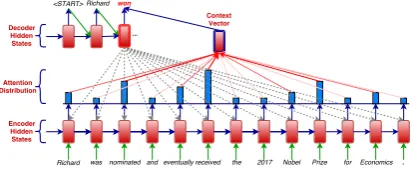
Figure 1: Attention-based encoder-decoder model. The model may attend to relevant source information while decoding the simplification, e.g., to generate the target wordwonthe model may attend to the source words
received,nominatedandPrize.
NSE as the encoder and an LSTM as the decoder performed the best among these models, improv-ing over strong simplification systems. (2) Sec-ond, we perform an extensive evaluation of vari-ous approaches proposed in the literature on differ-ent datasets. Results of both automatic and human evaluation show that our approach is remarkably effective for the task, significantly reducing the reading difficulty of the input, while preserving grammaticality and the original meaning. We fur-ther discuss some advantages and disadvantages of these approaches.
2 Neural Sequence to Sequence Models 2.1 Attention-based Encoder-Decoder Model
Our approach is based on an attention-based Seq2seq model (Bahdanau et al., 2015) (Figure 1). Given a complex source sentenceX = x1:Tx,
the model learns to generate its simplified version
Y = y1:Ty. The encoder reads through X and
computes a sequence of hidden statesh1:Tx:
ht=Fenc(ht−1, xt),
where Fenc is a non-linear activation function
(e.g., LSTM),htis the hidden state at timet. Each
time the model generates a target wordyt, the
de-coder looks at a set of positions in the source sen-tence where the most relevant information is lo-cated. Specifically, another non-linear activation function Fdec is used for the decoder where the
hidden statestat timetis computed by: st=Fdec(st−1, yt−1, ct).
Here, the context vector ct is computed as a
weighted sum of the hidden vectorsh1:Tx:
ct= Tx
P i=1
αtihi, αti= TxPexp(st−1hi)
j=1
exp(st−1hj)
,
whereis the dot product of two vectors. Gen-eration is conditioned onctand all the previously
generated target wordsy1:t−1:
P(Y|X) =
Ty
Q t=1
P(yt|{y1:t−1}, ct),
P(yt|{y1:t−1}, ct) =G(yt−1, st, ct),
whereGis some non-linear function. The training
objective is to minimize the cross-entropy loss of the training source-target pairs.
2.2 Neural Semantic Encoders
An RNN allows us to compute a hidden statehtof
each word summarizing the preceding wordsx1:t,
but not considering the following words xt+1:Tx
that might also be useful for simplification. An al-ternative approach is to use a bidirectional-RNN (Schuster and Paliwal,1997). Here, we propose to use Neural Semantic Encoders (NSE,Munkhdalai and Yu, 2017). During each encoding time step t, we compute a memory matrix Mt ∈ RTx×D
where D is the dimensionality of the word tors. This matrix is initialized with the word vec-tors and is refined over time through NSE’s func-tions to gain a better understanding of the input sequence. Concretely, NSE sequentially reads the tokensx1:Tx with itsreadfunction:
rt=Freadenc(rt−1, xt),
whereFreadenc is an LSTM,rt ∈ RD is the hidden
state at timet. Then, acompose function is used to composertwith relevant information retrieved
from the memory at the previous time step,Mt−1: ct=Fcomposeenc (rt, mt),
where Fcomposeenc is a multi-layer perceptron with one hidden layer, ct ∈ R2D is the output vector,
andmt∈RD is a linear combination of the
mem-ory slots ofMt−1, weighted byσti∈R:
mt= Tx
P i=1
σtiMt−1,i, σti= TxPexp(rtMt−1,i)
j=1
exp(rtMt−1,j)
.
Here,Mt−1,iis theithrow of the memory matrix
at timet−1,Mt−1. Next, awritefunction is used to mapctto the encoder output space:
wt=Fwriteenc (wt−1, ct),
whereFwriteenc is an LSTM,wt ∈RD is the hidden
state at timet. Finally, the memory is updated ac-cordingly. The retrieved memory content pointed byσtiis erased and the new content is added:
Mt,i = (1−σti)Mt−1,i+σtiwt.
NSE gives us unrestricted access to the entire source sequence stored in the memory. As such, the encoder may attend to relevant words when encoding each word. The sequencew1:Tx is then
2.3 Decoding
We differ from the approach of Zhang et al. (2017) in the sense that we implement both a greedy strat-egy and a beam-search stratstrat-egy to generate the tar-get sentence. Whereas the greedy decoder always chooses the simplification candidate with the high-est log-probability, the beam-search decoder keeps a fixed number (beam) of the highest scoring can-didates at each time step. We report the best sim-plification among the outputs based on automatic evaluation measures.
3 Experimental Setup 3.1 Datasets
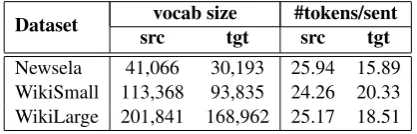
Following (Zhang and Lapata, 2017), we exper-iment on three simplification datasets, namely: (1) Newsela (Xu et al., 2015), a high-quality simplification corpus of news articles composed by Newsela1 professional editors. We used the split of the data in (Zhang and Lapata, 2017), i.e., 94,208/1,129/1,077 pairs for train/dev/test. (2) WikiSmall (Zhu et al., 2010), which contains aligned complex-simple sentence pairs from En-glish Wikipedia (EW) and SEW. The dataset has 88,837/205/100 pairs for train/dev/test. (3) Wik-iLarge (Zhang and Lapata, 2017), a larger cor-pus in which the training set is a mixture of three Wikipedia datasets in (Zhu et al.,2010;Woodsend and Lapata,2011;Kauchak,2013), and the devel-opment and test sests are complex sentences taken fromWikiSmall, each has 8 simplifications written by Amazon Mechanical Turk workers (Xu et al., 2016). The dataset has 296,402/2,000/359 pairs for train/dev/test. Table1provides statistics on the training sets.
Dataset srcvocab sizetgt #tokens/sentsrc tgt
[image:3.595.77.286.564.631.2]Newsela 41,066 30,193 25.94 15.89 WikiSmall 113,368 93,835 24.26 20.33 WikiLarge 201,841 168,962 25.17 18.51
Table 1: Statistics for the training sets: the vocabulary size (vocab size), and the average number of tokens per sentence (#tokens/sent) of the source (src) and target (tgt) language.
3.2 Models and Training Details
We implemented two attention-based Seq2seq models, namely: (1) LSTMLSTM: the encoder
1https://newsela.com
is implemented by two LSTM layers; (2) NSE L-STM: the encoder is implemented by NSE. The
decoder in both cases is implemented by two LSTM layers. For all experiments, our mod-els have dimensional hidden states and 300-dimensional word embeddings. Parameters were initialized from a uniform distribution [-0.1, 0.1). We used the same hyperparameters across all datasets. Word embeddings were initialized ei-ther randomly or with Glove vectors (Pennington et al., 2014) pre-trained on Common Crawl data (840B tokens), and fine-tuned during training. We used a vocabulary size of 20K for Newsela, and 30K for WikiSmall and WikiLarge. Our mod-els were trained with a maximum number of 40 epochs using Adam optimizer (Kingma and Ba, 2015) with step sizeα = 0.001for LSTMLSTM,
and0.0003for NSELSTM, the exponential decay
ratesβ1 = 0.9, β2 = 0.999. The batch size is set to 32. We used dropout (Srivastava et al., 2014) for regularization with a dropout rate of 0.3. For beam search, we experimented with beam sizes of 5 and 10. Following (Jean et al., 2015), we re-placed each out-of-vocabulary token hunki with the source word xk with the highest alignment
scoreαti, i.e.,k= argmax i
(αti).
Our models were tuned on the development sets, either with BLEU (Papineni et al., 2002) that scores the output by countingn-gram matches with the reference, or SARI (Xu et al.,2016) that compares the output against both the reference and the input sentence. Both measures are commonly used to automatically evaluate the quality of sim-plification output. We noticed that SARI should be used with caution when tuning neural Seq2seq simplification models. Since SARI depends on the differences between a system’s output and the input sentence, large differences may yield very good SARI even though the output is ungrammat-ical. Thus, when tuning with SARI, we ignored epochs in which the BLEU score of the output is too low, using a threshold ς. We setς to 22 on Newsela, 33 on WikiSmall, and 77 on WikiLarge.
3.3 Comparing Systems
We compared our models, either tuned with BLEU (-B) or SARI (-S), against systems reported in (Zhang and Lapata, 2017), namely DRESS, a
deep reinforcement learning model, DRESS-LS,
a combination of DRESS and a lexical
-R, a PBMT model with dissimilarity-based re-ranking (Wubben et al., 2012), HYBRID, a
hy-brid semantic-based model that combines a sim-plification model and a monolingual MT model (Narayan and Gardent,2014), and SBMT-SARI, a
SBMT model with simplification-specific compo-nents. (Xu et al.,2016).
3.4 Evaluation
We measured BLEU, and SARI at corpus-level following (Zhang and Lapata, 2017). In addi-tion, we also evaluated system output by elicit-ing human judgments. Specifically, we randomly selected 40 sentences from each test set, and in-cluded human reference simplifications and corre-sponding simplifications from the systems above2. We then asked three volunteers3to rate simplifica-tions with respect toFluency(the extent to which the output is grammatical English),Adequacy(the extent to which the output has the same meaning as the input sentence), andSimplicity (the extent to which the output is simpler than the input sen-tence) using a five point Likert scale.
4 Results and Discussions
4.1 Automatic Evaluation Measures
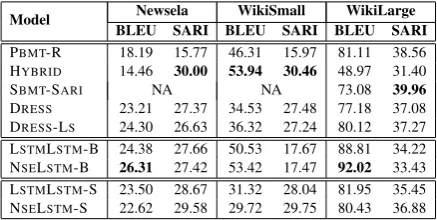
The results of the automatic evaluation are dis-played in Table 2. We first discuss the results on Newsela that contains high-quality simplifica-tions composed by professional editors. In terms of BLEU, all neural models achieved much higher scores than PBMT-R and HYBRID. NSELSTM-B
scored highest with a BLEU score of 26.31. With regard to SARI, NSELSTM-S scored best among
neural models (29.58) and came close to the per-formance of HYBRID(30.00). This indicates that
NSE offers an effective means to better encode complex sentences for sentence simplification.
On WikiSmall, HYBRID– the current
state-of-the-art – achieved best BLEU (53.94) and SARI (30.46) scores. Among neural models, NSELSTM
-B yielded the highest -BLEU score (53.42), while NSELSTM-S performed best on SARI (29.75). On
WikiLarge4, again, NSELSTM-B had the highest BLEU score of 92.02. SBMT-SARI – that was 2The outputs of comparison systems are available at https://github.com/XingxingZhang/dress.
3two native English speakers and one non-native fluent English speaker
4Here, BLEU scores are much higher compared to Newsela and WikiSmall since there are 8 reference simpli-fications for each input sentence in the test set.
Model BLEU SARI BLEU SARI BLEU SARINewsela WikiSmall WikiLarge
PBMT-R 18.19 15.77 46.31 15.97 81.11 38.56
HYBRID 14.46 30.00 53.94 30.46 48.97 31.40
SBMT-SARI NA NA 73.08 39.96
[image:4.595.307.526.62.172.2]DRESS 23.21 27.37 34.53 27.48 77.18 37.08 DRESS-LS 24.30 26.63 36.32 27.24 80.12 37.27 LSTMLSTM-B 24.38 27.66 50.53 17.67 88.81 34.22 NSELSTM-B 26.31 27.42 53.42 17.47 92.02 33.43 LSTMLSTM-S 23.50 28.67 31.32 28.04 81.95 35.45 NSELSTM-S 22.62 29.58 29.72 29.75 80.43 36.88
Table 2: Model performance using automatic evalua-tion measures (BLEU and SARI).
trained on a huge corpus of 106M sentence pairs and 2B words – scored highest on SARI with 39.96, followed by DRESS-LS (37.27), DRESS
(37.08), and NSELSTM-S (36.88).
4.2 Human Judgments
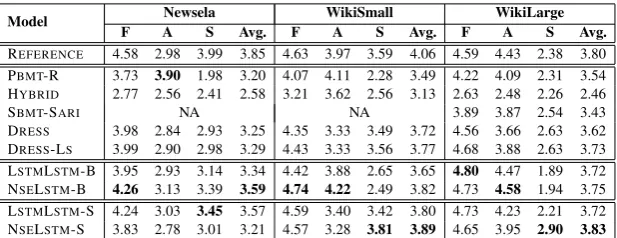
The results of human judgments are displayed in Table3. On Newsela, NSELSTM-B scored highest
on Fluency. PBMT-R was significantly better than
all other systems on Adequacy while LSTMLSTM
-S performed best on -Simplicity. NSELSTM-B did
very well on both Adequacy and Simplicity, and was best in terms of Average. Example model out-puts on Newsela are provided in Table4.
On WikiSmall, NSELSTM-B performed best
on both Fluency and Adequacy. On WikiLarge, LSTMLSTM-B achieved the highest Fluency score
while NSELSTM-B received the highest
Ade-quacy score. In terms of Simplicity and Average, NSELSTM-S outperformed all other systems on
both WikiSmall and WikiLarge.
As shown in Table 3, neural models often outperformed traditional systems (PBMT-R, HY -BRID, SBMT-SARI) on Fluency. This is not
sur-prising given the recent success of neural Seq2seq models in language modeling and neural machine translation (Zaremba et al., 2014; Jean et al., 2015). On the downside, our manual inspection reveals that neural models learn to perform copy-ing very well in terms of rewrite operations (e.g., copying, deletion, reordering, substitution), often outputting the same or parts of the input sentence. Finally, as can be seen in Table 3, REFER -ENCEscored lower on Adequacy compared to
Flu-ency and Simplicity on Newsela. On Wikipedia-based datasets, REFERENCE obtained high
Model F ANewselaS Avg. F WikiSmallA S Avg. F WikiLargeA S Avg.
REFERENCE 4.58 2.98 3.99 3.85 4.63 3.97 3.59 4.06 4.59 4.43 2.38 3.80 PBMT-R 3.73 3.90 1.98 3.20 4.07 4.11 2.28 3.49 4.22 4.09 2.31 3.54 HYBRID 2.77 2.56 2.41 2.58 3.21 3.62 2.56 3.13 2.63 2.48 2.26 2.46
SBMT-SARI NA NA 3.89 3.87 2.54 3.43
[image:5.595.145.454.61.180.2]DRESS 3.98 2.84 2.93 3.25 4.35 3.33 3.49 3.72 4.56 3.66 2.63 3.62 DRESS-LS 3.99 2.90 2.98 3.29 4.43 3.33 3.56 3.77 4.68 3.88 2.63 3.73 LSTMLSTM-B 3.95 2.93 3.14 3.34 4.42 3.88 2.65 3.65 4.80 4.47 1.89 3.72 NSELSTM-B 4.26 3.13 3.39 3.59 4.74 4.22 2.49 3.82 4.73 4.58 1.94 3.75 LSTMLSTM-S 4.24 3.03 3.45 3.57 4.59 3.40 3.42 3.80 4.73 4.23 2.21 3.72 NSELSTM-S 3.83 2.78 3.01 3.21 4.57 3.28 3.81 3.89 4.65 3.95 2.90 3.83
Table 3: Average human ratings (Fluency (F), Adequacy (A), Simplicity (S), and Average (Avg.)).
COMPLEX: Another parent , Mike Munson , sits on the bench with a tablet and uses an app to track and analyze the team ’s shots . REFERENCE:Basketballparent Mike Munson sits on the bench with a tablet ,like an iPad.
PBMT-R: Another parent , Mike Munsonison the bench with a tablet and uses an app to track and analyze the team ’s shots .
HYBRID: another parent , mike munson sits uses an app to track and analyze shots . DRESS: Another parent , Mike Munson , sits on the bench with acomputer. DRESS-LS: Another parent , Mike Munson , sits on the bench with acomputer. LSTMLSTM-B:He startson the bench with a tablet and uses an app to track .
NSELSTM-B: Another parent , Mike Munson , sits on the bench with a tablet and uses an app to track .
LSTMLSTM-S:Shesits on the bench with a tablet and uses an app to track andstudythe team ’s shots . NSELSTM-S:Hesits on the bench with a tablet .
COMPLEX: Stowell believes that even documents about Lincoln ’s death will give people a better understanding of the man who was assassinated 150 years ago this April .
REFERENCE: Stowellthinksthat eveninformationabout Lincoln ’s death willhelppeopleunderstand him.
PBMT-R: Stowellthinksthat even documents about Lincoln ’s death will give people a better understanding of the man who was killed 150 years ago this April .
HYBRID: documentsthatwill give people a understanding the man was assassinated 150 years ago .
DRESS: Stowellthinksthat even documents about Lincoln ’s death will give people a better understanding of the man .
DRESS-LS: Stowellthinksthat even documents about Lincoln ’s death will give people a better understanding of the man . LSTMLSTM-B: Stowell believes thatonlydocuments about Lincoln ’s death will give people a better understanding . NSELSTM-B: Stowell believes thatthe discoveryabout Lincoln ’s death will give people a better understanding of the man .
LSTMLSTM-S: Stowellthinksthat even documents about Lincoln ’s death will give people a better understanding of the man . NSELSTM-S: Stowellthinksthat evenpapersabout Lincoln ’s death will give people a better understanding of the man .
Table 4: Example model outputs on Newsela. Substitutions are shown in bold.
4.3 Correlations
Table5shows the correlations between the scores assigned by humans and the automatic evaluation measures. There is a positive significant correla-tion between Fluency and Adequacy (0.69), but a negative significant correlation between Adequacy and Simplicity (-0.64). BLEU correlates well with Fluency (0.63) and Adequacy (0.90) while SARI correlates well with Simplicity (0.73). BLEU and SARI show a negative significant correlation (-0.54). The results reflect the challenge of manag-ing the trade-off between Fluency, Adequacy and Simplicity in sentence simplification.
Adequacy Simplicity BLEU SARI Fluency 0.69∗∗ -0.03 0.63∗∗ -0.48∗∗
Adequacy -0.64∗∗ 0.90∗∗ -0.81∗∗
Simplicity -0.56∗∗ 0.73∗∗
BLEU -0.54∗∗
Table 5: Pearson correlation between the scores as-signed by humans and the automatic evaluation mea-sures. Scores marked∗∗are significant atp <0.01.
5 Conclusions
In this paper, we explore neural Seq2seq models for sentence simplification. We propose to use an architecture with augmented memory capacities which we believe is suitable for the task, where one is confronted with long and complex sen-tences. Results of both automatic and human eval-uation on different datasets show that our model is capable of significantly reducing the reading diffi-culty of the input, while performing well in terms of grammaticality and meaning preservation.
6 Acknowledgements
[image:5.595.77.284.671.729.2]References
Dzmitry Bahdanau, Kyunghyun Cho, and Yoshua Ben-gio. 2015. Neural machine translation by jointly learning to align and translate. In Proceedings of the International Conference on Learning Represen-tations (ICLR), Curran Associates, Inc., San Diego, CA, USA, pages 3104–3112.
Beata Beigman Klebanov, Kevin Knight, and Daniel Marcu. 2004. Text simplification for information-seeking applications. In Proceed- ings of On-tologies, Dabases, and Applications of Semantics (ODBASE) International Conference, volume 3290 of Lecture Notes in Computer Science. Springer, Berlin, Heidelberg, pages 735–747.
John Carroll, Guido Minnen, Darren Pearce, Yvonne Canning, Siobhan Devlin, and John Tait. 1999. Sim-plifying text for language-impaired readers. In
Proceedings of the 9th Conference of the Euro-pean Chapter of the Association for Computational Linguistics (EACL). Association for Computational Linguistics, Bergen, Norway, pages 269–270.
R. Chandrasekar, Christine Doran, and B. Srinivas. 1996. Motivations and methods for text simplifica-tion. InProceedings of the 16th International Con-ference on Computational Linguistics (COLING). Stroudsburg, PA, USA, pages 1041–1044.
Kyunghyun Cho, Bart van Merrienboer, Caglar Gul-cehre, Dzmitry Bahdanau, Fethi Bougares, Holger Schwenk, and Yoshua Bengio. 2014. Learning phrase representations using rnn encoder–decoder for statistical machine translation. InProceedings of the 2014 Conference on Empirical Methods in Nat-ural Language Processing (EMNLP). Association for Computational Linguistics, Doha, Qatar, pages 1724–1734.
Will Coster and David Kauchak. 2011. Learning to simplify sentences using wikipedia. InProceedings of the Workshop on Monolingual Text-To-Text Gen-eration. Association for Computational Linguistics, Portland, Oregon, pages 1–9.
Sepp Hochreiter and Jrgen Schmidhuber. 1997. Long short-term memory. Neural Computation
9(8):1735–1780.
S´ebastien Jean, Orhan Firat, Kyunghyun Cho, Roland Memisevic, and Yoshua Bengio. 2015. Montreal neural machine translation systems for wmt15. In
Proceedings of the Tenth Workshop on Statisti-cal Machine Translation. Association for Computa-tional Linguistics, Lisbon, Portugal, pages 134–140.
David Kauchak. 2013. Improving text simplification language modeling using unsimplified text data. In
Proceedings of the 51st Annual Meeting of the As-sociation for Computational Linguistics (ACL). As-sociation for Computational Linguistics, Sofia, Bul-garia, pages 1537–1546.
Diederik Kingma and Jimmy Ba. 2015. Adam: A method for stochastic optimization. InProceedings of the International Conference on Learning Rep-resentations (ICLR), Curran Associates, Inc., San Diego, CA, USA.
Kevin Knight and Daniel Marcu. 2000. Statistics-based summarization - step one: Sentence com-pression. In Proceedings of the Seventeenth Na-tional Conference on Artificial Intelligence (AAAI) and Twelfth Conference on Innovative Applications of Artificial Intelligence (IAAI). AAAI Press, pages 703–710.
Tsendsuren Munkhdalai and Hong Yu. 2017. Neu-ral semantic encoders. In Proceedings of the 15th Conference of the European Chapter of the Asso-ciation for Computational Linguistics (EACL). As-sociation for Computational Linguistics, Valencia, Spain, pages 397–407.
Shashi Narayan and Claire Gardent. 2014. Hybrid sim-plification using deep semantics and machine trans-lation. In Proceedings of the 52nd Annual Meet-ing of the Association for Computational LMeet-inguistics (ACL). Association for Computational Linguistics, Baltimore, Maryland, pages 435–445.
Sergiu Nisioi, Sanja ˇStajner, Simone Paolo Ponzetto, and Liviu P. Dinu. 2017. Exploring neural text sim-plification models. InProceedings of the 55th An-nual Meeting of the Association for Computational Linguistics (ACL). Association for Computational Linguistics, Vancouver, Canada, pages 85–91.
Kishore Papineni, Salim Roukos, Todd Ward, and Wei-Jing Zhu. 2002. Bleu: a method for automatic eval-uation of machine translation. In Proceedings of 40th Annual Meeting of the Association for Com-putational Linguistics (ACL). Association for Com-putational Linguistics, Philadelphia, Pennsylvania, USA, pages 311–318.
Jeffrey Pennington, Richard Socher, and Christopher Manning. 2014. Glove: Global vectors for word representation. In Proceedings of the 2014 Con-ference on Empirical Methods in Natural Language Processing (EMNLP). Association for Computa-tional Linguistics, Doha, Qatar, pages 1532–1543.
Mike Schuster and Kuldip K Paliwal. 1997. Bidirec-tional recurrent neural networks. IEEE Transactions on Signal Processing45(11):2673–2681.
Advaith Siddharthan. 2003. Syntactic simplification and text cohesion. Ph.D. Thesis, University of Cam-bridge, University of Cambridge.
Ilya Sutskever, Oriol Vinyals, and Quoc V Le. 2014. Sequence to sequence learning with neural net-works. In Z. Ghahramani, M. Welling, C. Cortes, N. D. Lawrence, and K. Q. Weinberger, editors, Ad-vances in Neural Information Processing Systems 27 (NIPS), Curran Associates, Inc., pages 3104–3112.
Sanja ˇStajner, Hannah Bechara, and Horacio Saggion. 2015. A deeper exploration of the standard pb-smt approach to text simplification and its evaluation. In
Proceedings of the 53rd Annual Meeting of the Asso-ciation for Computational Linguistics (ACL) and the 7th International Joint Conference on Natural Lan-guage Processing (IJCNLP). Association for Com-putational Linguistics, Beijing, China, pages 823– 828.
Willian Massami Watanabe, Arnaldo Candido Junior, Vin´ıcius Rodriguez Uzˆeda, Renata Pontin de Mattos Fortes, Thiago Alexandre Salgueiro Pardo, and San-dra Maria Alu´ısio. 2009. Facilita: Reading assis-tance for low-literacy readers. InProceedings of the 27th ACM International Conference on Design of Communication (SIGDOC). ACM, New York, NY, USA, pages 29–36.
Kristian Woodsend and Mirella Lapata. 2011. Learn-ing to simplify sentences with quasi-synchronous grammar and integer programming. In Proceed-ings of the 2011 Conference on Empirical Meth-ods in Natural Language Processing (EMNLP). As-sociation for Computational Linguistics, Edinburgh, Scotland, UK., pages 409–420.
Sander Wubben, Antal van den Bosch, and Emiel Krahmer. 2012. Sentence simplification by mono-lingual machine translation. InProceedings of the 50th Annual Meeting of the Association for Compu-tational Linguistics (ACL). Association for Compu-tational Linguistics, Jeju Island, Korea, pages 1015– 1024.
Wei Xu, Chris Callison-Burch, and Courtney Napoles. 2015. Problems in current text simplification re-search: New data can help. Transactions of the Association for Computational Linguistics (TACL)
3:283–297.
Wei Xu, Courtney Napoles, Ellie Pavlick, Quanze Chen, and Chris Callison-Burch. 2016. Optimizing statistical machine translation for text simplification.
Transactions of the Association for Computational Linguistics (TACL)4:401–415.
Wojciech Zaremba, Ilya Sutskever, and Oriol Vinyals. 2014. Recurrent neural network regularization.
arXiv preprint arXiv:1409.2329.
Xingxing Zhang and Mirella Lapata. 2017. Sen-tence simplification with deep reinforcement learn-ing. In Proceedings of the 2017 Conference on Empirical Methods in Natural Language Processing (EMNLP). Association for Computational Linguis-tics, Copenhagen, Denmark, pages 595–605.