Proceedings of NAACL-HLT 2018, pages 1687–1696
Estimating Summary Quality with Pairwise Preferences
Markus Zopf
Research Training Group AIPHES / Knowledge Engineering Group Department of Computer Science, Technische Universit¨at Darmstadt
Hochschulstraße 10, 64289 Darmstadt, Germany [email protected]
Abstract
Automatic evaluation systems in the field of automatic summarization have been relying on the availability of gold standard summaries for over ten years. Gold standard summaries are expensive to obtain and often require the availability of domain experts to achieve high quality. In this paper, we propose an alter-native evaluation approach based on pairwise preferences of sentences. In comparison to gold standard summaries, they are simpler and cheaper to obtain. In our experiments, we show that humans are able to provide useful feedback in the form of pairwise preferences. The new framework performs better than the three most popular versions of ROUGE with less expensive human input. We also show that our framework can reuse already available evaluation data and achieve even better results.
1 Introduction
Due to the huge amount of information contained in texts, the task of automatic text summarization (Mani, 2001; Nenkova and McKeown, 2011) is a pressing challenge nowadays and will become even more important in the future. Building sum-marization systems is, however, not the only chal-lenge in this field. Evaluation of automatically generated summaries is also an active field of re-search.
Ideally, we would like to ask humans for their opinion about the quality of automatically gener-ated summaries in an extrinsic evaluation (Hal-teren and Teufel,2003). Since summaries are gen-erated for humans, they should also be evaluated directly by humans. Unfortunately, manual evalu-ation cannot be performed at a large scale because of the huge effort which is necessary for evalua-tion. (Lin,2004) reported that 3,000 hours of hu-man effort would be required for a simple evalu-ation of the summaries for the Document
Under-standing Conference (DUC) 2003, a popular sum-marization shared task series. This motivates re-search of automatic evaluation methods for auto-matic summarization.
ROUGE (Lin, 2004), the current method of choice for evaluating automated text summariza-tion, relies on the availability of gold standard summaries. The gold standard summaries are used to define the optimal output of a summarization system. Writing high-quality summaries, how-ever, requires the availability of expert writers and takes a lot of effort. (Dang, 2005) reported that creating the reference summaries for the DUC 2005 shared task was a difficult endeavor with an effort of five hours to produce each reference sum-mary. Since ROUGE needs at least four reference summaries to become reasonably reliable, the fort sums up to at least 20 hours of annotation ef-fort per topic. For this reason, gold standard sum-maries are only available for a few, rather small datasets. Also the more accurate (but also even more expensive) Pyramid method (Nenkova and Passonneau, 2004) requires expensive gold stan-dard summaries.
Lack of larger and diverse evaluation corpora limits research in automatic summarization. Fur-thermore, currently available automatic evaluation methods are viewed with skepticism (Rankel et al., 2013). Proper evaluation is, however, an indis-pensable ingredient for good research. Comput-ing the similarity between two summaries as in ROUGE is a very difficult task. This seems to be obvious since estimating the similarity between sentences and even words is still an active field of research.
In this work, we present an alternative evalu-ation framework which does not use gold stan-dard summaries to estimate the quality of sum-maries. Instead of comparing automatically gen-erated summaries with gold standard summaries,
our model is trained with simple and inexpensive pairwise preferences (Thurstone,1927;F¨urnkranz and H¨ullermeier,2010) of sentences. To this end, we provide pairs of sentences from the input doc-ument of a summarization task to human anno-tators and ask which of the two sentences con-tains more important information. We use here the idea of intrinsic information importance (Hong and Nenkova,2014;Zopf et al.,2016) which de-scribes that information can be intrinsically im-portant. For example, the information “Donald Trump won the U.S. presidential election” is in-trinsically important. It is likely that it should also be contained in the generated summary if this in-formation is contained in an input document.
After collecting few preferences, our model uses the preferences to generate a ranking of all sentences according to information importance. Summaries which contain sentences similar the upper part of the ranking are then considered to be better than summaries which contain unimportant sentences from the lower part of the ranking.
Pairwise preferences are an appealing form of annotation, since they are much easier to generate than producing complex gold standard summaries. Not only collecting the annotations is easier, but also using the collected annotations is much sim-pler. The presented model does not have to solve the difficult task of estimating the similarity be-tween generated and gold standard summaries. In-stead, the model uses the ranking to estimate the summary quality.
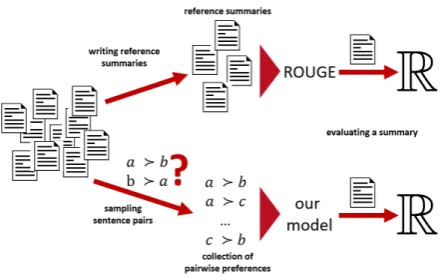
Figure 1 provides an illustration of the tradi-tional evaluation and our new model. On the left, the input documents are illustrated which should be summarized. In the upper part gold standard summaries are generated by humans and used to estimate the quality of an automatically generated summary. In the lower part, we collect pairwise preferences of sentences and use the preferences for evaluation.
An evaluation on topics from two standard datasets, looking at predicting the relative ratings of automatically generated summaries, shows that our new evaluation model is as good as or better than existing methods, at a much lower annotation cost.
2 Related Work
In this section, we will recapitulate previous work in automated text summarization evaluation,
fo-Figure 1: Illustration of traditional evaluation models based on reference summaries (top) and the new model (bottom) which is based on pairwise preferences.
cusing on three important approaches, namely model-free evaluation, ROUGE, and Pyramid. The evaluation methods are ordered according to their annotation requirements from none (model-free evaluation) to high (Pyramid). In addition to the most prominent methods described below, sev-eral evaluation models were developed in the Au-tomatically Evaluating Summaries Of Peers (AE-SOP) shared tasks. The systems in this shared task also considered reference summaries as ad-ditional information to evaluate a reference sum-mary and are therefore as expensive as ROUGE in terms of required human annotation. Similarly, Giannakopoulos and Karkaletsis (2013) use ma-chine learning to learn a linear combination of n-gram methods to evaluate summaries. Mackie et al. (2014), Giannakopoulos (2013), and Co-han and Goharian (2016) investigate evaluation for microblog, multilingual, and scientific sum-marization, respectively. Our evaluation, on con-trary, uses newswire datasets since this is the most prominent application domain for automatic sum-marization. Furthermore, we focus on evaluating the information content of summaries and do not evaluate linguistic quality. This is, for example, captured byPitler et al.(2004).
2.1 Model-free Evaluation
[image:2.595.308.531.60.199.2]2.2 ROUGE
ROUGE (Lin, 2004) was first used in the Doc-ument Understanding Conference (DUC) (Over et al., 2007) and is nowadays the method of choice for automatic evaluation in text summariza-tion. Many popular summarization systems were evaluated with ROUGE (Erkan and Radev,2004; Mihalcea and Tarau, 2004; Gillick et al., 2009; Lin and Bilmes, 2011). It is inspired from the BLEU evaluation method (Papineni et al., 2002) and is based on measuring lexical n-gram over-lap of (stemmed) tokens between generated and gold standard summaries. Researchers usually report the n-gram recall of a summary to eval-uate the quality of a summary. The quality of ROUGE is often criticized in the research com-munity. Sj¨obergh (2007), for example, shows nicely how the ROUGE recall scoring can be fooled easily. A simple greedy language model based on the source documents extracts frequent bi-grams which are likely to occur in the refer-ence summaries. The generated texts are merely lists of bi-grams and not meaningful sentences which cannot be considered to be summaries. However, they achieve superhuman ROUGE recall scores. In the TAC 2008 shared task (Dang and Owczarzak,2008), both 2 and ROUGE-SU4 score automatic systems higher than human summaries, which would lead to the conclusion that these systems are able to produce better sum-maries than humans. Furthermore, studies show that the correlation between ROUGE scores and human judgments may not be significant in non-newswire genres and other summary types (Liu and Liu, 2008). ROUGE also has many param-eters (Graham, 2015), which makes reproduction and comparison of results problematic. Last but not least, ROUGE computes text similarity only based on simple string matching. Expressing the same information with different words is not re-warded by ROUGE. In addition toGraham(2015), Owczarzak et al.(2012) andRankel et al. (2013) analyze ROUGE in more detail.
Agreement with human judgments (Owczarzak et al.,2012) can be used instead of Pearson’s cor-relation to validate an automatic evaluation model. Measuring agreement allows to obtain a better un-derstanding of the performance of an evaluation model compared to the Pearson correlation. We will also use agreement similarly to Owczarzak et al.(2012) in our experiments.
2.3 Pyramid
The Pyramid method (Nenkova et al.,2007) (sim-ilar to (Teufel and Van Halteren,2004)) was used in the Text Analysis Conference (TAC) (Dang and Owczarzak, 2008) and goes beyond lexical comparisons. It is based onSummarization Con-tent Units(SCUs, later also called Summary Con-tent Units). An SCU is a set of lexical expres-sions with same meaning (e.g. {”2 people passed away”, ”two persons died”}). After generating the gold standard summaries, SCUs are extracted from these summaries and are weighted by their occurrence frequency in an additional annotation step. Furthermore, every generated summary has to be annotated individually with SCUs before the Pyramid method can be applied. (Nenkova and Passonneau, 2004) have already reported that a large-scale application of the Pyramid method is infeasible. (Over et al.,2007) report a huge effort for the annotation process in the DUC challenges. This additional annotation effort is unattractive for researchers, who prefer automatic methods such as ROUGE. This is validated by the few applications of the Pyramid method until today. The need for more human annotation also introduces an addi-tional source for annotation mistakes. Inspecting the annotations in the TAC 2008 dataset in detail reveals that this is not only a theoretical issue but has practical implications.1 PEAK (Yang et al.,
2016) is an attempt to automate the Pyramid evalu-ation (similar to (Passonneau et al.,2013)). PEAK also requires reference summaries and is therefore as expensive as ROUGE.
2.4 Qualitative Feedback in Other NLP Tasks
Simple and inexpensive qualitative human feed-back has already been used in the field of machine translation (Callison-Burch,2009;Callison-Burch et al., 2012;Guzm´an et al., 2015). (Snow et al., 2008) showed that in a wide variate of NLP tasks, cheap non-expert labels can replace expensive ex-pert annotations. In comparison to our work, we are not asking non-experts to perform the same task as expert annotators (namely writing refer-ences summaries) but replace the complex task with a simpler tasks (providing qualitative feed-back in form of pairwise preferences).
1We found several issues such as not annotating parent
3 Problem Definition
First, we defineTto be the set of all possible texts
which can be considered to be summaries. For a given set of source documentsD, we define a
bi-nary relation>D ⊂T ×T with the intuition that a >D bholds for two textsa,b ∈T if and only
ifais considered to be the better summary of
doc-ument collectionDthanb. Whenever the context
is clear, we will omitDand writea>bfor short.
The relation >induces a strict total order (given
that ties are not allowed) over T. A text which
ranks high according to>D is a good summary of
the document collectionD.
How good summaries are is annotated in sum-marization corpora only for a very small subset of assessed textsT+ ⊂ T by human annotators.
We use the relation>∗ to express in which order
summaries are ranked by humans in summariza-tion corpora for each document setD(also called
topic or cluster). The relation>∗ therefore
mod-els the human judgments. For not assessed texts
T−=T \T+the human judgment is unknown.
The quality of an evaluation methodE can be
assessed by measuring the agreement with the hu-man judgments. Evaluation models define (im-plicitly) a ranking>E by assigning scores to
sum-maries or predicting the ranking directly. Calcu-lating the agreement of the ranking>E with the
human ranking defined by >∗ provides a scores
which can be used to assess the performance of evaluation models. Measuring the agreement be-tween two relations (which are sets) can be easily done by computing the intersection of both sets:2
Agreement(>∗, >E) = |>∗ ∩> E|
|>∗| (1)
This evaluation of evaluation models is similar to the definition of Agreement andContradiction in Owczarzak et al. (2012): “Agreements occur when the two evaluation metrics make the same distinction between System A and System B (...). Contradictions occur when both metrics find a (...) difference between A and B, but in opposite direc-tions.”A perfect evaluation model, which predicts the preference for all pairs of summaries correctly, will have an agreement of 1 whereas a random
2We require that an evaluation metric has to make a
de-cision for two summaries if the two summaries are different according to the human judgment. Formally: a >∗ b →
a>Eborb>Ea.
Donald Trump won the election and be-came president.
The U.S. Congress certified the results on January 6.
Figure 2: Example of a pairwise preference annotation of two sentences. The first sentence is preferred over the second sentence because the first sentence contains more important information given that the information is not already known.
evaluation model, which always predicts the pref-erence randomly, will have an expected value of 0.5 according to this measure.
We prefer to use the agreement as defined in Equation1for evaluation since it can be much bet-ter inbet-terpreted (Owczarzak et al.,2012). Further-more, Pearson’s correlation is known to be sen-sitive to outliers, is only able to measure linear correlations, and requires normally distributed, in-terval scaled residuals (Anscombe, 1973). These properties cannot be assumed to be given when comparing human scores and automated evalua-tion measures. We therefore prefer to use the agreement according to human judgments as de-fined in Equation 1 instead of calculating Pear-son’s correlation.
4 Preference-based Evaluation of Summaries
4.1 Sampling Preference Annotations
The easiest strategy to select pairs of sentences for which preferences should be annotated is to sam-ple pairs of sentences randomly and to ask anno-tators to provide a preference label for each sam-pled pair (i.e. annotating whetheraborb a
for two randomly sampleda, b ∈ S∗). The
sen-tences are sampled from all source document of a topic and are therefore independent from the au-tomatically generated summaries. Our model will therefore not only be able to evaluate already gen-erated summaries but also summaries which will be generated in the future.
All preferences are stored in a matrix M. An
entry ofnat positionMij indicates that sentence
with indexiwas preferred n-times over sentence with index j. To reduce the number of
annota-tions, we apply a smooth propagation of knowl-edge. The idea is that we do not only obtain infor-mation about the sampled sentence pair but also about pairs which are similar to the sampled pair.
To estimate how much information can be trans-fered from one to another pair, we calculate the similarities between all sentences. As similarity measure we use the average of the well-known and simple Cosine similarity of TF-IDF vectors and Jaccard similarities. The combination allows to both rely the similarity computation on lexi-cal similarity (Jaccard) and on important content words (Cosine). We define the set of all sentences in the source documents of a topic as S∗. Let (a, b), a, b ∈ S∗ be one annotated sentence pair
and a,˙ b˙ the vector of similarities between a and
band all sentences (i.e. a˙i denotes the similarity
betweenaand thei-th sentence inS∗).
We define the similarity of the pair(a1, b1)and the pair(a2, b2)assim(a1, a2)∗sim(b1, b2). Ifa1 is the exact same sentence as a2 and b1 is sim-ilar with a degree of 0.7 to b2, we will transfer
0.7 of the information from (a1, b1) to the pair
(a2, b2). Transferring information means that we generate additional preferences based on human preferences. If a1 was preferred over b1 by a human annotator, we will additionally generate a weighted preferences of with a weight of 0.7 be-tweena2andb2. This can be modeled by the outer producta˙1⊗b˙1 ofa1 andb1. For each annotated pair (a, b), in whichawas preferred by a human
overb, we update matrixM byM ←M+ ˙a⊗b˙.
4.2 Sentence Score Prediction
The proposed usage of pairwise preferences be-tween sentences is close to the idea of generat-ing a rankgenerat-ing of sports teams by playgenerat-ing individual matches. Instead of competitions between teams, we observe competitions between sentences. The outcome of a match between teams equals to the annotation of a pair of sentences by a human an-notator. Since different people can have differ-ent opinions about the importance of information (Gambhir and Gupta, 2016), we expect that one sentence will not always be preferred by humans similarly to the situation that the better sports team does not always win against a weaker opponent. This is expressed by the winning probability be-tween teams (or sentences).
In sports, the term power ranking is used to describe a ranking which does not only rank the individual teams but also assigns a score to each team, theskill. A well-known method to generate a power ranking is the Bradly-Terry (BT) model (Bradley and Terry,1952). It estimates the utili-tiesv(a), v(b) of two teams (or two sentences)a
andbso that the winning probability of aagainst bequals the score ofadivided by the sum of the
scores ofaandb:
p(ais prefered overb) = v(a)
v(a) +v(b) (2)
An algorithm to find a maximum-likelihood esti-mator (MLE) has already been proposed in (Zer-melo, 1929). To find the MLE, we iteratively perform Equation3 for all sentences si until the
difference between two iterations is sufficiently small.3 wins(s
i)denotes the total number of wins
ofsi and duels(si, sj)the number of duels played
between sentencessiandsj. This information was
collected in the previous step and is stored in ma-trixM.
v(si)←wins(si) X
i6=j
duels(si, sj)
v(si) +v(sj) (3)
We normalize the resulting skill vector after each iteration since every multiple of the solution is also a correct solution and therefore restrict the model to converge to one particular solution.
3We initialize all scoresv(s
4.2.1 Summary Score Prediction
We estimate the score of summaryswith function
u:T →Ras follows:
u(s) = |s| X
i=1
wsi·v(arg max
s∈S∗ sim(s, si)) (4)
The utility of a summary is therefore defined as the weighted sum of the sentence utilities v.
Since we do not want to restrict our model to purely extractive summaries (which would mean that all sentences contained in the automatic sum-mary have to be exactly contained in the source documents), we estimate the score of a sentence
siin the summary by searching for the most
sim-ilar sentencesin the source documents with
sim-ilarity functionsim : S ×S → [0,1]. As weight ofsi, we use ||si|s| where |.|denotes the length of
the summary and sentence measured in number of characters. The intuition of the weight is that a sentence contributes more to the overall score of a summary if it is longer. The score of a mary will decrease if a large fraction of the sum-mary is occupied with a poor sentence. By using a similarity function instead of a hard matching, our method is able to generalize to unseen sentences.
The definition ofuin Equation4does not
con-sider redundancy. Including a sentence s twice
would result in adding the score ofstwice to the
summary score. This behavior of the evaluation measure is not desirable. We therefore include a redundancy penalization which does not reward redundant information. For a summary s, we
re-duce the score of sentencesby
vred(s) =v(s) 1
|s|
X
g∈s
num(g, s)
num(g,s) (5)
where num(g, s) and num(g,s)denote the number
of occurrences of the bi-gramginsands,
respec-tively.|s|denotes the number of bi-grams ins. 4.3 Reusing Available Annotation
Information
For already existing summarization corpora, refer-ence summaries and/or Pyramid annotations have already been created. Instead of generating new preference annotations by asking human annota-tors, we can also reuse the available data to simu-late annotations. To this end, we define functions
wrandwpwhich estimate the score of a single
sen-tence based on reference summaries (r) and Pyra-mid scores (p), respectively. We will use the scores
generated bywrandwpto simulate annotations of
sentence pairs. For two sentencea, bwe can
sim-ulate a human preference annotation of a bif wr(a) > wr(b) and a win of b overa otherwise
(equivalent forwp).
For a set of gold standard summariesR, we
de-finewr :S → Rsimply to be the maximum
sim-ilarity to the sentences in the gold standard sum-maries:
wr(s) = max
t∈r,r∈R(sim(s, t)) (6)
If a very similar sentence appears in a gold stan-dard summary, swill receive a high score. If no
similar sentences are in the gold standard sum-maries the sentence will receive a low score.
Given that Pyramid annotations are available (as in the TAC 2009 corpus, for example), we can define the score of a sentence as the sum of the weights of the matched unique SCUs (similar to the Pyramid method). Annotations are, unfortu-nately, only available for all sentences in the doc-uments in T+ and not for sentences in S∗. We
therefore search for sentencesinS∗ for the most
similar sentencesˆin the documents inT+
ˆ
s= arg max t∈t,t∈T+
sim(s, t) (7)
and set the score ofsto
wp(s) = X
scu∈ˆs
weight(scu) (8)
wherescu∈tare all unique SCUs contained int
andweight(scu)denotes the weight of an SCU as
defined in (Nenkova and Passonneau, 2004). As described above, we will observe wins and losses between pairs based on the estimated scores.
5 Experiments
We provide in this section a detailed analysis of our proposed evaluation method. For the experi-ment, we use eight topics from two popular multi-document summarization datasets, the DUC 2004 (DUC04) and TAC 2009 (TAC09) corpora, which are freely available upon request.4 Each topic
in the datasets contains ten source documents. Each topic contains automatically generated sum-maries which were generated in the DUC 2004 and TAC 2009 shared tasks. All automatically
4http://duc.nist.gov and https://tac.
JS R1 R2 R3 R4 SU4 man DUC04 0.480 0.651 0.639 0.649 0.606 0.558 0.673
[image:7.595.308.525.62.113.2]TAC09 0.565 0.638 0.668 0.660 0.674 0.663 0.688
Table 1: Agreement of preference based evaluation as defined in Equation1of different versions of Jensen-Shannon, ROUGE and our novel model based on man-ually labeled pairwise preferences.
generated summaries were evaluated by humans. Each summary was labeled with a score from 1 to 5 (DUC04) or 1 to 10 (TAC09) indicating the in-formation content of the summary. Evaluation of grammatically, writing style, etc. is not included in the scores. An evaluation model predicts the preference for two selected summaries correctly if the model predicts the same preference according to the annotated reference scores and incorrectly otherwise. We do not consider ties in the exper-iments. In the following, we report the agree-ment as described in Equation 1 for various ex-periments. We use the abbreviationsJS (Jensen-Shannon),R1- R4 (ROUGE-1 - ROUGE-4),SU4 (ROUGE-SU4), andPY (Pyramid (Nenkova and Passonneau, 2004)) to denote the reference sys-tems.
5.1 Manual Annotations
In the first experiment, we investigate whether hu-mans are able to provide useful feedback in the form of pairwise preferences.
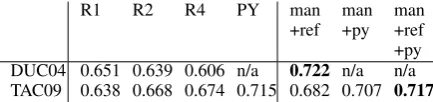
To evaluate our model, we annotated 200 ran-domly sampled sentence pairs for the first four topics in the DUC04 and the first four topics in the TAC09 corpus with pairwise preferences. The preferences were used (including the previously described smoothed sampling) as input for the proposed model. The results are shown in Ta-ble 1. Column man denotes the performance of our now model and columnTime (min)indicates how much time was required to generate the an-notations. This information is in particular impor-tant for this paper since our main aim is to develop a cheap evaluation framework. In average, our model achieves an agreement of 0.673 in DUC04 and 0.688 in TAC09. This means, that 67.3/68.8 percent of all pairs of manually rated summaries were predicted correctly. This outperforms the best versions of ROUGE in the respective corpora (SU4 with 65.1 percent in DUC04 and R2 with 66.0 percent in TAC09).
With an average annotation time per topic of 53
R1 R2 R4 PY man
+ref man+py man+ref +py DUC04 0.651 0.639 0.606 n/a 0.722 n/a n/a TAC09 0.638 0.668 0.674 0.715 0.682 0.707 0.717
Table 2: Agreement of different versions of ROUGE and Pyramid (PY) and our novel models based on hu-man and automatically generated pairwise preferences in addition to manually labeled preferences.
and 54 minutes our model needs much less anno-tation effort than ROUGE.
5.2 Weak Supervision with Additionally Simulated Annotations
In the next experiment, we are interested whether we can simulate additional annotations based on already available reference summaries and Pyra-mid annotations. The automatically annotated pairs can be considered to be an additional weak supervision for the model. We simulated 200 ad-ditional annotations based on reference summaries and/or Pyramid annotations in addition to the 200 manual annotations per topic. To this end, we ran-domly sampled 200 additional pairs and annotated the pairs with a preference label based on refer-ence summaries and/or Pyramid annotations. Ta-ble2, columnman+refcontains the results for 200 manual + 200 simulated reference summary-based annotations; columnman+pycontains the results for 200 manual + 200 simulated Pyramid score-based annotations; and columnman+ref+py con-tains results for 200 manual + 200 reference summary-based + 200 Pyramid score-based anno-tations. The results show that we can improve the agreement with additional simulated annota-tions based on reference summaries in DUC04 by 5 percent points. Additional annotations increased Agreement in TAC09 by 3 percent points. This leads to the conclusion that we can use already available reference summaries in order to substi-tute more human preference annotations, which makes the trade-off between performance and an-notations effort of our model even better.
R1 R2 R4 PY ref py DUC04 0.651 0.639 0.606 n/a 0.716 n/a TAC09 0.638 0.668 0.674 0.715 0.644 0.709 Table 3: Agreement with human judgments for refer-ence systems and our model fed with only automati-cally generated preferences labels.
perform much better than ROUGE at DUC 2004. In TAC 2009, our model achieves similar perfor-mance as the best performing evaluation based on Pyramid annotations. We conclude that automat-ically generating pairwise preferences based on already available reference summaries is already sufficient to outperform ROUGE. Pairwise pref-erences generated based on the more expensive Pyramid annotations do not improve the perfor-mance.
5.4 Convergence
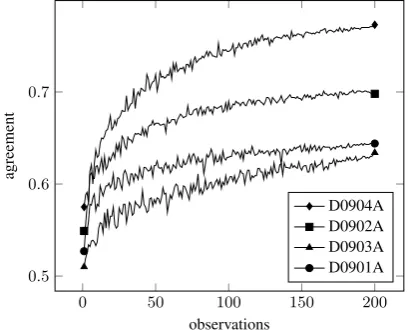
In the next experiment, we investigate how agree-ment changes with an increasing amount of anno-tations. Figure3shows how agreement improves with more annotations. We sampled n
annota-tions (horizontal axis) randomly from the human annotations and averaged the resulting agreement scores (vertical axis) of 100 runs to obtain reli-able results. We observe a continuous improve-ment of agreeimprove-ment in all four topics in the TAC 2009 dataset which indicates that sampling more annotations can further improve the performance of our system.
0 50 100 150 200 0.5
0.6 0.7
observations
agreement
D0904A D0902A D0903A D0901A
Figure 3: Agreement trajectories averaged over 100 runs per topic in the TAC 2009 corpus.
5.5 Ranking Evaluation
We now investigate the ranking generated by our model directly. Since individual sentences are
an-notated in the TAC 2009 corpus with SCUs, we can generate a ranking of the sentences and di-rectly compare this ranking with the ranking gen-erated by our model. Table4 shows the percent-age of correctly ordered sentence pairs (similar to Kendall’s τ) for our model without and with
smoothed sampling.
non-smoothed smoothed
man pyr ref man pyr ref
0.683 0.987 0.661 0.727 0.941 0.698 Table 4: Percentage of correctly ordered sentence pairs in the TAC 2009 corpus for both a non-smoothed and a smoothed sampling.
Smoothed sampling improves the raking of the model if we use 200 manual or 200 reference summary-based preferences in the TAC 2009 cor-pus. Given that we can sample pairs based on Pyramid scores, the model is able to reconstruct the ranking almost perfectly if we do not use smoothed sampling. With smoothed sampling, the performance decreases in this case. The re-sult confirms the previously observed performance at summary scoring where preferences based on Pyramid annotations performed best followed by manually generated preference annotations.
6 Conclusions & Outook
Evaluating automatically generated summaries is a challenging task and creating annotations which are required by applications such as ROUGE or Pyramid is laborious and expensive. We presented an alternative model which does not rely on refer-ence summaries or Pyramid annotations but only on simple pairwise preferences of sentences.
We showed in our experiments that the pro-posed model is able to perform better than the cur-rent state-of-the-art ROUGE method with less ex-pensive annotations and that humans are able to provide useful feedback in the form of pairwise preferences. In combination with already avail-able references summaries and Pyramid annota-tions, we were able to simulate more annotaannota-tions, which improved performance further.
We conclude that gold standard summaries are not the only usable human feedback which can be used for summary evaluation. Investigating other kinds of feedback such as pairwise preferences might be a promising future research direction.
[image:8.595.79.284.495.660.2]collect pairwise preferences on a large scale. Fur-thermore, we want to investigate whether we can reduce the number of required preferences with smarter sampling methods. Active learning meth-ods can be used to replace the simple random sam-pling strategy. Additionally, the investigation of more sophisticated similarity functions can poten-tially improve the model’s performance.
Acknowledgments
This work has been supported by the German Re-search Foundation (DFG) as part of the ReRe-search Training Group Adaptive Preparation of Informa-tion from Heterogeneous Sources (AIPHES) un-der grant No. GRK 1994/1.
References
F. J. Anscombe. 1973. Graphs in Statistical Analysis.
The American Statistician27(1):17–21.
Ralph Allan Bradley and Milton E. Terry. 1952. Rank Analysis of Incomplete Block Designs. Biometrika
39(3):324–345.
Chris Callison-Burch. 2009. Fast, cheap, and creative: evaluating translation quality using Amazon’s
Me-chanical Turk. Proceedings of the 2009
Confer-ence on Empirical Methods in Natural Language Processing 1(August):286–295. https://doi. org/10.3115/1699510.1699548.
Chris Callison-Burch, Philipp Koehn, Christof Monz, Matt Post, Radu Soricut, and Lucia Specia. 2012.
Findings of the 2012 Workshop on Statistical
Ma-chine Translation. Proceedings of the Seventh
Work-shop on Statistical Machine Translation pages 10– 51.https://doi.org/10.3115/1626431. 1626433.
Arman Cohan and Nazli Goharian. 2016. Revisiting Summarization Evaluation for Scientific Articles. In
Proceedings of the Tenth International Conference on Language Resources and Evaluation. pages 806– 813.
Hoa Trang Dang. 2005. Overview of DUC 2005. In Proceedings of the Document Understanding
Conference. https://doi.org/10.3115/
1654679.1654689.
Hoa Trang Dang and Karolina Owczarzak. 2008. Overview of the TAC 2008 Update Summarization Task. InProceedings of the First Text Analysis Con-ference.
G¨unes Erkan and Dragomir R Radev. 2004. LexRank: Graph-based lexical centrality as salience in text summarization. Journal of Artificial Intelligence Research22:457–479.
Johannes F¨urnkranz and Eyke H¨ullermeier, editors. 2010.Preference Learning. Springer.
Mahak Gambhir and Vishal Gupta. 2016. Recent
auto-matic text summarization techniques: a survey.
Ar-tificial Intelligence Review47(1):1–66. https:// doi.org/10.1007/s10462-016-9475-9.
G. Giannakopoulos and V. Karkaletsis. 2013. Sum-mary Evaluation: Together We Stand NPowER-ed. 14th International Conference on Computa-tional Linguistics and Intelligent Text Processing
pages 436–450.
George Giannakopoulos. 2013. Multi-document mul-tilingual summarization and evaluation tracks in ACL 2013 MultiLing Workshop. MultiLing 2013
page 20.
Dan Gillick, Benoit Favre, Dilek Hakkani-T¨ur, Berndt Bohnet, Yang Liu, and Shasha Xie. 2009. The ICSI/UTD Summarization System at TAC 2009. In
Proceedings of the Second Text Analysis Conference.
Yvette Graham. 2015. Re-evaluating Automatic Sum-marization with BLEU and 192 Shades of ROUGE. In Proceedings of the 2015 Conference on Empiri-cal Methods in Natural Language Processing. pages 128–137.
Francisco Guzm´an, Shafiq Joty, Llu\’is M`arquez, and Preslav Nakov. 2015. Pairwise Neural Machine
Translation Evaluation. Proceedings of the 53rd
Annual Meeting of the Association for Computa-tional Linguistics and the 7th InternaComputa-tional Joint Conference on Natural Language Processing (Vol-ume 1: Long Papers) pages 805–814. http:// www.aclweb.org/anthology/P15-1078.
Hans Van Halteren and Simone Teufel. 2003. Exam-ining the consensus between human summaries:
ini-tial experiments with factoid analysis. Proceedings
of the HLT-NAACL2003 Workshop on Text Summa-rizationpages 57–64. https://doi.org/10. 3115/1119467.1119475.
Kai Hong and Ani Nenkova. 2014. Improving the Estimation of Word Importance for News Multi-Document Summarization. In Proceedings of the 14th Conference of the European Chapter of the As-sociation for Computational Linguistics. pages 712– 721.
Chin-Yew Lin. 2004. Rouge: A package for automatic evaluation of summaries. In Text Summarization Branches Out. pages 25–26.
Hui Lin and Jeff Bilmes. 2011. A Class of Submodu-lar Functions for Document Summarization. In Pro-ceedings of the 49th Annual Meeting of the Associa-tion for ComputaAssocia-tional Linguistics. pages 510–520. Feifan Liu and Yang Liu. 2008. Correlation between
Linguistics: Human Language Technologies. pages 201–204.
Annie Louis and Ani Nenkova. 2013. Automati-cally Assessing Machine Summary Content With-out a Gold Standard. Computational Linguistics
39(2):267–300.
Stuart Mackie, Richard Mccreadie, Craig Macdon-ald, and Iadh Ounis. 2014. On Choosing an Effective Automatic Evaluation Metric for
Mi-croblog Summarisation. Proceedings of the
5th Information Interaction in Context Sympo-sium pages 115–124. https://doi.org/10. 1145/2637002.2637017.
Inderjeet Mani. 2001. Automatic Summarization. John Benjamins Publishing Co.
Rada Mihalcea and Paul Tarau. 2004.
Tex-tRank: Bringing order into texts. In
Pro-ceedings of the 2004 Conference on Empirical Methods in Natural Language Processing. vol-ume 85, pages 404–411. https://doi.org/ 10.3115/1219044.1219064.
Ani Nenkova and Kathleen McKeown. 2011.
Au-tomatic Summarization. Foundations and Trends
in Information Retrieval 5(3):103–233. https: //doi.org/10.1561/1500000015.
Ani Nenkova and Rebecca Passonneau. 2004. Evaluat-ing content selection in summarization: The pyra-mid method. In Proceedings of the Human Lan-guage Technology Conference of the North Ameri-can Chapter of the Association for Computational Linguistics. pages 145–152.
Ani Nenkova, Rebecca Passonneau, and Kathleen McKeown. 2007. The Pyramid Method. InACM Transactions on Speech and Language Processing. volume 4, pages 1–23. https://doi.org/10. 1145/1233912.1233913.
Paul Over, Hoa Dang, and Donna Harman. 2007.
DUC in context. Information Processing and
Man-agement43(6):1506–1520.https://doi.org/ 10.1016/j.ipm.2007.01.019.
Karolina Owczarzak, John M Conroy, Hoa Trang Dang, and Ani Nenkova. 2012. An assessment of the accuracy of automatic evaluation in summariza-tion. In Proceedings of Workshop on Evaluation Metrics and System Comparison for Automatic Sum-marization. pages 1–9.
Kishore Papineni, Salim Roukos, Todd Ward, and Wj Zhu. 2002. BLEU: a method for automatic
eval-uation of machine translation. InProceedings of the
40th Annual Meeting of the Association for Compu-tational Linguistics. July, pages 311–318. https: //doi.org/10.3115/1073083.1073135.
Rebecca J. Passonneau, Emily Chen, Weiwei Guo, and Dolores Perin. 2013. Automated Pyramid Scoring of Summaries using Distributional Semantics. In
Proceedings of the 51st Annual Meeting of the As-sociation for Computational Linguistics. pages 143– 147.
Emily Pitler, Annie Louis, and Ani Nenkova. 2004.
Automatic Evaluation of Linguistic Quality in
Multi-Document Summarization. Proceedings of
the 48th Annual Meeting of the Association for Com-putational Linguistics pages 544–554. http:// www.aclweb.org/anthology/P10-1056.
Peter A Rankel, John M Conroy, Hoa Trang Dang, and Ani Nenkova. 2013. A Decade of Automatic Con-tent Evaluation of News Summaries: Reassessing the State of the Art. InProceedings of the 51st An-nual Meeting of the Association for Computational Linguistics. pages 131–136.
Jonas Sj¨obergh. 2007. Older versions of the ROUGEe-val summarization eROUGEe-valuation system were easier
to fool. Information Processing and
Manage-ment 43(6):1500–1505. https://doi.org/ 10.1016/j.ipm.2007.01.014.
Rion Snow, Brendan O Connor, Daniel Jurafsky, An-drew Y Ng, Dolores Labs, and Capp St. 2008.
Cheap and fast - but is it good? Evaluation
non-expert annotiations for natural language tasks.
Pro-ceedings of the Conference on Empirical Methods in Natural Language Processing (EMNLP) pages 254–263. https://doi.org/10.1.1.142. 8286.
Simone Teufel and Hans Van Halteren. 2004. Evalu-ating Information Content by Factoid Analysis: Hu-man annotation and stability. InProceedings of the 2004 Conference on Empirical Methods on Natural Language Processing. pages 419–426.
Louis Leon Thurstone. 1927. A law of comparative judgement.Psychological Review34:278–286.
Qian Yang, Rebecca J. Passonneau, and Gerard de Melo. 2016. PEAK: Pyramid Evaluation via Au-tomated Knowledge Extraction. In Proceedings of the 30th Conference on Artificial Intelligence. pages 2673–2679.
Ernst Zermelo. 1929. Die Berechnung der Turnier-Ergebnisse als ein Maximumproblem der Wahrscheinlichkeitsrechnung. Mathematische Zeitschrift29:436–460.