Abstract—Cloud computing is a pervasive paradigm that is growing by the day. Various service types are gaining increased importance. Internet of things is a technology that is developing. It allows connectivity of both smart and dumb systems over the internet. Cloud computing will continue to be relevant to IoT because of scalable services available on the cloud. Cloud computing is the need for users to procure servers, storage, and applications. These services can be paid for and utilized using the various cloud service providers. Clearly, IoT which is expected to connect everything to everyone, requires not only connectivity but large storage that can be made available either through on-premise or off-premise cloud facility. On the other hand, events in the cloud and IoT are dynamic. This paper aims to provide an understanding of cloud and IoT. In addition, the paper discusses current trends in terms of industry activities. It also examines the prospects of cloud and IoT trends in cloud application management. This will be of benefit to prospective cloud users and even cloud providers.
Index Terms— Cloud Computing, Internet of Things
I. INTRODUCTION
LOUD computing is a model for enabling ubiquitous, convenient, on-demand network access to a shared pool of configurable computing resources (e.g., networks, servers, storage, applications, and services) that can be rapidly provisioned and released with minimal management effort or service provider interaction” [1]. Cloud computing allows the delivery of computing resources as a service over the Internet. It allows enterprises and organizations to access resources without having to invest in on-premise infrastructure. Cloud users can access resources on demand for their workloads. The elastic nature of cloud computing allows enterprises to scale up or down their demands as the need arises. [2] The demands for resources are on a pay–per–use basis; hence consumers pay only for workloads or resources utilized. In view of this, enterprises reduce expenditure on in–house infrastructure and the maintenance requirements are minimal. Cloud computing
Manuscript received December 08, 2017; revised January 22, 2018. This work was supported in part by the Covenant University through the Centre for Research, Innovation and Discovery (CUCRID).
I. Odun-Ayo is with the Department of Computer and Information Sciences, Covenant University, Ota, Nigeria. (+2348028829456; [email protected])
H. Orovwode is with Department of Electrical and Information Engineering, Covenant University, Ota, Nigeria (e-mail: [email protected])
C. Okereke is with the Department of Electrical and Information Engineering, Covenant University, Ota, Nigeria (e-mail: [email protected]).
allows access to recent technologies and it enables enterprises to focus on core activities, instead programming and infrastructure. The services provided include Software-as-a-Service (SaaS), Platform-as–a–Service (PaaS) and Infrastructure–as–a–Services (IaaS). SaaS provides software applications over the Internet and it is also known as web service [2].
Cloud users can access such applications anytime, anywhere either on their personal computers or on mobile systems. In PaaS, the cloud service provider makes it possible for users to deploy applications using application programming interfaces (APIs), web portals or gateways provided by the CSP [2]. CSPs offering IaaS provide server instance, storage, and enables users migrate workloads to virtual machines (VMs). IaaS provides storage, compute and VM capacities of various types to the consumer. The cloud deployment types include the private, public, community and hybrid clouds. Private clouds are provided from the on-premise data centre of an organization allowing for control or through a third party for access to staff of the organization only. Public cloud provides off-premises services through major cloud providers over the Internet [2]. Amazon Web Service (AWS) Microsoft Azure, IBM/SoftLayer and Google Computer Engine are typical examples. Community clouds are provided by multiple organizations with shared common interest using the same infrastructure. Hybrid clouds are a combination of private, public or community clouds. Internet of Things (IoT) is the network of physical objects, devices, vehicles, buildings and other items which are embedded with electronics, software, sensor and network connectivity permitting these objects to gather and interchange data. [3] IoT is a worldwide network of interconnected objects uniquely addressable, based on standard communication protocols [4] that utilizes the Internet. The concept is that of having things around people that is able to measure, understand, modify or control aspects of the environment. The things in the IoT could be either complex devices or common objects. From smart devices to simple objects that can communicate over the Internet [5]. The things become communicating nodes using radio frequency identification (RFID) tags. The things can be clothing’s, furniture or any item acting as sensors, that are able to interact with each other [4]. This will definitely impart every aspect of human endeavour as millions of items can be interconnected for everyday purpose. Such interaction among things on the Internet will generate large amount of data that will require large storage and computing resources that can be provided on the cloud. Cloud
Cloud Computing and Internet of Things: Issues
and Developments
Isaac Odun-Ayo, Member, IAENG, Chinonso Okereke, and Hope Orovwode
computing can provide the infrastructure that allows the integration of monitoring devices, storage, analytic tools and various platforms for seamless operation [5].
The focus of this paper therefore is to discuss cloud computing in relation to the operations of Internet of things. The paper will examine the relevance of IoT and how cloud computing can be leveraged upon. Thereafter, the current IoT developments as it relates to cloud computing from industries perspective will be examined. This paper will contribute to the understanding of the developments in IoT and cloud computing. This paper is organized as follows: Section 2 reviews related work in IoT and cloud computing. Section 3 discusses IoT and its integration with cloud computing. Section 4 examines current trends in IoT and cloud computing. Finally, Section 5 concludes and makes future recommendations.
II. RELATED WORK
In [5], internet of things: a vision, architectural elements, and future directions is presented. The focus is on the relevance of wireless sensors and cloud computing in our day to day activities. Private and public clouds will be an enabler of the actualisation of IoT in conjunction with various web technologies. In [6], cloud of things: integrating internet of things with cloud computing and the issues involved is proposed. The focus is on the need to integrate the cloud with the IoT because of the amount of data being generated. The issues involved in this unique integration were discussed in the paper. In [4], bringing IoT and cloud computing towards pervasive healthcare is presented. Health care delivery generates a lot of sensor data that can be supported by the use of cloud computing. The focus is the using both open hardware and software resources to manage patient related data. In [7], integration of cloud computing and internet of things: a survey is proposed. The focus is the integration of IoT and cloud as a CloudIoT paradigm. This application is expected to become relevant in virtually all areas of human endeavour. In [8], the cloud is not enough: saving IoT from the cloud is presented. The focus is on the need to streamline the connectivity of IoT and the cloud to avoid obvious disadvantages. A data-centric approach was suggested to take of observed pitfalls. In [9], the internet of things in the cloud is presented. The focus is on the requisite middleware for IoT. A variety of middleware were discussed that would enhance utilization of IoT on the cloud. In [10], on integration of cloud computing and internet of things is proposed. The focus is the integration of IoT and cloud as a CloudIoT paradigm. This application is expected to become relevant in virtually all areas of human endeavour. In [11], the internet of things (IoT) and its impact on individual privacy: an Australian perspective is presented. The approach is to discuss the mode of operation of IoT in terms of individual data. The conclusion is that data collection through IoT does not safeguard individual’s privacy. In [12], integration of IoT and DRAGON-lab in cloud environment is proposed. The approach is the utilization of a Dragon-lab for the implementation of a three-layer cloud structure integrated with IoT. In [3], secure integration of IoT and cloud computing is presented. The focus is to examine the
features of cloud computing and IoT showing the complimentary role of both. Thereafter the security concerns of the integration of both systems were discussed. In [13], design and implementation of a novel service management framework for IoT devices in cloud is presented. The approach was to design and implement a framework to manage IoT and non-IoT data. Various IoT and non-IoT data which are generated takes advantage of the processing and storage capabilities of the cloud. In [14], a utility paradigm for IoT: the sensing cloud is proposed. The approach is to implement a top-down system that senses, collect and make data available as service. This framework was implemented on an android device.
III. CLOUD COMPUTING AND INTERNET OF THINGS There are three IoT components that enables utilization of IoT. The first is the hardware components made up of sensors, actuators and embedded communicating hardware [5]. There is also the middleware, comprising storage and computing tools for data analytics. Finally, the visualization aspect which is available for different applications on different platforms [5]. The RFID tags, the wireless sensor networks, addressing schemes, storage, analytics and visualization are critical components of IoT.
A. Typical Applications of Internet of things
1) Healthcare
Smart devices, mobile, and the Internet have contributed immensely to providing easy healthcare services, which is cheap, efficient and available almost everywhere [9]. The utilization of sensors, generates vast amount of data and cloud computing has reduced the need for the computing infrastructure for such data generated [9]. Secure multimedia health care services utilizing sensors has also been made possible on the cloud.
2) Smart City
IoT is enabling smart cities through the acquisition of information from diverse geographical locations using RFID and geo-tagging [9]. Cloud computing will enable access to these information through architectures that support the various IoT activities. Sensors and cloud platforms with relevant equipment will make management of smart cities easy. Cloud platforms will also make it easy to have IoT plugins to support communication among things in IoT.
3) Smart Home and Metering
IoT is being applied in homes through embedded devices in the various house appliances and items. The cloud could provide applications to make this task simple [9]. Control of home equipment and the use of IoT in social networking for reading and modifying home appliance will allow for better home management [5]. The cloud will provide the framework for the information access.
4) Enterprise
possible to deliver surveillance information over the cloud using the elastic, on–demand benefits of cloud computing
5) Smart Mobility
Intelligent transportation system will be made possible by IoT, through the integration of cloud, wireless sensor, RFID and other technologies [5]. Cloud-based platforms integrated with IoT can be used for vehicular purposes. Such vehicular data clouds will reduce congestion, increase safety and enhance maintenance activities.
6) Smart Energy
IoT and cloud can be integrated to enhance the management of energy in diverse geographical locations. Lighting can be optimally distributed using sensing modes [9]. Such modes, utilizing the cloud computing infrastructure will be able to predict where and when light is needed. The issue of energy option and compatibility can be solved by integrating data on the cloud to provide optimal electricity distribution [9]. Optimum energy consumption can also be accomplished by monitoring electricity points in a house, to determine what should be consumed [5].
B. Issues of IoT and Cloud Computing
IoT can be seen as a bridge between Information Technology (IT) and Operational Technology (OT) [15]. IT has been the traditional tool for communicating between people and organizations, while OT focused on process in delivering a product or service. IoT connects billions of things capturing data from them that can be analysed to produce information for use. The growth and convergence of processes, data and things is making networked connections more relevant and valuable, providing unprecedented opportunities for enterprises. Despite the diverse applications of IoT in relations to cloud computing, there are numerous challenges that must be overcome.
1) Protocols
Utilization different sensors on IoT will affect the compatibility based on specific protocols. For different things to be connected to the Internet, different protocols will be required [5]. Sensors may be working on different protocols such as ZigBee, IEEE1451 etc. [5]. The protocol support will depend on the sensor and the gateway; hence there is no guarantee that a sensor on a device can be successfully on figured.
2) Energy Consumption
A large number of sensors will require more computing resources leading to more power consumption in cloud datacentres. Wireless systems comprise the sensing out, processing unit, transceiver and power unit, while video sensing involves encoding and decoding [14]. In both instances, power plays a major role. Cloud data centres are already contending with high cost of energy consumption, which can be aggravated by the application of IoT.
3) Privacy/ Access Control
The utilization of sensors everywhere for everything in IoT implies the possibility of eroding privacy. The sensors utilized in connection with the cloud is out of user’s control [7]. Hence the issue of privacy will be further worsened.
4) Resource Allocation and Scalability
As the ‘things’ increase in IoT, so also will be the demand for cloud computing resources [5]. It may sometimes be difficult to know how much resources are needed for particular applications of IoT. Billions of objects are expected to be connected to the cloud through IoT and this will likely make storage on the cloud over -stretched [7].
5) Identity Management
Currently, the issues of identity and access management have not yet been completely resolved on the cloud. Several devices connecting to the cloud through IoT will also require proper identity management [5]. Without adequate identity and access management for things on the cloud, security will be breached.
IV. CURRENT DEVELOPMENT IN IOT AND CLOUD
A. IOT Development and Industry
Over a million new IoT devices are being connected to the Internet daily and that process is accelerating [16]. Experts predict that as many as 25 to 50 billion new online IP-enabled IoT devices will be deployed online by 2020. As a result, IoT has created on explosion of data that is expected to move freely between devices and locations. Such movement will also be across network environment and public clouds. This will definitely be a challenge to cloud infrastructure. Traditionally, global data centre traffic is commonly measured in zettabytes and it is expected to be around 15ZB by 2020. However, according to Forbes, the total volumes of data generated by IoT will be around 600ZB per year by 2020 which is 275 times higher than projected traffic going from data centres to users and devices (2.2ZB) and 39 times higher than total projected data centre traffic 15.3ZB. The resulting wave of structured and unstructured data will challenge the ability of security teams in identifying problems and also aggravate the handling capacity of cloud service providers. These changes are already affecting access points and data centres. It is also projected that 25% of Internet attack will be on IoT.
B. IOT Trends
1) Data Analytics
A major feature of IoT will be in the form of real-time information enhanced decision-making capabilities. According to ABI research, by 2020 enterprise will spend more than 26% of their entire IoT solution cost on technologies and services such as cloud computing that stores, integrate, visualize and analyse IoT data.
2) Application Enablement Platforms
Application enablement platforms (AEPs) were created to simplify the extraction of data from devices and machines, transport that data efficiently over a network, and connect it to a form that can be easily utilized by IoT devices [16]. These devices use such information to maintain inventories, optimize priority activities in manufacturing and provide critical information to data users. In view of this, AEPs are now converging OT and IT networks, while OT networks are considered more valuable than IT networks. OT networks use proprietary and legacy operating systems and devices that may not designed to be IP – enabled [16]. Such devices can be accessed by a simple scan and it can easily be targeted by malware. Shutting down an active manufacturing floor is more devastating than hacking and stealing data from a website. Attacks in the last few years that destroyed industrial furnaces and centrifuges are examples.
3) Things Identity and Management
IoT devices and service suppliers in smart homes, cars, health and entertainment are already cross–connecting devices. Things identity is needed to facilitate these services. Many simple IoT devices are difficult or impossible to secure, hence things identity and authentication is crucial to IoT security [16]. Security solutions need to identify and analysed things connected to the network, and also share and apply needed rules
4) Edge Computing
Normally, IoT data is collected by a remote sensor and sent back to a cloud environment where it utilizes storage or computing resources. Operating on the IoT data is used to output information required in IoT services and products. It is necessary in most instance that computing resources be utilized where the devices are located instead of remote geographical location in the cloud data centre [16]. Edge computing helps to limit the amount of data transported back to the cloud. It also reduces connectivity cost over metered networks along with storage and analysis cost. Applications such as automatic breaking in smart cars require edge computing to avoid collision, because the application cannot wait for analysis and response from the cloud. In addition, smart cities must optimize energy and other resources such as traffic patterns and parking space.
5) Low Power Wide Area and Long-Range
Technologies
Low-Power-Wide-Area (LPWA) and Long Range (LoRa) technologies are the latest in connectivity technologies [16]. It comprises cellular, short–range wireless, satellite and fixed line connections. LoRa standards have been established and standardized but LPWA is gradually being established. LPWA and LoRa provides long range connectivity of greater than 15km, high capacity that can
support up to 1 million nodes and over 10 years of battery life. In addition, it has reduced synchronization overhead with no hops in meshed ecosystem.
C. Cloud and IoT Security Suggested Solutions
[image:4.595.303.547.223.776.2]Many of the cloud and IoT security suggested challenges are new, but they can be managed through a combination of good practices and better framework. This can be accomplished through high speed authentication and monitoring. In addition, using internal segmentation designed to protect distributed computing and networking and to enforce distributed security. Also, utilizing cloud– based services that can track and defend devices and data
TABLE I.
COMPARATIVEANALYSISOFCLOUDANDIOTAREAS References V ir tu a li za ti o n i ss u e D a ta I ss u es A p p li ca ti o n s Is su es A P I is su es Id en ti ty M a n a g em en t a n d A cc es s C o n tr o l S ec u ri ty C o n ce rn s C o m m . Te ch n o lo g y A rc h it ec tu ra l Is su es Ed g e C o m p u ti n g (Suciu, Vulpe, Fratu, & Suciu, 2015)
x x x
(Ren, Ren, Wu, & Lee, 2015)
x x x x
(Dinh, Kim, & Lee, 2016)
x x x
(Kelaidonis et al n.d.)
x x x x x x
(Munir et al ,2017)
x x x x x x
(Neagu et al 2017)
x x x x
(Al-turjman et al, 2017)
x x x x x
(Massonet et al., 2017)
x x x x x x
(Yang et al., 2017)
x x x
(Fujii, 2017) x x x x
(Nastic et al 2017)
x x x x x x x
(Orsi & Nesmachnow, n.d.)
x x x x x
(Srinivasulu, 2017)
x x x x x
(Ferrer et al n.d.)
x x x x x x
(Atayero et al 2015)
x x x x
(Doukas & Maglogiannis, 2012)
x x x x x x x
(Botta, et al 2014)
x x x x x x x x x
(Distefano, et al 2015)
x x x x x x x x
(Zhang et al., 2015)
anywhere across the Internet. Security will also include automated visibility from the data centre to the cloud and IoT, combined with advanced detection capabilities, and threat intelligence leading to response at machine speed [16]. Accomplishing all this will enable enterprises monitor legitimate traffic, authentication, credentials and access control in an integrated security architecture.
V. ANALYSIS AND DISCUSSION
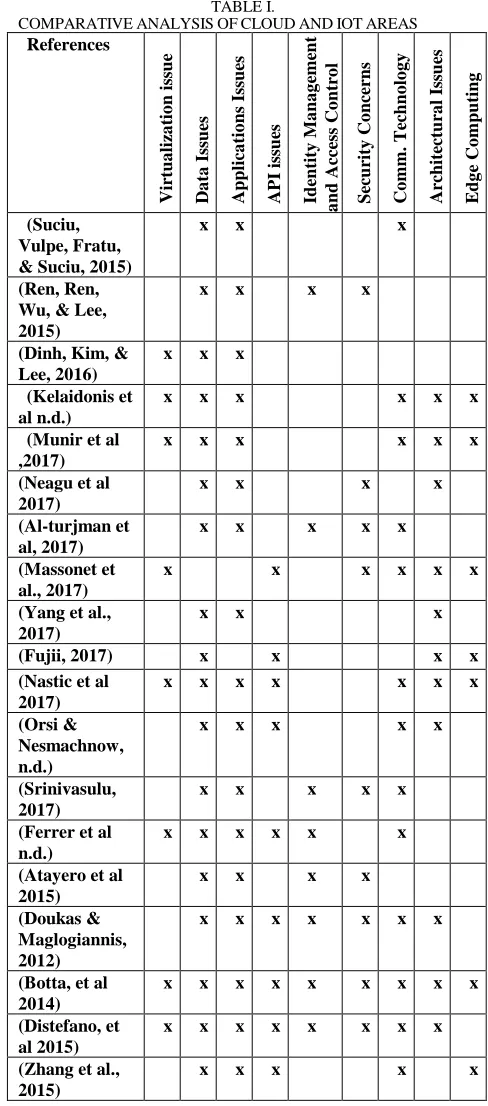
The application of IoT in Cloud Computing is an emerging trend with great future. This section analyses some of the most recent research papers based on core areas namely Virtualisation issues, Big Data/Data analytics, Application Issues, API issues, Security Concerns, Identity Management/Access Control, Communication Technologies, architectural models, Edge computing, and energy management issues. Table I shows the comparative analysis of the core areas in cloud computing and IoT
From the analysis of the reviewed papers. Big data and application issues are the most important areas as they are mentioned in all reviewed papers except [24]. After data and application issues, communication technologies as expected was the next highly discussed with 68% of the reviewed literature. The next core issues with highest percentage of discuss among reviewed papers are architectural models and security concerns with 58% and 53% respectively. API related issues seen in 47%, Virtualization issues 42% while Identity Management/Access Control and Edge computing seen in 37% of the reviewed literature. The lowest researched area from recent literature is Energy management issues.
Based on the analysis, there is a need more research on energy management as it related to devices used in cloud computing and IoT. It is expected that more research will the carried out in edge computing since it is a recent trend. However, there is need to increase research on identity management and access control because of its direct relation to privacy in cloud computing which is very generally lacking
VI. CONCLUSION
IoT and cloud computing are both dynamic paradigms that is providing and will continue to provide solutions in all aspects of life. Cloud computing provides elastic resources on demand, while IoT connect devices on different application areas over the Internet. IoT utilizes the benefits of the cloud to enable seamless operation of connected devices. The paper discussed application areas of IoT in relation to cloud computing and also highlighted challenges of IoT. Industry trends which is aimed at addressing IoT and cloud issues were also discussed.
ACKNOWLEDGMENTS
We acknowledge the support and sponsorship provided by Covenant University through the Centre for Research, Innovation and Discovery (CUCRID).
REFERENCES
[1] Peter Mell, Timothy Grance, (2011) “The NIST Definition of Cloud Computing”, NIST Special Publication 800-145
[2] Project Success Plan: Cloud Migration A guide for transitioning to a cloud-based infrastructure. (2015) TechTarget Publication.
[3] Christos Stergiou, Kostas E. Psannis, Byung-Gyu Kim, Brij Gupta, (2016), “Secure Integration of IoT and Cloud Computing”, Future Generation Computer Systems (2016), http://dx.doi.org/10.1016/j.future.2016.11.031
[4] Charalampos Doukas, Ilias Maglogiannis, (2012) “Bringing IoT and Cloud Computing towards Pervasive Healthcare”, 2012 Sixth International Conference on Innovative Mobile and Internet Services in Ubiquitous Computing. 2012 IEEE DOI 10.1109/IMIS.2012.26.
[5] Jayavardhana Gubbi, Rajkumar Buyya, Slaven Marusic, Marimuthu Palaniswamia, “Internet of Things (IoT): A Vision, Architectural Elements, and Future Directions” Accessed on 24 May 2017.
[6] Mohammad Aazam, Pham Phuoc Hung, Eui-Nam Huh, (2014), “Cloud of Things: Integrating Internet of Things with Cloud Computing and the Issues Involved”, Proceedings of International Bhurban Conference on Applied Sciences & Technology Islamabad, Pakistan, January 14 – 18, 2014.
[7] Alessio Botta, Walter de Donato, Valerio Persico, Antonio Pescap´e, (2015), “Integration of Cloud Computing and Internet of Things: a Survey”, Preprint submitted to Journal of Future Generation Computer Systems September 18, 2015.
[8] Ben Zhang, Nitesh Mor, John Kolb, Douglas S. Chan, Nikhil Goyal Ken Lutz, Eric Allman, John Wawrzynek, Edward Lee, John Kubiatowicz, “The Cloud is Not Enough: Saving IoT from the Cloud”. HotCloud’15 Proceedings of the 7th USENIX Conference on Hot Topics in Cloud Computing, pp, 21.
[9] Honbo Zhou, (2013), “The Internet of Things in the Cloud”, Taylor & Francis Group, LLC CRC Press 2013.
[10] Alessio Botta, Walter de Donato, Valerio Persico, Antonio Pescape, (2015), “On the Integration of Cloud Computing and Internet of Things”, 2014 International Conference on Future Internet of Things and Cloud, Barcelona, 2014, pp. 23-30.
[11] Xavier Caron, Rachelle Bosua, Sean B. Maynard, Atif Ahmad, (2016), “The Internet of Things (IoT) and its impact on individual privacy: An Australian perspective”, Computer Law & Security Review 32 (2016) 4–15
[12] FAN Tong-rang, GAO Feng, ZHANG Xuan, WANG Xu, (2012) “Integration of IoT and DRAGON-lab in cloud environment”, The Journal of China Universities of Posts and Telecommunications April 2012, 19(2): 87–91
[13] Chinmaya Kumar Dehury, Prasan Kumar Sahoo, (2016) “Design and implementation of a novel service management framework for IoT devices in cloud”, The Journal of Systems and Software 119 (2016)149-161.
[14] Salvatore Distefano, Giovanni Merlino, Antonio Puliafito, (2015), “A utility paradigm for IoT: The sensing Cloud”, Pervasive and Mobile Computing 20 (2015) 127-144.
[15] Shawn Rahn (2016) How IoT Drives Your Analytics Strategy. www.presidio.com
[16] Understanding the IoT Explosion and Its Impact on Enterprise Security. (2017) www.fortinet.com
[17] G. Suciu, A. Vulpe, O. Fratu, and V. Suciu, “M2M Remote Telemetry and Cloud IoT Big Data Processing in Viticulture”, IWCMC, pp. 1117–1121, 2015.
[18] W. Ren, Y. Ren, M.-E. Wu, and C.-J. Lee, “A Robust and Flexible Access Control Scheme for Cloud-IoT Paradigm with Application to Remote Mobile Medical Monitoring,” in Third International Conference on Robot, Vision and Signal Processing, 2015, pp. 130– 133.
[20] D. Kelaidonis, A. Rouskas, V. Stavroulaki, and P. Demestichas, “A Federated Edge Cloud-IoT Architecture,” 2016 European Conference on Networks and Communications, Athens, 2016, pp. 230-234. [21] B. A. Munir, P. Kansakar, and S. U. Khan, “IFCIoT: Integrated Fog
Cloud IoT,” arXiv:1701.08474, July, 2017.
[22] G. Neagu, Ș Preda, A. Stanciu, and V. Florian, “A Cloud-IoT Based Sensing Service for Health Monitoring,” E-Health and Bioengineering Conference, pp. 53-56, 2017.
[23] F. Al-turjman, Y. K. Ever, E. Ever, Hu. X. Nguyen, and D. B. David, “Seamless Key Agreement Framework for Mobile-Sink in IoT Based Cloud-Centric Secured Public Safety Sensor Networks,” IEEE Access 5: 24617-24631, 2017
[24] P. Massonet et al., “Security in Lightweight Network Function Virtualisation for Federated Cloud and IoT,” IEEE FiCloud, pp. 148– 154, 2017.
[25] G. Yang, M. Jiang, S. Member, W. Ouyang, P. Liljeberg, and H. Tenhunen, “IoT-based Remote Pain Monitoring System : from Device to Cloud Platform,” IEEE Journal of Biomedical and Health Informatics, vol. PP, no 99, pp. 1-1, 2017.
[26] N. Fujii, “IoT Remote Group Experiments in the Cyber Laboratory :,” International Conference on Cyberworlds, UK, pp. 162-165, 2017.
[27] S. Nastic, H. Truong, and S. Dustdar, “Data and Control Points : A Programming Model for Resource-constrained IoT Cloud Edge Devices,”, SMC 2017, Canada, pp. 3535–3540, 2017.
[28] E. Orsi and S. Nesmachnow, “Smart home energy planning using IoT and the cloud,” XXIII Congresso Argentino, pp. 1091-1100
[29] P. Srinivasulu, “Cloud Service Oriented Architecture ( CSoA ) for Agriculture through Internet of Things ( IoT ) and Big Data,” ICEICE, 2017.
[30] B. R. Ferrer, W. M. Mohammed, E. Chen, and J. L. M. Lastra, “Connecting Web-Based IoT Devices to a Cloud- Based Manufacturing Platform.” IECON 2017, Beijing, pp. 8628-8633 [31] A. A. Atayero, O. A. Ilori, and M. O. Adedokun, “Cloud Security and
the Internet of Things: Impact on the Virtual Learning Environment,” Edulearn15 7th Int. Conf. Educ. New Learn. Technol., pp. 3857– 3863, 2015