ePrints Soton
Copyright © and Moral Rights for this thesis are retained by the author and/or other
copyright owners. A copy can be downloaded for personal non-commercial
research or study, without prior permission or charge. This thesis cannot be
reproduced or quoted extensively from without first obtaining permission in writing
from the copyright holder/s. The content must not be changed in any way or sold
commercially in any format or medium without the formal permission of the
copyright holders.
When referring to this work, full bibliographic details including the author, title,
awarding institution and date of the thesis must be given e.g.
AUTHOR (year of submission) "Full thesis title", University of Southampton, name
of the University School or Department, PhD Thesis, pagination
Faculty of Engineering, Science & Mathematics
Optoelectronics Research Centre
Design Method for Ultimate Efficiency in
Linear-cavity Continuous-wave Lasers
Using Distributed-Feedback
by
Kuthan Yelen
Thesis Submitted for the Degree of Doctor of Philosophy
OPTOELECTRONICS RESEARCH CENTRE Doctor of Philosophy
DESIGN METHOD FOR ULTIMATE EFFICIENCY IN LINEAR-CAVITY CONTINOUS-WAVE LASERS
USING DISTRIBUTED-FEEDBACK by Kuthan Yelen
A novel analytical method for the design of linear-cavity continuous-wave laser cavities
that guarantees the ultimate efficiency is developed, theoretically studied and
experimentally verified. Opposed to the earlier methods, which optimise the parameters
of a priori defined cavity, the developed method derives the cavity analytically based on
the active medium properties for the chosen pumping scheme. The method combines the
general grating design equations, valid for both passive and active media, and the
optimum signal power calculations. The idea that lies at the heart of the design method is
to sustain the optimum signal power at every single point in the entire cavity by
employing distributed-feedback for the maximum local, as a result, for the maximum
overall conversion efficiency.
Theoretical study starts with the critical investigation of the previous optimisation
approaches. After addressing the limitations of these approaches, it is shown how to
improve the efficiency further than the parametric optimisation using intuitive arguments
based on the effective cavity length and optimum reflectivities in DFB lasers. The critical
importance of the signal distribution is highlighted, and following this observation the
grating design method for arbitrary signal distributions is developed. The concept of
optimum signal power is introduced and the spatial unfolding of the optimum values is
illustrated. Boundary conditions, grating production limitations and effects of modelling
parameters are addressed. Modal stability of the new designs is investigated.
A novel approach to the simulation of Er/Yb co-doped fibre lasers is presented with
experimental justification. Accurate laser characteristics are predicted for different
designs, including the ultimate efficiency designs. Theoretical studies are verified with
experimental data in Er/Yb co-doped fibre and discussions are extended to Yb doped
TABLE OF CONTENTS
CHAPTER 1 INTRODUCTION...10
1.1.MOTIVATION...11
1.2.APPROACH...13
1.3.MODELLING AND SIMULATIONS...13
1.4.OVERVIEW OF THE THESIS...14
1.5.REFERENCES...15
CHAPTER 2 FIBRE DFB LASERS: A BRIEF HISTORICAL PERSPECTIVE AND APPLICATIONS...16
2.1.HISTORICAL PERSPECTIVE...17
2.2.APPLICATIONS...20
2.3.REFERENCES...20
CHAPTER 3 COMPUTATIONAL METHODS...23
3.1.INTRODUCTION...24
3.2.SIMULATION OF PROPAGATION IN GRATING STRUCTURES...24
3.2.1. Grating Simulation ...27
3.2.2. Threshold Simulation...29
3.2.3. Normalised Modal Distribution...30
3.2.4. Power Distributions...31
3.3.SIMULATION OF ACTIVE MEDIUM...31
3.4.CONCLUSIONS...32
3.5.REFERENCES...33
CHAPTER 4 MODELLING OF ERBIUM YTTERBIUM CO-DOPED DFB FIBRE LASERS...34
4.1.INTRODUCTION...35
4.2.CHARACTERISATION OF ACTIVE MEDIUM...37
4.2.1. Analytical Model...37
4.2.2. Fibre Composition and Geometry ...40
4.2.3. Spectroscopy at Pump Wavelength...41
4.2.4. Spectroscopy at Signal Wavelength ...47
4.3.CHARACTERISATION OF THE GRATING...48
4.4.CHARACTERISATION OF THE PUMP SOURCE...50
4.5.FITTING PARAMETERS...51
4.6.RESULTS...52
4.7.DFBLASER SIMULATIONS...54
4.8.CONCLUSIONS...56
4.9.REFERENCES:...57
CHAPTER 5 INVESTIGATION OF THE CLASSIC OPTIMISATION METHOD FOR DFB LASERS...60
5.1.INTRODUCTION...61
5.2.UNIFORM DESIGN...61
5.3.STEP-APODISED DESIGN...66
5.4.EXPERIMENTAL RESULTS...70
5.5.CONCLUSIONS...72
CHAPTER 6 CAVITY DESIGN METHOD FOR ULTIMATE LASER EFFICIENCY...74
6.1.INTRODUCTION...75
6.2.FUNDAMENTAL DESIGN EQUATIONS...76
6.3.DESIGN OF SINGLE REFLECTORS...79
6.3.1. Exponential Signal Distribution ...80
6.3.2. cosh(mz) Signal Distribution ...82
6.3.3. Linear Signal Distribution ...84
6.3.4. Effect of Loss and Gain...85
6.4.DESIGN OF LASER CAVITIES...87
6.4.1. Laser with Uniform Distribution ...88
6.4.2. Laser with Varying Distribution ...89
6.5.GRATING DESIGN FOR MAXIMUM LASER EFFICIENCY...93
6.5.1. Optimum Signal Intensity...93
6.5.2. Calculation of Optimum Signal in Yb Doped Fibre...96
6.5.3. Longitudinal Distribution of Optimum Signal in Yb doped fibre ...102
6.5.4. Ultimate Efficiency Laser Design in Yb doped fibre ...104
6.6.CONCLUSIONS...107
6.7.REFERENCES...108
CHAPTER 7 ULTIMATE EFFICIENCY DESIGN IN ER/YB CO-DOPED FIBRE...109
7.1.THEORETICAL PREPARATION...110
7.1.1. Investigation of the Active Medium...110
7.1.2. Effects of Active Medium Properties...112
7.1.3. Spatial Distributions for Co-Pumping Scheme...114
7.1.4. Longitudinal-Mode Stability ...118
7.1.5. Chirped Design ...120
7.1.6. Alternative Pumping Schemes...121
7.2.EXPERIMENTAL INVESTIGATION...128
7.2.1. Effects of the Uncertainties in the Active Medium Model...128
7.2.2. Results...130
7.3.CONCLUSIONS...132
7.4.REFERENCE...134
CHAPTER 8 HIGH POWER YB-DOPED FIBRE DFB LASERS WITH ULTIMATE EFFICIENCY ...135
8.1.INTRODUCTION...136
8.2.HIGH POWER STANDARD OPTIMISED YB-DOPED FIBRE DFBLASERS...136
8.3.ULTIMATE EFFICIENCY DESIGNS...140
8.3.1. Design for core-pumped fibre...140
8.3.2. Design for cladding-pumped fibre ...144
8.4.ALTERNATIVE WAVELENGTHS...147
8.4.1. 915 nm pumping for 976 nm signal ...147
8.4.2. 915 nm pumping for 1060 nm signal ...150
8.5.CONCLUSIONS...151
8.6.REFERENCES...152
CHAPTER 9 CONCLUSIONS...153
APPENDIX – A : DERIVATION OF CONVERSION EFFICIENCY IN YB IONS...158
APPENDIX – B : ALTERNATIVE BOUNDARY TRANSITIONS...160
List of Abbreviations
ASE
Amplified
Spontaneous
Emission
CUP
Co-operative
Up-Conversion
DBR
Distributed Bragg Reflector
DFB
Distributed Feedback
ESA
Excited-state
Absorption
FP
Fabry-Perot
JAC
Jacketed
Air
Cladding
LHS
Left-hand
side
NA
Numerical Aperture
PM
Power
Meter
RHS
Right-hand
side
TLS
Tunable Laser Source
List of Symbols
Symbol Value
or
[Unit] Description
Subscripts
s
At signal wavelength
p
At pump wavelength
n
Normal
ytterbium
ions
q
Lifetime
quenched
ytterbium
Ions
Subscripts
a
Absorption
e
Emission
C
ESA[
m
2]
Excited
state
absorption
cross-section
C
UP[
m
3s
-1] Co-operative
up-conversion
coefficient
D
[ m ]
Penetration depth (Chapter 5)
D(z)
[ W ]
Difference between forward and backward
propagating powers at position z
E [
W m2]
Total electric field (Normalised)
Er
i[]
Single erbium ion at energy level i
G
[ W ]
Generated signal power over a volume
∆
G(z)
[ W / m ]
Generated signal per unit length at position z
k
tr[
m
3s
-1]
Energy transfer coefficient between Er
and Yb ions
L
[ m ]
Total device length
L
eff[
m
]
Effective
cavity
length
n
0[]
Effective refractive index of the medium
∆
n
[]
Refractive
index
modulation
amplitude
n
1[]
Refractive
index
of
the
core
n
2[]
Refractive
index
of
the
cladding
N
T[
m
-3]
Total
ion
concentration
P(z)
[ W ]
Pump power at position z in a laser cavity
∆
P(z)
[ W / m ]
Absorbed pump power per unit length
P
p[ W ]
Pump power in an amplifying medium
P
s[ W ]
Signal power in an amplifying medium
r
[]
Reflection
coefficient
R
[]
Reflectivity
R
+[
W m2]
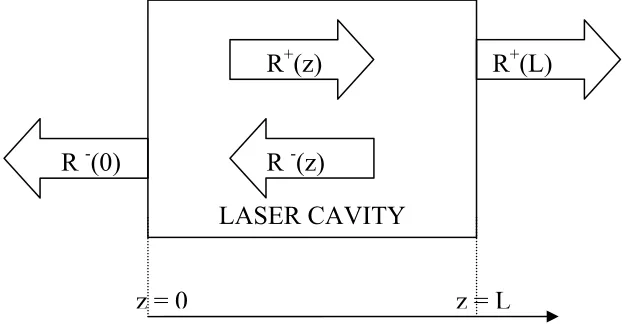
Forward Propagating Electric Field Envelope
(Normalised)
R
-[
W m2]
Backward Propagating Electric Field Envelope
(Normalised)
S(z)
[ W ]
Sum of forward and backward propagating
powers at position z
Yb
i[]
Single
ytterbium
ion
at
energy
level
i
z
[ m ]
Position
z
π[ m ]
Position of the phase-shift
α
[
m
-1]
Field gain (positive) or loss (negative)
coefficient
β
[
m
-1]
Propagation
constant
Γs,p
[]
Overlap coefficient for signal or pump
field
Γ
[
m
-1]
Phase difference between the fields and the
grating
ε
[
m
-1]
Field
background
loss
Λ
[
m
]
Period
of
the
grating
η
[]
Pump-to-signal
conversion
efficiency
κ
(z)
[
m
-1]
Coupling coefficient of the grating at position z
λ
[
m
]
Wavelength
ν
[
s
-1]
Frequency
σ
[
m
2]
Cross-section
τi
[ s ]
Life-time at energy level i
To my aunt Ayfer Özbeyli, for her contributions to my life… Teyzem Ayfer Özbeyli’ye, hayatımdaki - destekten öte - katkılarına minnetle…
ACKNOWLEDGEMENTS
With ample amount of coffee and the ability to survive some not-so-easy periods
any stubborn person can complete a PhD. However, enjoying the entire PhD
experience requires more than being determined; you have to be lucky. A sensible
initial point
, years-long non-fading guidance, and a harmony with your
supervisor in terms of both academic approach and personality are what it takes
to make your postgraduate life enjoyable. With the wisdom of hindsight, I can see
that I was one of the luckiest persons around. For all these, I thank my supervisor
Professor Michalis Zervas heartily.
Playing with equations, pushing the simulations to the limits, and the feeling of
being the only person, at that particular moment, who knows what it is all about,
is fantastic. But making things actually work in reality is even more satisfying.
Louise Hickey is the person who made it possible for me to link all the theory to
the physical world. I would like to thank Louise and the personnel of
Southampton Photonics, SPI Inc. for the icing on the cake. Writing up the thesis is
another story. Avoiding
writers’ cramp
by
hitting the gym,
I finally finished the
thesis and dear Eleanor Tarbox kindly allocated her valuable time to correct my
countless mistakes.
“
The purpose of computing is
insight, not numbers.
”
1.1. Motivation
Improving the efficiency of lasers is of great importance throughout the entire
optoelectronics field. As well as being a fundamental research interest, better laser
efficiency is a very strong commercial driver too. Today, linear-cavity continuous-wave
(CW) lasers are one of the most widely used types of lasers that come in categories such
as semiconductor, solid-state, fibre and planar glass. Therefore maximizing the efficiency
of this particular type of lasers is very desirable and will have a broad impact in the
optoelectronics field.
The performance of a laser is set by various characteristics of the device such as the
active medium spectroscopy, temperature control mechanism and pumping scheme. One
of the most critical features of a laser that has profound effect on the efficiency is the
design of the resonator cavity. The structure of the cavity defines the circulating power,
the amount of output coupling and the extracted output power. For a given pump power
and active medium under the same operating conditions different laser cavities yield
different efficiencies; therefore the cavity design lies at the heart of laser performance.
The simplest form of a linear cavity laser is the classic Fabry-Perot (FP) type laser, which
comprises two mirrors and an active medium in between, whereas the most complex
linear cavity is the distributed feedback (DFB) laser, which incorporates a grating into
the active medium. A distributed Bragg reflector (DBR) or a FP laser can be treated as a
sub-set of DFB lasers: In the case of a DBR laser the coupling coefficient of the grating in
the active medium is reduced to zero, but it is extended into the passive section. In the
case of a FP laser the coupling is localised at the ends of the active medium by placing
infinitesimal gratings; that is mirrors.
Optimisation of the cavity design for FP lasers dates back to the well- known Rigrod
analysis [1, 2]. This analytical optimisation, however, is based on very limiting
assumptions and simplifications: First of all, the unsaturated gain is assumed to be
for example, be valid for electrically side-pumped semiconductor lasers however this
assumption excludes many other pumping schemes. Then the active medium is assumed
to be a homogenously saturated 2-level system. Optimisation of a FP laser cavity
constructed in this medium assumes very small output coupling from the end mirrors
(very high reflectivity) and very small saturated gain. With these assumptions the
circulating signal inside the cavity is almost constant and with an additional assumption
of constant loss the optimum output coupling and the optimum circulating signal are
found analytically (For example see [3]).
Any deviation from any of these assumptions, which is almost always the case for any real
system, causes the analytical Rigrod optimisation to break down. In the case of a
multi-level active medium with varying signal and pump powers or signal dependent loss a
parametric optimisation is required; that is one of the cavity parameters is varied at a
time while the others are kept constant and the laser is simulated for the output powers
using numerical techniques.
A FP laser cavity is defined by only three parameters: the two mirror reflectivites and the
cavity length. Therefore, a parametric optimisation, although computationally intense,
can consider all the possible combinations. But the FP cavity is not the only possible laser
configuration, hence the efficiency maximised for a FP design is not guaranteed to be the
maximum possible for the given medium and pump power. Other laser structures such as
distributed Bragg reflector (DBR) or distributed feedback (DFB) configurations may
provide better efficiencies under comparable conditions. However optimisation of these
complex structures parametrically is even more challenging since there are literally an
infinite number of combinations of parameters when apodisation profile, chirp profile,
total length and phase shift positions and amounts are considered; therefore the
parametric optimisation cannot guarantee the maximum efficiency possible for the given
pump and active medium. A maximum may be a local peak in efficiency over an infinite
number of different parameter combinations.
To sum up, there is a lack of a general comprehensive design method for widely used
linear cavity CW lasers which would assure the fundamental efficiency limit analytically.
In this work we present a novel analytical method for the design of laser cavities. In our
approach we do not optimise a certain laser cavity but we derive the cavity for a given
1.2. Approach
Being the most complex and general cavity, DFB lasers will provide the starting point for
our study. We will critically investigate the classic DFB laser optimisation approach in
order to improve our understanding of the effects of cavity design on the laser
performance. Observing the importance of the signal distribution in the cavity and
experimentally verifying its effect, we will introduce the concept of the optimum signal
and continue with the method for achieving the optimum signal distribution in the entire
cavity. Then imposing the boundary conditions and production limitations and employing
the novel grating design method we will show how to find the coupling coefficient profile
which provides this signal distribution.
The method does not discriminate between the Fabry-Perot, DBR or DFB structures,
however, in general, the maximum efficiency laser cavity requires a distributed feedback;
consequently the method is applicable to any active medium in which a grating can be
incorporated. Therefore we expect this design method to find immediate application over
a wide device range from semiconductor, planar glass, solid-state bulk to fibre lasers
since in these media the grating writing technologies have already matured.
As a demonstration we applied the method experimentally in Er/Yb co-doped fibre lasers.
We chose this particular medium because of the attractive feature of fibre DFB lasers
that we will cover in Chapter 2.
1.3. Modelling and Simulations
To facilitate the theoretical and the experimental investigations we use numerical models
extensively, both for the derivation of the laser designs and their simulation. Therefore,
the model and the simulation tools we developed are an essential part of our study.
Although several entirely theoretical works on modelling of erbium-ytterbium co-doped
media have been reported [4-10] with only very few experimental verifications for
amplifiers [11, 12] there is no work on benchmarking the simulation results with
experimental results for Er/Yb co-doped lasers, neither in FP, DBR or DFB configuration.
The value of any simulation result should be judged according to its proximity to the
behaviour of the real device or system. If the performance of a model is not checked
against the experimental data then the simulation results will make sense only in terms of
tendencies instead of actual numbers.
Here, in addition to the novel design method, we present a model for Er/Yb co-doped
up conversion in erbium ions as well as the life-time quenching of ytterbium ions. We
describe simple techniques for the measurement of the model parameters. In this new
modelling approach we treat the pump, the active medium and the feedback mechanism
as a complete system, and we characterise and model each one of them. For the first
time, we present simulations that predict the actual characteristics of the Er/Yb co-doped
DFB fibre lasers within the range of experimental measurement errors.
1.4. Overview of the Thesis
Following this introduction chapter, an overview of fibre DFB lasers is presented in
Chapter 2, followed by the brief description of numerical and computational methods
used throughout the rest of the study in Chapter 3. The modelling of the active medium
and DFB lasers are discussed in Chapter 4. The transitions and the rate equations are
discussed in detail and the measurement of the required parameters as well as the
characterisation of the pump source and the grating are presented. Results of the
simulations are compared against the experimental data.
Chapter 5 is devoted to the detailed investigation of the classic DFB laser optimisation
method. It is shown that, the method is equivalent to the Rigrod analysis for the
reflectivities, however in addition to the feedback the signal distribution inside the cavity
is identified as a critical variable affecting the efficiency. The concept of effective cavity is
introduced and the step-apodised profile is presented to increase the effective cavity
length for better efficiency. The theoretical results are verified with the experimental
data.
Identification of the signal distribution as a critical factor for the laser efficiency leads to
the general theoretical analysis for a design method in order to achieve any desired signal
distribution inside passive and active cavities in Chapter 6. Here we discuss the optimum
signal distribution for the maximum possible efficiency and we illustrate the new design
method in a numerical study in a simple ytterbium doped fibre.
Chapter 7 covers the theoretical and experimental application of the design method in
erbium-ytterbium co-doped fibre. Initially, designs for alternative pumping schemes are
derived and compared, longitudinal-mode stability is discussed, and the effects of the
uncertainties in the model parameters on the design are investigated, then the method is
experimentally verified. High power applications along with alternative pump and signal
Concluding remarks on the design method are presented in Chapter 9. References are
given at the end of each chapter.
1.5. References
[1] W. W. Rigrod, "Saturation Effects in High-Gain Lasers," Journal of Applied
Physics, vol. 36, no. 8, pp. 2487-2490, 1965.
[2] C. T. Meneely, "Laser Mirror Transmissivity Optimization in High Power Optical
Cavities," Applied Optics, vol. 6, no. 8, pp. 1434-1436, 1967.
[3] A. E. Siegman, "Section 12.3," in LASERS. Sausalita, CA: University Science
Books, 1986.
[4] C. Strohhofer and A. Polman, "Relationship between gain and Yb3+ concentration
in Er3+ - Yb3+ doped waveguide amplifiers," Journal of Applied Physics, vol. 90,
no. 9, pp. 4314-4320, 2001.
[5] E. Yahel and A. Hardy, "Modeling and Optimization of Short Er3+-Yb3+ Codoped
Fiber Lasers," IEEE Journal of Quantum Electronics, vol. 39, no. 11, pp.
1444-1451, 2003.
[6] E. Yahel and A. Hardy, "Modeling High-Power Er3+ - Yb3+ Codoped Fiber
Lasers," Journal of Lightwave Technology, vol. 21, no. 9, pp. 2044-2052, 2003.
[7] M. Karasek, "Optimum Design of Er3+-Yb3+ Codoped Fibers for Large-Signal
High-Pump-Power Applications," IEEE Journal of Quantum Electronics, vol.
33, no. 10, pp. 1699-1705, 1997.
[8] G. C. Valley, "Modeling Cladding-Pumped Er/Yb Fiber Amplifiers," Optical Fiber
Technology, vol. 7, no. 1, pp 21-44, 2001.
[9] F. Di Pasquale, "Modeling of Highly-Efficient Grating-Feedback and Fabry-Perot
Er3+ Yb3+ Co-Doped Fiber Lasers," IEEE Journal of Quantum Electronics, vol.
32, no. 2, pp. 326-332, 1996.
[10] J. Nilsson, P. Scheer, and B. Jaskorzynska, "Modeling and Optimization of Short
Yb3+ Sensitized Er3+ Doped Fiber Amplifiers," IEEE Photonics Technology
Letters, vol. 6, no. 3, pp. 383-385, 1994.
[11] G. Sorbello, S. Taccheo, and P. Laporta, "Numerical modelling and experimental
investigation of double-cladding erbium-ytterbium-doped fibre amplifiers," Optical and Quantum Electronics, vol. 33, no. 6, pp 599-619, 2001.
[12] M. Achtenhagen, R. J. Beeson, F. Pan, B. Nyman, and A. Hardy, "Gain and Noise
in ytterbium-Sensitized erbium-Doped Fiber Amplifiers: Measurements and
Simulations," Journal of Lightwave Technology, vol. 19, no. 10, pp. 1521-1526,
2.1. Historical Perspective
The discovery of lasing in periodic structures dates back to the early 70s. Kogelnik and
Shank, then at the Bell Laboratories, reported lasing action in a dyed gelatine whose
refractive index was periodically modulated [1]. Figure 2-1 illustrates the earliest DFB
laser structure. The laser consists of a uniform refractive index grating, with constant
amplitude and constant period, incorporated in an active medium. This classic design
operates at two fundamental longitudinal modes at different wavelengths, corresponding
to the edges of the grating band-gap, and gives symmetric output powers from both ends,
Pleft and Pright, which are equally divided between these two modes. Therefore, such a
cavity provides dual-wavelength bi-directional operation.
Figure 2-1 Refractive index profile for classic DFB laser design with two-wavelength bi-directional operation.
The theory of lasing action in periodic structures was developed in the classic paper,
again by Kogelnik and Shank, based on coupled-wave theory [2].
After this initial observation of lasing action in the periodic structures, the second
mile-stone leading to fibre DFB lasers came with the discovery of the formation of permanent
gratings in photosensitive germania-doped fibres by Hill et al [3] of the Canadian
Communications Research Centre in 1978. The grating was formed by the interference
pattern of argon-ion laser radiation propagating in opposite directions in the fibre. This
method required that in order to write a Bragg grating at a certain wavelength one would
need to launch a field at the same wavelength longitudinally into the fibre, therefore the
wavelength of the Bragg grating was limited with the available source wavelengths.
The major breakthrough came from Meltz, Morey and Glenn, working at the United
Technologies Research Centre, in 1989 [4]. In their holographic approach the grating was
produced by exposing the photosensitive fibre transversely to the interference pattern
produced by two intersecting UV beams. By doing so, the period of the grating became a
function of the angle between the beams, hence gratings with any periodicities could be
written. This holographic writing approach found application in erbium doped fibre. Ball
and Morey from United Technologies Research Centre and Zyskind et al from AT&T Bell
Laboratories reported Er doped DBR laser structures in 1992 [5, 6]. Further
improvements in grating writing techniques followed in 1993 by the introduction of phase
masks in order to produce the UV interference pattern demonstrated by Hill et al [7] and
Anderson et al of AT&T Bell Laboratories[8]. The phase-mask method reduced the
mechanical sensitivity of the writing setup and allowed the introduction of apodisation
and chirping profiles.
The next breakthrough, again in 1993, was the sensitisation of the erbium ions by
co-doping with ytterbium. Kringlebotn et al, from the Optoelectronics Research Centre of
Southampton University showed that the introduction of Yb ions dramatically increased
the pump absorption [9]. This discovery made short fibre lasers feasible and efficient.
However there was one problem: The highly absorbing Yb required the use of a
phosphosilicate host which reduces the photosensitivity, as opposed to the
germanosilicate host used for Er-only doped fibres. In 1994 the same research group
from Southampton University solved this problem by loading the aluminophosphosilicate
fibre with hydrogen to induce photosensitivity. They produced the first Er/Yb co-doped
DFB fibre laser by combining the holographic grating writing method and the hydrogen
loaded photosensitive active fibre technology [10]. Although the fibre suffered from
hydrogen related losses they were able to obtain laser action. Contrary to the
dual-wavelength output from the classic DFB cavity, in practice, a single-dual-wavelength operation
is desired. This can be achieved by introducing a π-shift in the spatial phase of the grating
as shown below. Such a cavity provides a single-wavelength, coinciding with the grating
Bragg wavelength, and bi-directional operation.
Figure 2-2 Symmetric, π-phase shifted DFB laser design for single-wavelength operation with bi-directional outputs.
Kringlebotn et al managed to introduce the necessary phase-shift by heating the grating
locally with a thin resistance wire. Although this approach provided the single-mode
operation desired, the induced phase shift was not a permanent feature of the grating.
In 1995 Cole, Loh et al from Southampton University improved the phase-mask method
further [11, 12]. In their approach the fibre was moved relative to the phase mask while
the writing beam was scanning. This method allowed the use of simple short phase
masks, as opposed to the earlier, stationary, custom designed phase mask, and the
required grating periodicity, phase-shift, apodisation and chirping profiles were produced
by precisely controlling the position of the successive exposures to the UV interference
pattern. This method greatly reduced the errors in the grating and allowed flexibility for
the production of complex grating structures. 1995 witnessed the announcement of Er
doped DFB fibre lasers with a permanent phase-shift simultaneously from two research
groups. The studies by Loh and Laming from Southampton University [13] and Sejka et al
from Technical University of Denmark [14] defined the point where DFB fibre production
technology reached maturity. Once the basics of the technology had been established the
efforts were focused around the optimisation of the fibre and the cavity designs in the
following years.
Dong et al from Southampton University showed that a better fibre for DFB lasers would
be one with a photosensitive cladding. Instead of loading the core with lossy hydrogen to
get improved photosensitivity, they produced a boron and germanium-doped
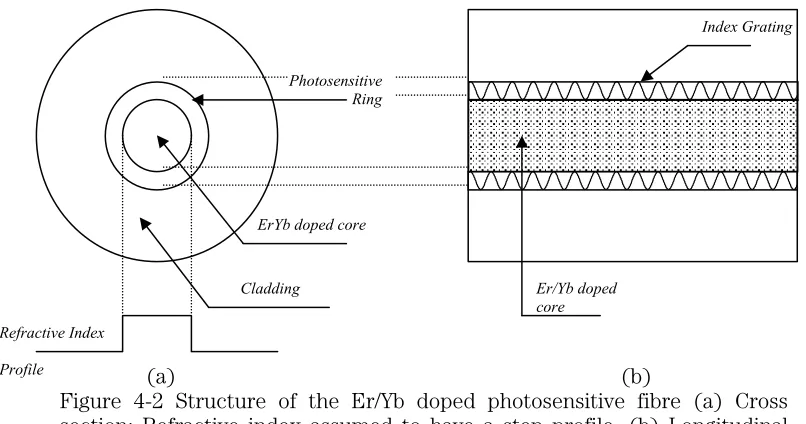
photosensitive cladding surrounding the active phosphosilicate core doped with Er and
Yb [15], thus boosting the laser efficiency greatly in 1997.
At the end of 90s, Lauridsen et al [16, 17] and Ibsen et al [18] showed that a better cavity
design would be composed of an optimum combination of grating strength and an
asymmetrically positioned phase-shift so that the uni-directional output power is the
maximum. By placing the phase-shift asymmetrically with respect to the grating centre,
as shown in Figure 2-3 larger output power is obtained from the closer end.
Figure 2-3 Refractive index profile for asymmetric π-phase shifted DFB laser design for single-wavelength uni-directional operation.
Today a typical state of art Er/Yb DFB laser is 5 cm long and produces around 20 mW
output power at 1550 nm when pumped with 100 mW at 980 nm and is limited to 50 mW
output power even when pump powers as large as 650 mW are used [19].
P
left2.2. Applications
The fibre DFB lasers possess certain unique properties that make them more attractive
compared to the semiconductor lasers. First of all they are in-fibre lasers therefore they
are inherently fibre compatible and their output can be connected to a transmission fibre
using a standard splice. Similarly, the pump power can be delivered to the fibre DFB
laser using simple low-loss transmission fibres. In addition, very simple passive thermal
stabilisation is sufficient to ensure the stability of a fibre DFB laser. A number of different
active dopants, such as erbium, ytterbium, neodymium and thulium, can be used in order
to cover different windows of the optical spectrum and offer extended coverage.
These features, combined with the ability to define the emitted wavelength precisely, a
narrow linewidth and a low relative intensity noise (RIN), make DFB fibre lasers very
advantageous for telecommunication applications [20-22]. Typically an Er/Yb doped laser
has a linewidth less than 50 kHz, much smaller compared to 1MHz of a conventional
semiconductor laser. The RIN figure in such lasers is less than 100 dB/Hz above 50MHz,
and the signal-to-noise ratio is larger than 65 dB. In addition to these advantages, a
number of DFB fibre lasers can be configured in a parallel array to provide flexibility in
pumping conditions and provide pump redundancy [23].
Various methods have been demonstrated to ensure robust single polarisation operation
of fibre DFB lasers [24-26]. This robust single polarisation operation and stable
wavelength with narrow linewidth are very desirable for sensor systems. Alternatively,
DFB lasers can be made to operate in stable dual-polarisation so that simultaneous
measurements can be carried out [27-29]. In addition to the sensing and telecom
applications, we recently demonstrated the high power application of DFB fibre lasers
[30] following the advances in the pump source technologies.
2.3. References
[1] H. Kogelnik and C. V. Shank, "Stimulated Emission in a Periodic Structure,"
Applied Physics Letters, vol. 12, no. 18, pp. 152-154, 1971.
[2] H. Kogelnik and C. V. Shank, "Coupled-wave Theory of Distributed Feedback
Lasers," Journal of Applied Physics, vol. 43, no. 5, pp. 2327-2335, 1972.
[3] K. O. Hill, Y. Fujii, D. C. Johnson, and B. S. Kawasaki, "Photosensitivity in Optical
Fiber Waveguides: Application to Reflection Filter Fabrication," Applied Physics
Letters, vol. 32, no. 20, pp. 647-649, 1978.
[4] G. Meltz, W. W. Morey, and W. H. Glenn, "Formation of Bragg Gratings in Optical
Fibers by a Transverse Holographic Method," Optics Letters, vol. 14, no. 15, pp.
823-825, 1989.
[5] G. A. Ball and W. W. Morey, "Continuously Tunable Single-Mode erbium Fiber
[6] J. L. Zyskind, V. Mizrahi, D. J. DiGiovanni, and J. W. Sulhoff, "Short Single
Frequency erbium-Doped Fiber Laser," Electronics Letters, vol. 28, no. 15, pp.
1385-1387, 1992.
[7] K. O. Hill, B. Malo, F. Bilodeau, D. C. Johnson, and J. Albert, "Bragg Gratings
Fabricated in Monomode Photosensitive Optical Fiber by Uv Exposure through a
Phase Mask," Applied Physics Letters, vol. 62, no. 10, pp. 1035-1037, 1993.
[8] D. Z. Anderson, V. Mizrahi, T. Erdogan, and A. E. White, "Production of in-Fiber
Gratings Using a Diffractive Optical- Element," Electronics Letters, vol. 29, no. 6,
pp. 566-568, 1993.
[9] J. T. Kringlebotn, P. R. Morkel, L. Reekie, J. L. Archambault, and D. N. Payne,
"Efficient Diode-Pumped Single Frequency erbium:ytterbium Fiber Laser," IEEE
Photonics Technology Letters, vol. 5, no. 10, pp. 1162-1164, 1993.
[10] J. T. Kringlebotn, J. L. Archambault, L. Reekie, and D. N. Payne, "Er3+Yb3+
Codoped Fiber Distributed-Feedback Laser," Optics Letters, vol. 19, no. 24, pp.
2101-2103, 1994.
[11] M. J. Cole, H. Geiger, R. I. Laming, S. Y. Set, M. N. Zervas, W. H. Loh, and V.
Gusmeroli, "Broadband dispersion-compensating chirped fibre Bragg gratings in a 10Gbit/s NRZ 110km non-dispersion-shifted fibre link operating at 1.55 mu m," Electronics Letters, vol. 33, no. 1, pp. 70-71, 1997.
[12] W. H. Loh, M. J. Cole, M. N. Zervas, S. Barcelos, and R. I. Laming, "Complex
Grating Structures with Uniform Phase Masks Based on the Moving
Fiber-Scanning Beam Technique," Optics Letters, vol. 20, no. 20, pp. 2051-2053, 1995.
[13] W. H. Loh and R. I. Laming, "1.55 um phase-shifted distributed feedback fibre
laser," Electronics Letters, vol. 31, no. 17, pp. 1440-1442, 1995.
[14] M. Sejka, P. Varming, B. Hubner, and M. Kristensen, "Distributed feedback Er3+
doped fibre laser," Electronics Letters, vol. 31, no. 17, pp. 1445-1446, 1995.
[15] L. Dong, W. H. Loh, J. E. Caplen, J. D. Minelly, K. Hsu, and L. Reekie, "Efficient
single-frequency fiber lasers with novel photosensitive Er/Yb optical fibers," Optics Letters, vol. 22, no. 10, pp. 694-696, 1997.
[16] V. C. Lauridsen, J. H. Povlsen, and P. Varming, "Design of DFB fibre lasers,"
Electronics Letters, vol. 34, no. 21, pp. 2028-2030, 1998.
[17] V. C. Lauridsen, J. H. Povlsen, and P. Varming, "Optimising erbium-doped DFB
fibre laser length with respect to maximum output power," Electronics Letters,
vol. 35, no. 4, pp. 300-302, 1999.
[18] M. Ibsen, E. Ronnekleiv, G. J. Cowle, M. O. Berendt, O. Hadeler, M. N. Zervas, and
R. Laming, "Robust high power (>20mW) all-fibre DFB lasers with unidirectional and truly single polarisation outputs," presented at CLEO, Baltimore, USA, 1999,CWE4
[19] K. H. Yla-Jarkko and A. B. Grudinin, "Performance Limitations of High-Power
DFB Fiber Lasers," IEEE Photonics Technology Letters, vol. 15, no. 2, pp.
191-193, 2003.
[20] J. Hubner, P. Varming, and M. Kristensen, "Five wavelength DFB fibre laser
source for WDM systems," Electronics Letters, vol. 33, no. 2, pp. 139-140, 1997.
[21] M. Ibsen, S. U. Alam, M. N. Zervas, A. B. Grudinin, and D. N. Payne, "8-and
16-channel all-fiber DFB laser WDM transmitters with integrated pump redundancy," IEEE Photonics Technology Letters, vol. 11, no. 9, pp. 1114-1116, 1999.
[22] H. N. Poulsen, P. Varming, A. Buxens, A. T. Clausen, P. Munoz, P. Jeppesen, C. V.
Poulsen, J. E. Pedersen, and L. Eskildsen, "1607 nm DFB fibre laser for optical communcation in the L-band," presented at ECOC, Nice, France, 1999, MoB2.1
[23] L. B. Fu, S. R., M. Ibsen, J. K. Sahu, J. N. Jang, S. U. Alam, J. Nilsson, D. J.
Richardson, D. N. Payne, C. Codemard, S. Goncharov, I. Zalevsky, and A. B. Grudinin, "Fiber-DFB laser array pumped with a single 1-W CW Yb-Fibre Laser," IEEE Photonics Technology Letters, vol. 15, no. 5, pp. 655-657, 2003.
[24] Z. E. Haratjunian, W. H. Loh, R. I. Laming, and D. N. Payne, "Single Polarization
Twisted Distributed Feedback Fiber Laser," Electronics Letters, vol. 32, no. 4,
[25] H. Storoy, B. Sahlgren, and R. Stubbe, "Single polarisation fibre DFB laser," Electronics Letters, vol. 33, no. 1, pp. 56-58, 1997.
[26] J. L. Philipsen, M. O. Berendt, P. Varming, V. C. Lauridsen, J. H. Povlsen, J.
Hubner, M. Kristensen, and B. Palsdottir, "Polarisation control of DFB fibre laser
using UV-induced birefringent phase-shift," Electronics Letters, vol. 34, no. 7, pp.
678-679, 1998.
[27] J. T. Kringlebotn, W. H. Loh, and R. I. Laming, "Polarimetric Er3+-doped fiber
distributed-feedback laser sensor for differential pressure and force
measurements," Optics Letters, vol. 21, no. 22, pp. 1869-1871, 1996.
[28] O. Hadeler, E. Ronnekleiv, M. Ibsen, and R. I. Laming, "Polarimetric Fiber
Distibuted Feedback Laser Sensor for Simultaneous Strain and Temperature
Measurements," Applied Optics, vol. 38, no. 10, pp. 1953-1958, 1999.
[29] O. Hadeler, M. Ibsen, and M. N. Zervas, "Distributied-feedback fiber laser sensor
for simultaneous strain and temperature mesurements operating in the
radio-frequency domain," Applied Optics, vol. 40, no. 19, pp. 3169-3175, 2001.
[30] C. A. Codemard, L. Hickey, K. Yelen, D. B. S. Soh, R. Wixey, M. Coker, M. N.
3.1. Introduction
As in the case of any simulation, the accuracy and the computation time are the two
issues that have to be balanced in the calculation of the DFB laser characteristics. In this
Chapter we will discuss the algorithms that allowed us to simulate gratings, rare-earth
doped fibres and fibre lasers, typically with computation times less then 1 minute for
device lengths up to 10 cm, using a standard PC with Pentium® 4 1.2GHz processor and
128 Mb RAM. Matlab© Ver. 6.1. was used for the implementation of the algorithms
because of its very high performance for matrix-based calculations and the readily
available mathematical library.
The simulation of a device requires the solution of two groups of equations, namely; the
propagation equations for fields in the grating and the rate-equations of the active
medium. When the grating apodisation profile is suitably defined, solution of these two
sets of equations enables the simulation of fibre lasers with FP, DBR or DFB structures.
In addition to the power characteristics, we can also simulate the laser threshold
conditions and longitudinal signal and pump distributions.
Passive gratings can also be simulated by setting the loss to a constant value. In this case
the reflection, transmission and time-delay spectra can be calculated. Alternatively, the
grating can be ignored by setting the coupling coefficient to zero and free propagation in
the rare-earth doped medium can be simulated.
3.2. Simulation of Propagation in Grating Structures
The main requirement for the simulation algorithm for propagation is the ability to work
on any kind of grating, with arbitrary apodisation and chirp profiles, as well as with an
arbitrary number of discreet phase-shifts, so that it will be possible to compare very
different laser designs in our quest for maximum efficiency. For this purpose we
tool for the analysis of complex laser structures [1-5]. The essence of the method is to
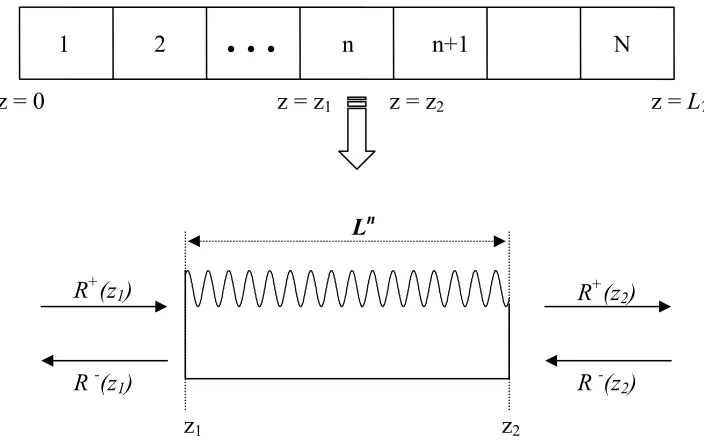
divide a complex structure into small segments so that each segment can be assumed to
[image:26.595.141.493.165.386.2]be uniform, as illustrated in Figure 3-1.
Figure 3-1 Transfer matrix method. A complex grating with arbitrary
apodisation and chirping profile and discrete phase shifts is divided into N
small segments so that each segment is approximately uniform.
If
Ψ
+(x,y)andΨ
-(x,y) are the transverse modal distributions, where (+) and (-) signsindicate the direction of propagation, then the total electric field E(x,y,z) at a position is
( , , ) ( ) ( , ) ( ) ( , )
E x y z =E z+ Ψ+ x y +E z− Ψ− x y . The transfer matrix, T, of a uniform segment relates the electric fields on one side of the segment to the fields on the other side in the
form:
1 11 12 2
21 22
1 2
( )
( )
( )
( )
E z
T
T
E z
T
T
E z
E z
+ +
− −
=
(3.1)We use the electric field amplitude envelopes, R(z), to separate the slowly varying part
form the fast modulated term,
e
βz and re-write the total electric field as:( , , ) ( ) ( , ) i z ( ) ( , ) i z
E x y z =R z+ Ψ+ x y e−β+ +R z− Ψ− x y eβ− (3.2)
where
β
+ andβ
– are the propagation constants of the forward and backward propagatingfields, respectively.
R
+(z
1)
R
-(z
1)
R
+(z
2)
R
-(z
2)
z
1z
2L
n1 2
. . .
n n+1 N
Starting from the coupled-wave equations, as given by Equations (6.2) and (6.3), the
entries of the T-matrix for the uniform grating segment, n, in Figure 3-1 between z = z1
and z = z2 of length Ln are found as [2]:
( )
11
'
cosh
sinh(
)
i BLnn n
i
nT
γ
L
β
γ
L
e
βγ
∆
=
+
(3.3)( )
12
sinh(
)
n n B
i L
n n
T
κ
γ
L e β φγ
− +−
= (3.4)
( )
21
sinh(
)
n n B
i L
n n
T
κ
γ
L e β φγ
+ −
= (3.5)
( )
22
'
cosh
sinh(
)
i BLnn n i n
T
γ
Lβ
γ
L e βγ
−
∆
= −
(3.6)
where
∆β
’
,γ
andφ
n are defined as:(
)
2 2 1 1 ' ' 2 n n j initial j j i Lβ
β α
γ
κ
β
π
φ
φ
−= ∆ = ∆ + = − ∆ = + Λ
∑
(3.7)Here
φ
initial is the initial phase of the grating at z = 0 andΛ
is the period of the segment.∆β
is the deviation from the propagation constant,β
B=
2πn0/λ
B,
at the Bragg wavelengthof the segment, given as
λ
B= 2
n0Λ
where n0 is the effective refractive index of themedium. In the equations positive
α
is the gain experienced by the field.φ
n is apiece-wise approximation of the grating phase defined in Equation (6.4) while the sinusoidal
refractive index modulation given by Equations (6.6) results in the coupling coefficient
κ
as given in Equation (6.7). In our analysis we assume the initial phase of the grating at
the origin to be 0 for the sake of simplicity.
The gain (loss) term,
α
,
in these equations depends on the medium in which the fieldspropagate. If a constant gain (or loss) is assumed throughout the device then T-matrix
entries for each segment are independent of the fields that are incident on the segments.
However if the dynamics of the active medium is to be taken into account, which results
solved as a function of the signal and pump power for the local
α
term and T-matricesbecome a function of distance and propagating fields.
3.2.1. Grating Simulation
A grating can be simulated for its reflection, transmission or time delay spectrum as a
passive device. When calculating the spectra of a grating we assume an incident field
from one of the ends. For example let us assume that a field propagating with wavelength
λ
in the positive direction R+(0) is incident on the grating at z = 0 and we want to
calculate the reflected field R -(0). The T-matrix describing the entire grating of length
LT seen from z = 0, TT, is found by multiplying the T-matrices of each segment in the
positive direction:
1 2... 1...
T n n N
T =T T T T+ T (3.8)
so that:
[ ]
( )(0)
(0) ( )
T T
T
R L R
T
R R L
+ +
− −
=
(3.9)
Since there is no incident field at z = LT , R-(LT) = 0 . The reflection, r, and transmission,
t, coefficients seen from z = 0 are found to be [2]:
21
11 T T
T
r
T
=
(3.10)11
1
T
t
T
=
(3.11)The reflected field at z = 0 is:
(0)
(0)
R
−=
rR
+ (3.12)Carrying out the same calculations at different wavelengths, the reflection and
transmission spectra of the grating can be calculated.
The time delay experienced by the reflected field ,
τ
r,
before it re-emerges and ther r
d
d
θ
τ
ω
=
(3.13)0
2
r
c
D
n
τ
=
(3.14)where
θ
r is the phase of the reflected field andω
is the angular frequency of the field, c isthe speed of light in vacuum and n0 is the effective refractive index of the medium.
Therefore once the reflection spectrum, r
(
λ
)
, is known, calculation of theθ
r andconsequently calculation of
τ
r and D is straightforward.The simulation of the spectral properties requires many wavelength iterations. We found
a segment length around 0.5 mm (350 x Bragg wavelength) and a spectral resolution of
0.5 pm to provide satisfactory results in less than one minute using Matlab’s array based
calculations.
In addition to the spectral calculations, the spatial distribution of the fields inside the
grating can also be calculated by employing the T-matrix method. Once the incident and
reflected fields at one end are known, calculating the fields at the end of each segment
gives the required spatial distribution with a resolution of the segment length.[7]. A
similar approach can be used to calculate the reflection and transmission coefficients as
well as time delays and penetration depths, not only at the ends of the grating but also
inside the cavity. By doing so one can calculate the grating reflectivities or penetration
depths, seen from a particular position inside the cavity. We will use this type of
calculation extensively when we investigate the effects of the classic optimisation
approach in Chapter 5.
For example, consider the location z = z2 in Figure 3-1. By multiplying the transfer
matrices of the segments seen from right to left in the decreasing order;
1 1 1
1
...
1 L n nT
=
T T
− −−T
− (3.15)and multiplying the transfer matrices from left to right
1 2
...
R n n None can characterise the two grating sections to the left and to the right of the position z2
respectively for their spectral behaviour. Note that with this formalisation, the reflection
and transmission coefficients of the left-hand side grating seen from z2 are;
21
22 22
1
;
L L
L
r
t
L
L
=
=
and similarly; 2111 11
1
;
R R
R
r
t
R
R
=
=
(3.17)where Lij and Rij are the elements of matrices TL and TR. By applying this procedure at all
the points between two adjacent segments it is possible to calculate the left- and
right-hand reflection, transmission, time-delay and penetration depth spectra as a function of
position in the cavity.
3.2.2. Threshold Simulation
Lasing of a device is the condition that occurs when finite signal outputs are observed
without any input signals to the cavity. This is mathematically equivalent to an infinite
transmission coefficient [2] i.e.:
11
1
T
t
T
=
→ ∞
(3.18)that is at threshold:
11
0
TT
=
(3.19)At the threshold the intensity build up inside the cavity will be minimal; therefore we can
assume that the gain will be constant and given by the unsaturated small signal value
throughout the entire cavity if the pump power is sufficiently large. With this assumption,
we can vary the gain constant,
α
, and the wavelength,λ
,
and calculate the overall transfermatrix TT in order to find
(
α
,
λ
)
pairs that make TT11 = 0. The pair with the smallest gaincorresponds to the fundamental longitudinal mode and increasing threshold gain values
satisfying the condition given by (3.18) correspond to the higher order modes of the
cavity.
The algorithm for determining
(
α
,
λ
)
pair is a successive application of the “golden search”approach, which is based on narrowing the search range while increasing the resolution:
Initially we define a range of wavelength, (
λ
1,
λ
2), with a certain resolution∆λ
.
We varyα
iteration gives a pair
(
α
i,
λ
j).
Then we reduce the wavelength range aroundλ
j with smaller∆λ
steps, and repeat the golden search with smaller∆α
steps. We repeat the iterationuntil the minimum |TT11| calculated is less then the tolerance limit. The time required for
the solution of threshold conditions strongly depends on the initial guess of the
wavelength range. Investigation of the reflection and time-delay spectra of the total
passive grating can improve this initial guess. In our simulations the typical time required
for convergence is limited to a few minutes with a tolerance value of 10-4.
Figure 3-2 Solution for threshold. |TT11| is calculated over a wavelength range
(
λ
1,
λ
2) with varying gain values. The minimum |TT11| is found for (α
i,
λ
j). Inthe next iteration gain and wavelength resolution is increased around (
α
i,
λ
j)until |TT11| is smaller then the tolerance.
3.2.3. Normalised Modal Distribution
When the threshold condition (
α
,
λ
) is known the spatial distribution of the mode can becalculated easily. In contrast to the grating case, however, the fields at the ends are
defined according to the laser boundary conditions, that is: There is no incident field at z
= 0 and we assume a unit field output z = 0 so that the distribution will be normalised
with the LHS output power:
(0) 0
(0) 1
R
+=
R
−=
(3.20)By using the constant threshold gain
α
and corresponding wavelengthλ
and starting fromthe left-hand side we evaluate the fields at the end of each segment to find the
normalised distribution throughout the cavity.
λ1 λ λ2
αi-1
αi+1
αi |TT11|
3.2.4. Power Distributions
Simulation for the signal and pump distributions when the device is pumped above the
threshold is a two-point boundary value problem. The two boundary conditions that must
be met are zero incident fields at the left and right boundaries of the cavity. We use a
shooting algorithm for the solution of this problem. The algorithm starts with an initial
guess for the left output power with no left input as the first boundary condition. For the
first segment the pump absorption and signal gain are calculated assuming constant
pump and signal powers in the segment. Then the transfer matrix of the segment is
calculated to find the fields at the end of the segment. Also the pump power arriving to
the consecutive segment is calculated since the pump absorption and segment length is
known. The same calculations are carried out for each segment until the last one, where
the right-end output and input powers are calculated. The second boundary condition
requires the right-end input to be zero. If this condition is not met then the initial guess
for the left output power is varied until the right input power is smaller than a tolerance
value.
When the simulation converges, it gives the forward and backward propagating signal
power and pump power distributions as well as the gain and absorption distributions. The
backward signal at the left-end corresponds to the left output power, and the forward
signal at the right end corresponds to the right-end output. The pump power at the RHS
end is the residual pump leaving the cavity.
These distributions are calculated at the lasing wavelength only therefore shorter
segments can be used without compromising the computation speed. Typically we used
segment lengths around 250 μm and iterations for a single pump power were completed
in less than one minute.
3.3. Simulation of Active Medium
The segments in the T-matrix method are short, therefore in each segment we assume
the pump and signal to be constant, and we solve the rate equations for the gain
(absorption) coefficient. In the case of a simple active medium such as only Yb doped
fibres, gain can be calculated by solving linear rate equations analytically. However, in the
case of a Er/Yb co-doped medium the rate equations are non-linear due to the
up-conversion terms, and a numerical solution method must be employed.
The transitions we will consider in Chapter 4 require solution of 8 steady state equations
(Equations (4.1) – (4.8)) where Ni is the concentration of ions at the energy state i. In
this set the most complex equations are for the N1 and N3 Er ions. For the solution
algorithm we assume a range of values for N3 and solve rate equations for N2, N4, N5, N6
and find N1 from total ion concentration (See Figure 4-1 for details of the energy levels) .
Finally we substitute all these results in the rate equation for N1. If the results are correct
then the N1 equation should give 0 at the steady state, if not the result will have an error
value
∆
(Figure 3-3).Figure 3-3 Solution of rate equations numerically reduced to
one-dimensional minimisation problem by assuming values for N3 and solving for
concentrations in other levels. When they are substituted in the rate
equation for N1 the error |
∆
| is a function of assumed N3. The N3 valuemaking the error less then tolerance is the numerically found solution.
Therefore by scanning N3 values, effectively we reduce the problem to a one dimensional
minimisation problem. After each iteration we increase the resolution around the dip of
the error curve until the minimum |
∆
| is smaller than the tolerance value. In ourimplementation we used a tolerance level of 10-3 of total Er ion concentration.
3.4. Conclusions
We implemented simulation algorithms for the analysis of gratings, rare-earth doped
fibres and lasers that provide solutions in practical times using a standard PC. The
algorithms consist of two sets of equations, namely the propagation equations and the
rate equations. The gain coefficient appearing in the transfer matrices for the
propagation simulations is the link between these two sets of equations.
The simulation tool is versatile; it allows simulation of passive gratings or lasers with any
chirp and apodisation profiles or phase-shifts. Proper definition of the apodisation profile
permits the simulation of FP, DBR or DFB lasers. The reflection, transmission, time-delay
|∆|
tolerance
spectra, threshold conditions, signal and power distributions and power characteristics of
these devices can be calculated.
The limit for practical computation time is set by the length of the device. Longer devices
require larger number of segments to be used if the same spatial resolution is to be
preserved. However, this would increase the computation time. Alternatively, if the
device is long, longer segments can be used, which will lead to reduced spatial resolution
and accuracy, while keeping the computation time short. Similarly, spectral analyses
require multi-wavelength computations therefore a longer segment length is needed in
order to keep the computation time practical.
3.5. References
[1] G. Bjork and O. Nilsson, "A New Exact and Efficient Numerical Matrix-Theory of
Complicated Laser Structures - Properties of Asymmetric Phase- Shifted Dfb
Lasers," Journal of Lightwave Technology, vol. 5, no. 1, pp. 140-146, 1987.
[2] M. Yamada and K. Sakuda, "Adjustable gain and bandwidth light amplifiers in
terms of distributed-feedback structures," Journal of the Optical Society of
America a-Optics Image Science and Vision, vol. 4, no. 1, pp. 69-76, 1987.
[3] M. Yamada and K. Sakuda, "Analysis of Almost-periodic Distributed Feedback
Slab Waveguides via a Fundamental Matrix Approach," Applied Optics, vol. 26,
no. 16, pp. 3474-3478, 1987.
[4] B. G. Kim and E. Garmire, "Comparisaon between the matrix method and the
coupled-wave method in the analysis of Bragg reflector structures," Journal of
Optical Society of America A, vol. 9, no. 1, pp. 132-136, 1992.
[5] S. Radic, N. Georges, and G. P. Agrawal, "Analysis of Nonuniform Nonlinear
Distributed Feedback Structures: Generalized Transfer Matrix Method," IEEE
Journal of Quantum Electronics, vol. 31, no. 7, pp. 1326-1336, 1995.
[6] D. I. Babic and W. Corzine, "Analytic Expressions for the Reflection Delay,
Penetration Depth, and Absorptance of Quarter-Wave Dielectric Mirrors," IEEE
Journal of Quantum Electronics, vol. 28, no. 2, pp. 514-524, 1992.
[7] M. A. Muriel, A. Carballar, and J. Azana, "Field distributions inside fiber gratings,"
4.1. Introduction
An analytical model of a device or a system is a very powerful tool for the design and
performance optimisation. Models can be used to calculate the behaviour of the
device/system under different operating conditions to reduce the design and
development time and cost significantly. In addition to being a design tool, a model can
also help to improve the physical insight for the device or system under investigation by
allowing one to carry out calculations and hypothetical experiments which in many cases
can be extremely difficult in laboratory conditions. The value of any simulation result
should be judged according to its closeness to the behaviour of the real device or system.
Closer predictions to the reality over a broader range of conditions make a model
superior to other models aiming to describe the same device or system. Therefore, in
order to be able to judge the usefulness of a model and its relevance, it is essential to
check the predicted results against the experimental data.
Three main difficulties can be identified in optical device modelling. The first difficulty is
the large number of equations required to describe a real system and often some
phenomena may escape attention. The second difficulty is the solution of these
equations; whether it is analytical or numerical, solution techniques usually require
simplifications and approximations. And finally, the third difficulty is the measurement of
the actual values of the parameters and coefficients that appear in these equations.
The erbium-ytterbium co-doped fibre DFB laser is an important device finding
applications in many areas ranging from telecom [1-3] to sensors [4-6]. Therefore,
speeding up the design process and cutting the costs through the simulations is quite
valuable. However, the required model is subject to the difficulties mentioned: When
pumped around 980 nm and operating around 1550 nm, an Er/Yb co-doped medium
allows multiple interactions between ions and propagating fields[7]. In addition to the
basic absorption and emission transitions of a quasi-three level system, there is energy
of both pump and signal is possible, co-operative up conversion (CUP) for ions at various
excited states is allowed which may be two-, three- or many- ion interactions, the
relaxation of excited ions can be through phonon emission as well as spontaneous
emission such as at green light wavelengths. Also life-time quenching of Yb ions has been
reported [8]. Therefore, the full description of all possible transition routes requires a
very large number of equations, which corresponds to the first difficulty in a modelling
effort that we mentioned.
Ignoring some of the less significant transitions, a set of equations was reported to
successfully model the Er/Yb doped medium in the amplifier regime[9]. Even in this
reduced model, calculation techniques may require further simplifications and
approximations in order for the calculation to be completed in practical times, giving rise
to the second of the challenges in the model-reality relation. Investigations on the
implications of these simplifications on an already reduced model have been reported
[10, 11]. In these studies a rather misleading terminology is used: the simplified
solutions are compared to the exact solutions, which are the solutions to the more
detailed equations, but as we just discussed even these are not the exact solutions since
one would need to consider all of the possible transitions and interactions to find the
exact solutions. Critically, one must also address the actual values of the ignored
parameters since any simplification is acceptable only if its impact is small compared to
other interactions.
Finally the third obstacle we address is the determination of the parameters. The
measurement of the active medium properties requires detailed spectroscopic
investigation [12, 13] and data usually represent the combined effect of various
parameters. Therefore, certain assumptions and fitting of some parameters cannot be
avoided.
If any of these three issues is not tackled adequately then the simulation results will
make sense only in terms of tendencies, instead of the actual numbers and only general
comments can be inferred. Although several entirely theoretical studies on modelling of
erbium ytterbium co-doped media have been reported [7, 10, 11, 14-17] with only very
few experimental verification for amplifiers [9, 18] there is no work benchmarking the
simulation results with experimental results for an Er/Yb co-doped laser, whether in
Fabry-Perot, DBR or DFB configuration.
In this Chapter, we present a model for Er/Yb co-doped fibre DFB lasers with a minimum
parameters. We characterise the pump, the active medium and the grating individually.
For the first time, we present simulations that predict actual characteristics of the Er/Yb
co-doped DFB fibre lasers within the range of experimental measurement errors.
4.2. Characterisation of Active Medium
4.2.1. Analytical Model
The Er/Yb co-doped medium is described by a set of rate equations derived from the
transitions between energy levels due to ion – ion and ion – light interactions. The ion –
ion interactions that we consider are co-operative up conversion (CUP) among Er ions
and energy transfer between Er and Yb ions. In both cases we assume that a two-ion
interaction takes place, although it is possible that more ions are exchanging energy at
the same time. Ion – light interactions include absorption at the ground state, stimulated
emission, and absorption at an excited state (ESA). In addition to these transitions we
also consider spontaneous emission and non-radiative transitions.
In principle any energy transfer between ions and propagating fields is possible as long as
there is an energy band that can accommodate the ions. The ideal analytical model
should consider all the possible routes. However, this would lead to extremely complex
equations whose parameters are practically impossible to measure. Therefore we only
focused on the transitions that are reported to have observable effects.
Figure 4-1
showsthese transitions and Table 4-1 details the mechanisms behind them. Also, in reality the
cross-sections vary with temperature [19, 20] . In our model we neglect this effect for the
sake of simplicity. Here N1 is the concentration of the Er ions at 4I15/2 level. An ion at this
energy level is indicated by Er1 in Table 4-1 below. Similarly N2 stands for the
concentration at 4I
13/2, N3 4I11/2, N4 2H11/2 and 4S3/2 together. For Yb ions N5 is the
concentration at 2F