Abstract—Being one of the youngest states of Brazil, Acre belongs to the north of the country, part of the Amazonian region with only 40% of the population economically active. The energy demand has increased in the last few years in Acre, accompanying population growth. However, its location makes it difficult to produce and distribute energy, making it expensive and sometimes inaccessible. The main activities are agriculture and extraction, the last one often being an informal one. The economy is based on the permanent fruits production, especially açaí, banana and cupuaçu, as well as temporary plantations like cassava. The last one shows production during the year, representing important subsistence for small farmers. Therefore, organic residues also have great potential in biomass generation. On açaí plantation, an extractive product from the forest, it has been noticed the relevant amount of organic waste, which may be recycled through different processes that generate less environmental impacts. For instance, açaí seed presents potential use as fuel and heat source in brick production, also providing a decrease in greenhouse gas emissions. Similarly, it was observed great potential in ethanol production from cassava, being estimated 100 liters of ethanol per ton of product. As well, photovoltaic energy is becoming interesting due to the high incidence of sunlight in the Amazonian region. Thus, Acre has great potential in biomass and renewables production, reduction of environmental impacts in the region, besides social development, especially for economy to local farmers and familiar agriculture.
Index Terms— açaí seed, banana, Amazon fruits, cassava, residues, energy, sustainability
I. INTRODUCTION
HERE is a concern of the society in establishing other mechanisms to generate alternative and economically attractive energy from renewable sources, especially in distant regions. Some cases, population who has less availability of energy or accessible technology also needs to adapt to new resources. In this context, bioenergy can be highlighted like a properly feasible and sustainable alternative.
Amazon River estuary, located close to the equator line, seems to have the potential to produce bioenergy from regional fruits and their crop residues.
Manuscript received March 28, 2019; revised August 05, 2019. This work was supported in part by the National Council for Scientific and Technological Development (sponsor and financial support).
F. B. Mendes Author is with the National Institute of Science and Technology of Sao Paulo, IFSP, 08673-010 Sao Paulo, Brazil (corresponding author to provide phone: +55-11-2146-1806; e-mail: [email protected]).
J. H. Barros Author was with National Institute of Science and Technology of Acre, Xapury, 69930-000. He is now with the Department of Food Technology, Campinas State University, Campinas, Brazil (e-mail: [email protected]).
Considering the dependence of energy supply, the geographical issues due the high cost of grid distribution, this region holds great potential of biomass energy, which can be even more strategic. Often, the access to the region only can be made by boats through rivers which are subjected to two daily cycles of flood and ebb tide, being inconvenient for fuels transportation coming from southeast regions. In addition, the soil instability induced by the dynamics of the tidal regime as well as extension of rivers are factors that difficult to provide energy distribution network. For that reasons, it is unfeasible to attend the needs of local communities [1].
Therefore, social and environmental benefits can be achieved through new investments in bioenergy which will be highlighted throughout some alternatives presented below.
II. BIBLIOGRAPHY REVISION
A. Acre state and its geographical and political history One of the most recent states of Brazil, Acre borders Bolivia and Peru and it has over 869,000 inhabitants in 2018. The territorial area is currently 16.4 million hectares which comprise 4.47 hab/Km² demographic density [2].
Initially, its territory belonged to Bolivia and Peru, was partially occupied by Brazilians. In order to dominate the region, the Bolivians were charged on the rubber extraction and so founded the city of Puerto Alonso. After armed conflicts, the city was taken by Brazilians and renamed Porto Acre. The end of the conflicts between two natives was signed with the Treaty of Petrópolis on November 17, in 1903, in which Brazil acquired the current territory of Acre [3].
The state of Acre is located on the south of the state of Amazonas, where most of the Brazilian Amazon forest is concentrated. Peru is located on the southwest and Bolivia is located on the southeast. The northern region is characterized by intense tropical forest climate.
B. Social and economic aspects of Acre
The population is mainly concentrated in the capital Rio Branco and the city of Cruzeiro do Sul, both totalize 53.4% of resident people. The urbanization rate was 72.5% in 2010, with 2.7% annual growth. Acre has a young population and concentrates about 20,000 indigenous inhabitants on the state. Almost 40% of acrean population is classified as economically active [3].
In 2015, three activities accounted for half employees economically active: Agriculture (25%); Trade and Repair (17%) and Education, Health and Social Services (11%). The
T
Economic, Social and Environmental Perspectives
on Organic Residues from Brazilian Amazonian
Fruits (Acre)
workers are classified as Employees and Own Account, representing 50% and 27%, respectively [4]. Nevertheless, in 2010 the illiteracy rate reached 16.6% of the population. In addition, basic education comprises the majority of the students and only 25,287 of them are in professional formation, i.e., technical and graduation [3], [4].
Social aspect is characterized by highest inequality indices among the Brazilian states (Index Gini: 0.61 in 2010), with a concentration of income and land, which in some ways may indicate a barrier to regional development [4].
This state has emerged with an economy above the national average, reduction of deforestation and high population growth. The region has demonstrated the need to develop social and economically across the reality of south-west where industrialized cities as Sao Paulo, Rio de Janeiro and Belo Horizonte lead the economy of the country. Acre is placed as 23rd between 27 Brazilian states in economic development. Its per capita household income is R$ 769 (Brazilian real) or US$ 202, value below to its neighbors Amazonas (R$ 850; US$ 224) and Rondonia (R$957; US$ 252) [3].
In 2010, the HDI - Human Development Index was 0.663 in Acre and for Amazonas state was 0.674. Its economy is based on native fruits, especially açaí, banana and cupuacu besides products originated from extractivism. Furthermore, agriculture and extractivism are not economic activities that formally employ specialized workers in the state, with only 0.21% of formal jobs in 2015 [1]. The agricultural predominance also includes relevant aspects of soil occupation. Over 4,230 mil ha, 32% comprises pastures and 46,8% refers to permanent preservation or legal reserve [5]. The land use to agricultural products is showed in Table I:
TABLE I:
Agricultural permanent production and pecuary in Acre Culture Quantity of producers
Açaí 201
Acerola 60
Banana 8,359
Rubber (from tree) total 155
Coffee (seed) 474
Coconnut (baía) 140
Cupuacu 277
Orange 237
Bovine (cattle) 22,533 Source: [4]
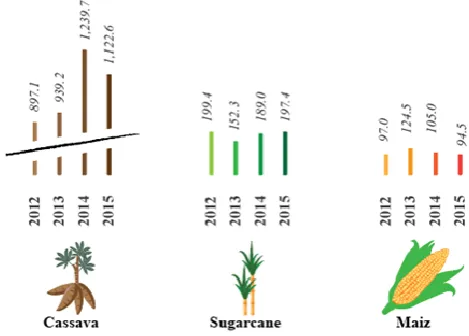
Apart from the permanent crop production, the temporary crop includes rice (2.7 Mtons); sugarcane (3.9 Mtons); cassava (201.8 Mtons); maize (57.9 Mtons). Cassava production represents an important agricultural crop produced in Acre for the whole year and provide a subsistence of several families of the state, moving up the economy [6].
Table II shows the season production for the main agroindustry products and the extractivism in a four-year period, highlighting the extraction of wood and açaí from the native forests.
1 SIN is the National Integrated Electric System, being Brazil a continental country, its electricity production and transmission system is a
[image:2.595.302.553.118.293.2]Part of the wood is used for thermal energy production (firewood) and the rest, in the form of logs, are intended for construction, furniture and other applications.
TABLE II:
Main agroindustry and extractivism production (in Mt) Product 2012 2013 2014 2015
A
g
ro
in
d
u
st
ry Cassava 897.1 939.2 1,239.7 1,122.6 Sugarcane 199.4 152.3 189.0 197.4
Maiz 97.0 124.5 105.0 94.5
Rice 18.4 15.5 7.5 7.1
Ex
tr
ac
tv
ism
Firewood 716,397 663,502 580,063 493,919
Wood 647,524 501,260 351,766 285,313
Brazilian
nut (brown) 14,088 13,599 13,684 14,038
Açaí 1,620 3,050 4,020 5,454
Source: [6]
[image:2.595.320.555.335.503.2]Other activities are intense in the state, as shown in Fig. 1 above.
Fig. 1: Infografic of Cassava, Sugarcane and Maiz production (Mt)
The scarcity of new technologies to improve the agricultural production is configured as a primary issue for economic viability in rural smallholders, especially that production cassava in state of Acre, one of the most important crop in that region [5].
C. Energy Demand on Amazon region
The National Integrated Electric System (SIN1) has
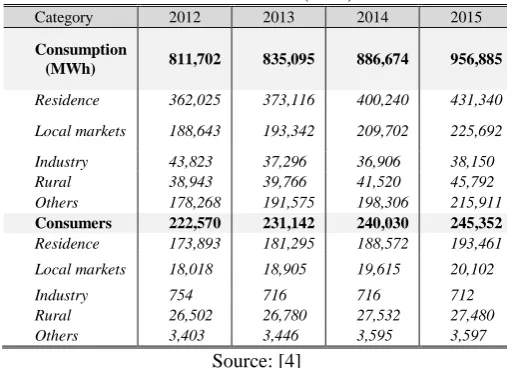
recently arrived in the Amazonian region. Thereby, it allows interconnecting the two different way of electricity generation: hydroelectric and thermoelectric. The first one is essentially installed in the state of Pará, its neighbor, and thermoelectric plants, some of them based on oil fuel, are concentrated in Acre. In terms of energy supply, Amazon region holds geographical and economic features which contribute to enhancing high and constant electric rates to final consumers [5]. Energy demand has been increasing between 2012-2015, according to Table III.
Residential, industrial, commercial and rural electricity consumption has increased, mainly due to the population growth experienced in this period.
TABLE III:
Evolution of electric consumption (in MWh) by categories between 2012-2015 (Acre)
Category 2012 2013 2014 2015
Consumption
(MWh) 811,702 835,095 886,674 956,885
Residence 362,025 373,116 400,240 431,340 Local markets 188,643 193,342 209,702 225,692
Industry 43,823 37,296 36,906 38,150
Rural 38,943 39,766 41,520 45,792
Others 178,268 191,575 198,306 215,911
Consumers 222,570 231,142 240,030 245,352
Residence 173,893 181,295 188,572 193,461 Local markets 18,018 18,905 19,615 20,102
Industry 754 716 716 712
Rural 26,502 26,780 27,532 27,480
Others 3,403 3,446 3,595 3,597
Source: [4]
There are two private grids serving the region. Eletronorte produces over 75% of electric energy in the state and Eletroacre serves the rest of the state as a distributor. Total installed capacity of two companies was 92,900 kW and the demand was 218,309 kWh [7].
III. AVAILABLEBIOMASSANDITSPOTENTIAL OFREUSE
A. General definitions
Biomass is the term used for all organic material originating from plants, trees and crops, and is essentially the collection and storage of the sun´s energy through photosynthesis. Biomass energy or bioenergy is the conversion of biomass into useful forms of energy such as heat, electricity and liquid fuels (biofuels) [8].
B. Açaí seed
Açaí (Euterpe oleracea) is one of the main fruit cultures of economic value in the North region in Brazil, which coincides to Amazon region. The edible portion of palm tree fruit is pulp which constitutes about 32% of total fruit mass in relation to the 68% occupied by the seed. With 2.12% participation, Acre is the fourth largest açaí producer in Brazil. The largest producer is the state of Pará, with 64.54% and 90% of this volume corresponds to residues generated after agroindustrial processing of the fruit for pulp production [6]. Residues are basically composed of the seed and attached fibers, which has potential as a renewable material. The proportion between of the amount of açaí production and its residues is 1.2:1.0 [8].
According to [8], bromatological composition of different components of açaí fruit on dry basis is 43% and 31%
2 According to H. Lamarche (1993) family agriculture is fundamentally the agriculture directed to the own rural producer. It demands the familiar workmanship instead of hiring external employees [20].
moisture from its seed with mesocarp and without mesocarp respectively; dry matter 57% and 69% respectively.
The energy content may vary with the presence of the mesocarp between 4,304 and 4,417 cal/g and moisture between 31 and 43%. According to this recent study, açaí seed presents important advantages as a thermal source in pottery (brown ware).
On the other hand, açaí trees are manually handled by small familiar farmers which the composition of forests is not altered and is carried out on a small scale for the subsistence of native families. Other products still represent local economic value and familiar income, especially wood products and there is the possibility to diversify their production and multiple uses of local areas [1].
C. Cassava
Cassava (Manihot esculenta) is the primary staple for a majority of Amazonian indigenous peoples, especially because its roots provided carbohydrates after traditional processing [9]. The medium production of cassava in Amazonian region is high, 14.5 to 20 ton.ha-1, the value
obtained in other regions only if using advanced root-crop management [10], [11]. The production of cassava in the state of Acre has great participation of the so-called family agriculture2. Part of the production of this tuber is intended
for the manufacture of flour and other derivatives, like starch. The cassava crop is interspersed to corn plantation. Its cost production ranges R$ 0.44 to R$ 0.88 / kg cassava [5].
D. Banana
The banana is the most cultivated fruit in Acre, making the state the third-largest producer of the fruit in Amazon. Pará is the largest producer, accounting for more than 50% of regional production [6].
The banana peel is an important agricultural residue, whose main application in Brazil is as organic fertilizer. The generation of peels and other fibrous residues from the banana processing represents approximately 30% of the raw material [12]. However, some authors suggest that the production of residues is up to 40% [13]. According to the Brazilian Agricultural Research Corporation (Embrapa), from every 100 kg of bananas harvested, 46 kg are not used because they do not meet the consumption standards [9].
Although the majority of the banana production is consumed in natura, the industrialization of this fruit represents between 2.5 – 3.0% of the national production [14], a considerable quantity, mainly due to the large volume of production. Therefore, it is extremely important that studies provide an alternative for the reuse of agroindustrial residue of the banana, contributing to the construction of a cyclical economy.
IV. SOCIAL EXTERNALITIES AND POTENTIAL OF INCLUSION
the tropical moist forests whether these incentives can effectively achieve policy objectives. In most cases, their focus on extensive areas characterized by massive flows of carbon and nutrients leaving aside the primary forests, which causes negative consequences for rural people and the environment.
[image:4.595.48.253.192.379.2]We can consider in Fig. 2 some advantages found from the public participation in the decision-making and in the seeking of social and environmental solutions when the reality of the Amazon region is well known:
Fig. 2: Positive aspects obtained from initiative in rural areas
Thus, as pointed by [15] is natural to face in regulatory and administrative barriers, and we highlight aspects at Amazonian region especially encounter like public acceptance, infrastructure limitations, capital shortage and lack of local technical knowledge at the beginning of projects implementations.
However, there has been an engagement to the economic development of dependent areas in the northern region of the country. One of the examples of public policies comes from the Ministry of Economy with SUFRAMA - Superintendence of the Manaus Free Trade Zone, an organization focused on the capital of Amazonas, a region that produces goods and technology. This initiative of internalizing economic development also has its action in the neighboring states, especially the Acre [16].
The most common action is the transfer of capital resources after the evaluation of projects. The flowchart shows in Fig. 3 the steps.
Fig. 3: Process to internalize economic development by Suframa in North region in Brazil
There is a concern in how projects are evaluated and
approved by the specialists, especially regarding security, transparency, impartiality and approval time of processes. One important to this type of public policy is follow-up after project implementation and execution. Corruption and diversion of funds may occur in distant regions in Brazil.
On the other hand, it is possible to enhance some important socio-environmental aspects identified through this work, especially in biomass and renewables. We discuss the next topic below.
V. BIOENERGY:BENEFITS,INVESTMENTAND DEPLOYMENT
A. General aspects
Bioenergy can provide a host of benefits to society. Beyond a reduction of carbon dioxide emissions, governments have enacted renewable energy policies to meet a number of objectives including the creation of local environmental and health benefits; facilitation of energy access particularly for rural areas and improving social and economic development through potential employment opportunities [5], [15].
Agroforestry denotes the general term to refer to the land use system of cultivating woody perennials, either polyculture or monoculture (i.e., plantation) on agricultural land, regardless of the current existence of crops or animals. [17].
B. Agroforestry as biomass to energy in Amazon
Agroforestry has been advocated and practiced by many countries to offer a wide range of economic, social, and ecological benefits: (1) increasing the per capita farm income by planning high-value tree products; (2) improving soil fertility and land productivity; (3) increasing household resilience; (4) mitigating the impacts of climate variability and change; (5) conserving biodiversity and (6) improving air and water quality [17].
C. Açaí seed as animal feed and as organic fertilizer As pointed, residues from agriculture and extractivism has been studied under different aspects.
[18] analyzed the use of açaí seed as a potential alternative ingredient in the feed of slow-growth broilers. After carried out the economic and bird performance analysis of all fractions of the açaí fruit, they realized that mesocarp was the best choice for formulation of the açaí bran. Also, they highlighted the reduction of the negative impacts generated by açaí residue in the environment.
In the Amazonian region, almost 70% of urban waste is deposited in the open and only 1.5% is used as organic compound for agriculture. In small cities, it is estimated a per capita production of 500g waste per day, containing about 50-65% of organic matter. Embrapa Amazônia, a Brazilian state agency that develops technological projects in agriculture, has studied the use of açaí seed and grass for the production of organic fertilizer in municipalities of up to 80,000 inhabitants in Pará. The management of waste, the decomposition process and maturation time, the characteristics of the organic fertilizer and its application in plantations like açaí, papaya, passion fruit, besides gardening [19].
Sustainability in rural areas
Local ownership and decision
making
Regional development
Increase in environmen tal values Renewable
education and training Local jobs
and community
income
Projects
Local Criteria, Legal aspects and
sustainability
Projects approval
Resources transfering
Projects implementation
[image:4.595.55.296.631.731.2]D. Açaí seed as fuel and as a component of new materials Açaí seed was studied as a source of energy in ceramic manufacturing. The residues from açaí palm trees were tested as a thermal source for the manufacture of bricks at Imperatriz, Amazonas state. The characterization indicated good potential for combustion (18.6 to 27.7 MJ.kg-1) as a
substitute for firewood which has lower heat potential (18.4 MJ.kg-1), according to the study. The manufacture of bricks
would be ecologically correct, gaining time and reducing the volume of waste from the extraction of the açaí [19], [20].
Açaí residues also present high content of fibers and including its energetic potential already mentioned, was also studied its ability to form briquettes. The positive aspects found were the easy acquisition of the residues, the local production concentrated in specific sites reducing costs, the very promising use as a source in biorefineries, and, in addition, the low gas emissions during the beneficiation process. [19], [21], [22], [23], [18].
E. Potential of banana biomass
Published studies suggest that the residues generated by the banana can be used with several applications. [24] demonstrated the efficiency of the production of hydrogen and methane from banana peels. Methane production from the banana by-product also presented promising results and was applicable on a commercial scale in a pilot-scale survey in Australia [25].
The use of banana peels for the production of bio-ethanol is another form of energy generation that has been studied by several authors with the objective of utilizing the residue of the banana industrialization [26], [27]. For the production of ethanol, however, the hydrolysis of carbohydrates is necessary, currently made by a combination of pectinolytic enzymes and cellulolytic enzymes [28]. The generation of electric energy through banana and its residues has also been proven by other studies. The residue of the banana processing can also be used directly for burning in boilers.
However, the high amount of moisture can decrease the efficiency of the process [25]. Other studies also demonstrate that due to their excellent adsorption potential, vegetable crop residues have been applied in the removal of heavy metals in the treatment of wastewater as a cheap and ecological alternative [29]. Thus, in addition to energy production, the banana peel has been tested for the removal of heavy metals from the water, such as copper (Cu) [30]. Other studies also suggest that this residue can be used in the production of biopolymers with substitutive applications to conventional plastics [31].
There are also issues related to access to production intensification technologies and the complex logistics involved in transporting biomass to the site of electric generation. In this way, the purpose of the study is to analyse different options before making any decision within such a socially and ecologically sensitive system.
F. Renewable energy in the state of Acre and its potentialities Economic and social studies were carried out with the aim to discuss approach evaluation and feasibility of electric energy from açaí seed biomass [19], [10].
Acre is a young state and the supply of electricity is fundamental for the continuity of its economic and social
development. The state has large sources of renewable energy that could complement, even on a small scale, the use of fossil energy that is still expensive and polluting. According to a recent study by UFRJ / WWF Brazil, the cost of energy in isolated regions would reach R$ 14,000.MWh-1 (Brazilian
real), 70 times more expensive than those in other regions of the country. Acre also has 30 MW of installed capacity in thermal energy from diesel, with a cost of R$1,000 to R$2,100 per MWh, still 5 to 10 times higher. The costs of fuel, equipment and transportation for this region of Brazil becomes expensive and unfeasible, not justifying a major electric undertaking in the region. According to projections for 2030, energy demand in the state will grow 4.7% per year [5].
Based on this scenario, there is great potential for bioenergy and solar energy generation, and less importantly hydroelectricity and win.
a) Ethanol from cassava: a technical-economical feasibility study to produce cassava ethanol in Acre lands were carried out by the same authors. It would therefore be possible, according to the average estimate, to obtain 100 liters of ethanol per tonne of cassava. From this data, the total investment would be R$ 2.84 million over 10 years (payback) for annual electricity production of 3,240 MWh. Externalities: part of the cassava production is for own consumption and part is sold by families. Producers would need to be oriented to gradually increase their scale of production and to be trained to supply the demand of ethanol plant. In addition, in the road transport system, the vehicles are supplied by liquid fuels from the region producing ethanol, gasoline and diesel, ie, the south-central region, with their states of Sao Paulo, Rio de Janeiro and Minas Gerais [11], [32].
b) Energetic forest: it is known that wood industry is largely concentrated on that region. Wood dust and chips are residues already used by the Triunfo industry in the capital Rio Branco. The installed capacity will increase on next years, with future cogeneration capacity up to 30MW. It is expected to burn biomass residues (33 tons of wood waste per hour) [5], [8].
VI.CONCLUSION
The studies suggest that agroindustrial residues have several applications which can lead to diversifying the primary energy in Acre, as well as helping in solving other environmental problems. It is important to integrate the bioenergy issues into any land use plan in Acre. Integrated management, taking into account the possibility of intensification of livestock production, can release land for other productive uses, such as planting of productive forests. The use of cascade biomass (first as a raw material for construction and furniture, then as a source of energy) is the most profitable situation from the point of view of reducing greenhouse gas emissions. The use of waste from a sustainable wood industry would be an appropriate way to explore this resource. The same considerations apply to the use of any form of biomass as a source of energy in isolated systems. In addition, food security must also be considered in these localities. A strong intervention that reduces subsistence production can have negative effects in this sense.
VII.ACKNOWLEDGMENT
The authors thank the Brazilian government, as Federal Institute of Education and Science in Sao Paulo and Acre.
Conflict of interest: The authors declare that there is no conflict of interest.
REFERENCES
[1] J. E. S. Farias, “Manejo de açaízais, riqueza floristica e uso tradicional de espécies do Estuário Amazônico (Dissertation),” Ph.D. dissertation, Programa de Pós-Graduação em Biodiversidade Tropical, Universidade Federal do Amapá, Macapá, AM, 2012.
[2] IBGE - Instituto Brasileiro de Geografia e Estatística, “Censo IBGE”
[Online]. Available:
https://cidades.ibge.gov.br/brasil/ac/pesquisa/24/76693.
[3] Brasil, “ACRE,” Portal do Governo Federal, 2017. [Online]. Available: http://www.ac.gov.br/wps/portal/acre/Acre/estado-acre/sobre-o-acre [4] CIMI, “Dossiê Acre - Documento especial para cúpula dos povos,” Rio
de Janeiro, 2012. [Online]. Available: https://cimi.org.br/wp-content/uploads/2017/11/Dossie-acre_2012.pdf
[5] WWF Brasil; COPPE; UFRJ, “Potencial de Aproveitamento de Energia Renovável no Estado do Acre” Brasilia, 2016. [Online]. Available: https://d3nehc6yl9qzo4.cloudfront.net/downloads/potencial_energia_ren ovavel_no_acre_sumario_executivo.pdf
[6] IBGE - Instituto Brasileiro de Geografia e Estatística, “Censo IBGE”
[Online]. Available: https://www.ibge.gov.br/estatisticas- novoportal/economicas/agricultura-e-pecuaria/9105-producao-da-extracao-vegetal-e-da-silvicultura.html?=&t=resultados
[7] Brasil, Eletrobrás Eletronorte. Usinas Termelétricas. Available at: http://www.eletronorte.gov.br/opencms/opencms/pilares/geracao/estado s/acre/
[8] O. Ellabban, H. Abu-Rub, and F. Blaabjerg, “Renewable energy resources: Current status, future prospects and their enabling technology,”
Renew. Sustain. Energy Rev., vol. 39, pp. 748–764, Nov. 2014. [9] J. M. Reichert, M. F. Rodrigues, C. M. P. Bervald, G. Brunetto, O. R.
Kato, and M. V. Schumacher, “Fragmentation, fiber separation, decomposition, and nutrient release of secondary-forest biomass, mechanically chopped-and-mulched, and cassava production in the Amazon,” Agric. Ecosyst. Environ., vol. 204, pp. 8–16, Jun. 2015. [10] M. K. D. Rambo, F. L. Schmidt, and M. M. C. Ferreira, “Analysis of the
lignocellulosic components of biomass residues for biorefinery opportunities,” Talanta, vol. 144, pp. 696–703, Nov. 2015.
[11] J. Salick, N. Cellinese, and S. Knapp, “Indigenous diversity of cassava: Generation, maintenance, use and loss among the Amuesha, peruvian upper amazon,” Econ. Bot., vol. 51, no. 1, pp. 6–19, Jan. 1997.
[12] J. Y. Tock et al. Banana biomass as a potential renewable energy resource: A Malaysian case study. Renewable and Sustainable Energy Reviews, v. 14, p. 798–805, 2010.
[13] A. F. M. Alkarkhi, Y. Shin, A. Mat. Comparing physicochemical properties of banana pulp and peel flours prepared from green and ripe fruits. Food Chemistry, v. 129, p. 312–318, 2011.
[14] M. I. S. Folegatti, F. C. A. U. Matsuura. Processamento de banana.
Available at:
https://www.agencia.cnptia.embrapa.br/recursos/Livro_Banana_Cap_13 ID-PA3643xufd.pdf.
[15] J. Börner, A. Mendoza, and S. A. Vosti, “Ecosystem services, agriculture, and rural poverty in the Eastern Brazilian Amazon: Interrelationships and policy prescriptions,” Ecol. Econ., vol. 64, no. 2, pp. 356–373, Dec. 2007.
[16] Suframa - Coordenação Geral de Regional, “Interiorizando o desenvolvimento no estado do acre,” Manaus, AM - Brazil, 2003. [17] Q. Chen et al., “Modeling and mapping agroforestry aboveground
biomass in the Brazilian Amazon using airborne lidar data,” Remote Sens., vol. 8, no. 1, pp. 1–17. 2016.
[18] J. C. B. Arruda et al., “Açaí seed bran in the feed of slow-growth broilers,”. Acta Amazônica, vol. 48, pp. 298–303, Jul. 2018.
[19] L. B. Texeira, V. L. C. Germano, R. F. Oliveira and J. F. Junior, “Processo de Compostagem a partir de lixo orgânico urbano e caroço de açaí,” Embrapa Amazônia, Belem, Pará, 2002.
[20] H. Lamarche, A agricultura familiar: comparação internacional, Editora Un. Campinas - SP: Editora Unicamp, 1993.
[21] B. O. Reis, I. T. da Silva, I. M. O. da Silva and B. R. P. Rocha “Produção de briquetes energéticos a partir de caroços de açaí", An. 4. Enc. Energ. Meio Rural, 2002.
[22] A. M. B. Neto, J. O. Lima and L. G. Marques “Secagem infravermelho de caroços de açaí para a obtenção de biomassa,” In: XX Cobeq, Florianópolis/ SC, pp. 1–8, 2014.
[23] L. R. Gehlen, “Efeito da utilização de fibras lignocelulósicas (açaí e curauá) em compósitos com matriz de resina poliéster insaturado,” (Dissertation),” Ph.D. dissertation, Programa de Pós-Graduação em Engenharia e Ciência dos Materiais – PIPE. Setor de Tecnologia, Universidade Federal do Paraná, Curitiba / PR, 2014.
[24] C. Nathoa, U. Sirisukpoca, N. Pisutpaisal. Production of hydrogen and methane from banana peel by two-phase anaerobic fermentation. Energy Procedia, v. 50, p. 702–710, Jul. 2014.
[25] J. Y. Tock, et al. Banana biomass as a potential renewable energy resource: A Malaysian case study. Renewable and Sustainable Energy Reviews, v. 14, p. 798–805, Feb. 2010.
[26] O. Souza et al. Energia alternativa de biomassa: bioetanol a partir da casca e da polpa de banana. Revista Brasileira de Engenharia Agrícola e Ambiental. vol. 16, p. 915–921, Aug. 2012.
[27] J. Gabhane et al. Pretreatment of banana agricultural waste for bioethanol production: individual and interactive effects of acid and alkali pretreatments with autoclaving, microwave heating and ultrasonication.
Waste management, New York, v. 34, p. 498–503, February. 2014. [28] H. S. Oberoi, S. K. Sandhu, P. V. Vadlani. Statistical optimization of
hydrolysis process for banana peels using cellulolytic and pectinolytic enzymes. Food and Bioproducts Processing, v. 90, p. 257–265, Apr. 2012.
[29] I. S. Arvanitoyannis, T. H. Varzakas. Vegetable waste management: treatment methods and potential uses of treated waste. [s.l.] Elsevier Inc., 2008. p. 703–761
[30] C. Liu et al. Optimal conditions for preparation of banana peels, sugarcane bagasse and watermelon rind in removing copper from water.
Bioresource technology, v. 119, p. 349–54, set. 2012.
[31] D. Evangelista, G. Carvalho and M. Sá. 2018. Produção de Biopolímeros à Base da Casca da Banana. MOC III, Experiência Beta, 2018.
[32] A. B. Guerrero, P. L. Aguado, J. Sánchez and M. D. Curt. "GIS-Based Assessment of Banana Residual Biomass Potential for Ethanol Production and Power Generation: A Case Study". Waste and Biomass Valorization, vol. 7, p. 405-415, April, 2016.