languages using a precise OO meta-modeling approach.
CLARK, Anthony <http://orcid.org/0000-0003-3167-0739>, EVANS, Andy, KENT, Stuart, BRODSKY, Steve and COOK, Steve
Available from Sheffield Hallam University Research Archive (SHURA) at:
http://shura.shu.ac.uk/11888/
This document is the author deposited version. You are advised to consult the publisher's version if you wish to cite from it.
Published version
CLARK, Anthony, EVANS, Andy, KENT, Stuart, BRODSKY, Steve and COOK, Steve (2000). A feasibility study in rearchitecting UML as a family of languages using a precise OO meta-modeling approach. Project Report. pUML Group and IBM.
Copyright and re-use policy
See http://shura.shu.ac.uk/information.html
A Feasibility Study in Rearchitecting
UML as a Family of Languages using a
Precise OO Meta-Modeling Approach
Version 1.0. September 2000
Tony Clark, Andy Evans, Stuart Kent
(for pUML group)
Steve Brodsky, Steve Cook
(for IBM)
© September 2000 Tony Clark, Andy Evans, Stuart Kent & IBM
All rights reserved.
Contents
Executive Summary
7
Version 1.0, 11th September 2000: ... 8
Version 0.1, 22nd May 2000: ... 8
Chapter 1: Rearchitecting UML
9
1.1. Definition of UML 1.x ...91.2. Why is the definition of UML 1.x inadequate? ...9
How can conformance to the definition be checked? ... 10
How can we be sure that the definition is self-consistent and is comprehensive yet lean?... 10
The specialization and extension of UML continues all the time. How does the existing definition allow this to be managed and controlled? ... 10
1.3. Requirements for a rearchitected definition of UML ... 11
Chapter 2: Precise OO Meta-Modeling
13
2.1. Motivation ...132.1.1 Why OO meta-modeling? ... 13
2.1.2 Why precise? What about tools? ... 13
2.2. Design Principles for MML...14
2.3. An idealised Meta-Modeling Facility (MMF)...16
2.3.1 Meta-Modeling Language (MML) requirements ... 16
2.3.2 Tool requirements ... 17
Satisfaction checker ... 17
Instance generator ... 17
Graphical editor generation/configuration... 18
Model interchange and XMI... 18
2.4. Relationship of MMF to MOF ...19
2.5. Summary...20
Chapter 3: An Architecture for UML
23
3.1. Introduction ...233.2. Subject areas ...25
3.3. Language aspects...27
3.4. Extending a language component...30
3.5. Summary...31
Well-formedness rules ...36
Methods...37
4.2.2 core.instance.concepts ...38
Well-formedness rules ...39
4.2.3 core.semantics ...39
Well-formedness rules ...40
Methods...40
4.3. datatypes ... 41
4.3.1 datatypes.model.concepts...42
Well-formedness rules ...42
4.3.2 datatypes.instance.concepts...42
Well-formedness rules ...43
Well-formedness Rules ...44
4.4. constraints ... 45
4.4.1 constraints.model.concepts...45
Well-formedness Rules ...46
Methods...47
4.4.2 constraints.instance.concepts ...47
Well-formedness Rules ...48
4.4.3 constraints.semantics...49
4.4.4 .Iterate... 50
Well-formedness Rules ...51
4.4.5 Object satisfaction ... 52
4.5. methods ... 52
4.5.1 methods.model.concepts ... 52
Well-formedness rules ...53
Methods...53
4.5.2 methods.instance.concepts ...54
Well-formedness Rules ...54
4.5.3 methods.semantics... 54
4.6. modelManagement... 54
4.6.1 modelManagement.model.concepts ... 55
Well-formedness Rules ...55
4.6.2 modelManagement.instance.concepts ...55
Well-formedness Rules ...56
4.6.3 modelManagement.semantics ... 56
4.7. reflection ... 56
4.7.1 reflection.model.concepts...56
4.7.2 reflection.instance.concepts ...56
4.7.3 reflection.semantics...57
Well-formedness Rules ...57
Example...59
Methods ... 60
4.8. associations...60
4.8.1 binaryAssociation ... 60
associations.model.concepts ... 61
Well-formedness Rules... 61
4.8.2 association Class ... 61
4.9. Conclusions ...62
Chapter 5: Syntax Definitions
63
5.1. Introduction ...635.2. Syntax Packages ...63
5.2.1 Strings ... 65
5.2.2 Box and Line diagrams ... 66
5.2.3 XML... 72
5.3. Graphical Syntax Mappings ...73
5.3.1 Mapping of staticCore.model.concepts to box and line diagrams ... 73
5.3.2 Mapping of modelManagement.model.concepts to box and line diagrams77 5.4. XMI ...78
5.4.1 Mapping of staticCore.model.concepts to XML ... 78
5.4.2 Mapping of modelManagement.model.concepts to XML... 80
5.4.3 XML Issues... 81
5.5. Conclusions ...82
Chapter 6: Dynamic aspects
85
6.1. Overview ...856.2. dynamicCore.model.concepts...85
Well-formedness Rules... 86
6.3. dynamicCore.instance.concepts ...86
Well-formedness Rules... 87
6.4. dynamicCore.semantics ...88
6.5. Real-time extensions ...88
6.6. Conclusion ...89
Chapter 7: Conclusions
91
7.1. Summary...917.2. Tool ...91
7.3. Further Work...92
7.3.1 Tool ... 92
7.3.2 Areas of UML ... 92
7.3.3 Backwards compatibility ... 93
Conformance ...94
Executive Summary
This report describes a feasibility study in rearchitecting UML. It develops a theory of precise OO meta-modeling in order to fulfil this task, and checks the feasibility of that theory by developing the meta-model of various aspects of UML.
The report is organized as follows.
Chapter 1 rehearses the arguments for rearchitecting UML. It concludes with some requirements for a rearchitected definition.
Chapter 2 introduces an approach to precise OO meta-modeling. Some effort is made to relate this to the OMG’s Meta-Object Facility - MOF, though this stops short of pro-viding an exhaustive comparison. Based on the requirements for rearchitecting UML, some requirements of a precise OO meta-modeling facility are identified, and an approach to meeting these requirements, with regard to notations and tools, is outlined.
Chapters 3-6 support the theory with the details. Chapter 3 describes the structure of the UML as a family of languages, notated with the package constructs that are part of the OO meta-modeling language, MML. MML is itself a member of the UML family. We note that circularity in the definition of MML is avoided by providing an external characterization of the MML package, for example by implementing it as a tool. Cer-tain essential patterns of packages and their relationships for language design are iden-tified. Specifically, patterns are identified for separating models from instances, where semantics is the mapping between the two, and syntax from concepts (similar to abstract syntax for textual languages).
Chapter 4 defines those key packages in the UML family that contribute to the defini-tion of MML, maintaining the focus on model concepts, instance concepts and seman-tics.
Chapter 5 gives examples of various syntax to concepts mappings, and shows how the same syntactic components may be mapped to different concepts, how syntax map-pings may be extended as the set of concepts is extended, and how XMI may be thought of as just another syntax mapping.
Chapter 6 outlines how dynamics aspects of the UML, including semantics, may be defined using this approach.
Version 1.0, 11th September 2000:
Chapter 2 (previously Chapter 1) has been rewritten and considerably reduced in size. In particular, the detailed descriptions of the various tools were deemed too implemen-tation-specific and have been replaced by much higher-level descriptions.
The remaining chapters have been reorganized. A new chapter 3, describes a proposed new architecture for UML 2.0, based around the notion that UML is a family of lan-guages.
Chapter 4 (previously chapter 2) has been reworked to take into account that MML, the meta-modeling language previously referred to as mofk2, is part of the UML family.
Chapters 5 & 6 replace chapter 3 in a previous version, demonstrating the feasibility of using MML to define syntax and dynamic aspects, respectively. These chapters report work that is less developed than the work on MML.
The previous chapter 4, on tools, has been deleted. A prototype tool is being developed and this will be described and delivered separately. The tool (and this report) should be available in the near future from www.puml.org.
Chapter 7 has been added to reflect on the feasibility study, to outline how the work should proceed, including known issues and problems, and to indicate how precise OO meta-modeling may be usefully employed in the standardisation process.
A tool, MMT, has been constructed which implements the features of MML. MMT will be/is available from www.puml.org, and has some associated documentation. A future evolution of this report will include a write-up of the tool.
Version 0.1, 22nd May 2000:
Definition of UML 1.x
Chapter 1
Rearchitecting UML
This brief chapter overviews the current definition of UML and rehearses the arguments, which have been set out elsewhere [Clark et al. 1999], for rearchitecting that definition, using a more precise, systematic and flexible approach.
1.1. Definition of UML 1.x
The UML 1.x family of definitions (e.g. [OMG 1999])each comprise the following main components:
• A description of the concrete syntax (i.e. diagrams), in terms of prototypical exam-ples and natural language explanation.
• A description of the semantics, comprising a meta-model description of the abstract syntax and an English description of the semantics. The meta-model description of the abstract syntax is given in terms of UML class diagrams with associated OCL expressions, where class diagrams and OCL have themselves been defined in a sim-ilar manner, the meta-model being replaced by a BNF syntax for OCL.
• The beginnings of descriptions of key profiles of UML, comprising a list of the lan-guage constructs used in the profile and the stereotypes that may be applied to those constructs. In the 1.3. standard the profiles included are for general-purpose soft-ware development and for business modeling.
The introduction of profiles recognizes that, as the popularity of the UML increases, so does the pressure to include new features that are particular to specific application domains or styles of modeling activity. Uncontrolled evolution of the UML can lead to a bloated notation that is difficult to learn and apply in practice. Profiles are intended to allow one to develop variants of the UML suited for particular purposes. There are essentially two kinds of profile. Horizontal profiles focus on particular styles of ling such as requirements, architecture design, software specification, business mode-ling, implementation design and so on. Vertical profiles focus on specific domains, ranging from quite general purpose (e.g. real time) to far more specific (e.g. the auto-motive industry). Vertical profiles will select and specialize fragments from horizontal profiles. Some profiles will be the cross-product of the two, for example requirements modeling for real time.
Our thesis in this report is that the current approach to defining UML, especially in the context of profiles, is inadequate. The next section provides evidence to support this thesis.
1.2. Why is the definition of UML 1.x inadequate?
How can conformance to the definition be checked?
Currently, the only way of checking that a tool or method conforms to UML definition, is by inspection: compare the source code/test results of the tool with the syntax and semantics definition on paper. This is certainly infeasible without having a method for systematically transforming the source code/test results to something that can be com-pared directly with those definitions, and probably infeasible without automating this mapping and the checks in some way. In order to systemize or automate conformance checking the definition needs to be far more precise than it currently is. In particular:
• The mapping of concrete syntax to abstract syntax (the meta-model) needs a more systematic and unambiguous definition, which in turn probably requires the defini-tion of the concrete syntax itself to be more precise and generic (i.e. not just proto-typical examples).
• The semantics must be more than an English definition, conformance to which is totally reliant on inspection and human interpretation.
How can we be sure that the definition is self-consistent and is
comprehensive yet lean?
Obviously it is important that the definition of UML is self-consistent, that one part of the definition does not contradict another. It should be comprehensive, fully covering the definition of concrete and abstract syntax as well as semantics. On the other hand, it should be lean in the sense that redundancy of concepts is kept to the minimum. [Clark et. al 1999] cites evidence where the current definition is weak with respect to these aspects. Specifically:
• The informal description of concrete syntax, especially the use of prototypical examples, is not comprehensive, and the lack of a fully-documented systematic mapping from concrete syntax to abstract syntax (meta-model) makes this prone to error and ambiguity. It has also allowed aspects of concrete syntax to creep into the abstract syntax, as there is no clear separation between the two.
• The informally described semantics is also not comprehensive, and leaves room for error and inconsistency, as well as failure to properly relate and sometimes integrate concepts, leading to redundancy.
The specialization and extension of UML continues all the time. How does
the existing definition allow this to be managed and controlled?
The proliferation of profiles suggests that UML is not a single language, but a continu-ally evolving family of languages. The challenge is to develop an approach to defini-tion that supports an architecture which facilitates the graceful evoludefini-tion of the UML family.
Requirements for a rearchitected definition of UML
specialization using stereotypes is quite shallow, unless supported by specializations in the abstract syntax and semantics. But how this is done is not sufficiently defined.
Instead, an additive and evolvable architecture is required. To achieve this, it must be possible to break the monolith into focused, clearly separated fragments which can be specialized/extended independently, and assembled in different configurations to form profiles. The relationships between profiles and language fragments should be explicit and unambiguous so that the impact of proposed refactorings and extensions can be identified simply and minimized where feasible.
1.3. Requirements for a rearchitected definition of UML
Three key requirements for a rearchitected definition of UML can be deduced from the preceding discussion:
1. It should be precise to the degree that conformance can be checked systematically, without argument and, preferably automatically, and that self-consistency of the def-inition can be established.
2. It should be comprehensive, covering syntax, both concrete and abstract, and semantics. On the other hand, redundant and overlapping concepts should be kept to a minimum.
3. It should accept that UML is a family of languages, providing mechanisms that allow profiles and language extensions to be defined in a controlled and managed way, and which makes the relationships of profiles and extensions to existing lan-guage fragments explicit and unambiguous.
A fourth requirement, which is met by the 1.x definitions to a large degree is that:
4. The definition should be accessible to tool builders and those involved in the stand-ardization of the language.
In other words, the definition will be of little use if it is phrased in a language (for example, a complex piece of mathematics) that those who need access to it can not understand. That does not mean that it might not be supported by equivalent definitions in such a language, if there is a good reason for doing this, such as provision of sophis-ticated tools such as model checkers and theorem provers.
Motivation
Chapter 2
Precise OO Meta-Modeling
This chapter outlines a framework for precise OO meta-mode-ling. This framework is motivated by a discussion of the benefits to be gained from a precise, OO approach, specifically with regard to the rearchitecting of UML.
2.1. Motivation
2.1.1 Why OO meta-modeling?
The OMG has adopted an OO meta-modeling approach to the definition of UML. Essentially this means using a subset of UML to define UML. This has proved itself to be an intuitive way of defining the conceptual basis (or abstract syntax) of UML.
We have started investigating the use of an OO meta-modeling approach to define the (concrete) syntax and semantics of languages, and have found that, for a certain class of languages, including UML, it is both feasible and intuitive, provided some important features, such as a constraint language, are included.
In this study, our focus is on the precise definition of languages, with particular refer-ence to the definition of UML. In this chapter we isolate the requirements of a OO meta-modeling language (MML), as dictated by this focus. The remaining chapters give a definition of MML in terms of itself, and show how MML can be used to charac-terize significant fragments of UML, using an architecture that explicitly recognizes that UML is not a single language, but a family of languages.
2.1.2 Why precise? What about tools?
By a precise MML, we mean the following:
• There is a single, precise reference definition of MML to which all other definitions must conform.
• MML syntax, concepts and semantics are included in this definition.
• There should be tools which faithfully implement or embed the precise definition.
Precise does not mean that there need be an external mathematical definition of the lan-guage. The part most frequently missing from definitions of a language, and which is missing from UML 1.3, is a precise semantics. We see it as fundamental that this is defined. In one approach the definition of MML is embodied in a tool which checks conformance of models to meta-models defined in the language. For MML, this essen-tially encodes a model-theoretic semantics, which states what models are valid
of MML increases. The definition of MML in itself can become the reference defini-tion, and tools implementing the translation of syntax to concepts, for example, would be based on this definition. Indeed, it may even be possible to (partially) automate the construction of the latter.
If we have a precise MML, that is expressive enough to define syntax, concepts and
semantics, then meta-models defined in MML will also be precisely defined, in the same fashion as MML itself. In particular, we expect that the checking tool embodying the semantics of MML can be used to realise the semantics part of any meta-model defined in MML, in the sense that it can be used to check that instances of a model con-forming to that meta-model (e.g. instances of some UML model) satisfy the definition of that model. This will work provided the meta-model (e.g. of UML) includes a semantics component that can be defined fully in MML.
An idealised meta-modeling facility (MMF = MML + tools) is outlined at the end of this chapter.
2.2. Design Principles for MML
MML is for defining languages. Experience of language definition in general, and the UML in particular, suggests the following design principles, which, if followed, dis-charge at least the requirements for an approach to the definition of UML set out at the end of the previous chapter.
1. MML should be able to describe syntax (both textual and visual, as in the UML), concepts and semantics, including well-formedness rules and mappings.
A language definition comprises two key orthogonal distinctions.
The first is the distinction between model and instance. The model part comprises a definition of the valid expressions in the language. The instance part comprises a definition of the possible situations that expressions in the language may denote at any point in time. For example, the model part of the definition of the language of class diagrams defines what are valid class diagrams and what are not. The instance part defines the valid object configurations (visualized as object diagrams) which can be denoted by a class diagram at a point in time.
The second key distinction is between syntax and concepts, and this distinction applies to both models and instances. Concepts are the essential concepts of the model or instance part of a language. So the concepts underpinning class diagrams are class, attribute, association, cardinality etc., and those underlying object config-urations are objects, slots and links. A syntax for a set of concepts is a model of a particular rendering of those concepts so that they may be written down, displayed, read etc. A syntax for class diagrams could include boxes, lines, strings and so on. Instances also have syntax: an object diagram is a syntax for the object configura-tions.
Syntaxes may be more or less concrete than other syntaxes. So a syntax involving only pixels on a page or screen is more concrete that one involving boxes, lines and strings.
Design Principles for MML
may be regarded as a syntax for specifying the allowed action sequences in a model, or as a syntax for visualizing a single execution trace (i.e. an instance).
A language definition is not complete unless its various aspects are properly related. The relationship between the model part and the instance part represents the seman-tics of the language. In the tradition of denotational semanseman-tics in the programming language field, and model-theoretic semantics for logics, it gives the rules for when an instance is a valid instance of, satisfies a model and when it does not. It is suffi-cient to define semantics as a mapping between the model concepts and instance concepts.
It is also necessary to stipulate how the syntax(es) map into the concepts. An imple-mentation of this mapping in the direction of syntax to concepts is essentially a parser. An implementation of the mapping in the other direction is usually harder, as one has to supply layout information – notoriously difficult for graphical languages. To summarise, MML must include constructs to define the model and instance parts of a language, to define syntax(es) and concepts for each of these parts, and to define the mappings between all these components.
2. MML should be accessible to stakeholders in the activity of language design. For UML this means those actively engaged in defining UML, and those involved in providing tool support. Users of the UML notation and tools may be presented the definition in a form that facilitates learning of the notation, for example a catalogue of positive and negative examples.
3. MML should provide explicit support for the definition and evolution of language families. There is strong evidence that UML is not a single language, but a family of languages. Every organization seems to use its own UML ‘profile’ – a subset of the language, extended with organization-specific stereotypes. Some
‘standard’ profiles are already on the drawing board. There is no evidence to sug-gest that UML will not continue to evolve in this way.
4. MML should be precise and unambiguous, so that definitions in MML are precise and unambiguous. The reasons for this have already been explained in Section 2.1.2.
5. MML is itself a language. Thus the definition of MML should distinguish between syntax, concepts and semantics, and these should be defined in a precise and unam-biguous way. Or, to put it another way, it should be possible to define MML in itself. At the very least this will be a good test of the capabilities of MML.
6. MML should be a declarative language. Issues related solely to the implementation of a repository to store language definitions (e.g. UML) and expressions of those languages (e.g. a UML model) need not be part of MML. The language designer does not need to know how tools to support that language are implemented, or be unnecessarily exposed to features in the language which have no purpose other than to support the implementation of tools such as a repository. On the other hand, we recognize the importance of implementation, and hope and expect that MML would provide the kernel of a model specifying one or more tools implementing aspects of MML.
be used with this tool to check UML instances against UML models, UML models against the UML meta-model, and the UML meta-model against MML itself (remembering that we should be able to describe MML in itself, i.e. as a model).
In addition, there are some general principles that should apply to any language, including MML:
8. A language should be coherent and consistent.
9. A language should keep the number of concepts used to a minimum. Preferably, there should be a small set of orthogonal core concepts, on top of which other con-cepts can be defined.
10.A language should not include unmotivated or unnecessary restrictions, that is restrictions which seem to be there on whim.
2.3. An idealised Meta-Modeling Facility (MMF)
It is possible to distil from the preceding discussions some requirements for a meta-modeling facility, which is a meta-meta-modeling language plus its support tools.
2.3.1 Meta-Modeling Language (MML) requirements
In order to define the various components of a language (syntax, concepts, model, instance) and the mappings between them the following two requirements are essen-tial:
Constructs for specifying object structures. Class diagrams are essential to define the vocabulary used to define object structures.
Constructs for expressing well-formedness constraints on object structures. Cen-tral to writing out the full definition of syntax, concepts, semantics and the mappings between them is to have a language that is up to the job of writing subtle constraints on object structures. The Object Constraint Language that is part of UML is just such a language; it is essentially a variant of FOPL tuned for writing constraints on object
structures.
To support (a) the separation of concerns (syntax, concepts, semantics) in a language definition and (b) definitions of language families, such as UML, MML must include:
Constructs for packaging and composing fragments of language definition. Spe-cifically, packages, package generalization, and realization/translation relationships between packages.
So that generic tools can be built, MML requires:
Constructs to support reflection. Something can be viewed as both model and instance. The class Association in the UML meta-model is both an instantiable thing
- it can have instances - and an instance - it is an instance of the MML Class construct.
Similarly the UML class Library is both instantiable and an instance, in this case of
An idealised Meta-Modeling Facility (MMF)
2.3.2 Tool requirements
Little has been said, so far, about the tools required to support MML. It is our firm belief that a meta-modeling language is little use without the tools to support it. Fur-ther, as our approach is to define MML using itself, it is important to provide a method that increases our confidence that the definition of MML is correct.
One approach to this would be to provide a definition of MML in a language which already has a venerable past and in which we (and many others) have confidence, such as the language of mathematics.
Another approach is to define a working model of that language which can be tried and tested with examples. The more examples for which it works as expected, the greater our confidence will be that the definition is correct. Even better, if that working model is generated automatically from the description of MML in itself. And of course, a working model can be used to perform useful tasks like help define new languages using MML. This working model is the set of tools we propose to build. Following is a list of tools we expect such a toolset to include. Of these, we see the first two as most important.
Satisfaction checker
Check that a given instance satisfies a model. A key component of this is to provide a checker that is able to take account of OCL-style constraints: does instance x satisfy constraint c from model m?
Combined with reflective ability, such a tool can be used to perform a number of checking tasks. Using the 4-layer architecture as a reference point, a model can be viewed as an instance of a model, so we can check that a model satisfies its meta-model definition. We can also check that a meta-meta-model satisfies the rules of the MML itself. MML is itself a meta-model, and so meta-models are instances (models) of this meta-model. Finally, MML is an instance of itself, so its well-formedness can be checked against MML. Thus a satisfaction checker is an essential tool in helping us become more confident that MML is correctly defined.
Initially one would implement the checker for MML or some appropriate subset, and this would then work with any language whose concepts could be mapped back to MML concepts. However, eventually it would be desirable to have a satisfaction checker for any language that defined a model part and an instance part. Preferably, this should be generated from the definition of that language in MML, or, alternatively, there should be a generic tool that is able to adapt itself according to the language defi-nition in use (see next tool).
Instance generator
Given a model, generate an instance that satisfies it. Again, the ability to take account of OCL-like constraints is essential.
mapping between the syntax and concepts of, say, class diagrams, one could use this tool to generate an expression of the concepts part (specific classes, attributes and asso-ciations) from a collection of boxes, lines and strings (the syntax part), by generating a valid mapping.
If this tool has been implemented for some MML, this tool could be used to implement a satisfaction checker for any language whose semantics can defined in MML (the lat-ter condition means that the MML in question must include an OCL-like constraint language). By providing a description of the semantics using MML, and the constraint language in particular, the proposed tool could be used to generate anything that is missing to complete the mapping of a given instance and model. If the mapping can’t be completed, then checking fails.
In general, it is expected that an instance generator will never be fully automatic. For example, consider the mapping from concepts to a graphical syntax. That mapping is unlikely to specify the exact layout of diagrams at the syntax end, so will be underde-termined in the sense that many diagrams (with the same boxes and lines, but different layout) would map to the same concepts. To cater for such cases, a mechanism must be provided whereby the additional information can be supplied as required, either from the user of the tool or by virtue of another program (e.g. a layout algorithm).
Graphical editor generation/configuration
The main purpose of MML is to provide a more complete definition of UML organised as a family of languages. Many of the key notations in UML are graphical. It would be desirable to have a means of generating graphical editors for a graphical syntax defined in MML, or, alternatively, of configuring a generic editor for a particular MML-defined language. Research is continuing elsewhere to establish the feasibility of this and how it might be done. An important aspect to keep in mind is the useability of the resulting editor – the editor controls must match the concepts that the diagrams are intended to represent, not the diagrammatic symbols themselves.
Model interchange and XMI
In both the UML and MOF 1.x standards, XMI is used for model interchange. In this section we introduce XMI and argue that it should be treated as “just another syntax”.
What is XMI? There are two kinds of XML documents: datatype definitions, files with extension .dtd and XML documents, with extension .xml. XML documents con-form (or not) to data type definitions. A data type definition essentially defines the tags and attribute values of tagged elements that can be used in a conforming XML docu-ment. XMI is a standard for representing MOF and UML models in XML, and includes various tools for manipulating XMI documents.
Relationship of MMF to MOF
We understand that there is a tool that will take X.xml conforming to uml.dtd, but which only uses a subset of UML – essentially class diagrams – and generate Xasmof.xml conforming to mof.dtd. No doubt this makes use of the close correspondence between (a subset of UML) and MOF.
Currently XMI does not include a .dtd governing xml documents representing
instances of UML models. This is not a failing of XMI, but rather a consequence of the fact that the UML meta-model does not encode the concept of model instance. Encod-ing a concept of model instance is a major step to encodEncod-ing semantics, i.e. the relation-ship between instances.
Similarly, there is also nothing in XMI to represent concrete syntax (e.g. boxes, com-partments and lines on a class diagram), including layout information. Again, this can be remedied by including a definition of syntax(es) in the meta-model, and its (their) relationship to the concepts (and to each other). The .dtd defining the tags to carry this information could then be generated using existing tools, allowing XML documents to be written encoding this information.
XMI and MML. The first point to recognize is that XML is just another syntax. When defining MML in itself, we should be able to provide a model of the XML syntax and a mapping of that model into the model concepts part of the definition of MML in itself. The effect of this would be to provide a definition of the XML representation of any meta-model defined using MML. That XML representation could take the form of an .xml or a .dtd document – a model of and mapping to each could both be defined.
As MML is itself a meta-model, this would also serve to define the XML representa-tions for MML.
Thus by treating XML as another syntax we get all the existing features of XMI in the current standards. Combine these with the tools suggested above, we get a more pow-erful feature set. The satisfaction checker is a much stronger checking tool than the rather weak checking provided by XML, in the guise of checking an .xml document against its corresponding .dtd. Even when XMI is revised to replace .dtd’s with XML schemas, the checking will still be weak in comparison. The proposed generation tools will provide all the generation facilities included in XMI, and more.
In addition, as language definitions in MML will include an instance part, as required to define semantics, an XML syntax can br provided for that also. Thus, again be treat-ing XML as just another syntax, it will be possible to produce XML representations of instances of models.
Finally, it is also possible to give a syntax a syntax. So, for example, one can define a mapping between a model of XML and a model of box and line diagrams. In this way the representation of concrete, graphical syntax in XML can also be defined and gener-ated using the tools proposed above.
2.4. Relationship of MMF to MOF
there is an encoding of the abstract syntax of UML in MOF which is used to generate IDL and XMI. The OMG has a goal to define UML directly in MOF (i.e. for there only to be one meta-model, not two) and for MOF to be (isomorphic to) a subset of UML.
A key goal of the work described in this report is for UML to be defined in MML and for MML to be a subset of UML, in other words a member of the UML family of lan-guages.
We have not conducted a detailed comparision of MOF and MMF. However, it is worth making the following observations:
• MOF 1.3. does not clearly separate those features targeted on language design and those features targeted on repository generation.
• If the features targeted on language design could be extracted, it seems that there are some problems with the package extension, nesting and reference mechanisms, there is a need to integrate OCL properly, and the reflective aspects could probably be improved.
• If one accepts the argument that UML should be a family of languages, then rearchi-tecting the definition of MOF so that it is a member of the UML family would be desirable.
• There has been no attempt to separate out the different aspects of a language defini-tion (syntax, concepts, semantics) both in the use of MOF to define languages and in the definition of MOF itself.
Given these observations, it seems that the two goals of
• defining UML directly in MOF and making MOF a subset of UML, and
• incorporating the expressive power of MML in distinguishing between syntax, con-cepts and semantics,
could only be achieved with major revisions to MOF. An alternative approach would be to define, in MML, a (two way) mapping from MML to MOF and thereby retain MOF in more or less its current form. This is very important given the many existing implementations of MOF. Further work is needed to construct such a mapping.
2.5. Summary
Driven by the needs of language design in general, and the rearchitecting of UML in particular, we have proposed a meta-modeling facility (MMF), which combines a meta-modeling language (MML) with the tools to support that language. The goal is for language designers to define languages as expressions in MML, assisted by tools for editing and managing language definitions, and for users of those languages to be provided, preferably automatically, with language-specific tools based on those defini-tions. The latter can be via one of two routes: generic tools that work with any language definition, or generation of tool(s) from the language definition.
Summary
Introduction
Chapter 3
An Architecture for UML
This chapter proposes a new architecture for UML, based on the central tenet that UML represents a family of languages. Pack-ages, package generalization and containment are used to pro-vide layering of languages units, and to separate concerns, for example distinguish between model and instance and between syntax and concepts. Some patterns of packages and their rela-tionships, which seem to recur in the language design, are identi-fied.
3.1. Introduction
The architecture proposed in this chapter takes the idea that UML is a family of lan-guages as a central tenet. Packages are used to separate out components of UML in two ways.
• By subject area, for example those aspects at the core of static and dynamic mode-ling, respectively, a constraint language, those aspects dealing with model manage-ment, and many more. Language components build on top of more basic
components. For example, constraints are built on top of a static core. Package spe-cialization is used to achieve this kind of layering. At some point a language compo-nent becomes a language that is recognized as having a particular use, such as MML.
• By language aspect, maintaining a separation between syntax and concepts, and between model and instance, as discussed in Chapter 2. Language aspects require mappings between them. Thus syntax needs to be mapped to concepts and models mapped to instances (semantics). Mappings are expressed as packages which spe-cialize the packages representing the two sides being mapped.
The aim is to define the UML family, including MML itself, in MML. At this stage in the report, and when we started out on this work, a definition of MML does/did not exist. In Chapter 2, we suggested an approach where the definition of MML is embod-ied in a tool which checks conformance of models to meta-models defined in the lan-guage. For MML, this essentially encodes a model-theoretic semantics, which states what models are valid instances of any particular meta-model expressed in MML. Then MML (syntax, concepts and semantics) is defined in itself, and put through the tool. There is then a cycle where the model and tool are improved in tandem as one’s confi-dence in the definition of MML increases.
notions, or combines them with a rich model of reflection. That is one of our tasks. However, the notions are understood enough to allow a first cut model to be produced using existing notations.
Subject areas
3.2. Subject areas
To illustrate how UML can be broken down into subject areas consider Figure 1 and Figure 2.
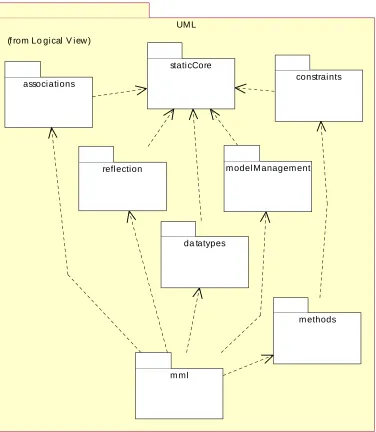
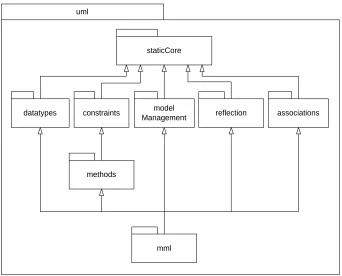
Figure 1 shows the various language components from which MML is constructed. Each of these is described in detail in Chapter 4. The arrows are intended to represent generalisation between packages. StaticCore generalises associations,
reflection etc. Our preference would have been to use the normal UML inheritance
[image:26.595.127.503.157.589.2]arrow, but we have been constrained by what is possible in Rational Rose. Generalisa-tion between packages is similar to generalisaGeneralisa-tion between classes. If one thinks of a class as a container, in the sense that it contains attributes, methods and so on, then in a class generalisation relationship, the child must contain everything that the parent con-tains, but is allowed to specialise any of its components in a behaviourally conformant manner, and include new components. Similarly for package generalisation, except that packages contain classes and associations, instead of attributes and methods. We also
Figure 1. The components of MML
UML
(f rom Lo gical V iew )
staticCore
constraints associations
da tatypes reflection
m ethods
m ml
allow renaming on generalisation (for packages and classes). Every model element has a name, and a model element can be specialised by changing its name. An example of renaming in use is given in Chapter 5.
All the language components are contained in the package UML. So, as well as con-taining classes and associations, packages can contain other packages.
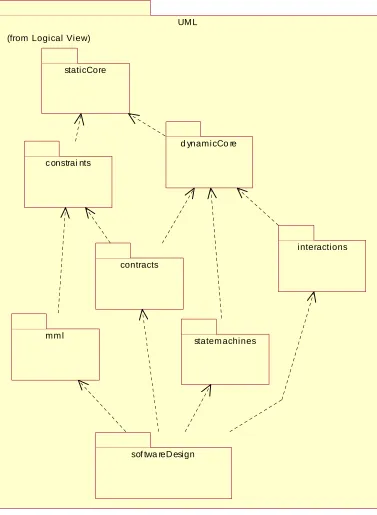
[image:27.595.94.471.186.701.2]Figure 2 shows how another family member for UML could be constructed, this time a language for software design. One can see how new components to handle the dynamic aspects are introduced, which specialise and extend components used for MML. In
Figure 2. A language for software design
UM L
(from Logical View)
sof twa reD esign contracts
mm l
interactions d ynamicCo re
c onstrai nts staticCore
Language aspects
addition, the language for software design must include all the features of MML itself, as these provide all the facilities for static modeling.
Of course there are likely to be many other family members: languages for modeling business processes, for modeling software design processes, which may be a speciali-sation of the language for modeling business processes, for modeling real-time sys-tems; then languages for modeling in specific domains such as telecoms, health, automotive industry, and so on. We expect that all of these can be defined in a similar manner.
3.3. Language aspects
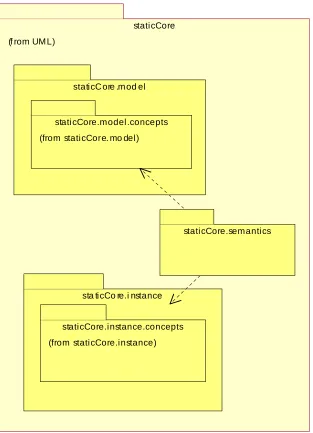
Figure 3 illustrates how a language component is broken down into a model and instance aspect, where semantics is a mapping between the conceptual aspect of each.
[image:29.595.118.431.127.560.2]Semantics mappings are examined more closely in Chapter 4.
Figure 3. the components of staticCore
staticCore
(f rom UM L)
staticC ore .m od el
sta ticCo re.i nstance
staticCore.semantics staticCore.model.concepts
(from staticCore. mo del)
staticCore.instance.concepts
Language aspects
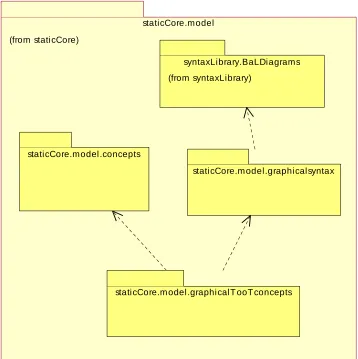
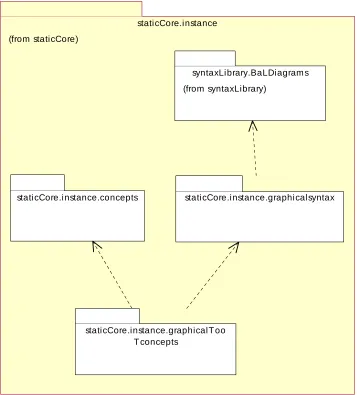
[image:30.595.133.491.145.504.2]Figure 4 and Figure 5 shows that both model and instance aspects can be broken down into syntax and concepts aspects. This may seem odd for instances, until one considers that an object diagram is just a syntax for the concepts of object, link, etc.
Figure 4. Components of staticCore.model
staticCore.model
(from staticCore)
staticCore.model.concepts
syntaxLibrary.BaLDiagrams
(from syntaxLibrary)
staticCore.m odel.graphicalsyntax
The mapping between syntax and concepts is given by a syntaxTooTconcepts package. Where syntax my be a graphical syntax, xml etc. Syntax mappings are examined more closely in Chapter 5.
We haven’t shown the full contents of either staticCore.instance or staticCore.model, as there are likely to be other syntaxes that will be defined. Thus in Chapter 5, both graph-ical and xml syntaxes are defined for staticCore.model.
3.4. Extending a language component
So what happens to the sub-components when a language component is extended? The definition of generalisation tells us that by Figure 1, for example, modelManagement
must contain the components of staticCore, that is it must also have model, instance
and semantics packages, and, further, that these are still broken down into syntax (pos-sibly more than one), concepts and the mappings between them. In the
modelManagement package we are at liberty to further specialise the components
inherited from staticCore. Numerous examples of language extension can be found
[image:31.595.106.463.89.484.2]in subsequent chapters.
Figure 5. Components of staticCore.instance
staticCore.instance
(from staticCore)
staticCore.instance.concepts staticCore.instance.graphicalsyntax syntaxLibrary.BaLDiagram s
(from syntaxLibrary)
Summary
3.5. Summary
This chapter has overviewed a collection of packages representing part of the UML family of languages. It has shown how UML can be constructed incrementally using package generalisation (specialisation) and how a clear separation between the differ-ent aspects of a language definition can be maintained. Subsequdiffer-ent chapters add detail to some of the packages presented here.
Introduction
Chapter 4
The Meta-Modeling Language, MML
This chapter presents a precise meta-model description of the meta-modeling language, MML.
4.1. Introduction
The purpose of this chapter is to present a precise description of the semantics of the Meta-Modelling Language (MML). As outlined in the previous chapter, the description consists of a meta-model of the semantics of MML written using the MML itself.
[image:34.595.150.492.360.636.2]The components of the MML are shown in Figure 6. In order to make the definition of the MML manageable and understandable, a layered, pluggable architecture has been adopted. Packages are used to separate out different concepts of the language. Package extension is then used to combine and extend upon these concepts in a logically con-sistent way, resulting in the complete MML definition.
Figure 6. Components of the MML
A brief description of the purpose of each package is described below.
staticCore: fundamental object-oriented constructs for describing the static compo-nents of MML. It includes classifiers, classes, attributes, instances, objects and slots.
staticCore
datatypes model reflection Management
uml
constraints associations
methods
This package provides the basic semantic structures and concepts from which all other parts of the MML are extended.
datatypes: a package of UML data types, including basic data types such as integers and strings. It also includes collection types, such as sets, sequences and bags.
constraints: constructs relating to the expression of constraints. It defines a constraint language for MML that is similar to OCL, but which has a precise meta-model seman-tics.
methods: a definition of static methods. A static method has parameters and a return type, but no side effects.
model management: general mechanisms for managing collections of MML con-structs. The primary mechanism provided is package extension (package specialisa-tion).
reflection: a definition of meta-levels and meta-instances. It provides a precise defini-tion of what it means for a model to be a meta-instance of another model, a pre-requi-site for allowing reflection in the MML.
associations: contains a definition of MML associations.
mml: merges all the components of MML into a single package.
As described in the previous chapter, each component of the MML is further divided into a strict pattern of syntax, concepts, instance and semantics packages. The concepts package describes the modelling concepts of the component, and the instance package describes the semantic domain of the modelling concepts. A mapping from each con-cept to its semantic domain is given in the semantics package, which extends both packages. Finally, the syntax package maps syntactical constructs (boxes, lines, etc.) to concepts.
The remainder of this chapter gives a detailed description of the contents of these ages, thus providing a definition of the semantics of MML. Details of the syntax pack-ages are left until a later chapter.
4.2. staticCore
The static core package describes the fundamental static modelling constructs required to build MML models. It provides a general framework for extending MML with new model elements, including plug in-points for extension and useful meta-modelling pat-terns.
staticCore
Figure 7. core package
4.2.1 core.model.concepts
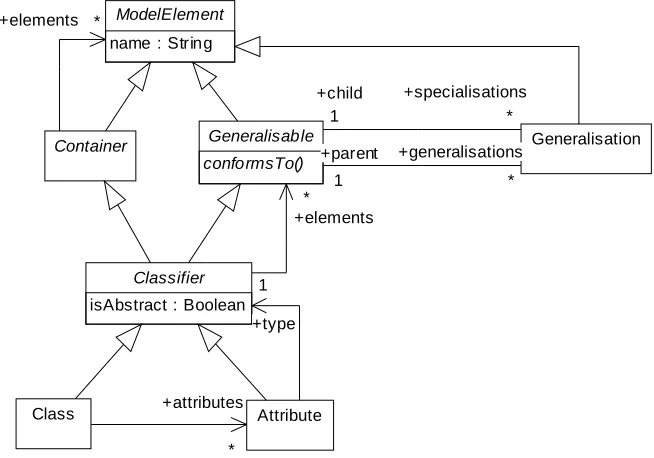
The model concepts package of the core is shown in detail in Figure 8. The purpose of this package is to provide an abstract classification hierarchy within which the model-ling elements of MML can be ‘plugged’. Briefly, it consists of the following classes:
ModelElement: All components of a model are model elements. Every modelling element has a name.
Container: Many modelling elements contain other modelling elements.This pat-tern is defined by the class container.
Generalisable: The generalisable class captures the notion of an extension rela-tionship between model elements. A generalisation is a named link between a gener-alisable element and its parents/children.
Classifier: a generalisable, container of model elements, which captures the notion of a collection of instances. A classifier represents a fundamental pattern of features and properties which are shared by any model element in MML whose purpose is to classify properties of a model.
In addition, two important concrete (i.e. non-abstract) elements of the MML are defined in the staticCore. Classes are denoted as classifiers (they are named and are generalisable and instantiable). Classes also contain attributes. An attribute has a name, and a type, which is a classifier. Attributes are also classifiers, and are viewed as con-taining their types.
Note, that in the MML, attributes do not have multiplicities. Instead, their type indi-cates whether they are multi-valued or not (see section 4.3.1). This aims to provide a less restrictive and more coherent way of expressing attribute values, which is more appropriate for OCL.
semantics core
instance
concepts syntax
syntax2concepts syntax concepts
Figure 8: core.model.concepts Package
Well-formedness rules
The following well-formedness rules apply to the static abstract syntax package:
[1] No two elements belonging to a container can have the same name:
context uml.staticCore.model.concepts.Container inv: elements -> forall (e1 |
elements -> forall (e2 |
e1.name <> e2.name implies e1 <> e2))
[2] Circular inheritance is not allowed.
context uml.staticCore.model.concepts.Generalisable inv: not(self.allParents()->includes(self))
[3] The parents of a generalisable element must be of the same type.
context uml.staticCore.model.concepts.Generalisable inv: parents() -> forall(p | p.type() = self.type())
Note, the definition of the method type() is given in Section 4.7.4.
[4] A generalisable element must conform to its parents.
context uml.staticCore.model.concepts.Generalisable inv: parents() -> forall(g | self.conformsTo(g))
Generalisable must set up an extensible constraint that must hold between a parent and child. This is done via an abstract method 'conformsTo' that all generalisable elements must provide. This allows specific sub-classes of Generalisable to define their own conformance rules.
ModelElement
name : String
Container * +elements * Class Generalisation Attribute * +attributes * Generalisable conformsTo() 1 * +parent 1 +generalisations * 1 * +child 1 +specialisations * Classifier
staticCore
[5] The elements of a class contain its attributes.
context uml.staticCore.model.concepts.Class inv elements->exists(g |
g.name = "attributes" and g.elements = allAttributes())
Note that because a class is a container, it is necessary to state an invariant which links each of its contained elements (in this case attributes) with those of the inherited asso-ciation ‘elements’. Furthermore, if it is desirable to add further contained elements, a classifier must be used as a intermediate container for elements of each type. Other-wise, it will not be possible to distinguish between different contained elements which share the same type. For example, a class will be further extended by a variety of fea-tures such as methods and constraints. Thus, we distinguish between these by associat-ing a class’s elements with named containers, each of which contains the appropriate elements.
[6] The elements of an attribute contain its type.
context uml.staticCore.model.concepts.Attribute inv: elements->size = 1 and
elements->exists(g | g.name = "type" and g.elements = Set{type})
Methods
The method parents() returns a set containing all the direct parents of a generalisable element.
context uml.staticCore.model.concepts.Generalisable parents() : Set(Generalisable)
self.generalisations -> iterate(g set = Set{} | g.parent)
The method allParents() returns a set containing all parents of a Classifier, excluding the Classifier itself.
context uml.staticCore.model.concepts.Generalisable allParents() : Set(Generalisable)
self.parents()->union(parents()->iterate(parent set = Set{} | set->union(parent.allParents())))
The method allContents() is an abstract method that is inherited by all classifiers. It returns the set of all elements of the classifier, including those of its parents.
context uml.staticCore.model.concepts.Classifier allContents() : Set(Classifier)
elements->union(parents()->iterate(parent contents = Set{} | contents->union(parents().allContents())))
The method allAttributes() returns the set of all attributes of Class, including those of its parents:
uml.staticCore.model.concepts.Class allAttributes() : Set(Attribute) parents->iterate(p s = attributes |
s->union(p.allAttributes()->reject(c |
Duplicate attributes from multiply inherited classes are removed non-deterministically.
The methods conformsTo(c) defines what it means for a Classifier to conform to its parents:
uml.staticCore.model.concepts.Classifier conformsTo(g:Generalizable):Boolean if self = g then true
else
if g.isKindOf(Classifier) then
if self.allParents()->includes(g) then g.elements->forAll(e1 |
elements->exists(e2 | e1.name = e2.name and e2.conformsTo(e1))) else false
endif else false endif
endif
A classifier defines the essential conformance constraint via a definition of the inher-ited method 'conformsTo'. Two classifiers conform when the sub-classifier defines model elements with the same name as the super-classifier and when the corresponding elements conform. Note that it does not matter whether the elements under test are con-tainers or atomic model elements, as it can be relied upon that the elements of a classi-fier are generalisable and therefore comparable.
4.2.2 core.instance.concepts
[image:39.595.200.367.552.746.2]The instance.concepts package (see Figure 9) describes the semantic domain of the concepts in the core.model.concepts package. By semantic domain, it meant the mini-mal set of concepts that can be used to describe the meaning of the concepts in the model.concepts package.
Figure 9: core.instance.concepts Package
InstanceElement name : String
Object Slot
* +slots
*
I nstance satisfies() 1
+value
1 *
staticCore
An instance is a named instance element. An instance represents a fundamental pattern of features and properties which are shared by any instance in MML whose purpose is to classify properties of a model instances.In particular, it describes the fact that many instances contain other instances, and that instances satisfy the property of their classi-fiers.
Object and slot are fundamental concrete instances. An object contains slots, which have values.
Well-formedness rules
[1] The elements of an instance have unique names.
context uml.staticCore.instance.concepts.Object inv: elements -> forall(e1 |
elements -> forall(e2 |
e1 <> e2 implies e1.name <> e2.name))
[2] An object contains its slots.
context uml.staticCore.instance.concepts.Object inv: elements->exists(g |
g.name = "attributes" and g.elements = slots)
[3] A slot contains is its value.
context uml.staticCore.model.concepts.Slot inv: elements->size = 1 and
elements->exists(g | g.name = "type" and g.elements = Set{value})
4.2.3 core.semantics
The core.semantics package (Figure 10) imports all the constructs of Figure 8 and Fig-ure 9. It associates classifiers with the valid set of instances that they may classify. Here, the association is further subclassed to restrict slots to being instances of attributes, and objects as instances of classes.
Figure 10: core.semantics Package Instance Classifier
* 1
+instances
* +of
1
Object
Class +of +instances
Slot
Well-formedness rules
The following OCL expressions precisely describe the constraints that relate model to instance concepts.
[1] An instance must satisfy the properties of its classifier.
context uml.staticCore.semantics.Instance inv: self.satisfies(self.of)
[2] Abstract classifiers cannot be instantiated.
context uml.staticCore.semantics.Classifier inv: isAbstract implies self.instances -> isEmpty
Methods
The method satisfies(c) defines what it means for an instance to satisfy the structural properties of a classifier.
context uml.staticCore.semantics.Instance inv: satisfies(c : Classifier) : Boolean
if self.of = c then
of.allContents() -> forall(e1 | self.elements -> exists(e2 |
e1.name = e2.name and e2.satisfies(e1))) else false
endif
An instance defines the essential satisfaction constraint via a definition of the inherited method 'satisfies'. An instance satisfies the properties of a classifier if, it is an instance of the classifier, and, for every element of the classifier, there exists an element of the instance such that the name of the instance element equals the name of the classifier element, and the instance element satisfies the classifier element.
The staticCore package is designed to ease the definition of new types of modelling element and their instances. In general, new types of element will be generalisable and will act as containers. Modelling elements may be defined as extensions of the existing classes, for example adding class features by extending Class with a new generalisable container. Alternatively, new types of modelling element may be defined, for example state transition machines or collaboration diagrams. Each new type of modelling ele-ment may take advantage of the standard patterns by extending Generalisable and/or Container. New sub-types of Generalisable should specialise the 'conformsTo' method so that it defines how to compare two instances of the new type. New sub-types of Container should define an invariant describing how 'elements' is structured. Finally, new sub-types of Instance should specialise the ‘satisfies’ method so that it defines how to compare instances against the model elements that they are an instance of.
It is possible to identify a number of steps that can be followed when adding new model elements to the MML. Briefly, these are as follows:
datatypes
2. if so, subclass the model element as a classifier in the model.concepts package;
3. constrain the model element’s contents to be those of the attribute ‘elements’;
4. in the instance.concepts package, identify or add a new instance subclass which is an instance of the classifier;
5. in the semantics package, link them by subclassing the ‘of/instances’ association;
6. for each element of the new model element repeat steps 4-5;
7. determine any dependencies between instances and their elements, and specify these using appropriate constraints.
Note, in future versions of the MML it is intended to generalise the staticCore package further still. This will involve constructing packages of appropriate meta-modelling patterns (container/containable, instantiable/instance, and so on) and then defining con-crete MML classes to be ‘mix-ins’ of the various patterns. As more experience is gained in extending MML with new model elements, an appropriate set of patterns will no doubt become identifiable.
4.3. datatypes
[image:42.595.228.399.444.700.2]In this section, we extend the core model with data types. The extension is described by the datatypes package (see Figure 11). It extends the model, instance and semantics packages of the core. We follow the guidelines in the previous section to ensure that the extension satisfies the minimal semantic properties of model and instance concepts.
Figure 11: datatypes Package
core
instance
semantics model
semantics
instance model
4.3.1 datatypes.model.concepts
[image:43.595.106.426.193.438.2]The contents of the datatypes.model.concepts package is shown in Figure 12. It intro-duces a new classifier, the data type. Datatypes include primitive built-in types (such as integer and string). In addition, a collection datatype is introduced to represent the basic built-in collection types of the MML (sets, sequences and bags).
Figure 12: datatypes.model.concepts Package
There can only be one classifier representing a boolean, string, real or integer data type, and this is denoted by defining each data type as being an ‘instance’ of datatype (a def-inition of what it means for a class to be an instance of another class is given in section 4.7.4). Collections are parameterised by the type of classifier that they can contain. Finally, integers are subclasses of real datatypes, as integer values are also real values.
Well-formedness rules
[1] A collection contains its elementtype
context uml.datatypes.model.concepts.Collection inv: elements->size = 1 and
elements->exists(g | g.name = "elementtype" and g.elements = Set{elementtype})
4.3.2 datatypes.instance.concepts
The Datatypes.instance.concepts package is shown in Figure 13. For each type in the datatype.model.concepts package, a corresponding datatype value is included in the package. For example, a boolean is represented by a boolean value, which may be true or false. Collection values contain elements, i.e. objects or datavalues. In the case of
DataType
Set Sequence Bag
Boolean String Real Integer
Classifier
Collection
1 +elementtype
datatypes
[image:44.595.126.521.125.465.2]sequence values, an index is associated with each element in the sequence, while a count is associated with each element in a bag value.
Figure 13: datatypes.instance.concepts Package
Well-formedness rules
[1] A sequence value with n elements, will have 1..n index values.
context uml.datatypes.model.instance.SequenceValue inv: index -> forall(i1,i2 |
i1 <> i2 implies i1.value <> i2.value) and index -> iterate(x set = Set{} |
set -> union(x.value)) = 1..(index -> size())))
[2] A set value contains are its instances.
context uml.datatypes.instance.concepts.SetValue inv: elements->exists(g | g.name = "elementtype" and
g.elements = elements)
[3] A sequence value contains its instances.
context uml.datatypes.instance.concepts.SetValue inv: elements->exists(g | g.name = "elementtype" and
g.elements = index -> iterate(e set = Set{} | set->union(e.elements)))
DataValue
BooleanValue value : boolean
StringValue value : String
RealValue value : Real
IntegerValue value : Int eger
CollectionValue
BagValue Set Value
Count value : Integer
* +count
* SequenceValue
Instance
(f ro m s ta ti cCo re.i nst anc e.conc ept s)
* +elements * 1 +element s 1 Index value : Int eger
* +index *
1
A similar definition is required for a bag value.
The datatypes.semantics package extends the datatypes.model.concepts and
[image:45.595.120.417.179.530.2]datatypes.instance.concepts packages. It associates datavalues with datatypes by sub-classing the instances association (see Figure 14).
Figure 14. datatypes.semantics Package
Well-formedness Rules
[1] Collection values contain elements that satisfy their collection’s element type.
Inherited from Instance
Because the elements of both datatypes and data values have been defined above, the satisfies method will ensure that every element of a collection value will be an instance of the type of its collection.
DataValue DataType
(fro m d a ta typ e s.mo d e l .co n ce p ts)
* 1
+ instanc es * + of
1
Bo olea nValue valu e : B oolean B oolean
* 1
+ ins tances * + o f
1
S tringV alue value : String S tr ing
* 1
+ instanc es * + of
1
RealV alue value : Real Real
* 1
+ instanc es * + of
1
IntegerV alue val ue : Int eger Integer
* 1
+ instanc es * + of
1
SetValue
(fro m d a ta typ e s.i n sta n ce .co n ce p ts)
Set
(fro m d a ta typ e s.m o d e l .co n ce p ts)
* 1
+ ins tances * + of
1
SequenceV alue
(fro m d a ta typ e s.i n sta n ce .co n ce p ts)
Sequenc e
(fro m d a ta typ e s.m o d e l .co n ce p ts)
* 1
+ instanc es * + of
1
B agValue
(fro m d a ta typ e s.i n sta n ce .co n ce p ts)
Bag
(fro m d a ta typ e s.m o d e l .co n ce p ts)
* 1
+ ins tances * + of
constraints
4.4. constraints
In this section, the syntax and semantics of the constraint language provided by the MML are presented. The language is based on the Object Constraint Language (OCL) with the exception of one or two semantic changes that have been added in response to agreed changes at the Kent OCL workshop [uok 2000].
The constraints package extends the data types package in the normal way - each con-straints.model.concepts, constraints.instance.concepts and constraints.semantics pack-age extends the corresponding data types packpack-age.
4.4.1 constraints.model.concepts
The MML constraints.model.concepts package provides all the basic language expres-sions of OCL. These include logical expresexpres-sions (and, not, equals, includes), slot refer-ences, variables and iterations. Note that all other constructs of the language, for example or, collect, set union, can be easily defined in terms of the basic expressions defined here. These will be added at a later date.
The abstract syntax of the language is described the constraints.model.concepts pack-age shown in Figure 15.
Figure 15: constraints.model.concepts Package
Associated with every classifier is an invariant. An invariant is a set of named con-straints. Each constraint is expressed as an expression. An expression has a resulttype and is associated with a set of local variables - its environment.
Iterate variable : Variable initial : Exp collection : Exp body : Exp
And
SlotRef slotname : String obj : Exp
Not
BinaryLogicalExp x, y : Exp
Includes Equals
UnaryLogicalExp x : Exp
Well-formedness Rules
[1] A classifier contains its constraints.
context uml.constraints.model.concepts.Classifier inv: elements -> exists(g |
g.name = "invariant" and
g.elements = allConstraints())
The following constraints set up the contained elements of expressions to include vari-ables, sub-expressions, and expression type.
[2] An expression contains its variables and resulttype.
context uml.constraints.model.concepts.OCLExp inv: elements ->
(exists(g | g.name = "variables" and g.elements = vars) and
exists(g | g.name = "resulttype" and g.elements = resulttype))
[3] A binary expression contains the expressions, x and y.
context uml.constraints.model.concepts.BinaryExp inv: elements ->
(exists(g | g.name = "x" and g.elements = x) and
exists(g | g.name = "y" and g.elements = y))
[4] A unary expression contains the expression, x.
context uml.constraints.model.concepts.UnaryExp inv: elements ->
exists(g | g.name = "x" and g.elements = x)
Similarly for SlotRef, Variable and Iterate expressions, etc.
The following constraints ensure that variables are propagated to sub-expressions.
[1] And propagation.
context uml.constraints.model.concepts.And inv: self.x.env = self.env and self.y.env = self.x
[2] Not propagation.
context uml.constraints.model.concepts.Not inv: self.x.env = self.env
[3] Includes propagation.
context uml.constraints.model.concepts.Includes inv: self.x.env = self.env and self.y.env = env
[4] Equals propagation.
constraints
[5] Slot reference propagation.
context uml.constraints.model.concepts.SlotRef inv: self.obj.env = self.env
Finally, constraints are required to ensure that each expression is associated with an appropriate resulttype.
[1] Binary and Unary expressions return a Boolean Value.
context uml.constraints.model.concepts.BinaryExp inv: self.resulttype -> isKindOf(Boolean)
context uml.constraints.model.concepts.Un