The practice of physiotherapy : Theoretical and contextual
reflections.
ROBERTS, Penelope A.
Available from Sheffield Hallam University Research Archive (SHURA) at:
http://shura.shu.ac.uk/20795/
This document is the author deposited version. You are advised to consult the publisher's version if you wish to cite from it.
Published version
ROBERTS, Penelope A. (2000). The practice of physiotherapy : Theoretical and contextual reflections. Doctoral, Sheffield Hallam University (United Kingdom)..
Copyright and re-use policy
viz::
(xd-s
ProQuest Number: 10702898
All rights reserved
INFORMATION TO ALL USERS
The quality of this reproduction is dependent upon the quality of the copy submitted.
In the unlikely event that the author did not send a com plete manuscript and there are missing pages, these will be noted. Also, if material had to be removed,
a note will indicate the deletion.
uest
ProQuest 10702898
Published by ProQuest LLC(2017). Copyright of the Dissertation is held by the Author.
All rights reserved.
This work is protected against unauthorized copying under Title 17, United States C ode Microform Edition © ProQuest LLC.
ProQuest LLC.
789 East Eisenhower Parkway P.O. Box 1346
The Practice of Physiotherapy:
Theoretical and Contextual
Reflections.
Penelope Anne Roberts
A thesis submitted in partial fulfilment
of the requirements of Sheffield Hallam
University for the degree of Doctor of
Philosophy
School of Health and Social Care,
Sheffield Hallam University
u 3 fx - ^
s W. cV
Dedication
This thesis is dedicated to
Peter, Joanna and Andrew and
all those of an enquiring mind
who struggle to make sense of
Acknowledgements
The Department of Health and Social Security awarded me a Research
Tranining Fellowship which funded the first two years of this work and enabled
me to carry out the fieldwork. I would like to acknowledge this support without
which this work would not have been started. However, this thesis would never have been written without the support of a great many people. Dr Pat
Lyne provided guidance in the early stages and helped me towards an
understanding of the research process; Professor Gerry Larkin has been an erudite and challenging supervisor who has always seemed to understand
where I wanted to go; Thelma Turner and North Derbyshire Health Authority encouraged and supported me with study leave and financial help; many
colleagues in practice, education and on CSP Council allowed me to bend their ears and grapple with some difficult issues; many others pointed me in
useful directions; Dr Diana Daltrey has encouraged me and granted me study
leave to complete this work; I owe a lot to all these people, but above all of them one person stands out. I would like to acknowledge the tireless support
of Professor Anne Parry, without whom this thesis would never have been
started, or completed. She never gave up on me and walked the extra mile whenever I was flagging. Whether this work is worthy of all that has been put
into it is not for me to judge. It is mine, mistakes and all, and all I can say is thank you Anne for being there.
Contents
1. Introduction
1.1 The Practice of Physiotherapy 1.2 Practitioner Research
1.3 The Building Blocks of the Thesis 1.4 Objectives
2. Background
2.1 The Organisation of Physiotherapy
2.2 The Origins of the Professional Body
2.3 Physiotherapy and its Relationship to Medicine
2.4 Education, Specialities and Specialisms
2.5 The Development of Medicine and Physiotherapy
2.6 Medicine and Society
3. Methodology
3.1 Methodology and Personal Perspectives
3.2 Naturalistic Design
3.3 Triangulation
3.4 The Emerging Design 3.5 The Research Process
4. Fieldwork Findings
4.1 Observations from Stage 1 Interviews
4.2 Observations from stage 2 interviews
4.3 Discussion
pages 1-14
pages 15-61
pages 62-101
5. Models of Health Care
5.1 The Biomedical Model 5.2 The Economic Model5.3 The Behavioural Perspective 5.4 The Materialistic Perspective
5.5 The Geographical Perspective
5.6 The Social Model 5.7 Holism
5.8 Discussion
6. Discussion
Conclusion
7.1 Introduction7.2 Strong professional identity
7.3 Relevant knowledge base 7.4 Existing models
7.5 New relationships
7.6 A paradigm shift
References
pages 137-160
pages 161-168
pages 169-192
pages 193 -206
Figures
Figure 1, page 2
How and where the three strands of the thesis are presented.
Figure 2, page 3
How the data from different sources were used to deveiop the theoretical framework.
Figure 3, page 62
Diagrammatic representation of the relationship between question formulation, use of findings, data collection and literature reviews.
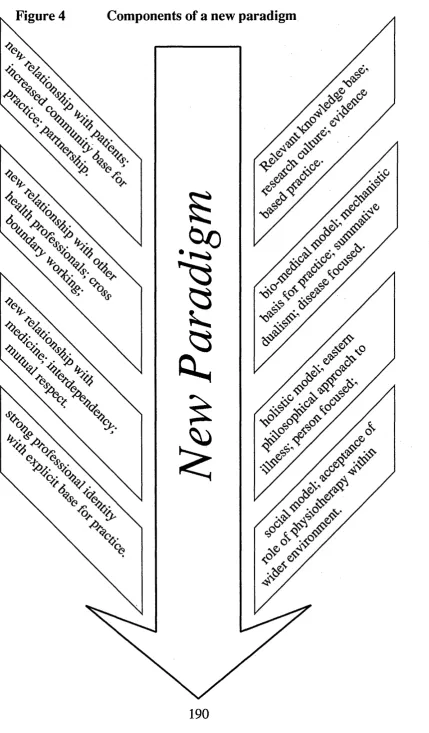
Figure 4, page 190
Appendices
Appendix A. Letters agreeing co-operation with study.
Appendix B. Example of notes from a field visit.
Appendix C. Example of, and instructions for, filling in diary sheet.
Appendix D. Examples of completed diary sheets.
Appendix E. Example of collation of data from diary sheets.
Appendix F. Examples of interviews with physiotherapy and nursing staff.
Appendix G. Definitions of Physiotherapy 1974 -1996
Abstract
This thesis is an examination of the practice of physiotherapy, an exploration of the
context within which the profession of physiotherapy developed and an identification of the theoretical frameworks within which it is practised. The experiences of
physiotherapists and nurses working in particular settings at a specific point in the
development of the profession provided a starting point for the study. Physiotherapy, a profession openly dependent for a significant part of its history on medicine for its
practice and knowledge base, is contextualised with reference to the development of a
medical hegemony, the changing role of women in society, and the development of specialisms within physiotherapy.
A methodological framework was developed through the use of a naturalistic design which places the researcher within the study and legitimises personal perspectives.
Knowledge of the field prior to the study, fieldwork observations, and findings from two sets of interviews generated the data which provided the framework for an
exploration of the theoretical base for the practice of physiotherapy.
The thesis concludes by examining the components of context and theory which are
fundamental to the practice of theory, and places them within a new framework. This
new framework or paradigm is based on a re-evaluation of the concept of holism and goes back to the origins of this model which developed amidst the chaos of post-Boer
was South Africa. The meaning of holism has been changed to make it nearer the concept of summative dualism which fits well with key concepts of balance, harmony
and homeostasis. True holism is about movement and change and this is proposed as
1. INTRODUCTION
Physiotherapy is a profession which has developed under the influence of a range of factors and which continues to respond to external and internal drivers. Both the context of practice and the content of physiotherapy are continually changing and the debate about whether there is a recognisable set of skills that can be labelled
physiotherapy, or whether physiotherapy is what physiotherapists do, is one which has gone on ever since there were practitioners of the art and science of physiotherapy. Pany (1995) averred that she could not identify a profession that had a "less certain grip on its own identity". More recently the debate about what physiotherapy is has moved from the examination of a set of skills or techniques to an attempt to identify a body of knowledge unique to the practitioners of those techniques and separate from other disciplines such as medicine. (Pany 1991; Richardson 1993; Roberts 1994). The importance of identifying this body of knowledge has been stressed by many, including Higgs and Titchen (1995).
The profession of physiotherapy has many roots and branches. Some of its roots, such as massage and exercise, can be traced back to the baths and gymnasia of ancient Greece and Rome, and China 3000 years BC (Barclay 1994); some of its branches are taking physiotherapy into new areas such as the physical and psychological assessment of exposure to different occupations (Frontline 1997). The history of the profession is that of an eclectic movement, deriving its practices from a range of sources and with no attachment to a particular set of philosophies or beliefs. It is essentially a pragmatic profession - "dealing with matters with regard to their practical requirements or
consequences." (Concise Oxford Dictionary 1990).
This thesis is an exploration of the practice of physiotherapy, its attempts to establish a theoretical base, and the effect of the contextual issues which frame it. It is an
Figure 1
How and where the three strands of the thesis are presented
CM
C
O
t/J
W)
CZ
J
C
O
on
co
O
rH
C
O
on
£
*5
5
■si
^
P
h
o
co
P
h
J
h
p
H
[image:14.613.84.734.91.441.2]How the data from different sources were used to develop the theoretical framework
Data from pre-study/prior ethnography/tacit
knowledge
Data from Stage
1 interviews Data from pilotof diary sheets
Data from Stage
2 interviews observationData from
Analysis of literature on
models
Methodology literature review
Contextual analysis
practice, chose to operate under the patronage of medical men within hospitals and is now emerging as an independent, or quasi-independent profession, working in a variety of settings in response to changing social and political demands.
There are three main strands to the thesis. One is an exploration of the social, historical and political contextual issues which have influenced the way in which physiotherapy has been practised over the last decade, the second an examination of the clinical practice of physiotherapy in two specific settings, and the third the
identification of theories used by physiotherapists to explain their practice. (Figure 1)
Fieldwork carried out over several months in 1987 provided a picture of the clinical practice of a group of physiotherapists at a particular time and in particular places. From the extremely rich and varied data generated by the fieldwork, a framework for the exploration of the theoretical and contextual issues that surround the practice of physiotherapy was built. The data from that fieldwork is presented as the foundation for the development of the theoretical framework of the thesis. The themes that emerged from that period of the study informed the development of the theoretical framework and are reflected throughout the analysis of a range of issues, theoretical and contextual, pertinent to the practice of physiotherapy. (Figure 2).
The historical, social and political context in which physiotherapy, and indeed all health care, is delivered is examined, with the key features being the emergence of an organised female profession able to articulate its history, women's role in society and in particular in the world of medicine, the organisation of health care delivery - the development of hospital based medicine, the NHS reforms of the 1990s, and more parochially the issue of the regulation of the physiotherapy profession through state registration in 1960 and beyond.
The government reforms of the 1990s in particular had a massive impact on the way physiotherapy is delivered. The shift of resources and control to doctors in primary care, the decision to provide more services, particularly for elderly people, in
community settings rather than in hospitals, and the split of health care provision into purchaser and provider components, are manifestations of the revolution that has swept across health during this decade. Physiotherapy has not been exempt from its effects, and the changing context is examined in the light of its impact on the practice of physiotherapy.
The story of the changing nature of physiotherapy education, and in particular the impact of the move into institutions of higher education, is told as an example of the influence of context on the development of a profession, control over the process and content of education being an important part of professional identity. The evolution of specialisms is explored to illustrate the influence of theory on the unfolding practice of physiotherapists and the tensions created by an inadequate theoretical base.
The strength of this thesis lies in its multiple levels of exploration - both
methodologically and contextually. Methodologically the design emerged from within the thesis and was generated concurrently with the analysis of the findings.
professions, notably medicine and nursing, and from analysis of models of health care, created the context for an examination of physiotherapy practice. (Figure 2).
1.1 The Practice of Physiotherapy
The research process began with an examination of the clinical practice of
physiotherapy within particular settings and it was from the data produced during the fieldwork that the thesis developed. The impetus for it came from a desire to explore issues arising from work done with elderly patients in two health authorities and this provided the setting for an examination of the practice of physiotherapy. During the time spent working as a clinical physiotherapist in these two hospitals the varying nature of the relationships between physiotherapists and nurses and an apparent effect of this relationship on patient care was noted. Specifically it was observed that physiotherapists working on wards for the elderly relied heavily on nursing staff both qualified and unqualified, for referrals.
Consultant medical staff at both hospitals gave 'blanket referral', that is they considered the physiotherapy staff to be clinically and managerially responsible for deciding who needed physiotherapy treatment. While most physiotherapists welcomed this
A close working relationship with nursing colleagues was considered necessary by the physiotherapists to facilitate their therapeutic input. However, marked differences were noted in the way nursing staff reacted to physiotherapists. Many were openly hostile and appeared to resent the involvement of both physiotherapists and
occupational therapists in patient care. Others welcomed additional professional expertise and did not appear to feel threatened by other practitioners wanting to work closely with them. It was felt at this stage that nurses at the two different hospitals held markedly different attitudes towards cooperating in a multi-disciplinary delivery of care and that this was largely dependent on where they worked. Several reasons for these different attitudes were considered at this stage.
There were different experiences of physiotherapy in each hospital; one had a long history of a well established physiotherapy service, the other did not. There were different working environments; in one hospital there was a small physiotherapy department attached to the geriatric wards which meant that patients received some of their physiotherapy off the ward and out of the nurses’ charge, in the other hospital there was no physiotherapy department and all treatment was done on the ward. There were different management strategies; physiotherapy management in one hospital was dynamic and the superintendent physiotherapist was determined to give the service a high profile and make it as effective as possible. In the other the service was part-time and managed from the acute hospital two miles away by a
superintendent physiotherapist who rarely visited the site. Nurse managers in one hospital appeared willing to work with physiotherapists to benefit the service to the patients; in the other it appeared that nurse managers were determined to prove they could manage without any paramedical input and that any friction was due to
personality clashes with individual therapists. These issues and their effect on the delivery of care to elderly people was the starting point for the fieldwork.
elderly people. There were two particular clinical areas of interest - continence promotion and the management of pressure sores. Incontinence and pressure sores were major problems for elderly patients and all those concerned in their care. These two clinical areas became a focus for questions relating to issues of physiotherapist- nurse interaction.
Although at this stage the emphasis of the study was intended to be on nurses' perceptions of physiotherapy it was thought that a preliminary stage would be to discover what physiotherapists themselves thought physiotherapy had to offer elderly patients. The thinking behind this was that it would be useful to document how physiotherapists described their practice as a precursor to documenting how others described it. It was this decision to move from an exploration of what nurses thought physiotherapists did to an examination of what physiotherapists thought they did that laid the foundation of the thesis.
The emphasis of the study at this stage was veiy much on care and how the
professional relationships between professionals working with the elderly affected the care received by patients. Various quality assurance measures, developed particularly for nursing, were examined to see if inter-disciplinary cooperation was a factor taken into account. While various professional groups were each evaluating the service they delivered, it did not appear that anyone was taking an overall view of the total care received by patients. Early objectives therefore included such phrases as "to describe aspects of quality of care offered to elderly patients..." and "to investigate
relationships between inter-disciplinary management of elderly patients and quality of care delivered."
However, as the study developed it became apparent that this was too large and
practice and the understanding of it held by physiotherapists and nurses. In order to make meaning of physiotherapy as a practical application of skills an understanding had to be gained of the mind set of the practitioners themselves.
"Human behaviour cannot be understood without reference to the meanings and purposes attached by human actors to their activities." (Guba and Lincoln 1994 pl06).
Results from the analysis of the fieldwork data showed that relationships between nurses and physiotherapists were poor in both settings. The usual explanation given was that there were 'difficult’ personalities and that this was the basis of disagreements. However, it appeared to be more deep rooted than that and analysis of the data showed that physiotherapists and nurses were using different conceptual models to determine their practice. Differences in these models within the same setting was leading to conflict in practice with a lack of understanding of the origins of the conflict. The conceptual models used were not profession specific but appeared to be determined by contextual issues. The next stage was therefore to examine the origins of these
models, particularly those relating directly to physiotherapy, and their effect on practice and on relationships with others. From the specifics therefore of the practice of physiotherapy in a particular setting, the research expanded to encompass the meanings given to the profession by its practitioners, their conceptual frameworks and the theoretical basis of physiotherapy.
1.2 Practitioner Research
In looking for a methodological approach to examine the issues described above the importance of using the involvement of the researcher as a strength rather than
challenges claims that research, like science, is intrinsically neutral. An approach was adopted therefore that recognised the importance of the stories people told, and
allowed the design to emerge during the process of the research.
One of the strengths of qualitative data is that it provides contextual information and overcomes the problems of the context stripping of the positivist approach. Research methods which are designed to exclude variables which, if included, might alter the findings are limited in their usefulness as the findings from them are only applicable to similarly contextually stripped situations. (Guba and Lincoln 1994). The advantages of close links therefore were felt to outweigh any potential and actual disadvantages.
Access was readily granted to the researcher and it seemed that an insider studying aspects of health care was not as threatening as an outsider. This clear identity as a physiotherapist also facilitated access to the previously employing health authority. It was seen as good for a physiotherapist to be studying aspects of care of elderly people at a time when the profession was realising the importance of improving its research base. Many of the professionals with whom negotiations were undertaken identified closely with the questions being asked in the study and all appeared to be of the opinion that these were important issues that should be made explicit.
not the norm. Having good knowledge and experience in the field enables the intuition of a practitioner to identity and prioritise issues and to select areas to be investigated. These are more likely to be considered important or relevant by other practitioners and to be of direct relevance to clinical practice.
As the study was so deeply rooted in practice it was seen as unnecessary and indeed
impossible for the researcher to adopt a new role for the period of the investigation.
As long as it was acknowledged that this was a piece of research into clinical physiotherapy by a physiotherapist then the potential disadvantages of observer bias
could be used to enhance the investigation.
Practitioner research, particularly involving participant observation, has its own inherent problems, ethical and practical, and is not a soft option. These were addressed throughout the study, particularly the fieldwork stage, and resolved with careful thought and consultation with participants. That they affected the fieldwork and its findings is undeniable. However, the value of an emergent design is that the lessons learnt from the process itself feed into the design and are part of the total picture instead of being something that distorts or warps the original methodology. Denzin and Lincoln (1994) describe the process of designing a qualitative research project as beginning with a socially situated researcher who moves from a research question to a paradigm or perspective and then into the empirical world. This is the model that best describes the approach adopted in this thesis.
1.3 The building blocks of the thesis
a clearer idea of what they termed 'models' of practice. Published literature on these nursing models was available and did not appear to be matched by anything in the physiotherapy literature. However, an examination of the roots of these nursing models identified underlying conceptual frameworks which illuminated health care in general and allowed physiotherapy paradigms to be explored. A significant part of the thesis therefore is the identification and examination of a range of models which impact on or explain the practice of physiotherapy. In particular, the tension between models which explain physiotherapy in mechanistic terms, viewing the human body as a machine subject to purely physical laws, and those which seek to explain human existence in metaphysical terms, is identified and examined.
Contextual issues which were identified as being important and relevant to the development of physiotherapy as a profession were examined and included in the thesis to provide a clear framework within which the practice of physiotherapy is placed. These include the role of women in society at a key point in the development of the hegemony of medicine, the origins of organised healthcare and its regulation. These strands of the thesis are clearly large enough to warrant theses in their own rights and are included here only in so far as they illuminate the practice of physiotherapy, not as independent studies.
The study progresses from the specifics of physiotherapy practice as identified in the fieldwork, through the examination of societal and political influences on the
development of the profession, into an exploration of the theory underpinning that practice. This showed a rapidly developing research base and a growing awareness of the importance of establishing sound theory to underpin physiotherapy practice. (Parry 1991, Richardson 1993, Roberts 1994, Parry 1995).
physiotherapy in their terms. Difficulties with this approach led to a search for explanations that were more firmly founded in the practice of physiotherapy. The drive to establish a credible body of knowledge has come from several sources - political with the call for evidence based practice and cost effectiveness, financial with competition between practitioners including the advent of state registration for
osteopaths and chiropractors, and academic with the move of physiotherapy undergraduate education into institutions of higher education. The thesis therefore addresses these issues in so far as they have influenced the development of
physiotherapy theory and affected the practice of physiotherapy.
The thesis deals with issues that are complex and interrelated. They are of necessity dealt with discretely but drawn together in the conclusion which identifies the
components of a new paradigm for physiotherapy. These components are those which the work undertaken has identified as being the key drivers for physiotherapy practice in the 21st century. They are focused around two key themes - new relationships between physiotherapists, patients and other health care professionals, and the acknowledgment and articulation of a range of theoretical models which currently underpin practice. Key to a new paradigm is holism, the exploration of which leads to the conclusion that this model for change could form a firm basis for the future of physiotherapy.
1.4 Objectives
1. To investigate physiotherapy practice and the understanding of it held by physiotherapists and nurses in particular settings.
2. To investigate the theoretical models available to and used by physiotherapists.
3. To investigate the contextual issues which have influenced the development and practice of physiotherapy.
4. To develop a methodology appropriate to the emerging study.
2. BACKGROUND
An investigation of issues of contemporary physiotherapy practice necessarily involves a study of the accounts of the history of the development of physiotherapy. This section describes that development, within the United Kingdom, and varying accounts of the origin of the profession. Physiotherapy's relationship with medicine is also examined in the light of the events leading up to the formation of the Chartered Society of Physiotherapy. The story of the push for specialisation within the profession and the development of clinical interest groups is then recounted to gain insight into some of the issues which have shaped the professional practice of physiotherapy.
2.1 The Organisation of Physiotherapy
The Chartered Society of Physiotherapy (CSP) is the professional association of Chartered Physiotherapists in Britain. The term professional association is used to describe the formal organisation of the practitioners of a profession (Carr-Saunders and Wilson 1933 cited Sim 1985). According to these authors the functions of a professional society are various and include controlling standards of entry to the profession through an examining and licensing system. Its existence therefore fulfilled one of what Sim (1985) claims to be the true criteria of a profession, that of selective entry. However the passing of the Professions Supplementary to Medicine Act (1960) significantly affected the control the CSP could exert.
in 1996 addressed the issue of protection of common title.
Up to the formation of the Council for Professions Supplementary to Medicine (CPSM) in 1960 the CSP controlled its own educational process; the setting up of the CPSM threatened this (Jones 1991). While retaining ultimate control the CPSM delegated its examining and licensing powers to a Joint Validating Panel made up of CSP and CPSM members. Jones (1991) however argues that through the CPSM, the setting up of which was welcomed by physiotherapists and other professionals involved, ultimate control of the physiotherapy curriculum by physiotherapists was lost. The Physiotherapy Board of the CPSM has nine physiotherapy members and eight non-physiotherapy members, but all decisions have to be ratified by the Council, where there is no physiotherapy majority, then by Privy Council.
In evidence to the Cope report (DHSS 1951) the Chartered Society of Physiotherapy had called for a ’Council for Physical Therapy’ similar in concept to the General
Nursing Council (Larkin 1983, Barclay 1994). This call was rejected and it is noted by Barclay (1994) that Captain Nathan, a private practitioner member, reproached
Council for its ineffectual dealings with the Ministry of Health. He claimed that Ministry officials:
’’regarded the CSP not as an important body with whom they were glad to confer, but as an irritating body who were always insinuating their imagined status in support of their arguments, and because of this ....were taking little heed of their submissions.”
(Barclay 1994 pi 64)
The Cope proposals were opposed by all those affected by it and their reactionary nature had the effect of uniting a disparate group of medical auxiliaries. They were eventually modified into what was to become the PSM Act (1960) which was a compromise. It gave physiotherapy the status of a profession supplementary to
medicine, more than the British Medical Association wanted, but less than physiotherapists had hoped for.
Growing dissatisfaction with the workings of the 1960 Act was targeted on two areas. One was the ineffectiveness of the legislation in dealing with unqualified practitioners in the private sector, anxieties exacerbated by the refusal of the government to prohibit the use of unregistered physiotherapists by fundholding General Practitioners. In 1981 a DHSS (1981) consultative document had been published which seemed to offer the opportunity to gain protection for the title physiotherapist. However the profession could not agree on whether it should go for closure of title or closure of function. (Barclay 1994). The other main complaint was that the disciplinary procedures of the CPSM were not adequate or appropriate to deal with an increasingly litiginous
population.
The refusal of the government to consider new legislation was undermined by a Bill proposing the setting up of the General Council and Register of Osteopaths in 1993, a move which led to renewed calls for an urgent revision of the Act that governed the practice of physiotherapy. As noted by Simon (1993) the CSP's attitude was generally welcoming to a statutory register for osteopaths but it was, he claimed, saddened that the Government was not prepared to give the same level of protection of title to physiotherapists.
"We will continue to press for revision of the 1960 Professions Supplementaiy to Medicine Act to bring
registration arrangements for PSMs into line with other health care professions. The Osteopaths' Bill strengthens our case." (Simon 1993 p6)
Faced with the prospect of nine separate professions calling for their own Act
The decision of a previously intransigent government firmly in favour of deregulation to commission a review should not be seen only as a reaction to the growing demands for revision by the professions concerned, in particular physiotherapy and chiropody. It was also an opportunity for the government’s own agenda for the professions allied to medicine to be effected. In return for protection of common title the professions were losing their autonomous Boards and being put under the control of an overarching Council which would have no single professional voice. Physiotherapy was being put together with professions as diverse as art and drama therapy, radiography and bio medical science. The existence of separate Councils for medicine, dentistry, nursing and osteopathy, professions with which physiotherapy at times had more in common than those covered by the PSM Act, was an anomaly that was of little concern to anyone outside the professions involved. A typical comment voiced at a meeting to discuss the issues around the review, and made by a key medical stakeholder, was that the nine professions had common roots as they all practised primarily in hospitals and under the control of doctors.
2.2 The Origins of the Professional Body
In 1948 the CSP published its official history (Wicksteed 1948). This commissioned work set out to trace the origins of organised physiotherapy in this country. According to this account the roots of modem physiotherapy are to be found in nursing.
Wicksteed starts her account of the history of the present Chartered Society of Physiotherapy in the summer of 1894 when nine nursing and midwifery colleagues joined together to form the first Society of Massage. The CSP acknowledges these nine nurses as its founders and chronicles the Society of Trained Masseuses as the forerunner of the present Society (CSP 1980).
"An understanding of the origins of many of the
complementary paramedical groups such as physiotherapists ... clearly demonstrates that their roots lie in nursing."
(Pearson and Vaughan 1986 p21).
Wicksteed traced the development of the CSP through to 1948 and the arrival of the National Health Service. Milestones along this path include amalgamations with other societies such as the Institute of Massage and Medical Gymnastics (1920), and The Incorporation of Physiotherapists (1945). In May 1980 the CSP published details of the stages the Society had gone through after 1948. These include amalgamations with The Faculty of Physiotherapists in 1968 and The Physiotherapists Association Ltd in
1970. Since this account was published there has been another amalgamation - with the Society of Remedial Gymnastics in 1986. This latest merger brought back into the fold of the CSP a splinter group of male gymnasts who set up the Society of Remedial Gymnasts after the second world war (Mercer 1979).
Little has been written about the origins of many of these groups, Barclay's history of the Chartered Society of Physiotherapy 1894-1994 (1994) being the seminal work in this area. However it is clear, from their titles and from Barclay's descriptions, that they were not as firmly embedded in the hospital nursing tradition as the nine women who formed the Society of Massage in 1894. It may be that the choice of the official archivists of the organisation to follow the strand connecting the Chartered Society of Physiotherapy to these nine women rather than alternative options was made to reinforce the respectability of the origins of physiotherapy.
The existence of various organised groups of physiotherapists, and the work being done in Sweden by such people as Madame Bergman Osterberg, Gerda Nyholm and Miss Adolphson, whose contribution to the development of the profession is
Equally in claiming through its Royal Charter to be the legitimate practitioners of massage the Chartered Society is assuming a role that may not go unchallenged. As Larkin (1983) states:
"Physical medicine itself, particularly in the form of massage and manipulation has very ancient origins." (Larkin 1983 p92)
Pratt and Mason (1981) also emphasise the point that massage is one of the most ancient therapies known to mankind. Indeed, towards the end of 1992 a British Council of Massage has been set up to bring together all those practising massage in order to regularise its practice. Chartered Physiotherapists may claim to be the rightful practitioners of this therapy but massage exists outside the auspices of the CSP. However, the sequence of successful mergers that have occurred during the CSPs existence have left it in the position of being the representative organisation for all practitioners of physiotherapy in the UK apart from a small number, estimated in a 1994 CSP exercise as 300, of unregistered physiotherapists, most of whom are trained by and members of the SMAE Institute (Simon 1994 personal communication).
What is clear is that once masseuses and teachers of remedial exercises formed
themselves into discrete organisations it was possible for a history of the profession to be chronicled. Once chronicled this account became the accepted version and thus the history of physiotherapy in this country has been taken to mean the history of the Chartered Society of Physiotherapy. The appropriateness of this history has been challenged by Williams (1986):
"Our founders did not begin physiotherapy, indeed far from it. Massage is a very ancient form of treatment." (Williams 1986 p69)
Nursing historians, amongst others, have challenged the authorised versions of their origins. Davies (1980), Versluyen (1980), Ehrenreich and English (1973) have all offered evidence to counter the traditional picture of the modem nurse created by
Florence Nightingale's reforming zeal out of Dicken's Sarah Gamp. They have chosen to examine the role women played as lay healers throughout history which has been largely ignored by those who chronicled nursing history. This approach has
implications for physiotherapy which needs to look further back than 1894 for its origins. As Versluyen (1980) states:
"To date the history of health care has been fairly narrowly conceived as the history of organised medicine." (Versluyen 1980 p i77)
The accepted account of physiotherapy as having originated from within nursing has led to claims by nurses that physiotherapy skills were once nursing skills which nurses somehow lost. Pearson and Vaughan (1986) see this as a natural result of the
reductionist approach which they claim so strongly influenced medicine and nursing and led to the formation of new occupational groups which took over some of the functions previously carried out by nurses. They particularly cite the loss of the skill of 'encouraging mobility' to physiotherapists as evidence of the inappropriateness of a reductionist approach to health care. However as noted by Davies (1980) histories of professions are often written from within that profession and with a special
professional purpose.
Whatever the motives or purposes of the chroniclers of physiotherapy history, or however inappropriate it may in the future be considered, physiotherapy is currently seen by many nurses and physiotherapists as a branch of nursing which split away in 1894, rather than as a separate profession.
2.3 Physiotherapy and its Relationship to Medicine
"it became at one time almost a matter of honour for any lady of position in society to have a course in massage, and to be visited by her masseur or masseuse, generally once in the day before she commenced her other occupations." (Wicksteed 1948 p22).
This growth in the popularity of massage was accompanied by a number of scandals concerning 'houses of ill-fame' and a linking in the public mind of massage with these less than reputable establishments. A series of 'Massage Scandals’ filled the popular press in 1894 but what was very alarming to those ladies who were anxious to establish massage as a respectable form of treatment was the publication in July
1894 of an article in the British Medical Journal (1894). Cited in Wicksteed this article states that its author found it necessary to warn readers against the use of massage on account of the number of unscrupulous person practising it. Wicksteed claims that the women who formed the ’Society of Massage’ in 1894 were motivated by a concern that massage should become respectable and that it was the threat to the ’good name’ of massage that led to the formation of The Society of Trained Masseuses in 1895. As Barclay (1994) notes:
"...the founder's action was... a reactionary
protection of their reputation amid the 'massage scandals' of the 1890s..." (Barclay 1994 pxii)
Twenty five years later The Hospital carried a report of efforts being made by London County Council to regulate massage establishments. The Select Committee of the House of Commons had been informed by the Council that existing legislation was inadequate and not nearly strong enough to suppress what was considered 'a grave social evil.' (The Hospital 1920). The report notes that:
It is noted with some satisfaction in The Hospital (1920) that The Chartered Society of Massage and Medical Gymnastics - formed in that year from the Incorporated Society of Trained Masseuses with the Institute of Massage and Remedial Gymnastics and granted a Royal Charter - had been 'exceedingly fortunate' in securing as Chairman of Council Sir. E. Cooper Peny, consulting physician to Guy's Hospital and Principal Officer to London University. From 1920 until 1972 the post of Chairman was held by a succession of medical men and women and it was not until 1972 that the
Chartered Society of Physiotherapy, as it had become in 1943, was to elect a physiotherapist as Chairman of Council - Miss Lois Dyer (Barclay 1994).
Opting for medical patronage appears to have been the means by which these women believed they could obtain the respectability they deserved. From the very first attempts to achieve legitimacy it was made clear that masseuses were to treat patients only under instructions from a qualified doctor. This medical control was reinforced throughout the development of the professional organisation of physiotherapy in this country. The founders of the CSP wanted the medical profession to give them the credibility and respectability they felt they needed and in return accepted a reduction in their professional autonomy.
Barclay (1994) considers the mid-1970's to be the point that marked the demise of medical control and the acquisition of full professional status for physiotherapy. It was at this time that the bye-laws were changed, with the necessary agreement of the Privy Council, to allow treatment by physiotherapists in emergencies without a medical referral, but the norm was still that a medical referral was required. However, control of the profession through the need for medical referral except in emergencies was to continue until January 1987 when, under the new bye-laws introduced in that year, Chartered Physiotherapists were permitted to take direct referrals, but with the
This decision to achieve respectability by opting for medical patronage had far- reaching effects on the way physiotherapy practice developed. The issue was not just one of physiotherapists not being allowed to treat patients unless referred by a doctor or dentist, but one of how physiotherapists developed their understanding of their role within medicine and society.
Writers such as Friedson, Ehrenreich, and Zola have studied the place of medicine in society and the way organised medicine achieved domination of the healing
professions. Friedson (1970) notes the problems doctors had in coming to terms with other healers. They faced the dilemma of wanting and needing the services offered by alternative healers, but fearing their expansion if not controlled by the medical
profession. Miles-Tapping (1985) identified three forms of medical dominance that have been studied by many sociologists - subordination, limitation and exclusion. Physiotherapy was controlled by being made subordinate to medicine.
Friedson argues that in the medical model of disease the functions of diagnosis and treatment are paramount and put the doctor firmly in charge. Other tasks, carried out by other workers, are seen to assist in these primary functions of medicine and the people who cany out these subordinate tasks are therefore subordinate to the doctor. The occupations defined as subordinate had a choice. Some, including physiotherapy and dentistry, accepted medical dominance. Others such as osteopathy did not and were marginalised as ’quacks’. In particular, they were denied access to patients within the National Health Service and so their effective practice was reduced.
Osteopaths (in the United Kingdom) and chiropractors (in Canada) resisted medical dominance. Because they refused to accept medical theories of disease osteopaths were denied medical recognition. Although their practice of manipulative procedures connected them closely to physiotherapy, their refusal denied them the legitimacy of orthodox medicine. It did however, allow them to develop alternative theories. Larkin (1983) recognises the threat alternative medical theories pose to the medical
profession. In his study of occupational monopoly he argues that physiotherapists had to distance themselves from any alternative medicine:
"The medical profession has sought out the skills of the physiotherapist provided that they were uncontaminated by osteopathic concepts of pathology." (Larkin 1983 p93).
Miles-Tapping discusses the similar case of chiropractors in Canada who refused to accept medical control of their knowledge base. They have not been controlled by medicine and have therefore been free to select their own definitions of what
constitutes knowledge and reality. It is, according to Miles-Tapping, this control of the knowledge base that is the key to medicine's control of the paramedical professions. By insisting that physiotherapy practice is judged by its 'scientific' worth and that only scientific facts are legitimate, doctors assert their dominance over physiotherapy:
"As long as the physiotherapy profession rests its body of knowledge and practice on the medical model, it will continue to be subjected to medical dominance."
(Miles-Tapping 1985 p293)
accepted medical dominance. This allowed them to still cany out their essential functions but firmly under medical control.
Jones (1991) claims that physiotherapy as a profession has moved significantly along the continuum of professionalisation. He includes the existence of a discrete body of knowledge and area of practice, and the existence of systematic theory as prerequisites of professionalisation that have been met by physiotherapy. He argues that it is
through management structures that physiotherapy will attain and retain its
professional autonomy and perceives the move to non-physiotherapy management of physiotherapy services to be the biggest threat to the autonomous and independent practice of physiotherapy.
The Tunbridge report (DHSS 1972) certainly reinforced the dominance of the medical profession in the management, supervision and clinical practice of physiotherapy. This provided the structure through which medicine could continue its control. However, the weakening of this structure envisaged in the McMillan report (DHSS 1973) and the acknowledgement that senior members of the physiotherapy profession were able to organise their own departments did not remove this control. Jones claims that the McMillan report demonstrated a "quantum leap" in official attitudes towards the remedial professions. However, it is difficult to see this report as a watershed when it still placed the organisation of physiotherapy departments 'within the framework set by a consultant', and still promoted the idea of medically orientated physiotherapy practice.
2.4 Education, Specialities and Specialisms
century. They allied themselves with orthodox medicine and thus, knowingly or not, gave up control of the knowledge base of their profession. The increasing hegemony of medicine boosted the status of those professions that chose to ally themselves to it, but restricted their autonomous development. Larkin identified the discontent that this was causing by the early 1940’s:
"Thus by the early 1940's the two extreme factions within the Chartered Soceity were bitterly divided. One group argued that the link with the medical profession had brought nothing but harm, whilst the leadership group suggested the opposite.” Larkin (1983 pi 19).
Acceptance of the medical model meant subordination of physiotherapy to the key medical functions of diagnosis and cure and prevented significant progress being made towards the articulation of physiotherapy's unique knowledge base. Larkin (1983) notes the British Medical Journal's warning in 1948 against the lessening of medical control which was clearly needed to prevent physiotherapists developing a
pathological and therapeutic system of their own like osteopathy (BMJ 1948).
Two key issues that need to be explored further to examine the practice of physiotherapy are the growth in the hegemony of medicine in the 19th and 20th centuries, and the role of women in the society of that period. The link between the development of the organised practice of physiotherapy and the medical profession has been shown through the history of the Chartered Society of Physiotherapy. An
examination therefore of the growth in influence of medicine in society will illuminate the relationship between the two professions. As a mainly female profession, which actively excluded men from its ranks until the 1920’s, an examination of the attitudes of society towards women’s role in the relationship between medicine and society will again illuminate some of the issues that have influenced the development of the physiotherapy profession.
the incorporation of physiotherapists into what he terms the modem medical division of labour was through a system of patronage which reflected medical interests and
"that the character and boundaries of physiotherapists' knowledge and training have been extensively affected by what was permitted rather than by what was desired." (Larkin 1983 p i24)
The argument that physiotherapy’s domination by medicine continues in spite of organisational and legislative changes and is because of its continuing reliance on medical theory for its knowledge base is developed further at a later stage. An examination of the theoretical models of health that are available to the profession together with a discussion on the reasons why these alternative models have not been taken up by the profession is a later part of this thesis.
Physiotherapy Education
Significant changes in the way physiotherapists were educated took place between 1974 and 1997. This period was characterised by move from diplomate profession to all graduate profession and by the continuing debate over the relationship between formal classroom based learning and learning through clinical practice.
In 1970 the policy of the Chartered Society of Physiotherapy was to encourage the development of a limited number of degree courses so as to have a small number of graduates in the profession. There were strong arguments put forward against an all graduate profession and there was uncertainty about the value of degree courses for all in a profession where the "practical applications of skills is so important." (Piercy
1979).
Piercy argued that the profession must revisit the arguments and base its decision, hopefully for an all graduate profession, on giving improved care to patients. She acknowledged the very real and widely held concerns that "the trend to transfer to higher educational institutions will separate the clinical and educational components of
the course." This fear of separateness was to become a recurring theme right through to the development of the 1996 Curriculum Framework. However Piercy (1979) refers to a CPSM working party on higher and further education and supports one of their main arguments in favour of an all graduate profession:
"The purpose of physiotherapy education is to produce skilled clinicians, who are capable of a critical approach to their work in order to form decisions and achieve the most effective results." (Piercy 1979 pl86)
In November 1979 the CSP Education Committee issued a policy statement in favour of all degree courses. The emphasis was on the importance of developing a critical, evaluative approach to practice and practitioners who would regard learning as a life long process:
"We see no service needs, other than those fulfilled by helpers which do not require the critical, evaluative approach to professional skills acquired during a degree level professional course." (CSP 1979)
"The values and skills associated with critical evaluation, analysis, development and innovation must become a part of the preparation of the physiotherapist. Degree courses in physiotherapy would provide these skills and would provide ready access to instruction, expertise and facilities for post-graduate studies." (CSP 1979)
In 1980 the first British graduates in physiotherapy completed the 4 year course at
Ulster Polytechnic's School of Health Sciences. (Barclay 1994). In 1981 the London
Hospital School of Physiotherapy took in its first students for the BSc physiotherapy course and following these successes the CSP put the case for an all-graduate
profession to the Minister of State for Social Security in 1981.
continued, with Queen’s College Glasgow and two schools in the Republic of Ireland gaining approval for degree status in 1982 and 1983. The reason for the government embargo is believed by some to have been due to the beliefs of Sir Keith Joseph (first as Minister of State for Health, then Secretary of State for Education) who would not agree to any further degree courses for professions covered by the CPSM Act. In his view these professions were not academic subjects so should not be studied at degree level. This prejudice was never publicly articulated or put into policy statements, but was used to influence Privy Council (Larkin 1997 personal statement).
During the period of the moratorium an argument had been constructed around whether physiotherapy courses should be 3 years or 4 years in length. The need to resolve this was one reason given for not funding English and Welsh degree courses. The argument hinged on whether clinical education could count towards an academic award, as claimed by Brook and Party (1988) or whether 1000 hours had to be
additional to 3 years academic study as in the Ulster model. This was resolved by 1996 when the new Curriculum Framework adopted an integrated approach between clinical components and theoretical basis and therefore between clinicians and university lecturers (Brook 1996).
"The curriculum is based on the notion that the learning achieved by students in university and clinical settings is of equal educational significance and should be wholly integrated." (CSP 1996 p8)
In 1988 Atkinson (Atkinson 1988) pushed for physiotherapy to move into institutions of Higher Education. She refuted arguments that the development of the academic side of profession would be to detriment of clinical practice and claimed that clinical competence and intellectual development are totally inter-dependent. She articulated the need to educate rather than train physiotherapists and to develop an attitude of enquiiy with research becoming a habit, a plea repeated regularly in the following years and still being made nine years later (Moore 1997).
Once Sir Keith Joseph resigned in 1989 the government embargo was lifted and "a period of explosive development in physiotherapy education followed". (Walker and Humphreys 1994). Teesside, Sheffield, Coventry and Newcastle went to degree status very quickly as these schools had used the embargo period to develop courses ready for validation. Between 1989 and 1992 twenty four physiotherapy degrees were established in the United Kingdom and the profession became all-graduate by entry in September 1992.
One of the main tensions amongst academics and clinicians throughout this period was between the desire for academic recognition and the fear of losing practical skills. These two components were not always seen as compatible. Higher education was valued as the means to develop reflective practice, a research base for profession and as a way of attracting more candidates. However, there were those whose main concern was that if physiotherapy became an academic profession it would lose its desire to do practical work which would then have to be picked up by others. This was the very argument that had persuaded Keith Joseph not to allow degree courses to be funded. It was certainly acknowledged that the mere acquisition of a large body of knowledge would be no assurance that patient care would benefit. (Richardson 1992).
practice. (McCoy 1991, CSP 1996). However one of the issues to arise out of the consultative conference on the 1996 Curriculum Framework was the anomaly of a framework that was focused on outcome rather than process yet still had a quantitative requirement for its clinical component. That anomaly was recognised and assurance given by the Director of Education (Alan Walker) that the review of clinical education which was ongoing would address the outcome versus process issue.
Discussion
The changes in physiotherapy education were to a large extent driven by external factors. Once physiotherapy had entered the Higher Education arena it was subject to forces which as a professionally controlled and highly centralised system it had
hitherto avoided. Moreover it was educating a workforce for a marketplace which was itself undergoing massive structural and cultural changes. These two factors forced physiotherapy education to rapidly make up the time it had lost during the Keith Joseph moratorium.
"Over the past ten years the NHS has been subject to constant and relentless change. Health care education, by its very nature, cannot fail to to be influenced by the
changes occurring within the NHS, but is also affected by changes in the wider field of education." (Quinn 1994 p27)
Specialities and Specialisms
rise to tensions and conflicts not previously evident and these are explored through the formation of the special interest groups. Their development since 1986 is outlined and this is linked to internal and external pressures for specialisation.
Medical specialisation and physiotherapy
One of the manifestations of the domination of physiotherapy by medicine is in the way in which the development of medical specialities has been closely followed by the development of complementary physiotherapy specialities. The reductionist approach integral to medicine is mirrored by physiotherapy through a pragmatic approach to move with doctors into ever expanding areas of medical influence. Thus when geriatrics became an acceptable medical speciality physiotherapists began to develop skills specific to their work with elderly people and to promulgate the view that geriatrics was a specialist area of work for physiotherapists. A special interest group of physiotherapists working in this field (Association of Physiotherapists in Geriatric Medicine) was formed and experience of working in geriatrics became a requirement at both pre and post registration level.
A list of the areas of medical specialisation can be matched to a large extent by a list of areas claimed by physiotherapists to be legitimate physiotherapy specialities. Special interest groups exist in these areas and all are either mandatory or specified optional areas of physiotherapy education and practice at pre and post registration level. Orthopaedic medicine, paediatrics, psychiatry, neurology, geriatrics, rheumatology, cardio-thoracic medicine, and respiratory medicine all fit this pattern. (Exceptions are some organ related specialist areas such as ophthalmology and ear, nose and throat medicine.)
other is the special or clinical interest groups.
Pre-registration clinical practice
Physiotherapy registration requires 1000 hours of clinical practice - almost all of which is organised within the National Health Service in, or under the auspices of, large general hospitals. The accepted model is for a physiotherapy student to spend periods of time in college learning theoretical and practical physiotherapy skills interspersed with time applying those skills, under supervision, in a clinical setting. The 1984 Curriculum of Study (CSP 1984) describes the clinical education placements as providing the integrating element in physiotherapy education. Similarly the 1991 Curriculum of Study (CSP 1991) states that clinical education provides the focus for the integration of the knowledge and skills learnt at the college base. In 1984 the curriculum stated that clinical experience through clinical placements must be gained in seven areas - all of which are medical specialities: Cardio-vascular disorders, General surgery, Geriatrics, Neurology, Orthopaedics and trauma, Respiratory
disorders including intensive care, and Rheumatology. Additional areas, for inclusion where possible but not considered essential, were: Advanced rehabilitation, Bums and plastic surgery, Mental handicap, Mental illness, Obstetrics and gynaecology,
Paediatrics, Physical handicap, Remedial pools, Spinal injuries. All of these, with the exception of Remedial pools’, are medical specialities.
The 1991 curriculum is not quite so prescriptive. The equivalent section requires that clinical placements should be arranged to give experience in: ’’a wide range of patients suffering from disorders of the neuromuscular, musculoskeletal, and cardio-vascular and respiratory systems.’’ These areas are not such discrete areas of medical
specialisation but offer a broader perspective of medical practice. The significance of the choice of systems of the human body (neuromuscular, musculoskeletal,
bio-medical model. The choice could have been to use age- related groups of people - elderly, young disabled, paediatrics - within which to organise the practice of
physiotherapy skills. Another alternative would have been the use of the setting to determine the practice - hospital, home, industry, schools. Mention is made in the curriculum of the setting - health centres, daycare centres, etc. but the overall classification of the practice of physiotherapy is a medical one.
1996 Curriculum Framework
The result of this sub-division of pre-registration physiotherapy clinical practice into medically defined areas is that the theory and assumptions that have led to the development of contemporary medical practice have become a major influence on physiotherapy students. The culture of clinical practice is held by educationalists to be a key component of physiotherapy education, and this culture is essentially that of a health service dominated by medicine and by the assumptions of the medical model.
There is no evidence that the possibility of using a non-medical theoretical framework within which to teach physiotherapy has been considered by any of the groups that have been set up to review physiotherapy education. The practice of physiotherapy from the very start of the pre-registration stage is bound closely to medical model assumptions; clinical practice influences the development of physiotherapy education which in turn reinforces the medical model as the basis for clinical practice.
Post-registration - the early years
adequate professional skills. There has been a growth in the demand for a
formalisation of this probationary period (CSP 1992a). It is the practical difficulties of implementing such a probationary period that has led to the idea being rejected
centrally. The principle of such a period, which is common in other professions, is held to be sound. The 1996 report on newly qualified physiotherapists recognised that a quantitative requirement to complete two years at junior grade in order to consolidate prior learning was meaningless as some individuals would develop more quickly than others. So while it endorsed the concept of a post-registration period it did not
prescribe a set time. (CSP 1996).
These early years are traditionally spent working in a large general hospital on a rotation scheme. Rotations are worked for three months at a time and in largely the areas covered as a student. The practice is that of a qualified physiotherapist rather than a student but the reinforcement is the same - that clinical practice is grounded in medical specialties. The work is also carried out in the same medically dominated culture and it is a firmly held belief amongst physiotherapists that a sound grounding in all medical areas is necessaiy before branching out to work in non medically dominated areas such as the community (CSP 1992a).
Pressure to conform to this model comes from the central body which will strongly advise physiotherapists requesting information about non traditional practice options to complete a two year rotation period in a large district general hospital first.
reinforcement from colleagues, hospital structures, physiotherapy managers responsible for rotation schemes, and the professional body.
There does not appear to be any evidence of dissatisfaction at this stage with the domination of physiotherapy by medicine. Students and newly qualified
physiotherapists appear to accept the commitment to the medical model of health care. There is, as has been demonstrated above, a strong socialisation period in which many factors operate. The structure within which clinical skills are practised is medically defined, and the process of this practice is dominated by the hegemony of medicine.
Clinical Interest Groups
The first two years of post-registration clinical practice are graded at the lowest level of pay - junior grade (previously called basic-grade). No figures are available but it is generally considered that all but a veiy few physiotherapists conform to this model and spend eighteen months to two years on a junior rotation scheme. The structure after that is Senior 2 which marks the beginning of specialisation, Senior 1 in an established speciality, and then a move into management grades (Superintendent 3,2 and 1,). A physiotherapist working at Superintendent 3 level would be expected to retain a significant clinical workload, but Senior 1 is considered to be the top of the clinical grades and one to which most physiotherapists aspire.
Throughout the progression from junior to Senior 1 the emphasis is on narrowing the field of expertise to a single speciality. A Senior 1 has to be a Senior 1 in a named field such as orthopaedics, neurology, respiratoiy care or paediatrics. The pattern is again that of medical specialties. As physiotherapy practice established itself in these areas complementary special interest groups emerged. The pressure behind the formation of individual special interest groups varied. For some the desire to share knowledge and experience with physiotherapists working in the same field was paramount. For others it was a way of pushing physiotherapy into areas not
from within the profession, sometimes from without, usually by factions from both.
The Recognition Process
In 1985 a decision was taken by the central professional body to 'recognise' the special interest groups that had formed within the profession. At an early stage a
differentiation was made between special interest groups that were occupationally based - private practitioners, physiotherapists working in industry, independent hospitals, teachers and managers - and those that were formed out of a common clinical interest. These latter were the clinical interest groups.
Recognition was seen as desirable for different reasons by different parties. The request from the groups was for more central support, particularly in the administrative aspects of running groups which had growing national and regional membership, annual conferences and newsletters. The groups wanted this support supplied centrally or for money in the form of a capitation fee to be allocated to them to purchase it. The central body resisted this and there is evidence throughout the history of the clinical group conferences and the recognition process that the main motive of the
establishment was to find a way of controlling and containing the emerging special interest groups.
Clinical Interest Group Conferences
or four specialist areas to be identified, based on a reductionist model of the human body. The pressure for specialisation along medical lines came from several sources within the structure of the central professional body. For educationalists involved with the review of the curriculum, specialisation was necessaiy to regularise post
qualification education:
"The Review Committee sees an urgent need to establish proper mechanisms for post-qualification education to assure continued personal and professional development and the further development of specialisms."
"Practical aspects of the collegiate role necessitate that the professional body takes a leading part in matters such as specialisation and the formulation of its components and in the monitoring of post-qualification educational opportunities."
(CSP 1983 )
Those involved in clinical practice wanted the profession to make a decision on where it stood on specialisation to clarify the situation of the special interest groups:
"Several groups would welcome a stronger lead from the CSP with regard to the development of SIGs and specialisms."
"It should be for the profession to identify specialisms, of which there can only be a few."
( CSP1985)
"It seems that the Society needs to identify the core skills of the profession and develop specialisms based on these core subjects. The Society should concentrate its efforts and resources on developing these professional specialisms."
Opposition to the Medical Model
It is clear that within the profession there is a substantial body of opinion in favour of specialisation along medical lines. Equally, some physiotherapists, and the critical factor appears to be their chosen area of clinical practice, find great problems with the idea of physiotherapy specialisms which match those in the medical field. They are strongly opposed to any limitation of physiotherapy practice to a few all-encompassing systems-based specialisms. These are physiotherapists whose practice has developed away from direct medical influence and may be based on alternative, non-medical, models of care.
In 1986, at the first conference for clinical