DEVELOPMENT OF STABLE FORMULATION OF TRAVOPROST
OPHTHALMIC SOLUTION 0.004%
Sapna Ramesh Pujari1,* and Supriya S. Mahajan1 1
C. U. Shah College of Pharmacy, S.N.D.T University, Mumbai.
2
Indoco Remedies Ltd, Mumbai.
ABSTRACT
Travoprost, an insoluble prostaglandin is solubilized using a
combination of surfactants, Polysorbate 80 and Solutol HS 15
(Macrogol 15 Hydroxystearate) to form a micellar solution. The
marketed formulation, Travatan Z, uses Zinc as the preservative in a
patented preservative system SofZia, which has potential to form
precipitates due to interaction of Zn with one of the surfactants. In this
work, potassium sorbate is used as a preservative and acceptable
anti-microbial efficacy test was demonstrated at 80% and 100% of
preservative concentration. The concentrations of sodium chloride and
propylene glycol were optimized using a statistical experimental run using Design of
Experiments in a Design Expert 9 software using a Central Composite Design using
Response Surface method (RSM). Particle size of micelles (Z-average) and osmolality of the
formulation were measured as responses. Effect of tubings, filters, sterilization of container
closure system were evaluated and pH-Stability profile was generated. Bottles sterilized by
ethylene oxide showed better stability than gamma sterilized bottles. The stability of the
formulation is better as pH increases from 5 to 6. At an optimum pH of 5.7 the stability
profile was compared with the marketed formulation Travatan Z and showed superior
stability.
KEYWORDS: Travoprost micelles, potassium sorbate, pH-stability, preservative efficacy, LDPE bottles.
1. INTRODUCTION
Travoprost is a prostaglandin analogue widely used for reducing intraocular pressure (IOP) in
patients affected with glaucoma and ocular hypertension. It exerts its ocular hypotensive
Volume 8, Issue 13, 768-783. Research Article ISSN 2277– 7105
Article Received on 24 Sept. 2019,
Revised on 14 Oct. 2019, Accepted on 04 Nov. 2019, DOI: 10.20959/wjpr201913-16228
*Corresponding Author Sapna Ramesh Pujari
effect through the prostaglandin FP receptors, located in the ciliary muscle and the trabecular
meshwork.[1] Alcon Laboratories Inc. markets this travoprost ophthalmic solution 0.004% in
several countries across the globe. However, Alcon’s formulation is not the same in all
countries. In USA and Canada, the formulation contains the patented sofZia preservative
system and is marketed under the brand name Travatan Z®. In Europe and Australia, the
preservative is polyquaternium-1 and in South Africa, the preservative is benzalkonium
chloride. Alcon has disclosed in patent[2] that the zinc present in the sofZia preservative
system interacts with 12-hydroxy stearic acid and tends to form precipitate on storage. Thus
the shelf life granted to Alcon for this formulation during initial review was only 14
months.[3] Alcon has also used a patented Syndiotactic Polypropylene bottles to minimize
adsorption of drug in low density polyethylene (LDPE) bottles.[4] Detrimental effects of
long-term use of quaternary ammonium compounds like benzalkonium chloride on the cornea are
widely reported in the literature. Benzalkonium chloride has been reported to cause punctate
keratopathy and/or toxic ulcerative keratopathy, may cause eye irritation and is known to
discolour soft contact lenses.[5]
The primary objective of this work is to develop stable formulations of travoprost ophthalmic
solution using regular Low density Polyethylene (LDPE) bottles without using a quaternary
ammonium preservative.
2. MATERIALS AND METHODS
2.1 Materials
Travoprost was sourced from Cayman Pharma. Potassium sorbate and sodium chloride were
procured from Merck. Polysorbate 80 was sourced from Croda International. Solutol HS 15
(Macrogol 15 Hydroxystearate) was a generous gift from BASF.
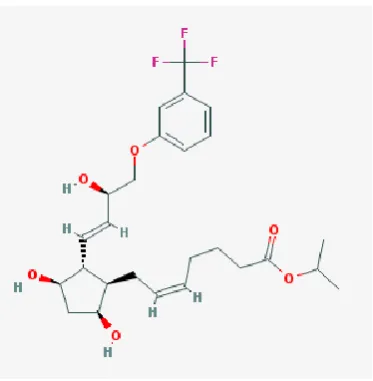
2.2Chemical structure of Travoprost
IUPAC Chemical Name
Propan-2-yl
Fig. 1: Structure of Travoprost.
2.3 Potential impurities in Travoprost drug substance
The potential impurities and degradation products[6] that are controlled in the drug substance
are listed below.
1. Travoprost related compound A (NMT 0.2%)- Arising from synthesis and degradation
(hydrolytic)
2. Epoxy derivative (NMT 0.4%) - Arising from synthesis
3. 15-epi diasteriomer(NMT 0.1%) - Arising from synthesis
4. 5,6-trans isomer (NMT 3.5%) - Arising from synthesis and degradation
5. 15-keto derivative (NMT 0.3%) - Arising from synthesis and degradation (oxidation)
6. Any other individual impurity (NMT 0.1%)
7. Total impurities (NMT 4.0%)
2.4 Drug product specifications
The potential degradation impurities that are listed in the drug substance specifications are
monitored in the drug product throughout its shelf life. The specifications of related
substances in the drug product, travoprost ophthalmic solution 0.004% and its justifications
are listed in below. The known impurities are controlled at limits specified in the USP
monograph[7], and the unidentified impurities are controlled at ICH qualification threshold
limit based on daily dose of product.
1. Travoprost related compound A – NMT 1.0% (USP limits)
2. 5,6-trans isomer - NMT 5.0% (USP limits)
3. 15-keto derivative - NMT 1.0% (USP limits)
5. Total impurities (excluding Impurity A) - NMT 5.5% (USP limits)
2.5 Formulation development of travoprost ophthalmic solution 0.004%
In order to develop an alternate formulation, experimental runs using Design expert 9
software were run to select a surfactant combination that forms stable micellar solutions. The
authors have published this work earlier[8] and a combination of 0.1% each of Solutol HS 15
and polysorbate 80 were chosen for further formulation development. Propylene glycol acts
as a co-solubilizer and helps to keep travoprost in solubilized state and also acts as a tonicity
building agent. Potassium sorbate was chosen as the preservative as it is one of the safer
preservatives as compared the commonly used quaternary ammonium compounds like
benzalkonium chloride and it is most effective below pH 6.0. A concentration of 0.47% was
used as it is approved for ophthalmic solutions at this level, in the ‘Inactive ingredient
database’ of USFDA. Sodium chloride was chosen as the tonicity builder, in addition to
propylene glycol. The concentrations of sodium chloride and propylene glycol were varied
using a statistical experimental run using Design of Experiments in a Design Expert 9
software. A Central Composite Design (CCD) using Response Surface method (RSM)[9] was
used to optimize concentrations of sodium chloride and propylene glycol. Since propylene
glycol acts as a co-solubilizer, it could affect the particle size of micelles as well as
osmolality. Sodium chloride would only affect the osmolality of the finished product. Hence
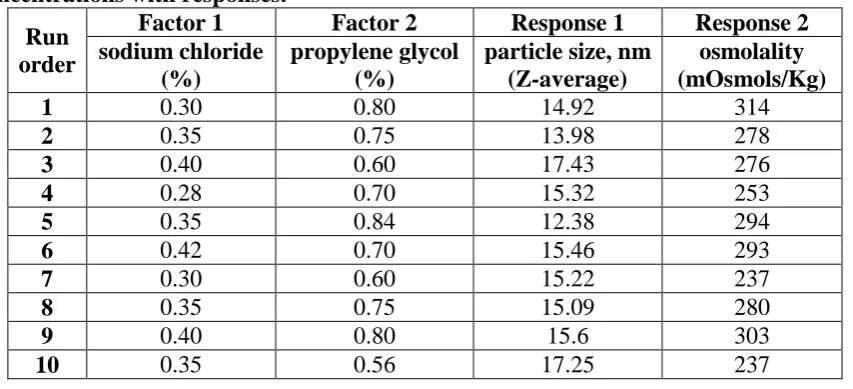
particle size and osmolality were chosen as the responses. Ten experiments including two
center points with various concentrations of sodium chloride and propylene glycol were
performed. (Table 1). The concentrations of other ingredients in the formulation were kept
constant.
Table 1: Experimental run for optimization of sodium chloride and propylene glycol concentrations with responses.
Run order
Factor 1 Factor 2 Response 1 Response 2
sodium chloride (%)
propylene glycol (%)
particle size, nm (Z-average)
osmolality (mOsmols/Kg)
1 0.30 0.80 14.92 314
2 0.35 0.75 13.98 278
3 0.40 0.60 17.43 276
4 0.28 0.70 15.32 253
5 0.35 0.84 12.38 294
6 0.42 0.70 15.46 293
7 0.30 0.60 15.22 237
8 0.35 0.75 15.09 280
9 0.40 0.80 15.6 303
[image:4.595.85.512.579.773.2]
2.6 Measurement of average particle size (Z-average)
Particle size measurement was carried out using Sympatec nanophox instrument which
employs the principle of Dynamic Light Scattering (DLS) to measure nano particles in the
range of 1nm to 10,000 nm. Mean particle size, Z-average was measured on undiluted
samples of Travoprost ophthalmic solution. The results are tabulated in table 3.
2.7Measurement of osmolality
Osmolality was measured on undiluted samples using an Osmometer- Model 3250 of
Advanced Instruments, Inc. This instrument uses the principle of measuring osmolality
precisely by measuring the difference in freezing point depression due to presence of solutes
in the test product and in solvent alone. The results of osmolality are tabulated in table 3.
2.8 Statistical analysis (ANOVA)
The results of particle size and osmolality were evaluated statistically using regression
analysis. The following polynomial equations were generated, in which the model F ratios
were statistically significant at α <0.05, with a statistically non-significant lack of fit at α >
0.05. The model for statistical analysis of particle size is Response surface linear model and
that for osmolality is Response surface reduced cubic model.
Z-average particle size = +20.45308+7.71997*A - 11.27153*B (1)
Osmolality = -5661.39773 + 41951.22657*A + 4183.42895*B -
50352.27279*AB-67025.25253*A2+6130.74494*B+96928.93219*A2B-14284.27125*AB2 (2)
Where A= Concentration of Sodium Chloride and B= Concentration of Propylene glycol.
The results of statistical analysis for Z-average particle size and Osmolality is tabulated in
Table 2. The response surface plots and the Contour plots showing the effect of sodium
cChloride and Propylene glycol on Z-Average particle size are shown in Figures 2A and 2B
respectively and effect on osmolality are shown in figures 2C and 2D respectively.
Table 2: Results of statistical analysis (ANOVA) of the experimental design.
Responses Model p value Adequate precision Lack of fit test; p value
Z-avg particle size 0.0403 5.604 0.5071
Design-Expert® Software Factor Coding: Actual Z average particle size (nm)
Design points above predicted value
Design points below predicted value
17.43
12.38
X1 = A: Sodium chloride X2 = B: Propylene glycol
0.60 0.65 0.70 0.75 0.80 0.30 0.32 0.35 0.38 0.40 12 13 14 15 16 17 18 19 Z a v e ra g e p a rt ic le s iz e ( n m )
A: Sodium chloride (%) B: Propylene glycol (%)
Design-Expert® Software Factor Coding: Actual Z average particle size (nm)
Design Points
17.43
12.38
X1 = A: Sodium chloride X2 = B: Propylene glycol
0.30 0.32 0.35 0.38 0.40
0.60 0.65 0.70 0.75
0.80 Z average particle size (nm)
A: Sodium chloride (%)
B : P ro p y le n e g ly c o l (% ) 14 15 16 2 Design-Expert® Software Factor Coding: Actual Osmolality (Mosmol/Kg)
Design points above predicted value
Design points below predicted value
314
237
X1 = A: Sodium chloride X2 = B: Propylene glycol
0.60 0.65 0.70 0.75 0.80 0.30 0.32 0.35 0.38 0.40 220 240 260 280 300 320 O s m o la li ty ( M o s m o l/ K g )
A: Sodium chloride (%) B: Propylene glycol (%)
Design-Expert® Software Factor Coding: Actual Osmolality (Mosmol/Kg)
Design Points
314
237
X1 = A: Sodium chloride X2 = B: Propylene glycol
0.30 0.32 0.35 0.38 0.40
0.60 0.65 0.70 0.75
0.80 Osmolality (Mosmol/Kg)
A: Sodium chloride (%)
B : P ro p y le n e g ly c o l (% ) 260 280 280 300 2
Fig 2: (A) and (B) – Response surface plot and Contour plots showing of effect of sodium chloride and propylene glycol on Z-Average particle size; (C) and (D) - Response surface plot and Contour plots showing of effect of sodium chloride and propylene glycol on Osmolality.
2.9 Final formulation of travoprost ophthalmic solution 0.004%
From the DOE results, concentration of 0.35% sodium chloride and 0.75% of propylene
glycol gave an osmolality of 278-280mOsmols/Kg. Human tears have been disclosed to be
isotonic to plasma.[10] Though eyes can tolerate a wide range of osmolality without marked
discomfort, most ophthalmic formulations that are marketed have osmolality between 275 to
295 mosmols/Kg close to osmolality of human plasma.[11] The concentrations of sodium
chloride and propylene glycol finalized are 0.35% and 0.75% respectively. The final formula
is listed in Table 3.
(A) (B)
Table 3: Formulation of travoprost ophthalmic solution 0.004%.
Sr. No. Ingredients mg/ml
1 Travoprost 0.04
2 Potassium sorbate 4.7
3 Sodium chloride 3.5
4 Propylene glycol 7.5
5 Polysorbate 80 1.0
6 Solutol HS 15 1.0
7 O.1N HCl q.s
8 Purified water q.s
q.s- quantity sufficient.
2.10 Selection of filter and tubing for filtration of travoprost ophthalmic solution
Filter and tubings that are used during the aseptic manufacturing and filtration sterilization of
the finished product could have an impact on the assay of travoprost and assay of potassium
sorbate due to possible adsorption on the filter, as well as on the related substances test due to
possible leaching from tubings and filter. To assess the impact on tubings, the product was
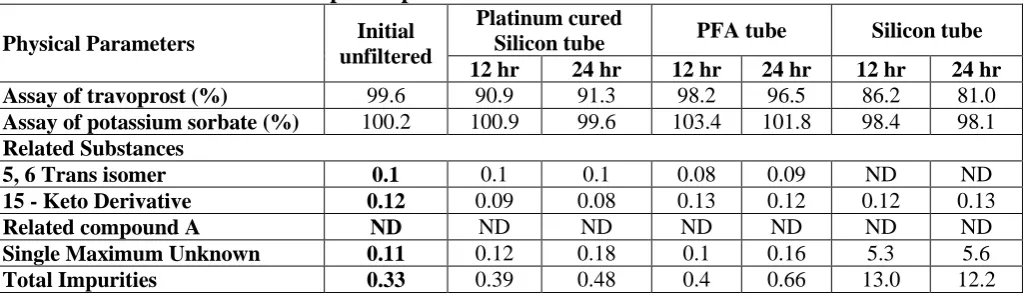
filled in three different tubings, namely, Platinum cured silicon tubes, Perfluoroalkoxy tubes
(PFA) and Silicon tubes, sealed at both ends and kept standing for 24 hours. Samples were
analyzed after 12 hours and 24 hours for assay of travoprost, assay of potassium sorbate and
related substances. For assay of travoprost and related substances test, analysis was carried
out using USP methods and for assay of potassium sorbate, an in house HPLC method was
developed. To assess the impact of filters, three different filters, namely, 0.22µ
Polyvinylidene Fluoride filter (PVDF), 0.2µ Nylon filter and 0.2µ Polyether sulfone filter
(PES), were dipped in travoprost solution and analyzed for assay of travoprost, assay of
potassium sorbate and related substances after 12 and 24 hours The results were compared
with unfiltered bulk analysis. The results of tubing study is tabulated in table 4 and the results
of filter study is tabulated in Table 5.
Table 4: Effect of tubing material on assay of travoprost, potassium sorbate and on related substances of travoprost ophthalmic solution 0.004%.
Physical Parameters Initial
unfiltered
Platinum cured
Silicon tube PFA tube Silicon tube
12 hr 24 hr 12 hr 24 hr 12 hr 24 hr
Assay of travoprost (%) 99.6 90.9 91.3 98.2 96.5 86.2 81.0
Assay of potassium sorbate (%) 100.2 100.9 99.6 103.4 101.8 98.4 98.1
Related Substances
5, 6 Trans isomer 0.1 0.1 0.1 0.08 0.09 ND ND
15 - Keto Derivative 0.12 0.09 0.08 0.13 0.12 0.12 0.13
Related compound A ND ND ND ND ND ND ND
Single Maximum Unknown 0.11 0.12 0.18 0.1 0.16 5.3 5.6
[image:7.595.44.559.610.759.2]
ND- Not detected.
Table 5: Effect of filter material on assay of travoprost, potassium sorbate and on related substances of travoprost ophthalmic solution 0.004%.
Physical Parameters Initial unfiltered
0.22 µ PVDF 0.2 µ Nylon 66 0.2 µ PES 12 hr 24 hr 12 hr 24 hr 12 hr 24 hr
Assay of travoprost (%) 99.6 98.2 97.8 93.5 93 97.8 97.5
Assay of potassium
sorbate (%) 100.2 103.5 104.4 101.8 100.1 102.7 101
Related Substances
5, 6 Trans isomer 0.1 0.09 0.09 0.08 ND ND 0.10
15 - Keto Derivative 0.12 0.12 0.11 0.11 0.11 0.11 0.10
Related compound A ND ND ND ND ND ND ND
Single Maximum
Unknown 0.11 0.12 0.12 0.1 0.11 0.10 0.11
Total impurities 0.33 0.33 0.32 0.29 0.22 0.21 0.31
ND- Not detected.
2.11 Method of manufacture
Travoprost is dissolved in a stock solution of propylene glycol, Solutol HS 15 and
polysorbate 80 in water. A solution of sodium chloride and potassium sorbate in water is
prepared and added to the travoprost stock solution and mixed well. pH is adjusted with 0.1N
HCl between 5.4 and 6.0. The solution is aseptically filtered through 0.22µ Polyethersulfone
membrane (PES) and filled in low density polyethylene vials (LDPE) fitted with LDPE
droppers and high density polyethylene cap (HDPE).
2.12 Sterilization of container closure system
Before starting formal stability studies on the final formulation, it is important to know the
impact of sterilization technique of the container closure system (CCS) on the product
stability. The container closure system selected for travoprost ophthalmic solution 0.004% is
white opaque LDPE vials with transparent nozzles and HDPE caps. Sterilization of CCS
using two different techniques was done i.e. ethylene oxide gaseous sterilization and gamma
irradiation. The finished product was filled in both these containers and charged on stability
Table 6: Effect of Sterilization of CCS on related substances of travoprost ophthalmic solution 0.004%.
Test Limits Initial 40°C/25%RH
2M ETO 2M Gamma
Assay of travoprost 90.0-110.0% 100.5 97.7 95.7
Assay of potassium sorbate 90.0-110.0% 100.6 96.3 95.2
Related substances
Travoprost related compound A NMT 1.0% 0.07 0.52 0.55
5,6-trans isomer NMT 5.0% ND ND ND
15-keto derivative NMT 1.0% ND 0.32 0.53
Single maximum unknown NMT 1.0% 0.3 0.57 0.6
Total impurities NMT 5.5% 1.1 2.8 3.5
NMT – Not more than; ND – Not detected.
2.13 Effect of pH on the finished product stability
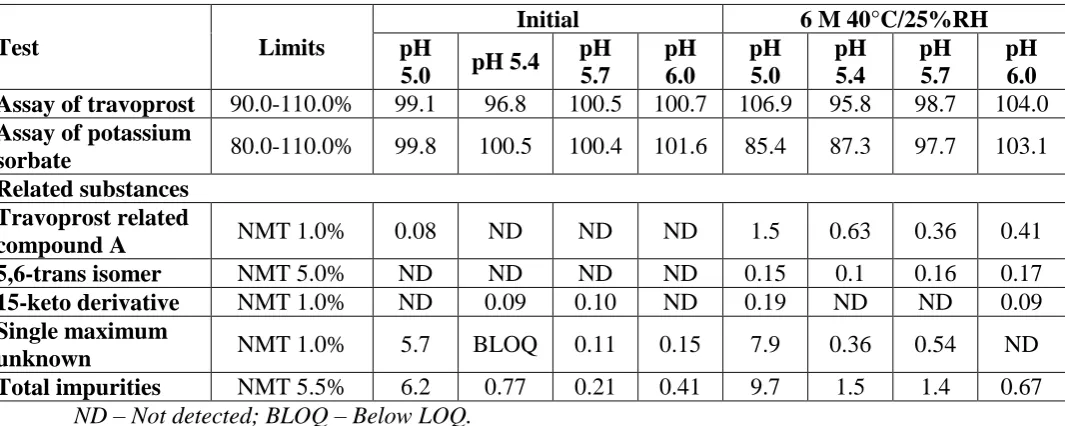
The finished product was manufactured at four different pH to study effect on pH on impurity
profile of the finished product, namely pH 5.0, pH 5.4, 5.7 and 6.0. Comparative data of
initial time point and after six months at accelerated conditions of 40°C/25% RH is tabulated
in Table 7 and graphically represented in Fig 3.
Table 7: Effect of pH on related substances of travoprost ophthalmic solution.
ND – Not detected; BLOQ – Below LOQ.
Test Limits
Initial 6 M 40°C/25%RH
pH
5.0 pH 5.4
pH 5.7
pH 6.0
pH 5.0
pH 5.4
pH 5.7
pH 6.0 Assay of travoprost 90.0-110.0% 99.1 96.8 100.5 100.7 106.9 95.8 98.7 104.0
Assay of potassium
sorbate 80.0-110.0% 99.8 100.5 100.4 101.6 85.4 87.3 97.7 103.1
Related substances Travoprost related
compound A NMT 1.0% 0.08 ND ND ND 1.5 0.63 0.36 0.41
5,6-trans isomer NMT 5.0% ND ND ND ND 0.15 0.1 0.16 0.17
15-keto derivative NMT 1.0% ND 0.09 0.10 ND 0.19 ND ND 0.09
Single maximum
unknown NMT 1.0% 5.7 BLOQ 0.11 0.15 7.9 0.36 0.54 ND
Fig. 3: Effect of pH on total impurities of travoprost ophthalmic solution 0.004% at 6 months accelerated stability.
2.14 Antimicrobial efficacy test (AET) of potassium sorbatein the finished formulation
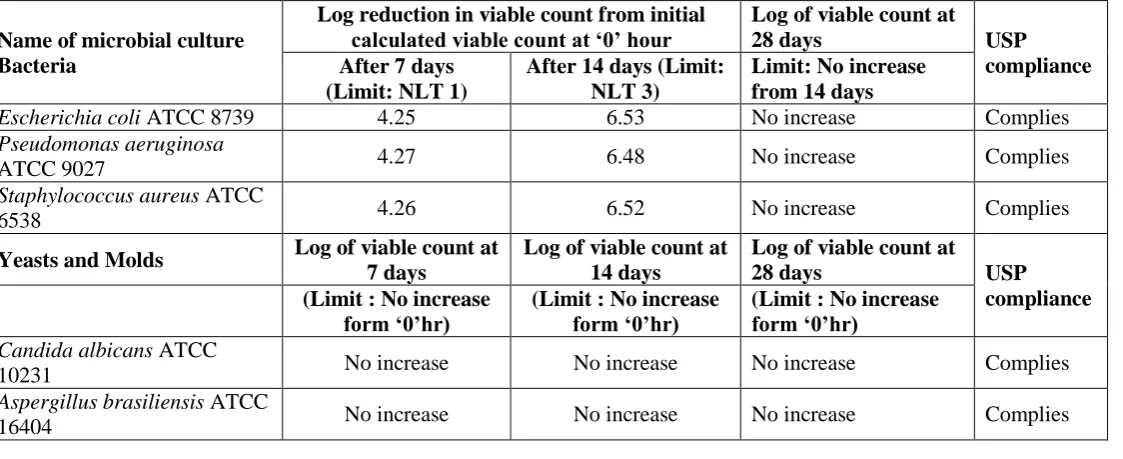
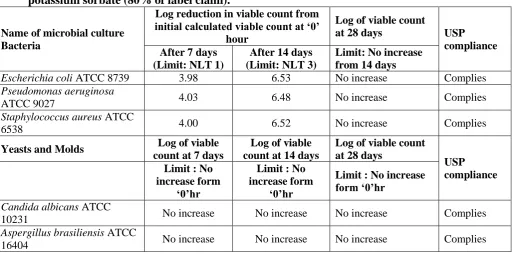
Two batches of travoprost solution were manufactured as per formula in table 5 at 100% and
80% concentration of potassium sorbate, in order to assess its preservative effectiveness as
per USP. Antimicrobial preservative testing at lower concentration of preservative i.e. 80% of
label claim is tested, as there is a drop in levels of potassium sorbate at lower pH of 5.0 and
5.4 to around 85% of the label claim at the end of 6 months accelerated stability at
40ºC/25%RH.
The results of AET test for 100% and 80% preservative concentration are tabulated in Tables
[image:10.595.119.478.71.243.2]8 and 9 respectively.
Table 8: Summary results of antimicrobial effectiveness test at 100% concentration of potassium sorbate.
Name of microbial culture Bacteria
Log reduction in viable count from initial calculated viable count at ‘0’ hour
Log of viable count at
28 days USP
compliance After 7 days
(Limit: NLT 1)
After 14 days (Limit: NLT 3)
Limit: No increase from 14 days
Escherichia coli ATCC 8739 4.25 6.53 No increase Complies
Pseudomonas aeruginosa
ATCC 9027 4.27 6.48 No increase Complies
Staphylococcus aureus ATCC
6538 4.26 6.52 No increase Complies
Yeasts and Molds Log of viable count at
7 days
Log of viable count at 14 days
Log of viable count at
28 days USP
compliance (Limit : No increase
form ‘0’hr) (Limit : No increase form ‘0’hr) (Limit : No increase form ‘0’hr)
Candida albicans ATCC
10231 No increase No increase No increase Complies
Aspergillus brasiliensis ATCC
[image:10.595.24.586.549.778.2]
Table 9: Summary results of antimicrobial effectiveness test at lower concentration of potassium sorbate (80% of label claim).
Name of microbial culture Bacteria
Log reduction in viable count from initial calculated viable count at ‘0’
hour
Log of viable count
at 28 days USP
compliance After 7 days
(Limit: NLT 1)
After 14 days (Limit: NLT 3)
Limit: No increase from 14 days
Escherichia coli ATCC 8739 3.98 6.53 No increase Complies
Pseudomonas aeruginosa
ATCC 9027 4.03 6.48 No increase Complies
Staphylococcus aureus ATCC
6538 4.00 6.52 No increase Complies
Yeasts and Molds Log of viable
count at 7 days
Log of viable count at 14 days
Log of viable count at 28 days
USP compliance Limit : No
increase form ‘0’hr
Limit : No increase form
‘0’hr
Limit : No increase form ‘0’hr
Candida albicans ATCC
10231 No increase No increase No increase Complies
Aspergillus brasiliensis ATCC
16404 No increase No increase No increase Complies
2.15 Comparative stability studies with brand product, Travatan Z
The test formulation given in Table 5 was filled in 5 ml ETO sterilized Low density
Polyethylene (LDPE) bottles fitted with LDPE nozzles and turquoise colored polypropylene
caps and charged on accelerated stability conditions of 40ºC/25%RH and at 25ºC/40%RH
and 2-8ºC as per ICH guidelines[12] for semi-permeable containers. The brand product,
Travatan Z was charged only at accelerated conditions. The results are summarized in Table
[image:11.595.44.558.93.347.2]10.
Table 10: Comparison of stability results of marketed formulation with the test product.
Tests Limits
*Travatan Z® Test product
Initial 40°C/25%RH Initial 40°C/25%RH 25°C/40%RH 2-8ºC
3 M 6 M 3M 6M 6M 6M
% Assay of
travoprost 90.0 -110.0 101.1 100.9 104.9 100.5 100.1 98.7 102.5 98.7
pH 5.4-6.0 5.67 NP 5.83 5.7 5.9 6.0 5.84 5.78
Osmolality
(mOsmols/Kg) 260-300 278 NP 283 278 284 284 282 287
Related substances travoprost related
compound A NMT 1.0% ND 0.06 0.15 ND 0.16 0.36 0.2 0.04
5,6-trans isomer NMT 5.0% 3.2 3.2 2.9 ND 0.16 0.16 ND ND
15-keto derivative NMT 1.0% 0.11 0.14 0.17 0.10 ND ND ND ND
Single maximum
unknown NMT 1.0% 0.97 3.6 6.4 0.11 0.31 0.54 0.34 0.3
Total impurities NMT 5.5% 4.3 7.6 11.3 0.21 1.0 1.4 1.1 1.2
[image:11.595.22.583.534.759.2]
3. RESULTS AND DISCUSSION 3.1 Evaluation of results of DOE
Model p value in Table 4 indicates that there is only a 4.03% chance that the model F value
of the model equation (1) for Z average particle size, occurred due to noise. For Osmolality,
the model p value indicates that there is only a 0.15% chance that the model F value of the
model equation (2) occurred due to noise. Adequate precision measures the signal-to-noise
ratio. A ratio greater than 4 is desirable. For both responses, ratios were higher than 4,
indicating adequate signal. The p values of the lack of fit test for both models were not
significant, indicating that these model equations fitted the data well and can be used for
prediction.
The results of Z average particle size for the experimental runs ranged between 12.38 to
17.43 nm. The positive sign in equation 1 for sodium chloride and negative sign for
propylene glycol indicates that the concentration of Sodium Chloride is directly proportional
and that of propylene glycol is inversely proportional to particle size. This is expected as
propylene glycol helps in solubilizing travoprost and thus lowering the particle size of the
micelles at higher concentrations. For osmolality, the results were in the range of 237 to 314
mOsmols/Kg. Concentration of 0.35% sodium Chloride and 0.75% of propylene glycol gave
an osmolality of 278-280mOsmols/Kg and was found to be optimum for an ophthalmic
solution.
3.2Filter and tubing selection 3.2.1 Tubing study
The results in Table 6 show around 8-9% of adsorption of travoprost in platinum cured tubing
after 12 and 24 hours of tubing contact study. In PFA tubing after 12 hours, the adsorption is
negligible. However, after 24 hours, around 3% of travoprost gets adsorbed onto the PFA
tubing. With silicon tubings, maximum adsorption of travoprost was observed, around 13%
and 18% in 12 hours and 24 hours respectively. The rise in related substances also is
significantly high in silicon tubings compared to the other two tubings.
In all the tubings, adsorption of potassium sorbate is negligible. There is a slight increase in
total impurities after 12 and 24 hours of exposure in platinum cured silicon tubes and in PFA
tubes. However, in silicon tubings, there is significant increase in unknown impurity as well
as in the level of total impurities. Based on the results of the tubing study, PFA tubings were
This study reflects a worst case scenario for filtration as the solution is filled in the tubes and
kept for 12 hours and 24 hours. In actual production runs, during filtration, the solution will
be constantly in motion and hence contact time of solution in the tubings will be minimal.
However, based on the results, the filtration time will be restricted to not more than 12 hours
during manufacturing.
3.2.2 Filter selection
There is no significant change in assay of travoprost and potassium sorbate in PVDF and PES
filters. However, in Nylon 66 filter, significant adsorption of around 6.6% of travoprost is
observed No significant increase in impurities were observed in any of the filter studied. PES
was finalized for further studies over PVDF due to ease of availability and available
inventory.
3.3 Sterilization of container closure system
Results of 2 month samples showed that product filled in gamma irradiated CCS showed
significantly higher percentage of 15-keto derivative than those filled in ETO sterilized ones.
This impurity is formed due to oxidation. The higher percentage of 15-keto impurity in
gamma sterilized CCS, could be due to residual free radicals generated during sterilization of
CCS triggering an oxidative reaction. Based on the data, ETO sterilized CCS were chosen for
conducting stability studies as per ICH guidelines.
3.4 Effect of pH on stability of travoprost ophthalmic solution
The results of related substances at different pH of the formulation from pH 5.0 to 6.0 shows
significant increase in the values of total impurities with decrease in pH. At pH 5.0, initial
results for total impurities is higher than the limit of 5.5% due to significant increase in
unknown impurity. However, there is no drop in assay of travoprost and mass balance is not
achieved. This could be due to different chromophores present in the unknown impurity
giving very different response as compared to travoprost in the chromatographic method. At
pH 5.7 and pH 6.0, the results of related substances is satisfactory and well within the
acceptance criteria. Potassium sorbate is known to be most effective below pH 6.0. Hence the
pH range selected for travoprost ophthalmic solution is 5.4 to 6.0, with an optimum pH of
3.5 Antimicrobial Efficacy test results
Test results of both formulations, one containing 100% of potassium sorbate and second one
containing 80% of potassium sorbate levels in the formulation were within the USP
acceptance criteria for all the specifies bacteria and yeasts and fungi. Thus potassium sorbate
in the formulation acts effectively as a preservative.
3.6 Comparison of stability data with brand product
There is no significant difference in assay of travoprost in the test product across all stability
conditions as well as in the brand product, Travatan Z. Travoprost related compound A is the
free acid degradant of travoprost. It is formed by the hydrolytic cleavage of the isopropyl
ester group from the travoprost molecule. In the brand product the free acid degradant
increases from below detection level to 0.15% at 6 months accelerated conditions. However,
in the test product, though the free acid impurity is slightly higher than the brand product and
increases from below detection limit to 0.36% at 6 months accelerated conditions, it is still
well within the USP acceptance criteria of not more than 1.0%. The 5, 6-trans isomer is a
degradation product formed by thermal conditions. The values of this impurity for test
product is better than the brand product, though both are within USP limits of 5.0%. 15-keto
impurity is an oxidative impurity and controlling this impurity at low levels require extensive
controls on the oxygen content of the solution during manufacturing as well as nitrogen
purging in the bottles during filling operations. The brand product has used a specific resin,
syndiotactic polypropylene to contain adsorption of API and to control oxidation of
travoprost. The brand product was assigned a shelf life of only 14 months in the initial
approval and requires storage at 2-25ºC. Surprisingly, the test product that was developed,
did not require any controls of nitrogen flushing during manufacturing or filling and showed
no detectable levels of 15-keto impurity even at accelerated conditions up to 6 months at
optimum pH of 5.7.
4. CONCLUSION
A stable formulation of travoprost was developed using principles of quality by design. A
simple manufacturing process, without the need for nitrogen flushing in manufacturing or the
need to control oxidation by any means, was developed. Factors affecting the critical quality
attributes of the product were studied to mitigate risks. The product is stable up to 6 months
months can be assigned to the product without the need for any special storage conditions,
which translates to significant commercial benefits with respect to logistics as well as costs.
Disclosures
The author reports no conflict of interest in this work. This research did not receive any
specific grant from funding agencies in the public, commercial, or not-for-profit sectors.
ACKNOWLEDGEMENT
S. R. Pujari acknowledges the help provided by Indoco Remedies Ltd. for the laboratory
facilities in carrying out the research work.
REFERENCES
1. L. Quaranta et al., Safety and efficacy of Travoprost solution for the treatment of elevated
intraocular pressure Clinical Ophthal, 2015; 9: 633–643.
2. B.P. Kabra, et al., Self-preserved aqueous pharmaceutical compositions, US patent
8323630 B2, https://www.pat2pdf.org/patents/pat8323630.pdf
3. Chemistry Review(s), Travatan Z, Centre for Drug Evaluation and Research, Drug
approval package,
https://www.accessdata.fda.gov/drugsatfda_docs/nda/2006/021994s000_ChemR.pdf
4. Scientific discussion, Travatan (EMEA, 2004),
http://www.ema.europa.eu/docs/en_GB/document_library/EPAR_Scientific_Discussion/h
uman/000390/WC500041987.pdf
5. C. Baudouin, Detrimental effect of preservatives in eye drops: implications for the
treatment of glaucoma, Acta Ophthalmol, 2008; 86(7): 716-726.
6. DRUG MASTER FILE # 22289, Cayman Pharma s.r.o. (non-confidential information).
7. Travoprost Ophthalmic solution, USP monograph,
http://www.uspnf.com/sites/default/files/usp_pdf/EN/USPNF/travoprost_ophthalmic_solu
tion.pdf
8. S.R. Pujari et al, Screening and selection of surfactants for solubilization of Travoprost
using Design of Experiments Eur. J. Of Pharm. Med. Res., 2018; 5(03): 337-342.
9. M.J. Anderson, P.J. Whitcomb, RSM Simplified, Optimizing Processes using response
surface methods for design of experiments CRC press, 2005.
10.J.M. Tiffany, Tears in health and disease, Eye, 2003; 17: 923-926.
11.M. Villiger et al., Evaluation and review of body fluids saliva, sweat and tear compared to
12.Stability testing of new drug substances and products, ICH Q1A(R2), 2003
http://www.ich.org/fileadmin/Public_Web_Site/ICH_Products/Guidelines/Quality/Q1A_