Discourse through making: eliciting knowledge to support
craft skills learning
WOOD, N.
Available from Sheffield Hallam University Research Archive (SHURA) at:
http://shura.shu.ac.uk/978/
This document is the author deposited version. You are advised to consult the
publisher's version if you wish to cite from it.
Published version
WOOD, N. (2007). Discourse through making: eliciting knowledge to support craft
skills learning. In: 7th European Academy of Design Conference (EAD07): Dancing
with disorder: design, discourse and disorder, Izmir, Turkey, 11-13 April 2007.
Copyright and re-use policy
See
http://shura.shu.ac.uk/information.html
DISCOURSE THROUGH MAKING: ELICITING KNOWLEDGE TO SUPPORT CRAFT SKILLS LEARNING
Dr Nicola Wood
Sheffield Hallam University [email protected]
Abstract
In this paper I describe the development of techniques for eliciting craft knowledge for use in an interactive learning resource, illustrated with examples from two practical research projects. In each I explored the skills of both expert and novice craft practitioners, firstly in the field of traditional bowl turning and secondly in the field of traditional clog making.
The result of this work was to highlight the personal, context-specific and highly tacit nature of such craft knowledge which is explained through a review of the writings of Michael Polanyi and Donald Schön. I conclude by redefining the concept of knowledge elicitation and transmission in this context. I describe the role of the designer-researcher as helping the expert to articulate their tacit knowledge through stimulating reciprocal reflection between the expert and a novice, and designing interpretation to help bridge the knowledge gap between the two.
Context for the research
The central problem for my research has been, from the perspective of a designer of interactive media, how to understand and transmit the expert knowledge of skilled craftspeople, with particular interest in craft skills that may be disappearing even though there are people interested in preserving those skills and learning them. For example, many traditional rural skills are essential for preserving our heritage of buildings and other aspects of rural life, but there are few people left to pass on the knowledge and learners do not have the time for traditional apprenticeships
(Heritage Lottery Fund 2002). My main aim has been to develop a body of knowledge to assist with the development of interactive learning materials that support learning of craft skills.
In this research I have used a practice-led approach to explore the craft skills of both expert and novice practitioners in the fields of traditional bowl turning and clog making. In the light of outcomes from the practical work I have reconsidered the current context for craft knowledge and developed a framework to understand craft learning. Whilst they are not mutually exclusive, this paper focuses the first of three specific contributions to knowledge made by the research: in the field of multimedia design it establishes techniques for eliciting craft knowledge1.
1
Documenting the research
To manage the dual designer-researcher role undertaken in this research it was important to have an accurate recording process that allowed consideration from different perspectives and in the light of new knowledge as it emerged. However, for the research setting to be realistic, the recording process must not distract those under observation from their practice and equally must not require too much attention from myself.
When I reviewed the documentation of practical work undertaken during my previous research (Wood 2003), including use of handwritten notes, photography, audio and video recording, I concluded that video recording could most closely meet these requirements through reinforcing the strengths and managing the problems. The major strength of video recording was being able to capture a very rich record, including those events whose significance only became apparent later.
However, the “always on” policy led to generation of a large number of tapes that needed to be catalogued and referenced and this was managed through a simple event logging procedure. The event logs summarised both activities and speech, aiming at a clear and concise narrative of the proceedings rather than a complete record. By writing them immediately after the recordings had taken place, I was able to review them from the dual perspective of designer-researcher. They served both as a reminder of events that had taken place and allowed me to observe myself in action.
Whilst some of the outcomes were explicit, such as decisions about camera angles or specific lines of questioning, many were tacit and I only became aware of them later, such as the conflicting opinions of the practitioners on the properties of timber described below. As Buur et al (2000) propose, “video recordings … are no longer hard data but rather the first attempts to create stories that frame the design problem and impose order on the complexity of everyday life”.
Formal elicitation with the bowl turner
In my first practical project I experimentally used a systems-orientated approach to explore the tacit knowledge within the practice of an experienced traditional bowl turning practitioner, Robin Wood2. This involved a series of interviews and
observations to elicit craft knowledge from him, using a low-fidelity prototype learning resource as a means of representing that knowledge, and observing learners applying the knowledge through using the resource to support their learning. In this paper I shall focus on the elicitation part of the process.
During the elicitation I experimented with both on-line and off-line verbal reportage techniques using concurrent verbalisation, where Robin was filmed giving a verbal report as he carried out his normal practice; and stimulated recall, where he was filmed undertaking his normal practice and immediately afterwards reviewed the recording and commented on his practice. After both sessions issues arising from the reportage were used as a basis for semi-structured interviews with the aim of
probing more deeply into his knowledge.
2
Whilst Robin appeared at ease talking in front of the video camera in both sessions, my attempts at questioning were frequently dismissed or prompted defensive
answers. For example, in the observational video he could be seen regularly stopping turning to inspect the surface of the wood and as he did so he often ran his
fingertips over the surface too. On four occasions I suggested that the sense of touch played a part in this inspection, but he constantly denied or avoided the issue:
01.02 RESEARCHER: You can just see those bumps or can you feel them?
PRACTITIONER: You can tell when they've gone because of the noise it makes.
01.15 RESEARCHER: That's what you're feeling with your hand? PRACTITIONER: I was seeing them.
RESEARCHER: Seeing them?
PRACTITIONER: Yes I turned it slowly round and I could see them - and I could see how deep they are so I can see how much to take off in this cut here.
01.27 RESEARCHER: You're also stroking it aren't you?
PRACTITIONER: Yes - a little bit - yes - I'm pointing there at - um - I'm pointing there at where it needs to be cut off.
11.21 RESEARCHER: And there you're checking it - is that visual or feel or both?
PRACTITIONER: It's mostly visual: you can see the tear out and I'm making an aesthetic decision on what quantity is OK.
(Wood 2007:35)
However, my initial feelings about this observation were confirmed about a year later when I was asked to contribute video material showing craft makers using their sense of touch for an exhibition. In this context I asked Robin again about using his sense of touch and he talked quite openly about feeling with his fingers to
differentiate between tear-out on the surface of the wood that needed to be removed and natural dark markings in the wood grain, which did not.
As observed by other researchers in similar situations (Shadbolt & Milton 1999, Edwards 2003), when pressed into talking about elements that he did not have immediate answers for, the practitioner’s initial reaction was to give quick responses that gave minimal insight into the situation. Argyris (1995) commented that when individuals discovered a difference between their espoused theory and their theory-in-use their natural tendency was to attempt to preserve their espoused theory, or at least minimise damage to it.
LEARNER: One thing that's quite difficult. You're saying that I'm to put it in at this angle, at times anyway, but you're also saying to turn it this way,
whereas if it's flat onto that and I turn it this way then obviously it comes out. So I've just been inching my hand along.
PRACTITIONER: So you've been listening to what I say then working out the actual way to do it, obviously!
(Wood 2007:126)
However, upon reviewing the video of the Robin’s original instruction, I surmised it had been correct and the problem had been that the learner had not remembered what he had been told. Given this, it is notable that Robin did not respond in a defensive manner and instead provided encouragement that the learner had worked out what to do.
I concluded that, whilst elicitation via purposeful interviews and observations provided much useful material, it triggered a defensive attitude in the craft
practitioner which limited the knowledge elicited. More was revealed by involving the practitioner in the subsequent work with the learners and the developing learning resource, and this led to an adaptation of the techniques for the following elicitation with the clog maker.
Gradual elicitation with the clog maker
In the second project I undertook a series of video-recordings with a traditional clog maker, Jeremy Atkinson, during which I developed a less intrusive elicitation
technique based on increasingly focussed observation and interviewing. This
overcame the defensiveness encountered with the first practitioner with whom I had initially used an elicitation approach based on his descriptions of his practice.
The elicitation technique used during this phase of practical work involved a hybrid of the focussed observation, concurrent verbalisation and semi-structured interview techniques that had been used with the previous practitioner. I started with very general observation and open questions aimed at gaining contextual information, and then gradually increased the focus of observation and questioning as my understanding grew. To help with contextualisation, the interviews were nearly all based in the workshop whilst Jeremy was undertaking his regular practice.
I visited Jeremy six times over a period of approximately two months. During each recording session I would watch his work, take notes, and talk to him whilst also continuously filming proceedings. Afterwards, I would watch the video, compare with my notes and decide upon areas requiring further clarification to be used as the basis for discussion during the next session. So, each session built upon the
proceeding one with any gaps filled in by the semi-structured interviewing. Only the final session was more formal in nature, where I asked direct questions to fill in specific areas of uncertainty. By that stage he was completely at ease with the recording equipment and myself and readily talked directly to the camera in answer to the questions.
think much more about his own skills through trying to communicate his practice to the learner. Whilst I was unable to openly interview the learner and had little time with him when Jeremy was not present, I felt his perception of the craft to be very useful. In further research I plan to explore the role of the ‘expert learner’ as an aid to elicitation.
This process of gradual immersion enabled me to come to a wide-ranging
understanding of the craft without the difficulties encountered in the first, tentative stage of practical work, showing that this stage was effective in refining and developing elicitation methods. However, my official remit whilst undertaking the recordings of Jeremy was to generate archive footage so I did not have the
opportunity to develop and test a learning resource which led me to consider other ways of validating the knowledge I was eliciting.
Boundaries to knowledge
Whilst I was able to undertake some quite deep questioning without triggering defensiveness in the clog maker, there still remained some issues where his stated theory was at variance with my understanding. As I did not have the opportunity to develop any interpretation for such theory and test it through a learning resource, I undertook a deeper investigation which revealed boundaries to his knowledge.
For example, in the documented history of clog making, alder and birch were the most commonly used clog timbers. Itinerant labourers would fell the trees and rough-cut them into clog-blocks which would be sold to clog makers who would refine the shape and nail on the uppers. Jones (1927:46) states, “the blocks must be left to dry for some months before they can be shaped into soles.” Jeremy was of the opinion this was because otherwise it would split. His experience of working alder dated to the 1970s when he was originally taught the craft:
“what we used to do was we’d go out, we’d cut a tree down, we’d come back, we’d rough cut it and … we’d leave it on the north side of a stream, under cover against a wall. I mean you couldn’t get a damper place. It would be left there in the air to circulate on a rack for six weeks, maybe, at least five. If you didn’t do that it would crack on you.”
(Wood 2007:92)
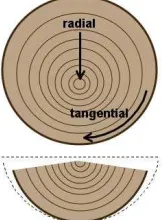
However, Robin’s experience of using green alder to make bowls was that it suffered from a large amount of shrinkage as it dried. As this shrinkage was not even;
[image:6.595.94.175.634.744.2]tangential shrinkage can be as much as twice radial shrinkage (see Figure 1) the wood will definitely warp and could split. To stop the splitting, his method of working any green wood, but particularly alder with its high rate of shrinkage, was to remove the pith and central few growth rings where the tension was at its greatest:
Jeremy’s experience of the problems of cracking might have been caused by his own teacher’s inexperience, as at that time he too was quite new to the craft. Thirty years later when teaching the novice who was now working with Jeremy, this teacher appeared to have overcome the problem in the same way as Robin described:
CLOG MAKER, splitting the remaining log in two: “When you cut alder you are supposed to get rid of the centre anyway.”
RESEARCHER & NOVICE: “Mmm.” CLOG MAKER: “So Robin told me”
NOVICE: “Trevor [the teacher] told me that as well.”
CLOG MAKER (sounding surprised): “Did he? Must be true then, must be.” (Wood 2007:93)
As the itinerant block-cutters were able to cut and dry whole blocks presumably without many of them splitting, this must have been common knowledge at the time and it should have been equally feasible to cut and dry complete soles without them splitting. I feel a more likely reason for this not being done was because the sole would shrink and warp as it was drying making it uncomfortable and uneven to walk in.
Jeremy, having had a bad experience with alder, put his energy into learning to use sycamore. Having solved his problem through switching tracks he was disinclined to re-examine why he had struggled with alder, preferring to believe it was the fault of the wood. In his case I feel it was lack of other craft masters that left these
assumptions unchallenged.
Unpicking the possible origins of Jeremy’s beliefs alongside my own and Robin’s provided insight into the difficulties caused to the elicitation process by the context-specific nature of such knowledge. It highlighted the importance of the interplay between representation and validation of elicited craft knowledge in learning resource design. It would not be possible to investigate the ‘truth’ of all elicited knowledge and, as such investigation could also lead to defensiveness from the practitioner, it would also be inadvisable. The designer would need to validate any interpretation they created for the learning resource and other material generated during elicitation should retain its original context whenever possible so the learner can form their own judgement and make their own interpretation.
The nature of craft knowledge
To fully explain the means by which this elicited knowledge could be used by a novice and the role of the designer-researcher in the process, I shall firstly provide a brief literature review relating to the nature of craft knowledge and the ways in which it can be transmitted, illustrated by examples from the research.
the largest role in guiding the performance (Polanyi 1958). He observed that much of this knowledge was so internalised and interwoven it was not possible to express: “we can know more than we can tell” (Polanyi 1966:4) and such knowledge became widely known as tacit knowledge.
On a functional level, tacit knowledge could be seen as offering advantage to the craft practitioner by reducing cognitive load, freeing the mind from one level of a task to enable thought to be directed at another. This element was described by the clog maker, Jeremy, when talking about the difficulties of the novice he was training:
“[the novice has] got to the point where he can manage everything but he’s concentrating so much on each individual task he doesn’t look at the whole. Which is easy to do. It’s just a sort of transitional thing. He can do all the individual things but because he’s concentrating so hard on it he’s not always stepping back.”
(Wood 2007:122)
Polanyi (1966:10) differentiated between two terms of tacit knowing: the proximal and the distal and described the functional relationship between the two as knowing the proximal term only by relying on our awareness of it for attending to the distal. This explains the difficulty the practitioners had describing the theory that governed their practice, they only knew it through attending to their practice. He further described the phenomenal structure of tacit knowing as that we attend from the proximal to the distal: we attend from the theory to things seen in its light, hence theory could only be learned through practising its use, a process he called interiorisation (ibid:17) (see Figure 2).
Polanyi (ibid:18) also considered the reverse of this process, where the focus of the practitioner’s attention was returned to the theory. The immediate result of the action becoming proximal and the theory distal was often a complete loss of meaning; “By concentrating attention on his fingers, a pianist can temporarily
[image:8.595.92.321.525.660.2]paralyse his movement”. However, Polanyi believed the long-term effect need not be negative, destructive analysis of such knowledge followed by re-interiorisation could result in a more secure and accurate basis for practice (ibid:19):
Figure 2: My interpretation of Polanyi’s theory3.
This was described prosaically by John Ruskin (1853:54):
3
This is purposefully represented as two separate processes above and below the dotted line as I do
“You can teach a man to draw a straight line … and to copy and carve any number of given lines or forms, with admirable speed and perfect precision; and you find his work perfect of its kind: but if you ask him to think about any of those forms, to consider if he cannot find any better in his own head, he stops; his execution becomes hesitating; he thinks, and ten to one he thinks wrong; ten to one he makes a mistake in the first touch he gives to his work as a thinking being. But you have made a man of him for all that. He was only a machine before, an animated tool.”
The elicitation process described above can be seen to be making the craft
practitioners turn their attention from their actions to the theory governing them, a process which can be destructive. This explains why the bowl turner, Robin, could have an incorrect perception of the way in which he held the tool and, even after observing himself on video, deny it until he returned to his regular practice then ‘caught’ himself using the technique (Wood 2005).
Transmission of craft knowledge
Given that craft knowledge tends to be personal, context specific and highly tacit, how can it be ‘transmitted’ from expert to novice, or elicited by a researcher? There is a widespread belief that tacit knowledge can be transmitted from one person to the next by making it explicit and I feel this to be in need of closer examination. I feel a more accurate description to be that the expert uses explicit concepts to articulate his tacit knowledge.
Nonaka & Takeuchi (1995) did much to popularise the work of Polanyi and the concept of tacit knowledge within the field of knowledge management. They describe how individuals share tacit knowledge within large organisations through externalisation which is, “a process of articulating tacit knowledge into explicit concepts. It is a quintessential knowledge-creation process in that tacit knowledge becomes explicit, taking the shapes of metaphors, analogies, concepts, hypothesis or models” (ibid:64). This may be the origination of the concept that “tacit knowledge becomes explicit”, having lifted the phrase from the context in which it was written, although the broader concept is that explicit knowledge is used to articulate the tacit. As Rust (2004) says “the idea that people’s tacit knowledge can be somehow extracted and made explicit in the form of rules for all to employ … is fundamentally misguided”. The implication is that tacit knowledge could be articulated verbally through metaphors, analogies etc. or, as frequently observed in the craft context, visually through demonstration, sketching or modelling. Gamble (2002) gives a vivid description of such an interaction from her observation of cabinet-making
apprentices at a trade school in South Africa: “When asked in an interview about the propensity to draw everything, an apprentice called drawing his ‘third language’ (in addition to two spoken languages).”
Donald Schön (1987:101) similarly referred to “an apparently unbridgeable
communication gap” between novice and expert, however he suggested the solution was in “reciprocal reflection-in-action” implying that the expert needed to make as much effort as the novice in the process of bridging it. The expert needed to view the novice’s actions in response to instruction as revealing the meaning they had constructed for that instruction. They needed to observe the novice’s actions reflectively and respond back until they felt there was a convergence in meaning (ibid:104).
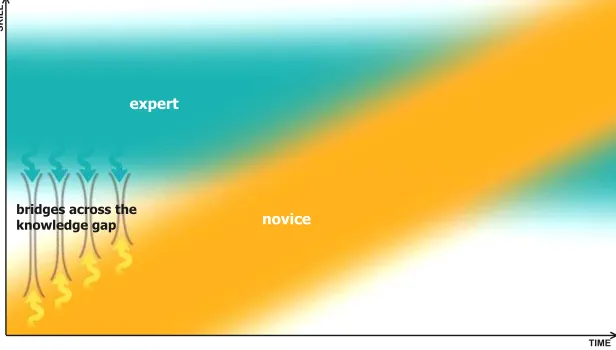
My perception of this process is illustrated in Figure 34. At the top there is the personal knowledge of the expert practitioner and below is that of the novice who is seeking to bring their craft skill at least up to the level of the expert. Initially,
however, there is a ‘knowledge gap’ between the two where the novice struggles to imitate the expert’s practice, being unable to interpret their own observations. To assist, the expert attempts to articulate their tacit knowledge through use of explicit concepts. These might be adapted and refined through reciprocal reflection until the novice and expert are in accord, the novice gains experience which enables them to dwell in the actions of the expert, and the gap is bridged.
novice expert
TIME
SK
IL
L
[image:10.595.95.403.327.502.2]bridges across the knowledge gap
Figure 3: Bridging the knowledge gap between craft expert and novice.
My role in this process has been both to encourage the articulation, helping negotiate reciprocal reflection between expert and novice, and to design the ‘bridges’: the explicit concepts that could help a novice access the expert’s tacit knowledge.
This was demonstrated in the research where I helped Robin articulate his
knowledge of how to achieve the correct cutting angle of the tool (Wood 2007:121). During the formal, experimental elicitation I had undertaken I had failed to
understand his technical explanation using angles. Working with the novice appeared to help Robin reflect on his explanation of the cutting angle of the tool. As the novice struggled to respond to his guidance he tried both modifying his explanation and physically putting the tool at the correct angle. Whilst this reciprocal reflection was not entirely satisfactory as the novice continued to struggle to use the tool,
afterwards Robin continued to reflect on the experience and came up with the notion
4
of dividing the movement into three which he demonstrated for me to record on video. Although this explanation was hesitant, it was sufficient for me to gain an understanding and then to use the prototype learning resource to develop
interpretive drawings with other learners. These helped the learners gain experience of the correct cutting angle of the tool as a starting point for building their own personal knowledge of tool use.
Once the novice has sufficient skill, they will become increasingly able to interpret the actions of the expert without need of bridges. This was illustrated by Robin when he described watching another turner who uses the same sort of hook tools but on an electric lathe, making a bowl on Robin’s foot-powered lathe:
“He just naturally turned the tool over and cut back at it from that side, which I'd never done before and I said, "oh no, you don't use it that way" and then I stopped and thought, "ah, that's actually quite helpful" and so I do that quite often myself if I've not got a flat rim. So I'd been a full time professional turner for 5 years before I started doing that.”
(Wood 2007:128)
As they reach this stage, the learners will increasingly be able to use the broader scope of a learning resource, making use of a wider range of video clips provided without interpretation.
Conclusion
The practical knowledge of a skilled craft practitioner is personal, context specific and largely tacit which can present a barrier to formal elicitation, but engagement with a novice practitioner can help stimulate the expert to articulate their knowledge. The novice seeks to dwell in the actions of the expert through observing them and taking action to imitate them (Polanyi 1966:30) and the expert offers assistance in the form of explicit concepts which are negotiated through a process of reciprocal reflection to bridge the knowledge gap between them.
The process of elicitation for the designer-researcher in this context can be seen as helping the expert craft practitioner articulate his knowledge through stimulating reciprocal reflection between expert and novice, then identifying and designing ‘bridges’ across the knowledge gap. The result of this elicitation will be contextual footage of the practitioner working and teaching, with additional interpretation provided for key skills which expert and novice consider fundamental to the learning process5.
The concepts of ‘true’ and ‘false’ cannot be applied to such elicited knowledge and in their place ‘helpful’ and ‘unhelpful’ are more appropriate. The bridges are not
necessarily the way to undertake the task, but a way that the expert feels to be helpful to get started. As their skill develops, the learner might find some of these to be the foundations upon which their skill is built, but some might be just stepping-stones on the way. Deciding which is which requires the learner to increasingly learn from experience, the feedback from their own actions, and this is achieved through developing the ability to think and act reflectively. This is where it is important that as much of the material generated during elicitation as possible should be also made available in the learning resource. It should retain its original context wherever
5
possible so more advanced learners can form their own judgement and make their own interpretation as their skill level advances.
To test and further develop these concepts I am just starting a joint research project with another practice-led researcher who is a contemporary knife maker, Dr Grace Horne. We shall be studying the skills of the last few traditional, Sheffield knife makers with Horne acting as ‘expert-learner’, working alongside the master
craftsmen and assisting with elicitation by stimulating reciprocal reflection. I will be observing and recording the process, using video as a starting point for developing interactive learning materials as well as a tool to help promote the expert-learner’s reflection. The understanding of the master craftsman's skills embedded in these materials will be progressively evaluated using low-fidelity prototyping techniques following methods developed in the preceding research. The resultant learning resource will finally be evaluated by a group of creative metalworkers with an interest in adapting traditional skills to new practices.
Bibliography
ARGYRIS C (1995). Action science and organizational learning. Journal of Managerial Psychology, vol 10, no 6, pp20-26.
BUUR J, BINDAR T & BRANDT E (2000). Taking video beyond 'hard data' in user centred design. Proceedings of the Participation and Design Conference (PDC 2000), New York.
COUNTRYSIDE AGENCY (2004). Crafts in the English countryside: towards a future. Countryside Agency, Wetherby, UK.
EDWARDS J S (2003). Knowledge engineering: a forgotten element in knowledge management. Keynote Presentation to Operational Research Society Annual Conference 2/3 September 2003 available at http://www.orsoc.org.uk/conf/ previous/or45/OR45%20Knowledge%20Engineering.doc accessed Oct 2004. GAMBLE J (2002). Teaching without words: tacit knowledge in apprenticeship.
Journal of Education, vol 28, pp63-82.
HERITAGE LOTTERY FUND (2002). Sustaining our living heritage - skills and training for the heritage sector. Research report, http://www.hlf.org.uk/dimages /sustaining_heritage.pdf, accessed Feb 2002.
JONES A M (1927). The rural industries of England & Wales, volume 4. Wales. E P Publishing, Wakefield, UK [1978 Edition].
NONAKA I & TAKEUCHI H (1995). The knowledge-creating company: how Japanese companies create the dynamics of innovation. Oxford University Press, New York.
POLANYI M (1958). Personal knowledge: towards a post-critical philosophy. Routledge & Kegan Paul, London.
POLANYI M (1966) The Tacit Dimension. Peter Smith, Gloucester MA [1983 edition]. RUSKIN J (1853). The Nature of Gothic. In Wilmer C [ed] (1985) Unto this last and
other writings. Penguin, London.
RUST C (2004). Design enquiry: tacit knowledge and invention in science. Design Issues, vol 20, no 4, pp76-85.
SCHÖN D A (1987). Educating the reflective practitioner: toward a new design for teaching and learning in the professions. Jossey-Bass, London.
SHADBOLT N & MILTON N (1999). From Knowledge Engineering to Knowledge Management. British Journal of Management, vol 10, no 4, pp309-322. WOOD N (2003). Design for tacit learning. MA Thesis, Sheffield Hallam University
WOOD N (2005). Unknown knowns: uncovering tacit knowledge for the design of interactive media. Proceedings of the Cumulus Spring Conference, IADE, Lisbon available from www.nicolawood.net.