A DESCRIPTIVE STUDY ON A PATTERN OF ANTIMICROBIAL
DRUGS USAGE IN A TERTIARY CARE HOSPITAL OF CENTRAL
TAMILNADU
Malliga Duraipandian1 and Jeyakumari Duraipandian*2
1
Associate Professor, Department of Pharmacology, KAPV Govt. Medical College, Tiruchirappalli, Tamilnadu.
2
Professor & Head, Department of Microbiology, JIPMER, Karaikal, Pondicherry. India.
ABSTRACT
Background: The resistant bacteria are on upward trend all over the world. Irrational and inappropriate prescription of antimicrobials is major contributing factor for developing drug resistance in addition to poor patient compliance. It is the high time to create awareness of
antimicrobial resistance among physicians and patients. Aim: The aim
of this study was to assess the pattern of antimicrobial usage in a tertiary care hospital in Tamil Nadu and to determine whether antimicrobials are prescribed judiciously. Methods: A retrospective study was conducted to determine the current antimicrobial prescribing practices in a tertiary care hospital. A randomized sample of 140 patients’ case sheets of various departments were taken from the
Medical record department and analyzed with respect to oral and
parenteral administration of antimicrobials. Results: In our study 46% were males and 54%
females. Majority of the patients were middle aged (44%). Duration of treatment was of three days minimum and maximum 13 days. The mean duration was 5.5 days. Common route of administration was parenteral. The parenteral drugs were metronidazole 42%, Cefotaxime 40%, ceftriaxone 33%, Amikacin 18%, Vancomycin 2% and Meropenem 1%. Among 140, 52% were empirical prescriptions, 19% directed and 28% targeted prescriptions.
Conclusions: The most frequently used antimicrobials were Metronidazole, Cefotaxime and Ceftriaxone. Antimicrobials commonly used were for lower respiratory tract infection. The proportion of targeted prescriptions was low compared to empirical prescriptions. Antimicrobials have to be prescribed rationally based on antibiotic policy. In near future we
Volume 8, Issue 1, 1097-1108. Research Article ISSN 2277– 7105
Article Received on 06 Nov. 2018,
Revised on 26 Nov. 2018, Accepted on 16 Dec. 2018
DOI: 10.20959/wjpr20191-13927
*Corresponding Author
Dr. Jeyakumari
Duraipandian
Professor & Head,
Department of
Microbiology, JIPMER,
Karaikal, Pondicherry.
should follow the recommendations of antibiotic stewardship relevant to the infections addressed in the guidelines.
KEYWORDS: Antimicrobial agents, Drug resistance, rational prescription, antibiotic policy, antibiotic stewardship.
INTRODUCTION
Antimicrobials are among the most prescribed medicine in a hospital setting for treatment of infection. Antimicrobial resistance is growing as the major challenge to the infectious disease control globally including India.[1,2,3,4] Literature reported the unnecessary or incorrect use of antimicrobials ranging from 9% to 64%.[5] This practice apart from development of drug resistance results in higher morbidity, mortality, treatment cost and prolonged length of hospital stay with unnecessary exposure of patients to potentially harmful drugs.[6,7,8] The world Health Organization (WHO) reports that more than 50% of the drugs are inappropriately prescribed, dispensed or sold and 50% of patients do not take medicines as per the schedule.[9] Because of increasing alarm and alertness of antimicrobial resistance problems, incorrect use of antimicrobial agents, these drugs have often been the target of challenges to assess and control their uses.[10] Therefore to fight against antimicrobial resistance, antibiotic utilization studies are being carried out. Clinicians often face challenges in selecting, initiating and individualizing appropriate drug therapy for patients admitted in the emergency medicine ward.[11] Antibiotic utilization studies are carried out to analyze the
prescribing pattern of drugs and prescribing behavior of physicians.[12] Monitoring the trends in drug utilization in tertiary care hospital can provide insight into major health care problems. Therefore, with the same perspective this retrospective study was done to evaluate the current usage of the antimicrobial agents in our tertiary care hospital.
MATERIALS AND METHODS
Study Design : Retrospective study
Study place : Tertiary care hospital, Central Tamilnadu
Study subjects : n=140, Inpatients case sheets from MRD was analyzed (Sep 2018 to October 2018)
discontinuation and related laboratory investigations were collected from patient case sheets from MRD.
Inclusion criteria: Inpatients from General Medicine, General Surgery, OBG, Pediatrics, Ophthalmology, Orthopedics, ENT, and Dermatology were included in this study.
Exclusion criteria: Patients in ICU and out patients were excluded in this study. Data were analyzed by descriptive method.
RESULTS
A total of 140 admitted patients’ case sheets were reviewed. Among 140 patients 46% were males and 53% were females. Majority of the patients were in 17 - 40 years (44%) of age
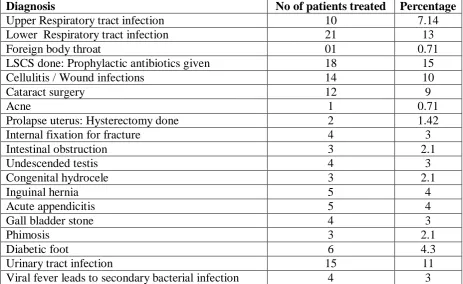
group and 20% were children. (Table 1) Out of the 140 patient records analyzed and that 12.85% were treated for lower respiratory tract infection and 10% were treated for cellulitis or wound infections. The others were treated for upper respiratory tract infections (7%), urinary tract infections (10%), viral fever (2%), acute appendicitis (3%), cataract surgery (8%) and skin infections (1%). (Table 2) The majority of the patients were treated in General Medicine (21%) followed by General surgery (22%), OBG (23%), Pediatrics (15%) and
others were treated in Ophthalmology, Orthopedics, ENT, and Dermatology ward. (Table 3)
15% of patients were received prophylactic antibiotics for LSCS.
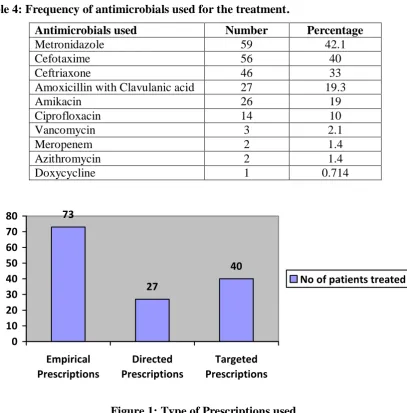
There were about ten different antimicrobials used for their treatments. The commonly prescribed antimicrobials were metronidazole (42%), Cefatoxime (40%), Ceftriaxone (32%),
Amoxycillin with clavulanic acid (19%), Amikacin (18%) and Ciprofloxacin (10%). (Table
4) Most of the above drugs were given by parenteral route since inpatients only were studied. Duration of treatment was minimum 3 days and maximum 13 days. Mean duration was 5.5 days and none of them reported any side effects.
Prescriptions were classified as three categories:
Empirical - When the pathogen was unknown at the time of prescription.
Directed - when the pathogen was suspected based on provisional microbiological result (such as Grams stain)
Targeted - When a pathogen was identified
Table 1:Demographic profile.
Age
Variable Frequency (Numbers) Percentage
0 – 16 years 31 22.14
17-40 years 62 44.3
41-60 years 34 24.3
˃ 60 years 13 9.3
Sex Male 65 46.4
[image:4.595.66.530.231.515.2]Female 75 53.6
Table 2: Clinical conditions for which patients were started antibiotics.
Table 3: Department under which the patients have been admitted and treated.
Department Frequency Percentage
Medicine 30 21.4
Surgery 31 22.1
OBG 33 23.6
Pediatrics 21 15.00
Pediatric Surgery 7 5.00
Ophthalmology 12 8.6
ENT 1 0.71
Skin 1 0.71
Orthopedics 4 2.9
Diagnosis No of patients treated Percentage
Upper Respiratory tract infection 10 7.14
Lower Respiratory tract infection 21 13
Foreign body throat 01 0.71
LSCS done: Prophylactic antibiotics given 18 15
Cellulitis / Wound infections 14 10
Cataract surgery 12 9
Acne 1 0.71
Prolapse uterus: Hysterectomy done 2 1.42
Internal fixation for fracture 4 3
Intestinal obstruction 3 2.1
Undescended testis 4 3
Congenital hydrocele 3 2.1
Inguinal hernia 5 4
Acute appendicitis 5 4
Gall bladder stone 4 3
Phimosis 3 2.1
Diabetic foot 6 4.3
Urinary tract infection 15 11
Table 4: Frequency of antimicrobials used for the treatment.
Antimicrobials used Number Percentage
Metronidazole 59 42.1
Cefotaxime 56 40
Ceftriaxone 46 33
Amoxicillin with Clavulanic acid 27 19.3
Amikacin 26 19
Ciprofloxacin 14 10
Vancomycin 3 2.1
Meropenem 2 1.4
Azithromycin 2 1.4
Doxycycline 1 0.714
40
27 73
0 10 20 30 40 50 60 70 80
Empirical Prescriptions
Directed Prescriptions
Targeted Prescriptions
[image:5.595.92.500.70.484.2]No of patients treated
Figure 1: Type of Prescriptions used.
DISCUSSIONS
In our study, the most frequently used antimicrobials were Metronidazole, Cefotaxime and Ceftriaxone. A study by Pandimunian etal, stated that Cephalosporin (35.6%) and Penicillin (21.3%) were the most commonly prescribed group of antimicrobials.[13] Similar to our study, Vandana AB et al also mentioned that the commonest antimicrobial agent prescribed was
Cefotaxime,[14] whereas Ampicillin, Amoxicillin, Metronidazole, Ciprofloxacin and
Crystalline Penicillin were the five commonly prescribed antibiotics in the study conducted by Shankar etal.[15] Sharif etal study showed that Amoxicillin – Clavulanic acid combination
was prescribed commonly among the antibiotics.[16] A study performed in Ethiopia revealed
In our study, duration of treatment was minimum 3 days and maximum of 13 days and mean duration was 5.5 days. Generally, the majority of infectious diseases were treated for period less than 2 weeks, but severe and complicated cases may demand multiple antimicrobials for prolonged duration.[18,19,20] Prolonged use of antibiotics is one of the factors which provoke the emergence of resistant organism. The common route by which antimicrobials were administered was parenteral as the patients were inpatient. The common parenteral (IV) drugs were Metronidazole, Cefotaxime, Ceftriaxone, Amikacin and Ciprofloxacin. In our study, nearly two fifth of the patients (64%) have received two are more antimicrobial agents. Correspondingly, Girish MB, etal reveals that 58% received two or more antimicrobials in combination and their mean duration of administration being 9.79 ± 1.33 days.[21] In our study the common organism causing lower respiratory tract infections were due to gram
positive and gram negative bacteria, so they were prescribed by broad spectrum antibiotics like Cefotaxime, Ceftriaxone along with Metronidazole. Majority of the patients were treated empirically (52%) and only 28% cases were treated appropriately and rationally after doing antibiogram of the specific clinical sample isolates.
In our study, 15% of the patients were received prophylactic antimicrobials, but in Cusini etal study highlighted that out of 1270 antimicrobial prescriptions, 958 (75.4%) were for
treatment and 312 (24.6%) were for prophylaxis, which concluded that 37% of the therapeutic and 16.6% of the prophylactic prescriptions were inappropriate.[22] As infectious disease specialist are not available adequately and these drugs are prescribed by various health care professionals both in developed and developing countries, sometimes without adequate knowledge about the use of these important therapeutic drugs.[9] Certain other factors also influences antimicrobial prescribing practices include patients factors (demand, culture, attitude and socioeconomic status), prescribers factors (prequalification training, in - service education, work load and feedback from patient responses), drug factors (availability, cost) and influence of industry (medical detailing). However, the most important factor could be the current antibiogram pattern of the hospital.[9]
infectious disease specialist all over India. An antibiotic guide line (as a booklet) was introduced in Australia and study was conducted subsequently in order to reduce the drug resistance.[23] Antibiotic guidelines should be formulated and accepted by various health care professionals including physicians, surgeon, microbiologist and pharmacologist. Physician must be aware of the prevalence of various pathogens and resistance patterns in their hospital and explore good judgments in selecting empirical antibiotics regimens.[24]
Antibiotic resistance and the scarce antibiotic choices for multi - drug resistant organisms are exigent worldwide public health problems. Consequently, antibiotic stewardship has become a critical responsibility for all health care institutions and antibiotic prescribers. Professional societies and organizations have been developing guidelines for management of infectious diseases. It includes recommendations for antibiotic prescribing and also incorporating antibiotic stewardship principles. The CDC released the core elements of hospital antibiotic stewardship program in 2014.[25] It endorses, as suitable for the type of infection and treatment scenario should be cited in guidelines and to determine the optimal antibiotic selection, dose, route and duration of treatment. Hence, the Healthcare Infection Control Practices Advisory Committee (HICPAC) recommends that guidelines for treatment of infectious diseases include clear recommendations for antibiotic stewardship relevant to the
infections addressed in the guidelines.[26]
I. Professional societies and guidelines developers should also incorporate the principles of
diagnostic testing and their treatment guidelines. This leads to optimal effective treatment, minimal adverse consequences including the development of antibiotic resistance and health care values.
a. Principles of testing
1. Diagnostic testing should be used wisely to avoid unnecessary antibiotic therapy or therapy that is unnecessarily broad – spectrum with consideration of health care value.
2. Rapid diagnostic tests, biomarkers, the decision rules that should have acceptable performance characteristics to differentiate bacterial versus non bacterial infection should be used to avoid use of unnecessary antibiotic therapy.
4. When available and appropriate for the infection and the bacterial isolate, molecular testing to identify specific resistance genes or novel non culture based phenotypic assays of susceptibility may be used to target antibiotic therapy towards susceptible or resistant isolates.
5. Avoid diagnostic testing without an appropriate clinical indication when the results may
have unintended consequences. For example, a urine culture, rapid Strep test or C.difficile testing should not be done, unless the patient meets criteria for testing.
b. The principles of treatment include
1. When appropriate for the infection, source removal (eg: drainage of abscess, removal of
implicated device) should be accomplished early in the course of treatment.
2. Recommendations for initial empirical antibiotic therapy choices should balance
treatment, efficacy, severity of illness (ie: sepsis) and the potential for adverse events including the development of antibiotic resistance. When multiple therapeutic options are available, a hierarchy of antibiotic treatment recommendations should be provided with “first choice” options being those with adequate therapeutic efficacy, lower risk of
facilitating antimicrobial resistance and C. difficile and other adverse events, with consideration of health care value.
3. Recommendations for optimal dosing of antibiotics should be based on efficacy studies and Pharmacokinetic and Pharmacodynamics principles.
4. Recommendation for duration of therapy should be made emphasizing the shortest
effective duration.
5. Recommendations for de - escalation of initial empiric antibiotic therapy should be provided including:
a) Using the results of bacterial cultures and diagnostic tests to discontinue or narrow unnecessarily broad spectrum antibiotic therapy.
b) Using other stewardship tools such as consultation with an antibiotic stewardship team and or infectious diseases specialist, daily review of antibiotic therapy and automatic stop orders after adequate treatment duration.
6. Potential adverse events related to antibiotic treatment should be noted in the guideline so that an antibiotic or to choose a recommended agent that has a lower potential for adverse events.
efficacy and adverse consequences including antibiotic resistance, with consideration of health care value either in the text or a table.
III.Recommendations for patient’s education regarding diagnostic testing, antibiotic therapy
and duration of therapy should be provided when feasible and appropriate.
To ensure that these principles are incorporated into the recommendation of clinical practice guidelines, organizations and guidelines panels review the principles at multiple stages of the guideline development process including.
1. Establishments of the guidelines panel and writing group comprise the antibiotic
stewardship principles in the training and education of the guideline panel or writing group chairs.
2. Scoping of the guidelines – it provides panel chairs with checklist of the principles at the scoping phase of the development process so that the principles inform the guideline scope.
3. Development of PICO (T) guideline questions (Population, Intervention, Comparison,
Outcome and Time)
4. Review and draft recommendations and evidence summaries which include an assessment
of the incorporation of the principles
CONCLUSION
From this study, we concluded that most frequently used antimicrobials were Metronidazole,
Cefotaxime and Ceftriaxone and the condition for which these antimicrobials were commonly used was lower respiratory tract infections. The proportion of targeted prescriptions was low compared to empirical prescriptions. Antimicrobials have to be prescribed rationally based on antibiotic policy. In near future we should follow the
recommendations of antibiotic stewardship relevant to the infections addressed in the guidelines. Antibiotic stewardship program should provide regular updates on antibiotic prescribing, antibiotic resistance and infectious disease management that address both national and local issues.
REFERENCES
1. Boucher HW, Talbot GH, Bradley JS, Edwards JE, Gilbert D etal. Bad bugs, no drugs: no
2. Khan E, Ejaz M, Zafar A, Jabeen k, Shakoor S, Inavat R etal. Increased isolation of ESBL producing Klebsiella pneumoniae with emergence of Carbapenem resistant isolates in Pakistan: report from a tertiary care hospital. J Pak Med Assoc, 2010; 60(3): 186-90.
3. Huttner A, Harbarth S, Carlet J, Cosgrove S, Goossens H, Holmes A etal. Antimicrobial
resistance; a global view from the 2013 World Health Care- Associated infections Forum. Antimicrob Resist Infect Control, 2013; 2: 31.
4. Goossens H, Ferech M, Vander Stichele R, Elseviers M, ESAC Project Group. Outpatient
antibiotic use in Europe and association with resistance: A cross – national database study. Lancet, 2005; 365(9459): 579-87.
5. Cusini A, Rampini SK, Bansal V, Ledergerber B, Kuster SP, Ruef C etal. Different patterns of inappropriate antimicrobial use in Surgical and Medical units at a tertiary care
hospital in Switzerland: A prevalence survey. PLoS One, 2010; 5(11): e14011. https://doi.org/10.1371/journal.pone.0014011
6. Cosgrove SE. The relationship between antimicrobial resistance and patient outcomes: mortality, length of hospital stay and health care costs. Clin Infect Dis, 2006; 42(2): S82- 9.
7. McGowan JE, Jr, Economic impact of antimicrobial resistance. Emerg infect Dis, 2001;
7(2): 286-92.
8. Maragakis LL, Perencevich EN, Cosgrove SE. Clinical and economic burden of
antimicrobial resistance. Expert Rev Anti Infect Ther, 2008; 6(5): 751-63.
9. Seikh Farid UA, Mohammed Fauzi AR, Jamalluddin Ab Rahman, Mohamad SN, Sapari
S, Mohamed BA et al. Antimicrobial Use and Factors Influencing Prescribing In Medical Wards of a Tertiary Care Hospital in Malaysia. Int J. of Sci Environ and Technol, 2012; 1(4): 274-84.
10.Sahar Mohy Ahmed EA. Different patterns of inappropriate antimicrobial use: A cross sectional study. Life Sci J, 2013; 10(3): 216-22.
11.Farhan AK, Vinod KS, Sanjee S, Preeti S. Prospective study on the antimicrobial usage in
the Medicine Department of a tertiary care teaching hospital. J Clin Diagn Res, 2013; 7(7): 1343- 46.
12.Cheekavolu C, Pathapati RM, Laxmansingh KB, Saginela SK, Makineedi VP,
13.Pandiamunian J, Somasundaram G. A study on prescribing pattern of antimicrobial agents in the medical intensive care unit of a tertiary care teaching hospital in Puducherry Union territory, South India. Int J Pharm and Pharm sci, 2014; 6(3): 235-38.
14.Vandana AB, Sanjaykumar BN. Study of prescribing pattern of antimicrobial agents in medicine intensive care unit of a teaching hospital in Central India. JAPI, 2012; 60: 20-23.
15.Shankar RP, Praveen P, Nagesh Kumar S, Joshy ME, Kottallur Narayanan B et al. Prescribing patterns of antibiotics and sensitivity patterns of common microorganisms in the internal medicine ward of a teaching hospital in western Nepal: A prospective study. Ann clin Microbiol Antimicrob, 2003; 2: 7.
16.Sharif SI, Al – Shaqra M, Hajjar H, Shamout A, Wess L. Patterns of Drug prescribing in a
hospital in Dubai, United Arab Emirates. Libyan J Med, 2008; 3: 10-12.
17.Woldu MA, Suleman S, Workneh N, Berhane H. Retrospective study of the patterns of
antibiotic use in Hawassa University referral hospital Paediatric ward, Southern Ethiopia. J Appl Pharm Sci, 2013; 3(2): 93 – 98.
18.Rao GG, Patel M. Urinary tract infection in hospitalized elderly patients in the United Kingdom: the importance of making an accurate diagnosis in the post broad – spectrum antibiotic era. J Antimicrob Chemother, 2009; 63(1): 5-6.
19.Nicolle L. AMMI Canada Guidelines Committee. Complicated urinary tract infection in
adults. Can J Infect Dis Med Microbiol, 2005; 16(6): 349 -60.
20.Wood ford HJ, George J. Diagnosis and management of urinary infections in older people. Clin Med (Lond), 2011; 11(1): 80-83.
21.Girish MB, Kumer TN, Srinivas R. Pattern of antimicrobials used to treat infected Diabetic in a tertiary care hospital in Kolar. Inter J Pharma and Biomed Sci, 2010; 1: 48-52.
22.Cusini A, Rampini SK, Bansal V, Kuster SP, Ruef C, Weber R. Different patterns of inappropriate antimicrobial use in surgical and Medical units at a tertiary care hospital in
Switzerland. A Prevalence Survey. Plos one, 2011; 5(11): e14011.
23.Harvey K, Rogers S, Roughbad L. Initiative to improve antibiotic use. Aust Prescriber, 1999; 22: 26-28.
24.Hanssens Y, Ismaeil BB, Kamha AA, Elshafie SS, Adheir FS, Saleh TM et al. Antibiotic
25.CDC. Core Elements of Hospital Antibiotic Stewardship Programs. Atlanta, GA: US
Department of Health and Human Services, CDC; 2014. Available at
http://www.cdc.gov/getsmart/healthcare/ implementation/core-elements.html.