v1.2
Manual
Click here to continue or whack the logoIntroduction Tutorials Reference What's New FAQ Credits
v1.2
Introduction
What's New in Audacity 1.2 How to use this manual
Tutorials
Basics − About Digital Audio
I.
Editing for Beginners II.
Common Editing Tasks III.
Effects for Beginners IV.
Selecting and Aligning V.
Shortcuts
Effects − How they work
Frequently Asked Questions Credits
Back to the main page Introduction
Experienced users should head down to this section
in this document. Audacity ...
a free cross platform audio editor.
For new users to Audacity, see the Tutorial in five parts for some basics on digital audio, setting up Audacity, selecting, aligning, and recording.
Audacity is currently in version 1.2.3. This is a stable release of Audacity; it has been tested and works well for most people. However, it comes with no guarantee, and we depend on your feedback in order to continue to improve on it. Please check our website for the latest version. Audacity is a collaborative project, so there are lots of opportunities for you to get involved if you're interested!
http://audacity.sourceforge.net/ What can you do with Audacity?
Audacity is a program that manipulates digital audio waveforms. In addition to recording sounds directly from within the program, it imports many sound file formats, including WAV, AIFF, MP3, and Ogg Vorbis. PCM
What can't Audacity do?
Although Audacity is a very powerful audio editor that works with an unlimited number tracks of virtually unlimited size, it cannot do everything. It cannot :
sound
built−in volume envelope editor
•
customizable spectrogram track view mode
•
frequency analysis window for audio analysis applications
•
custom playback rate for every track, which is live−resampled to the project sample rate
•
simple to complex align operations for tracks and groups of tracks
•
MIDI editor, and its MIDI features are extremely limited.
How does it work − a quick intro for experienced users Audacity works with tracks, that contain one
audio file. This file is editable and all actions are undoable. Undo's are instantaneous.
Almost anything is undoable, including importing and deleting tracks!
There are no inserts, auxes or buses yet.
All versions can use LADSPA plugins, and the Windows and Mac versions can use VST plugins using the VST Enabler (a separate download).
There is volume automation via the envelope tool.
Editing functions include Cut, Copy,
Paste,Duplicate(to new track at same timecode), Split(to new track at same timecode), and Silence.
A grid can be activated for each track, and snapping can be switched on as well.
What makes Audacity unique?
Audacity is free and the source code is available under the GNU General Public License.
•
Audacity is cross−platform − it runs on Windows (98 through XP), Mac OS X, and many Unix platforms, including Linux. Previous versions worked with Mac OS 9.
•
No limits on the number of tracks or the length of any track, except the size of your hard disk.
Import almost anything: WAV, AIFF, Next/AU, IRCAM, MP3, and Ogg Vorbis files are supported natively, but Audacity will also open just about any uncompressed sound file and automatically deduce the format (using the Import Raw Data... feature).
•
Audacity not only includes many high−quality effects built−in, but also lets you use LADSPA and VST plug−in effects. There are dozens of free, shareware, and commercial plug−ins online that do everything from Reverb to Noise Reduction.
•
Audacity supports plug−ins written in the Nyquist programming language, a high−level language designed specifically for working with audio.
•
Audacity acts like a non−destructive editor, providing multiple levels of undo, but it also writes changes made to the audio to disk, eliminating the need for complicated real−time processing.
•
Label tracks allow you to annotate waveforms (for example, transcribing speech) and later export the waveforms to a text file.
•
Powerful spectral features allow you to view waveforms as spectrograms or plot the power spectrum of any region of audio, and even export this data to a spreadsheet.
•
Pitch−changing and tempo−changing effects
•
Credits
The Audacity manual was written by Anthony Oetzmann, with major contributions by Dominic
Mazzoni.
Anthony Oetzmann is the primary documentation writer for Audacity. He wrote most of the manual
you are reading now, and has also influenced the program design significantly. He is a professional audio engineer who lives and works in Germany.
Dominic Mazzoni is the Audacity project leader and Audacity's primary programmer. He began the
project while a graduate student at Carnegie Mellon University in Pittsburgh, PA. He is currently a research programmer at the NASA Jet Propulsion Laboratory in Pasadena, CA.
The Audacity logo was designed by Harvey Lubin of Agrapha.
For a list of all of the people who contributed to Audacity, and for up−to−date contact information for Tony, Dominic, and other contributors, please visit our website at:
Back to the front page
What's New in Audacity 1.2 ??
(History of Audacity)
New features in Audacity 1.2:
User Interface
New Mixer toolbar allows you to control the output volume, input volume, and input source directly from Audacity.
•
Every track now has its own gain and pan controls.
•
Uses improved project file format.
•
Block files (stored in Audacity project directories) now use the standard AU format. Though some Audacity meta−information is in these files, they can now be read by many other popular audio programs as well.
•
Import RAW has a simpler GUI but support for far more file formats. The autodetection algorithms are much more accurate than in 1.0.
•
Using high quality resampling algorithms, with the option of better
•
Effects
Repeat Last Effect command.
•
Support for LADSPA plug−ins on all platforms.
•
VST support now comes through an optional LADSPA plug−in called the VST Enabler.
•
Most effects now have a Preview button.
•
Compressor (Dynamic Range Compressor).
•
Change Pitch (without changing tempo).
•
Change Tempo (without changing pitch).
•
Change Speed (changing both pitch and tempo).
•
Repeat (useful for creating loops).
•
Normalize (adjust volume and DC bias).
Improved look and placement of toolbars.
•
New custom mouse cursors.
•
Complete implementation of editable keyboard shortcuts.
•
Find zero−crossings.
•
Mouse wheel can be used to zoom in and out.
•
Multi−Tool mode.
•
Amplify and fade using envelope.
•
Labels can store selections (like Audacity 1.0.0).
•
Open multiple files from the same dialog.
•
button).
New features in Audacity 1.1.1:
User Interface
Tooltips appear in Statusbar.
•
Vertical cursor follows play/record.
•
Pause button.
•
Drawing tool (with three different modes).
•
Vertical Resizing of stereo tracks is more fun.
•
Adjust selection by click−dragging selection boundary.
•
Toolbar button context−sensitive enabling/disabling.
•
Better zooming functionality (centers region).
•
Mac OS X
Support for more audio hardware
•
Support for full−duplex (play while recording).
•
Support for MP3 exporting using LameLib Carbon.
•
Hardware and Software playthrough support.
•
Unix
Audacity now has a man page (it describes command−line options and how to set the search path).
Multiple ways to display the cursor position and selection.
•
Snap−to selection mode.
•
Drag tracks up and down.
•
Align and group align functions.
•
Cursor save/restore.
•
Working history window.
•
Effects
Effects broken down into three menus: Generate, Effect, and Analyze.
•
Generate menu lets you generate silence, noise, or a tone.
•
Nyquist support (supports plug−ins written in Nyquist, an interpreted functional language based on Lisp).
•
Localization
Improved localization support.
•
More languages available.
•
Language selection dialog on first startup.
•
File Formats
Uses libsndfile, which fixes some bugs and improves performance. Allows a wide range of
uncompressed audio formats to be imported and exported
•
Searching for Files:
On Windows and Mac OS, Audacity now looks for translations in the "Languages" folder and all plug−ins in the "Plug−ins" folder, relative to the program.
•
On Unix, Audacity looks for
translations in <prefix>/share/locale and looks for everything else in <prefix>/share/audacity and also in any paths in the AUDACITY_PATH environment variable.
•
New features in Audacity 1.1.0:
New libraries in Audacity 1.1:
here you'd normally find links to stuff of the same category as the current page
How to use this manual
In this manual you'll find lots of common screen elements, that you can rely on to navigate this manual.
TOP LEFT CORNER −> Back to the main page. Having trouble with this? Take a nap
and try again.
TOP MIDDLE −> Back to the previous page, in this case probably the main page
BOTTOM MIDDLE −> Back to the previous page, in this case probably the main page
BOTTOM LEFT
CORNER −> Back to the main page
To reiterate, to get back to the main contents page, check the top−left corner of the page. To return to the page above the current one in the manual, check the top−middle of the page.
Any stuff that fits in to the same category of the current page is usually available as a link just above the page title and below the link back to the previous page.
That way you can jump around all the tutorial pages that belong together for example.
Keyword search
Back to the main page Tutorials
I. Basics
Digital Audio 1.
Rules of Audacity 2.
Setup, Audio Import and Playback 3.
Recording with Audacity 4.
II. Editing for Beginners
Introduction to Editing... 1.
Cut, Copy & Paste 2.
Silence, Duplicate and Split 3.
Splitting and Submixes 4.
III. Common Editing Tasks
Quickies 1.
Editing Vocal Tracks 2.
Cutting up long Tracks 3.
IV. Effects for Beginners
A virtual room with Reverbs 1.
V. Selecting and Aligning
How do effects work in Audacity ? Basic Calculus of Acoustics
Reverb Delay Chorus
Back to the main page Back to the Tutorial Page
Digital Audio Rules of Audacity Setup, Audio Import and Playback Recording with Audacity
Tutorial − I.Basics
Part 1 − Digital Audio − Part 1
What is sound?
Sounds are pressure waves of air. If there wasn't any air, we wouldn't be able to hear sounds. There's no sound in space.
We hear sounds because our ears are sensitive to these pressure waves. Perhaps the easiest type of sound wave to understand is a short, sudden event like a clap. When you clap your hands, the air that was between your hands is pushed aside. This increases the air pressure in the space near your hands, because more air molecules are temporarily compressed into less space. The high pressure pushes the air molecules outwards in all directions at the speed of sound, which is about 340 meters per second. When the pressure wave reaches your ear, it pushes on your eardrum slightly, causing you to hear the clap.
strike (which is a little like a hand clap), the sound comes from the vibration of the bell. While the bell is still ringing, it vibrates at a particular frequency, depending on the size and shape of the bell, and this causes the nearby air to vibrate with the same frequency. This causes pressure waves of air to travel outwards from the bell, again at the speed of sound. Pressure waves from continuous vibration look more like this:
How is sound recorded?
A microphone consists of a small membrane that is free to vibrate, along with a mechanism that translates movements of the membrane into electrical signals. (The exact electrical mechanism varies depending on the type of microphone.) So acoustical waves are translated into electrical waves by the microphone. Typically, higher pressure corresponds to higher voltage, and vice versa.
A tape recorder translates the waveform yet again − this time from an electrical signal on a wire, to a magnetic signal on a tape. When you play a tape, the process gets performed in reverse, with the magnetic signal transforming into an electrical signal, and the electrical signal causing a speaker to vibrate, usually using an electromagnet.
How is sound recorded digitally ?
as many times as you want, with no loss in quality, and they can be burned to an audio CD or shared via the Internet. Digital audio files can also be edited much more easily than analog tapes.
The main device used in digital recording is a Analog−to−Digital Converter (ADC). The ADC captures a snapshot of the electric voltage on an audio line and represents it as a digital number that can be sent to a computer. By capturing the voltage thousands of times per second, you can get a very good approximation to the original audio signal:
Each dot in the figure above represents one audio sample. There are two factors that determine the quality of a digital recording:
Sample rate: The rate at which the samples are captured or played back, measured in Hertz
(Hz), or samples per second. An audio CD has a sample rate of 44,100 Hz, often written as 44 KHz for short. This is also the default sample rate that Audacity uses, because audio CDs are so prevalent.
•
Sample format or sample size: Essentially this is the number of digits in the digital
representation of each sample. Think of the sample rate as the horizontal precision of the digital waveform, and the sample format as the vertical precision. An audio CD has a precision of 16 bits, which corresponds to about 5 decimal digits.
•
familiar with the decibel (dB) scale, the dynamic range on an audio CD is theoretically about 90 dB, but realistically signals that are −24 dB or more in volume are greatly reduced in quality. Audacity supports two additional sample sizes: 24−bit, which is commonly used in digital recording, and 32−bit float, which has almost infinite dynamic range, and only takes up twice as much storage as 16−bit samples.
Playback of digital audio uses a Digital−to−Analog Converter (DAC). This takes the sample and sets a certain voltage on the analog outputs to recreate the signal, that the Analog−to−Digital Converter originally took to create the sample. The DAC does this as faithfully as possible and the first CD players did only that, which didn't sound good at all. Nowadays DACs use Oversampling to smooth out the audio signal. The quality of the filters in the DAC also contribute to the quality of the recreated analog audio signal. The filter is part of a multitude of stages that make up a DAC. How does audio get digitized on your computer?
Your computer has a soundcard − it could be a separate card, like a SoundBlaster, or it could be built−in to your computer. Either way, your soundcard comes with an Analog−to−Digital Converter (ADC) for recording, and a Digital−to−Analog Converter (DAC) for playing audio. Your operating system (Windows, Mac OS X, Linux, etc.) talks to the sound card to actually handle the recording and playback, and Audacity talks to your operating system so that you can capture sounds to a file, edit them, and mix multiple tracks while playing.
Standard file formats for PCM audio
There are two main types of audio files on a computer:
PCM stands for Pulse Code Modulation. This is just a fancy name for the technique described above, where each number in the digital audio file represents exactly one sample in the waveform. Common examples of PCM files are WAV files, AIFF files, and
Sound Designer II files. Audacity supports WAV, AIFF, and many other PCM files.
•
The other type is compressed files. Earlier formats used logarithmic encodings to squeeze more dynamic range out of fewer bits for each sample, like the u−law or a−law encoding in the Sun AU format. Modern compressed audio files use sophisticated psychoacoustics
algorithms to represent the essential frequencies of the audio signal in far less space. Examples include MP3 (MPEG I, layer 3), Ogg Vorbis, and WMA (Windows Media Audio). Audacity supports MP3 and Ogg Vorbis, but not the proprietary WMA format or the MPEG4 format (AAC) used by Apple's iTunes.
For details on the audio formats Audacity can import from and export to, please check out the Fileformats page of this documentation. Please remember that MP3 does not store uncompressed PCM audio data. When you create an MP3 file, you are deliberately losing some quality in order to use less disk space.
Next part − Rules of Audacity
Digital Audio Rules of Audacity Setup, Audio Import and Playback Recording with Audacity
Tutorial − I.Basics
Part 2 − Rules of Audacity − Part 2
If you'd like to get straight playing an imported file or recording something, you can skip this section and come back later.
Whenever you work with Audacity, there are some rules you should remember: 1. One clip per track
A clip is simply a piece of audio material. Imported, recorded, split or duplicated from another track, one track can only carry one piece of audio at a time. You can extend it by pasting material or inserting silence in to it, or cut a piece away, but it will always be one continuous piece of audio. 2. Audacity always records to a new track
This new track is opened at the bottom. You'll have to zoom out and then resize the track view of the bottom most track to see what is recorded. You can actually use the window sliders at the bottom and right to do this after starting to record, but this way no performance will be lost to the windowing system.
I suggest hitting CTRL+F to get an overview of the entire project as well. This only affects the horizontal zoom by the way(left−right zoom). There is no way to zoom out vertically without using the mouse yet.
3. Edit/Duplicate will not create a new audio file
This may not seem a big deal, but it is if you're editing a large live recording.
What Audacity does is reference the original audio material until you actually perform some kind of edit on it, such as cutting a piece away, or using any effect on it. One thing to remember is the
saved your project.
You may ask what happens if you do, for example, cut away a piece or mark off a 30 minute piece and split it to a new track. It only writes changed data to disk. Since Audacity works with chunk of audio data of around one megabyte in size, this happens quite fast. Rest assured that the only big waiting period might be the importing of large audio files.
To further explain how Audacity works, flip to the next page ...
Next Part − Setup, Audio Import and Playback
Digital Audio Rules of Audacity Setup, Audio Import and Playback Recording with Audacity
Tutorial − I.Basics
Part 3 − Setup, Audio Import and Playback − Part 3
1. Create a new project This is very important!
Audacity writes all the changed and recorded audio to a directory called Projectname_data, which is located right where you saved the project file itself.
Thus, select and choose a location and filename for your project. Please note that when you startup Audacity fresh, only the " Save As..." menu option is available. To save your project later on, you can also use the keyboard shortcut : CTRL+S
2. Check the Preferences Again, this is very important!
...set the sample rate of your choice... (44.1 kHz is the default)
before editing" means, that Audacity actually copies the entire audio file that you imported in to its project data directory and in the process sets up the little overview graphics, whose descriptions get stored in the project data directory too.
The second way is to use the original imported audio. You may think we're actually editing this file, but no we aren't. In fact, Audacity will now read the imported file once and simply create the
graphics overviews for them in the data directory, and subsequently write to disk all the audio data that you change. The original file is only used for playback. All audio that remains unchanged will be played from the original file.
The advantage of choosing to make a copy of the original is that you avoid trouble, should
anything in the original file change.
For example, should you accidentally delete the original file, you're lost.
You have to make up your mind before you start a project. Choose to make a copy of all imported files, and you'll use more space on your hard disk(s), but it will be easier to back up the project too, because all files that have anything to do with your project will be in the project data directory. The Uncompressed Export Format can be set to WAV or AIFF for now. Please check the fileformats page for further information on export formats.
We'll ignore the Spectrogram settings for now. The Directories setting can be ignored as well for now, because all it sets is the directory to use for recordings, undo data and other stuff, if you haven't yet saved your project. Since we already saved our project, this setting is of no importance to us, though you may want to set it properly later on. Initially this is set to a folder called
"audacity_temp_1.2" in the system temporary directory. 3. Import an audio file
1. Simply drag and drop the audio file in to the Audacity window. (If you're using Mac OS 9 or X, drag the audio file to the Audacity icon instead...)
2. Select Import Audio ... in the Project menu. 3. Use the keyboard shortcut : CTRL+I
Audacity can import WAV, AIFF, AU, IRCAM, MP3 and OGG files. Please refer to the fileformats page for further reference on these audio formats.
4. Playback
The imported file should now be displayed in an audio track. The track will look a little like this, depending on what you imported :
Trackpanel and Waveform Overview of the imported Track
If you're not sure where to find audio material, simply rip some off a CD, or in Windows, check the Media folder in the directory of your Windows installation.
Back to the main page Back to the Tutorial Page
Digital Audio Rules of Audacity Setup, Audio Import and Playback Recording with Audacity
Tutorial − I.Basics
Part 4 − Recording with Audacity − Part 4
1. Create a new project
Save an empty project. Or simply use the one from the previous part. Remember, that if you don't save your project before you start recording or importing, that all recordings, edit and other files will be written to directory set in the Directories preferences.
2. Check the preferences
Make sure your playback and recording device are set. If you're going to record a stereo signal, check the "Record in stereo" checkbox in the Audio I/O preferences.
When picking a device to record from, make sure you've set up all the connections properly, such as plugging a microphone in to the Mic Input, and any other device in to the Line In of your sound card. Then check that the gain level knob(the amount by how much the input should be amplified) of the mixer of your soundcard is set right.
Since most soundcards can mix the inputs back in to the outputs, the easiest way to test your
Click on the blue Pause button to pause the recording. Press it again to continue.
Click on the yellow Stop button to cease recording. The cursor will return to its previous position, before the recording was started.
That's it. You can now play around with your recording and explore the editing capabilities of Audacity. Remember that you can use the Undo function almost without limits.
Back to the main page Back to the Tutorial Page
Introduction Cut,Copy&Paste Silence, Duplicate and Split Splitting and Submixes
II.Editing for Beginners
Part 1 − Introduction − Part 1
Sound Editing in the "real world"
Sound editors clean up dialogue tracks, cut layers of special effects, place sounds at certain times, create ambiance tracks by cutting out unwanted stuff and mixing in interesting or necessary sounds. Music production engineers may cut pieces of vocals away or shift them to a another spot in a song. Editing is about cutting, placing, fading, cross−fading, shifting, duplicating and adjusting the volume (also referred to as level) of audio material. Mixing is a form of editing too of course.
Here is an example of what is done in sound editing during the production of a television show or film. In the next part we will run you through a few of those techniques in Audacity.
The Path of Sound in Film and TV Postproduction
Film and TV crews have at least two people present that take care of recording sound during principal photography of a show. Principal photography is usually shooting the scenes with actual live actors or real backgrounds by the way.
Sound in Principal Photography
records the sound captures by the boom pole operator, either via cable or wireless devices to tape, optical disks or hard drive.
This is the raw sound material of a show. It is called production sound and the only desirable parts it usually contains are dialogue and body sounds. In post production, depending on the complexity, budget size and time, almost everything you hear except for the dialogue and some body sounds, are added later during ...
Post Production
This is where most of the stuff we'll be describing for Audacity will happen. You've got the recording. Now what ?
After the visual part of the show is cut, the first of which usually isn't the final one, it is handed to the sound editor. In TV shows, you'll usually have one or two people for this, for major film productions a whole bunch more, for which tasks will be subdivided on a finer level.
Raw sound − Cleanup time
No shows do without film edits and many have plenty of them.
Scenes may be shot with with one or more cameras and mics. Actors might have flunked their lines and picking up shooting prior to the mistake might be chosen or the entire sequence reshot. The film editor may have chosen parts from different takes for the cut of the scene. The action might be moving along at the wrong pace and the film editor shortened or stretched parts of a scene. The sound editor makes sure transitions between cuts are smooth. He or she removes undesired sounds, such as breathers of the same person that overlap from one film edit to the next.
Material is cut away that contains unwanted sounds, such as creaking chair legs and sharp impacts of objects on tables and floors. Some of these may require looping of dialogue in the studio, because the noise may have been intolerable. Also, material may sometimes be de−noised. The most
as possible though.
It's always desirable to get the best possible sound from the start, which is the recording stage. Adding stuff − the really big deal
After this cleanup is complete, sounds are added.
The first is ambiance. Just close your eyes and listen the sound around you. That's ambiance. Sophistication of ambiances rises with budgets. From premixed to over a dozen tracks, you'll find it all in TV shows and feature films. In any indoor scene with a lot of people in the background,
nobody except for the actors being filmed will actually talk. That flurry of conversation is added later on.
Next comes foley. These are clothes rustling(body sounds), foot steps and objects being handled. People that have the ultimate edition of Terminator 2 will know that all of Arnold Schwarzenegger's footsteps and rustle of his leather clothing were created by a five foot woman. These people are usually called foley walkers or foley artists.
The foley editor then cleans those sound, chooses the most fitting takes and makes sure they all sync to the picture properly. The foley mixer then does his/her thing.
Next come effects. Foley are effects too, but they are a special category and can best be described as live created studio effects. Effects are usually more heavily edited and recorded from all kinds of places. A lot of effects are created by layering sounds on top of each other, changing their pitch and loudness, editing bits out and adding others.
The techniques required to properly handle sounds like these are used in all kinds of productions. Audio books, music production, sound effects creation ... you name it.
For more on this subject, read the Audio Post FAQ at www.filmsound.org.
So let's jump in to the fray and look at how you can handle your sounds in Audacity. proceed to
Back to the main page Back to the Tutorial Page
Introduction Cut,Copy&Paste Silence, Duplicate and Split Splitting and Submixes
II.Editing for Beginners
Part 2 − Cut, Copy and Paste − Part 2
From here on you may encounter funny letter combinations in boxes like this.
These are keyboard shortcuts to the functions presented to you in the text. These can be either single keys (e.g. SPACE) or combinations that need to be held down at the same time(e.g.CTRL+C). You can usually create your own. Check out the this page for more details.
The most basic editing step is cut and paste. It's what people did with tape and it's easy with data in computers, so take a look at these basic operations, referred to as Cut, Copy and Paste. The next page will handle Silence, Duplicate and Split. You may also want to check out the reference section, so you'll know where to find all the tools and how to resize tracks for example.
It is assumed that you have a project open and that at least one track of audio material is present. Let's take a look at this example of an Audacity window:
The View
As you can see by the graphics above, the time shift tool is selected. It is used to move the entire audio clip around inside its track.
The cursor (little blinking line across a track and the timeline) will remain at its position, so effectively you'll be sliding your audio material underneath the cursor.
Let's say we want to cut out that bit in the middle then. First we've got to select it.
To select the part you wish to cut, copy or paste to, use the selection tool . If it's not activated, do so now by clicking on it in the toolbar.
Now press and hold the left mouse button while you drag the mouse to mark an area.
This area is darker than the surrounding area of the clip. Note, that even though you can mark an area larger than or extending beyond the actual audio clip in the track, the operations will only work on the actual clip. Playback however will work outside the clip.
Press the space bar to listen to the audio in the marked area.
To extend or contract your selection, hold down the SHIFT button and click on the area you wish your selection to extend or contract to.
Before the cut After the cut
To undo this operation, select Undo in the Edit menu or press CTRL+Z
Copy will copy the selection to the clipboard.
You can then paste that data back in to any track by clicking where you want this audio to be inserted and select Paste in the Edit menu,
or press CTRL+V.
Thus pasting is the opposite of cutting. You can also copy material, make another selection with the mouse and then paste. This will replace the selected material with the contents of the clipboard, no matter how short or long either of them are.
during all operations of this kind, the bottom row of the screen will display two things, namely the start time and the end time of your selection. The display to the left if that called "Project rate:" and its value, defaulting to 44100, can be changed by clicking on that number and selecting another from the drop−down menu. This sets the sample rate of everything you produce in audacity.
All files, no matter which will be played at the project rate, and exported at that rate. Should the sample rate of a track be different from the Project Rate, these tracks will be resampled to the
Audacity will not change the sample rate of any imported audio. If you want to change the rate of an imported track for any reason this can be done using the Rate option on the track pop−down menu.
Introduction Cut,Copy&Paste Silence, Duplicate and Split Splitting and Submixes
II.Editing for Beginners
Part 3 − Silence, Duplicate and Split − Part 3
Silencing unwanted sources
This operation flattens the selection. It essentially is a cut operation without deleting the selection completely. After all, if you cut a second away, nothing remains. Using the Silence operation will still leave you with a flatlined area.
When silencing parts between vocal lines, please keep in mind that a sudden drop in background ambiance can have an bad effect, so at the very least fade the area around the silenced part, to minimize that effect. Rules to start with are, fade in quickly and fade out slowly.
Alternately, use the envelope tool to lower the volume in that area. That way, you can comfortably change it later.
Keyboard Shortcut : CTRL+L
Duplicate
The selected area gets copied, a new track is created and the copied material is pasted in to that new track at the same point in the timeline.
The benefits of a duplicate are many. One of these is experimentation with effects.
Some of you may say "I can do that with the original track too". But you can't change the volume of your effect and original audio separately. If you put some Reverb on to your audio, you can only lower that processed audio in volume later on. If you duplicate the audio first and use the reverb on that(with 100% reverb and 0% original signal), you can freely change the volume for both the original and reverb signal.
Also, you can do weird and wonderful things to your duplicates to create special effects. You'll have two pieces of the same audio to work with. Silence parts, reverb another, phase a third, filter another and see how that sounds. It is so easy to duplicate a piece of audio and do weird things to it, so try it. Combining sounds produces magic.
A special note on performance :
The new piece of audio isn't actually copied on the hard disk. Audacity will still play from the original audio file(s) until you change a piece of it.
Keyboard Shortcut : CTRL+D
Split
go to
Back to the main page Back to the Tutorial Page
Introduction Cut,Copy&Paste Silence, Duplicate and Split Splitting and Submixes
II.Editing for Beginners
Part 4 − Splitting and Submixes − Part 4
Moving bits of an Audio track
In all projects you'll be pushing your audio around at some point. Otherwise, what are you doing here ?
There are techniques, easily achievable with Audacity, to cover almost any kind shifting you'd want to do. In our example, we have a small sentence of speech, where the speaker made a pause after the first word. We'd like to eliminate that pause.
The part after the pause is selected
Select
Split
The Time Shift Tool is selected and the audio on the lower track is moved left.
Now, it's a good idea to listen to the two tracks individually for breathing sounds for example. Use the solo button of the tracks for this. Then listen them both in the mix. Again, you can use the solo buttons for this.
If you have a lot of other tracks playing at the same time, press the solo buttons on both tracks. There should be no over lapping or cut−off breathing sounds.
When you're satisfied, fade out the last two thirds of the overlapping upper part of the track, and fade in the first two thirds of the lower
overlapping audio.
Two thirds, and not the whole overlapping audio, are chosen to keep the level of audio constant. If the whole overlapping parts were faded, you would get a level drop of 3dB in the middle of those fades.
You can check this out by taking a piece of music, duplicating it, and then fading the tracks, one fading out, the second fading in. In the middle of those fades, the level of the mix will drop audibly. Do a fade over last two thirds for the fade out and first two thirds for the fade in, and you probably won't notice any change in level.
Two thirds is a guideline, but not the law, so you may have to experiment a little.
Mixing it back together again
!!!Remember!!!
The final mix is done with the Export as WAV function in the File Menu. Here we'll be looking at creating submixes with the Quick Mix function.
Bits and Pieces spread all over the screen First four tracks selected for quick mixing
We can use the Quick Mix function in the Project menu to bring down the number of tracks. However, you don't need to mix everything in to one new track.
Select the tracks you want to mix together by SHIFT+click 'ing on the track panels. In the graphics above, the first four tracks are selected.
Then select Quick Mix. In this example I have quick mixed everything down to two tracks :
Bits and Pieces, quick mixed down to two tracks
And thus, two submixes were created. Remember though, that we did this for convenience of not having to organize a large number or tracks.
Quickies Editing Vocal Tracks Cutting up long Tracks
Tutorial − III.Common Editing Tasks
Part 1 − Quickies − Part 1
This page will give you an idea of some of the possible things you can do with Audacity and walk you through the process.
1. Splitting an MP3 into two separate files 2. Mixing background music with a voiceover 3. Recording harmonies with yourself
4. Recording two sound sources on separate tracks
Splitting an MP3 into two separate files (Before you try to export MP3 files, read the section on Exporting MP3 Files for some important information on steps you need to do first.)
Open the MP3 file.
•
Select the part of it that you want to be the first file. Listen to it by clicking the Play button.
•
While this part is selected, choose Export Selection as MP3... from the File menu.
•
Now select the part you want to be the other song and Export again.
•
Mixing background music with a voiceover
Recording harmonies with yourself
Open the Preferences, click on the Audio I/O tab, and check the box marked "Play other tracks while recording new one".
•
Click the Record button. Record yourself singing. Click Stop.
•
Click the Record button again. The first track you recorded will play, but
Audacity will also record a new track at
the same time, allowing you to sing harmony with yourself.
•
When you play the two tracks you
recorded together, they probably won't be synchronized. This is normal and is not the fault of Audacity. To fix it, you will need to grab the Time Shift tool and slide one of the tracks around until it sounds
Audacity makes it very easy to mix two different sounds together.
Open one sound (for example, the background music).
•
Select Import Audio... from the Project menu and open the other sound (for example, the voiceover).
•
Listen to your sound using the Play button. Audacity automatically mixes them together.
•
Choose the Time Shift tool and adjust the position of one track or the other until they're synchronized the way you want them. You can even move tracks around while they're playing.
•
If you hear clipping which wasn't present in either of the original files, it means that the combined volume of the two tracks is too loud. Use the gain controls on the tracks to reduce the volumes until you don't hear clipping anymore.
•
Export as a WAV or MP3 file.
•
right.
Recording two sound sources on separate tracks Open the Preferences, click on the Audio I/O tab, and make sure "Record in Stereo" is checked.
•
Connect one sound source to the left channel of your soundcard and the other on the right. If you don't have an external mixer with a pan control, use a
stereo/mono splitter cable.
•
Record your stereo track.
•
On the button with the track name is a drop−down menu. Select "Split Stereo Track" from this menu.
•
Use the drop down menu again to change each track to mono.
•
To position sounds in the stereo image use the pan control on each track.
•
To export your recording in stereo you need to include at least one Stereo track. If necessary add a blank one using Project > New Stereo Track.
•
Repeat as necessary for further tracks (see Recording harmonies with yourself above). If mastering from tape, a click recorded across all tracks will help you
Quickies Editing Vocal Tracks Cutting up long Tracks
Tutorial − III.Common Editing Tasks
Part 2 − Editing Vocal Tracks − Part 2
The Situation
You have:
Vocals, Speech or Wallas (fx made with voices)
You want to:
remove inappropriate breathers,
coughing, bad takes, parts you didn't like and bad noises
•
use only the good parts of takes
•
construct sequences from parts of
different takes
•
You can combine three ways of handling this:
Silence stuff you don't want. 1.
Substitute it with,
a piece of ambience to prevent a sudden hole in the sound texture
♦
more fitting breather, that works better, if you're cutting a breather away.
♦
2.
Use the envelope tool to create volume automation to pull down those parts, so they won't sound as loud in the end. 3.
When do I use what ?
The first option is a tool, but is rarely used by itself.
In audio books, radio interviews and sometimes in dialog for a film, the vocal tracks will stand
alone in many parts of your project.
Therefore the second option is general practice. Many times, the third option is used as
well(envelope tool). The holes you create with it are easier to control and change at later times, but still need to be filled up with replacement
Continuous sound is the key in those cases and
having the ambience, even if it's just a bit of quiet dark noise, drop away in many parts by silencing them isn't going to sound as good as keeping a steady sound texture.
material.
When using the envelope tool, replacement material is usually overlayed by placing the filler material on another track right at the area in the timeline as the hole is. For this reason only silence unwanted audio if it's too obtrusive.
Bad takes are of course not usable, so usually
you'll have to cut that stuff away.
Just remember, that cut and delete(cut without copying to the clipboard) work like cutting tape
away and sticking the remaining pieces together.
If you're doing things that require critical timing, you need to keep this in mind. Use the Silence function instead.
The best way is to have a very quiet recording room or location.
The second best way is to use volume automation to get rid of any unwanted stuff. It allows you to change or take back what you did after you have made those changes to the volume curve with the envelope tool.
With volume automation you can mute sections of the audio without actually making any edits to the audio data.
The Three Options − a quick How To
Silencing
Select an unwanted piece of audio.
•
Listen to it a couple of times, adjust your selection if necessary, and listen again.
•
Select Silence from the edit menu or hit CTRL+L on your keyboard.
•
Fade the edges of the audio beyond your selection to smooth it out.
•
Listen to it. If it doesn't sound good, hit Undo or press CTRL+Z on your keyboard, and try again fading those edges.
•
Repeat this procedure for every part you don't want in your audio.
Now find a piece of audio that'll work as a substitute for those deleted parts. This is usually a piece of ambience somewhere else in the audio track. The speaker might have made a longer pause, so look in those areas first. Select that bit and duplicate it.
♦
Using the time shift tool, move the duplicated ambience directly beneath the first silenced part in your vocal track.
♦
Now select the entire track by clicking on track panel just beneath the Solo buttons, and duplicate it. Mute that new track. This will be our filler for the next gap in the original track.
♦
Turn your attention back to the first bit of ambience, that is now right underneath the bit that we silenced in our vocal track.
♦
Using the Envelope Tool
Switch to the envelope tool
•
Left−Click in to an area to create a new automation point or left−click on an existing automation point and drag to change the location of the point.
•
The automation you have written remains bolted to the audio, so it will move along with the audio when you use the timeshift tool.
•
An example:
Using the envelope tool − an example
•
Back to the main page Back to the Tutorial Page
Quickies Editing Vocal Tracks Cutting up long Tracks
Tutorial − III.Common Editing Tasks
Part 3 − Cutting up long Tracks − Part 3
Long Recordings
You have:
a large audio file
(a mix, a live recording, loads of voice overs recorded at once,...)
You want to split it up in to parts that you wish
to be separate audio tracks on a CD.
You can cut it up, so all the parts can be selected
easily for export. Splitting tracks for CD burning
Important:
The selection format for the track that contains the audio clip to be split has to be :
cdda min:sec:frames 75fps (from ruler)
Also, "Set Snap−To Mode" to "On (for ruler based formats)"
The result is that all the tracks you split away will lie within the grid that not only CD players can access, but that CD burning programs can actually burn without pauses.
That grid consists of 1/75th of a second, and beginnings and ends of any tracks on an audio CD cannot lie outside that grid.
Place the cursor where you'd like the current track to end and the new one to start.
2.
Go to the Edit menu and pick Select Cursor To End. 3.
Go to the Edit menu and pick Split. 4.
Repeat steps 1 to 4 as necessary. 5.
You can also select from Start to Cursor instead. The track with the split away material will retain the ruler and Snap−TO setting of its source track.
Get Them Ready for Deep Fry:
Once all the tracks are created you need to Export each Audacity track that you wish to be on your CD. Check the preferences under "File Formats". The "Uncompressed Export Format" needs to be set to "WAV (Microsoft 16 bit PCM) (PC or Linux users) or "AIFF (Apple/SGI 16 bit PCM)" (Mac users).
Click on an empty part of the track panel(left of the wave display with the mute and solo
buttons) of the track you wish to export. The contents of that track will be selected. 1.
Go to the File menu and pick "Export Selection as WAV" (or AIFF if you're on a Mac). Pick your filename carefully. Number them accordingly, so it'll be easy to select them for burning the audio CD later on.
2.
Repeat steps 1 and 2 for each track you wish to be on your audio CD 3.
Roast, Toast or Burn Them
Open your CD burning application to burn your audio CD with the exported audio files. Make sure that no pauses are between those tracks. The only exception is the standard pause before the first track. That's required by the Red Book standard, so don't be alarmed. Burn and enjoy.
Conclusion
That was easy, wasn't it. Think you know how this could work a lot easier ? Do you need additional help or have suggestions on how to improve Audacity ? Drop us a line at
A Virtual Room with Reverbs
IV.Effect for Beginners
Part 1 − A Virtual Room with Reverbs − Part 1
An example by the numbers
As an example I'd like to show you how to create a reverb for small club with a band.
Let's see what we have to do with parameters in the reverb fx in sample editors. First we determine some basics about the room we want to simulate.
Our room(the club) is about eight meters on all sides(for simplicity) and three meters high. The band will be playing no more than four meters away from us. The room volume will be about 200 cubic meters.
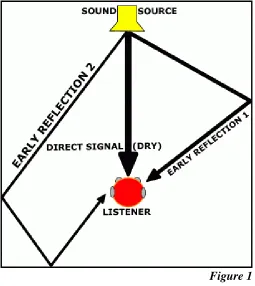
This means that the DIRECT SOUND will get to you within about 11 ms (milliseconds). This is the amount of time we'll need to take off the other values.
The first EARLY REFLECTIONS (off the left and right walls) travel around nine meters before reaching you, so they'll get to your ears about 15 ms later! (9 meters at 343 meters/sec −> 26 ms minus the 11 ms the DIRECT SOUND takes to travel to your ears).
I'm not taking the floor into account because of the obstacles, such as your own legs and a table, that prevent reflections of sound from the band from reaching you. It is also probable that your sitting close to a wall and EARLY REFLECTION time may drop considerably. Experiment and listen very carefully.
Please note that the timing of the EARLY REFLECTIONS are defined by the rooms characteristics such as shape and size. The sound colour of the EARLY REFLECTIONS is defined by the surfaces in the room.These are parameters that are available to professional reverbs only(hard− or software), so don't worry about not finding that stuff in great detail in either Soundforge's, CoolEditPro's or plugins of other editors.
The PRE−DELAY and REVERB TIME depend on more than just room size. Wall and floor
material, as well as anything else that reflects, disperses and dampens sound will influence the reverb in quite a few ways.
Our club has lots of wood on it's walls and floor and people are sitting at tables and the air's probably filled with a little smoke(except in California :).
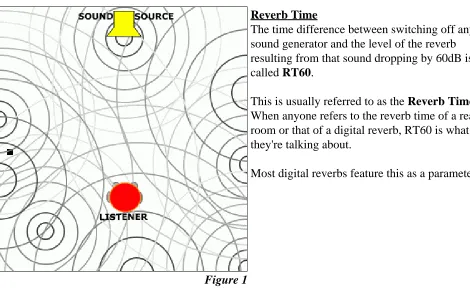
The REVERB TIME, a parameter found in almost all plugins, should be set to no more than one second. In small, crowded rooms where little REVERB occurs it is quite important to set the
EARLY REFLECTIONS right. Experiment with the reverb time keep it lower than 1.2 seconds and above 0.7 seconds. Freeverb puts all this information in to the SIZE parameter.
The PRE−DELAY can be set to 30 ms or more. Larger rooms will develop REVERB later since the reflecting sound will travel a while before the reflections become hard to identify but it also depends on the reflecting materials. Freeverb once again doesn't know any Predelays, but since you're reading this to learn how things work, it's still worth spelling out.
frequencies. Freeverb has the DAMPEN parameter for this.
This can effectively add to room's liveliness. A room full of people will absorb high frequencies a lot faster than an empty room, in which only the materials would make the difference, so in Cool Edit we'll set the 'High Frequency Absorbtion Time' very low, since we're in a crowded club. For Soundforge activate the 'Attenuate high frequencies above' box and set the frequency parameter to around 2000−2500 Hz. Experiment a bit. The higher this frequency and the longer the Absorbtion Time parameter in Cool Edit, the emptier and and colder your room will seem. In small rooms this can cause the room to sound very metallic. Sewer pipes and oil pipelines e.g.
The Reverb EQs are the final processing stage and can change the sound dramatically. These Hishelf and Lowshelf EQs are found in almost ANY Reverb plugin and hardware unit. Freeverb has both in form of Hipass and Lowpass filters. These are not EQs. The parameters change the target frequencies of the filters. Again, listen.
The last thing you have to do is set the balance between the WET signal and your original DRY signal. Here you can do as you please but remember that only very smoothed hard surfaces in big cavernous space create very loud reverbs. A church might do that if there aren't a big number of people and wooden benches in there, but a club doesn't :). Remember that in Audacity it is smarter to DUPLICATE the part you wish to add reverb to, and run the effect over that duplicate. The volume of that reverbed material is easier to control, so set the WET parameter in Freeverb to 0dB(−>100%) and the DRY parameter to −endless(−>0% left most slider position).
So when you create your next 'soon−to−be−the−hit' song or want to put things in perspective, be sure to check the possibilities of adding dimension and scope to your material through clever use of reverbs. Put your snare to the front, the piano a little to the back, and the sax just a little in front of the drums. Experiment. With these basics you'll be able to get better results in less time.
Dry versus Wet
Have you heard of those silent rooms, where they test speakers and microphones ? They're great if you don't happen to be inside of one. After a few minutes you hear the blood in your ears roar like an ocean. You hear only your inner voice when you speak. The room swallows almost everything else. Most people can't stand being in a room like this for more than 10−15 minutes. I am told that this is very different to wearing ear plugs. Those only attenuate sound from the outside. A silent room kills it completely.
This room is horrible to listen to, because it basically features no room reverberation, i.e. it doesn't reflect anything at all. It doesn't reveal any information about its size or surface composition. You may be surprised to know that many vocals are actually recorded in similar environments. Vocal booths are little rooms, in which the walls reflect sound as little as possible. During mixing, digital reverbs are used to create a virtual space.
Digital Reverbs
Audacity for Windows and MacOS8&X includes the VST plugin Freeverb, which is one fine reverb, and ideally suited to take your first steps with digital reverbs. It features simple controls that require little explanation.
For details about Freeverb, check out the effects menu page. For information on how digital reverbs work and what reverb is, check out this page of this manual.
Keeping effects on seperate tracks
Selecting
V.Selecting and aligning
Part 1 − Selecting − Part 1
Basic rules
Selecting can be done with the keyboard, the mouse or by combining the keyboard and mouse. You need to have the Selection Tool activated for making a selection.
The exception is selecting the entire track by clicking on the track panel. The align functions all still work the same way no matter which tool is activated. However, making selections and placing the cursor still requires the Selection Tool.
The selection modifier key is SHIFT.
In a word processor or text editor, the SHIFT key is the modifier to turn any character that you enter via the keyboard in to an UPPERCASE character. In Audacity and most audio editing applications, holding down the SHIFT key means that any cursor movement or placement will result in a
selection.
What follows are ways of making selections. How do I ...
select audio on one track ?
Place the cursor on the waveform of a track, hold down the mouse button, drag the mouse and release the mouse button.
You can select audio with the keyboard as well,
select all the audio of a track ?
but may need to place the cursor with the mouse first. You need to hold down the SHIFT key and use the left/right cursor keys to expand the selection. Combine the former with the CTRL key (STRG on the German keyboard) to shrink the selection.
expand/shrink my selection ?
Hold the SHIFT key, then click and hold the mouse button.
If you clicked to the left of the center of the current selection, you will now be able to move the left selection boundary with your mouse. The same goes for the right hand side of the selection center. Release the mouse button when you are satisfied.
You can use the cursor keys as well. It works the same way as described in the previous item. select from the cursor to the start of the track ? Use the Start to Cursor function in the Edit menu. select from the cursor to the end of the track ? Use the Cursor to End function in the Edit menu. select from the cursor to the start of the project ?
It cannot be done precisely right now, if one track isn't within the range of the other.It actually doesn't have to be, because of the group functions in the Align menu, but more of that later.
If the start and end of one track is within the start and end of the other, simply select the longer track, then SHIFT + click the second track panel. If the start and end of one track is not within the start and end of the other, select the one track, then expand the selection by SHIFT + clicking in to the second track until the selection
encompasses all the desired material. select all the audio of the project ?
button.
Back to the Main page
Reference
Menus Toolbars
Tracks
Keyboard Shortcuts Create or Edit Shortcuts
Effects
Preferences
Menus
Back to the main page Back to the Reference page
FileEditViewProjectGenerateEffectAnalyze
File Menu
New...
Creates a new empty project window.
Open...
Selecting Open presents you with a dialog where you can choose a file to open. If the current project window is empty, the new file will take over the current window, otherwise a new project window will be opened.
The file formats recognized by Audacity are WAV, AIFF, NeXT/AU, IRCAM, MP3, Ogg Vorbis, MIDI, and the Audacity Project file format (AUP).
In addition, Audacity can also attempt to open an audio file in a different format, as long as it is uncompressed − to do this, use the Import Raw
Export Selection As WAV...
This is the same as Export, but it only exports the part of the project that is selected. This is very useful if you want to save a small clip from part of a track as a separate file.
Export As MP3...
Exports the current Audacity project as an MP3 file. Audacity does not encode MP3 files directly, but instead requires that you download a separate MP3 encoder. See Exporting MP3 Files for details.
To export only a single track or part of track, use Export Selection as MP3.
Save Project
Saves the current Audacity project (AUP) file. Audacity projects are not intended to be read by other programs, but they are extremely fast to load and save within Audacity. When you are finished working on a project and you want to be able to use it in another program, select one of the Export commands instead.
Note that most of the audio data for an Audacity project is not stored in the AUP file, but in a directory (folder) with the same name as the project. For example, if you save a project as
chanson.aup, there will be a directory called
chanson_data created to store the actual audio tracks of the project. For more information on the project file format, see the file formats page.
Save Project As...
Saves the current Audacity project (AUP) file, allowing you to give it a different name or move it to a new location if you have already saved it in one location.
Audacity projects are not intended to be read by other programs, but they are extremely fast to load and save within Audacity. When you are
Export As OGG...
Exports the current Audacity project as an Ogg Vorbis file.
To export only a single track or part of track, use Export Selection as Ogg.
Export Selection As OGG...
This is the same as Export As OGG, but it only exports the part of the project that is selected. This is very useful if you want to save a small clip from part of a track as a separate file. Export Labels...
If you have any Label Tracks, this command will export them as a text file. This feature is
commonly used in Speech Recognition research to annotate a speech utterance and export the annotation to be later processed by another program.
To import these labels into a different project later, use the Import Labels command.
finished working on a project and you want to be able to use it in another program, select one of the Export commands instead.
For more information on the project file format, see the file formats page.
Export As WAV...
Exports the current Audacity project as a standard audio file format such as WAV or AIFF.
You can change the format of exported files in the Preferences dialog.
If there are multiple tracks in your project, they will be automatically mixed in the exported data. For more information about mixing, see Quick Mix.
To export only a single track or part of a track, use Export Selection.
This allows you to do multiple exports from audacity with one command based either on multiple tracks in the project or labels in a single audio track. It's great for splitting up long
recordings into CD tracks
Preferences
Opens a dialog window that lets you configure Audacity. For more information on the different preferences, see the section on Audacity
Preferences.
Exit/Quit
Closes all project windows and exits Audacity. It will ask you if you want to save changes to your project. It is not necessary for you to save
changes if you just exported your file as WAV or MP3 and you are finished working with it. On the other hand, if you are working on a mix and plan to continue where you left off, saving an
Audacity Project will let you restore everything as it is later.
FileEditViewProjectGenerateEffectAnalyze
Edit Menu
Undo
This will undo the last editing operation you performed to your project. Audacity currently supports full unlimited undo − meaning you can undo every editing operation back to when you opened the window.
Redo
This will redo any editing operations that were just undone. After you perform a new editing operation, you can no longer redo the operations that were undone.
Cut
Removes the selected audio data and places it on the clipboard. Only one "thing" can be on the clipboard at a time, but it may contain multiple tracks.
Copy
Copies the selected audio data to the clipboard without removing it from the project.
Paste
Inserts whatever is on the clipboard at the position of the selection cursor in the project, replacing whatever audio data is currently selected, if any.
Trim
Delete
Removes the audio data that is currently selected without copying it to the clipboard.
Silence
Erases the audio data currently selected, replacing it with silence instead of removing it completely.
Split
Moves the selected region into its own track or tracks, replacing the affected portion of the original track with silence. See the figure below:
Duplicate
Makes a copy of all or part of a track or set of tracks into new tracks. See the figure below:
Select... > All
Selects all of the audio in all of the tracks.
Select... > Start to Cursor
Selection Save
Selects all the audio from the cursor to the end of project, which is as far as audio exists in the project.
Find Zero Crossings
Moves the cursor or the edges of the selection to the nearest point where the audio waveform passes though zero. Use this to help achieve click−free cuts in audio, as the two ends of the cut will exactly line up.
Move Cursor...
These commands provide quick and accurate ways to manoeuvre the cursor around the project to the start and end of tracks and selections.
Snap−To...
Turns snapping of the cursor to a grid of time values on or off. When off, your cursor can be positioned on any sample in the audio file. When on, it is restricted to certain points in time, determined by the time format in use. This is useful if your project must follow an external timecode exactly.
Back to the main page Back to the Reference page
FileEditViewProjectGenerateEffectAnalyze
View Menu
Zoom In
Zooms in on the horizontal axis of the audio, displaying more detail about less time. You can also use the zoom tool to zoom in on a particular part of the window.
Zoom Normal
Zooms to the default view, which displays about one inch per second.
Zoom Out
Zooms out, displaying less detail about more time.
Fit in Window
History
Brings up the history window. It shows all the actions you have performed during the current session, including importing. The right−hand column shows the amount of HD space your operations used. You can jump back and forth between editing steps quite easily by simply clicking on the entries in the window.
The history window can be kept open at all times. It doesn't interfere with any other operations.
Plot Spectrum
Adjusts the height of all the tracks until they fit in the project window.
Zoom to Selection
Zooms in until the selected audio fills the width of the screen to show the selection in more detail.
Set Selection Format
Sets the format in which selections are measured in at the bottom of the application window. Combined with setting Set Snap−To Mode to ON, this is ideal to cut stuff up in to exact measures.
Set Snap−To Mode
the Autocorrelation function.
The Enhanced Autocorrelation function is very good at identifying the pitch of a note.
Float or Dock Control Toolbar
Toggles between displaying the tool docked at the top of each project window, or in a separate floating window. You can also float any toolbar by grabbing the handle on the left side and dragging it to the location you want.
Once they are floating these options change to docking the toolbars back into the main window. Float or Dock Menu Toolbar
Float or Dock Mixer Toolbar Float or Dock Meter Toolbar
Do the same thing for the other toolbars
Back to the main page Back to the Reference page
FileEditViewProjectGenerateEffectAnalyze
Project Menu
Import Audio...
This command is used to import audio from a standard audio format into your project. Use this command if you already have a couple of tracks, and you want to add another track to the same project, maybe to mix them together.
Use this command to import anything except MIDI files. You cannot yet use this option to import Audacity Projects.
Import Labels...
This command takes a text file which contains time codes and labels, and turns them into a Label Track.
Import MIDI...
Quick Mix
This command mixes all of the selected tracks down to one or two tracks. The channel of a track being mixed affects whether it will be mixed into the left channel of the resulting track(s), the right channel, or both (mono).
For example, if you have four tracks: Track 1: left channel
•
Track 2: left channel
•
Track 3: right channel
•
Track 4: mono channel
•
This menu command allows you to open a file in virtually any format, as long as it is not
compressed. When you select the file, Audacity will look through it and try to guess its format. It will guess correctly about 90% of the time, so you can try just pressing "OK" and listening to it. If it is not correct, however, you can use the dialog presented to try all of the different possibilities.
At the beginning of your imported track(s), you may notice a little bit of noise. This is probably the file's header, which Audacity was not able to parse. Just zoom in and select the noise with the Selection Tool, and then choose Delete.
Edit ID3 Tags...
Opens a dialog allowing you to edit the ID3 tags associated with a project, for MP3 exporting. ID3 Tags are used to store the Title, Artist, Author, and other information in MP3 files. When you import an MP3 file, Audacity remembers this informatio