Yasir et al. World Journal of Pharmaceutical Research
ANTIBACTERIAL EFFECT OF AQUEOUS EXTRACT OF ALOE
VERA AGAINST THE GRAM-POSITIVE BACTERIA
STAPHYLOCOCCUS AUREUS IN MEDANI CITY - GEZIRA
STATE – SUDAN- 2018
Yasir Hakim1*, Dalia Hamza2, A. KH Khalil3, Abdalla Khalid4
Assistant Professor of Pathology with MD Pathology, Head Unit of Microbiology,
Department of Basic Medical Science, College of Medicine, Dar Al Uloom University,
Riyadh, Kingdom of Saudi Arabia & Sennar University, International College of Medicine,
Sudan.
ABSTRACT
The plant Aloe vera was used historically as a topical to heal wounds,
various skin conditions and orally as a laxative. The Gram-positive
bacterium Staphylococcus aureus is considered to be the most
pathogenic species of the genus Staphylococcus, being implicated in
both community-acquired and nosocomial infections. The present
investigation was undertaken at the University of Gezira, Center of
Plant Pathology, during the year 2018. The aim of the study was to
investigate the effect of Aloe vera on Staphylococcus aureus as
antibacterial activity of aqueous and alcoholic extracts of Aloe vera on
inhibiting the growth of the Staphylococcus aureus against a known
Antibiotics (Gentamycin) as appositive control. Three concentrations
of aqueous extract of Aloe vera and the Gentamycin, (25, 50 and
100%) were tested. The aqueous suspensions of the dried Aloe vera
extracts were screened for their anti-Staphylococcus aureus activity
using the agar-disc diffusion method. The results obtained indicated
that the highest concentration of Aloe vera aqueous extract (100%)
used in this study had the highest inhibitory effects (18.2 mm) against
the tested bacterium, while the other two concentrations (50 % and 25%) showed an
inhibition zones of 15 mm and 12 mm, respectively. For the positive control (Gentamycin)
the highest inhibition zone 16.5 mm was obtained with the higher concentration (100 %). The
World Journal of Pharmaceutical Research
SJIF Impact Factor 8.074Volume 7, Issue 12, 18-34. Research Article ISSN 2277– 7105
Article Received on 22 April 2018,
Revised on 12 May 2018, Accepted on 03 June 2018,
DOI: 10.20959/wjpr201812-12607
*Corresponding Author
Yasir Hakim
Assistant Professor of
Pathology with MD
Pathology, Head Unit of
Microbiology, Department
of Basic Medical Science,
College of Medicine, Dar
Al Uloom University,
Riyadh, Kingdom of Saudi
Arabia & Sennar
University, International
College of Medicine,
Yasir et al. World Journal of Pharmaceutical Research
other concentrations (25 and 50 % showed inhibition zones of 7.75 and 6 mm, respectively.
The study recommended that, further research should be done to clearly identify the active
ingredients of Aloe vera and their other antimicrobial activities.
KEYWORDS:Aloe Vera, Antimicrobial activities, Gentamycin, Staphylococcus aureus.
INTRODUCTION
Aloe vera belongs to the Liliaceae family, of which there are about 360 species. It is a
cactus-like plant that grows readily in hot, dry climates and currently, because of demand, is
cultivated in large quantities. The gel of A. vera was used to treat stomach ailments,
gastrointestinal problems, skin disease, constipation, radiation injury, inflammatory effect,
healing wounds and burns, ulcer and diabetes. A. vera products are mainly for cosmetic,
pharmaceutical, nutraceuticals and food industries. The gel stimulates cell growth and
enhances the restoration of damaged skin. It moisturizes the skin because it has a water
holding capacity. As a drink, it protects the mucous membrane of the stomach especially
when irritated or damaged. A. vera juice is considered helpful for relieving many types of
gastrointestinal irritation and juice products are widely available (Anderson and Phillipson.,
1996).
Staphylococcus aureus poses an important problem in hospitals, nursing homes, and other
health care settings. Serious infections due to these organisms currently necessitate the use of
non -β-lactam antibacterial therapy (Hackbarth and Chambers,1989).Many hospital acquired
MRSA strains are only susceptible to vancomycin (Fitzgerald et al., 2001). Thus, there are
strong concerns about the possible development and spread of vancomycin resistance in
MRSA. Some vancomycin-resistant MRSA strains have been reported since 1996 (EI-Jakee
et al., 2014; ALian et al., 2012). Some necrosis poisons cases occur by strong acids as
H2SO4, it affects skin created necrosis or burns and these allow for bacteria growth. H2SO4 is
one form of strong poison, because the poison's symptoms appear after five minutes from
application on skin. If possible, treatment by Na2Co3 as antidote for H2SO4, but the necrosis
caused by bacterial infection should be treated use drugs. The main constituents of Aloe Vera
gel are mucopolysaccharides (glucomannans, polymannoses, about 10% of total solids),
enzymes, anthranoids, lignin, saponins, vitamins, amino acids (almost 50% of the total
amount consisting of 8 of the 10 essential amino acids) and minerals (quantities not given).
Total solids are in the range of 1.3 to 2%, the rest being water (Vinson et al., 2005). Aloe
Yasir et al. World Journal of Pharmaceutical Research
processing of the whole leaf, in which case the product usually also contains appreciable
quantities of the latex material and anthranoids. The anthranoids in whole leaf extracts of
Aloe Vera can however, be reduced to levels below10mg/kg in the product (Reynolds and
Dweck, 1999; Lee et al., 2000; Hu et al., 2003). Oliver (Oliver, 2012) indicates that Aloe
Vera gel is used in veterinary medicine topically to promote wound healing on general skin
wounds in all animals. It has also been recommended as a teat-dip in lactating cows, by intra
mammary administration for (adjuvant) treatment of mastitis or high somatic cell counts, and
by oral route in all food producing species as adjuvant treatment for a number of afflictions
(ranging from anemia to infertility, mastitis and shock (Hu et al., 2003;Oliver,2012).
Medicinal plants according to the World Health Organization (WHO) defines them as herbal
preparations made by introducing plant materials to extraction, fractionation, purification,
concentration, or other physical or biological processes, which may be produced as a basis for
herbal products or for immediate consumption. In human medicine Aloe Vera gel is used
topically to promote wound healing. Oral use as a general tonic for a number of indications,
where scientific proof is outstanding, has also been described. Aloe Vera gel is also widely
used in cosmetics (Ramachandra and Rao, 2008; Subramanian et al., 2006; Saravanan et al.,
2010; Kedarnath et al., 2012). Moreover, Aloe Vera has ulcerogenic activity (Sai et al.,
2014).
OBJECTIVES
To test the antimicrobial effects of Aloe vera aqueous and alcohol and Antibiotic (control) leaf
extracts on Staphylococcus aureus.
To determine the effect of Aloe vera leaf extract different concentration on
Staphylococcusaureus.
MATERIALS AND METHODS
Staphylococcus aureus
It was obtained from the microbiological laboratory of the Department of Pathology Medical
lab, Faculty of Medicine, University of Gezira, Wad Medani, Sudan during the period from
January to May, 2018.
Aloe vera plant
Yasir et al. World Journal of Pharmaceutical Research
Preparation of Nutrient agar
This was a general-purpose cultured medium for bacteria. It was obtained in a dehydrated
form. The constituent of the medium were beef extract, yeast extract, peptone, sodium
chloride and agar. It was prepared according to the manufactures instruction by suspending
28g in one liter distilled water. The medium was allowed to boil until it was completely
dissolved. The pH of medium was adjusted to pH 7.4±0.2 and then the medium was sterilized
in an autoclave at 121ºC (115b\in²) for 15 min (Harrigan, 1998).
Preparation of the crude extracts
Aloe vera leaf extract to prepare crude extract of fresh Aloe vera whole leaves were washed
with distilled water, chopped into small pieces, air-dried and ground into powder. The Aloe
vera mixed with 80% concentration of ethanol The pulp ethanol mix was then centrifuged at
3000rpm for 10 minutes and the supernatant collected was allowed to evaporate over a dry
oven. The gelatinous extract thus prepared was weighed using distilled water, serial dilutions
of 25g/75ml, 50g/50ml and 100mg (w/v) were made in order to obtain 25%, 50% and 100%
concentrations, respectively.
Preparation of test organism
The nutrient agar were mixed well and poured on the sterile petri plates. The agar media on
petri plates were allowed to set for few minutes. nutrient agar plates were inoculated with
respective bacteria (S.aureus ), and then incubated at 37° C for overnight. Each time, a fresh
bacterial culture was prepared.
Antimicrobial agent
The antibacterial agent gentamicin was dissolved in distilled water. Further dilutions were
made using the same solvent according to CLSI document M100-S18. Gentamicin was used
in the concentrations 25%, 50% and 100%.
Antibacterial activity
Antibacterial activity was measured using paper disc diffusion method, (Method of Saba et
al., 2011) was followed.
The following steps were involved in paper disc diffusion method. The normal agar were
mixed well and poured on the sterile petri plates. The agar media on petri plates were allowed
Yasir et al. World Journal of Pharmaceutical Research
The small autoclaved discs of Whatmann filter paper were used. The test organism was
spread on the petri plates by using sterilized glass spreader. During paper-disc diffusion
method, the sterile discs were dipped in the different crude extracts of medicinal plants and
antibiotic drugs with the help of sterilized forceps and placed on the Petri plates. Distilled
water was used as a control to check the comparison of antibacterial activity with different
crude extracts of medicinal plants. The petri plates were sealed with para film.
Then, the petri plates were left at room temperature for 30 minute, to allow the diffusion of
the test sample and then incubated at 37° C for overnight. The diameter of the zones of
inhibition were measured in cm.
Statistical analysis
The obtained data was statistically analyzed by computer software MSTATC according to
analysis of variance (ANOVA); Duncan's Multiple Range Test was used for mean separation.
RESULTS
1. Two days post inoculation
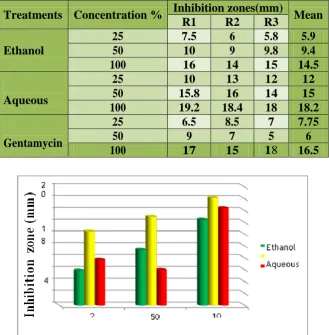
The results depicted in Table (1) and figure (1) indicate that the high concentrations of Aloe
vera aqueous extract (100%) used in this study had the highest inhibitory effects (18.2 mm)
against the tested Staphylococcus aureus. However, this extract showed inhibition action of
12 mm even at minimal concentration (25%) used. The other concentrations of the aqueous
phase (50 %) gave an inhibition zones of 15 mm.
Control (Gentomycin) extract of Aloe vera at all concentrations shows an inhibitory effect
against the Staphylococcus aureus. The highest inhibition zone obtained was 16.5 mm with
the concentration of 100 % Concentrations of 25 and 50 % showed an inhibition zones of
Yasir et al. World Journal of Pharmaceutical Research
Table 1: Effect of different Concentration of aqueous and alcoholic extracts of Aloe vera and Antibiotic on inhibition (mm) of Staphylococcus aureus using disc method at two days post inoculation.
Treatments Concentration % Inhibition zones(mm) Mean R1 R2 R3
Ethanol
25 7.5 6 5.8 5.9
50 10 9 9.8 9.4
100 16 14 15 14.5
Aqueous
25 10 13 12 12
50 15.8 16 14 15
100 19.2 18.4 18 18.2
Gentamycin
25 6.5 8.5 7 7.75
50 9 7 5 6
[image:6.595.134.464.134.470.2]100 17 15 18 16.5
Figure 1: Effect of different Concentration of aqueous and alcoholic extracts of Aloe vera and Antibiotic on inhibition (mm) of Staphylococcus aureus using disc method at two days post inoculation.
2. Three days post inoculation
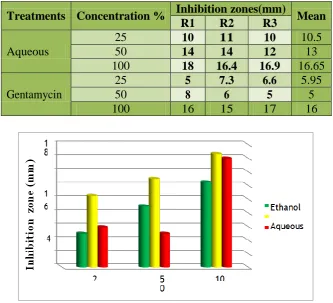
The results depicted in Table( 2 )and Figure ( 2) indicate that the high concentrations of Aloe
vera aques extract (100%) used in this study had the highest inhibitory effects (16.65 mm)
against the tested Staphylococcus aureus. However, this extract showed inhibition action of
10.5 mm even at minimal concentration (25%) used in this study. The other concentrations of
the aqueous phase (50 %) gave an inhibition zones of 13 mm.
Control (gentamycin) extract of Aloe vera at all concentrations shows an inhibitory effect
against the Staphylococcus aureus. The highest inhibition zone obtained was 16 mm with the
concentration of 100 % Concentrations of 25 and 50 % showed an inhibition zones of 5.95
Yasir et al. World Journal of Pharmaceutical Research
Table 2: Effect of different Concentration of aqueous and alcoholic extracts of Aloe vera and Antibiotic on inhibition (mm) of Staphylococcus aureus using disc method at three days post inoculation.
Treatments Concentration % Inhibition zones(mm) Mean R1 R2 R3
Aqueous
25 10 11 10 10.5
50 14 14 12 13
100 18 16.4 16.9 16.65
Gentamycin
25 5 7.3 6.6 5.95
50 8 6 5 5
100 16 15 17 16
Figure 2: Effect of different Concentration of aqueous and alcoholic extracts of Aloe vera and Antibiotic on inhibition (mm) of Staphylococcus aureus using disc method at three days inculation.
3. Four days post inoculation
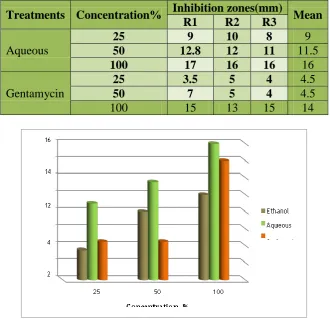
The results depicted in (Table 3 and Figure 3) indicate that the high concentrations of Aloe
vera aqueous extract (100%) used in this study had the highest inhibitory effects (16 mm)
against the tested microorganisms. However, this extract showed inhibition action of 9 mm
even at minimal concentration (25%) used in this study. The other concentrations of the
aqueous phase (50 %) gave an inhibition zones of 11.5 mm.
Control (Gentomycin) extract of Aloe vera at all concentrations shows an inhibitory effect
against the Staphylococcus aureus. The highest inhibition zone obtained was 14 mm with the
concentration of 100 % Concentrations of 25 and 50 % showed an inhibition zones of 4.5 and
[image:7.595.131.465.133.436.2]Yasir et al. World Journal of Pharmaceutical Research
Table 3: Effect of different Concentration of aqueous and alcoholic extracts of Aloe vera
and Antibiotic on inhibition (mm) of Staphylococcus aureus using disc method at four days post inoculation.
Treatments Concentration% Inhibition zones(mm) Mean R1 R2 R3
Aqueous
25 9 10 8 9
50 12.8 12 11 11.5
100 17 16 16 16
Gentamycin
25 3.5 5 4 4.5
50 7 5 4 4.5
100 15 13 15 14
Figure 3: Effect of different Concentration of aqueous and alcoholic extracts of Aloe vera and Antibiotic on inhibition (mm) of Staphylococcus aureus using disc method at four days post inoculation.
[image:8.595.133.464.134.453.2]
Table 4: Antimicrobial activity of different Concentration preparations of Aloe vera gel aqueous and alcoholic extract on inhibition (mm) of Staphylococcus aureus with antibiotics as reference standard.
Treatments Concentration% Inhibition zones(mm)
Aqueous
25 +
50 ++
100 ++
Gentamycin
25 +
50 ++
100 ++
Antimicrobial activity: No inhibition +, Zone of inhibition ≤8mm in diameter; ++, Zone of
[image:8.595.156.444.599.700.2]Yasir et al. World Journal of Pharmaceutical Research
DISCUSSION
This study showed that aqueous exstract phase of Aloe vera gave better results compared to
the antibiotic phase of the same extract at this study at all concentration tested. The broad
antimicrobial action of the aqueous extract of the Aloe vera used in the study could be
ascribed to the water soluble components which are naturally occurring in the plant materials.
Other workers have reported There was no antimicrobial activity was reported using aqueous
extract of A. vera leaves (Martineze et al.,1996).
The antimicrobial activity of the extracts and their potency was quantitatively assessed by the
presence or absence of inhibition zone and zone diameter. Only alcoholic extract was found
to be a better solvent for extraction of antimicrobially active substances compared to water
and hexane (Ahmad et al., 1998).
(Subramanian et al., 2006) In other studies, the most effective antibiotic for gram positive is
vancomycin than Gentamycin (Hoeger., 2004).
Aloe vera is a potent antimicrobial agent compared with the conventional antibiotics. The
results of the study by Coopoosamy and Magwa., (2007) also revealed that lowest
concentrations of ethyl acetate and ethanol crude extracts of Aloe excels resulted in complete
inhibition of visible growth of pathogenic bacteria compared with the control antibiotics,
chloramphenicol and streptomycin sulfate.
The results of this study disagree with earlier studies that showed that the antibacterial
activity of some Iranian medicinal plants were more significant in the solvent extracts
compared with aqueous extracts in all the plants, indicating that the active principle(s)
responsible for antibacterial activity were more soluble in organic solvents (Babu et al.,
2007). Similarly, the solvent extract of cloves flower was also found to exhibit a significantly
higher inhibitory effect on the caries-inducing properties of Streptococcus mutans compared
with the crude aqueous extracts (Abd Rahim and Gulam.,2006). In other studies the
methanolic and petroleum spirit extracts of Pelargonium essential oils were more potent
antibacterial agents than the steam distilled volatile samples (Lis- Balchin et al.,1998).
Finally, it was observed that the highest concentration of the aqueous and ethanolic extract of
the plant has significant effect on the bactria isolates. They had liger zone of inhibition
Yasir et al. World Journal of Pharmaceutical Research
et al. (2006).
REFERENCES
1. Agarry OO, Olaleye MT, Bello-Micheal CO., Comparative activities of Aloe vera gel and
leaf. African Journal of Biotechnology; 2005; 4(12): 1413-1414.
2. Ahlawat KS & Khatkar BS Processing, food applications and safety of aloe vera
products: a review. J Food Sci Technol, 2011; 48(5): 525–33.
3. Ahmad, J., Mehmood, Z. and Mohammad, F., Screening of some Indian medicinal plants
for their antimicrobial properties. Journal of Ethnopharmacology., 1998; 62: 183-193
4. ALian, F,Rahimi.,E,Shakerian,A, Momataz, H, Riah, M and Momeni M,A Antimicrobial
resistance of staphylococcus aerus isolated from bovine, sheep and goat raw milk. Global
veterinaria, 2012; 8: 111 -114.
5. Anderson LA, Phillipson JD. Herbal medicines, A Guide for Healthcare professionals,
Pharmaceutical press, London; 1996.
6. Argudin MA, Mendoza MC, Rodicio MR Food poisoning and Staphylococcus aureus
enterotoxins. Toxins, 2010; 2(7): 1751–1773.
7. T, Kumeda Y, Kawai T, Shibata T, Oda H, Haruki K, Nakazawa H, Kozaki S An
extensive outbreak of staphylococcal food poisoning due to low-fat milk in Japan:
Estimation of enterotoxin A in theincriminated milk and powdered skim milk.
Epidemiology and Infection 2003; 130: 33–40.
8. A, Sudagidan M, Muratoglu K Prevalence of staphylococcal enterotoxins, toxin genes
and genetic relatedness of foodborne Staphylococcus aureus strains isolated in the
Marmara region of Turkey. International Journal of Food Microbiology, 2011; 148:
99–106.
9. Boudreau MD, Beland FA, Nichols JA, Pogribna M Toxicology and carcinogenesis
studies of a noncolorized whole leaf extract of Aloe barbadensis Miller (Aloe vera) in
F344/N rats and B6C3F1 mice (drinking water study). Natl Toxicol Program Tech Rep
Ser, 2013; 577(577): 1–266. PMID:24042237.
10.CDC (ummary of notifiable diseases - United States, 2010. Morbidity and Mortality
Weekly Report, 2012; 59(53): 1–111.
11.Channe Gowda D, Neelisiddaiah B, Anjaneyalu YV Structural studies of polysaccharides
from Aloe vera. Carbohydr Res, 1779; 72: 201–5.
12.Committee of Experts on Cosmetic Products Aloe extracts with anthraquinones. Active
Yasir et al. World Journal of Pharmaceutical Research
Publishing; 2008; 9–27.
13.Coopoosamy RM, Magwa ML., Traditional use, antibacterial activity and antifungal
activity of crude extract of Aloe excelsa. African Journal of Biotechnology 2007; (20):
240-2410.
14.Cosmetic Ingredient Review Expert Panel Final report on the safety assessment of
AloeAndongensis Extract, Aloe Andongensis Leaf Juice,aloe Arborescens Leaf Extract,
Aloe Arborescens Leaf Juice, Aloe Arborescens Leaf Protoplasts, Aloe Barbadensis
Flower Extract, Aloe Barbadensis Leaf, Aloe Barbadensis Leaf Extract, Aloe Barbadensis
Leaf Juice,aloe Barbadensis Leaf Polysaccharides, Aloe Barbadensis Leaf Water, Aloe
Ferox Leaf Extract, Aloe Ferox Leaf Juice, and Aloe Ferox Leaf Juice Extract. Int J
Toxicol, 26(1): Suppl 2007; 2: 1–50.
15.Dal’Belo SE, Gaspar LR, Maia Campos PM Moisturizing effect of cosmetic formulations
containing Aloe vera extract in different concentrations assessed by skin bioengineering
techniques. Skin Res Technol, 2006; 12(4): 241–6.
16.Taylor TM Chemical preservatives and natural antimicrobial compounds. Ch 33 In:
Doyle MP, Beuchat LR(eds) Food microbiology: Fundamentals and frontiers. 3rd ed,
ASM Press, Washington D.C., 2007; 713–745.
17.Dentali S. “Nondecolorized” essential qualifier for NTP aloe vera study material. Toxicol
Sci, 2013; 133(2): 342.
18.EFSA The European Union summary report on trends and sources of zoonoses, zoonotic
agents and foodborne outbreaks in 2010. EFSA Journal, 2012; 10(3): 2597.
19.EFSA The European Union summary report on trends and sources of zoonoses,zoonotic
agents and foodborne outbreaks in2011. EFSA Journal 2013; 11(4): 3129.
20.EI-Jakee, S, A. Marouf, Nagwa S. Ata, Eman H. Abdel-Rahman, ShereinI. Abd El-Moez,
A.A. Samy and 2Walaa E. El-Sayed, Rapid Method for Detection of Staphylococcus
aureus Enterotoxins in Food, Global Veterinaria, 2014; 11: 335-341.
21.Elsohly MA, Gul W, Avula B, Khan IA Determination of the anthraquinones
aloe-emodin and aloin-A by liquid chromatography with mass spectrometric and diode array
detection. J AOAC Int, 2007; 90(1): 28–42. PMID: 17373434.
22.EMA Community herbal monograph on Aloe barbadensis MILLER and on Aloe (various
species, mainly Aloe ferox MILLER and its hybrids). London, UK: European Medicines
Agency., 2006.
23.Eur Ph; European Pharmacopoeia European pharmacopoeia. 7.0. Strasbourg, France:
Yasir et al. World Journal of Pharmaceutical Research
24.Evenson ML, Hinds MW, Berstein RS, Bergdoll MS Estimation of human dose of
staphylococcal enterotoxin A from a large outbreak of staphylococcal food poisoning
involving chocolate milk. InternationalJournal of Food Microbiology., 1988; 7: 311–316.
25.Femenia A, Sanchez E, Simal S, Rosselló C Compositional features of polysacchardies
from Aloe vera(Aloe barbadensis Miller) plant tissues. Carbohydr Polym, 1999; 39(2):
109–17. doi:10.1016/S0144- 8617(98)00163-5.
26.Figueroa G, Navarrete P, Caro M, Troncoso M, Faundez G Carriage of enterotoxigenic
Staphylococcus aureus in food handlers. Revista Medica De Chile, 2002; 130(8): 859–
864.
27.J.R., Sturdevant, D. E., Mackie., S.M..,Gill and S.R., Musser, J.M, Evolutionary
genomics of Staphylococcus aurous: insights into the origin of methicillin-resistant
strains and the toxic shock syndrome epidemic. Proceeding of the Natural Academic
Science, 2001; 98: 8821-8826.
28.Foster T, Staphylococcus., in: Baron (Ed.), Medical Microbiology, University of Texas
Medical Branch at Galveston, Texas, 1996.
29.Gavimath, C.C., Ramachandra, Y.L., Padmalatha Rai, S., Sudeep, H.V., Sujan, P.S.,
Ganapathy and Kavitha, B.T. Antibacterial activity of Aegle marmeles Correa leaves
extract, Asian Journal of Bioscience. 2008; 3(2): 333-336.
30.Gaze JE The effect of oil on the heat resistence of Staphylococcus aureus. Food
Microbiology, 1985; 2: 277–283.
31.Grindlay D & Reynolds T The Aloe vera phenomenon: a review of the properties and
modern uses of the leaf parenchyma gel. J Ethnopharmacol,1986;
16(2-3): 117–51.doi:10.1016/0378-8741(86)90085-1PMID:3528673
32.Hackbarth, C.J., and Chambers, H.F, Methicillin- resistant staphylococci: detection
methnods and treatment of infections. Antimicrobial. Agents Chemother. 1989; 33:
995 -999.
33.Hall G, Kirk MD, Becker N, Gregory JE, Unicomb L, Millard G, Stafford R, Lalor K
Estimating foodborne gastroenteritis, Australia. Emerging Infectious Diseases, 2005;
11(8): 1257–1264.
34.Hamman JH Composition and applications of Aloe vera leaf gel. Molecules, 2008; 13(8):
1599–616. doi:10.3390/molecules13081599PMID:18794775
35.Harrigan, W.F., Laboratory Methods in Food Microbiology. Academic Press, San Diego.,
Yasir et al. World Journal of Pharmaceutical Research
36.Hatakka M, Bjorkroth KJ, Asplund K, Maki-Petays N, Korkeala HJ Genotypes and
enterotoxicity of Staphylococcus aureus isolated from the hands and nasal cavities of
flight catering employees. Journal of Food Protection, 2000; 63(11): 1487–1491.
37.Howard BJ and Kloos WE, Staphylococci., in: Howard BJ, Klass J, J RS, Weissfeld AS,
and Tilton RC (Eds.), Clinical and Pathogenic Microbiology, Mosby, Washington, 1987;
231-234
38.Hu, Y., J. Xu and Q. Hu, Evaluation of antioxidant potential of Aloe vera (Aloe
barbadensis Miller) extracts. Journal Agriculture. Food Chemistry, 2003; 51: 7788-7791.
39.ICMSF Staphylococcus aureus. Ch 17 In: Microorganisms in food 5: Microbiological
specifications of food pathogens. Blackie Academic and Professional, London, 1996;
299–333.
40.Jehan Bakht, Amjad Islam and Mohammed Shafi antimicrobial potentials of eclipta alba
by well diffusion method., Pak. J.Bot., 2011; 43: 169-174.
41.Joseph B & Raj SJ Pharmacognostic and phytochemical properties of Aloe veraLinn−an
overview. International Journal of Pharmaceutical Sciences Review and Research, 2010;
4: 106–110.
42.JP XVI, The Japanese Pharmacopoeia The Japanese Pharmacopoeia.16thed. English
Version, Tokyo, Japan: Ministry of Health, Labour and Welfare., 2011.
43.Kaithwas G, Kumar A, Pandey H, Investigation of comparative antimicrobial activity of
Aloe vera gel and juice. Pharmacology online; 2008; 1: 239-243.
44.Kedarnath, N.K., Surekh.a, Ramesh. S, Mahantesh. S. PandPatil C.S, Phytochemical
screening and antimicrobial activity of Aloe vera L. World Research Journal of Medicinal
& Aromatic Plants, 2012; 1: 11-1.
45.Kennedy J, Blair IS, McDowell DA, Bolton DJ An investigation of the thermal
inactivation of Staphylococcus aureus and the potential for increased thermo tolerance as
a result of chilled storage. Journal of Applied Bacteriology, 2005; 99: 1229–1235.
46.Kitai S, Shimizu A, Kawano J, Sato E, Nakano C, Kitagawa H, Fujio K, Matsumura K,
Yasuda R, Inamoto T Prevalence and characterization of Staphylococcus aureus and
enterotoxigenic Staphylococcus aureus in retail raw chicken meat throughout Japan. The
Journal of Veterinary Medical Science, 2005; 67(3): 269–274.
47.Kloos WE and Bannerman TL. Update on clinical significance of coagulase-negative
staphylococci. Clinical Microbiology Reviews, 1994; 7(1): 117-140.
48.Kloos WE and Lambe DWJ, Staphylococcus., in: Barlows A, Hausler WJ, Hermann KL,
Yasir et al. World Journal of Pharmaceutical Research
Washington D.C, 1991; 222-237.
49.Kluytmans J, van BelKum A, and Verbrugh H. Nasal carriage of Staphylococcus
aureus: epidemiology, underlying mechanisms, and associated risks. Clinical
Microbiology Reviews, 1997; 10(3): 505-520.
50.Lachenmeier K, Kuepper U, Musshoff Fet al. Quality control of Aloe vera
beverages. Electronic Journal of Environmental, Agricultural and Food Chemistry, 2005;
4: 1033–1042.
51.Lee, K., S. Weintraub and B. Yu, Isolation and identification of a phenolic antioxidant
from Aloe barbadensis. Free Radical Biology and Medicine Journal, 2000; 28: 261-265.
52.Leon L The medicinal plant Aloe. Ganzheitliche Tiermedizin, 2003; 17: 138–143.
53.E, Lopez L, Borman A, Cressey P, Pirie R Annual report concerning foodborne disease in
New Zealand 2011. Ministry for Primary Industry, New Zealand., 2012.
http://www.foodsafety.govt.nz/science-risk/human-health-surveillance/foodborne-diseaseannual-reports.htm. Accessed 11 April 2013.
54.Liu GY, Essex A, Buchanan JT, Datta V, Hoffman HM, Bastian JF, Fierer J, and Nizet V.
Staphylococcus aureus golden pigment impairs neutrophil killing and promotes virulence
through its antioxidant activity, T. The Journal of Experimental Medicine, 2012; 202(2):
209-215.
55.Mandal G & Das A Structure of the D-galactan isolated from Aloe barbadensis Miller.
Carbohydr Res, 1980; 86(2): 247–57.
56.Mangena T., Comparative evaluation of the antimicrobial activities of essential oils of
Artemisia afra, Pteronia incana and Rosmarinus officinalis on selected bacteria and yeast
strains. Lettent. Applied Microbiology; 1999; 28(4): 291-296.
57.Montville TJ, Matthews KR Food microbiology: An introduction. 2nd ed, ASM Press,
Washington D.C., 2008.
58.NCCAM Aloe vera. Bethesda (MD): National Center for Complementary and Alternative
Medicine. Available from: http://nccam.nih.gov/health/aloevera, accessed 5 June 2014.
2012.
59.Nema V, Agrawal R, Kamboj DV, Goel AK, Singh L Isolation and characterization of
heat resistant Entertoxigenic Staphylococcus aureus from a food poisoning outbreak in
Indian subcontinent. International Journal of Food Microbiology, 2007; 117: 29–35.
60.Newton LE Aloes in habitat. In: Reynolds T, editor. Aloes: the genus Aloe. Boca Raton
(FL), USA: CRC Press; 2004; 3–14.
Yasir et al. World Journal of Pharmaceutical Research
components of Aloe vera L. leaf pulp. Int Immunopharmacol, 2004; 4(14): 1745–55.
62.NLM Products that contain active ingredient - Aloe vera. Dietary supplements labels
database. United States National Library of Medicine. Available from: 2012.
http://www.dsld.nlm.nih.gov/dsld/; accessed 5 June 2014.
63.Normanno G, La Salandra G, Dambrosio A, Quaglia NC, Corrente M, Parisi A,
Santagada G, Firinu A, Crisetti E, Celano GV Occurrence, characterization and
antimicrobial resistance of enterotoxigenic Staphylococcus aureus isolated from meat and
dairy products. International Journal of Food Microbiology, 2007; 115: 290–296.
64.O’Neil MJ, Heckelman PE, Koch CB et al. The Merck Index - An Encyclopedia of
Chemicals, Drugs, and Biologicals. 14th Ed. Version 14.6. Whitehouse Station (NJ),
USA: Merck & Co., Inc., 2006.
65.OzFoodNet Monitoring the incidence and causes of diseases potentially transmitted by
food in Australia:, 2012.
66.Annual report of the Oz FoodNet Network, Communicable Diseases Intelligence 2010;
36(3): E213–E241.
67.OzFoodNet OzFoodNet Quarterly report, 1 July to 30 September (2011). Communicable
Diseases Intelligence, 2012b; 36(2): E188–E195.
68.Park YI, Jo TH Perspectives of industrial application of Aloe vera. In: Park YI, Lee SK,
editors. New Perspectives on Aloe. New York (NY), USA: Springer Science+Business
Media; 2006; 191–200.
69.Peacock SJ, de Silva I, and Lowy FD. What determines nasal carriage of Staphylococcus
aureus? Trends in microbiology, 2001; 9(120: 605-610.
70.Pelley RP, Martini WJ, Liu DQe t a l. Multiparameter analysis of commercial “Aloe
vera” materials and comparison to Aloe barbadensis Miller extracts. Subtropical Plant
Science, 1998; 50: 1–14.
71.Pellizzoni M, Molinari GP, Lucini L Stability of the main Aloe fractions and Aloe-based
commercial products under different storage conditions Agrochimica, 2011; 5: 288–296.
72.Pinchuk IV, Beswick EJ, Reyes VE Staphylococcal enterotoxins. Toxins, 2010; 2:
2177–2197.
73.Plata K, Rosato AE, and Wegrzyn G. Staphylococcus aureus as an infectious agent:
overview of biochemistry and molecular genetics of its pathogenicity. Acta Biochimica
Polonica, 2009; 56(4): 597-612.
74.Raj HD, Bergdoll MS Effect of enterotoxin B on human volunteers. Journal of
Yasir et al. World Journal of Pharmaceutical Research
75.Ramachandra, C and Rao. P, Processing of Aloe vera leaf gel: a review. American
journal of Agricultural and Biological Sciences, 2008; 3: 502-510.
76.Ray C and Ryan KJ, Sherris Medical Microbiology: An Introduction to Infectious
Diseases., 2003.
77.Crossley KB and Archer GL, The Staphylococci in Human Disease., Churchill
Livingstone, 1997.
78.Reynolds T Aloe chemistry. In: Reynolds T, editor. Aloes: The genus Aloe. 38th Ed.
Boca Raton (FL), USA: CRC Press; 2004; 39–74.
79.Reynolds, T and A. Dweck, Aloe Vera leaf gel: a review update. Journal Ethnopharmacol,
1999; 68: 3-37.
80.Rodríguez ER, Martín JD, Romero CD Aloe vera as a functional ingredient in foods. Crit
Rev Food Sci Nutr, 2010; 50(4): 305–26.
81.Saba Irshad, Muneeba Butt and Hira Younus, “In-vitro antibacterial of Aloe barbadensis
Miller (Aloe vera)”, International research journal of pharmaceuticals 2011; 01(02):
59-64.
82.D, Bogoni P, Procida G Aloe exudate: characterization by reversed phase HPLC and
headspace GC-MS. J Agric Food Chem, 2001; 49(10): 4526–30.
83.Groom QJ & Reynolds T Barbaloin in aloe species. Planta Med, 1987; 53(4): 345–8.
84.Saravanan, P., Ramya V, Sridhar H, Balamurugan. Vand Umamaheswari S, Antibacterial
activity of Allium sativum L. on pathogenic bacterial strains. Global Veterinaria, 2010; 4:
519-522.
85.Sehgal I, Winters WD, Scott M, Kousoulas K. An in vitro and in vivo toxicologic
evaluation of a stabilized aloe vera gel supplement drink in mice. Food Chem Toxicol,
2013; 55: 363–70.
86.Seo KS, Bohach GA Staphylococcus aureus. Ch 22 In: Doyle MP, Beuchat LR (eds)
Food microbiology: Fundamentals and frontiers. 3rd ed, ASM Press, Washington D.C.,
2007; 493–518.
87.Shao A, Broadmeadow A, Goddard G, Bejar E, Frankos V. Safety of purified decolorized
(low anthraquinone) whole leaf Aloe vera (L) Burm. f. juice in a 3-month drinking water
toxicity study in F344 rats. Food Chem Toxicol, 2013; 57: 21–31.
88.Simon SS, Sanjeev S. Prevalence of enterotoxigenic Staphylococcus aureus in fishery
products and fish processing factory workers. Food Control, 2007; 18(12): 1565–1568.
89.Steenkamp V & Stewart MJ Medicinal applications and toxicological activities of Aloe
Yasir et al. World Journal of Pharmaceutical Research
doi:10.1080/13880200701215307.
90.Steenkamp V & Stewart MJ Medicinal applications and toxicological activities of Aloe
products. Pharmaceutical Biology, 2007; 45(5): 411–20.
91.Stewart CM Staphylococcus aureus and staphylococcal enterotoxins. Ch 12 In: Hocking
AD (ed) Foodborne microorganisms of public health significance. 6th ed, Australian
Institute of Food Science and Technology (NSW Branch), Sydney, 2003; 359–380.
92.Subramanian S, Kumar DS, Arulselvan P, Senthikumar GP., In vitro antibacterial and
antifungal activities of ethanolic extract of Aloe vera leaf gel. Journal of Plant Science,
2006; 1(4): 348-355.
93.Subramanian, S., D. Sathish Kumar and P. Arulselvan, Wound healing potential of Aloe
vera leaf gel studied in experimental rabbits. Asian Journal Biochemistry, 2006; 1:
178-185.
94.Talarico F, Roccia E, Nero Id Prevalence of enterotoxigenic Staphylococcus in
foodhandlers in the province of Catanzaro (Italy). Igiene Moderna, 1997; 107(2):
137–142.
95.Ulbricht C, Armstrong J, Basch E, Basch S, Bent S, Dacey Cet al. An evidence-based
systematic review of Aloe vera by the natural standard research collaboration. J Herb
Pharmacother, 2007; 7(3-4): 279–323.
96.Vinson, J., H. Al kharrat and L. Andreoll, Effect of Aloe Vera preparations on the human
bioavailability of vitamins C and E. Phytomedicine Journal, 2005; 12: 760-765.
97.Wertheim HFL, Melles DC, Vos MC, van Leeuwen W, van BelKum A, Verbrugh HA,
and Nouwen JL. The role of nasal carriage in Staphylococcus aureus infections. The
Lancet Infectious Diseases, 2005; 5(12): 751- 762.
98.Aloe and Aloe vera gel. WHO Monographs on selected medicinal plants.. Geneva,
Switzerland: World Health Organization; 1999; 1: 33–49. (available from http://apps.
who int/medicinedocs/en/d/Js2200e/5.html).
99.Wilkinson BJ, Biology, in: Crossley KB and Archer GL (Eds.), The Staphylococci in
Human Diseases. Churchill Livingston, London, 1997; 1-38.
100.Yaron A Characterization of Aloe vera gel before and after autodegradation, and