Applied Mathematics, 2011, 2, 1546-1550
doi:10.4236/am.2011.212220 Published Online December 2011 (http://www.SciRP.org/journal/am)
Test of Generating Function and Estimation of Equivalent
Radius in Some Weapon Systems and Its Stochastic
Simulation
Famei Zheng
School of Mathematical Science, Huaiyin Normal University, Huai’an, China E-mail: hysyzfm@163.com, 16032@hytc.edu.cn, hssky10@163.com
Received November 16, 2011; revised December 6, 2011; accepted December 14, 2011
Abstract
We discuss three-dimensional uniform distribution and its property in a sphere; give a method of assessing the tactical and technical indices of cartridge ejection uniformity in some type of weapon systems. Mean-while we obtain the test of generating function and the estimation of equivalent radius. The uniformity of distribution is tested and verified with ω2test method on the basis of stochastic simulation example.
Keywords:Uniform Distribution in a Sphere, Weapon Systems, Generating Function, Equivalent Radius,
Stochastic Simulation
1. Introduction
Uniform distribution is very important in the probability statistics, many scholars pay attention to it. The follow-ing questions have been explored: the estimate of inter-val length about uniform distribution in [a,b] [1,2], the estimate of regional area about two dimension uniform distribution in a rectangle [3], the estimate of cuboid volume about three dimension uniform distribution [4], the estimate of regional area about two-dimensional uni-form distribution in a circle [5,6], estimate of radius on three-dimensional uniform distribution in a sphere [7]. In addition, many scholars get useful test statistics and limit theorems [8-12]. In this paper, basing on some articles [13-18], according to t the indices of cartridge ejection uniformity in some type of weapon systems, we give the test of generating function and the estimation of equiva-lent radius by simulation example.
Definition 1 [7]. If ( , , )X Y Z is three-dimensional continuous random variable, its probability density func-tion is
3 0
3 , ( , , ) 4π
( , , )
0 ( , , )
,
. x y z G R
f x y z
x y z G
(1.1)
where
2 2 2 2
0 0
( , , ) , 0
G x y z x y z R R , then we call that ( , , )X Y Z obeys uniform distribution in
2 2 2 2
0
( , , )
G x y z x y z R
, recorded as (X,Y,Z)~U(G). Give a transformation
0 sin cos
sin sin (0 ,0 π,0 2π)
cos x r
y r r R
z r
(1.2)
The probability density function of three-dimensional
r.v.
( , , )R is( , , ) ( , , ) ( sin cos , sin sin , cos )
( , , ) x y z
h r f r r r
r
(1.3) in which 0 r R0, 0 π, 0 2π,
( , , ) ( , , ) x y z r
is
Jacobi determinant of the transformation (1.2), and
2 ( , , ) ( , , )
sin cos cos cos sin sin
sin sin cos sin sin cos
cos sin 0
sin
x x x
r
x y z y y y
r r
z z z
r
r r
r r
r r
Therefore the probability density function of ( , , )R is 2 0 3 0 3 sin
, 0 , 0 π,0 2π
( , , ) 4π
0, otherwise
r
r R
h r R
(1.5) Theorem 1. Ifthe marginal density functions of
about are
r.v.
( , , )R R, , h r1( ), h2( ), h3( ) ,
then 1) 2 0 3 1 0 3 , 0 ( ) 0, otherwise. r r R
h r R
,
2) 2
1
sin ,0 π, ( ) 2
0, otherwise h
.
3) 3
1 , 0 2π,
( ) 2π
0, otherwise.
h
Proof. According to (1.5) and the definition of mar-ginal density function, we have
π 2π
1 0 0
2 2
π 2π π
3 3
0 0 0
0 0
2 2
3 3 0 0 0
( ) ( , , )d d
3 sin d d 2π 3 sin d
4π 4π
3 3
2π 2 ,
4π
where 0 ,
h r h r
r r R R r r R R r R
0 0 0 22π 2π
2 0 0 0 0 3
0 2
3 0 0
3 sin
( ) ( , , )d d d d
4π
3sin 1
2π d sin ,
2 4π
where 0 π,
R R
R
r
h h r r
R r r R r
0 0 0 2 π π3 0 0 0 0 3
0
π
2 3
0
3 0 0 3
0 0
3 sin
( ) ( , , )d d d d
4π
3 3
d sin d 2
3
4π 4π
1 , 2π where 0 2π.
R R
R
r
h h r r
R
r r R
R R 1 r
Corollary 1 [7]. If
r.v.
( , , )R is defined by (1.5), then threer.v.
R, , are independent each other.Corollary 2. If is defined by (1.5), the marginal distribution function of about
are
r.v.
1( ),H2
( , , )R
3
( ),H ( )
r.v.
( , , )R , ,R H r , then
3
1 3 0
0
0
0, 0
( ) , 0
1,
r r
H r r
R r R R , 2 0, 0 1
( ) (1 cos ), 0 π
2 1, π H , 3 0, 0
( ) , 0 2π
2π 1, 2π H .
Proof. According totheorem 1, we can get it easily. Corollary 3. If E R( ) , Var R( )2, then the probability of cartridges falling into a ball with radius is about 42.2%, and the probability of cartridges fal-ling into a sphere with radius is about 84.0%.
Proof. Bythe definition of Mathematical expectation, we have
0
1 0
3
( ) ( )d
4
R
E R rh r r R
0 (1.6)0 0 4
2 2
1 3 0
0 0
0
3 3
( ) ( )d d
5
R R r
E R r h r r r R
R
2 (1.7)then
2 2 2 2 2
0 0
3 9 3
( ) ( ) ( )
5 16 80
D R E R E R R R R
2
0
and 15 0 20 R
, then the probability of cartridges fal-
ling into a sphere with radius is about
1 1 1 0
3
( ) ( ) 42.2%
4 H H E R H R
(1.8)
then the probability of cartridges falling into a sphere with radius is about
1 1 0 0
3 15 84.0%
4 20
H H R R
(1.9)
2. Test of Generating Distribution Function
Usually there are 2 test method, 2 test method andCole Moge Rove test method (K test method) [17] to test distribution function. Here, we use 2 test method, we
F. M. ZHENG 1548
) )
test them one by one, test R~H r1( , ~H2( , 3
~H ()
. We give testing hypotheses H0 0: ( ) 0( )
H F x x
where F x( ) is generating distribution function, 0( )x is knowndistribution function, and 0( )x is the deriva-tive of 0( )x
, ,
y y
.
Tests for generating function should be independent,
(1) (2) ( ) is the sequent sub-sample of the test,
under hypotheses ,yn
0
H is correct, the statistic
2 2 1 2 1 1 12 n i n
0( ( ))2 i i y n n
(2.1)
is Smirnov distribution. For the given confidence level , according to the Table 10 in [17], we obtain the boundary value z of n2, in which P n( 2 )
z
. Then is rejection region of the hypotheses 0
( , )z H , when
2
n z, we reject H0, if n2z, we should accept
0
H .
3. Estimation of Equivalent Radius
On the supposition that N is the number of cartridges from a shrapnel, n is the actual observed number of car-tridges within a certain region near the centre of disper-sion. When calculating equivalent radius, we presume all the cartridges are found. The distances from any car-tridges to the dispersion centre point A are recorded as
( 1, 2,
i
r i , )n , let
1 1 n i r ( ) h r i r n
. According to the pro-perties of density function 1 , we know that R obeys
uniform distribution in a ball with radius
0(0 0
n n
r r R0), 0
3 ( )
4 n
E R r (by 1.6), owing to
0 2
3 0
1 1 0
3
1 1
( ) n n rn i
i i
i i n
r
E r E r r r
n n r
03 4
i n
dr (3.1)
so 0 is a unbiased estimate of n0 [7]. on the basis of
the properties of distribution function, let ˆn
r r
π, 2π
,
we have ( ) ( , , ) π 2π H r H r
, let N , (N is
amount of test cartridges ),then
3 0 3 0 n N r R π lim ( , , ) lim
2π N n H r N
(3.2)
Therefore let ˆ0 ˆn
N R
n
r0, that is 0
4 3 1 ˆ n i i N R r
n n
, and 0 2 16 ˆ ( ) ( ) 9 i N
D R D r
n
As well as by (1.7),
(3.3) 2 0 3 ( ) 80 i n
D r r substitute into (3.3
,
), we obtain
2
0 16
( ) N N Nr
D R 2 0
0
2 2 2
0 0
16 3
ˆ ( ) ,
80
9 9 15
15 ˆ ( ) 15 n i n n
D r r
n n n
N r R n . (3.4)
Based on Formula (3.4), if N is large enough, , becomes small enough. In order to
ss of above methods, we some type of weapon when nN
le size 0 ˆ ( )R
large e
decrease estimating error of equivalent radius R0,
sam-p is nough.
4. Stochastic Simulation
In order to verify the correctneive a simulation example. For g
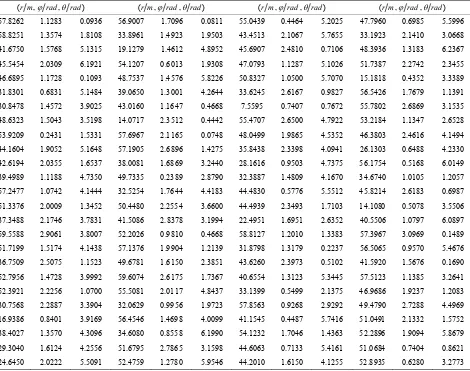
systems, assuming the tactical technical requirements, the cartridges from single shrapnel should be more evenly scattered in a ball with equivalent radius (120 ± 20) m, launching a shrapnel, the number of cartridges is N = 400, measuring the coordinates of one hundred car-tridges near the dispersion centre (n = 100), they were produced by computer simulation basing on uniform requirements in a sphere, i.e. ( , , )r were produced by stochastic simulation according to the following for-mulas
3
1( ) ,n0 arccos 1 2 2( ) ,
r H r r H
3
2πH ( )
(4.1)
where, rn060, H r1( ), H2( ) , H3( ) are
number (0,1
for cartr es as ow Table 1, a
*sqrt(r(1)); 2*r(2)+1); 0 (2*k-1)/200))^2; ((2*k-1)/200))^2; )^2; :100 sum(a); m(b); random ), coor-produced by stochastic simulation in
dinates idg bel nd the
MAT-LAB program as below, >> clear for k=1:100 nd(1,3); r=ra x=60 z=2*pi*r(3); [x, y, z]
end >>clear 1:10 for k= a=(x^2-( b=(y^2/3600-c=(z^2/3600-((2*k-1)/200) [a, b, c]
end ar >> cle or k=1 f s=1/1200+ u=1/1200+su v=1/1200+sum(c); [s u v]
Table 1. Polar coordinates points of fall for cartridges.
(r m, rad, rad) (r m, rad, rad) (r m, rad, rad) (r m, rad, rad)
57.8262 1.1283 0.0936 56.9007 1.7096 0.0811 55.0439 0.4464 5.2025 47.7960 0.6985 5.5996
58.8251 1.3574 1.8108 33.8961 1.4923 1.9503 43.4513 2.1067 5.7655 33.1923 2.1410 3.0668
41.6750 1.5768 5.1315 19.1279 1.4612 4.8952 45.6907 2.4810 0.7106 48.3936 1.3183 6.2367
45.5454 2.0309 6.1921 54.1207 0.6013 1.9308 47.0793 1.1287 5.1026 51.7387 2.2742 2.3455
46.6895 1.1728 0.1093 48.7537 1.4576 5.8226 50.8327 1.0500 5.7070 15.1818 0.4352 3.3389
31.8301 0.6831 5.1484 39.0650 1.3001 4.2644 33.6245 2.6167 0.9827 56.5426 1.7679 1.1391
30.8478 48.6323 1.
1.4572 3. 5043
9025 3.5198 14.
43.0160 0717 2.
1.1647 0. 3512
4668 7. 0.4442 55.
5595 0. 4707
7407 0. 2.6500
7672 4.7922 53.
55.7802 2184 1.
2.6869 1347
3.1535 2.6528
53.9209 0.2431 1.5331 57.6967 2.1165 0.0748 48.0499 1.9865 4.5352 46.3803 2.4616 4.1494
44.1604 1.9052 5.1648 57.1905 2.6896 1.4275 35.8438 2.3398 4.0941 26.1303 0.6488 4.2330
42.6194 2.0355 1.6537 38.0081 1.6869 3.2440 28.1616 0.9503 4.7375 56.1754 0.5168 6.0149
39.4989 1. 57.2477 1.
1188 0742
4.7350 49. 4.1444 32.
7335 0. 5254 1.
2389 7644
2.8790 32. 4.4183 44.
3887 4830
1.4809 0.5776
4.1670 34. 5.5512 45.
6740 1. 8214 2.
0105 6183
1.2057 0.6987
51.3376 2.0009 1.3452 50.4480 2.2554 3.6600 44.4939 2.3493 1.7103 14.1080 0.5078 3.5506
37.3488 2.1746 3.7831 41.5086 2.8378 3.1994 22.4951 1.6951 2.6352 40.5506 1.0797 6.0897
59.5588 2.9061 3.8007 52.2026 0.9810 0.4668 58.8127 1.2010 1.3383 57.3967 3.0969 0.1489
51.7199 1. 36.7509 2.
5174 5075
4.1438 57. 1.1523 49.
1376 1. 6781 1.
9904 6150
1.2139 31. 2.3851 43.
8798 6260
1.3179 2.3973
0.2237 56. 0.5102 41.
5065 0. 5920 1.
9570 5676
5.4676 0.1690
52.7956 1.4728 3.9992 59.6074 2.6175 1.7367 40.6554 1.3123 5.3445 57.5123 1.1385 3.2641
52.3921 2.2256 1.0700 55.5081 2.0117 4.8437 33.1399 0.5499 2.1375 46.9686 1.9237 1.2083
30.7568 2.2887 3.3904 32.0629 0.9956 1.9723 57.8563 0.9268 2.9292 49.4790 2.7288 4.4969
16.9386 0. 38.4027 1.
8401 3570
3.9169 56. 4.3096 34.
4546 1. 6080 0.
4698 8558
4.0099 41. 6.1990 54.
1545 1232
0.4487 1.7046
5.7416 51. 1.4363 52.
0491 2. 2896 1.
1332 9094
1.5752 5.8679
29.3040 1.6124 4.2556 51.6795 2.7865 3.1598 44.6063 0.7133 5.4161 51.0684 0.7404 0.8621
24.6450 2.0222 5.5091 52.4759 1.2780 5.9546 44.2010 1.6150 4.1255 52.8935 0.6280 3.2773
in d s i
aper, using above MATLAB program, we obtain
Takeconspicuous level
Accord g to the data in Table 1 an method n this p
2 0.0888, 2 0.0425, 2 0.0749
r
n n n
0 0
ˆ 117.4909, ( ) 3.0984ˆ
R R
10%
, seeing the Table in [17], we obtain the bou e
10 ndary valu z 0.3472
2 for
n . Because 2
r
n , n 2
, n 2
are less than 0.3472, so we consider that cartridges obeys unif tion
sphere.
5. Referen
orm distribu in a
ces
nterval Estimate of the Interval Length on Uniform Distribution,” Pure and Applied Mathematics
bution,” Journal
im U Di ,” M
t-ics, Vol. 23, No. 4, 2007, pp. 155-159.
n-
i and B. Deng, “On the Testing and
ensional
of Ball D ensional niform stribution College athema
[1] G. S. Chen, “I
Uni
, P
Vol. 22, No. 3, 2006, pp. 349-354.
[2] H. B. Zhang, “The Shortest Confidence Interval of the Interval Length on Uniform Distri of Xiaogan University,Vol. 27, No. 3, 2007, pp. 52-55. [3] Z. J. Liu, “Estimate of Rectangle Region Area on Two
[4] Z. J. Liu, “Estimate of Cuboid Volume on Three-Dime sional Uniform Distribution,” Statistics and Decision, No. 5, 2007, pp. 23-24.
[5] Z. X. Wang, “Parameter Estimation of Two-Dimensional Uniform Distribution in a Circle,” College Mathematics, Vol. 24, No. 2, 2008, pp. 150-152.
[6] W. Q. Jin, D. S. Cu
Estimation of Uniform Distribution in a Circle,” Acta Armamentarii, Vol. 22, No. 4, 2001, pp. 468-472. [7] F. M. Zheng, “Estimate of Radius on Three-Dim
form Distribution in a Sphere,” Mathematics in Prac- tice and Theory, Vol. 40, No. 14, 2010, pp. 166-170. [8] Y. X. Liu and P. Cheng, “Uniform Distribution
PCM Test Statistic on Dimension and Sample Size Berry-Esseen Boundary and LIL,” China Science Bulletin, Vol. 43, No. 13, 2005, pp. 1452-1453.
F. M. ZHENG 1550
r the Number and [10] Z. S. Hu and C. Su, “Limit Theorems fo
Sum of Near-Maxima for Medium Tails,” Statistics & Probability Letters, Vol. 63, No. 3, 2003, pp. 229-237.
doi:10.1016/S0167-7152(03)00085-3
[11] Y. Qi, “Limit Distributions for Products of Sums,” Statis-tics & Probability Letters, Vol. 62, No. 1, 2007, pp. 93- 100. doi:10.1016/S0167-7152(02)00438-8
[12] G. Rempala and J. Wesolowski, “Asymptotics for
Prod-tical Anal ucts of Sums and U-Statistics,” Electronic Communica-tions in Probability, Vol. 7, No. 7, 2002, pp. 47-54. [13] K. T. Fang, J. Q. Fan, H. Jin, et al., “Statis ysis
of Directional Date,” Journal of Application of Statistics and Management, Vol. 9, No. 2, 1990, pp. 59-65. [14] M. D. Troutt, W. K. Pang and S. H. Hou, “Vertical
Den-sity Representation and Its Applications,” World
Scien-tific Publishing Co. Pte. Ltd, Singapore, 2004.
doi:10.1142/9789812562616
[15] Z. S. Wei, “Probability Theory and Mathematic
tics,” Higher Education Press, Beijing, 1983. al Statis-
ility Theory
[16] S. M. Berman, “Extreme Sojourns of a Gaussian Process with a Point of Maximum Variance,”Probab
and Related Fields, Vol. 74, 1987, pp. 113-124.
doi:10.1007/BF01845642
[17] C. P. Pan and Z. J. Han, “Probability and Statistic o Weapon Test,” National Defence Industry Press, Beijing, f
sidual Quadratic Sums in the Dispersion Equation 1979.
[18] N. I. Sidnyaev and K. S. Andreytseva, “Independence of the Re
with Noncentral χ2-Distribution,” Applied Mathematics,