z
RESEARCH ARTICLE
INFORMATION COMMUNICATION TECHNOLOGY IN AGRICULTURE AND RURAL
DEVELOPMENT-WITH SPECIAL REFERENCE TO MOBILE PHONE TECHNOLOGY (MAGRI-RD): PROSPECTS AND
CHALLENGES IN ETHIOPIA
1
Dr. Paul Mansingh, J.,
2Sasikumar, P. and
3Fikadu Abdise Erena
1
Professor, Department of Rural Development and Agricultural Extension, AMBO University, AMBO, Ethiopia
2Assistant Professor, Department of Information Technology, Institute of Technology, AMBO University,
AMBO, Ethiopia
3
Head, Department of Rural Development & Agricultural Extension, AMBO University, AMBO, Ethiopia
ARTICLE INFO ABSTRACT
Farmers are plagued by myriad issues such as timely and reliable access to farm inputs, access to markets, access to reliable information at the right time and cheap access to credit. The proliferation of mobile phones across the
globe has impinged on agriculture in various ways. Mobiles are being used to help raise farmers’ incomes, making
agricultural marketing more efficient, lowering information costs, reducing transport costs, and providing a platform to deliver services and innovate. The role of mobiles in enhancing food security and supporting rural livelihoods is increasingly being recognized and was officially endorsed at the World Summit on the Information Society (2003-2005). Several countries in Africa and Asia are now using mobiles for the dissemination of agricultural knowledge and information. Ethio Telecom currently provides mobile telephone service to approximately 50 million subscribers and aims to provide mobile telephone service to a total of 91 million subscribers, which is nearly double the number of current mobile users. Broadband internet data subscription will grow to 39 million from the current 1.46 million subscribers. Mobile internet data coverage will also grow from 8 million to 16.9 million users, while overall internet data coverage will grow to 10 per cent from the current 3.3 percentage. The most notable opportunity in Ethiopia is the presence of ICT infrastructure called the Woredanet that can be easily extended to reach most of the rural farmers and to further strengthen the research-extension-farmer linkage. The challenges of access to ICT can be divided into two: (i) access to ICT infrastructure and (ii) access to ICT services. The access to ICT infrastructure in Ethiopia is still very low despite some noticeable improvements registered in recent years. Damages on fibre optic cables and power interruptions are among the challenges the service provider faced in its expansion and network quality improvement efforts. However, the power of mobile phone technology in agriculture is its ability to catalyse a wide range of interventions that are core to transforming the sector.
Copyright©2016, Dr. Paul Mansingh et al. This is an open access article distributed under the Creative Commons Attribution License, which permits unrestricted use, distribution, and reproduction in any medium, provided the original work is properly cited.
INTRODUCTION
We believe that a new digital economy is emerging which affords new opportunities to promote broad-based growth, empower citizens and improve service delivery in developing countries. Technologies like the mobile phone are exciting because they place an incredible channel for information and service delivery in the hands of the poor at a never before seen scale. Today’s phones are more powerful than the first computers and, therefore, are tools for two-way communication that can support rich content and a diverse array of applications.
*Corresponding author: Dr. Paul Mansingh, J.,
Professor, Department of Rural Development and Agricultural Extension, AMBO University, AMBO, Ethiopia.
The opportunities to harness mobile technology to solve development challenges are immense (Andrew, 2014). Productivity is extremely low due to unscientific farming practices, fragmented landholdings, lack of agro climatic focus for crop selection and lack of access to the right farming advice at the right time. Farmers are plagued by myriad issues such as timely and reliable access to farm inputs, access to markets, access to reliable information at the right time and cheap access to credit. To resolve these issues, an integrated system would serve as a one-stop knowledge base, creation engine and delivery channel for distributing personalized cultivation practices to all farmers (Srinivasu, 2015).
Functional uses of mobiles in development:
Josh et al. (2014) listed out the following functional uses of mobiles in development.
ISSN: 0975-833X
Available online at http://www.journalcra.com
International Journal of Current Research Vol. 8, Issue, 08, pp.37411-37418, August, 2016
INTERNATIONAL JOURNAL OF CURRENT RESEARCH
Article History:
Received 29thMay, 2016
Received in revised form 05thJune, 2016
Accepted 27thJuly, 2016
Published online 31stAugust, 2016
Citation: Dr. Paul Mansingh, J., Sasikumar, P. and Fikadu Abdise Erena, 2016.“Information communication technology in agriculture and rural development-with special reference to mobile phone technology (magri-rd): prospects and challenges in Ethiopia”, International Journal of Current Research, 8, (08), 37411-37418.
Key words:
ICT, Mobile Phone Technology in Agriculture and Rural Development, Ethiopia.
z
RESEARCH ARTICLE
INFORMATION COMMUNICATION TECHNOLOGY IN AGRICULTURE AND RURAL
DEVELOPMENT-WITH SPECIAL REFERENCE TO MOBILE PHONE TECHNOLOGY (MAGRI-RD): PROSPECTS AND
CHALLENGES IN ETHIOPIA
1
Dr. Paul Mansingh, J.,
2Sasikumar, P. and
3Fikadu Abdise Erena
1
Professor, Department of Rural Development and Agricultural Extension, AMBO University, AMBO, Ethiopia
2Assistant Professor, Department of Information Technology, Institute of Technology, AMBO University,
AMBO, Ethiopia
3
Head, Department of Rural Development & Agricultural Extension, AMBO University, AMBO, Ethiopia
ARTICLE INFO ABSTRACT
Farmers are plagued by myriad issues such as timely and reliable access to farm inputs, access to markets, access to reliable information at the right time and cheap access to credit. The proliferation of mobile phones across the
globe has impinged on agriculture in various ways. Mobiles are being used to help raise farmers’ incomes, making
agricultural marketing more efficient, lowering information costs, reducing transport costs, and providing a platform to deliver services and innovate. The role of mobiles in enhancing food security and supporting rural livelihoods is increasingly being recognized and was officially endorsed at the World Summit on the Information Society (2003-2005). Several countries in Africa and Asia are now using mobiles for the dissemination of agricultural knowledge and information. Ethio Telecom currently provides mobile telephone service to approximately 50 million subscribers and aims to provide mobile telephone service to a total of 91 million subscribers, which is nearly double the number of current mobile users. Broadband internet data subscription will grow to 39 million from the current 1.46 million subscribers. Mobile internet data coverage will also grow from 8 million to 16.9 million users, while overall internet data coverage will grow to 10 per cent from the current 3.3 percentage. The most notable opportunity in Ethiopia is the presence of ICT infrastructure called the Woredanet that can be easily extended to reach most of the rural farmers and to further strengthen the research-extension-farmer linkage. The challenges of access to ICT can be divided into two: (i) access to ICT infrastructure and (ii) access to ICT services. The access to ICT infrastructure in Ethiopia is still very low despite some noticeable improvements registered in recent years. Damages on fibre optic cables and power interruptions are among the challenges the service provider faced in its expansion and network quality improvement efforts. However, the power of mobile phone technology in agriculture is its ability to catalyse a wide range of interventions that are core to transforming the sector.
Copyright©2016, Dr. Paul Mansingh et al. This is an open access article distributed under the Creative Commons Attribution License, which permits unrestricted use, distribution, and reproduction in any medium, provided the original work is properly cited.
INTRODUCTION
We believe that a new digital economy is emerging which affords new opportunities to promote broad-based growth, empower citizens and improve service delivery in developing countries. Technologies like the mobile phone are exciting because they place an incredible channel for information and service delivery in the hands of the poor at a never before seen scale. Today’s phones are more powerful than the first computers and, therefore, are tools for two-way communication that can support rich content and a diverse array of applications.
*Corresponding author: Dr. Paul Mansingh, J.,
Professor, Department of Rural Development and Agricultural Extension, AMBO University, AMBO, Ethiopia.
The opportunities to harness mobile technology to solve development challenges are immense (Andrew, 2014). Productivity is extremely low due to unscientific farming practices, fragmented landholdings, lack of agro climatic focus for crop selection and lack of access to the right farming advice at the right time. Farmers are plagued by myriad issues such as timely and reliable access to farm inputs, access to markets, access to reliable information at the right time and cheap access to credit. To resolve these issues, an integrated system would serve as a one-stop knowledge base, creation engine and delivery channel for distributing personalized cultivation practices to all farmers (Srinivasu, 2015).
Functional uses of mobiles in development:
Josh et al. (2014) listed out the following functional uses of mobiles in development.
ISSN: 0975-833X
Available online at http://www.journalcra.com
International Journal of Current Research Vol. 8, Issue, 08, pp.37411-37418, August, 2016
INTERNATIONAL JOURNAL OF CURRENT RESEARCH
Article History:
Received 29thMay, 2016
Received in revised form 05thJune, 2016
Accepted 27thJuly, 2016
Published online 31stAugust, 2016
Citation: Dr. Paul Mansingh, J., Sasikumar, P. and Fikadu Abdise Erena, 2016.“Information communication technology in agriculture and rural development-with special reference to mobile phone technology (magri-rd): prospects and challenges in Ethiopia”, International Journal of Current Research, 8, (08), 37411-37418.
Key words:
ICT, Mobile Phone Technology in Agriculture and Rural Development, Ethiopia.
z
RESEARCH ARTICLE
INFORMATION COMMUNICATION TECHNOLOGY IN AGRICULTURE AND RURAL
DEVELOPMENT-WITH SPECIAL REFERENCE TO MOBILE PHONE TECHNOLOGY (MAGRI-RD): PROSPECTS AND
CHALLENGES IN ETHIOPIA
1
Dr. Paul Mansingh, J.,
2Sasikumar, P. and
3Fikadu Abdise Erena
1
Professor, Department of Rural Development and Agricultural Extension, AMBO University, AMBO, Ethiopia
2Assistant Professor, Department of Information Technology, Institute of Technology, AMBO University,
AMBO, Ethiopia
3
Head, Department of Rural Development & Agricultural Extension, AMBO University, AMBO, Ethiopia
ARTICLE INFO ABSTRACT
Farmers are plagued by myriad issues such as timely and reliable access to farm inputs, access to markets, access to reliable information at the right time and cheap access to credit. The proliferation of mobile phones across the
globe has impinged on agriculture in various ways. Mobiles are being used to help raise farmers’ incomes, making
agricultural marketing more efficient, lowering information costs, reducing transport costs, and providing a platform to deliver services and innovate. The role of mobiles in enhancing food security and supporting rural livelihoods is increasingly being recognized and was officially endorsed at the World Summit on the Information Society (2003-2005). Several countries in Africa and Asia are now using mobiles for the dissemination of agricultural knowledge and information. Ethio Telecom currently provides mobile telephone service to approximately 50 million subscribers and aims to provide mobile telephone service to a total of 91 million subscribers, which is nearly double the number of current mobile users. Broadband internet data subscription will grow to 39 million from the current 1.46 million subscribers. Mobile internet data coverage will also grow from 8 million to 16.9 million users, while overall internet data coverage will grow to 10 per cent from the current 3.3 percentage. The most notable opportunity in Ethiopia is the presence of ICT infrastructure called the Woredanet that can be easily extended to reach most of the rural farmers and to further strengthen the research-extension-farmer linkage. The challenges of access to ICT can be divided into two: (i) access to ICT infrastructure and (ii) access to ICT services. The access to ICT infrastructure in Ethiopia is still very low despite some noticeable improvements registered in recent years. Damages on fibre optic cables and power interruptions are among the challenges the service provider faced in its expansion and network quality improvement efforts. However, the power of mobile phone technology in agriculture is its ability to catalyse a wide range of interventions that are core to transforming the sector.
Copyright©2016, Dr. Paul Mansingh et al. This is an open access article distributed under the Creative Commons Attribution License, which permits unrestricted use, distribution, and reproduction in any medium, provided the original work is properly cited.
INTRODUCTION
We believe that a new digital economy is emerging which affords new opportunities to promote broad-based growth, empower citizens and improve service delivery in developing countries. Technologies like the mobile phone are exciting because they place an incredible channel for information and service delivery in the hands of the poor at a never before seen scale. Today’s phones are more powerful than the first computers and, therefore, are tools for two-way communication that can support rich content and a diverse array of applications.
*Corresponding author: Dr. Paul Mansingh, J.,
Professor, Department of Rural Development and Agricultural Extension, AMBO University, AMBO, Ethiopia.
The opportunities to harness mobile technology to solve development challenges are immense (Andrew, 2014). Productivity is extremely low due to unscientific farming practices, fragmented landholdings, lack of agro climatic focus for crop selection and lack of access to the right farming advice at the right time. Farmers are plagued by myriad issues such as timely and reliable access to farm inputs, access to markets, access to reliable information at the right time and cheap access to credit. To resolve these issues, an integrated system would serve as a one-stop knowledge base, creation engine and delivery channel for distributing personalized cultivation practices to all farmers (Srinivasu, 2015).
Functional uses of mobiles in development:
Josh et al. (2014) listed out the following functional uses of mobiles in development.
ISSN: 0975-833X
Available online at http://www.journalcra.com
International Journal of Current Research Vol. 8, Issue, 08, pp.37411-37418, August, 2016
INTERNATIONAL JOURNAL OF CURRENT RESEARCH
Article History:
Received 29thMay, 2016
Received in revised form 05thJune, 2016
Accepted 27thJuly, 2016
Published online 31stAugust, 2016
Citation: Dr. Paul Mansingh, J., Sasikumar, P. and Fikadu Abdise Erena, 2016.“Information communication technology in agriculture and rural development-with special reference to mobile phone technology (magri-rd): prospects and challenges in Ethiopia”, International Journal of Current Research, 8, (08), 37411-37418.
Key words:
Delivery Models
Generally speaking, there are four different ways through which a mobile phone user can interact: voice, messaging, web browsing, and apps (Josh et al. 2014). Each of these is subdivided into service types, as follows:
Why mobile phones in Agriculture and Rural Development?
The pervasiveness of connectivity—to mobile phones, Internet, and other wireless devices—is due to a number of factors, including decreases in costs, increases in competition, and expansion of last-mile infrastructure. Several trends, working in tandem, are making ICT devices and services more affordable in ways that also extend access to small-scale producers (World Bank, 2011). Mobile phone penetration in the developing world now exceeds two subscriptions for every three people, driven by expanding networks in Asia and in Africa.
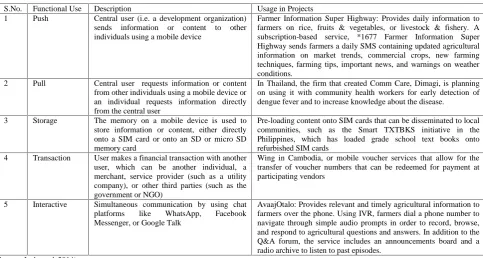
[image:2.595.56.540.71.329.2]The ability to purchase a low-cost mobile phone is complemented by the expansion in telecommunications infrastructure; most countries now have more than 90 per cent of their population served by a cell phone signal, including coverage in rural areas. This rapid expansion results from enabling regulations that ensure competition in the telecommunications sector as well as from high demand for mobile phone subscriptions (International Telecommunications Union, 2010). The proliferation of adaptable and more affordable technologies and devices has also increased ICT’s relevance to smallholder agriculture. Innovation has steadily reduced the purchase price of phones, laptops, scientific instruments, and specialized software. Agricultural innovation in developed countries has become more applicable to developing-country needs. The intuitive design of many technologies and their capacity to convey information visually or audibly make them useful to people with limited formal education or exposure to technology (World Bank, 2011). Table 1. Functional Uses of mobiles in development
S.No. Functional Use Description Usage in Projects 1 Push Central user (i.e. a development organization)
sends information or content to other individuals using a mobile device
Farmer Information Super Highway: Provides daily information to farmers on rice, fruits & vegetables, or livestock & fishery. A subscription-based service, *1677 Farmer Information Super Highway sends farmers a daily SMS containing updated agricultural information on market trends, commercial crops, new farming techniques, farming tips, important news, and warnings on weather conditions.
2 Pull Central user requests information or content from other individuals using a mobile device or an individual requests information directly from the central user
In Thailand, the firm that created Comm Care, Dimagi, is planning on using it with community health workers for early detection of dengue fever and to increase knowledge about the disease.
3 Storage The memory on a mobile device is used to store information or content, either directly onto a SIM card or onto an SD or micro SD memory card
Pre-loading content onto SIM cards that can be disseminated to local communities, such as the Smart TXTBKS initiative in the Philippines, which has loaded grade school text books onto refurbished SIM cards
4 Transaction User makes a financial transaction with another user, which can be another individual, a merchant, service provider (such as a utility company), or other third parties (such as the government or NGO)
Wing in Cambodia, or mobile voucher services that allow for the transfer of voucher numbers that can be redeemed for payment at participating vendors
5 Interactive Simultaneous communication by using chat platforms like WhatsApp, Facebook Messenger, or Google Talk
AvaajOtalo: Provides relevant and timely agricultural information to farmers over the phone. Using IVR, farmers dial a phone number to navigate through simple audio prompts in order to record, browse, and respond to agricultural questions and answers. In addition to the Q&A forum, the service includes an announcements board and a radio archive to listen to past episodes.
(Source: Josh et al. 2014)
Table 2. Different service types/delivery models
S.No. Delivery Model
Description
1 Voice There are two main categories of voice services. The first is a voice call between mobile phone users (often referred to as native voice), which normally occurs on a peer-to-peer basis but can also occur with multiple individuals through three-way and conference calling. The second is interactive voice response (IVR), which is a computer-based system that callers can interact with using their device keypad (via touch tone) and/or voice recognition. IVR systems are generally menu-based and allow callers to navigate a series of menu options to find out specific information or to leave a message
2 Messaging Short Message Service (SMS) or text messages enable people to communicate via text between phones—or also from a computer to phones via an SMS gateway in the case of services such as Frontline SMS, which provides an interface that allows users to send many text messages at the same time, referred to as bulk messaging
3 Web Browsing
Access and browse the web: using WAP (Wireless Application Protocol), a protocol through which mostly older feature phones access the internet. Java, which allows software developers to build better applicationsthat improve the user’s experience when
accessing the internet on lower-priced phones. HTML-capable mobile browser, which are basically scaled down versions of the same browsers used on computers for browsing the web directly
4 Apps Mobile phone apps provide a way for a user to directly access a service rather than accessing through a web browser, often providing a much more user-friendly experience
Advances in data storage and sharing have improved the ability to exchange information—for instance, between departments and levels of government—and avoid costs associated with data transmission charges. The development and use of many ICTs originated in the public sector but were quickly dominated by the private sector when their profit potential became clear.
Crowd sourcing, in which scientists, governments, and development organizations request feedback from farmers and consumers through devices like mobile phones, is also facilitating agriculture development. Farmers can use SMS to send critical local agricultural information like incidences of pests or crop yields that was previously difficult to obtain without expensive surveys by researchers. Using the digital tools available, consumers can also provide information related to changing consumption patterns and tastes to private enterprise (World Bank, 2011). The proliferation of mobile phones across the globe has impinged on agriculture in various ways. Mobiles are being used to help raise farmers’ incomes (Labonne and Chase, 2009; Ilahiane, 2007, making agricultural marketing more efficient (Jensen, 2007; Aker, 2010; Ilahiane, 2007), lowering information costs (DeSilva and Ratnadiwakara, 2008), reducing transport costs (Overa, 2006), and providing a platform to deliver services and innovate (http://www.crisscrossed.net/2009/11/01/the-many-potential-channels-for-mobile-services/).
Helping Farmers Raise Their Incomes
Mobile phones seem to influence the commercialization of farm products. A study from Uganda found that market participation rose with mobile phone access (Muto and Yamano, 2009). Mobile phones can serve as the backbone for early warning systems to mitigate agricultural risks and safeguard agricultural incomes. In Turkey, local weather forecasts transmitted through SMS provided very timely warnings of impending frosts or conditions that favoured pests (World Bank, 2010).
Making Agricultural Marketing More Efficient
Farmers have little information about market prices in urban areas of their own countries, let alone internationally. Mobile phones, in addition to other ICTs, can overcome this problem by informing both producers and consumers of the prices offered for agricultural products in various locations. Despite having the lowest mobile phone penetration in sub-Saharan Africa, Niger has seen important effects on agricultural markets from mobile phone diffusion. As mobile networks have expanded, grain price differences have decreased by 20 per cent, traders’ search costs have decreased by 50 per cent, scarce resources have been better allocated, and consumers paid, on average, 3.5 per cent less for grain, which is equivalent to 5–10 days of grain consumption annually (Aker, 2010). A small study in Morocco found that farmers with mobile phones increasingly dealt directly with wholesalers or larger-scale intermediaries than smaller intermediaries (Ilahiane, 2007). These studies, in conjunction with a host of anecdotal and theoretical evidence, point to the promise of mobile phones in making markets more efficient.
Lowering the Costs of Information
The most obvious and cross-cutting way that mobile phones can improve agriculture is by improving access to information and making it less costly to obtain. A study undertaken in Sri Lanka, where an inconsistent subsidy on fertilizer introduces considerable uncertainty, it was found that 53 per cent of the informational transaction costs were incurred during the growing season, when farmers were attempting to ascertain fertilizer costs. Another 24 per cent were incurred during the initial decision to plant or not, while only 9 per cent of the costs related to information were incurred during the selling stage, where studies typically focus (De Silva and Ratnadiwakara, 2008). It is easy to understand how mobile phones could reduce farmers’ informational transaction costs at critical points in the production cycle.
Reducing Transport Costs
Mobile phones may help users to substitute phone calls for travel. Where safety standards are minimal, roads are in disrepair, and distances are great, substituting phone calls for travel reduces farmers’ time and cost burdens. Time savings are important for agricultural households, because many crops have extremely time-sensitive and labour-intensive production cycles. Farmers who use mobiles can also save on transport costs (Overa, 2006), an effect that is stronger in rural area (Muto and Yamano, 2009). Transportation cannot be avoided entirely: Crops need to get to customers. Although mobiles can inform farmers where they should travel to market their crops, evidence suggests that the wealthy maintain an advantage in their ability to make use of this information (Fafchamps and Hill, 2004).
Methodology
Model of a project using Mobile in technology transfer Registration of Farmers
The selected farmers will be registered in this project and they will be issued with the identity number. Their mobile number and contact details will be registered.
Creating Data bank of the registered farmers
The personal demographic, economic, and socio-psychological characteristics of the farmers and farming details will be collected and a data bank will be created.
Developing Web Portal
The requirements for developing our system
1. Apache– For Web server
2. MySQL- Database Server- for database storage as backup end(back end)
3. PHP – Scripting language – to fetch data from database and storing data into database(front end)
4. Text Editor–For editing PHP Script 5. GSM SIM Card
6. Modem
The actors of our system are
a. Actors
i. Admin–For controlling the web portal ii. Data clerk
a. Registering farmers information b. Administering farmers information c. Sending SMS to farmers
d. Receiving feedback from farmers e. Advising farmers
iii.Farmers–The end users
Steps for creating web portal
a. Creating database tables in the MySQL database(Database connection, closing connection) b. Creating user interface(GUI)
c. Creating login page for Admin and Data Clerk
d. Creating user registration page( i.e. adding, updating , retrieving and deleting users information)
e. Creating send SMS page
Designing Call Centre
Their main task is serving the customers i.e. usually done by the sales and technical support departments as product support, telemarketing or market research.Powered by LaSuperbaIt is essential for good call centres to be able to handle large amount of simultaneous calls, because among large companies hundreds of phone calls might come in simultaneously. Due to this fact, applying effective call managing options (call queuing, call forwarding, call holding, etc.) has become inevitable (http://www.asterisk.org/get-started/ applications/ call-center).
IVR Setup
Each well-functioning call centre has an Interactive Voice Response (IVR) menu that takes a lot of toll from the agents, because it helps the customers to access to basic services in connection with usually their account details or the products/services available.
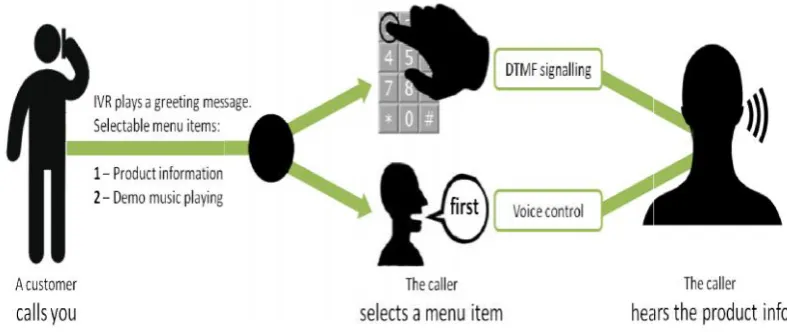
Usually your callers can access some simple actions through the IVR or you can ask to be forwarded to a live agent. For better understanding, IVRs are voice menu systems that can direct the customers to the menu points they need. It receives the customer’s responses given by their touch-tone telephone keypad entry (DTMF signal). Instead of DTMF signalling, IVR systems can be also controlled with human voice commands (voice control). (http://www.codeproject.com/ Articles/746512/How-to-build-a-basic-IVR-Interactive-Voice-Respons).
Prerequisites
1. IVR application is to be built in C#. An IDE (Integrated
Development Environment) supporting this
programming language, such as Microsoft Visual Studio is needed.
2. .NET Framework is to be installed in the PC.
3. As IVR system is based on VoIP technology; some VoIP components to the references in IDE are to be added in order to define the default behaviour of the IVR in the simplest way. Since Ozeki VoIP SIP SDK will be used for another VoIP development (created an IP PBX), the prewritten VoIP components of this SDK will be used.
Prospects and Challenges in Ethiopia
The role of mobiles in enhancing food security and supporting rural livelihoods is increasingly being recognized and was officially endorsed at the World Summit on the Information Society (2003-2005). Several countries in Africa and Asia are now using mobiles for the dissemination of agricultural knowledge and information.
Prospects
[image:4.595.103.497.482.648.2]Ethio Telecom, which provides mobile, fixed line, internet, data, broadband, narrowband and GPRS services, currently has over 31.5 million customers across the country. (Source:http://www.waltainfo.com/index.php?option=com_co Figure 1. IVR Setup
The actors of our system are
a. Actors
i. Admin–For controlling the web portal ii. Data clerk
a. Registering farmers information b. Administering farmers information c. Sending SMS to farmers
d. Receiving feedback from farmers e. Advising farmers
iii.Farmers–The end users
Steps for creating web portal
a. Creating database tables in the MySQL database(Database connection, closing connection) b. Creating user interface(GUI)
c. Creating login page for Admin and Data Clerk
d. Creating user registration page( i.e. adding, updating , retrieving and deleting users information)
e. Creating send SMS page
Designing Call Centre
Their main task is serving the customers i.e. usually done by the sales and technical support departments as product support, telemarketing or market research.Powered by LaSuperbaIt is essential for good call centres to be able to handle large amount of simultaneous calls, because among large companies hundreds of phone calls might come in simultaneously. Due to this fact, applying effective call managing options (call queuing, call forwarding, call holding, etc.) has become inevitable (http://www.asterisk.org/get-started/ applications/ call-center).
IVR Setup
Each well-functioning call centre has an Interactive Voice Response (IVR) menu that takes a lot of toll from the agents, because it helps the customers to access to basic services in connection with usually their account details or the products/services available.
Usually your callers can access some simple actions through the IVR or you can ask to be forwarded to a live agent. For better understanding, IVRs are voice menu systems that can direct the customers to the menu points they need. It receives the customer’s responses given by their touch-tone telephone keypad entry (DTMF signal). Instead of DTMF signalling, IVR systems can be also controlled with human voice commands (voice control). (http://www.codeproject.com/ Articles/746512/How-to-build-a-basic-IVR-Interactive-Voice-Respons).
Prerequisites
1. IVR application is to be built in C#. An IDE (Integrated
Development Environment) supporting this
programming language, such as Microsoft Visual Studio is needed.
2. .NET Framework is to be installed in the PC.
3. As IVR system is based on VoIP technology; some VoIP components to the references in IDE are to be added in order to define the default behaviour of the IVR in the simplest way. Since Ozeki VoIP SIP SDK will be used for another VoIP development (created an IP PBX), the prewritten VoIP components of this SDK will be used.
Prospects and Challenges in Ethiopia
The role of mobiles in enhancing food security and supporting rural livelihoods is increasingly being recognized and was officially endorsed at the World Summit on the Information Society (2003-2005). Several countries in Africa and Asia are now using mobiles for the dissemination of agricultural knowledge and information.
Prospects
Ethio Telecom, which provides mobile, fixed line, internet, data, broadband, narrowband and GPRS services, currently has over 31.5 million customers across the country. (Source:http://www.waltainfo.com/index.php?option=com_co Figure 1. IVR Setup
The actors of our system are
a. Actors
i. Admin–For controlling the web portal ii. Data clerk
a. Registering farmers information b. Administering farmers information c. Sending SMS to farmers
d. Receiving feedback from farmers e. Advising farmers
iii.Farmers–The end users
Steps for creating web portal
a. Creating database tables in the MySQL database(Database connection, closing connection) b. Creating user interface(GUI)
c. Creating login page for Admin and Data Clerk
d. Creating user registration page( i.e. adding, updating , retrieving and deleting users information)
e. Creating send SMS page
Designing Call Centre
Their main task is serving the customers i.e. usually done by the sales and technical support departments as product support, telemarketing or market research.Powered by LaSuperbaIt is essential for good call centres to be able to handle large amount of simultaneous calls, because among large companies hundreds of phone calls might come in simultaneously. Due to this fact, applying effective call managing options (call queuing, call forwarding, call holding, etc.) has become inevitable (http://www.asterisk.org/get-started/ applications/ call-center).
IVR Setup
Each well-functioning call centre has an Interactive Voice Response (IVR) menu that takes a lot of toll from the agents, because it helps the customers to access to basic services in connection with usually their account details or the products/services available.
Usually your callers can access some simple actions through the IVR or you can ask to be forwarded to a live agent. For better understanding, IVRs are voice menu systems that can direct the customers to the menu points they need. It receives the customer’s responses given by their touch-tone telephone keypad entry (DTMF signal). Instead of DTMF signalling, IVR systems can be also controlled with human voice commands (voice control). (http://www.codeproject.com/ Articles/746512/How-to-build-a-basic-IVR-Interactive-Voice-Respons).
Prerequisites
1. IVR application is to be built in C#. An IDE (Integrated
Development Environment) supporting this
programming language, such as Microsoft Visual Studio is needed.
2. .NET Framework is to be installed in the PC.
3. As IVR system is based on VoIP technology; some VoIP components to the references in IDE are to be added in order to define the default behaviour of the IVR in the simplest way. Since Ozeki VoIP SIP SDK will be used for another VoIP development (created an IP PBX), the prewritten VoIP components of this SDK will be used.
Prospects and Challenges in Ethiopia
The role of mobiles in enhancing food security and supporting rural livelihoods is increasingly being recognized and was officially endorsed at the World Summit on the Information Society (2003-2005). Several countries in Africa and Asia are now using mobiles for the dissemination of agricultural knowledge and information.
Prospects
ntent&view=article&id=18936:ethiopia-to-attain-rural-telecom -access-within-5-km-radius-of-service-target-&catid=52: national-news&Itemid=291 viewed on 25.11.2015). The telecom giant currently provides mobile telephone service to approximately 50 million subscribers. Andualem Admassie, CEO of ET, told Capital that the telecom enterprise aims to provide mobile telephone service to a total of 91 million subscribers, which is nearly double the number of current mobile users. Broadband internet data subscription will grow to 39 million from the current 1.46 million subscribers. Mobile internet data coverage will also grow from 8 million to 16.9 million users, while overall internet data coverage will grow to 10 per cent from the current 3.3 percentage. (Source: http://www.capitalethiopia.com/index.php?option=com_conten t&view=article&id=5274:ethio-telecom-aims-mobile-phone-access-to-reach-113-million&catid=35:capital&Itemid=27 viewed on 25.11.2015).
Ethiopia has some ICT related opportunities that can be utilized in the dissemination of agricultural knowledge and information to the users. The most notable opportunity is the presence of ICT infrastructure called the Woredanet that can be easily extended to reach most of the rural farmers and to further strengthen the research-extension-farmer linkage. At present, almost all woredas have the infrastructure that enabled them to be connected to the network and have access to internet, telecommunication, video conference and databases at national level (Adam, 2010). Thus, the presence of such modern ICT initiatives can be considered to be a good opportunity to enhance the flow of agricultural knowledge and information in the country. It is also an important medium to expand and effectively provide a wide range of other extension services including health and nutrition extension services and conducting civic education programs.
In Ethiopia, public agricultural extension services have been in action for about half a century. Studies show that Ethiopia has the largest agricultural extension system in Sub‑Saharan Africa, and third largest in the world after China and India (Swanson and Rajalahti, 2010). According to the Bill and Melinda Gates Foundation (BMGF 2010), a total of 8,500 farmer training centres (FTCs) have been established and 63,000 field extension workers (known as development agents‑DAs) have been trained. The current extension approach, therefore, follows FTC‑based extension system (Source:https://foodsecuritysm.wordpress.com/2014/03/01/ictf oragriculturealessonforethiopianresearchandextensionsystem/). Farmers Training Centres (FTCs) are central to Ethiopia’s extension system and serve as an entry point to field level extension delivery, by providing training, technology demonstration, and other services. Each FTC, supported by at least three development Agents (DAs), plays a vital role in ensuring a bottom up extension approach. FTCs have functional demonstration plots on which they are conducting trainings. However, it has been difficult to determine the type and level of training necessary for FTCs given the lack of clear classification criteria. As such, new detailed classified criteria have been developed and agreed by all key stakeholders that provide target levels and interventions to bring all FTCs in the country to the level necessary to support all smallholder farmers.
In addition, at least 1,200 FTCs have been targeted to receive capacitation with support from various donors and stakeholders. An additional 50 FTCs will be upgraded to model FTC level. One thousand model farmers per model FTC, totalling 50,000 farmers, are also expected to receive comprehensive training on integrating plant and animal production in climate smart agriculture. Each of these farmers will implement at least three technologies in their farms. There are also plans to increase the number of FTCs to 18,000 or one for each kebele. (Source:http://www.ata.gov.et/programs/ systems/researchextension/)
A new information hotline is giving smallholder farmers across Ethiopia access to best practice agronomic advice revolutionizing traditional agricultural extension. In collaboration with the Ministry of Agriculture (MoA), the Ethiopian Institute of Agricultural Research (EIAR), and Ethio Telecom, the 8028 hotline was created by the Ethiopian Agricultural Transformation Agency (ATA), who placed the extension information typically provided to agricultural Development Agents directly on a technology platform that can be accessed by anyone at any time. Twelve weeks after its launch in the Oromia, Amhara, Tigray and SNNP regions, the hotline has received nearly 1.5 million calls from 300,000 farmers (www.ata.gov-8028-agricultural-hotline-service-revolutionizing-agricultural-extension-in-ethiopia/).
The Interactive Voice Response (IVR)/Short Message Service (SMS) system currently provides smallholder farmers free access to information on cereal, horticulture, and pulse/oil seed crops, as well as a wide range of agriculture related activities. Currently 90 service lines connect smallholder farmers to automated and voice recorded information on pre planting, planting, crop protection, postharvest, fertilizer application, processing, irrigation and weather content. A push based voice and SMS alert system also notifies extension workers and smallholder farmers of any pertinent agriculture issues. Ato Khalid Bomba, Chief Executive Officer, ATA, attributed the success of 8028 to the unique two way functionality of the service, “Farmers can “pull” practical, real time advice available in their regional language by calling 8028 as often as they like. At the same time the hotline administrator can “push” customized content (such as in cases of drought, pest and disease) to callers based on crop, geographic or demographic data captured when farmers first register to use the system. For example, there is currently a concern about the possibility of wheat rust in certain parts of Ethiopia. With this IVR system, we have been able to send voice recorded messages to all wheat farmers registered on the system about strategies that they can use to minimize the impact of wheat rust on their crops.”
benefiting significantly from this new service which gives them information they would otherwise have only gotten through extension workers, whom they may only meet with periodically. With this system farmers can access the information they need at their convenience and as often as necessary.” “The IVR system offers users information relevant to the key cereals and high value crops, but I envisage that in the near future there will be the opportunity to upscale the service to include content relevant to all of the major agricultural commodities in the country, including livestock,” His Excellency said.
Ato Andualem Admassie, Chief Executive Officer, Ethio Telecom, remarked that development of the hotline presented a unique opportunity for three distinguished organizations to work collaboratively for the benefit of Ethiopia. “This is a landmark initiative and one that has tangible benefits for farmers and their communities. EthioTelecom is proud to be part of this project and assist where there is a real need in our country,” said AtoAndualem. Additional support from the ATA’s development partners, The Royal Netherlands Embassy, and the Department of Foreign Affairs, Trade and Development (DFATD) Canada, was critical to the success of the project. “The 8028 information service is the first initiative of its kind in Ethiopia,” stated Her Excellency Ms. LidiRemmelzwaal, The Netherlands’ Ambassador to Ethiopia. “That it received 1,500,000 calls during two months of operation is indicative of the project’s impact potential on the country’s agriculture community in the months to come.”
His Excellency Mr. David Usher, Canadian Ambassador to Ethiopia added, “The content made available through this project is vital in assisting Ethiopia’s farmers to maximize productivity, improve income earning potential and transform livelihoods.” The ATA is currently working with the Ministry of Agriculture, Ethio Telecom and other partners to scale up the initiative. Plans are underway for the deployment of a further 30 service lines and expansion of the hotline content to cover all aspects of agricultural information pertinent to
Ethiopia’s smallholder famers (Source:
http://www.ata.gov.et/new8028agricultural-hotline-service-revolutionizing-agricultural-extensionin-ethiopia/ )
Challenges
The challenges of access to ICT can be divided into two: (i) access to ICT infrastructure and (ii) access to ICT services. The access to ICT infrastructure in Ethiopia is still very low despite some noticeable improvements registered in recent years. According to the country diagnostic report of the World Bank issued in March 2010, the coverage of ICT in Ethiopia is one of the lowest in Africa. For instance, the coverage of GSM signal is about 10 per cent of the population compared to the per cent benchmark for low income countries. Similarly, at the time of assessment, the Internet bandwidth benchmark for low income countries is about 20 times higher than that of Ethiopia. Studies have argued that the monopolistic market structure exists in Ethiopia’s fixed, Internet and mobile markets is one of the major factors behind the slow development of its ICT sector (Adam, 2010). In most places, FTCs are not connected to modern ICT infrastructure and
services. As a result, research-extension-farmer linkages are weak and costly as such linkages have to be fostered through physical contact such as training, field demonstration, field day program and visits. The low level of access to ICT infrastructure is also believed to have slowed the sharing and exchange of knowledge and information generated from research centres at national and regional levels. Relatedly, electricity infrastructure coverage in the rural parts of the country remains low despite recent efforts to extend the electricity grid to rural areas through the rural electrification program. The low level of electricity coverage has in turn inhibited the expansion of ICT services to rural areas (UNDP Ethiopia, 2012).
In spite of being a necessary condition, access to ICT infrastructure by itself is not sufficient for the dissemination of knowledge and information to occur through it. Access to ICT infrastructure must be accompanied by access to ICT services. In this respect, the other challenge is how to make ICT services both affordable and available in venues or modes that are convenient to smallholder farmers. Availability of venues refers to the presence of various access points particularly information kiosks, tele-centres, call-centres, and so on in a manner that is accessible to the majority of the farmers. These services are not adequately available and accessible to farmers in Ethiopia. A recent study has pointed out that there are only three public tele-centres per ten thousand people and even existing service centres are unlikely to be sustainable, and extension to rural areas is a challenge due to lack of funds reported by Chekol(2009) as quoted by Samuel et al. (2012). Furthermore, affordability poses a great challenge to accessibility of ICT service, especially among subsistent farmers. Moreover, although the tariff for modern ICT services such as mobile phone, internet, and fixed lines in Ethiopia is one of the lowest in Africa, prices are not that low in purchasing power parity terms when one takes into account the low levels of household per-capita income (Adam, 2010).
But in order to realize such benefits of ICT, the service must be available and accessible, demand driven, affordable, and its application should be within the capacity of the majority of the farmers. ICT should serve as a repository of knowledge created by researchers and farmers; and also a platform for experience sharing so that more smallholders can benefit from it. In Ethiopia the application of ICT in this way is very limited except for few programs and initiatives whose coverage is currently very low to generate the desired agricultural production and productivity outcomes. Damages on fibre optic cables and power interruptions are among the challenges the service provider faced in its expansion and network quality improvement efforts, he said. According to Abdurahim, some 1,477 fibre optic cable damages were occurred last Ethiopian budget year alone. (Source: http://www.waltainfo.com/ index.php?option=com_content&view=article&id=18936:ethio pia-to-attain-rural-telecom-access-within-5-km-radius-of-service-target-&catid=52:national-news&Itemid=291viewed on 25.11.2015.)
Conclusion
information and services throughout many sectors. Mobile phone technology can play a huge role in agricultural development and the lives of smallholder farmers. The power of mobile phone technology in agriculture is its ability to catalyse a wide range of interventions that are core to transforming the sector. For example, mobile phone can leverage information for farming advice, enable mobile money to exchange and save capital, or rapidly alert farmers in emergency situations such as severe weather, diseases and pests. ICTs are tools and make information easier to access, but unless farmers or end users are informed of their purpose, benefits and operation, their usefulness can be overlooked. The main objective of the Program area during the GTP II is to develop and support ICT related solutions for all agricultural challenges encountered by government institutions, smallholders, and other key stakeholders. Mobile phone technology plays major role by connecting smallholders to resources and information that can help them increase their productivity and household income, enhancing the ability of extension workers and farmers to make agronomic decisions that increase productivity through the recently scaled up IVR/SMS Agricultural Information Hotline.
REFERENCES
Adam, L. 2010. Ethiopia ICT Sector Performance Review 2009/2010: Towards Evidence-based ICT Policyand Regulation. Volume Two, Policy Paper 9
Aker, J.C. 2010. “Information from Markets Near and Far: Mobile Phones and Agricultural Markets in Niger.” American Economic Journal: Applied Economics, 2(3):46– 59.
Andrew, S. 2014. quoted by Josh Woodard, Jordan Weinstock, and Nicholas Lesher 2014. “Integrating Mobiles into Development Projects”, U.S. Agency for International Development, FHI 360 and Open Revolution.
BMGF. 2010. Accelerating Ethiopian Agriculture Development for Growth, Food Security, and Equity. Cisco. 2010. “Cisco Visual Networking Index: Global Mobile
Data Traffic Forecast Update, 2010–2015.” San Jose: Cisco. http:// www.cisco.com/en/US/solutions/ collateral/ ns341/ ns525/ns537/ ns705/ns827/white_paper_c11-520862.pdf, accessed July 2011.
De Silva, H., and D. Ratnadiwakara. 2008. “Using ICT to Reduce Transaction Costs in Agriculture Through Better Communication: A Case-Study from Sri Lanka.” LIRNEasia, http://www.lirneasia.net/wp-content/uploads/ 2008/11/transactioncosts.pdf, accessed May 2011.
Donner, J. 2009. “Mobile-Based Livelihood Services in Africa: Pilots and Early Deployments.” In Communication Technologiesin Latin America and Africa: A Multidisciplinary Perspective, edited by M. Fernández-Ardèvol and A. Ros. Barcelona: IN3. Pp. 37–58.
Fafchamps, M., and R. Vargas Hill. 2004. “Selling at the Farm-Gate or Travelling to Market.” CSAE Working Paper Series 2004-30. Oxford: Centre for the Study of African Economies, University of Oxford.
Hellstrom, J. 2010. The Innovative Use of Mobile Applications in East Africa. Stockholm: Swedish International Development Cooperation Agency.
http://mashable.com/2013/07/24/google-play-1-million/
http://nazret.com/blog/index.php/2012/09/20/number-of- mobile-subscribers-in-ethiopia-tops-17-million-ethio-telecom
http://www.asterisk.org/get-started/applications/call-center
http://www.ata.gov.et/new8028agricultural-hotline-service-revolutionizingagricultural-extensionin-ethiopia/ http://www.ata.gov.et/programs/systems/researchextension/ http://www.capitalethiopia.com/index.php?option=com_conten
t&view=article&id=5274:ethio-telecom-aims-mobile-
phone-access-to-reach-113-million&catid=35:capital&Itemid=27viewedon 25.11.2015.
http://www.codeproject.com/Articles/746512/How-to-build-a-basic-IVR-Interactive-Voice-Respons
http://www.crisscrossed.net/2009/11/01/the-many-potential-channels-for-mobile-services/;(a)
http://www.slideshare.net/ondevice/the-mobileonly-Internet-generation;
http://www.oracle.com/technetwork/java/javame/javamobile/o verview/about/index.h m
http://www.waltainfo.com/index.php?option=com_content&vi ew=article&id=18936:ethiopia-to-attain-rural-telecom-access-within-5-km-radius-of-service-target-&catid=52: national-news&Itemid=291viewedon (25.11. 2015) http://www.waltainfo.com/index.php?option=com_content&vi
ew=article&id=18936:ethiopia-to-attain-rural-telecom-access-within-5-km-radius-of-service-target-&catid=52: national-news&Itemid=291viewedon 25.11.2015.
Ilahiane, H. 2007. “Impacts of Information and Communication Technologies in Agriculture: Farmers and Mobile Phones in Morocco.” Paper presented at the Annual Meetings of the American Anthropological Association, December 1, Washington, DC.
International Telecommunications Union. 2010. International Telecommunications Union’s World Telecommunication/ ICT Indicators Database. http://www.itu.in/17u-D/ict/ statistics/.
Internet World Statistics. 2011. Facebook Users in the World. June 2011, http://www.internetworldstats. com/ facebook.htm, accessed September 15, 2011.
Jensen, R. 2007. The Digital Provide: Information (Technology), Market Performance, and Welfare in the South Indian Fisheries Sector. Quarterly Journal of Economics, 122 (3): 879-924.
Josh Woodard, Jordan Weinstock, and Nicholas Lesher. (2014). Integrating Mobiles into Development Projects, FHI 360 and OpenRevolution, U.S. Agency for International Development: 149
Labonne, J. and R.S.Chase. 2009. The Power of Information: The Impact of Mobile Phones on Farmers’ Welfare in the Philippines, Policy Research Working Paper No.4996. Washington, D.C: World Bank.
Muto M, Yamano T. 2009. The impact of mobile phone coverage expansion on market participation: Panel data evidence from Uganda. World Development 37 (12):1887-1896.
Overa, R. 2006. “Networks, Distance, and Trust: Telecommunications Development and Changing Trading Practices in Ghana.”World Development 34(7):1301–15. Posted on March 1, 2014 by SEYOUM MENGIST
Samuel Bwalya, Kwadwo Asenso-Okyere and Wondwosen Tefera, 2012. Promoting ICT based Agricultural Knowledge Management to increase production and productivity of small holder farmers in Ethiopia, UNDP ETHIOPIANo.3/2012
Srinivasu Pappula. 2015. The revolutionary PRIDE™ model by mKRISHI®– empowering farmers to live with dignity In: Success Stories On Information And Communication Technologies For Agriculture And Rural Development, Edited by Gerard Sylvester, Food and Agriculture Organization of the United Nations Regional Office for Asia and the Pacific Bangkok, 2015, RAP PUBLICATION 2015/02.
Swanson, B.E. and Rajalahti, R. 2010. Strengthening Agricultural Extension and Advisory Systems: Procedures
for Assessing, Transforming, and Evaluating Extension Systems. Agriculture and Rural Development Discussion Paper 45. Washington, D.C: World Bank.
The World Bank. 2011. ICT in Agriculture: Connecting Smallholders to Knowledge, Networks and Institutions, Report Number 64605, Washington DC.
UNDP Ethiopia. 2012. Promoting ICT Based Agricultural Knowledge Management to Increase Production and Productivity of Smallholder Farmers in Ethiopia. Development Brief No.3/2012. UNDP.
World Bank. 2010. New Uses for Global Forecasts: FY 10 ECA Innovation Grant. Istanbul.
www.http://www.8villages.com/