A CONSTRUCTION GRAMMAR ANALYSIS OF TOPICALIZATION AND
LEFT DISLOCATION IN PERSIAN
Department of General Linguistics, Tarbiat Modares University, Tehran, Iran
ARTICLE INFO ABSTRACT
Goldbergian
function is used, here, to analyze Topicalization (TOP) and Left Dislocation (LD) as the very productive syntactic construction in spoken language of
structure and information structure, could present a comprehensive analysis of the studied construction. Results showed that
type of the verb plays
element in TOP could have a macro the element in LD must always have always represents with ‘
TOP is somehow optional. The leftmost constituent in TOP and LD constructions could have different functions depending on the prev
element are ‘secondary topic’ ‘focus’ which always contains new constructions are
more abstract ones.
of constructions which exist in the mind of Per relations.
Copyright © 2016, Yunes Azizian. This is an open access article distributed under the Creative Commons Att distribution, and reproduction in any medium, provided the original work is properly cited.
INTRODUCTION
Goldbergian construction grammar is, intrinsically, a cognitive theory which gives the same weight to form and function. The followers of this approach believe in the notion of ‘construction’ and they study language through study the different kind of constructions. A construction in this kind of grammar, like a Saussurean sign, is a form/function pairing and ranges in size from a single morpheme to ‘partially lexically filled and fully general phrasal patterns’ (Goldberg, 2006:5). In this model, a complex word, phras
will only count as a construction if some aspect of its form or meaning cannot be predicted from its subparts. Constructions are in relation to each other through a network of relations the value of one is determined based on its relation
others. This paper aims to study Topicalization (TOP) and Left Dislocation (LD), as marked construction in the spoken
*Corresponding author: Yunes Azizian,
Department of General Linguistics, Tarbiat Modares University, Tehran, Iran.
ISSN: 0975-833X
Article History:
Received 21st December, 2015
Received in revised form 28th January, 2016
Accepted 17th February, 2016
Published online 31st March,2016
Key words: Topicalization, Left Dislocation, Construction grammar, Argument structure, Persian.
Citation: Yunes Azizian, 2016. “A Construction Grammar Analysis of Topicalization and Left Dislocation in Persian
Research, 8, (03), 28852-28867.
RESEARCH ARTICLE
A CONSTRUCTION GRAMMAR ANALYSIS OF TOPICALIZATION AND
LEFT DISLOCATION IN PERSIAN
*Yunes Azizian
Department of General Linguistics, Tarbiat Modares University, Tehran, Iran
ABSTRACT
Goldbergian construction grammar as a cognitive theory which gives the same weight to form and function is used, here, to analyze Topicalization (TOP) and Left Dislocation (LD) as the very productive syntactic construction in spoken language of Persian. This theory b
structure and information structure, could present a comprehensive analysis of the studied construction. Results showed that the ‘agent’ cannot be topicalized in TOP and LD and the Aktionsart type of the verb plays no role in determining what may be topicalized in both of them. Preposed element in TOP could have a macro role assignment of ‘undergoer’
the element in LD must always have a macro role assignment. The topicalized
always represents with ‘-ra’ as topic marker, but the representation of this functional postposition with TOP is somehow optional. The leftmost constituent in TOP and LD constructions could have different functions depending on the previous discourse. The common functions of their sentence element are ‘secondary topic’ and ‘contrastive focus’. The topicalized element in TOP could also be ‘focus’ which always contains new information. It also has been cleared that TOP
constructions are inherited by some less abstract constructions and also inherit some properties from more abstract ones. Goldbergi an construction grammar could determine their position in the network of constructions which exist in the mind of Persian native speakers based on their inheritance relations.
is an open access article distributed under the Creative Commons Attribution License, which distribution, and reproduction in any medium, provided the original work is properly cited.
construction grammar is, intrinsically, a cognitive theory which gives the same weight to form and function. The followers of this approach believe in the notion of ‘construction’ and they study language through study the A construction in this kind of grammar, like a Saussurean sign, is a form/function pairing and ranges in size from a single morpheme to ‘partially lexically filled and fully general phrasal patterns’ (Goldberg, 2006:5). In this model, a complex word, phrase or sentence will only count as a construction if some aspect of its form or meaning cannot be predicted from its subparts. Constructions are in relation to each other through a network of relations and the value of one is determined based on its relationships to others. This paper aims to study Topicalization (TOP) and
as marked construction in the spoken
Department of General Linguistics, Tarbiat Modares University,
language of Persian1. Some scholars like Dabir
(2006: 263) believe that neither a mere formal nor a functional theory is able to provide a clear explanation for Persian linguistic data. We, here, employ Goldbergian construction grammar to present a comprehensive analysis for TOP and LD in Persian. The aim of this study is to analyzeTOP and LD as non-canonical constructions of
Persian in the framework of
construction grammar. Accordingly, the questi
research can be: 1) how Goldbergian construction grammar analyzes TOP and LD in Persian? 2)
TOP and LDare related in the systematic inventory of constructions imprinted on the mind of Persian native speakers? Hence, the research hypotheses will be: 1) comprehensive explanations for both of TOP and LD processes can be provided by Goldbergian construction grammar in Persian. 2) This kind of grammar canidentify the position of TOP and LD and their related constructions in the
network of constructions in the mind of Persian native speakers.
1All the abbreviations and notations used in the paper have been introduced in
Appendixes 1 and 2.
International Journal of Current Research
Vol. 8, Issue, 03, pp.28852-28867, March, 2016
INTERNATIONAL
A Construction Grammar Analysis of Topicalization and Left Dislocation in Persian
A CONSTRUCTION GRAMMAR ANALYSIS OF TOPICALIZATION AND
Department of General Linguistics, Tarbiat Modares University, Tehran, Iran
construction grammar as a cognitive theory which gives the same weight to form and function is used, here, to analyze Topicalization (TOP) and Left Dislocation (LD) as the very Persian. This theory by exploring argument structure and information structure, could present a comprehensive analysis of the studied the ‘agent’ cannot be topicalized in TOP and LD and the Aktionsart ng what may be topicalized in both of them. Preposed role assignment of ‘undergoer’ or no macro role assignment, but role assignment. The topicalized constituent in LD, ra’ as topic marker, but the representation of this functional postposition with TOP is somehow optional. The leftmost constituent in TOP and LD constructions could have different ious discourse. The common functions of their sentence-initial focus’. The topicalized element in TOP could also be also has been cleared that TOP and LD as abstract inherited by some less abstract constructions and also inherit some properties from an construction grammar could determine their position in the network sian native speakers based on their inheritance
ribution License, which permits unrestricted use,
Some scholars like Dabir-Moghaddam (2006: 263) believe that neither a mere formal nor a functional theory is able to provide a clear explanation for Persian We, here, employ Goldbergian construction a comprehensive analysis for TOP and LD in Persian. The aim of this study is to analyzeTOP and LD as canonical constructions of in spoken variety of modern Persian in the framework of the mentioned kind of construction grammar. Accordingly, the questions of this Goldbergian construction grammar TOP and LD in Persian? 2) To which constructions TOP and LDare related in the systematic inventory of constructions imprinted on the mind of Persian native esearch hypotheses will be: 1) comprehensive explanations for both of TOP and LD processes can be provided by Goldbergian construction grammar in This kind of grammar canidentify the position of and LD and their related constructions in the structured network of constructions in the mind of Persian native
All the abbreviations and notations used in the paper have been introduced in
INTERNATIONAL JOURNAL OF CURRENT RESEARCH
Literature review
TOP and LD have been considered as topic-promoting strategies and probably first identified by John Robert Ross in his PhD dissertation at 1967. He, for the first time, identified sentences like1bas topicalization; a syntactic construction which moves a part of sentence to the sentence initial position.
1) a. Do you like beans?
b. Beans I don’t like. (Ross, 1967: 168)
Gundel (1974) distinguished two types of topicalization which were ‘topic topicalization’ as in1band ‘focus topicalization’ as in2b:
2) a. A certain monkey I saw.
b. Macadamia nuts they’re called. (Ibid: 187)
Chafe (1976) likewise notes these two types and calls them, respectively, ‘Topicalization with foci of contrast’, and ‘Topicalization with a single focus of contrast’ (49). Prince (1981) calls the first ‘Topicalization’ and the second ‘Focus-movement’. Left Dislocation is superficially similar to preposing, but in LD a coreferential pronoun appears in the marked constituent’s canonical position (Schiffrin et al, 2008: 131-132). LD has been considered as a strategy for topicalization. TOP and LD besides the similarity, differ formally in these ways: TOP observes syntactic constraints upon long-distance dependencies, while LD does not. TOP contains a gap in the clause which corresponds to an argument position that the preposed constituent can be interpreted as filling, whilst LD contains a resumptive pronoun in an argument-position which is coreferential with the left-dislocated element. Main-clause subjects cannot be unambiguously topicalized; a clause containing a position gap looks identical to the predicate in a subject-predicate construction. Since LD sentences contain no gaps, they are complete predications with or without the left-dislocated constituent (Prince, 1984; Gregory and Michaelis, 2001). Prince’s (1997) clearly identifies three form-function correlations for LD in English. She named these LD types as: a) ‘Simplifying LD’ which renders to facilitate the discourse processing of discourse-new entities (Ibid: 124), b) ‘Poset LD’ which triggers an inference on the part of the hearer that the left-dislocated element represents a salient entity (Ibid: 126), and c) ‘Resumptive pronoun topicalization (island amnesty)’ which is indeed topicalization in another pretense (Ibid: 133). Examples of these three kinds of LDs are shown respectively in 3, 4 and 5.
3) ‘It’s supposed to be such a great deal. The guyi, when he came over and asked if I wanted a route, hei made it sound so great. Seven dollars a week for hardly any work. And then you find out the guy told you a bunch of lies.’ (Ibid: 121).
4) ‘“My father loves crispy rice,” says Samboon, “so we must have it on the menu. And Mee Grobi, too, he loves iti, just as much.” Mee Grob ($4.95) is a rice noodle […]’ (Ibid: 125). 5) GC: ‘You bought Anttila?’
EP: ‘No, this is Alice Freed’s copy.’
GC: ‘My copy of Anttilai I don’t know who has iti.’
*? My copy of Anttilai I don’t know who has [e]i.(Ibid: 133) Gregory and Michaelis (2001) claim that all the above mentioned Prince’s types of LDs have a common function
which is ‘topic-promoting’. Topicalizationas a productive constructionin Persian, especially in its spoken language,can be done in two distinct ways: the first way is topicalizing adverbs of time and place and indirect objects via‘-ra’ (its other phonetic forms are ‘-ro’ and ‘-o’) as a topicalizer (Dabir-Moghaddam, 1992; Mahootian and Gebhardt, 1997: 121). For example, in6ruj-e jx‘on the ice’ is an adverb of place which has been topicalized via ‘-ra’ particle:
6) ruj-e jx-oiab rixt-ndi
on-E2 ice-RA they water poured-3P
‘On the ice, they poured water.’(Dabir-Moghaddam, 1992) And the second way is moving a constituent to the sentence initial position without ‘-ra’. The moved element can be objects (direct, indirect and oblique) and adverbials of time, manner and place (Mahootian and Gebhardt, 1997: 122-123). Topicalization of the direct and the oblique objects are, respectively, shown in 7a and 7b:
7) a. ketab-a-ro, ejdaiz ketabforui xrid-i
book-P-OM Sheida from bookstore bought-3S ‘The books, Sheida bought from the bookstore.’ b. z ketabforui, ejdai ketab-a-ro xrid--i
‘From the bookstore, Sheida bought the books.’
LD in spoken language of Persian like TOP, as Dabir-Moghaddam (1992) claims, is a very productive process. It moves an item to the leftmost (sentence-initial position) and leaves a resumptive pronoun (or an anaphoric pronominal enclitic, according to Perry, 2005: 282) in its original place; exemplified by8:
8)irædi-o Øj pul be-hei be-d-ej
Iraj-OM you money to-3S.PE IMP-give-3S
‘Iraji, give himi money.’(Mahootian and Gebhardt, 1997: 124)
Noun phrases are the only elements which can be left dislocated via LD, as a strategy for topicalization, to the initial position. Adjectives, adverbials and verbs cannot undergo such a movement (Ibid: 125). The whole nominal part of a PP may also move by LD (cf. Dabir-Moghaddam, 2006: 54-55 for a detailed discussion). He also claims that in sentences with complement clauses, subject, direct object, indirect or oblique object of the embedded clause may be left-dislocated and set as the beginning constituent of the main clause (Ibid: 54-55). He also notes that LD can move a relative construction which may appear in any syntactic position in Persian to the sentence-initial position. In this process the head NP of the relative construction must not be coreferential with the subject of the relative clause (cf. Ibid: 57). Dabir-Moghaddam (1992) believes thatas a result of LD and TOP processes, the moved item is marked with ‘–ra’; except when LD applies to Ezafe-construction3 (EC) in the subject position. The topicalized or
2Ezafe is a grammatical particle found in some Iranian languages which links
two words together; in Persian it consists of the unstressed vowel -e- or -i- (
or -ji after vowels) between the words it connects, and often approximately corresponds in usage to the English preposition "of " (Abrahams, 2005: 25). It is realized as an enclitic, links the head noun to its modifiers and to the possessor NP (Samvelian, 2007).
left-dislocated NP sets the scene for a comment. The pragmatic function of ‘-ra’, he assumes, is a natural projection of the syntactic stabilization of ‘-ra’ as a direct object marker, i.e. the upper bound of the hierarchy of object hood, in contemporary Persian (c.f. section 3.1 of the referred paper). He uses the term secondary topic to characterize this pragmatic function. Karimi (1989) has adopted Government-Binding theory as her theoretical framework. When she discusses on the presence of ‘-ra’ beside NPs, claims when there exist an accumulation of the notions of obliquness4 and specificity in an NP, presence of ‘-ra’ after it will be obligatory. She, in her later work (2005), by indicating to two types of focus; information and identificational focus, believes that only the identificational focus is the cause of the movement of a constituent in Persian.
Rahimian (1995), in contrary with Dabir-Moghaddam (1992), believes that the topicalized element is not always presented with ‘-ra’, and the presence of this marker after the topicalized constituent is entirely optional. Shahidi (2000) examines topic-promoting strategies in Persian in two functional frameworks; Halliday’s Systemic Functional Grammar and Givon’s 1984. She makes a distinction between scrambling and topicalization. She believesthat in scramblingthe topic is defined according to changing in the position of topicalized constituents in a linear dimension, and in topicalization, according to its occurrence with ‘-ra’ as the secondary topic marker (112-115). Therefore, she counts scrambling as a topic-promoting strategy which topicalizes an element which represents without ‘-ra’. Mahand and Ghiasvand (2014) through a corpus-based study of functional factors affecting on scrambling as a topic-promoting strategy in spoken variety of Persian, show that as a constituent has a newer information load, a heavier grammatical weight and be more definite, it is more probable to be scrambled [to the sentence initial position]. This study shows that animacy, as another studied functional factor, has no impact on scrambling a constituent. Orouji (2012) in his work ‘the
movement of a constituent to the beginning of the sentence in
Persian: topicalization or focalization?’ believes that
topicalization is the only motivation for moving a constituent to the initial position of the sentence, therefore, a topicalized constituent can also be the focus; it means that the constituent has been focalized in its original position and then has been moved to the beginning of the sentence in order to topicalization.
Theoretical framework
Perhaps the most important development in the area of constructional approach to the study of language, after its development in 1980s, has been Adele Goldberg’s (1995) prominent work5. Goldberg developed atype of construction grammar that sought to extend the constructional approach
(head noun) -E NPM (modifier)]. This construction has three Common uses in Persian: 1) Possessive: bradr-e-Mrjm ‘Maryam's brother’ 2) Adjective-noun: bradr-e-bozorg‘the big brother’ 3) Given name/title-family name: Mohmmd-e-Mosddeq ‘Mohammad Mosaddegh’, aqa-je-Mos
ddeq, ‘Mr. Mosddeq’ (Moshiri, 1988: 21-23).
4 She, in a footnote (p. 117), mentions that she has used the term oblique in its classical meaning which is a collective term for all cases other than nominative case.
5‘Constructions: A construction grammar approach to argument structure’
from ‘irregular’ constructions such as words and idioms to ‘regular’ constructions. In order to do this, Goldberg focused on ‘verb argument constructions’. In other words, she examined ‘ordinary’ sentences, like transitives and ditransitives, and built a construction grammar on the patterns she found there (Evans and Green, 2006: 667). In the traditional view of semantics, meaning of a sentence is shaped through the accumulation of the meaning of individual lexical items (words and morphemes). In developing this idea, Construction Grammar recognizes a more comprehensive category called ‘construction’ as a bearer of meaning. Goldberg (1995: 4) asserts that “C is a CONSTRUCTION iff, C is a form-meaning pair <F, S> such that some aspect of F, or some aspect of S, is not strictly predictable from C’s component parts or from other previously established constructions”. She believes that in her constructional model, there is no strict division between lexical and syntactic constructions, but they just differ in internal complexity, and in the extent to which phonological form is specified. Both lexical and syntactic constructions are basically the same sort: both pair form with meaning (Ibid: 7).
Even the most general syntactic constructions have corresponding general rules of semantic interpretation. Thus, constructions are fundamentally ‘symbolic units’ (Croft and Cruse, 2004: 257).Here, the symbolic unit as indicated, is not just words, but it is a stored form/function pairing which can include different morphological and syntactic categories such as morphemes, words, idioms, partially lexically filled and fully general linguistic patterns (Goldberg, 2003).In this approach, it is important to note the syntactic, semantic and pragmatic properties of the construction. Construction Grammar suggests that semantics can be interpreted at the level of phrase and sentence-level structures such as caused-motion, resultative, and ditransitive constructions. These constructions are associated with a distinct meaning independent from the semantics of the individual lexical items. As constructions blur the boundaries between lexicon and syntax, Goldberg assumes a ‘lexicon-grammar continuum’-construction. Argument structure patterns contribute directly to the sentence meaning, and both the meaning of the construction and the meaning of the verb, together, will shape the overall meaning of the sentence. While the constructional meaning maybe redundant with that of the main verb, the verb and construction may contribute distinct aspects of meaning to the overall interpretation. For instance, some studies (Goldberg, 1995; Green, 1974; Pinker, 1989) show that the meaning of ditransitive construction is associated with the notion of ‘transfer’. When this construction is used with give, as in John gave Mary a book, the commitment of the construction is fully superfluous with the meaning of the verb. Therefore, lexical items commonly have a richer meaning than the abstract constructions (Bencini and Goldberg, 2000).
of mind that knowledge of languageis separate and distinct in nature from other kinds of knowledge. Instead, she believes that the properties of language directly reflect ‘human experiences’, ‘conceptual organization’ and ‘construal’. Hermodelis monostratal and does not involve transformations. Accordingly, Goldbergian construction grammar is a cognitive approach to grammar (Evans and Green, 2006: 669). Construction grammar focuses on formal and functional aspects of a construction as a symbolic unit; the form covers syntax and phonological properties, such as word order, prosody and intonation, and the function covers semantic, as well as, pragmatic meaning of the construction. Therefore, form and function play substantial roles in Goldbergian construction grammar.
DISCUSSION
Argument structure
Constructionists changed the claim of earlier grammars that the form and the meaning of different patterns of sentence in a language were determined by the semantic and syntactic properties of the main verb of the sentence. They attribute this duty to the main verb of the sentence and its argument structure. Using a constructional approach to argument structure, the “differences in meaning between the same verb in different constructions are attributed directly to the particular constructions” (Goldberg, 1995:4). Verbs specify the participant roles that are obligatorily profiled and constructions specify which argument roles are profiled. In general, for a verb to occur in a particular construction, the participant roles associated with the verb must fuse with the argument roles associated with the construction (Ibid: 189). Each one of TOP and LD constructions have two obligatory profiled argument roles which are an oblique6 which appears as the leftmost constituent, and a subject. However, TOP and LD constructions have two obligatory profiled argument roles, but, verbs with different valance requirements (monovalent, divalent and trivalent) can occur with TOP and LD. Monovalent or intransitive verbs in Persian such as
amædæn‘to come’ and ræftæn‘ to go’ which require one argument role to fulfill their meaning, must adapt themselves with valence needs of the constructions and to do this they will accept one more argument. Therefore, they must increase their valence by using a valence increasing strategy. Dixon and Aikhenvald (1997) believes increasing valence7involves moving an argument from the periphery into the core. Applicatives and causatives are prototypical valence increasing devices (Ibid). In Persian, using an applicative (adding a PP as an oblique object) which is shown in 9 and 10 respectively for TOP and LD, and the causative voice of intransitive verbs, as instantiated in11 and 12 respectively for TOP and LD, are two principle ways to add the number of arguments of an intransitive verb by one.
9) z grma, omidi motenfer-ei
of heat Omid hate-3S ‘From the heat, Omid hates.’
6In the present work, we use the term Oblique as an umbrella term denoting all
objects (direct, indirect, and prepositional).
7 ‘valency’ is mentioned in original source.
10) grmai-ro, omidjz-i motenfer-ej
heat-RAOmidof-PE hate-3S ‘As for the heat, Omid hate it.’
11) ba pnk, samaniotaq-o xonk--kærd-Øi
with fan Saman room-OM cool made-3S ‘With the fan, Saman made the room cool.’
12) pnki-ro, samanjotaq-o ba-hai xonk--kærd-Øj
fan-RA Saman room-OM with-3S.PE cool made-3S ‘As for the fan, Saman made the room cool with it.’
Prepositional phrases can occur to the left of the subject but in most cases, sentences of that type do not make use of the TOP construction, as, prepositional phrases are generally considered adjuncts and are not an argument. As adjuncts, multiple prepositional phrases can appear to the left of the subject as part of a construction other than the TOP construction. There are, however, cases in which the prepositional phrase is a core argument and so its presence is obligatory and would be considered as a participant role. When a prepositional phrase of this type occurs at the sentence initial position, the TOP construction is utilized, as is shown in 13:
13) be saman, sidi ketab-o dad-i
to Saman Saeed book-OM gave-3S ‘To Saman, Saeed gave the book.’
Divalent or transitive verbs such as xordn‘to eat’ have two obligatory arguments (subject and direct object). This kind of verbs commonly can inherit TOP and LD constructions by preposing their oblique argument (direct object), as in 14 and 15 for TOP and LD, respectively.
14) ketab-o, samani ferestad-Øi
book-OM Saman sent-3S ‘The book, Saman sent.’
15) ketabi-o, samanjuni-o ferestad-Øj
book-RA Saman it-OM sent-3S ‘The book, Saman sent it.’
The sentence 5, however is grammatical, but has a low frequency in spoken Persian. Divalent verbs generally accept one more oblique in some ways to inherit LD construction in the more productive way in Persian. One way is to add a PP as oblique and move its NP to the initial position of the sentence as in 16:
16)ostadi-o, Øjz-i mqal-ro gereft-mj
Professor-RA I from-3S.PE paper-OM took-1S ‘As for the professor, I took the paper from him.’
logical structure of the verb” (160) and as differing from an adjunct preposition “in that it does not take a logical structure as one of its arguments; rather, it shares an argument with the logical structure of the verb.... It is this shared argument which is the defining feature of argument-adjunct prepositions” (160). Another reason argument adjuncts are considered as such, as opposed to being considered arguments, is that the preposition, while required, can vary. The preposition is selected from a set of prepositions that can indicate source, goal, or path, thus contributing as predicates. Some examples of sentences with topicalized argument-adjunct prepositions are sentences 17 and 18:
17) be forugah, Sidi rft-i
to store Saeed went-3S ‘To the store, Saeed went.’
18) z Tehran, samaniamd-i
from Tehran Saman came-3S ‘From Tehran, Saman came.’
Both rft ‘went’ and amd ‘came’ have multiple senses, but in the senses in the above sentences, the prepositional phrase is required by the verb. These sentences would be ungrammatical without the prepositional phrase when they are used in the same sense as those sentences above. Without the prepositional phrase, the verbs have a different sense (i.e. amdmeans something similar to ‘arrive’ and rftmeans something similar to ‘leave’).
19)# samaniamd-i.
20)# sidirft-i.
The person who amd ‘came’/rft ‘went’ can be construed as an instance of the subject and there forefuses with that role. Given the Semantic Coherence Principle, the goal (be forugah ‘to the store’) and the source (z Tehran ‘from Tehran’) must be construed as an instance of the leftmost constituent of the TOP construction in order to be fused. TOP and LD constructions, in addition to the types of two-argument sentences above, also occur in sentences with three participant roles. Consider 21 and 22 as instances respectively for TOP and LD constructions:
21) be btte, madri qza--dad-i.
tobaby mother food--give-3S ‘To the baby, mother gave the food.’
22) sabxun i-ro, Øj kelid-a-ro be-i dad-mj
landlord-RA I key-PL-OM to-3S.PE gave-1S ‘As for the landlord, I gave the keys to him’
In 21 and 22, TOP and LD constructions are responsible for the fact that an argument occurs to the left of their subject, while the ditransitive construction contributes the fact that there are three arguments. In the sentence21, the three profiled participants of the verb dad‘give’fuse with the three profiled arguments of the ditransitive construction. In the sentence21, the two profiled participants of the verb qza--dadn ‘to feed’ (i.e. the feeder (mother) and the feedee (baby)) fuse with the
subject and one of the object roles of the ditransitive construction. Thethird argument role of the ditransitive construction imposes profiled status on the thirdparticipant of the verb (qza‘the food’). All types of participant roles except the ‘agent’ which according to Saeed (2009: 153-4) are: ‘patient’, ‘theme’, ‘beneficiary’, ‘instrument’, ‘location’, ‘goal’, ‘stimulus’ and ‘source’, can be preposed to the sentence-initial position via TOP process. Consider the occurrence of different types of participant roles with TOP and LD construction in the Table 1.
Constructions, in addition to their ability to identify the type of participant roles, must also be able to specify the types of the verbs which can combine with them. In other words, according to Goldberg (1995: 49), “they must also specify the way in which the event type designated by the verb is integrated into the event type designated by the construction.” Van Valin and LaPolla (1997) argue that verbs represent different ‘states of affairs’, which can be sorted as ‘events’, ‘actions’, ‘processes’, and ‘situations’. Accordingly, they propose four main sorts of verbs based on the ‘Aktionsart’ distinctions. Aktionsart is concerned with the temporal semantics of an utterance in terms of the time intervals conceptualized in the construal of the situation expressed by that utterance. The fundamental criterion is the inclusion or non-inclusion of starting points and/or end-points (boundaries) in the conceptualization of the situation (Sasse, 2006). The four proposed verb types are ‘states’, ‘achievements’, ‘accomplishments’, and ‘activities’. States which often express situations are non-dynamic and unlimited to time as in danestn‘to know’, while activities which often express actions are dynamic and also temporally unbounded as in rah--rftn‘to walk’. Achievements which often express events are immediate changes and have an inherent end point as in txis--dadn‘to realize’. Accomplishments which often express processes are non-instantaneous changes that lead to an end-point as in q
rq--odn‘to sink’. These verbs sometimes play different roles with their causative forms; because of this dichotomy in treatment he proposes their causative forms also as distinct verb classes. Apart from the eight principle types of verb, in Van Valin’s newer manuscripts (2005, 2013), he introduces ‘Semelfactives’, ‘Active Accomplishments’ and their causative forms as other types. Semelfactives include punctual (taking just a moment) temporary events which don’t lead to any result, as in tse--krdn‘to sneez’ and Active Accomplishments include punctual dynamic events, as in
rng--zdn‘to paint’. In this way the number of verb types reached to 12. Note to the occurrence of verbs belonging to different Aktionsart types with TOP and LD constructions in Table 2:
Table 1. Occurrence of different types of participant roles with TOP and LD
Participant role Topicalization Left Dislocation Patient ketab-o, samani ferestad-Øi
book-RA Saman it-OM sent-3S ‘The book, Saman sent.’
ketabi-o, samanjuni-o ferestad-Øj
book-RA Saman it-OM sent-3S ‘The book, Saman sent it.’ Instrument ba sndaq, bttei badkonak-o terek-un-d-i
with pin kid balloon-OM pop-CC-PAST-3S ‘With the pin, the kid popped the balloon.’
pnki-ro, samanjotaq-o ba-hai xonk--kærd-Øj
fan-RA Saman room-OM with-3S.PE cool made-3S ‘As for the fan, Saman made the room cool with it.’ Stimulus z gorbe, bttei trsid-i
of cat baby scared-3S ‘Of the cat, the baby scared.’
grmai-ro, Øjz-i motenfer-mj
heat-RA I of-PE hate-1S ‘As for the heat, I hate it.’ Location dr mejdan, goruhbani srbaz-a-ro ree--bord-i
in field sergeant soldier-P-OM march--took-3S ‘In the field, the sergeant marched the soldiers.’
[park-e mhle]i-ro, Øj hrruz dr-ei vrze mi-kon-imj
Park-E neighborhood-RA we everyday in-3S.PE exercise DUR-do-1P ‘As for the neighborhood park, we everyday exercise in it.’ Beneficiary bra dust-m, i divar-e xun-ro rng--zd-mi
for friend-1S I wall-E house-OM paint--hit-1S ‘For my friend, I painted the wall of the house.’
[dust-m]i-o, Øj pul-o bra-i ferestad-ij?
friend-1S.PE-RA you money-OM for-3S.PE sent-2S.PE ‘As for my friend, did you send the money to him?’ Source z Tehran, samaniamd-i
from Tehran Saman came-3S ‘From Tehran, Saman came.’
ostadi-o, Øjz-i mqal-ro gereft-mj
Professor-RA I from-3S.PE paper-OM took-1S ‘As for the professor, I took the paper from him.’ Goal be forugah, Sidi rft-i
to store Saeed went-3S ‘To the store, Saeed went.’
polisi-o, ejdaj govahinam--o be-i dad-Øj
policeman-RA Sheida licence-3S-OM to-PE.3S handed-3S ‘As for the policeman, Sheida handed her license to him’ Recipient be saman, sidi ketab-o dad-i
to Saman Saeed book-OM gave-3S ‘To Saman, Saeed gave the book.’
sabxuni-ro, Øj kelid-a-ro be-i dad-mj
landlord-RA I key-PL-OM to-3S.PE gave-1S ‘As for the landlord, I gave the keys to him’.
Table 2. Occurrence of verbs belonging to different Aktionsart types with TOP and LD constructions
Aktionsart type Topicalization Left Dislocation State z gorbe, bttei trsid-i
of cat baby scared-3S ‘Of the cat, the baby scared.’
sgi-o, bttejz-i trsid-Øj
dog-RA baby of-PE scared-3S ‘As for the dog, the baby scared of it.’ Causative state btt-ro, gorbei trs-un-d-i
baby-OM cat frighten-CC-PAST-3S ‘The baby, the cat frightened.’
maski-o, Øj ba-(ha)i btt-ro trs-un-d-Øj
mask-RA he/she with-PE baby-OM frighten-CC-PAST-3S ‘As for the mask, he/she frightened the baby with it.’ Activity be trf-e sahel, iena--krd-mi
toward-E beach I swim--did-1S ‘Toward the beach, I swam.’
estxri-o, Øj ta axr-e-i-o ena--krd-mj
pool-RA I to end-E-PE-OM swim--did-1S ‘As for the pool, I swim to the end of it.’ Causative activity dr mejdan, goruhbani srbaz-a-ro ree--bord-i
in field sergeant soldier-P-OM march--took-3S ‘In the field, the sergeant marched the soldiers.’
mejdani-o, goruhbanj dr-ei srbaz-a-ro ree--bord-Øj
field-RA sergeant in-PE soldier-P-OM march--took-3S ‘As for the field, the sergeant marched the soldiers in it.’ Achievement bevsileje gui, doktori mrizi-o txis--dad-i
with stethoscope doctor disease-OM diagnose--gave-3S ‘With the stethoscope, the doctor diagnosed the disease.’
guii-o, Øj ba-(ha)i mrizi-o txis--dad-Øj
stethoscope-RA he/she with-PE disease-OM diagnose--gave-3S ‘As for the stethoscope, he/she diagnosed the disease with it.’ Causative achievement ba sndaq, bttei badkonak-o terek-un-d-i
with pin kid balloon-OM pop-CC-PAST-3S ‘With the pin, the kid popped the balloon.’
sndaqi-o, bttej ba-(ha)i badkonak-o terek-un-d-Øj
pin-RA kid with-PE balloon-OM pop-CC-PAST-3S ‘As for the pin, the kid popped the balloon with it.’ Accomplishment ba nrmfzar, i violon-o jad--gereft-mi
with software I violin-OM learn--took-1S ‘With the software, I learned the violin.’
nrmfzari-o, Øj violon-o ba-(ha)i jad--gereft-mj
software-RA I violin-OM with-PE learn--took-1S ‘As for the software, I learned the violin with it’ Causative accomplishment ba nrmfzar, i violon-o jad--mi-de-i
with software he/she violin-OM teach--DUR-give-3S ‘With the software, he/she teaches violin.’
nrmfzari-o, Øj violon-o ba-(ha)i jad--mi-de-Øj
software-RA he/she violin-OM with-PE teach--DUR-give-3S ‘As for the software, he/she teaches the violin with it.’ Semelfactive be dr-e-main, kjanai brxord--krd-i
to door-E-car Kiana hit--did-3S ‘To the door of the car, Kiana hit.’
maini-o, kjanaj be dr-e-i xord-Øj
car-RA Kiana to door-E-PE hit-3S ‘As for the car, Kiana hit the door of it.’ Causative semelfactive be dr-e main, kjanai tup-o zd-i
to door-E car Kiana ball-OM CAUSE TO hit-3S ‘To the door of the car, Kiana hit the ball.’
maini-o, kjanaj tup-o be dr-e-i zd-Øj
car-RA Kiana ball-OM to door-E-PE CAUSE TO hit-3S ‘As for the car, Kiana hits the ball to the door of it.’ Active accomplishment bra dust-m, i divar-e xun-ro rng--zd-mi
for friend-1S I wall-E house-OM paint--hit-1S ‘For my friend, I painted the wall of the house.’
qltki-o, Øj divar-e otaq-o ba-i rng--b-zn-Øj
roller-RA you wall-E room-OM with-PE paint--IMP-hit-2S ‘As for the roller, paint the wall of the room with it.’ Causative active accomplishment be muze, Øi modsme-ha-ro thvil--dad-imi
to museum we statue-PL-OM deliver--gave-1P ‘To the museum, we deliver the statues.’
muzi-ro, Øj modsme-ha-ro be-i thvil--dad-imj
[image:6.595.46.560.372.731.2]In that same sentence, the undergoer is the direct object which can be a ‘patient’, a ‘theme’, or a ‘recipient’. The semantic macroroles differ from grammatical functions in that “there is no semantic equivalent of intransitive subject; syntactically, there can be intransitive subject, transitive subject and transitive object, but semantically, there are only actor and undergoer” (Van Valin and La Polla 1997:144). In clauses with more than one argument, the determination of which is actor and which is undergoer is not random; in sentences with a transitive verb, the actor is the subject and the undergoeris the direct object. In the sentence 23 the left dislocated NP (Saman) is the possessor of the EC (ketab-e Saman ‘Saman’s book’), as we said above, possessor role is one of the representations of actor as a macrorole. Therefore, actor can be left dislocated. Consider the following example:
23)samani-o, ketab-e-i-o j qrz--gereft-mj
Saman-RA book-E-PE-OM I borrow--got-1S ‘As for Saman, I borrowed his book.’
Unlike LD, actor cannot be present as the initial constituent of a sentence which inherits TOP construction. In other words, a constituent which has a macro role assignment of actor can be the leftmost constituent of a sentence, just when the sentence is in inheritance relation with LD construction. It is typically the undergoer that appears as the first constituent in TOP and LD constructions. But we have also seen sentences in which anargument-adjunct prepositional phrase occurs as that constituent.
24)morbii btte-ha-robetrfe xt-e pajan dv-an-d-i
coachguy-P-OM toward line-E final run-CC-PAST-3S ‘The coach ran the guys toward the final line.’
In this sentence, morbi ‘the coach’ is the actor while btt e-ha ‘the guys’ is the undergoer. It is possiblefor either the undergoer or the argument-adjunct to occur as the leftmost constituentof TOP and LD constructions which are shown in 25 and26 for TOP, and 27 and 28 for LD,respectively:
25)btte-ha-ro, morbii betrfe xt-e pajan dv-an-d-i
‘The guys, the coach ran toward the final line.’
26)betrfe xt-e pajan, morbii btte-ha-ro dv-an-d-i
‘Toward the final line, the coach ran the guys.’
27)[btte-ha]i-ro, morbijunai-ro betrfe xt-e pajan d
v-an-d-j [guy-P]- RA them-OM
‘As for the guys, the coach ran them toward the final line.’
28)[xt-e pajan]i-o, morbij btte-ha-ro betrfe-i d
v-an-d-j [line-E final]-RAtoward-PE
‘As for the final line, the coach ran the guys toward it.’
Since an argument-adjunct is not an undergoer, yet it can appear at the left, it must not be the status of undergoer that determines what can appear as the sentence-initial constituent. Additionally, in inheritance from TOP construction, direct objects that do not have a macrorole assignment can occur tothe left. A direct object does not have a macrorole when it is the second argument of anactivity structure and it is non-referential. As a non-referential argument, it characterizesthe
action rather than picking out a participant. If an argument does not refer to a specific participant, it cannot be an undergoer as undergoers are participants that are primarily affected by the action and therefore, must be referential. In the following sentences, macaroni ‘spaghetti’ is non-referential and is, therefore, not an undergoer.
29)rezai pnd dqiqe makaroni xord-i
Reza fiveminute spaghetti ate-3S ‘Reza ate spaghetti for five minutes.’
30)makaroni, rezai pnd dqiqe xord-i
‘Spaghetti,Reza ate for five minutes.’
The above sentences 28 and 29 differ from the following sentences 31 and 32 in that in the followingsentences,
makaroni ‘spaghetti’ is referential and therefore has a macrorole.
31)rezaije boqab makaroni xord-i
Reza one plate spaghettiate-3S ‘Reza ate a plate of spaghetti.’
32)je boqab macaroni, rezai xord-i
‘A plate of spaghetti,Reza ate.’
In Persian, when the topicalized element is identifiable and has an anaphoric reference, for all of the interlocutors or at least for the addresser as in 36, it can represent with ‘-ra’ as the optional topic marker. See the sentence 33:
33)je boqab makaroni-o, rezai xord-i
spaghetti-RA
Since both types of objects can appear as the leftmost constituent, it must not bemacroroles that determine what can appear as the leftmost constituent of the TOP construction. In inheritance from LD construction, the left dislocated constituent must always be referential and have a macrorole assignment. A non-referential argument which does not refer to a specific participant cannot be an undergoer, because as it mentioned previously, undergoers are participants that are primarily affected by the action. Therefore, a sentence like 28 in which makaroni is non-referential cannot inherit LD construction. When it inherit LD, a Persian native speaker interprets the left dislocated as a referential NP which has a macrorole assignment of undergoer, so, in this way, the semantics of the canonical sentence will fundamentally change, as in sentence 34:
34)makaroni-o, rezai pnd dqiqe xord-i
spaghetti-RA
‘Spaghetti, Reza ate for five minutes.’
construction must have a macrorole assignment (it must be actor or undergoer). But in TOP, the first constituent cannot be actor and there is no obligation for preposed element to have the macrorole assignment of undergoer (it can be undergoer or has no macrorole assignment).
Information structure
Left Dislocation
Goldbergian Construction grammar also considers the information structure of the constructions to determine all the formal and functional properties of them as symbolic units. Lambrecht (1994) believes that information structure is the part of grammar that pairs conceptual predicates with syntactic structures in accordance with the mental states of the verbal communication participants who interpret these structures in the given discourse. Information structure may be apparent in different ways in languages including, specific syntactic constructions, prosody, morpho-syntactic markers, changing the unmarked word order of a sentence, and choosing special lexical items. It analyzes based on semantically equivalent, but formally and pragmatically divergent sentence pairs, or allosentences (Ibid: 6). Let to examine the information structure of LD construction in Persian by considering the following example 35:
35)a. Øiba pitguti tikar krd-ii?
you with screwdriver what did-2S ‘What did you do with the screwdriver?’
b. pitgutii-o, Øj dr-o ba-i baz--krd-mj
screwdriver-RA I door-OM with-PE open--did-1S ‘As for the screwdriver, I opened the door with it.’
In the above mini-discourse, the speaker 35b preposes
pitguti‘ screwdriver’ NP. The left-dislocated NP functions as the sentence ‘topic’. It is topic, because, according to Lambrecht (Ibid: 131) it includes the concept of aboutness, and the proposition of the sentence expresses some information about it (pitguti). Lambrecht believes that there are two kinds of topic: a constituent which is not primarily the topic of the sentence, and has been moved to the sentence initial position, he named it “secondary topic”, and a constituent which is primarily the topic of the sentence, he called it “primary topic” (Ibid, 147). As Givón (1990: 901–908) believes, the primary topic is more important, continuous and recurrent than the secondary topic and tends to be encoded cross-linguistically as a subject, while the secondary topic tends to be encoded as an oblique (direct, indirect or prepositional) object (Croft 1991). The left-dislocated NP (pitguti) is a secondary and not a primary topic, because it is not the underlying and canonical topic of the sentence, but is moved to the sentence-initial position via LD process. Since Persian is a pro-drop language, the primary topic of the sentence 35b is the null subject ‘Ø’ (here is equal to ‘I’) which is recoverable in the sentence through a person suffix (-m) attached to the main verb (baz--krd, ‘opened’). This suffix accomplishes the duty of agreement between the dropped subject and the verb of the sentence. The left-detached constituent as the ‘aboutness secondary topic’ of the sentence is marked with the postposition ‘-o’ (an spoken form of ‘–ra’).
Preposed NP contains ‘old information’ because is mentioned in the previous discourse 35a, therefore, this kind of topic following López (2009: 32) can be called ‘old information topic’. The left-dislocated NP as an ‘aboutness secondary topic’ and ‘old information topic’ is ‘identifiable’ and expressed through a ‘definite NP’8. Identifiablity is the cognitive correlate of definiteness (Lambrecht, 1994: 81) and a definite NP usually contains old information. Some scholars such as Sadeghi (1970) believe that the post position ‘-ra’ can also be counted as ‘definite object marker’, but sentences like 36refute the claim:
36)Ketab-i-o, dastan-o z- trif--krd-m ke diruz x
rid-m.
book-IM-RA story-OM from-PE tell--did-1S which yesterday bought-1S
‘As for the book, I told the story from it which I bought yesterday.’
ketab (book) in the above example is an indefinite noun phrase and as a noun phrase cannot simultaneously be definite and indefinite, hence, ‘-ra’ (-o) cannot be counted as a definite marker. The referent of this NP is identifiable for the speaker, however, is not identifiable for the hearer and because of this reason is expressed via indefinite NP. When the left-dislocated NP of a sentence contains new information, that sentence is not acceptable in Persian. In supporting this claim consider the following example:
37) a. Øi dr-o ba ti baz--krd-ii?
you door-OM with what open--did-2S ‘What did you open the door with?’
b. ??pitgutii-o, Øj dr-o ba-i baz--krd-mj
screwdriver-RA I door-OM with-PE open--did-1S ‘As for the screwdriver, I opened the door with it.’
Since the sentence initial slot in LD construction is reserved for old information and in 37b the preposed NP (pitguti, ‘screwdriver’) contains new information which is the answer of the question 37a, this sentence is unacceptable. The left-dislocated constituent as an ‘aboutness secondary topic’ must be commonly formalized as a definite NP, and its referent must be identifiable, at least, for the speaker (refer to the example 36). As Lambrecht believes the purpose of some constructions is to promote referents on the topic acceptability scale from a non-active to an active state in the discourse (Ibid: 176). Here, as we see, LD construction in Persian has such function and promotes a referent to an active state in discourse, and makes it the departure point of message by preposing it to the sentence-initial position as a secondary topic. Therefore, in Persian, LD construction is a ‘topic-promoting’ construction. In the following instance 38 the NP pitguti ‘screwdriver’ encompasses the focus domain in 38b and, however, the topic referent of ‘pitguti’ is old information (is presented in previous discourse; 38abut in this proposition has the function of focus. It is focus, because it is unpredictable. This kind of focus is called ‘contrastive focus’ because it makes the
pitguti ‘screwdriver’ in contrast to the nbor-dst ‘pliers’.
8 In Persian there is no overt marker for definiteness; only indefiniteness is
Contrastive focus usually expresses with a ‘contrastive stress’. Hence, another pragmatic function of the preposed constituent in Persian LD construction is the function of ‘contrastive focus’:
38)a. pitgutii-o Øj dr-o ba-I baz--krd-ij ja nbor-dsti-o?
screwdriver-RA you door-OM with-PE open--did-2S or pliers-hand-RA
‘Did you open the door with a screwdriver or pliers?’ b. pitgutii-o, Øj dr-o ba-i baz--krd-mj
screwdriver-RA I door-OM with-PE open--did-1S
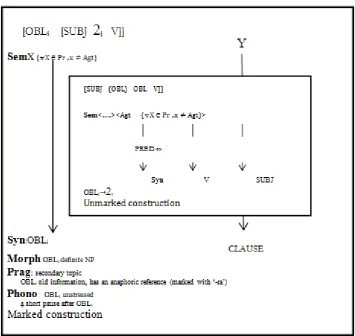
‘As for the screwdriver, I opened the door with it.’ As is clear from 38b, the ‘contrastive focus’ like the ‘aboutness secondary topic’ represents with postposition ‘-ra’. Thus, we can conclude that ‘-ra’ is a functional morpheme which is used for marking ‘aboutness secondary topic’ and ‘contrastive focus’ in discourse. Occurring silence or having a short pause after the left-dislocated element which is shown by coma; ‘,’ is another formal marker of LD construction which similar to the ‘contrastive stress’ belongs to the level of phonology.
According to the findings of this research, we can propose a construction for LD in Persian as shown in Figure 1:
The Figure 1 represents the functional and formal properties of LD construction in Persian. The semantic of LD construction is directly dependent on the Aktionsart type of the predicate utilized for constructing the sentence. Because of this, its semantics is represented as <…. >. Figure 1 illustrates that the prepoesd NP (OBL), which is co-indexed with a RP, is marked with postposition ‘-ra’ which, referring to the previous discourse can be the marker of ‘contrastive focus’ or ‘aboutness secondary topic’. This case marking is a surface hallmark of LD construction. There occurs also a pause (silence) after the preposed constituent in the phonological representation of LD construction. It is a formal marker which is represented at the level of phonology. Left-dislocated NP always contains ‘old information’ and is ‘identifiable’ for the addresser or in other words the NP has an anaphoric reference. For this reason, it is generally expressed by a definite NP. It can be expressed either with a ‘contrastive stress’ when is focus, or in ‘unstressed’ way when is secondary topic. Hence, depending on the two different functions of left-dislocated element, we suggest two constructions for LD in Persian which can be named ‘topic left dislocation construction’ and ‘focus left dislocation construction’. These two constructions are in polysemy inheritance relationship with each other. It means that they inherit the same syntactic specifications and have a shared set of characteristics. In other words, they only differ in the function of preposed element and the phonetic representation of it –is uttered in a stressed way when is focus and in an unstressed way when is secondary topic. These constructions have their specific formal and functional properties which set them as symbolic units in unique positions in the network of Persian constructions. Their locations in the network are determined by their inheritance relations with other constructions and their degree of motivation.
Topicalization
The topicalization construction has been thought by some to “mark the entity represented by the [leftmost] NP as being
either already evoked in the discourse or else in a salient set relation to something already evoked or inferable from the discourse” (Prince, 1984:4). Others say that the function of topicalization is “not to mark an activation state of a referent but to mark the referent of an NP as a (particular kind of) topic in the proposition” as well as “to mark the proposition as being about the referent of this topic” (Lambrecht, 1994:161). In other words, the function of the TOP construction is thought to be to promote the oblique noun phrase from part of the focus to being the topic of the sentence. However, the topicalization construction serves two distinct functions. One is as thought - to promote the oblique noun phrase to topic, while the other is to mark that noun phrase as the focus. Gundel (1974) calls sentences like 40, in which the topicalized noun phrase carries the primary stress, ‘focus topicalization’ and those sentences like 39, in which the primary stress is not on the topicalized noun phrase, ‘topic topicalization’.
39) reza-ro,molemiseda--zd-i
Reza-OM teacher call--hit-3S ‘Reza, the teacher called.’ 40) reza-ro, molemi seda--zd-i
Figure 1. Constructional configuration for Persian Left Dislocation (LD) construction
[image:10.595.123.479.399.735.2]Thus, focus constituent is not equal to ‘new information’, but it is equal to ‘non-recoverable’ or ‘unpredictable’ information (Ibid: 222). Reza in sentence 40 can also contain old information if the sentence was an answer tothe question Did the teacher call Reza or Saman?, in this case, Reza is focus again but it does not contain new information. The focus here is contrastive. So we can claim that, in Persian, the classical topicalization can be divided into three distinct constructions which are ‘Topic Topicalization (TT)’ as in 39, ‘Focus Topicalization (FT)’ as in 40 when it is the answer to the question Who did the teacher call?, and ‘Contrastive Focus Topicalization (CFT)’ as in 40 when it is the answer to the question Did the teacher call Reza or Saman?
In 39 and 40Reza is presented with ‘-ra’ which is assumed as topic marker by some scholars (refer to part 2 of this paper) in Persian. In these examples, however, it seems that the presented ‘-ra’ is direct object marker as Reza is the direct object of the canonical sentence which is represented in 41:
41)molemi reza-ro seda--zd-i
teacherReza-OM call--hit-3S ‘The teacher called Reza.’
But there are some cases in Persian such as 42 and 43 in which a topicalized constituent can be represented with ‘-ra’ or without ‘-ra’.
42)sib,idus--dar-mi appleI love--have-1S ‘Apple, I love.’
43)sib-o,i dus--dar-mi apple-RA
It seems that 42 can be a proper answer to the question Which fruit do you love? Because sib ‘apple’ is focus in 42 and contains new information, is expressed with primary stress and represented without ‘-ra’. This sentence can also be the answer to the question Do you Love apple or orange? In the recent case, sib is contrastive focus and as a generic noun, however, is identifiable, but has the property of having non-anaphoric reference in the given discourse. The preposed NP in 43 (sib) is topic when the sentence is an answer to the question What’s your opinion about the apple? Or is contrastive focus when the sentence is an answer to the question Do you love the apple or the orange? In both of the cases, the preposed NP is identifiable and has an anaphoric reference; the referent of sib
is identifiable for the addresser, at least. Because of this reason is expressed with a definite NP and consequently presents with ‘-ra’. As a topic always contains old information, it is identifiable and has an anaphoric reference, because of this reason, it presents with ‘-ra’. ‘-ra’ cannot be assumed just as topic marker, because, as we see here, it can also be used with a contrastive focus when the preposed NP has an anaphoric reference. In summary, we can say that Persian TOP constructionis, in fact, a set of topic/focus-promoting constructions and its preposed constituent can contain new (in FT construction) or old information (in TT and CFT constructions) and accordingly, it can be expressed with primary stress or not. Each one of these constructions is responsible for its functions but TOP construction is responsible for the syntax of all of them. They inherit the same syntactic characteristics and are different in the function of the preposed element and the phonetic representation of it –is
uttered in a stressed way when is focus and contrastive focus and in an unstressed way when is topic. In the words of this paper, these constructions are in polysemy inheritance relationship with each other. According to the findings of this research, we can propose a constructional representation for each one of the discussed constructions. ‘Topic Topicalization (TT)’ construction is illustrated in Figure 2:
The Figure 2 illustrates that there occurs a pause (silence) after the preposed constituent in the phonological representation of TT construction. Preposed NP always contains ‘old information’ and has an ‘anaphoric reference’, at least, for the addresser.For this reason, it is generally expressed by a definite NP and is marked with ‘-ra’. TT construction in Persian, as a marked construction, has specific formal and functional properties which set it as a symbolic unit in a unique position in the network of Persian constructions. The location of any construction in the network of construction is determined by its inheritance relations with other constructions and its degree of motivation. We deal with this issue about LD and TOP in the next part.
Inheritance and Motivation
Sincea construction can be any morphological or syntactic unit; from a single morpheme to a complex sentence, a syntactic construction can be a combination of various constructions. In a sentence, different constructions can be combined without any restriction as long as the properties of one do not conflict with the properties of another. Conflicts result in ‘ill-formedness’ (Goldberg, 2006). The grammar of a language, in Goldbergian construction grammar account, is made up of taxonomic networks of constructions, which are based on two principles; ‘inheritance’ and ‘motivation’. In defining them in relation to each other is believed thata construction is motivated to the degree that its structure is inherited from other constructions (Goldberg, 1995: 70). In Lakoff’s opinion the more motivated construction is, the better it fits into the language system (1987).Constructions are ordered in a hierarchical network. At the top of the hierarchy there are constructions which are inherited by many other constructions. As long as we come to lower levels of the hierarchical network, less general and rare patterns will present (Goldberg, 2009). This hierarchy is not a strict taxonomy. That is, a construction may inherit properties from multiple constructions above it, in the hierarchy. TOP and LD are in the relatively high positions in the hierarchical network of constructions. They can be inherited by many other constructions which we briefly discuss several of them afterwards.
Left Dislocation
LD can be inherited by many constructions. Then we indicate to some of them:
Ditransitive construction
such as ferestadæn‘ to send’, in this class of verbs the indirect object is optional (Mahootian and Gebhardt, 1997: 49). Ditransitive predicates, because of the number and the type of their arguments, can easily inherit LD construction. A kind of ditransitive construction where the recipient receives a special coding is called ‘indirect-object construction’ (Haspelmath, 2008). In Persian, the indirect object of this type of constructions commonly represents as a dative oblique and receives preposition ‘be’ (to), for this reason, it also is called ‘to-dative construction’ (vaezi, 2015). When this construction inherits LD construction its indirect object can be left-dislocated, as in 44:
44)sabxuni-ro, Øj kelid-a-ro be-i dad-mj
landlord-RA I key-PL-OM to-3S.PE gave-1S ‘As for the landlord, I gave the keys to him’.
There is another kind of ditransitive construction in Persian which is called ‘incorporated construction’. In this kind of construction the direct object loses its dependent grammatical markers9 and incorporates to the main verb of the sentence, while, has no grammatical case (Dabir Moghaddam, 2006: 174). It seems that there are two types of incorporated constructions in Persian which can be called ‘dative incorporated construction’ and ‘object incorporated construction’ which are shown in45aand46a, respectively:
45)a. madri be btte qza--dad-Øi.
mother to baby (IDO) food (DO)+ (V) give-3S ‘Mother gave food to the baby.’ (Ibid)
46)a. mrjmi btt-roqza--dad-Øi.
Maryam baby-OM food (DO)+ (V) give-3S ‘Maryam gave food to the baby.’ (Vaezi, 2015)
We can prepose the oblique object of 45a via LD process or, in the words of this article; the dative incorporated construction45acan inherit LD construction as is shown in45b: 45) b. btti-ro, madrj be-i qza--dad-Øj.
baby-RA mother to-PE food--gave-3S ‘As for the baby, mother gave food to him/her.’
But when LD process applies on45athe resulted forms are unacceptable46bor of low frequency45cin spoken Persian: 46) b.*btt-ro, mrjmi-e qza--dad-Øi.
baby-RA.OM Maryam-PE food (DO)+ (V) give-3S c. btti-ro, mrjmjuni-o qza--dad-Øj.
baby-RA Maryam-PE him/her-OM food (DO)+ (V) give-3S
In fact, after incorporating a ditransitive verb such as dadn ‘to give’ to an object such as qza‘ food’, as it seen in an ‘object incorporated construction’, which is shown in46b, the verb’s argument structure would change and decrease by one. Consequently, the resulted verb will be a divalent verb. Like transitive verbs it can inherit LD, as it more acceptable in spoken Persian, just when it accepts an oblique argument, such as46d:
46) d. qaoqi-o, mrjamj btt-ro ba-i qza--dad-Øi.
spoon-RA Maryam baby-OM with-PE food--gave-3S
9 Markers such as, object marker ‘-ra’, indefinite marker ‘-je’, plural marker,
conjunct possessive pronoun and demonstrative.
‘As for the spoon, Maryam feed the baby with it.’
As we saw in this subpart, a trivalent verb could embed in LD construction and their rolesmerge with each other. In the case of ‘object incorporated construction’, it must receive an oblique object to inherit LD construction.
Ezafe construction
EC,as a phrasal construction, in its possessive usage, when plays the role of subject, as in47, or oblique of a sentence as in48can inherit LD construction:
47)hmsajei, mehmunj-e-iumd-Øj
neighbor guest-E-PE came-3S
‘As for the neighbor, his/her guest came.’(Dabir-Moghaddam, 2006: 52)
48)hmsaji-ro, lij derxt-e-i-o xok-un-d-Øj
neighbor-RA Ali tree-E-PE-OM dry-CC-PAST-3S ‘As for the neighbor, Ali dried his/her tree.’
In 47and 48, the possessor of EC from subject and oblique (direct object) positions have been preposed to the initial position of sentence, respectively. According to the results of the present study, in inheritance from LD construction only the oblique can be left-dislocated which is commonly represents with ‘-ra’, and the preposed element plays the role of aboutness secondary topic or contrastive focus. In47the preposed NP (hmsaje) is not the oblique of sentence, is not represented with ‘-ra’ and plays the role of primary topic of sentence, hence, the sentence is not in inheritance relation with LD construction. It must be claimed that, in this example just EC and not the sentence are in inheritance relation with LD construction. EC as a phrasal construction can partially inherit LD construction which is a sentential one. In the inheritance only the modifier of EC moves to the phrase-initial position and a resumptive pronoun remains. Its inheritance is partial because it inherits some (movement and remaining a pronoun) and not all the properties of LD construction; eg. the preopsed NP is not represented with ‘-ra’. The sentence48), which its oblique is represented in the form of EC, inherits some and not all the properties of LD construction. Here, just EC’s modifier and not the whole EC as oblique, has been moved to the beginning of sentence. Thus, the sentence inheritance from LD construction is defective. The sentence inherits some properties from EC and LD construction and also from some canonical constructions such as subject-predicate, transitive and causative constructions.
Double E-construction10 (DEC) which is shown in49aalso can inherit LD construction. This construction may inherit LD construction in two different ways; one way involves preposing two possessors of DEC as shown in49band the other way is to prepose just the possessor of the embedded EC to the sentence-initial position. You can see an instance of it in49c). In both of the ways the preposed constituent appears with ‘– ra’.
49)a. [dogme-je pirhæn-e bætt]DEC-ro be-duz-Ø.
10 Its syntactic structure could be presented in this way: [NP
HN-E [NPHN-E