ISSN Online: 2327-4344 ISSN Print: 2327-4336
DOI: 10.4236/gep.2018.611005 Nov. 16, 2018 67 Journal of Geoscience and Environment Protection
The Effect of Different Artificial Soil on Urban
Non-Point Source Pollution Reduction in the
Artificial Rapid Infiltration System
Junfeng Wu
1, Langrun Song
2,3, Qian Feng
2,3, Jingyang Luo
2,3, Zhaoxia Xue
2,3*1Academy of Environmental Planning & Design Co. Ltd., Nanjing University, Nanjing, China
2Key Laboratory of Integrated Regulation and Resource Development on Shallow Lakes, Ministry of Education, Hohai University,
Nanjing, China
3College of Environment, Hohai University, Nanjing, China
Abstract
The non-point source pollution posed great risks to the urban water envi-ronment which has aroused great concerns. Artificial rapid infiltration sys-tems have been widely used in sewage treatment, which have great environ-mental and economic values. This study investigated the potential of utilizing artificial rapid infiltration systems on the reduction of urban non-point source pollution. The obtained results showed that the components and composition of artificial soils were vital to the operational performance. The mixture of natural soil, coarse sand and zeolite was ideal for the construction of artificial soils. The permeability coefficient of soils could be improved to 0.166 cm/min at the optimized ratio of 1:1:0.05 (natural soil, coarse sand and zeolite). Also, high removal efficiency for the typical pollutants in rain runoffs (i.e. COD, NH4+-N, TN and TP) could be simultaneous obtained which was
above 74% in the artificial rapid infiltration systems. The results demonstrat-ed the effectiveness on the rdemonstrat-eduction of urban non-point pollution by opti-mized artificial rapid infiltration system.
Keywords
Non-Point Source Pollution, Artificial Rapid Infiltration System, Permeability Coefficient, Zeolite, Pollutants, Removal Efficiency
1. Introduction
The pollution sources of urban water environment are mainly classified into point source pollution (derived from industrial and domestic wastewater) and
How to cite this paper: Wu, J. F., Song, L. R., Feng, Q., Luo, J. Y., & Xue, Z. X. (2018). The Effect of Different Artificial Soil on Urban Non-Point Source Pollution Reduc-tion in the Artificial Rapid InfiltraReduc-tion
System. Journal of Geoscience and
Envi-ronment Protection, 6, 67-76. https://doi.org/10.4236/gep.2018.611005
Received: October 6, 2018 Accepted: November 13, 2018 Published: November 16, 2018
Copyright © 2018 by authors and Scientific Research Publishing Inc. This work is licensed under the Creative Commons Attribution International License (CC BY 4.0).
http://creativecommons.org/licenses/by/4.0/
DOI: 10.4236/gep.2018.611005 68 Journal of Geoscience and Environment Protection non-point source pollution. Currently, the industrial and domestic wastewater is commonly directly discharged into wastewater treatment plants (WWTPs). Therefore, the point source pollution has been effectively controlled. The non-point source pollution is becoming the key problem in addressing the issue of urban water environment. The non-point source is a dispersed pollution in urban area caused by rainfall runoffs. The contaminants are mainly consisted of organics, eutrophication substances (nitrogen and phosphorus) and suspended solids (Li et al., 2017; Zhuang et al., 2015; Huang et al., 2010). They would enter into surface water and groundwater from atmosphere, grounds and soils through leaching and scouring and ultimately cause serious water environment pollution (Qin et al., 2016). In China, the urban area is densely populated with anthropogenic activities while most of surface is impermeable. The non-point pollution caused by rainfalls is more severe. For example, Jing et al. found that the concentrations of total nitrogen and total phosphorus in storm pipelines of Beijing were respectively 3.2 and 25-folds higher than that of the natural rainfalls
(Jing et al., 2013). Moreover, the natural environments and rainfall processes are varied in different cities. In Beijing, the concentrations of suspended solids, chemical oxygen demand, total phosphorus and total nitrogen were respectively 3.9, 13.6, 3.3 and 16-folds higher than that of the V class of Environmental Qual-ity Standard for Surface Water. However, they were respectively 1.7, 8.4, 1.4 and 3.9 folds in Shanghai, correspondingly (Li et al., 2006; Ding & Liu, 2011). Therefore, the urban non-point source pollution is characteristic of high inten-sity and wide space-time variation which make its effective control quite difficult
(Qin et al., 2016; Huang & Xiang, 2014; Coppola et al., 2014).
Currently, the main measures taken for urban non-point source pollution control are through vegetation, percolation, wetland retention systems, and so on (Feng et al., 2016; Li et al., 2018; Lai et al., 2016). However, the application of these strategies was frequently restricted by the availability of lands, risks of eco-logical and environmental pollution, and the high costs of maintenance and management. Therefore, they are usually applied as auxiliary measures rather than the key control measures to control urban non-point source pollution.
The natural soils have the ability of physical retention, chemical precipitation, physicochemical adsorption and exchange due to the specific composition and properties of soil minerals. Moreover, they also provide necessary habitats for various microorganisms. It seems to be a good alternative to effectively and economically decompose and purify the organic and inorganic substances in the wastewater (Liu et al., 2018). However, the suitable permeability and high bio-logical activity (commonly correlated with the soil fertility) were required for the efficient pollutants removal by soil treatment which was hard to meet simulta-neously in natural environments. Artificial interference is usually necessary to make the natural soil be an ideal medium for sewage treatment.
DOI: 10.4236/gep.2018.611005 69 Journal of Geoscience and Environment Protection permeability) (Huang, 2005). The basic principles for constructing artificial rap-id filtration systems mainly follow three aspects: 1) good permeability 2) high treatment efficiency, and 3) low costs. The typical strategies to improve the per-meability of natural soil were accomplished by the addition of coarse sand, zeo-lite and so on (Wang & Wang, 2011). Among them, zeolite has been reported to improve the permeability of soil effectively and simultaneously remove ammo-nia nitrogen, heavy metals and organic pollutants(Boostani et al., 2017; Aljerf, 2018; Wang et al., 2018). For example, the results obtained by Rozic(RožIć et al.,
2000) show that the adsorption capacity of zeolite for ammonia nitrogen was
about 2 times higher than that of clay. Xue et al. also confirmed the positive ef-fects of artificial wetland systems amended with zeolite on ammonia nitrogen removal. The average removal efficiency of ammonia nitrogen in rainstorm wa-ter was up to 85% which could reduce the runoff pollution with short residence time (Xue et al., 2003).
Therefore, the main aim of this study is to investigate the performance of ar-tificial rapid filtration systems on the reduction of urban non-point source in Suzhou optimizing the composition and characteristics of organic soils with dif-ferent additives. Moreover, the main mechanisms for its promotion on pollu-tants removal are also explored.
2. Materials and Methods
2.1. Materials
The soils and coarse sand was obtained in the local regions of Suzhou, Jiangsu, China. The zeolites used in this study are synthetic 13X4A zeolites. The main characteristics are as follows: specific surface area: 200 - 300 m2/g, K+ exchange capacity: 420 mg/g, adsorption capacity for H2O: 20 g/100 g, specific gravity: 2.6%, crushing strength: 50 - 60 n/particle, bulk density: 0.8 - 0.9 g/cm3 and the particle diameter: 1.5 - 1.8 mm.
According to the previous monitoring results of surface runoff water in Suz-hou, the main pollutants are organic pollutants, eutrophication substances and suspended solids (Huang, 2005). Therefore, the concentrations of chemical oxy-gen demand (COD), total phosphorus (TP), total nitrooxy-gen (TN) and ammonia nitrogen (NH4+-N) were set as the main indices. The wastewater is synthetic to
simulate the natural surface runoffs in Suzhou and the main characteristics are shown in Table 1.
2.2. Correlations of Soil Compositions with the Performance of
Artificial Rapid Infiltration System
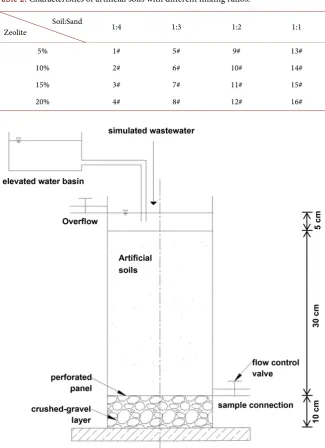
The natural soil, coarse sand and zeolite were mixed well with different mixing ratios (shown in Table 2) and then filled into the polymethyl methacrylate (PMMA) soil columns.
DOI: 10.4236/gep.2018.611005 70 Journal of Geoscience and Environment Protection
Table 1. Characteristics of synthetic runoffs.
Pollutants COD TP TN NH4+-N
[image:4.595.211.537.145.594.2]Concentration (mg/L) 500 ± 10 1 ± 0.02 20 ± 2 5 ± 0.4
Table 2. Characteristics of artificial soils with different mixing ratios.
Soil:Sand
Zeolite 1:4 1:3 1:2 1:1
5% 1# 5# 9# 13#
10% 2# 6# 10# 14#
15% 3# 7# 11# 15#
20% 4# 8# 12# 16#
Figure 1. Reactor of artificial rapid infiltration system.
per-DOI: 10.4236/gep.2018.611005 71 Journal of Geoscience and Environment Protection formance of artificial rapid infiltration system on the reduction of non-point source pollution by runoffs.
2.3. Analytic Methods
The determinations of COD, TN, TP, NH4+-N and SS were performed in
ac-cordance with standard methods (APHA, 1998). The measurement of permea-bility coefficient of artificial soil is according to Darcy’s law (Equation (1))
(Huang, 2005).
(
1 2)
kA h h Q
L
−
= (1)
where k is the permeability coefficient; A is the tested area.
The non-uniformity coefficient of artificial soils was obtained by screening test. 300 g of mixture were firstly taken and dried in a constant temperature box at 105˚C. Then 100 g of them was weighed for screening tests with a series of screens of 2.00 mm (10 meshes), 1.43 mm (14 meshes), 1.00 mm (18 meshes), 0.45 mm (40 meshes), 0.10 mm (150 meshes) and 0.063 mm (250 meshes). The non-uniformity coefficient was calculated based on the grading distribution curve: K80 = d80/d10. The d80 and d10 represents the pore sized of screens that al-low 80% and 10% amounts of particles to filtrate.
3. Results and Discussion
3.1. Permeability and Non-Uniformity with Different Artificial Soil
Compositions
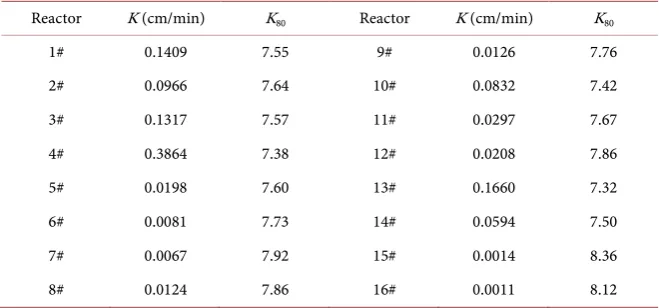
The permeability is one of the most significant features in evaluating the artifi-cial rapid infiltration system. The basic requirement for the permeability coeffi-cient (K) of an effective rapid soil infiltration system should be no less than 0.025 cm/min (Huang, 2005). The permeability coefficient of natural soils in Suzhou was only 2.17 × 10⁻⁴ cm/min which was far below the required limits and thus it was suitable for the construction of rapid infiltration system directly. However, the permeability coefficient was remarkably increased due to the addi-tion of coarse sand and zeolite and it was highly correlated with the mixing ratio. As shown in Table 3, the reactors with high addition of coarse sand contributed to the permeability most (Reactors 1 - 4#). However, the sand was rich of inor-ganics which would affect the soil fertility and then the abundances of active mi-croorganisms. The balance of permeability and soil fertility should be main-tained. Considering these, the ratio of natural soil and sand should be set as 1:2 to 1:1 with proper addition of zeolite. Particularly, the permeability coefficient in reactor 13# with the mixture of 1:1:0.15 was up to 0.1660 cm/min which far ex-ceeded the requirement of 0.025 cm/min.
DOI: 10.4236/gep.2018.611005 72 Journal of Geoscience and Environment Protection
Table 3. The permeability and non-uniformity coefficient in different reactors.
Reactor K (cm/min) K80 Reactor K (cm/min) K80
1# 0.1409 7.55 9# 0.0126 7.76
2# 0.0966 7.64 10# 0.0832 7.42
3# 0.1317 7.57 11# 0.0297 7.67
4# 0.3864 7.38 12# 0.0208 7.86
5# 0.0198 7.60 13# 0.1660 7.32
6# 0.0081 7.73 14# 0.0594 7.50
7# 0.0067 7.92 15# 0.0014 8.36
8# 0.0124 7.86 16# 0.0011 8.12
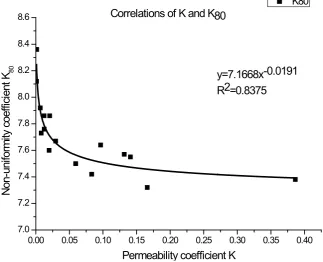
Further analysis showed that the permeability coefficient increases with the decrease of the non-uniformity coefficient (as shown in Figure 2). The permea-bility coefficient was negatively correlated with the non-uniformity coefficient which could be expressed as the following equation.
0.0191
7.1668
y= x− R2=0.8375 (2)
The above results indicated that the particle gradation was one of the main factors affecting the permeability coefficient of artificial soil. By optimizing the mixing ratio of three different materials, the grading distribution level as well as permeability coefficient could be improved, which could stimulate the hydraulic loads of artificial soil rapid infiltration system for the reduction of non-point source pollution in urban areas.
3.2. Performance of Artificial Rapid Infiltration Systems on the
Pollutants Removal
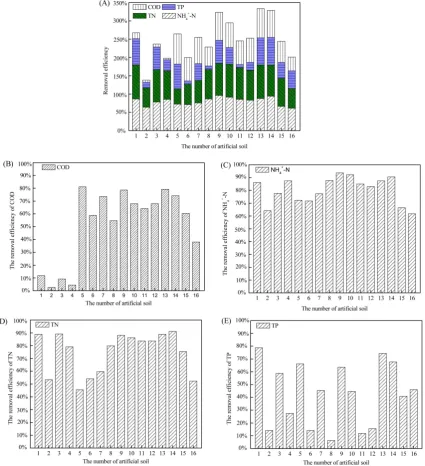
The removal efficiencies of various pollutants were shown in Figure 3. It can be seen that the removal efficiency of NH4+-N could reach above 60% in all
artifi-cial soil columns (Figure 3(A)). Correspondingly, the TN removal was above 45% (Figure 3(B)). The reason may be mainly attributed to the presence of zeo-lites which has been reported to have a strong adsorption effect on ammonia ni-trogen (RožIć et al., 2000). The dynamic adsorption tests also showed that the adsorptive ability of NH4+-N was improved by 1.15 - 10.92 mg/L and the
effec-tive adsorption time was increased by 50% in the artificial soil with 5% zeolite addition.
DOI: 10.4236/gep.2018.611005 73 Journal of Geoscience and Environment Protection
Figure 2. Correlations of permeability and non-uniformity coefficient.
absorption and utilization which required sufficient time. In the present study, the hydraulic retention time was short which was below 6 h considering the height of columns tested. Therefore, mechanical filtration and adsorption may become the main mechanism for the removal of organics removal in a short time. The treating performances in other artificial soil columns were all signifi-cantly higher than that of reactors 1 - 4#.
As to the TP removal, high removal efficiency was obtained in the reactors of 1# and 13#, which was respectively 78.8% and 74.1%. However, the lowest re-moval efficiency was observed in reactor 8# which was only 6.4%. The rere-moval of TP in soils could be achieved via plants intake, soil adsorption, chemical pre-cipitation and microbial accumulation (APHA, 1998). In this study, the plants intake could be excluded. Also, the biological accumulation of phosphorus by microorganisms was limited considering the short hydraulic retention time. The TP removal was also mainly attributed to the soils adsorption and chemical pre-cipitation. However, they were also affected by numerous factors, such as the ions exchange capacity, pH, hydraulic loads and retention time in the systems
(Reneau et al., 1989; Zhu et al., 2017; Semerci et al., 2010). Due to the different composition of artificial soils that resulted in the variations of physiochemical characteristics, the adsorption and chemical precipitation of phosphorus were affected in different degrees.
Considering the cumulative performance of pollutants removal in different reactors (as shown in Figure 3(E)), the 9#, 13# and 14# reactors showed prom-ising application as artificial rapid infiltration system, particularly reactor 13#
0.00 0.05 0.10 0.15 0.20 0.25 0.30 0.35 0.40 7.0
7.2 7.4 7.6 7.8 8.0 8.2 8.4 8.6
K80
Non-uni
for
m
ity
c
oef
fic
ient
K
80Permeability coefficient K
Correlations of K and K80
DOI: 10.4236/gep.2018.611005 74 Journal of Geoscience and Environment Protection
Figure 3. Removal rates of various pollutants with different artificial soils.
with a removal efficiency of 74% for all pollutants. Moreover, the permeability coefficient in reactor 13# met the requirement for the rapid infiltration system (not the case in 9# reactor) and the cost was also relatively economic considering the low zeolite consumption (5% versus the 10% in 14# reactor).
4. Conclusion
ar-DOI: 10.4236/gep.2018.611005 75 Journal of Geoscience and Environment Protection tificial soil rapid infiltration systems. The removal efficiency of COD, NH4+-N,
TN and TP in synthetic rain runoffs was respectively 79.2%, 88.1%, 88.8% and 74.1% in the artificial rapid infiltration systems, which exhibited the feasibility and effectiveness on the reduction of urban non-point pollution.
Acknowledgements
This work is financially supported by the water conservancy science technology project of Jiangsu province (2016040, 2017047), Special Funds for the Science and Technology Program of Public Wellbeing of Ningbo (2017C50002), Re-search Institute funds of Ningbo (2017A8002).
Conflicts of Interest
The authors declare no conflicts of interest regarding the publication of this pa-per.
References
Aljerf, L. (2018). High-Efficiency Extraction of Bromocresol Purple Dye and Heavy Met-als as Chromium from Industrial Effluent by Adsorption onto a Modified Surface of Zeolite: Kinetics and Equilibrium Study. Journal of Environmental Management, 225, 120-132.https://doi.org/10.1016/j.jenvman.2018.07.048
APHA (1998). Standard Methods for the Examination of Water and Wastewater (20th ed.). Washington DC: American Public Health Association.
Boostani, H. R., Hardie, A. G., Najafi-Ghiri, M., & Khalili, D. (2017). Investigation of Cadmium Immobilization in a Contaminated Calcareous Soil as Influenced by Bio-chars and Natural Zeolite Application. International Journal of Environmental Science & Technology, 15, 2433-2446.
Coppola, A., Dragonetti, G., Comegna, A., Zdruli, P., Lamaddalena, N., Pace, S., & Si-mone, L. D. (2014). Mapping Solute Deep Percolation Fluxes at Regional Scale by Inte-grating a Process-Based Vadose Zone Model in a Monte Carlo Approach. Soil Science & Plant Nutrition,60, 71-91.https://doi.org/10.1080/00380768.2013.855615
Ding, C. C., & Liu, J. (2011). Discussion on Urban Non-Point Source Pollution and Con-trol Technologies in China. China Population, Resources and Environment, 21, 86-89. Feng, C., Cai, Z., Yin, X., Nan, M. I., & Cai, Z. (2016). Effect of Plants on Phosphorus
Control and Transformation in Soil Infiltration System in Rainwater Runoff. Environ-mental Pollution & Control,3, 25-33.
Huang, J. J., & Xiang, W. (2014). Investigation of Point Source and Non-Point Source Pollution for Panjiakou Reservoir in North China by Modelling Approach. Water Quality Research Journal of Canada, 50, 167-181.
https://doi.org/10.2166/wqrjc.2014.019
Huang, J. X. (2010). Origin Analysis on Non-Point Source Pollution and Countermea-sures of the Chaobai River in Shunyi New Town. Beijing Water,4, 4-7.
Huang, W. (2005). Study on the Artificial Soil Rapid Infiltration System for the Reduciton of Pollution Load in Urban Non-Point Source. Nanjing: Hohai University.
DOI: 10.4236/gep.2018.611005 76 Journal of Geoscience and Environment Protection Lai, X., Liao, K., Feng, H., & Zhu, Q. (2016). Responses of Soil Water Percolation to Dy-namic Interactions among Rainfall, Antecedent Moisture and Season in a Forest Site. Journal of Hydrology, 540, 565-573.
https://doi.org/10.1016/j.jhydrol.2016.06.038
Li, C., Zheng, X., Zhao, F., Wang, X., Cai, Y., & Zhang, N. (2017). Effects of Urban Non-Point Source Pollution from Baoding City on Baiyangdian Lake, China. Water,9,
249.https://doi.org/10.3390/w9040249
Li, D., Zheng, B., Liu, Y., Chu, Z., He, Y., & Huang, M. (2018). Use of Multiple water Surface Flow Constructed Wetlands for Non-Point Source Water Pollution Control. Applied Microbiology & Biotechnology,102, 5355-5368.
https://doi.org/10.1007/s00253-018-9011-8
Li, T., Lin, L. F., & Li, H. (2006). Characteristics and Control of Urban Runoff Pollution in Shanghai. Environmental Pollution & Control, 28, 868-871.
Liu, W., Qiao, C., Yang, S., Bai, W., & Liu, L. (2018). Microbial Carbon Use Efficiency and Priming Effect Regulate Soil Carbon Storage under Nitrogen Deposition by Slow-ing Soil Organic Matter decomposition. Geoderma,332, 37-44.
https://doi.org/10.1016/j.geoderma.2018.07.008
Qin, P., Lei, K., Soon-Thiam, K., & Qiao, F. (2016). Discussion on Characteristics and Model Application of Urban Nonpoint Source Pollution in China. Journal of Envi-ronmental Engineering Technology, 6, 397-406.
Reneau, R. B., Hagedorn, C., & Degen, M. J. (1989). Fate and Transport of Biological and Inorganic Contaminants from On-Site Disposal of Domestic Wastewater. Journal of Environmental Quality,18, 135-144.
https://doi.org/10.2134/jeq1989.00472425001800020001x
RožIć, M., Cerjanstefanović, Š., Kurajica, S., Vančina, V., & HodžIć, E. (2000). Ammo-niacal Nitrogen Removal from Water by Treatment with Clays and Zeolites. Water Re-search,34, 3675-3681.https://doi.org/10.1016/S0043-1354(00)00113-5
Semerci, N., Bakici, N., & Kocamemi, B. A. (2010). Effects of Nitrite, Oxygen and Initial pH on Biological Phosphorus Removal in a Post-Denitrification System. Journal of Biotechnology,150, 292-292.https://doi.org/10.1016/j.jbiotec.2010.09.239
Wang, M., Xie, R. Z., Chen, Y., Pu, X. Q., Jiang, W. J., & Yao, L. (2018). A Novel Meso-porous Zeolite-Activated Carbon Composite as an Effective Adsorbent for Removal of Ammonia-Nitrogen and Methylene Blue from Aqueous Solution. Bioresource Tech-nology,268, 726-732.https://doi.org/10.1016/j.biortech.2018.08.037
Wang, Z. S., & Wang, C. D. (2011). Review on Main Technology Development about Constructed Rapid Infiltration System in China. Journal of Sichuan University of Science & Engineering, 24, 493-496.
Xue, Y., Zhang, X., Xudong, L. I., & Guanghe, L. I. (2003). Storm-Water Pollution Con-trol Using Zeolite Nitrogen Absorption System. Journal of Tsinghua University, 43, 854-857.
Zhu, C., Wang, Q., Pang, W., Wang, Z., Cao, J., Hu, W., Tang, J., Huang, J., & Wu, Z. (2017). Mechanisms of Phosphorus Removal from Wastewater by Ion Exchange Resin. Desalination & Water Treatment,79, 347-355.
https://doi.org/10.5004/dwt.2017.20890
Zhuang, Y., Hong, S., Zhan, F. B., & Zhang, L. (2015). Influencing Factor Analysis of Phosphorus Loads from Non-Point Source: A Case Study in Central China. Environ-mental Monitoring & Assessment,187, 718.