ELECTRONIC TECHNOLOGIES IN THE SYSTEM OF FLEXIBILITY TEST CONTROL
*
Viktor Koryagin and Oksana Blavt
Lviv Polytechnic National University, Ukraine
ARTICLE INFO ABSTRACT
In the present work we study the issues of the test control in physical education. Nowadays, one of the problems facing the researchers in the field of physical education is the need for the fundamental restructuring of the test control system in the direction of modernization, introduction of innovative approaches and modern technologies of its organization
creating a unified level control system for the physical fitness of the persons engaged in physical training One of the promising directions to improve the testing system is the development and practical implement
control and management of this process.
Copyright © 2015 Viktor Koryagin and Oksana Blavt.This
unrestricted use, distribution, and reproduction in any medium, provided the original work is properly cited.
INTRODUCTION
Physical education in educational institutions is carried out according to the requirements of controlled processes. In this case the decision of an expert (teacher), as the managing person, is based on the comprehensive, objective information about the mental and physical condition of students during the teaching process. In the teaching practice the objective assessment of physical capacity by means of students test control methodolog is regarded as one of the urgent issues. One of the most informative indicators of physical fitness is the indicator of the level of mobility in joints
determination of the level of mobility in joints is one of the determinants that defines the dynamics of physical fitness and allows purposefully to manage this process at the systematic
classes of physical education (Koryagin
Nowadays there are many ways to measure flexibility ranging from simple, by using the usual ruler, to complex, by
using various devices (X-ray radiography and its
modifications). We will not dwell on the complex ways of measuring flexibility because they are time
have scientific and educational interest but not practical, and therefore they are not used in the physical education.
the authors point to the impossibility of any systematization of the flexibility evaluation criteria due to a great variety of measurement techniques.
*Corresponding author: Viktor Koryagin, Lviv Polytechnic National University, Ukraine.
ISSN: 0975-833X
Vol.
Article History:
Received 23rd August, 2015 Received in revised form 06th September, 2015 Accepted 09th October, 2015
Published online 30th November,2015
Key words:
Flexibility, Control, Testing, Evaluation, electronic devices and Technologies, Electronic ruler.
Citation: Viktor Koryagin and Oksana Blavt, 2015. “ of Current Research, 7, (11), 22491-22495.
RESEARCH ARTICLE
ELECTRONIC TECHNOLOGIES IN THE SYSTEM OF FLEXIBILITY TEST CONTROL
Viktor Koryagin and Oksana Blavt
Polytechnic National University, Ukraine
ABSTRACT
In the present work we study the issues of the test control in physical education. Nowadays, one of the problems facing the researchers in the field of physical education is the need for the fundamental restructuring of the test control system in the direction of modernization, introduction of innovative approaches and modern technologies of its organization. And this study deals with the problem of creating a unified level control system for the physical fitness of the persons engaged in physical training One of the promising directions to improve the testing system is the development and practical implementation of new, highly effective means, methods, technologies for the integrated control and management of this process.
This is an open access article distributed under the Creative Commons Att use, distribution, and reproduction in any medium, provided the original work is properly cited.
Physical education in educational institutions is carried out according to the requirements of controlled processes. In this case the decision of an expert (teacher), as the managing person, is based on the comprehensive, objective information ntal and physical condition of students during the teaching process. In the teaching practice the objective assessment of physical capacity by means of students test control methodolog is regarded as one of the urgent issues.
ndicators of physical fitness is the indicator of the level of mobility in joints – flexibility. The determination of the level of mobility in joints is one of the determinants that defines the dynamics of physical fitness and this process at the systematic
Koryagin et al., 2013).
Nowadays there are many ways to measure flexibility – ranging from simple, by using the usual ruler, to complex, by
ray radiography and its
fications). We will not dwell on the complex ways of measuring flexibility because they are time-consuming and have scientific and educational interest but not practical, and therefore they are not used in the physical education. Some of to the impossibility of any systematization of the flexibility evaluation criteria due to a great variety of
Typically flexibility as an integral factor in the physical education practice is evaluated by the ability to perform a tilt forward from a standing position. The expediency of using this test is due to the fact that from a practical point of view, the most important is the flexibility of a spine and it is believed that the "combined flexibility of the body" can be judged by bending forward. In addition, it is simple and accessible for measurements during mass examinations and does not require special conditions of conducting. At the same time, we should note that to provide standartisation of testing procedures by this method is almost impossible. This method of flexibility testing is characterized by the certain dependence of subjective assessment in determining the results of the exercise. The defined facts make impossible and difficult the obtaining of the reliable informative monitoring results due to a large number of uncontrolled variables and the absence of a certain registration system for test resul
radically new approach to this issue.
It is believed that one of the promising areas of the improvement of testing system is the development and practical implementation of new, highly efficient tools, methods, technologies of test control. According to authoritative scholars, the progress in the knowledge of the theory and methods of physical culture requires the development of test control methods that allow in the shortest possible time to get maximum results. A constru
of this problem is of theoretical and practical significance for improving the methods of complex testing.
Available online at http://www.journalcra.com
International Journal of Current Research
Vol. 7, Issue, 11, pp.22491-22495, November, 2015
INTERNATIONAL
, 2015. “Electronic technologies in the system of flexibility test
z
ELECTRONIC TECHNOLOGIES IN THE SYSTEM OF FLEXIBILITY TEST CONTROL
In the present work we study the issues of the test control in physical education. Nowadays, one of the problems facing the researchers in the field of physical education is the need for the fundamental restructuring of the test control system in the direction of modernization, introduction of innovative . And this study deals with the problem of creating a unified level control system for the physical fitness of the persons engaged in physical training One of the promising directions to improve the testing system is the development and ation of new, highly effective means, methods, technologies for the integrated
is an open access article distributed under the Creative Commons Attribution License, which permits
Typically flexibility as an integral factor in the physical education practice is evaluated by the ability to perform a tilt forward from a standing position. The expediency of using this test is due to the fact that from a practical point of view, the t important is the flexibility of a spine and it is believed that the "combined flexibility of the body" can be judged by bending forward. In addition, it is simple and accessible for measurements during mass examinations and does not require tions of conducting. At the same time, we should note that to provide standartisation of testing procedures by this method is almost impossible. This method of flexibility testing is characterized by the certain dependence of subjective mining the results of the exercise. The defined facts make impossible and difficult the obtaining of the reliable informative monitoring results due to a large number of uncontrolled variables and the absence of a certain registration system for test results. Hence, there is a need for a radically new approach to this issue.
It is believed that one of the promising areas of the improvement of testing system is the development and practical implementation of new, highly efficient tools, es of test control. According to authoritative scholars, the progress in the knowledge of the theory and methods of physical culture requires the development of test control methods that allow in the shortest possible time to get maximum results. A constructive solution of this problem is of theoretical and practical significance for improving the methods of complex testing.
INTERNATIONAL JOURNAL OF CURRENT RESEARCH
The aim of study is the substantiation and implementation of modern electronic techniques for improving the testing of mobility in the joints.
MATERIALS AND METHODS
Moreover, the methods of comparing and contrasting are used and analysis, synthesis, abstraction, formalization, modeling.
RESULTS
Within the outlined direction of the study, the method of flexibility testing with the use of an electronic ruler was developed. Functioning of the electronic ruler is based on measuring changes of the electric capacitance formed on the surface of the dielectric substrate of metal electrodes when the student touches it with his hand in the course of the test task. The offered method of the evaluation of flexibility in physical education of students, according to which the monitoring of the overall level of joint mobility of locomotor system is carried out, is to use the electronic ruler (see Figure 1). When performing the test task, the subject of monitoring touches with the hand the ruler, which registers the exercise process and its outcome. The resulting signal is processed promptly by the signal transducer placed in the ruler. Then the digital signal enters the processor that ensures its further conversion and RF transmission to the personal computer. In the computer the signal is processed by developed software and is shown to the specialist on the screen in an easy to understand form.
The electronic ruler is the basis of a circuit board is made from fiberglass with formed copper electrodes, lines and switching lanes for the soldering the integrated circuits of signal transducer. Measurements are carried out by using the
capacitive sensors concept (Larry K. Baxter, 1997). The
[image:2.595.330.534.59.199.2]primary transducer (sensitive elements) of capacitive sensors is the matrix of capacitors modulated by external factors between electrode electric capacity. In this case are used the structure under the external environmental object influence, including student fingers. This structure is shown in Figure 2.
Figure 2. The structure of the primary transducer of capacitive sensor
Printed circuit board – PCB, Sensor pad – touch electrode, Ground hatch – grounding circuit, Overlay – dielectric protective film, in particular, enamel, Via – through holes, Trace – Track signal lines, I/O pin – conclusions inputs (Input) and outputs (Output) signal transducer integrated circuits.
Capacitive sensor in the electronic ruler, except the primary transducer (User Interface), which interacts with the student's hand, contains a signal transducer (Fig 3). In the structure of used signal transducer are:
controller – CapSence Controller with Haptics, for the
performing of measurement matrix of capacitors, for forming of informative touching signals in digital form (Touch Signal) and recognition of hand position;
controller – Host Controller, for providing the further
signal transformation and digital data processing;
amplifier – Amplifier and actuators Actuator, for feedback
providing;
Tactile Feedback Actuation, for improving the accuracy
and noise immunity of measurement process.
Controller CapSence Controller with Haptics implemented on
modern circuit concepts PSoC – Programmable
System-on-Chip by Cypress Semiconductor company, USA (Fig 4).
[image:2.595.116.487.543.694.2]Unlike the traditional microcontrollers and controlled electronic systems of signal conversion, the concept of PSoC provides the programming not only both digital and analog modes of systems nodes, but also configuring the structure of
these nodes and their linkages (CapSenseTM. Best practices
notebook, 2006; Getting Started with CapSense Document,
2014). Block diagram of the designed capacitive sensor «E
[image:3.595.112.486.61.228.2]ruler» shown in Figure 5, and the circuit connection CapSense
[image:3.595.100.498.266.518.2]Figure 3. Structure capacitive touch device
Figure 4. Detail of Web pages Cypress Semiconductor[www.cypress.com]
Figure 5. Block diagram of the capacitive sensor «E-ruler»
[image:3.595.100.502.546.679.2]Controller and fragment PCB signal transducer on the bases of PSoC in Figure 6.
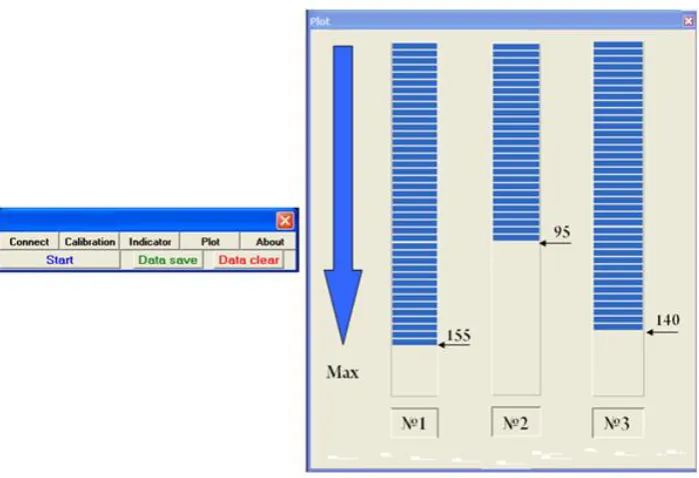
Signal conversion of the «capacity – digital code» measured matrix of electrodes placed on a measuring ruler – CapSence line meter, held Capsense processor on the bases of PSoC. The digital code is fed into the processor Signal transducer, for providing the following conversion and RF radiofrequency transmission in the personal computer (PC), including tablet. Treatment of obtained data in the course of student test task, and their visualization is carried out by software (Fig 7). The program includes: choice of protocol parameters interface – Connect, control the start and end of measurement – Start / Stop, calibration measurement process – Calibration, digital – Indicator and graphics – Plot results visualization, storage – Data save and erase – data Date clear information about the algorithm research – About.
DISCUSSION
The advantages of the offered electronic system of flexibility monitoring compared to existing methods of evaluation is:
ensuring of testing accuracy; usability and compactness of the device; ongoing monitoring, consisting of the time of getting
information (usually within 20-60 s), the time of viewing the resulting data and the analysis of results; ensuring of durable monitoring with the update of processing results; the high reliability of monitoring; the automatic receipt of the results of multiple tests as an electronic protocol; the quick conducting of complex calculations with the presentation of results in digital or graphical form; easy to view the structure of the results and their dynamics. The automated electronic measuring structure, developed on the base of the use of modern electronic technologies and software, is offered for the first time and has significant advantages compared to existing methods of monitoring and control of the dynamics of the development of the joint mobility of locomotor system. The scientific potential of the technical equipment for testing in physical education allows to control and evaluate the indicators of test quality at a very high level. The main methodical result of the work is that the using of the offered system allows to intensify the testing process during physical training of students.
[image:4.595.109.493.88.247.2](a) (b)
Figure 6. Scheme of connection of CapSense Controller (a) and a fragment of circuit board signal transducer on the bases of PSoC
[image:4.595.124.474.273.512.2]In turn, it allows to decide comprehensively the issue of current control and to judge with the sufficient substantiation the need for adjustments in the training program in accordance with the results, to improve the management of their physical education process.
REFERENCES
CapSense, T.M. 2006. Best practices notebook, Cypress,. http://www.cyprees.com.
Getting Started with CapSense Document. N 001-64846. 2014. Cypress Semiconductor, http://www.cypress.com /
Koryagin V., Blavt О. 2013. Test control in physical education: [monograph]: LAP LAMBERT Academic Publishing is a trademark of: OmniScriptum GmbH & Co. KG.
Larry K. Baxter, 1997. Capacitie sensors: design and application, IEEE Press.

![Figure 4. Detail of Web pages Cypress Semiconductor [www.cypress.com]](https://thumb-us.123doks.com/thumbv2/123dok_us/9269018.417777/3.595.100.498.266.518/figure-web-pages-cypress-semiconductor-www-cypress-com.webp)