integrating multiple intelligent or decision sup-port systems contributes to obtaining, a high quality, more comprehensible and reliable decision solution. This paper attempts to treat one of complex problems that have not gained much attention before, in spite of the wide prevalence of situation in which a group of expertises concurrently evaluate YES/no decision problems. The problem of integrating multiple FESs involves combining or aggregating the crisp outputs produced by the individual systems to obtain a final, consolidated, YES/no output decision. The need for multiple expert systems (ESs) can occur frequently when a complex problem in hand has multiple related aspects for which the existence of multiple independ-ent and separated expertises is necessary, and there is no available expertise that covers whole aspects of the problem ( see e.g. Arumugam et al. 2010; Beranová and Martinovičová 2010; Kubon and Krasnodębski 2010; Tomšík and Svoboda 2010). There are still some other practical reasons behind independence amongst ESs which have been described in Aly and Vrana (2010).
next we shall review the basic component of a FES, to give more insights about the combined units and the nature of their combined output values. The fuzzy expert system consists of four components: a fuzzi-fication subsystem, a knowledge-base, an inference mechanism, and a defuzzification subsystem which converts the implied fuzzy sets into crisp values ex-pressing the YES/no decisive degree (Figure 1).
The special concern around fuzzy expert systems is attributed to their wide applicability and use due to their capability to treat vagueness, and subjectiv-ity. Especially important is the possibility to convert subjective non-sharp factors into the corresponding easily manageable and comprehensible numerical scale. More description of the fuzzy set theory and FES can be found in zadeh (1965) and Kilagiz et al. (2004).
Various possible configurations for the cooperation among several expert systems have been described in Beeri and Spiegler (1996) and Aly and Vrana (2010). however, our proposed configuration is that FESs are arranged in such a way that the same problem is
pre-Combining the crisp outputs of multiple fuzzy expert
systems using the MPDI along with the AHP
Shady ALY, Ivan VRANA
Department of Information Engineering, Faculty of Economics and Management,
Czech University of Life Sciences, Prague, Czech Republic
Abstract: Business, economic, and agricultural YES-or-no decision making problems often require multiple, different and specific expertises. This is due to the nature of such problems in which decisions may be influenced by multiple different, relevant aspects, and accordingly multiple corresponding expertises are required. Fuzzy expert systems (FESs) are widely used to model expertises due to their capability to model the real world values, which are not always exact, but frequently vague, or uncertain. in this paper, different expertises relevant to the decision solution are modelled using several corre-sponding FESs. These systems are then integrated to comprehensibly judge the YES-or-no binary decision making pro-blem, which requires all such expertises. This integration involves several independent and autonomous FESs arranged synergistically to suit a varying problem context. Then, the main focus of this paper is to realize such integration through combining the crisp numerical outputs produced by multiple FESs. The newly developed methods MPDi and WMPDi are utilized to combine the crisp outputs of multiple parallel FESs, whilst weights are determined through the analytical hierar-chy process (AhP). The presented approach of utilizing the proved efficient MPDi combining criteria along with AhP will encourage practitioners to take advantage of integration and cooperation among multiple numerically outputting know-ledge sources in general.
Key words: fuzzy expert system (FES), combining criteria, group decision making (gDM), binary decision making, output combination/aggregation, AhP, knowledge integration
sented to every expert system concurrently in order to reach one consolidated output decision. Every system uses its tools, skills and expertises to reach its individual crisp output about whether the decision answer should be “Yes” or “no”. here the problem is how to combine the crisp outputs of multiple parallel expert systems to obtain such a representative consolidated output. The problem configuration is shown in Figure 2. Solving this problem specifically for fuzzy expert systems will be our concern in this research.
only few researches have been recorded up to date that involve the combination of multiple fuzzy expert systems. This research idea is novel. Also, there was no past research attempts that involved the integration of multiple expert systems through combining their final numerical outputs. however, considerable researches have been investigated that involve the integration or synergetic cooperation of multiple knowledge sources (Venkatasubramanian and chen 1986; Beeri and Spiegler 1996; gams et al. 1997). in addition, some researches in the field of pattern recognition have considered the integration between multiple pattern classifiers (ho et al. 1992; Xu et al. 1992; Kittler et al. 1998; constantindis et al. 2001). other research attempts have been conducted to combine the experts’ judgments (Ashton 1986; Lipscomb et al. 1998).
combining multiple fuzzy expert systems belongs to the gDM type problems. it involves obtaining a
finally consolidated output decision for a group of multiple expert systems or decision makers. Every system produces crisp numerical value within a cer-tain range, e.g. [0, 10], which expresses the degree of bias toward Yes or no decisions. group decision techniques, from the simple majority voting rule to more elaborate techniques, are available for knowl-edge aggregation (e.g., Jessup and Valacich 1993).in the literature, various combining rules or criteria are divided into three types depending on the output which the information experts or systems provide (Xu et al. 1992). Since combination methods span a wide variety of research areas, the term module is used to refer to the individual units to be combined. A module can be an expert, an expert system, a forecaster, an estimator, or a classifier. Depending on what level of information received from the module, there are three types of combination (Al-ghoneim and Kumar 1998): (a) Combination at abstract level
At this level, combination criteria or algorithms use only the abstract level information, the identity of the top class, provided by the modules. These methods are based on voting procedures that are adopted from the group decision-making theory such as unanimity, majority, plurality, … etc. The majority and plurality voting rules are the most widely used ones. They are further divided based on whether or not they take into account the relative importances of modules. They are as follows:
[image:2.595.117.442.66.185.2]Figure 1. comparison of yields in the Agro Žlunice with the cr (t/ha)
[image:2.595.145.438.614.744.2]
(b) Combination at rank level
At this level, the classifier modules provide rank information; that is the preference ordering of classes from the top to the bottom rank. Every module pro-vides a sorted list of classes arranged in order of preference. A well-known combination method at the rank level is the Borda count.
(c) Combination at a measurement level
At the measurement level, the combination criteria or algorithms have access to a set of numerical scores provided by the classifier modules. cordella et al. in1999 stated that combining schemes that exploit information from the classifiers at the measurement level allow us to define combing rules that are more sophisticated and potentially more effective. The combination at the measurement level is our main focus in this research.
combining criteria like the Arithmetic Mean (AM), geometric Mean (gM), and harmonic Mean (hM), belongs to combination methods at the measure-ment level. in Vrana et al. (2010) the widely used arithmetic mean combining criterion has proven to be a compromising, not decisive criterion, and the results in most situations led to the information loss due to its smoothing effect. it works always by pointing to the center of the numerical data based on their values, not on the direction of answer, and this is considered not adequate in our situation in which we need a considerable degree of decisiveness to reach either “Yes” or “no” final decisions. however, the AM is still is a useful formula used to refer to the central tendency of a group of numerical values, as long as there is an effective way to interpret the resulting combined value.
in Vrana et al. (2010), a new measurement-level combining criterion, called the MPDi (an acronym for Multiplicative Proportional Deviative influence) was proposed. The MPDi was compared to the well-known classical combining criteria: AM, gM, and hM, based on some uniformly created random nu-merical data. The results of such experiment have distinguishingly reported the superiority of the MPDi over other considered classical combining criteria.
in this paper, we propose an approach based on our newly developed combining criteria, MPDi along with the AhP (Saaty 1980) to combine the final crisp outputs of the multiple FESs, evaluating the binary-type gDM problems. First we shall outline the basic idea of the MPDi criterion and its weighted version WMPDi and we shall also discuss the offered advan-tage of the MPDi. Then we shall provide an example to demonstrate how the proposed two heuristics could be used.
THE MPDI AND WMPDI COMBINING CRITERION
The MPDi was introduced in Vrana et al. (2010) is a Black-board (chi et al. 2001) inspired new com-bining criteria. it imitates some processing aspect of the blackboard concepts in integrating the multiple knowledge sources. in the black-board, knowledge sources, which can be experts or any intelligent sys-tems, interact via a shared global data structure – the blackboard that organizes and stores the intermediate problem solving data. Knowledge sources produce changes to the blackboard that lead incrementally to a solution of the problem. communication between the knowledge sources is conducted solely through changing the blackboard. Similarly, the MPDi combi-nation is based on this idea in that there are multiple knowledge sources, each of which changes a numerical value initially existing on the black-board. All knowl-edge sources bear numerical value within the range [0, 10] expressing the degree of bias to either Yes or no answers. initially existing in the black-board is the middle value 5 of the psychometric scale used, which expresses that initially there is no bias. Then, all knowledge sources fairly participate in changing this initial value based on their deviation from that middle value. That is, the influence of every numeri-cal value is proportional to its deviation from the middle. Then, all deviation are accumulated on the middle by multiplicatively augmentig it if the devia-tion is positive, and decrementing if the deviadevia-tion is negative. This is why the criterion is called the Multiplicative Proportional Deviative influence, or MPDi. it is mathematically defined and expressed as follows:
m
O : initially non-biased middle value, 5
i
O : ith FES’s crisp output, i = 1, 2, ..., n
i
O
ǻ : absolute deviation of the i th FES’s crisp output, Oi, below from the middle
¯ ®
t
otherwise 0
if
ǻ i m i m
i
O O O O
O
i
O
ǻ : absolute deviation of the ith FES’s crisp output, Oi, above from the middle
¯ ®
d
otherwise 0
if
ǻ m i i m
i
O O O O
O
Then
>
@
>
@
mn
i i m
n
i i m O
O O
O O
u » » » »
¼ º
« « « «
¬ ª
1 1
) ǻ ( 1
) ǻ ( 1
MPDI (1)
of the number of experts or decision makers involved in judgment.
The WMPDi – the weighted version of MPDi – is based on a simple notion that as the relative impor-tances of the experts’ or expert systems’ outputs differ, then in this case their computed deviative influences are weighted to reflect the varying importances in im-posing influences. it is formally stated as follows:
Let
m
O : initially non-biased middle value, 5
i
O : ith FES’s crisp output, i = 1, 2, ..., n
i
W : i th FES’s weight
i
O
ǻ : absolute deviation of the i th expert judgment Oi, above from the middle
¯ ®
t
otherwise 0
if
ǻ i m i m
i
O O O O
O
i
O
ǻ : the absolute deviation of the i th expert judg- ment Oi, below from the middle
¯ ®
d
otherwise 0
if
ǻ m i i m
i
O O O O
O
Then:
>
@
>
@
mn
i i i m
n
i i i m O
O O W
O O W
u » » » »
¼ º
« « « «
¬ ª
1 1
) ǻ ( 1
) ǻ ( 1
WMPDI (2)
THE ADvANTAGEOus COMBINING CAPABIlITy Of THE MPDI
The distinct features and inherent combining char-acteristics of the MPDi have been described in the introductory paper (Vrana et al. 2010). We review it here only briefly. First, the MPDi notion is logically understood as a group of numerical values imposing influences on an existing non-biased value in a fair way, based on their deviation from that middle value. it can be considered a more logical formula than the widely used arithmetic average which only measures the central tendency of a group of numerical values. Arithmetic mean (AM) has important limitations in that it exhibits a smoothing effect on a group of numerical values which results in some information loss. in addition, it never gives the extreme value of a group of numbers, but in our case of two binary classes and the utilized numerical scale, decisive extremes value are more required than the comprising values. in contrast, our proposed formula is considered more decisive than the arithmetic mean in the sense that the multiplication process always gives a more magnified value than a sum and magnifies the agreement more than the AM. Sometimes the combined value rises
over 10, the extreme limit of “Yes” decision answer. The overflow of values means only a saturation, in which high degree of consensus have been attained. This can be logically interpreted as an increase of the number of experts who agree on a particular option, this should be reflected into the reinforcement of their concordant answers.
The experimental work conducted in (Vrana et al. 2010) has showed clearly that the criterion MPDi can be considered superior to the well-known arithmetic average and the others as well, and that the MPDi outperformed all other combining criteria under the most diverse values of the consensus level. The MPDi is particularly useful in that it is more decisive in attributing the combined outputs to the correct binary class.
THE ANAlyTICAl HIERARCHy PROCEss (AHP)
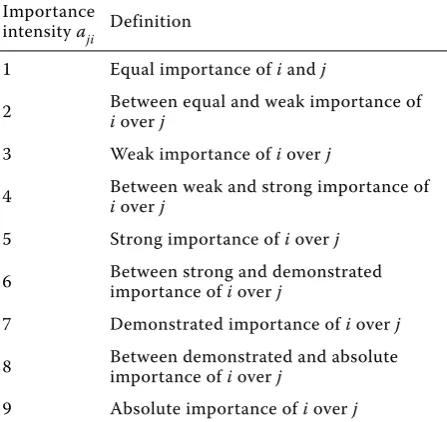
[image:4.595.307.531.553.764.2]The AhP is a basic approach to decision making (Dweiri and Meier 1996 ; Saaty 1980). in this process, the decision maker carries out simple pair-wise com-parative judgments, which are then used to develop overall priorities for ranking alternatives, factors or criteria. The AhP allows for inconsistency in the judg-ments and provides a mean to improve consistency. The decision makers assign an importance intensity value from the fundamental scale shown in Table 1, which represents the true preference of each reason with respect to another reason. The importance in-tensity of factor (also criterion, or alternative) i over j is denoted by aij, and the reciprocal importance Table 1. The fundamental scale of the AhP importance intensity value
importance
intensity aji Definition
1 Equal importance of i and j
2 Between equal and weak importance of i over j 3 Weak importance of i over j
4 Between weak and strong importance of i over j 5 Strong importance of i over j
intensity of factor j over i is denoted by aji = 1/aij, aji = 1, iff i = j. it is clear that aij is greater than 1 if factor i is more important than factor j, and is less than 1 if factor i is less important than factor j.
The AhP procedure by Saaty (1980), suggested by Dweiri and Meier (1996,) is as follows:
(1) Developing the importance intensity matrix A:
a ... a a
... ... ... ...
a ... a a
a ... a a A
nn n
n
n n
» » » »
¼ º
« « « «
¬ ª
2 1
2 22
21
1 12
11
Where:
n = the number of factors or alternatives to be compared. (2) Finding the vector (P) of the priorities of
fac-tors Pi:
(a) Multiplying the n elements in each row in the intensity importance matrix by each other. The result is the vector (Xi).
(b) Taking the n-th root of the vector (Xi) for each row. The result is the vector (yi).
(c) normalizing by dividing each number in the vector (yi) by the sum of all the numbers ∑Yi.
The result is a vector (P).
(3) Determining the consistency of judgments: (a) Finding the vector f by multiplying matrix A
by vector P.
(b) Dividing every Fi by Pi to determine Zi. (c) Summing Zi, and dividing by n to obtain the
maximum eigen value = λmax, which is the average.
(d) computing the “consistency index” iC = (λ
max – n)/(n – 1).
(e) Finding the “random index” iR from the Table 2, for the corresponding number of compared factors n.
(f ) computing the consistency ratio rC = iC/ iR. Any value of rC ≤ 0.1 is considered an accept-able ratio of consistency.
See Saaty (1980) for more details.
We shall utilize the AhP in our proposed approach to weigh the importance of every FES selected to judge the decision problem in the matched set. in the next section, we will demonstrate how the AhP could be used along with the MPDi combining criterion to obtain a reliable consolidated output for the crisp outputs of multiple FESs. An example will illustrate how the proposed approaches can be simply used to integrate the multiple parallel FESs.
AN IllusTRATIvE EXAMPlE
Decision making processes are applied in enterprises across all sectors, including agriculture. Besides ap-plying general approaches, agricultural enterprises should further consider many specific aspects as the biological character of production, the influence of climatic conditions, etc. This often leads to the multi-dimensional, multi-aspect decision-making problem, which might become very complex and should be simplified for the practical utilization in agricultural enterprises, e.g by reducing the number of dimen-sions where only a limited number of aspects and criteria are considered. As an example, we introduce a typical situation, when an agricultural enterprise wants to incorporate a new main crop (or to replace the existing one) into its production program. given suitable natural and other conditions for the given crop, mainly the following criteria are considered: – Economic profitability (which is given by an
eco-nomic effectiveness factor) – it incorporates aspects of the commodity direct costs, overhead costs, investment costs and the expected financial gain to the enterprise.
– Marketing potential (gaining a share at the local/ regional/broader market) – mainly the current com-petition in the given market segment is considered and also an inherent competitiveness.
– Social impact – it is possible to consider achieving support from the structural framework programs for the development of agriculture and rural areas, which is bound at the new production program. – Environmental impacts – analogically as above,
for adopting a final decision, it is important to consider a chance to achieve support related to environmental aspects from the structural frame-work development programs.
With respect to their importance, the individual aspects and criteria can have different weights in the decision making processes. The common objective is usually gaining financial resources – i.e. economic effect. it can be either a direct effect or an indirect one, which brings finances from the framework of the supporting structural policy.
[image:5.595.63.534.730.765.2]in our illustrative example, a large agricultural farm ABcD is considering the decision of whether or not to migrate from the present portfolio of poor croppers to better croppers, where a higher overall gain and sustainability is expected in the near future. Table 2. The random index iR versus the number of factors assessed
N 1 2 3 4 5 6 7 8 9 10 11 12
Such migration of the production portfolio can either require changes in the technology or adopting a new technology, it can increase environmental risks, it can lead to the new marketing strategy with changes in the supplier/customer relationships. it also would have a significant impact on the qualification struc-ture of employees with consequences in the social aspects. The farm management is seeking the help of four considered relevant FESs holding expertise and knowledge in marketing, environmental, technologi-cal, and social domains. The four FESs’ crisp outputs are as follows: O1 = 9, O2 = 3, O3 = 5, O4 = 8.
The company managers are relying on such FESs to reach the correct decision, and consequently there must be a mean to combine the outputs of such sys-tems. These systems may have different relative im-portances with respect to the decision problem.
The multiple FESs are to be combined first using the MPDi assuming equal relative importances, and then with the difference in the relative importances as follows:
(a) Combining multiple fEss with equal relative importances
First the deviative influence of each FESs is com-puted as follows:
– The middle value of the scale [0, 10] is Om = 5.
0 ǻ , 3 ǻ
0 ǻ , 0 ǻ
2 ǻ , 0 ǻ
0 ǻ , 4 ǻ
4 4
3 3
2 2
1 1
O O
O O
O O
O O
Then, according to eq. (1); in case of equal weights:
” Yes “ 10 3 10 5 1 1 4 1 1
6 1 1 1 8
1 . ( )
. .
.
MPDI «¬ª »¼ºu u u u
u u u
AM = 6.25 (> 5 ± 0.5) “Yes”.
The two combining criteria agree, but the MPDi is more decisive into pointing to the correct direc-tion.
(b) Combining multiple fEss with different rela-tive importance’s
Assume that the company’s product manager, who has a sufficient knowledge and experience to assess the relative importance of every expert system, will assign relative importance intensity values using the AhP fundamental scale in pair-wise compari-sons. he/she considered three criteria to be used in comparisons:
Knowledge: the amount of the important knowledge and information each FES bears.
Experience: the age and historical depth of the expertise contained in each FES.
Relevance: the degree of how much each FES has knowledge pertaining and relating to the decision problem.
stage 1: computing FESs’ absolute weights using the AhP:
The AhP hierarchy is shown in Figure 3. 1. computing absolute weights of the criteria
the importance intensity matrix:
» » » »
¼ º
« « « «
¬ ª
1 2
4 2
1 1
2 4
1 2 1 1 3 3x
A
» » »
¼ º
« « «
¬ ª
8 1 125 0.
Xi ,
» » »
¼ º
« « «
¬ ª
2 1 5 0. Yi ,
» » »
¼ º
« « «
¬ ª
571 0
286 0
143 0
. . .
Pi
» » »
¼ º
« « «
¬ ª
» » »
¼ º
« « «
¬ ª
» » » »
¼ º
« « « «
¬ ª
715 1
858 0
429 0
571 0
286 0
143 0
1 2
4 2
1 1
2 4
1 2 1 1
. . .
. . .
Fi ,
» » »
¼ º
« « «
¬ ª
3 3 3
i
Z ,
3 max
n Zi
Ȝ ¦
1 3
3 3 1 max
n
n Ȝ
CI , and from table iR = 0.58 for n = 3, then cr = 0 ≤ 0.1 (acceptable).
[image:6.595.158.409.593.748.2]
2. computing the absolute weights of FESs under each criterion
a. The knowledge criterion The importance intensity matrix:
» » » » » ¼ º « « « « « ¬ ª 1 6 1 4 1 5
14 3 1 6 4 3 1 1 2 1 5 4 1 2 1 4 4x A » » » » » ¼ º « « « « « ¬ ª 333 8 72 667 0 5 2 3 . . .
Xi ,
» » » » ¼ º « « « « ¬ ª 302 0 913 2 904 0 257 1 . . . .
Yi ,
» » » » ¼ º « « « « ¬ ª 302 0 913 2 904 0 257 1 . . . . Pi » » » » ¼ º « « « « ¬ ª » » » » ¼ º « « « « ¬ ª » » » » » ¼ º « « « « « ¬ ª 2351 0 318 2 9747 0 9855 0 302 0 913 2 904 0 257 1 1 6 1 4 1 5
14 3 1 6 4 3 1 1 2 1 5 4 1 2 1 . . . . . . . .
Fi ,
» » » » ¼ º « « « « ¬ ª 198 4 277 4 802 5 212 4 . . . .
Zi ,
622 4 max . n Zi Ȝ ¦ 2074 0 1 max . n n Ȝ
CI , and from table iR = 0.9 for n = 4, then cr = 0.23 > 0.1 (not acceptable), so the mana-ger must repeat judgments until his judgment be-comes consistent. he should investigate the relative importance of FESs over each other.
The revised importance intensity matrix:
» » » » » ¼ º « « « « « ¬ ª 1 7 1 2 1 5
14 6 1 6 2 6 1 1 2 1 5 4 1 2 1 3 3x A » » » » ¼ º « « « « ¬ ª 014 0 168 1667 0 5 2 . . .
Xi ,
» » » » ¼ º « « « « ¬ ª 344 0 6 3 639 0 257 1 . . . .
Yi ,
» » » » ¼ º « « « « ¬ ª 059 0 616 0 109 0 215 0 . . . . Pi » » » » ¼ º « « « « ¬ ª » » » » ¼ º « « « « ¬ ª » » » » » ¼ º « « « « « ¬ ª 2445 0 543 2 437 0 882 0 059 0 616 0 109 0 215 0 1 7 1 2 1 5
14 6 1 6 4 6 1 1 2 1 5 4 1 2 1 . . . . . . . .
Fi ,
» » » » ¼ º « « « « ¬ ª 144 4 128 4 009 4 102 4 . . . .
Zi ,
096 4 max . n Zi Ȝ ¦ 032 0 1 max . n n Ȝ CI
, and from table iR = 0.9 for n = 4, then cr = 0.036 ≤ 0.1 (acceptable).
b. The experience criterion The importance intensity matrix:
» » » » » ¼ º « « « « « ¬ ª 1 8 2 1 6 8 1 1 7 1 2
15 1 7 2 6 1 2 5 1 1 3 3x A » » » » ¼ º « « « « ¬ ª 24 929 8 70 067 0 3 . .
Xi ,
» » » » ¼ º « « « « ¬ ª 214 2 307 0 893 2 509 0 . . . .
Yi ,
» » » » ¼ º « « « « ¬ ª 374 0 052 0 488 0 086 0 . . . . Pi » » » » ¼ º « « « « ¬ ª » » » » ¼ º « « « « ¬ ª » » » » » ¼ º « « « « « ¬ ª 55 1 212 0 03 2 35 0 374 0 052 0 488 0 086 0 1 8 2 1 6 8 1 1 7 1 2
15 1 7 2 6 1 2 5 1 1 . . . . . . . .
Fi ,
» » » » ¼ º « « « « ¬ ª 144 4 077 4 16 4 07 4 . . . .
Zi ,
113 4 max . n Zi Ȝ ¦ 038 0 1 max . n n Ȝ
CI , and from table iR = 0.9 for n = 4, then cr = 0.042 ≤ 0.1 (acceptable).
c. The relevance criterion The importance intensity matrix:
» » » » » ¼ º « « « « « ¬ ª 1 2 4 1 2 1 1 3 2 1 4 1 3 1 1 4 1 6 1 2 4 1 3 3x A » » » » ¼ º « « « « ¬ ª 8 75 0 021 0 8 . .
Xi ,
» » » » ¼ º « « « « ¬ ª 682 1 931 0 381 0 682 1 . . . .
Yi ,
» » » » ¼ º « « « « ¬ ª 36 0 199 0 082 0 36 0 . . . . Pi » » » » ¼ º « « « « ¬ ª » » » » ¼ º « « « « ¬ ª » » » » » ¼ º « « « « « ¬ ª 446 1 805 0 328 0 446 1 36 0 199 0 082 0 36 0 1 2 4 1 2 1 1 3 2 1 4 1 3 1 1 4 1 6 1 2 4 1 . . . . . . . .
Fi ,
» » » » ¼ º « « « « ¬ ª 017 4 045 4 4 017 4 . . .
Zi ,
02 4 max . n Zi Ȝ ¦ 3 10 ) 583 6 ( 1 max u . n n Ȝ
CI , and from table iR = 0.9 for n = 4, then cr = (7.315)×10–3 ≤ 0.1 (acceptable). 3. Synthesis of priorities
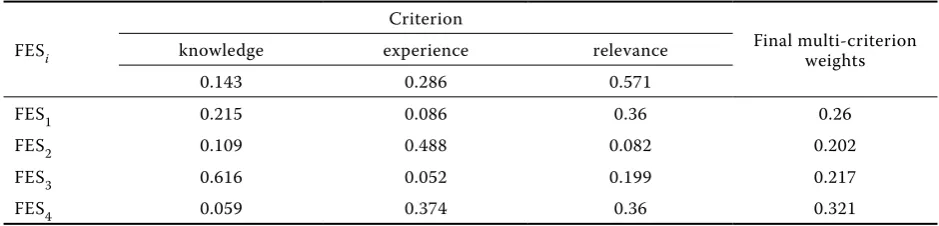
given the priorities of each FES under each cri-terion, now we follow the recommended additive synthesis method of the AhP for the distributive mode as follows (Table 3):
Then, first the weighted deviative influences of each FES is computed as follows:
Om = 5
Then, according to eq. (2); in case of equal weights: “Yes” 5) ( 67 6 5 1 1 0808 1 1
1926 1 1 1 208
1 u !
»¼ º «¬
ª
u u u
u u u
. .
. .
WMPDI
The weighted arithmetic means gives: WAM = 6.6 (> 5) “Yes”
The two combining criteria agree, and the WMPDi is still slightly more decisive in pointing to the cor-rect dicor-rection.
it should be noted that some direction threshold can be utilized to more reliably attribute the result-ing combined value of both criteria to the specific decision class. For instance, a threshold ± 0.5 can
be utilized. Then, if the combined value was greater than 5.5, it is classified as “Yes”; if the combined value was lower than 4.5, it is classified as “no”; otherwise the resulted value should be classified as non-biased. This threshold may contribute to the increasing reliability of results, and usually could be set based on the vision of the decision analysts and characteristics of the participating FESs or the decision problem.
CONClusION
in this paper, we have proposed a combining method for obtaining a final consolidated decision of nu-merical judgments made by the multiple cooperative FESs. This method is based on a newly promising criterion, the MPDi, and the AhP. The role of the AhP was to compute the weights of the individual FESs. These weights are to be used then in the pre-sented weighted version of the MPDi. The illustrative example has shown that the WMPDi is still slightly more decisive than the weighted arithmetic mean (WAM) criterion as was its original MPDi. Both the MPDi and WMPDi are superior to the AM and WAM, respectively. The whole approach of integrat-ing multiple FESs, effectively realized by a reliable combining criterion, actually improves the decision making process in general, and the group decision
making in particular. Since the individual FESs are able to model the expertise in both quantitative and qualitative contexts, to handle vague input variables and each of them incorporates a relevant source of knowledge and expertise, it is expected that the finally obtained consolidated output is a highly realistic and reliable decision answer. The proposed integration scheme of multiple FESs is novel and could be utilized in any field, such as economics, business, medicine, engineering areas, military decision making, …, etc. it is especially relevant, when we have multiple aspects and ill-structured, decision making problems.
REfERENCE
Al-ghoneim K, Kumar B.V.K.V. (1998): Unified decision combination framework. Pattern recognition, 31: 2077–2089.
Aly S., Vrana i. (2005): integrating Multiple Fuzzy Expert System under Varying requirements. Proceedings of the 5th international congress on information Tech-nology in Agriculture, Food and Environment. Adana, Turkey, oct.
Aly S., Vrana i. (2010): Approaches to assess the group con-sensus in Yes-or-no type experts’ group decision making. Agricultural Economics – czech, 56: 192–199. Arumugam n., Fatimah M.A., Eddie F.c. chiew E.F.c.,
zainalabidin M. (2010): Supply chain analysis of fresh fruits and vegetables (FFV): Prospects of contract fading. Agricultural Economic – czech, 56: 432–445.
Ashton r.h. (1986): combining the judgments of experts: how many and which ones? organizational Behavior and human Decision Processes, 38: 405–414.
Beeri Y., Spiegler i. (1996): Synergetic expert systems. Decision Support Systems, 17: 73–82.
Beranová M., Martinovičová D. (2010): Application of the theory of decision making under risk and uncertainty at modelling of costs. Agricultural Economic – czech, 56: 201–208.
[image:8.595.62.532.84.197.2]Bryson n. (1996): group decision-making and the analytic hierarchy process: exploring the consensus-relevant Table 3. The random index iR versus the number of factors assessed
FESi
criterion
Final multi-criterion weights
knowledge experience relevance
0.143 0.286 0.571
FES1 0.215 0.086 0.36 0.26
FES2 0.109 0.488 0.082 0.202
FES3 0.616 0.052 0.199 0.217
information content. computers and operations re-search,23: 27–35.
constantindis A.S., Fairhust M.c., rahman A.F.r. (2001): A new multi-expert decision combination algorithm and its application to the detection of circumscribed masses in digital mammograms. Pattern recognition, 34: 1527–1537.
cordella L.P., Foggia P., Sansone c., Tortella F., Vento M., (1999); reliability parameters to improve combination strategies in multi-expert systems. Pattern Analysis & Applications, 2: 205–214.
gams M., Karba n., Drobnič M. (1997): integration of multiple reasoning systems for process control. Applied Artificial intelligence, 10: 41–46.
ho T.K., hull J.J., Srihari S.n. (1992): Decision combination in multiple classifier systems. iEEE Transactions on Pat-tern Analysis and Machine intelligence, 22: 418–435. Jessup L.M., Valacich J.S. (1993): group Support Systems.
MacMillan, new York.
Kilagiz Y., Baran A., Yildiz z., cetin M. (2004): A fuzzy diagnosis and advice system for optimization of emis-sions and fuel consumption; Expert Systems with Ap-plications, 20: 1–7.
Kittler J., hatef M., Duin r.P.W., Matas J. (1998): on com-bining classifiers. iEEE Transactions on Pattern Analysis and Machine intelligence, 20: 226–239.
Kubon M., Krasnodębski A. (2010): Logistic costs in com-petitive strategies of enterprises. Agricultural Economics – czech, 56: 397–402.
Lipscomb J.; Parmigiani g.; hasselblad V. (1998): com-bining expert judgment by hierarchical modeling: an application to physician staffing. Management Science, 44: 149–161.
ngwenyama o.K., Bryson n., Mobolurin A. (1996): Sup-porting facilitation in group support systems: Techniques for analyzing consensus relevant data. Decision Support System, 16: 155–168.
Saaty T.L. (1980): The Analytic hierarchy Process. Mc-graw-hill, new York.
Tomšík P., Svoboda E. (2010): Diagnostics and decision-making of the company management within the period of economic crisis and recession. Agricultural Econom-ics – czech, 56: 303–309.
Venkatasubramanian V., chun-Fu chen (1986): A black-board architecture for plastics design. Artificial intel-ligence in Engineering, 1: 117–122.
Vrana i., Aly S., Vaníček J. (2010): TheMultiplicative Pro-portional Deviative influence combining criterion. Sys-témová integrace, 17: 77–88.
Xu L., Krzyzak A., Suen c.Y. (1992): Methods of combining multiple classifiers and their applications to handwriting recognition. iEEE Transactions on Systems, Man and cybernetics, 22: 418–435.
zadeh L.A. (1965): Fuzzy sets. information and control, 8: 338–353.
Arrived on 20th September 2010
Contact address: