rural areas in core economies had to face the spatial reorganization during the transition from the Fordism to the post-Fordism with all its negative impacts as any other area (Knox et al. 2003). Agriculture become to be dominated by integrated, corporate, transnational system called agribusiness during that reorganiza-tion, which was accompanied by the economic crisis of 1970s (Wilson 2001; Knox et al. 2003; robinson
2004). This shift in the world economy (Knox, Marston 2001) induced the search for the ways how to sustain the life in the rural areas (ilbery 2001). There was pointed out especially the diversification of rural based commercial activities (Butler 1998) as one of them and planning of these activities as the best prac-tice (ilbery 2001). The czech republic faces similar processes with delay in the context of its socialistic
Framework for utilizing angling as a tourism
development tool in rural areas
Rámce využití sportovního rybolovu jako turistického nástroje
rozvoje venkova
J. Navrátil
1, S. Martinát
2, E. Kallabová
21
University of South Bohemia, České Budějovice, Czech Republic
2
Institute of Geonics, Academy of Sciences of the Czech Republic, Ostrava,
Czech Republic
Abstract: Angling is considered as one of the rural tourism activities and is usually included into group of eco- and/or sus-tainable tourism activities. That is why it could be used as tourism development tool in rural areas but with local communi-ty respect. The aim is to reveal the push and pull motivation factors of rural anglers and their perception of conflicts. A self -organized questionnaire survey of members of the czech Fishing Union in the Třeboň region was used to obtain required data. Descriptive statistic and factor analysis were used for result analysis. rural anglers built up a diversified community because seven different push motivation factors have been found. There have been also found several types of the poten-tially important environment settings for anglers. Environment related motivation issues have been identified as the most important. The conflict analysis has revealed mainly the complexity of the environment related motivation issues as well as the complexity of relations between the anglers and other recreational use of water.
Key words: rural areas, development, angling
Abstrakt: Sportovní rybolov je považován za aktivitu venkovského cestovního ruchu a obvykle je řazen do skupiny ekoturistiky nebo udržitelné turistiky. Proto může být využit jako turistický rozvojový nástroj, ovšem s ohledem na místní komunitu. cílem je určit motivy a vnímání konfliktů lokální venkovskou rybářskou komunitou. Data byla získána dotazní-kovým šetřením mezi členy Českého rybářského svazu na Třeboňsku. Jeho výsledky byly analyzovány s využitím popisné statistiky a faktorové analýzy. Bylo zjištěno sedm odlišných „tlačících“ motivů – komunita je tedy výrazně diverzifikována. Stejně tak bylo zjištěno sedm různých preferovaných charakteristik prostředí. Jako nejdůležitější byla určena témata spojená s kvalitou prostředí. Analýza konfliktů odhalila komplexitu vnímání kvality prostření a vztahu rybářů k dalším rekreačním aktivitám vázaným na vodu.
Klíčová slova: venkov, rozvoj, sportovní rybolov
period. however, the needs for rural diversification intensified after 1990 when rural areas of the czech republic experienced global trends.
Rural areas and tourism
Tourism becomes one of the first recommended activities (Wilson et al. 2001), but tourism was intro-duced to rural areas much earlier – during the second half of 19th century in great Britain (robinson 1998b). Also the support for rural tourism is older than the crisis of Fordism and goes back to 1960s (Pina, Delfa 2005). Since then, many rural areas of Europe have turned to tourism as an alternative development strat-egy (Kneafsey 2000) and tourism activities become a part of policy-making and planning (Veal 2002). Subsequently, the national-level policies concentrated on trying to encourage the ‘bottom-up’ development revolving around the commodification of local re-sources (Kneafsey 2000). nowadays, rural areas are complex tourist destinations which attract people of different interests and characteristics (Molera, Albaladejo 2007), for whom rural communities are developing recreational and agricultural tourism products (Lowry 1996).
Tourism induced into rural areas is called rural tourism. however, there is no clear definition of rural tourism (chen, Kerstetter 2004; Meastro et al. 2007) as there is no clear definition of rural ar-eas as well (Moravčíková et al. 2007; ryglová 2007; Šimková 2007). nevertheless, rural tourism has been identified as a niche market with segmentation on continuum from the “rural based tourism” to “real rural tourism” (roberts, hall 2004). There have been also identified four basic rural tourist types – “want it all”, “independent”, “traditional” and “environmental” (Kastenholz et al. 1999).
Angling as tourism
Angling is considered as one of the rural tourism activities (Wilson et al. 2001; ryglová 2007), but there is a lack of studies considering human dimensions in recreational fisheries (Arlinghaus 2006), although angling is one of the most significant water based rec-reational activity (e.g. Upneja et al. 2001; Arlinghaus et al. 2002) and is generally considered as an efficient way of active relaxation which is important particu-lary for people exposed to adverse impacts of urban environment (Adámek et al. 1997).
The importance of angling as a tourism activity was studied first of all in the USA (Ditton et al. 2002),
because there are huge and long-term databases of anglers’ fishing behaviour. canada (Berry 1997) and’ fishing behaviour. canada (Berry 1997) and fishing behaviour. canada (Berry 1997) and Australia (ormsby, innes 1999) are the examples of the others.
researchers attempted to study angling as recrea-tional activity within the urban areas (Arlinghaus, Mehner 2003a) but it is also activity of tourism that is located in the rural areas across the world. The urban areas are also the greatest suppliers of anglers in the rural areas (Ditton et al. 2002). For example, the study of Berlin’s anglers shows that 71�� of them’s anglers shows that 71�� of themshows that 71�� of them spent more than 50�� of their fishing time outside the city, the average distance to recreational fish-eries where they occasionally catch is 60–70 km, almost 68�� of them catch during their holidays and 60�� have undertaken fishing holiday (Arlinghaus, Mehner 2004).
Angling related activities are one of those used by destination managers to (1) diversify the tourist supply of region by making packages of individual tourist attractions and to (2) tie local community with visitors by supporting special fishing tournaments (Wilson et al. 2001). Fishing related information is also utilized to promote the region attractiveness by the destination management (cawley et al. 2002)
The human dimension of angling is known in the czech republic (Pivnička, Čihař 1986). The attention was paid in the most cases to the hydrobiological, ecological or agricultural point of view (hartvich 1982; Pivnička, rybář 2001; Smutný, Pivnička 2001). however, there is still not any sufficient knowledge about anglers as tourists in the czech republic (Spurný et al. 2003), regardless the fact that attractiveness of angling is counted as a part of the tourism develop-ment potential in several strategies for tourism de-velopment in the tourism marketing of the regions of the czech republic.
Development of tourism
overall, the impact of development of tourism ac-tivities on places and societies has been well known for many years (e.g. Eyster 1976). The physical and economic development of tourism are the most con-spicuous impacts of all tourism related issues but the environmental and socio-cultural consequences of these impacts must be taken into account (heydendael 2002).
– the concept of sustainable tourism (WTo et al. 1995)
– the concept of ecotourism (Epler Wood 2002)
The concept of sustainable tourism very briefly means: “Sustainable tourism development meets the needs of present tourist and host regions while protect-ing and enhancprotect-ing opportunities for the future. It is envisaged as leading to management of all resources in such a way that economic, social and aesthetic needs can be fulfilled while maintaining cultural integrity, essential ecological processes, biological diversity and life support systems” (WTo, WTTc, Ec 1995).
The aims of sustainability in tourism could be achieved only if they are based on (1) responsible planning with the implementation of policies that embody the principles of sustainability and (2) coop-eration of the government and the private sector with the participation of civil society and local communi-ties (Vereczi 2002). This is not imaginable without the optimal knowledge of all parts and processes of the tourism system (WTo 2004).
Based on the definition, the concept of ecotourism very briefly means: “All nature-based forms of tour-ism in which the main motivation of the tourists is the observation and appreciation of nature as well as the traditional cultures prevailing in natural areas”
(WTo, UnEP 2001).
in contradistinction to the traditional nature-based tourism: (1) it contains educational and interpretation features, (2) it is generally organised for small groups by specialised and small, locally owned businesses, (3) it minimises negative impacts upon the natural and socio-cultural environment (WTo, UnEP 2001). The definitions and concepts of ecotourism are further analysed e.g. by Sjøholt (2000) or Fenel (2001).
if ecotourism meets the criteria of the sustainability principles, ecotourism could be considered as sus-tainable tourism. however, this concept depends on the authors’ understanding of sustainability (Klapka’ understanding of sustainability (Klapka understanding of sustainability (Klapka et al. 2005) and also the tourist perception of what a ecotourism activity is, and what it is not (hvenegaard 2002). Angling is usually included into the group of eco- and/or sustainable tourism activities (Ditton et al. 2002; Williams, richter 2002).
The majority of development tools related with tourism assistance on all geographical levels are based on principles of sustainable development. There are the principles of the United nations World Tourism organization (UnWTo) on the global level with its STEP Programme aimed at the development assist-ance for local communities in developing and last developed countries (UnWTo 2008). however, the UnWTo helps to spread the concept of sustainable
tourism worldwide. The principles of tourism sus-tainability are applied in the regional development in the EU. Although there is no common tourism policy, the European community considers the tour-ism development to be very important (EU 1984). A renewed EU tourism policy (EU 2006) is also aimed at the rural areas development. rural areas are sup-ported within the EU policy by the European regional Development Fund (rural Development Programme). The EU concepts are implemented on the national level of the czech republic. The Programme of rural renewal can be mentioned as a main tool for rural development via tourism activities. its aim is to pre-dominantly support the population stability of rural areas, the diversification of economic activities within rural areas, the improvement of transport accessibility and the improvement of the quality of life in these areas (Ministry of Agriculture 2007).
Attitudes of local communities towards tourism development are among other considered as the most important factor for the local tourism development (huh, Vogt 2008; Wilson et al. 2001). resident attitudes towards tourism have been a subject of research for more than 30 years and have constituted one of the well-studied areas of tourism research (Mcgehee, Andereck 2004). however, the results of research findings are mixed (harrill 2004) and there have been found differences among communities (Andereck, Vogt 2000) as well as changes in attitudes during the transition of the community from the traditional to a new one that is based on tourism income (huh, Vogt 2008).
Based on this, the authors would like to contrib-ute to enlarging the knowledge about czech rural anglers, especially about the rural anglers’ attitudes to the complex of the recreational fishing environ-ment. Two contexts were adopted – the motivation to participate and the perception of conflict. The aim of this paper is to reveal (1) the importance of the particular motives and complex factors of fish-ing motivation of rural anglers and (2) the percep-tion and factors of the perceppercep-tion of conflicts of the recreational fisheries.
MATERIAL AND METHODS
czech republic and (2) one of the most important nature and cultural based tourism destinations in the czech republic. Distribution of questionnaires was conducted with support of the czech Fishing Union, South Bohemian Board. During January 2005, there were sent the prints of questionnaires (together 270) by mail to the chiefs of eight local associations that stretch to the Třeboň basin and that agreed to participate in the survey (nové hrady, Suchdol n. Lužnicí, Trhové Sviny, Kardašova Řečice, Borovany, České Velenice, Veselí n. Lužnicí, Soběslav). The chiefs were asked (after phone agreement) to kindly distribute the questionnaires to anglers, to collect them and to send them back by mail to the author’s’ss address. The questionnaires were distributed and collected on the annual members’ meeting that took place from January to April 2005. 123 questionnaires returned till the end of June 2005, 11 of which had to be discarded because of the lack of credibility. Finally, there were data from 5.1�� members of the local associations that agreed to participate in the survey for the analysis.
it was pointed out, that the motivation for tourism has two sides – individuals are pushed by the motiva-tion variables into making travel decisions and they are pulled (or attracted) by the destination attributes (Yoon, Uysal 2005). The motivations were measured on five point Likert-type scales where 1 = not at all important, 2 = rather not important, 3 = slightly important, 4 = very important, 5 = extremely im-portant. The order of push and pull motivations was separately randomized.
The push motivation importance and structure were studied by using the particular push angling motives that were compiled from related research studies, es-pecially studies on the socio-economic characteristics of anglers (Arlinghaus, Mehner 2003b; Spurný et al. 2003). The final list consisted of 24 items: to get away from everybody, to obtain fish to eat, to catch the fish i can keep, to get away from the everyday work, to experience nature, to be with friends, to enjoy the experience of peace, to take fish home, to get away from the everyday life, to test my own baits, to get silence, to present my catch in the public, to improve my knowledge and skills, to catch any fish, to catch trophy fish, to compete with the others, to be with people like me, to take a rest from my wife/husband, to enjoy pleasant surroundings, to enjoy fighting fish, to have a rest, to enjoy the apprehension if i catch fish today, to be alone, to catch at least one fish.
The pull motivations importance and structure were studied by using the particular pull angling mo-tives that were compiled from the related research literature, especially studies on anglers’ perception of
environmental issues and outdoor recreational set-tings (Arlinghaus, Mehner 2003a; Spurný et al. 2003; navrátil 2004). The final list consisted of 18 items: absence of other holidaymakers, low number of an-glers on fishery, pub at the hand, occurrence of a parking place for a car, beauty of natural environ-ment, accessibility of information about fisheries, many individuals of all fish species, price of angling tickets, many fish species, amount of harmful matters in fish meet, size of fish, water quality, high amount of favourite fish species, higher chance to catch the trophy fish, the “wilderness”, occurrence of favour-ite fish species, special forms of banks modified for anglers, distance from home.
Previous studies on the recreational uses of water have confirmed that all of the three types of conflicts over the recreational use of water are of big impor-tance for regional tourism (or destination) manage-ment (Kakoyannis, Stankey 2002). The perception of conflict was studied by using several types of issues relating to the uses of water. The list was based on the previous research on local organization of the Moravian Fishing Union (navrátil 2004). Anglers were asked to decide if each activity from the list is or is not an enemy of the recreational fishing. if the answer was “yes”, they were then asked to decide how big the enemy is. Their opinion was measured on the five-point scale ranging from 1 = insignificant enemy to 5 = substantial enemy. There was assigned the value “0” for the answer “no”. The final list con-sisted of 16 items: irresponsible common population, small water power plants, swimming, water pollu-tion caused by agriculture, special modificapollu-tion of shores, environment protection, introduction of alien fish species, fish eating predators, irresponsible an-glers, fish farming, water pollution caused by waste from settled areas, boating, second homes owners, poaching, windsurfing, water pollution caused by industry.
The importance of each item of motivation and the utilization water was assessed by using the mean value and standard deviation values (SD). complex factors of the push motivation, pull motivation and the structure of factors of the conflicts perception on recreational fisheries were studied using factor analysis with the principal component analysis method (Luo, Deng 2008). only the factors with eigenvalue > 1 were considered as crucial (robinson 1998a). The results of factorial analysis were rotated with the varimax rotation method.
Table 1. Push motivations of rural anglers
Mean SD Factor loadings
1 2 3 4 5 6 7
Factor 1: introvert professional experience
to test my own baits 2.65 1.16 0.77 –0.11 0.03 0.16 0.09 0.04 0.15
to enjoy fighting fish 3.82 1.03 0.71 0.23 0.11 0.05 0.24 0.05 0.06
to improve knowledge and skills 3.17 1.24 0.67 –0.18 0.21 –0.01 0.02 0.10 0.38
to catch trophy fish 2.94 1.30 0.56 0.29 0.16 0.01 –0.13 –0.03 0.41
Factor 2: catch fish
to take fish home 2.00 1.00 –0.15 0.91 0.01 0.04 0.07 0.06 0.09
to obtain fish to eat 2.01 1.02 –0.09 0.87 0.01 –0.05 –0.02 0.09 0.04
to catch the fish i can keep 2.31 1.12 –0.01 0.85 –0.07 –0.01 –0.09 0.10 0.00 to catch at least one fish 2.46 1.15 0.25 0.71 0.07 0.26 –0.12 –0.05 0.11
to catch any fish 2.55 1.11 0.42 0.59 –0.01 0.21 –0.20 –0.01 –0.14
to enjoy the apprehension if i catch fish
today 2.86 1.24 0.41 0.58 0.10 –0.12 0.14 0.37 –0.10
Factor 3: relaxation through enjoyment of nature
to enjoy pleasant surroundings 4.08 0.86 0.15 –0.06 0.80 0.19 0.09 0.14 0.06
to experience nature 4.40 0.78 0.17 –0.02 0.74 –0.01 0.04 0.05 0.05
to get silence 3.75 1.04 –0.04 –0.03 0.72 0.34 –0.13 0.14 0.20
to have a rest 4.13 0.96 –0.03 0.07 0.70 0.21 0.10 –0.03 0.03
to enjoy the experience of peace 3.10 1.22 0.13 0.08 0.68 –0.25 0.11 0.22 –0.05 Factor 4: Escape
to get away from the everyday work 3.11 1.21 0.10 0.19 0.13 0.87 0.10 0.08 0.03 to get away from the everyday life 3.25 1.14 0.11 –0.01 0.23 0.85 0.02 0.16 0.11 Factor 5: Social gathering within anglers community
to be with friends 3.24 1.18 0.00 –0.11 0.05 0.16 0.91 –0.01 0.17
to be with people like me 3.12 1.21 0.23 –0.06 0.15 –0.05 0.84 –0.11 0.17 Factor 6: Loneliness
to get away from everybody 2.31 1.23 0.11 0.14 0.16 0.12 0.00 0.86 0.02
to be alone 2.63 1.24 0.02 0.13 0.30 0.07 –0.18 0.78 –0.09
Factor 7: Extrovert public appreciation
to compete with the others 1.93 1.14 0.31 –0.01 0.09 0.04 0.13 –0.05 0.81 to present my catch in the public 2.39 1.23 0.17 0.13 0.12 0.04 0.28 –0.06 0.73 to take a rest from my wife/husband 1.81 1.07 0.01 –0.02 –0.08 0.21 0.05 0.49 0.52
Eigenvalue 5.30 3.70 2.52 1.63 1.60 1.33 1.09
�� total variance 22.08 15.40 10.50 6.80 6.66 5.53 4.55
�� cumulative variance 37.47 47.98 54.78 61.44 66.97 71.51
results of factor analysis (principal component method, only factors with eigenvalue > 1), results rotated (Varimax normalized); n = 112
RESULTS AND DISCUSSION
Especially males (91��) of middle age (23�� between 31 and 40, 23�� between 41 and 50, 23�� between 51 and 60) with any type of secondary school education (77��) took part in the questionnaire survey. our sam-ple consists predominantly of non-specialised (83��) experienced anglers (45�� with more than 20 years experience) spending from 25 to 49 days a year (31��) on angling trips.
Motivation factors
Push motives related only to the environment quality and the motive “to enjoy fighting a fish” are considered by the rural anglers as very important (Table 1). The perception of high importance of the environment quality for recreational fishing was also found among local organizations (navrátil 2004).
As reported in Table 1, all 24 push motivation items loaded on seven factors which together explain 71.5�� of the total data variance. The seven factors were labelled (in order of factor eigenvalues) “introvert professional experience”, “catch fish”, “relaxation through enjoyment of nature”, “Escape”, “Social gath-ering within anglers community”, “Loneliness” and “Extrovert public appreciation”. relaxation through enjoyment of nature was found as the most important factor with the lowest standard deviation. Although some push motivation items were loaded differently and ordering of the factors is different than in the most comprehensive study of Arlinghaus and Mehner (2003b), the core of the motivation factors as well as their importance was revealed analogically.
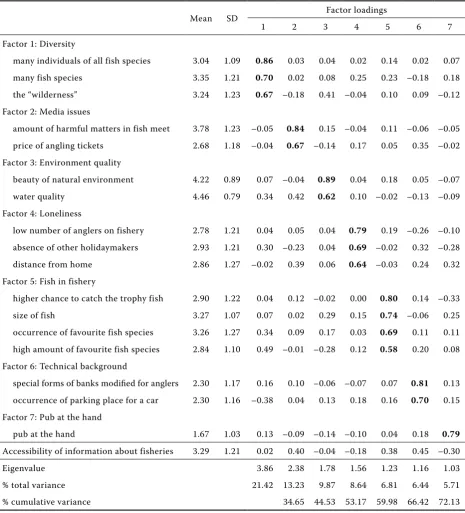
only two pull motivations related to the environ-ment quality were found more than very important (Table 2). This finding is analogical to the push mo-tivation findings. on the other hand, unimportant are reported: pub at the hand, occurrence of parking place for a car, special forms of banks modified for anglers. These results are similar to other studies (see discussion in Arlinghaus, Mehner 2003a).
17 out of 18 pull motivation items (without acces-sibility of information about fisheries) were loaded on seven factors that together explain 72.1�� of the total variance. These seven factors were labelled (in order of factor eigenvalues) “Diversity”, “Media issues”, “Environment quality”, “Loneliness”, “Fish in fishery”, “Technical background”, “Pub at the hand” (Table 2). These seven factors can be considered as the main issues for the marketing communication towards the potential anglers-tourists and notably extend the pull motivation findings of Spurný et al. (2003).
Perception of potential conflicts
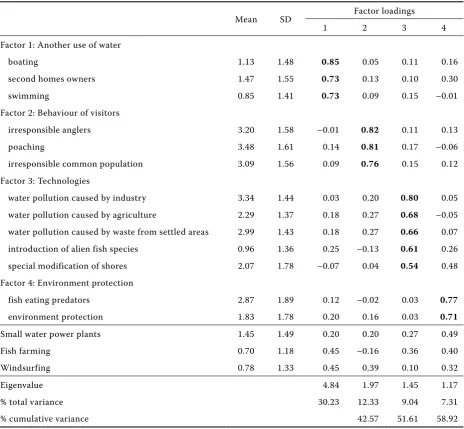
The poachers were found as the worst enemies of recreational fishing, water pollution caused by industry and irresponsible anglers followed. As non-enemies of recreational fishing, there were reported the introduction of alien fish species, fish farming and surprisingly recreational activities such as swimming, windsurfing and boating (Table 3).
According to the results of factor analysis – the enemies of sport fishing can be divided into four main groups – “Another use of water”, “Behaviour of visitors”, “Technologies” and “Environment pro-tection”. 13 out of 16 activity items were loaded on four factors that together explain 58.9�� of the total variance (Table 3).
Although the selected recreational activities were not reported as enemies of angling, it had been found previously, that there was a factor of pull motiva-tions related to the number of holidaymakers and other anglers on the fishery and the number of holi-daymakers for the anglers was slightly important. We must point out, that the attitudes toward other recreational uses of water were found very good, on the other hand, the attitudes toward irresponsible water visitors (it does not matter if anglers or non-anglers holidaymakers) were found very bad – the activities are not badly perceived as such, but the participant can produce heavy conflicts. The worst attitude of anglers was revealed to the second home owners – it may be due to the location of most of the second homes (in relationship to fisheries of the czech Fishing Union) in the selected area of water streams (Klufová et al. 2003). The second home own-ers present also a real rivalry to rural anglown-ers. The second place took boating, which is commonly a non-beloved water based activity among anglers (e.g. hladík 2002). The good position of windsurfing and swimming may be due to the specific conditions of fisheries in selected area – windsurfing is commonly popular on big fishponds which are not the fisheries of the czech Fishing Union and swimming is popular on still water – in the selected area, it means first of all great flooded gravel-sand lakes visited especially by anglers-tourists.
reported as non-enemies. This paradox was reported before (navrátil 2004). it is in contradiction to the motivation structure – more important are the items of quality rather than quantity of the recreational fishing. however, the activities of organizations involved in nature and landscape protection are perceived first of all as the activities that protect fish eating predators
[image:7.595.65.531.203.717.2]and reduce the quantity of fish farms by the restric-tion on fertilizers. This could be an obstrucrestric-tion to use the recreational fishing development not only as a tourism development tool but also as an environ-ment improveenviron-ment tool, because recreational fishing is considered as less dangerous for water quality that fish farming (Bninska, Wolos 2001).
Table 2. Pull motivation of rural anglers
Mean SD Factor loadings
1 2 3 4 5 6 7
Factor 1: Diversity
many individuals of all fish species 3.04 1.09 0.86 0.03 0.04 0.02 0.14 0.02 0.07
many fish species 3.35 1.21 0.70 0.02 0.08 0.25 0.23 –0.18 0.18
the “wilderness” 3.24 1.23 0.67 –0.18 0.41 –0.04 0.10 0.09 –0.12
Factor 2: Media issues
amount of harmful matters in fish meet 3.78 1.23 –0.05 0.84 0.15 –0.04 0.11 –0.06 –0.05 price of angling tickets 2.68 1.18 –0.04 0.67 –0.14 0.17 0.05 0.35 –0.02 Factor 3: Environment quality
beauty of natural environment 4.22 0.89 0.07 –0.04 0.89 0.04 0.18 0.05 –0.07
water quality 4.46 0.79 0.34 0.42 0.62 0.10 –0.02 –0.13 –0.09
Factor 4: Loneliness
low number of anglers on fishery 2.78 1.21 0.04 0.05 0.04 0.79 0.19 –0.26 –0.10 absence of other holidaymakers 2.93 1.21 0.30 –0.23 0.04 0.69 –0.02 0.32 –0.28
distance from home 2.86 1.27 –0.02 0.39 0.06 0.64 –0.03 0.24 0.32
Factor 5: Fish in fishery
higher chance to catch the trophy fish 2.90 1.22 0.04 0.12 –0.02 0.00 0.80 0.14 –0.33
size of fish 3.27 1.07 0.07 0.02 0.29 0.15 0.74 –0.06 0.25
occurrence of favourite fish species 3.26 1.27 0.34 0.09 0.17 0.03 0.69 0.11 0.11 high amount of favourite fish species 2.84 1.10 0.49 –0.01 –0.28 0.12 0.58 0.20 0.08 Factor 6: Technical background
special forms of banks modified for anglers 2.30 1.17 0.16 0.10 –0.06 –0.07 0.07 0.81 0.13 occurrence of parking place for a car 2.30 1.16 –0.38 0.04 0.13 0.18 0.16 0.70 0.15 Factor 7: Pub at the hand
pub at the hand 1.67 1.03 0.13 –0.09 –0.14 –0.10 0.04 0.18 0.79
Accessibility of information about fisheries 3.29 1.21 0.02 0.40 –0.04 –0.18 0.38 0.45 –0.30
Eigenvalue 3.86 2.38 1.78 1.56 1.23 1.16 1.03
�� total variance 21.42 13.23 9.87 8.64 6.81 6.44 5.71
�� cumulative variance 34.65 44.53 53.17 59.98 66.42 72.13
results of factor analysis (principal component method, only factors with eigenvalue > 1), results rotated (Varimax normalized); n = 112
CONCLUSION
rural anglers built up a diversified community according to the push motivation. it can be sup-posed that each of its parts will answer different the managerial implications to attract anglers-tourists. There were also found several types of the poten-tially important environment settings for anglers. These types can contribute to the improvement of fisheries management aimed at the satisfaction with angling. The conflict analysis has revealed especially the complexity of the environment related motivation issues as well as the complexity of relations between anglers and other recreational use of water.
Acknowledgement
[image:8.595.67.532.83.512.2]We are grateful to all from the czech Fishing Union and the Moravian Fishing Union who par-ticipatea in any way in this research. The authors also thank iveta Pavezová for the language revision. This paper was elaborated with support of: the czech Science Foundation – gAcr 403/09/P053 “The ty-pology of tourist’s attitudes towards environment, the case of waters in landscape”; the grant Agency of the Academy of Sciences of the czech republic KJB300860902 “Farming in mountain conditions, its spatio-temporal changes and importance for development of mountain areas”; and the long-term Table 3. rural anglers‘ perception of potential conflicts
Mean SD Factor loadings
1 2 3 4
Factor 1: Another use of water
boating 1.13 1.48 0.85 0.05 0.11 0.16
second homes owners 1.47 1.55 0.73 0.13 0.10 0.30
swimming 0.85 1.41 0.73 0.09 0.15 –0.01
Factor 2: Behaviour of visitors
irresponsible anglers 3.20 1.58 –0.01 0.82 0.11 0.13
poaching 3.48 1.61 0.14 0.81 0.17 –0.06
irresponsible common population 3.09 1.56 0.09 0.76 0.15 0.12
Factor 3: Technologies
water pollution caused by industry 3.34 1.44 0.03 0.20 0.80 0.05
water pollution caused by agriculture 2.29 1.37 0.18 0.27 0.68 –0.05
water pollution caused by waste from settled areas 2.99 1.43 0.18 0.27 0.66 0.07
introduction of alien fish species 0.96 1.36 0.25 –0.13 0.61 0.26
special modification of shores 2.07 1.78 –0.07 0.04 0.54 0.48
Factor 4: Environment protection
fish eating predators 2.87 1.89 0.12 –0.02 0.03 0.77
environment protection 1.83 1.78 0.20 0.16 0.03 0.71
Small water power plants 1.45 1.49 0.20 0.20 0.27 0.49
Fish farming 0.70 1.18 0.45 –0.16 0.36 0.40
Windsurfing 0.78 1.33 0.45 0.39 0.10 0.32
Eigenvalue 4.84 1.97 1.45 1.17
�� total variance 30.23 12.33 9.04 7.31
�� cumulative variance 42.57 51.61 58.92
results of factor analysis (principal component method, only factors with eigenvalue > 1), results rotated (Varimax normalized); n = 112
research plans of the University of South Bohemia (MSM 6007665806) and the institute of geonics (AVoz 30860518).
REFERENCES
Adámek z., Vostradovský J., Dubský K., nováček J., hartvich P. (1997): rybářství ve volných vodách (Fisheries in open waters). East Publishing, Praha; iSBn 80-7187-008-0.
Andereck K.L., Vogt ch.A. (2000): The relationship between residents’ attitudes toward tourism and tourism development options. Journal of Travel research, 39 (1): 27–36.
Arlinghaus r. (2006): overcoming human obstacles to conservation of recreational fishery resources, with emphasis on central Europe. Environmental conservation, 33 (1): 46–59.
Arlinghaus r., Mehner T. (2003a): Management pref-erences of urban angles: habitat rehabilitation versus other options. Fisheries, 28 (6): 10–17. Arlinghaus r., Mehner T. (2003b): Socio-economic
characterisation of specialised common carp ( Cypri-nus carpio L.) anglers in germany, and implications for inland fisheries management and eutrophication control. Fisheries research, 61 (1): 19–33.
Arlinghaus r., Mehner T. (2004): A management-orientated comparative analysis of urban and rural anglers living in a metropolis (Berlin, germany). Environmental Management, 33 (3): 331–344. Arlinghaus r., Mehner T., cowx i.g. (2002):
rec-onciling traditional inland fisheries management and sustainability in industrialized countries, with emphasis on Europe. Fish and Fisheries, 3 (4): 261–316.
Berry D.K. (1997): Sport fishing in Alberta. Edmon-ton, Alberta environment natural resources service. Available at http://www3.gov.ab.ca/srd/fw/fish-ing/pdf/SportfishingAlberta.PDF [Quoted 2003-11-10].
Bninska M., Wolos A. (2001): Management of selected Polish commercial and recreational lake fisheries activities. Fisheries Management and Ecology, 8
(4–5): 333–343.
Butler r. (1998): rural recreation and tourism. in: ilbery B. (ed.): geography of rural change. Long-man, harlow, pp. 211–232.
cawley M., gaffey S., gillmor D.A. (2002): Locali-zation and global reach in rural tourism: irish evidence. Tourist Studies, 2 (1): 63–86.
chen P., Kerstetter D.L. (1999): international students’ image of rural Pennsylvania as a travel destination. Journal of Travel research, 37 (3): 256–266.
Ditton r.B., holland S.M., Anderson D.K. (2002): recreational fishing as tourism. Fisheries, 27 (3): 17–24.
Epler Wood M. (2002): Ecotourism: principles, prac-tices and policies for sustainability. UnEP, Paris; iSBn 90-807-2064-3.
EU (1984): council resolution of 10 April 1984 on a community policy on tourism. official Journal, 30/04/1984 (c115): 2–27. Available at http://eur-lex.europa.eu [Quoted 2008-05-28].
EU (2006): A renewed EU tourism policy: Towards a stronger partnership for European tourism. Available at http://ec.europa.eu/enterprise/serv-ices/tourism/communications_2006.htm [Quoted 2008-05-28].
Eyster J. J. (1976): Economic development and public policy: tourism as an alternative. cornell hospital-ity Quarterly, 17 (3): 22–30.
Fennel D. A. (2001): A content analysis of ecotour-ism definitions. current issues in Tourecotour-ism, 5 (4): 403–421.
harrill r. (2004): residents’ attitudes toward tourism development: a literature review with implications for tourism. Journal of Planning Literature, 18 (3): 251–266.
hartvich F. (1982): Posouzení systému sportovní-ho rybolovu na příkladu růstu a početnosti kapra v štěrkopískových jezerech na Třeboňsku (Evalua-tion of sport fishing as exemplified by carp growth and abundance in two gravel-sand lakes in the Tře-boň region). Živočišná výroba, 27 (11): 865–874. heydendael A. (2002): Sustainable tourism within the
context of the ecosystem approach. in: di castri F., Balaji V. (eds.): Tourism, Biodiversity and informa-tion. Backhuys Publishers, Leiden, pp. 25–44. hladík M. (2002): Sportovní rybáři a vodáci (Anglers
and watermen). Český rybář, 3: 6–8.
huh ch., Vogt ch.A. (2008): changes in residents‘ attitudes toward tourism over time: a cohort ana-lytical approach. Journal of Travel research, 46
(4): 446–455.
hvenegaard g. T. (2002): Using tourist typologies for ecotourism research. Journal of Ecotourism,
1 (1): 7–18.
ilbery B. (2001): changing geographies of global food production. in: Daniels P., Bradshaw M., Swah D., Sidaway J. (eds.): human geography: issues for 21st century. Prentice hall, harlow, pp. 253–273.
Kakoyannis ch., Stankey g. h. (2002): Assessing and evaluating recreational uses of water resources: implications for an integrated management frame-work. USDA, Portland. Available at www.fs.fed. us/pnw/pubs/gtr536.pdf [Quoted 2008-05-28]. Kastenholz E., Davis D., Paul g. (1999):
Segment-ing tourism in rural areas: the case of north and central Portugal. Journal of Travel research, 37
(4): 353–363.
Klufová r., rost M., Šulista M. (2003): Statistické hodnocení intenzity volného a vázaného cestovního ruchu v chKo a Br Třeboňsko (Statistical evalu-ation of the tourism intensity in Třeboňsko bio-sphere reserve). in: hasman M., Říha J., Šittler E., Dvořák V. (eds.): cestovní ruch v České republice, ploblémy a možnosti jejich řešení. zF JU, Tábor, pp. 319–326.
Kneafsey M. (2000): Tourism, place identities and social relations in the European rural periphery. European Urban and regional Studies, 7 (1): 35– 50.
Knox P., Agnew J., Mccarthy L. (2003): The geog-raphy of the World Economy. hodder-Arnold, London; iSBn 978-0-340-80712-5.
Knox P.L., Marston S.A. (2001): Places and regions in global context: human geography. Prentice hall, new Jersey; iSBn 0-13-016831-9.
Lowry L.L. (1996): recreational and agricultural tour-ism: new markets for rural communities. Journal of Vacation Marketing, 3 (1): 5–7.
Luo Y., Deng J. (2008): The new environmental para-digm and nature-based tourism motivation. Journal of Travel research, 46 (4): 392–402.
Maestro r.M.h, gallego P.A.M., requejo L.S. (2007): The moderating role of familiarity in rural tour-ism in Spain. Tourtour-ism Management, 28 (3): 951– 964.
Mcgehee n.g., Andereck K.L. (2004): Factors pre-dicting rural residents’ support of tourism. Journal of Travel research, 43 (2): 131–140.
Ministry of Agriculture of the czech republic (2007): rural Development Programme of the czech re-public for period 2007–2013. Available at www. mze.cz/userfiles/file/EAFrD/PrV.pdf [Quoted 2008-05-30].
Molera L., Albaladejo i.P. (2007): Profiling segments of tourists in rural areas of South-Eastern Spain. Tourism Management, 28 (3): 757–767.
Moravčíková D., hanová M., Klimentová K. (2007): rural households in the stratification system of the Slovak society. Agricultural Economics – czech,
53 (8): 359–369.
navrátil, J. (2004): Konflikty rekreačního rybolovu s životním prostředím z pohledu zástupců Mo
MrS (conflicts between recreational fishing and environment from the point of view of local or-ganizations of Moravian Fishin Union). in: herber V. (ed.): Fyzickogeografický sborník 2. PřF MU, ČgS, Brno, pp. 217–220.
ormsby J., innes J. (1999): A preliminary report on the social and motivational aspects of recreational fishing in the great Barrier reef region. reef re-search, 9 (2): 23–25.
Pina i.P.A., Delfa M.T.D. (2005): rural tourism de-mand by type of accommodation. Tourism Man-agement, 26 (6): 951–959.
Pivnička K., Čihař M. (1986): Analýza sportovně rybářského využití údolní nádrže hostivař v Praze (Analysis of sport fishing use of hostivař dam in Prague). Živočišná výroba, 31 (10): 953–959. Pivnička K., rybář M. (2001): Long-term trends in
sport fishery yield from selected reservoirs in the Labe watershed (1958–1998). czech Journal of Animal Science, 46 (2): 89–94.
roberts L., hall D. (2004): consuming the coun-tryside: Marketing for ‘rural tourism’. Journal of Vacation Marketing, 10 (3): 253–263.
robinson g. M. (1998a): Methods and Techniques in human geography. John Wiley and Sons, chich-ester; iSBn 0-471-96232-5.
robinson S. (1998b): Tourism geography. routledge, London, new York; iSBn 0-415-14214-8.
robinson g. (2004): geographies of Agriculture: globalization, restructuring and Sustainability. Prentice hall, harlow; iSBn 9-78058235-662-7. ryglová K. (2007): Limiting factors in the field of
business activities in rural tourism. Agricultural Economics – czech, 53 (9): 421–431.
Sjøholt P. (2000): Eco-tourism and local develop-ment, conceptual and theoretical framework and problems in implementation, empirical evidence from costa rica and Ecuador. Fennia, 178 (2): 227–241.
Smutný P., Pivnička K. (2001): Analysis of sport fish-ing yields from the Mže and Berounka rivers in 1975 to 1998. czech Journal of Animal Science,
46 (3): 126–133.
Spurný P., Mareš J., Kopp r., Fiala J. (2003): Socioe-konomická studie sportovního rybolovu v České republice (Socio-economic study of sport fish-ing in the czech republic). ČrS, MzLU, Brno. Available at http://www.rybsvaz.cz/download/ rada/crS_socioekonomicka_studie.pdf [Quoted 2008-05-28].
UnWTo (2008): Sustainable tourism – Eliminating poverty. Available at http://www.unwto.org/step [Quoted 2008-05-28].
Upneja A., Shafer E.L., Seo W., Yoon J. (2001): Eco-nomic benefits of sport fishing and angler wildlife watching in Pennsylvania. Journal of Travel re-search, 40 (1): 68–78.
Veal A.J. (2002): Leisure and tourism policy and planning. cABi Publishing, oxon; iSBn 0-85199-546-2.
Vereczi g. (2002): Sustainable development of tour-ism: principles and practice. in: di castri F., Balaji V. (eds.): Tourism, Biodiversity and information. Backhuys Publishers, Leiden, pp. 45–55.
Wilson g.A. (2001): From productivism to post-productivism … and back again? Exploring the (un)changed natural and mental landscapes of European agriculture. Transactions of the institute of British geographers (nS), 26 (1): 77–102. Wilson S., Fesenmaier D.r., Fesenmaier J., van Es
J.c. (2001): Factors for success in rural tourism
development. Journal of Travel research, 40 (2): 132–138.
Williams P.W., richter ch. (2002): Developing and supporting European tour operator distribution channels for canadian aboriginal. Journal of Travel research, 40 (4): 404–415.
WTo (2004): Sustainable development of tourism, conceptual definition. Available at www.world-tourism.org [Quoted 2006-07-15].
WTo, UnEP (2001): WTo-UnEP concept paper – in-ternational year of ecotourism 2002. Available at www.world-tourism.org [Quoted 2006-07-15]. WTo, WTTc, Ec (1995): Agenda 21 for the travel
and tourism industry. Available at www.world-tourism.org [Quoted 2006-07-15].
Yoon Y., Uysal M. (2005): An examination of the ef-fects of motivation and satisfaction on destination loyalty: a structural model. Tourism Management,
26 (1): 45–56.
Arrived on 5th June 2008
Contact address:
Josef navrátil, University of South Bohemia, Faculty of Agriculture and Faculty of Economics, Department of Trade and Tourism, Studentská 13, 370 05 České Budějovice, czech republic
Stanislav Martinát, Academy of Sciences of the czech republic, institute of geonics, Department of Environmental geography, Studentská 1768, 708 00 ostrava, czech republic
Eva Kallabová, Academy of Sciences of the czech republic, institute of geonics, Department of Environmental geography, Drobného 28, 602 00 Brno, czech republic