Reliability of PCR based Screening for Identification
and Quantification of GMOs
Jaroslava OVeSNá
1, Ladislav Kučera
1, Jan HOdeK
1and Kateřina demNerOVá
21department of molecular Biology, division of Plant Genetics, Breeding and Product Quality,
Crop research Institute, Prague-ruzyně, Czech republic; 2department of Biochemistry and microbiology, Faculty of Food and Biochemical Technology, Institute of Chemical Technology
in Prague, Prague, Czech republic
Abstract
Ovesná J., Kučera L., Hodek J., Demnerová K. (2010): Reliability of PCR based screening for iden-tification and quaniden-tification of GMOs. Czech J. Food Sci., 28: 133–138.
Handling with genetically modified organisms (GMOs) is regulated namely in EC. Laboratories often use polymerase chain reaction (PCR) based screening methods to monitor the presence of GM particles in food commodities as a cost effective approach. The reliability was tested of such screening using 35S CaMV promoter as the target sequences. Soya grown from non-GM cultivar as declared by a seed company was investigated after the harvest, transport to the silo, and before processing. The results based on PCR and real-time PCR analysis clearly showed that, the contami-nation with debris of other species, dust during transport, storage, and other kind of handling led to contamicontami-nation with detectable amounts of Cauliflower mosaic virus (CaMV). Impurities are allowed by EC regulations but may, as we have shown, interfere with the analytical procedures based on PCR. The identification of 35S CaMV promoter and NOS terminator in food with uncertain history and no approved specific events may indicate unknown GMOs and perhaps emergency situation.
Keywords: GMO (Genetically Modified Organism); identification; PCR; real-time PCR; screening; RR soya
Supported of the Ministry of Agriculture of the Czech Republic, Projects No. 1B46068 PUV and MZE 0002700604.
Genetically modified plants (GMPs), that means plants whose genome was modified by insertion of one or more genes into the genome in a way that does not occur naturally, have become a part of the food chain worldwide and GMPs produc-tion has been constantly increasing (James 2008). Compared with other parts of the world, EC has approved only a limited number of GM events, most of which are imported anyway. On the whole, European food producers reflect the sensibilities of their consumers and prefer to use GM-free in-gredients, thus primarily corresponding cultivars
sampled materials or randomly selected samples for laboratory analysis.
PCR (Polymerase Chain Reaction)-based meth-ods have been developed and validated for the detection of GMOs and derived products in the food chain and PCR constitutes the most common approach (Garcia-Canas et al. 2004; Michelini et al. 2008). PCR, which enables multiple DNA sequences to be targeted by unique primer sets, is used not only to confirm the presence of a particu-lar DNA sequence, but also to quantify it (Elenis et al. 2008; Marmiroli et al. 2008). Even several copies of target transgenes may be detected and quantified by the approved methods. Their sensitiv-ity is given as Limit of Detection (LOD) or Limit of Quantification (LOQ), respectively. In EC such detection and quantification methods are normally validated in ring trials organised by the Community Reference Laboratory (CRL) at the Joint Research Centre in Ispra, Italy, which was established in accordance with EC regulations. The CRL is as-sisted by the ENGL (European Network of GMO Laboratories), which carries out validation stud-ies in accordance with EC regulation 1829/2003. Only methods meeting the specified performance criteria are approved as suitable for the purpose (Zel et al. 2008). The methods and their updates are available on the CRL website (http://gmo-crl. jrc.ec.europa.eu/statusofdoss.htm).
Most EC-approved GMPs were developed using the 35S CaMV (Cauliflower mosaic Virus) pro-moter and/or the NOS terminator derived from agrobacterium tumefaciens. These elements are present in the first generation of GM material, and they are used for GMO screening (Vollenhofer et al. 1999) and in some cases also for transgene quantification (e.g. TaqMan GMO 35S Soya De-tection Kit, Applied Biosystems; TaqMan GMO 35S Maize Detection Kit, Applied Biosystems). As the analysis of a specific GM event often requires multiple PCR reactions, it is expensive and time consuming. Consequently, the screening methods that only detect regulatory elements are considered more cost effective (Vollenhofer et al. 1999) when multiple samples have to be processed.
We investigated the ability of the screening meth-ods to identify reliably the presence of GMO. We applied the method throughout the transporta-tion/production chain from the farm to the fac-tory. We chose soya as a model because soya is the most cultivated GM plant in the world, with 75% of the world soya production resulting from
this cultivar (Anonymous 2008). GM Roundup Ready transgene consists of 35S CaMV promoter, transit peptide, EPSPS (5-enolpyruvylshikimate-3-phosphate synthase) tolerant to glyphosate, and NOS terminator. Although (EC) food producers generally aim to avoid GM products, the results of the screening tests show that their products are often contaminated nevertheless. The results based on such screening occasionally appear in the European rapid alert system. It was this fact that prompted our investigation.
MAteRIAlS And MethOdS
Plant material. All samples of soya kernels originated from a field in the Czech Republic in which a non-GM cultivar was grown as declared by the seed company. The samples were taken at three sampling points: the first sample was taken directly after harvesting, prior to the kernels be-ing loaded into trucks, the second was taken after transportation, during offloading from the trucks into a silo; and the third was taken prior to the processing of the grains in the factory. At each sampling point, triplicate samples were taken. For sampling from the end-gate grain stream, incre-ment samples from the entire width and depth of the grain stream were collected. Double-tube compartmented probes were used to collect the increment samples from lots of grain in carloads (stationary sampling). The grains from the first parallel were ground as they were harvested. Prior to analysis, visible impurities were manually re-moved from the grains in the second parallel, while grains in the third parallel were manually purified, carefully washed with sterile distilled water and dried.
DNA isolation. The soya kernels were ground into a homogenous powder with an average par-ticle size of 200 µm. The DNAs were extracted and purified in accordance with the procedure prescribed in EN ISO 21571:2002. Two independ-ent isolations were performed from each analyti-cal sample. DNA quality and quantity were then estimated following the procedure described in Appendix B of the same standard.
terminator, and EPSP synthase. The CaMV se-quence itself was detected following Wolfet al. (2000), using 100 ng of the extracted total genomic DNA per reaction. The detection limit of the re-actions was estimated as 30 copies of the target sequence with an expected confidentiality of 98% in soya flour using the equipment and personnel available in the laboratory. DNA extracted in the same way from IRMM RR soya standards ERM BF410 (Sigma-Aldrich, St. Louis, USA) were used as a control.
GMO quantification. GMO quantification was performed using the TaqMan® GMO 35S Soya Detection Kit on ABI 7900 HT (both Applied Bio-systems, Foster City, USA). To verify the results, quantification was done using TaqMan probes specific for EPSPS (Pietsch & Waiblinger 2000) with the exception of TaqMan probe labelling – VIC and FAM dyes as well. GMO content was assessed relatively using Ct of each reaction for endogene and transgene and the calibration curve developed from IRMM standards.
ReSultS And dISCuSSIOn
We investigated how reliably thescreening PCR-ba- sed methods may detect the accidental presence of GM material in soya, as the screening methods are most commonly used (Morisset et al. 2008). With the increasing number of GMOs on the mar-ket equipped with more gene-specific regulative elements (Jacobsen & Schouten 2007), it is clear that the exclusive use of the 35S CaMV promoter and NOS terminator in screening will lead to false negative results in the future. However, we tested whether or not the sole use of these elements can also easily produce false positives. Roundup Ready (RR) soya is the most widely cultivated GM plant variety in the world (Akhond & Machray
2009) and is used as feed and food. Its transgene consisting among others of the 35S CaMV pro-moter derived from the cauliflower mosaic virus, a widely occurring pathogen of the Brassicaceae family (Haas et al. 2002); and the NOS terminator derived from the soil bacterium agrobacterium tumefaciens (Yuan et al. 2008) were the analytical targets. The cauliflower mosaic virus itself is not infectious for soya, and thus should not be present in the kernel. Also a. tumafaciens is not expected to be part of the harvest. Therefore, a combination of two assays amplifying the 35S CaMV promoter and NOS terminator should be sufficient for de-tecting the presence of transgenic soya.
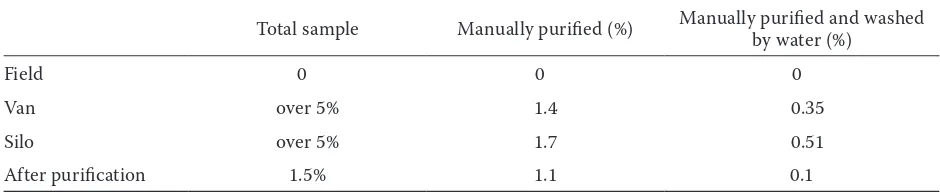
We analysed the soya samples taken at each stage of the transport chain from the farm to the factory. The plants were grown from the seeds of a traditional soya cultivar that had been tested negative for the presence of p35S CaMV and NOS terminator, as well as for the transgene itself (con-struct specific test) according to the certificate. The first samples analysed, i.e. those taken imme-diately after harvesting, were tested as negative, too (Table 1). However, the samples tested after the transportation in a truck, together with those tested after being stored in a silo, were both posi-tive for the screening elements. The validated Taq-Man GMO 35S Soya Detection Kit using also 35S CaMV sequence as the analytical target was used to quantify the level of contamination, which was found to exceed 0.9%. The analytical parameters of the assays were found to be within the expected limits (Fernandez et al. 2005), i.e. the slope of the calibration curve ranging from –3.1 to –3.6, Ct value for the endogen in the range 21–23, and uncertainty expressed as standard deviation was estimated to be 30% in all the samples analysed. As GM admixtures have a negative impact on the value of goods and their position in the market, we attempted to determine the cause of the
con-Table 1. p35S CaMV content (in %) insoya lots from field to processing, as detected using TaqMan GMO 35S Soya
Detection Kit
Total sample Manually purified (%) Manually purified and washed by water (%)
Field 0 0 0
Van over 5% 1.4 0.35
Silo over 5% 1.7 0.51
[image:3.604.62.532.660.756.2]tamination. Using the construct specific marker system, we tested the samples for the presence of the Roundup Ready transgene itself, but the re-sults were negative using both PCR and real-time PCR. As no other transgenic soya cultivar was in use anywhere in the world at the time, we assume that the lot could be contaminated by naturally occurring DNA sequences in the respective virus or organisms.
However, such an assumption can not be made with regards to the resulting food products of unknown history. Such products being tested positive for the screened elements and negative for the approved events should/must be considered to contain unapproved GMO and, in accordance with the current legislation, directly withdrawn from the market (Commission Regulation (EC) 1829/2003).
With the replicates ofthe samples taken at three different sampling points (field, van, and silo), we were able to analyse the samples from the truck and silo after purification: the remaining samples were manually purified and the debris of unknown origin was removed; additionally, the last portions were manually purified as described above, and carefully washed with sterile distilled water and dried.
All samples were subsequentlly subjected to analysis. Table 1 shows that the contamination percentage as detected by the kit decreased after purification.
Based on the quantification of 35S CaVM se-quence, the samples taken from the van and silo were reported to be GMO positive in quantity exceeding 5%. After the analysis of the manually purified samples, the detected contamination in the van and silo samples dropped to 1.4% and 1.7%, respectively; after manual purification with wash-ing it fell to 0.35% and 0.51%, respectively. Thus, even after such cleaning when all the impurities are removed, the analysis based on PCR screen-ing methods results in contamination percentage still exceeding the legal limit of 0.9% for labelling (Commission Regulation (EC) 1830/2003).
As the cleaning of the kernel decreased 35S CaMV promoter sequence quantity and contamination with other transgene was not probable, we at-tempted at detecting the sequence of the naturally occurring virus. PCR primers were used amplifying part of the virus genome outside 35S promoter. All the positive samples were analysed and found to be contaminated with the cauliflower mosaic
virus itself, suggesting that the contamination is spread by the debris and dust of other plant species collected during the transportation and storage process (data not shown). In particular, silos are often used to store several species subsequently, thus they are difficult to remain free of the rem-nants of the previous species, and so admixtures are allowed to some extent. Such contamination is legal and is referred to as botanical impurities by EC legislation and may reach up to 2%. Nor-mally, this does not have any negative impact on other properties of the lot. However, PCR is highly sensitive and, as other authors have also shown, good at detecting even the slightest amounts of specific DNA sequences (Holst-Jensen et al. 2003). DNA extracted from botanical impurities and their pathogens may interfere with the analyti-cal procedure. Likewise, transgene specific assays using DNA originally occurring in other species as e.g. Bacillus thuringiensis (Bravo et al. 2007) as a targetmay lead under some circumstances to false conclusions as well.
The indication of the presence of unauthorised or unknown GMOs leads to consequent analyti-cal and legislative steps that have to follow. Our findings clearly show that the methods targeting the screening elements including those suited for quantification have only informative value, however, such approaches are still used (Oraby et al. 2005; Reiting et al. 2007). If the individual validated event specific real-time PCR assays are used instead, the process of analysis slows down and the prices for the analysis of one sample increase. For that reason, laboratories call for simple cost effective assays as suggested e.g. by Hamels et al. (2009) or Chaouachi et al. (2008). However, they need to be approved by practice. We suggest that the combination of screening and event specific methods is a possible solution. New approaches are indeed highly required to ensure food safety in EC (Holst-Jensen 2008).
References
Akhond M.A.Y., Machray G.C. (2009): Biotech crops: technologies, achievements and prospects. Euphytica, 166: 47–59.
Bravo A., Gill S.S., Soberon M. (2007): Mode of action of Bacillus thuringiensis Cry and Cyt toxins and their potential for insect control. Toxicon, 49: 423–435. Chaouachi M., Chupeau G., Berapd A., McKhann
H., Romaniuk M., Giancola S., Laval V., Bertheau Y., Brunel D. (2008): A High-throughput multiplex method adapted for GMO detection. Journal of Ag-ricultural and Food Chemistry, 56: 11596–11606. Commision Regulation (EC) 1829/2003 on genetically
modified (GM) food and feed. Available at http:// europa.eu/eur-lex/pri/en/oj/dat/2003/l_268/l_ 26820031018en00010023.pdf (Accessed 11. 3. 2009) Commision Regulation (EC) No 1830/2003 of the
Euro-pean Parliament and of the Council of 22 September 2003 concerning the traceability and labelling of gene-tically modified organisms and the traceability of food and feed products produced from genetically modi-fied organisms and amending Directive 2001/18/EC, http://eur-lex.europa.eu/pri/en/oj/dat/2003/l_268/l_ 26820031018en00240028.pdf (Accessed 11. 3. 2009) Elenis D.S., Kalogianni D.P., Glynou K.,
Ioan-nou P.C., Christopoulos T.K. (2008): Advances in molecular techniques for the detection and quantifi-cation of genetically modified organisms. Analytical and Bioanalytical Chemistry, 392: 347–354.
Fernandez S., Charles-Delobel C., Geldreich A., Berthier G., Boyer F., Collonnier C., Coué-Philippe G., Diolez A., Duplan M.N., Kebdani N., Romaniuk M., Feinberg M., Bertheau Y. (2005): Quantification of the 35S promoter in DNA extracts from genetically modified organisms using real-time polymerase chain reaction and specificity assessment on various genetically modified organisms, Part I: Operating procedure. Journal of AOAC International, 88: 547–557.
Garcia-Canas V., Cifuentes A., Gonzalez R. (2004): Detection of genetically modified organisms in foods by DNA amplification techniques. Critical Reviews in Food Science and Nutrition, 44: 425–436.
Haas M., Bureau M., Geldreich A., Yot P., Keller M. (2002): Cauliflower mosaic virus: still in the news. Molecular Plant Patology, 3: 419–429.
Hamels S., Glouden T., Gillard K., Mazzara M., Debode F., Foti N., Sneyers M., Nuez T.E., Pla M., Berben G., Moens W., Bertheau Y., Audeon C., Van Den Eede G., Remacle J. (2009): A PCR-micro-array method for the screening of genetically modified organisms. European Food Research and Technology, 228: 531–541.
Holst-Jensen A. (2008): GMO testing – trade, labeling or safety first? Nature Biotechnology, 26: 858–859. Holst-Jensen A., Ronning S.B., Lovseth A., Berdal
K.G. (2003): PCR technology for screening and
quan-tification of genetically modified organisms (GMOs). Analytical and Bioanalytical Chemistry, 375: 985– 993.
Jacobsen E., Schouten H.J. (2007): Cisgenesis strongly improves introgression breeding and induced trans-location breeding of plants. Trends in Biotechnology, 25: 219–223.
James C. (2008): Global Status of Commercialized Bio-tech/GM Crops. Brief No. 39, ISAAA SEAsiaCenter, c/o IRRI, DAPO.
Marmiroli N., Maestri E., Gulli M., Malcevschi A., Peano C., Bordoni R., De Bellis G. (2008): Methods for detection of GMOs in food and feed. Analytical and Bioanalytical Chemistry, 392: 369–384.
Michelini E., Simoni P., Cevenini L., Mezzanotte L., Roda A. (2008): New trends in bioanalytical tools for the detection of genetically modified organisms: an update. Analytical and Bioanalytical Chemistry, 392: 355–367.
Morisset D., Stebih D., Cankar K., Zel J., Gruden K. (2008): Alternative DNA amplification methods to PCR and their application in GMO detection: a review. European Food Research and Technology, 227: 1287–1297.
Oraby H.A.S., Hassan A.A., Abou Mossallam A.A. (2005): Screening food products for the presence of CaMV 35S promoter and NOS 3 ‚ terminator. Journal of the Science of Food and Agriculture, 85: 1974– 1980.
Pietsch K., Waiblinger H.U. (2000): Quantification of genetically modified soybeans in food with the LightCycler system. In: Meuer S., Wittwer C., Nakagawara K. (eds): Rapid Cycle Real Time PCR – Methods and Applications. Springer Verlag, Hei-delberg.
Reiting R., Broll H., Waiblinger H.U., Grohmann L. (2007): Collaborative study of a T-nos real-time PCR method for screening of genetically modified orga-nisms in food products. Journal für Verbraucherschutz und Lebensmittelsicherheit-Journal for Consumer Protection and Food Safety, 2: 116–121.
Vollenhofer S., Burg K., Schmidt J., Kroath H. (1999): Genetically modified organisms in food – Scre-ening and specific detection by Polymerase Chain Reaction. Journal of Agricultural and Food Chemistry, 47: 5038–5043.
Yuan Z.C., Haudecoeur E., Faure D., Kerr K.F., Nester E.W. (2008): Comparative transcriptome
analysis of agrobacterium tumefaciens in response
to plant signal salicylic acid, indole-3-acetic acid and gamma-amino butyric acid reveals signalling cross-talk and Agrobacterium-plant co-evolution. Cellular Microbiology, 10: 2339–2354.
Corresponding author:
RNDr. Jaroslava Ovesná, CSc., Výzkumný ústav rostlinné výroby, v.v.i., Odbor genetiky, šlechtění a kvality produkce, Oddělení molekulární biologie, 161 06 Praha 6-Ruzyně, Česká republika
tel.: + 420 233 022 424, e-mail: [email protected]
Zel J., Mazzara M., Savini C., Cordeil S., Camloh M., Stebih D., Cankar K., Gruden K., Morisset D., Van Den Eede G. (2008): Method validation and quality management in the flexible scope of accredi-tation: An example of laboratories testing for geneti-cally modified organisms. Food Analytical Methods, 1: 61–72.