The Effect of Warm Equal Channel Angular Extrusion on Ductility
and Twinning in Magnesium Alloy ZK60
Rimma Lapovok
1, Peter F. Thomson
1, Ryan Cottam
1;*and Y. Estrin
21
School of Physics and Materials Engineering, Monash University, Clayton, Vic, 3800, Australia
2IWW, TU Clausthal, Agricolastr. 6, 38678 Clausthal-Zellerfeld, Germany
Tensile ductility of magnesium alloy ZK60 pre-strained by warm equal channel angular extrusion (ECAE) was investigated at 300C. It
was shown that a significant ductility (262%) is achievable with this technique for a fairly high strain rate of3103s1. The effect of
pre-straining by warm ECAE on twinning under room temperature deformation was also investigated. It was shown that a bi-modal grain structure, whose characteristics are determined by the ECAE route, number of passes and temperature, has a strong effect on the propensity for twinning and mechanical properties, including ductility.
(Received January 13, 2004; Accepted March 29, 2004)
Keywords: equal channel angular extrusion (ECAE), ZK60, tensile ductility, twinning
1. Introduction
It is generally believed that extreme grain refinement that can be achieved by severe plastic deformation may lead to enhanced ductility.1)However, room temperature ductility of
a number of nanostructured metallic materials was found to be extremely poor - the more so, the smaller the grain size.2) It was shown recently3) that premature necking in nano-structured fcc materials, such as copper, is, indeed, promoted at room temperature when grain size decreases. The stabilising effect of increased strain rate sensitivity of the flow stress owing to the increased role of the diffusion controlled mechanism of plasticity turns out to be outstripped by a concomitant loss of strain hardening. Zhang et al.4)
found the dependence of the room temperature ductility of Zn (taken here as representative of hcp metals) on grain sized
was similar to that found in fcc metals, such as Cu. Ductility at room temperature was shown to increase to 110% as grain size decreased to 238 nm. However, room temperature ductility was shown to deteriorate dramatically with further decrease of the grain size (down to 23 nm) — in accord with the general trend reported by Koch.2)
The situation with high temperature ductility is different. Here — mainly due to grain boundary sliding — the effect of grain refinement on ductility, particularly due to severe plastic deformation5) is favourable. However, a detailed understanding of the effect of severe plastic deformation on the microstructure of Mg alloys and the resulting tensile ductility is far from having been achieved. The work of Agnewet al.6)and Chuvil’deevet al.7)is particularly relevant
in this context, as it addresses just that question. Agnewet al.
found that the microstructure of hot-rolled ZK60 plate was heterogeneous, some larger grains (50mm) being embed-ded in an array of smaller grains (<10mm). Little change occurred after one pass of equal channel angular extrusion (ECAE) at 300C, but after two or more passes, the
microstructure was more homogeneous, consisting of a matrix of fine grains (2:5mm) in which a few larger grains
(>10mm) were embedded. The ductility of ZK60 improved by a factor of 2-3 after two or more passes. The increase in the strain rate sensitivity index,m, with the number of passes of ECAE suggested that grain boundary sliding accommo-dated by grain boundary diffusion may have occurred, cf. Zhang et al.4) Chuvil’deev et al.7) established routes for
processing by ECAE to produce optimal superplastic behaviour in analogues of ZK60 and AZ31 Mg alloys. A grain size of 1mm was associated with low temperature superplastic behaviour of Mg alloys, including ZK60, which was manifested by 810% elongation to failure at 250C under a strain rate of3103s1 and a 2-3 fold increase in room temperature ductility to 45%. Referring to reports that the distribution of basal planes plays an important role in enhancing room temperature ductility of Mg alloys by promoting basal slip, Mukaiet al.,8)annealed extruded ZK60
to produce grain sizes of 4mmand 120mm. Quasi-static room temperature ductility was greatly increased for the smaller grain size (from 20 to 35%). Failure in the coarse-grained material occurred by coalescence of cracks along twin and grain boundaries, while no macroscopic twins occurred in the fine-grained material. The same authors9)subjected ZK60 to eight passes of ECAE at 160C and annealed the product to
produce equiaxed grains as small as 1.4mm. The strain rate sensitivity index, m, found from strain rate jump tests at 160C, was approximately 0.5 at the mid-range of strain rates (about5103s1), which they interpreted to indicate grain boundary sliding was the dominant mechanism of deforma-tion, confirmed by SEM, and this remained so throughout the range of strain rates investigated. Under optimal conditions at 160C, the ductility of ZK60 processed by ECAE reached
600% and 1083% before and after annealing, respectively. It was suggested that equilibrium grain boundaries are neces-sary in Mg alloys for attaining low temperature super-plasticity.
The previous evidence suggests that tensile ductility at elevated temperatures of Mg alloys, and ZK60 in particular, is strongly enhanced by grain refinement down to the micrometer range. Ductility is favoured by basal slip, promoted by suitable mechanical pre-treatment, most notably ECAE, to re-orient basal planes suitably. The absence of *Graduate Student, School of Physics and Materials Engineering, Monash
and cold deformation. Much of this may be traced to differences in the parameters of processing by ECAE, notably the route (orientation between passes) chosen. For this reason, one of the main aims of the present work was a consistent investigation of the effect of the ECAE process parameters (including route and number of passes and the history of temperature and ram velocity) on the tensile ductility of alloy ZK60 at room temperature and moderately elevated temperatures (up to 300C). Another goal was to
study the occurrence of twinning in relation to grain size after warm ECAE, to elucidate its role in the ductility of fine-grained Mg alloys.
2. Experimental
Rectangular specimens of2010mm2cross-section and 70 mm length as well as cylindrical specimens with 10 mm2 diameter and 70 mm length were machined from a contin-uously cast billet of ZK60 (Mg-4.95%Zn-0.71%Zr). The samples were homogenised for four hours at 460C in alumina powder, to reduce surface oxidation. The homoge-nisation conditions were chosen on the basis of previous time-temperature homogenisation experiments to avoid incipient melting and possible grain growth. As a result of homogenisation, grain boundary precipitates were dissolved, leaving behind regions rich in zirconium. The initial micro-structure consisted of equiaxed grains with average diameter of 45.5mm and isolated zinc-zirconium particles dispersed within the grains or occurring in clusters.
The rectangular samples were subjected to 8 passes of ECAE (Routes A and C) with a 120 die at a ram speed of
0.5 mm/s. Cylindrical samples were subjected to 6 passes of ECAE (Route B) with a 90die at a ram speed of 0.5 mm/s. In some experiments, a ram speed of 50 mm/s was also used. The test temperatures were 200, 250 and 300C. Ductility measurements on tensile specimens machined from ECAE-processed material were carried out at 300C at two different
strain rates (3103s1and3102s1) using an Instron 1341 testing machine.
Microstructures formed by warm ECAE were investigated with an Olympus JSM-840 optical microscope and a trans-mission electron microscope Philips CM20.
3. Experimental Results
3.1 Evolution of microstructure under warm ECAE
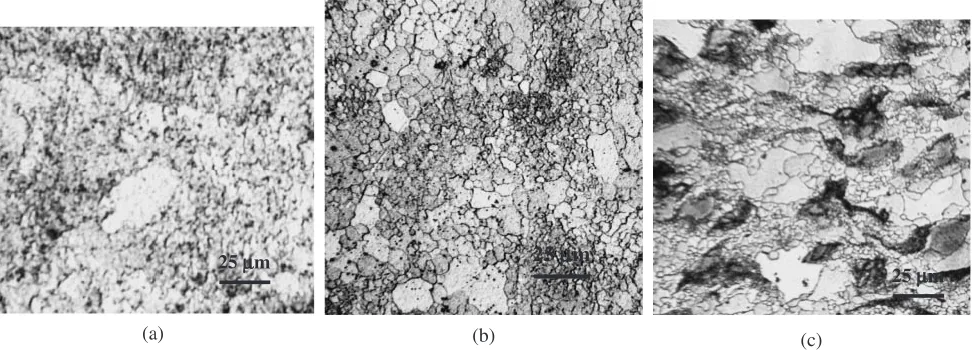
For all three routes and all three temperatures employed, warm ECAE with a constant ram velocity of 0.5 mm/s for all passes resulted in a bi-modal microstructure with two populations of grains distinctly different in size and
mor-through 120 die with equivalent strain equal to about 6.9. It should be noted that the amount of strain introduced by one pass has a significant effect, especially as a trigger of recrystallisation during subsequent heating for the next pass. For all three routes and at all three temperatures, an overall grain refinement was obtained upon ECAE. The grain size distribution was shifted towards a larger fraction of small recrystallised grains when processing temperature was increased. The population of small grains had the biggest grain size after ECAE performed at 300, especially for
Route B for which grain growth was observed, cf. Fig. 2(d). Due to a pronounced bi-modality in the grain size distribution, the average grain size of large and small grains could be determined separately, using the linear intercept method. The average grain size (Fig. 4) depends on temper-ature, the ECAE route and the amount of strain introduced in each pass as well as the total strain. A general trend observed is that the area fraction of large grains and their average diameter decrease with temperature and the number of passes for all routes. This tendency was more pronounced for Route A, as for Route C the scatter in the grain size measurement was greater due to grain rotation. The intensive grain refinement for Route B is explained by more severe deformation introduced in each pass of ECAE through the 90 die. It was observed that dynamic recystallisation set in
earlier, i.e. required a smaller number of ECAE passes, at higher temperatures or larger strain per pass. The volume fraction of dynamically recrystallised grains also increased with temperature.
The degree of grain refinement increased with the number of ECAE passes and/or with the amount of strain introduced per pass. Due to severe deformation, the mean size of large grains (in the transverse cross-section) dropped from 45.5mm
to26:72:5mmfor Route A, to19:37:5mmfor Route B and to 29:74:1mm for Route C. Figure 4 shows a weak dependence of the average grain size on the temperature of warm ECAE, except for Route B. A new population of small recrystallised grains with the average diameter ranging from 2mmfor ECAE at 200C to 4.8mmfor ECAE at 300C was
also observed. The area fraction of large grains was found to be smaller for higher ECAE temperatures, a very small number of large grains being retained after pressing at 300C.
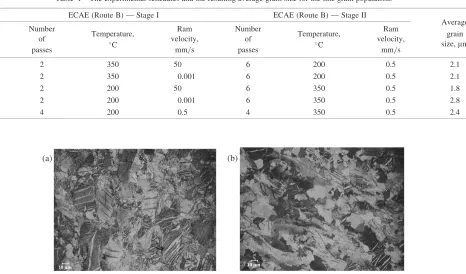
grain fraction of the grain population are presented in Table 1. In the first two experiments, the first stage (2 passes) of ECAE was performed at 350C. A higher density of twinning was found for the slower ram velocity, Fig. 5, which
promotes the subsequent recrystallisation of fine grains. Further ECAE (6 passes) at 200C produced microstructures that were very similar. The area fraction of large grains was smaller for the case where twinning density was substantially
25
µµ
m
25 µm(b) (c)
(a)
25 µm
Fig. 2 Microstructures of specimens deformed by warm ECAE (Route B, 90die) (a) after 6 passes at 200C, (b) after 6 passes at 250C,
(c) after 6 passes at 300C.
25
µ
m
25
µ
m
25
µ
m
25
µ
m
(a)
(b)
(c)
(d)
Fig. 1 Microstructures of specimens deformed by warm ECAE vis-a`-vis the initial one (Route A, 120die) (a) initial, (b) after 8 passes at
[image:3.595.80.515.71.455.2] [image:3.595.56.542.509.684.2]25 µm
25 µm 25 µm
(c)
(a) (b)
Fig. 3 Microstructures of specimens deformed by warm ECAE (Route C, 120die) (a) after 8 passes at 200C, (b) after 8 passes at 250C,
(c) after 8 passes at 300C.
[image:4.595.54.542.74.223.2]Fig. 4 Average grain size as a function of equivalent strain introduced by ECAE. The average diameter of large and small grains is shown for three ECAE temperatures. (a) Route A, (b) Route B, (c) Route C.
Table 1 The experimental schedules and the resulting average grain size for the fine grain population.
ECAE (Route B) — Stage I ECAE (Route B) — Stage II
Average
No. Number
Temperature, Ram Number Temperature, Ram grain
of of
C velocity, of C velocity, size,mm
exp. passes mm/s passes mm/s
1 2 350 50 6 200 0.5 2.1
2 2 350 0.001 6 200 0.5 2.1
3 2 200 50 6 350 0.5 1.8
4 2 200 0.001 6 350 0.5 2.8
5 4 200 0.5 4 350 0.5 2.4
(a) (b)
[image:4.595.53.547.276.436.2] [image:4.595.74.540.495.769.2]higher. However, in both cases the area of large grains was reduced to only about 1%. The fine grain size produced as a result of dynamic recrystallisation was the same for both samples.
When the first stage of ECAE was performed at 200C, the
density of twinning was also higher for the slower ram velocity, which resulted in an earlier start of dynamic recrystallisation in the second stage that was conducted at 350C. Grain growth usually occurred in the final ECAE
passes with the area fraction of large grains increasing to 14%. The lowest average grain size (1.8mm) corresponds to the case when dynamic recrystallisation was delayed and grain growth did not occur.
3.2 Twinning under warm ECAE
Evidence for twinning under warm ECAE is seen in Fig. 6 that shows microstructures of specimens deformed by 8 passes of ECAE under Route A at three different temper-atures. Deformation twins in large grains are clearly seen at all three temperatures. As could be expected,10)the
occur-rence of twins decreases with increasing ECAE temperature. The number of twins per unit area of large grain regions decreases almost to zero as the temperature of warm ECAE increases from 200 to 300C, cf. Fig. 7.
The evolution of the density of twins in large grains with the number of warm ECAE passes was also studied. Measurements were taken after each even pass number. It was found that the twin density acquired within the first two passes either stayed constant, as in the case of 200C ECAE,
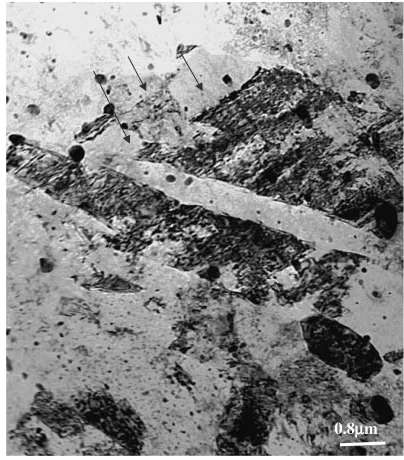
or exhibited an apparent decrease with the number of passes, as for the other two temperatures. This decrease can be attributed to dynamic recrystallisation at higher temperatures that is believed to be enhanced in the presence of twins,11)as
the twins can act as recrystallisation sites for new grains. The evidence for this is seen in Fig. 8.
3.3 Tensile ductility at elevated temperature
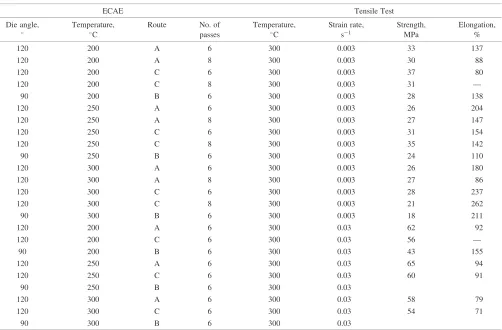
The results of uniaxial tensile tests on specimens pre-strained by warm ECAE with a ram speed of 0.5 mm/s are presented in Table 2.
An obvious improvement of ductility by warm ECAE pre-treatment was obtained. In particular, pre-straining by ECAE (Route C with the ram velocity of 0.5 mm/s) produced a
5 µm
(c) 5 µm
(a)
5 µm
(b)
Fig. 6 Microstructures of specimens deformed by warm ECAE (8 passes, Route A, 120 die) showing twins in large grains in the
transversal section (a)200C, (b)250C, (c)300C.
Fig. 7 Density of twins in large grains at equivalent strain of 6.9 as a function of the ECAE temperature (Squares - Route A, diamonds - Route B, triangles - Route C).
0.8µm
Fig. 8 The microstructure after warm ECAE (300C) showing a large
[image:5.595.54.543.76.219.2] [image:5.595.323.531.265.462.2] [image:5.595.324.526.519.749.2]tensile elongation of 262% at 300C and the strain rate of 3103s1. This is a reasonably good result, especially as no attempt was made in the present work to define strain rate and temperature range for maximum tensile ductility.
The stress-strain curves obtained by tensile testing at the temperature of 300C and strain rate of 3103s1 are shown in Fig. 9. Pre-straining was done by employing one of the three ECAE routes (A, B, or C) up to 6 or 8 passes using 120 die and up to 4 or 6 passes using 90 die, the
corresponding equivalent strain being 4.6 or 6.9. The character of flow curves is seen to change for pre-straining performed at 300C. After this treatment the microstructure, as shown, is no longer bi-modal, but rather consists of small recystallised grains with diameter less than 4mm. Pre-straining performed at 300C, Route C results in a long
portion of the deformation curve with a stable flow stress and delayed necking, Fig. 9, suggesting superplastic behaviour at the chosen parameters of the tensile test, namely temperature of 300C and strain rate of 3103s1. Tensile tests performed at a strain rate ten times higher, returned lower values of ductility, cf. Table 2.
3.4 Strain rate jump test
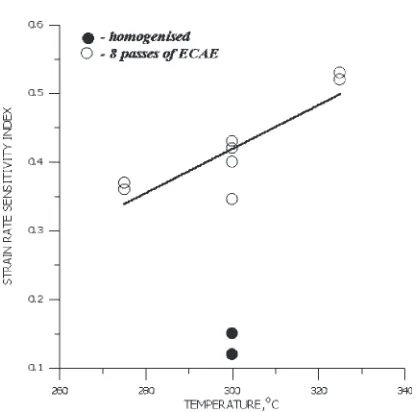
Strain rate jump tests were performed for homogenised material at 300C and for ECAE processed materials at
275C, 300C (Fig. 10) and 325C. Typically, the applied
strain rate was changed from 105 to 104s1, then to
103s1 and finally to 102s1. The strain rate sensitivity index,m, defined as
m¼
ln 2 1
ln ""_2 _ " "1 ¼ 1 2:3ln 2 1 ¼ 1 2:3 21
1
was determined from these measurements.
The results, Fig. 11, show that m is much larger for material processed by ECAE than for the homogenised material used as a reference. In fact, after ECAE processing the value ofmreaches the level of 0.5 for the temperature of 325C, which already signifies the superplastic range. Thus, the requirements of superplastic deformation, such as small grain size in the micrometer range and a sufficiently high value ofmapproaching 0.5, resulting in delayed necking and a stable plateau on the stress-strain curve, are fulfilled. One can conclude that the significant ductility of 262% achieved at 300C by virtue of ECAE pre-straining is a result of
superplasticity or a forerunner of superplasticity to set in at somewhat more elevated temperature.
4. Conclusions
The experimental observations made in this work lead us to conclude that:
(1) Pre-straining of alloy ZK60 by warm ECAE leads to a significant grain refinement, down to about 2mm
resulting in improved ductility and even superplasticity. (2) The density of twinning in warm ECAE increases as a temperature of ECAE decreases and is greatest for
120 250 A 8 300 0.003 27 147
120 250 C 6 300 0.003 31 154
120 250 C 8 300 0.003 35 142
90 250 B 6 300 0.003 24 110
120 300 A 6 300 0.003 26 180
120 300 A 8 300 0.003 27 86
120 300 C 6 300 0.003 28 237
120 300 C 8 300 0.003 21 262
90 300 B 6 300 0.003 18 211
120 200 A 6 300 0.03 62 92
120 200 C 6 300 0.03 56 —
90 200 B 6 300 0.03 43 155
120 250 A 6 300 0.03 65 94
120 250 C 6 300 0.03 60 91
90 250 B 6 300 0.03
120 300 A 6 300 0.03 58 79
120 300 C 6 300 0.03 54 71
[image:6.595.47.549.81.411.2]Route C.
(3) Because twinning influences the propensity for dynam-ic recrystallisation, an avenue for obtaining a desired fine grain structure appears to be the use of a two-stage ECAE schedule introducing controlled twinning in the first ECAE stage.
[image:7.595.79.520.68.495.2]Fig. 9 Stress-strain curves from tensile tests for specimens with different pre-straining histories.
Fig. 10 Strain rate jump tests for ZK60 processed by ECAE (Route B, 120
die) at 300C.
[image:7.595.62.275.538.658.2] [image:7.595.323.531.561.767.2]authors (Y. Estrin) also acknowledges support from DFG (Grant Es 74-7/1).
REFERENCES
1) R. Z. Valiev, R. K. Islamgaliev and I. V. Alexandrov: Prog. in Mater. Sci.45(2000) 103–189.
2) C. C. Koch and T. R. Malow: J. Metastable and Nanocryst. Mater.565
(1999) 2–6.
(WILEY-VCH Verlag, Germany, 2003) pp. 409–414.
8) T. Mukai, H. Watanabe, K. Ishikawa and K. Higashi: Mater. Sci. Forum
419–422(2003) 171–176.
9) H. Watanabe, T. Mukai, K. Ishikawa and K. Higashi: Mater. Sci. Forum
419–422(2003) 557–562.
10) J. W. Christian and S. Mahajan: Prog. in Mater. Sci.39(1995) 1–157. 11) A. Galiyev, R. Kaibyshev and G. Gottstein: Acta Mater.49(2001)